Pakistan Christian Refugees – Processes to Remember with UNHCR

For Pakistan Christian refugees seeking asylum in Thailand, R.E.A.L. recommend they become familiar with the following processes, rules, and guidelines:

R.E.A.L. views persecution of Pakistan Christian refugees to be consistent with the guidelines set by the UNHCR to consider refugee persecution, as described in the United Nations Handbook and Guidelines on Procedures and Criteria for Determining Refugee Status (HCR/1P/4/ENG/REV. 3). It is R.E.A.L.’s contention that, in accordance with Part One, Section B. Interpretation of terms, Subsection (2)(b) Persecution, paragraph 51, such cases fit the definition of “persecution,” which clearly applies to this case as defined by the facts of the case and the circumstances of his country of origin, as very clearly seen by past events and highlighted by recent events in the persecution of Pakistan Christians. Paragraph 51 clearly states that “From Article 33 of the 1951 Convention, it may be inferred that a threat to life or freedom on account of race, religion, nationality, political opinion or membership of a particular social group is always persecution. Other serious violations of human rights – for the same reasons – would also constitute persecution.” We have seen from the case of Pakistan Christian refugees based on religious persecution as a Christian by extremists, and the ongoing threats to this Pakistan Christian refugee, that such persecution is a threat to life and freedom based on his Christian religious minority status.

R.E.A.L. further notes the applicability of the May 14, 2012 UNHCR Eligibility Guidelines for assessing the international protection needs of members of religious minorities from Pakistan (HCR/EG/PAK/12/02), Section C.1, and the known threat documented in the UNHCR Eligibility Guidelines regarding threats to religious minorities from blasphemy laws. This includes the UNHCR statement that Blasphemy accusations sometimes spark assaults, assassinations and mob attacks.” It remains our concern that this will be the case in this specific Pakistan Christian refugee’s case.

I also want to point out that the UNHCR Eligibility Guideline in Section IV. “Eligibility for International Protection, A. Potential Risk Profiles, (2). Christians,” recognizes that “Criminal provisions, particularly the blasphemy laws, are reportedly used by militant organizations and members of some Pakistan Muslim communities to intimidate and harass Christians, as well as to exact revenge or settle personal or business disputes.” This section also recognizes that “In many instances, the authorities are reportedly unable or unwilling to protect the lives and properties of Christians, or to bring the perpetrators of such violence to justice.” It further recognizes that “There are allegations of collusion between law enforcement authorities and Muslim clerics” in regards to such persecution of Pakistan Christians.” The UNHCR has previously concluded in such UNHCR Eligibility Guidelines that “In light of the foregoing, UNHCR considers that members of the Christian community, including those targeted by Islamic extremist elements or charged with criminal offences under the blasphemy provisions, victims of bonded labour, severe discrimination, forced conversion and forced marriage, as well as Christians perceived as contravening social mores, may, depending on the individual circumstances of the case, be in need of international refugee protection on account of their religion or membership of a particular social group.”

In the United Nations Handbook and Guidelines on Procedures and Criteria for Determining Refugee Status (HCR/1P/4/ENG/REV. 3), Pakistan Christian refugees should also be considering the following points:

UNHCR Guidelines, Paragraph 51 – Religious Persecution of Pakistan Christians Must Constitute Persecution for UNHCR. Paragraph 51 clearly states that “From Article 33 of the 1951 Convention, it may be inferred that a threat to life or freedom on account of race, religion, nationality, political opinion or membership of a particular social group is always persecution. Other serious violations of human rights – for the same reasons – would also constitute persecution.”

UNHCR Guidelines, Paragraphs 42 and 43 – Assessment of Country of Origin as Factor for Pakistan Christian Refugees. R.E.A.L. has communicated to UNHCR evaluators on the need to effectively assess the dangerous conditions for Pakistan Christian refugees in their country of origin. This is also defined in the UNHCR Resettlement Handbook. The UNHCR Handbook Paragraph 42 specifically states that: “The competent authorities that are called upon to determine refugee status are not required to pass judgement on conditions in the applicant’s country of origin. The applicant’s statements cannot, however, be considered in the abstract, and must be viewed in the context of the relevant background situation. A knowledge of conditions in the applicant’s country of origin –while not a primary objective – is an important element in assessing the applicant’s credibility. In general, the applicant’s fear should be considered well-founded if he can establish, to a reasonable degree, that his continued stay in his country of origin has become intolerable to him for the reasons stated in the definition, or would for the same reasons be intolerable if he returned there.” The UNHCR Handbook Paragraph 43 also specifically states: “These considerations need not necessarily be based on the applicant’s own personal experience. What, for example, happened to his friends and relatives and other members of the same racial or social group may well show that his fear that sooner or later he also will become a victim of persecution is well-founded. The laws of the country of origin, and particularly the manner in which they are applied, will be relevant.”

UNHCR Guidelines, Paragraph 196: Level of Proof for Refugees – UNHCR Resettlement Handbook, Part Two, Procedures for the Determination of Refugee Status, Section B. Establishing the Facts. Paragraph 196. “Often, however, an applicant may not be able to support his statements by documentary or other proof, and cases in which an applicant can provide evidence of all his statements will be the exception rather than the rule. In most cases a person fleeing from persecution will have arrived with the barest necessities and very frequently even without personal documents. Thus, while the burden of proof in principle rests on the applicant, the duty to ascertain and evaluate all the relevant facts is shared between the applicant and the examiner. Indeed, in some cases, it may be for the examiner to use all the means at his disposal to produce the necessary evidence in support of the application. Even such independent research may not, however, always be successful and there may also be statements that are not susceptible of proof. In such cases, if the applicant’s account appears credible, he should, unless there are good reasons to the contrary, be given the benefit of the doubt.”

UNHCR Guidelines, Paragraph 197 – Requirement of Evidence – UNHCR Resettlement Handbook, Part Two, Procedures for the Determination of Refugee Status, Section B. Establishing the Facts. Paragraph 197. “The requirement of evidence should thus not be too strictly applied in view of the difficulty of proof inherent in the special situation in which an applicant for refugee status finds himself.”

UNHCR Guidelines, Paragraph 203: Benefit of the Doubt in Refugee Cases – UNHCR Resettlement Handbook, Part Two, Procedures for the Determination of Refugee Status, Section B. Establishing the Facts. Paragraph 203. “After the applicant has made a genuine effort to substantiate his story there may still be a lack of evidence for some of his statements. As explained above (Paragraph 196), it is hardly possible for a refugee to ‘prove’ every part of his case and, indeed, if this were a requirement the majority of refugees would not be recognized. It is therefore frequently necessary to give the applicant the benefit of the doubt.”

— UNHCR Guidelines, Paragraph 203 and Section 6.3.2 – Definition of Violence and Impact of Violence on Refugee Decisions – UNHCR Resettlement Handbook, Part Two, Procedures for the Determination of Refugee Status, Section B. Establishing the Facts. Paragraph 203. “After the applicant has made a genuine effort to substantiate his story there may still be a lack of evidence for some of his statements. As explained above (Paragraph 196), it is hardly possible for a refugee to ‘prove’ every part of his case and, indeed, if this were a requirement the majority of refugees would not be recognized. It is therefore frequently necessary to give the applicant the benefit of the doubt.”Definition of Violence by UNHCR in Pakistan Christian Refugee Cases. In those cases, where UNHCR evaluators have also dismissed actual reports of violence and violent threats against Pakistan Christian refugees, R.E.A.L. has brought to their attention that the UNHCR Resettlement Handbook calls for a clear definition of violence. In the UNHCR Resettlement Handbook, Chapter 6, Resettlement Submission Categories, Section 6.3.2, page 251, the UNHCR uses the definition of violence from the World Health Organization: “Violence is the intentional use of physical force or power, threatened or actual, against oneself, another person, or against a group or community, which either results in or has a high likelihood of resulting in injury, death, psychological harm, maldevelopment, or deprivation.” We must challenge UNHCR decisions that give the perception of a different definition of violence when it comes to Pakistan Christian refugees.

Commitment to Purpose of Resettlement and “Benefit of the Doubt.” The UNHCR Resettlement Handbook states that: “Resettlement is a vital instrument of protection and durable solution. Resettlement under UNHCR auspices is geared primarily to the special needs of refugees under the Office’s mandate whose life, liberty, safety, health or other fundamental human rights are at risk in the country where they sought refuge.” The Handbook also states: “Refugees may be denied basic human rights in a country of refuge; their lives and freedom may be threatened by local elements driven by racial, religious or political motives, or by attacks and assassinations directed from the outside. The authorities in the country of refuge may be unable or unwilling to provide effective protection. In such circumstances, resettlement becomes not a solution of last resort, as it has often been called, but a principal objective.” We must expect UNHCR RSD decisions to be consistent with the overall need by such refugees to find resettlement based on a reasonable “benefit of the doubt” that such refugees have made such claims based on a desperate situation.
Pakistan Christian Refugees in Thailand – Guidelines and United Nations Rules

For Pakistan Christian refugees seeking asylum in Thailand, R.E.A.L. recommend they become familiar with the following processes, rules, and guidelines:

R.E.A.L. views persecution of Pakistan Christian refugees to be consistent with the guidelines set by the UNHCR to consider refugee persecution, as described in the United Nations Handbook and Guidelines on Procedures and Criteria for Determining Refugee Status (HCR/1P/4/ENG/REV. 3). It is R.E.A.L.’s contention that, in accordance with Part One, Section B. Interpretation of terms, Subsection (2)(b) Persecution, paragraph 51, such cases fit the definition of “persecution,” which clearly applies to this case as defined by the facts of the case and the circumstances of his country of origin, as very clearly seen by past events and highlighted by recent events in the persecution of Pakistan Christians. Paragraph 51 clearly states that “From Article 33 of the 1951 Convention, it may be inferred that a threat to life or freedom on account of race, religion, nationality, political opinion or membership of a particular social group is always persecution. Other serious violations of human rights – for the same reasons – would also constitute persecution.” We have seen from the case of Pakistan Christian refugees based on religious persecution as a Christian by extremists, and the ongoing threats to this Pakistan Christian refugee, that such persecution is a threat to life and freedom based on his Christian religious minority status.

R.E.A.L. further notes the applicability of the May 14, 2012 UNHCR Eligibility Guidelines for assessing the international protection needs of members of religious minorities from Pakistan (HCR/EG/PAK/12/02), Section C.1, and the known threat documented in the UNHCR Eligibility Guidelines regarding threats to religious minorities from blasphemy laws. This includes the UNHCR statement that Blasphemy accusations sometimes spark assaults, assassinations and mob attacks.” It remains our concern that this will be the case in this specific Pakistan Christian refugee’s case.

I also want to point out that the UNHCR Eligibility Guideline in Section IV. “Eligibility for International Protection, A. Potential Risk Profiles, (2). Christians,” recognizes that “Criminal provisions, particularly the blasphemy laws, are reportedly used by militant organizations and members of some Pakistan Muslim communities to intimidate and harass Christians, as well as to exact revenge or settle personal or business disputes.” This section also recognizes that “In many instances, the authorities are reportedly unable or unwilling to protect the lives and properties of Christians, or to bring the perpetrators of such violence to justice.” It further recognizes that “There are allegations of collusion between law enforcement authorities and Muslim clerics” in regards to such persecution of Pakistan Christians.” The UNHCR has previously concluded in such UNHCR Eligibility Guidelines that “In light of the foregoing, UNHCR considers that members of the Christian community, including those targeted by Islamic extremist elements or charged with criminal offences under the blasphemy provisions, victims of bonded labour, severe discrimination, forced conversion and forced marriage, as well as Christians perceived as contravening social mores, may, depending on the individual circumstances of the case, be in need of international refugee protection on account of their religion or membership of a particular social group.”

In the United Nations Handbook and Guidelines on Procedures and Criteria for Determining Refugee Status (HCR/1P/4/ENG/REV. 3), Pakistan Christian refugees should also be considering the following points:

UNHCR Guidelines, Paragraph 51 – Religious Persecution of Pakistan Christians Must Constitute Persecution for UNHCR. Paragraph 51 clearly states that “From Article 33 of the 1951 Convention, it may be inferred that a threat to life or freedom on account of race, religion, nationality, political opinion or membership of a particular social group is always persecution. Other serious violations of human rights – for the same reasons – would also constitute persecution.”

UNHCR Guidelines, Paragraphs 42 and 43 – Assessment of Country of Origin as Factor for Pakistan Christian Refugees. R.E.A.L. has communicated to UNHCR evaluators on the need to effectively assess the dangerous conditions for Pakistan Christian refugees in their country of origin. This is also defined in the UNHCR Resettlement Handbook. The UNHCR Handbook Paragraph 42 specifically states that: “The competent authorities that are called upon to determine refugee status are not required to pass judgement on conditions in the applicant’s country of origin. The applicant’s statements cannot, however, be considered in the abstract, and must be viewed in the context of the relevant background situation. A knowledge of conditions in the applicant’s country of origin –while not a primary objective – is an important element in assessing the applicant’s credibility. In general, the applicant’s fear should be considered well-founded if he can establish, to a reasonable degree, that his continued stay in his country of origin has become intolerable to him for the reasons stated in the definition, or would for the same reasons be intolerable if he returned there.” The UNHCR Handbook Paragraph 43 also specifically states: “These considerations need not necessarily be based on the applicant’s own personal experience. What, for example, happened to his friends and relatives and other members of the same racial or social group may well show that his fear that sooner or later he also will become a victim of persecution is well-founded. The laws of the country of origin, and particularly the manner in which they are applied, will be relevant.”

UNHCR Guidelines, Paragraph 196: Level of Proof for Refugees – UNHCR Resettlement Handbook, Part Two, Procedures for the Determination of Refugee Status, Section B. Establishing the Facts. Paragraph 196. “Often, however, an applicant may not be able to support his statements by documentary or other proof, and cases in which an applicant can provide evidence of all his statements will be the exception rather than the rule. In most cases a person fleeing from persecution will have arrived with the barest necessities and very frequently even without personal documents. Thus, while the burden of proof in principle rests on the applicant, the duty to ascertain and evaluate all the relevant facts is shared between the applicant and the examiner. Indeed, in some cases, it may be for the examiner to use all the means at his disposal to produce the necessary evidence in support of the application. Even such independent research may not, however, always be successful and there may also be statements that are not susceptible of proof. In such cases, if the applicant’s account appears credible, he should, unless there are good reasons to the contrary, be given the benefit of the doubt.”

UNHCR Guidelines, Paragraph 197 – Requirement of Evidence – UNHCR Resettlement Handbook, Part Two, Procedures for the Determination of Refugee Status, Section B. Establishing the Facts. Paragraph 197. “The requirement of evidence should thus not be too strictly applied in view of the difficulty of proof inherent in the special situation in which an applicant for refugee status finds himself.”

UNHCR Guidelines, Paragraph 203: Benefit of the Doubt in Refugee Cases – UNHCR Resettlement Handbook, Part Two, Procedures for the Determination of Refugee Status, Section B. Establishing the Facts. Paragraph 203. “After the applicant has made a genuine effort to substantiate his story there may still be a lack of evidence for some of his statements. As explained above (Paragraph 196), it is hardly possible for a refugee to ‘prove’ every part of his case and, indeed, if this were a requirement the majority of refugees would not be recognized. It is therefore frequently necessary to give the applicant the benefit of the doubt.”

— UNHCR Guidelines, Paragraph 203 and Section 6.3.2 – Definition of Violence and Impact of Violence on Refugee Decisions – UNHCR Resettlement Handbook, Part Two, Procedures for the Determination of Refugee Status, Section B. Establishing the Facts. Paragraph 203. “After the applicant has made a genuine effort to substantiate his story there may still be a lack of evidence for some of his statements. As explained above (Paragraph 196), it is hardly possible for a refugee to ‘prove’ every part of his case and, indeed, if this were a requirement the majority of refugees would not be recognized. It is therefore frequently necessary to give the applicant the benefit of the doubt.”Definition of Violence by UNHCR in Pakistan Christian Refugee Cases. In those cases, where UNHCR evaluators have also dismissed actual reports of violence and violent threats against Pakistan Christian refugees, R.E.A.L. has brought to their attention that the UNHCR Resettlement Handbook calls for a clear definition of violence. In the UNHCR Resettlement Handbook, Chapter 6, Resettlement Submission Categories, Section 6.3.2, page 251, the UNHCR uses the definition of violence from the World Health Organization: “Violence is the intentional use of physical force or power, threatened or actual, against oneself, another person, or against a group or community, which either results in or has a high likelihood of resulting in injury, death, psychological harm, maldevelopment, or deprivation.” We must challenge UNHCR decisions that give the perception of a different definition of violence when it comes to Pakistan Christian refugees.

Commitment to Purpose of Resettlement and “Benefit of the Doubt.” The UNHCR Resettlement Handbook states that: “Resettlement is a vital instrument of protection and durable solution. Resettlement under UNHCR auspices is geared primarily to the special needs of refugees under the Office’s mandate whose life, liberty, safety, health or other fundamental human rights are at risk in the country where they sought refuge.” The Handbook also states: “Refugees may be denied basic human rights in a country of refuge; their lives and freedom may be threatened by local elements driven by racial, religious or political motives, or by attacks and assassinations directed from the outside. The authorities in the country of refuge may be unable or unwilling to provide effective protection. In such circumstances, resettlement becomes not a solution of last resort, as it has often been called, but a principal objective.” We must expect UNHCR RSD decisions to be consistent with the overall need by such refugees to find resettlement based on a reasonable “benefit of the doubt” that such refugees have made such claims based on a desperate situation.
 

Thailand: Pakistan Christian Refugee Urgent Medical Need

Responsible for Equality And Liberty (R.E.A.L.) has received a communication from the Pakistan Christian refugee community in Thailand that is seriously ill in the Bangkok Immigration Detention Center and who needs hospital treatment.

The individual’s name and contact information is as follows:

Full name: Noshad Young
Immigration detainee number: 8689
Immigration detention room number: 3

Our contacts in the refugee community state that Mr. Noshad Young is seeking medical treatment. They are reporting that Noshad Young is a heart patient, whose health has been deteriorating over the past month. They are reporting that he has been unable to eat for days, has blisters in his mouth, and is suffering from continuous anal discharge. His family tells the refugee community that his health is in serious jeopardy at this time, and that he is facing a life or death situation.

Our sources in the refugee community state that Mr. Young was taken into custody two and a half months ago, when he went to the immigration detention center to see his son. The reports state that he was taken into custody and his bail was canceled without notification.

Our human rights organization asks that you urgently contact the UNHCR Thailand office and the Thailand Embassy in your nation to get help for this refugee in the Immigration Detention Centre, to get him medical treatment.

We urge the international community to contact

You can reach the UNHCR Thailand office at:
United Nations High Commissioner for Refugees (UNHCR)
UNHCR Regional Representative in Thailand
3rd Floor, United Nations Building, Rajdamnern Nok Avenue, 10200 Bangkok, Thailand
Telephone: 66 2 288 1858
FAX: 66 2 280 0555
Email: thaba@unhcr.org

March 17, 2016 Genocide Declaration on ISIS and Call for Immediate Halt to Any Pakistan Christian Refugee Deportations from Thailand

March 17, 2016 Genocide Declaration on ISIS and Call for Immediate Halt to Any Pakistan Christian Refugee Deportations from Thailand

On March 17, 2016, the United States of America State Department declared that persecution and violence against minority Christians by the international ISIS (aka IS, ISIL, Daesh) movement was designated as “genocide” and “crimes against humanity.”

Given the continuing threat of such genocide and crimes against humanity in the greater Middle East, including ISIS growth in the nation of Pakistan, human rights and non-governmental organizations, and friends of the United Nations and the Kingdom of Thailand, are calling for the Thailand government to immediate halt any plans for the deportation of any Pakistan Christian refugees from Thailand to Pakistan, where the forces of ISIS are increasing in number and influence.

Human rights and non-governmental organizations also call for the United Nations High Commissioner for Refugees (UNHCR) Thailand office to immediately re-assess any Refugee Status Determinations (RSD) denied to such Pakistan Christian refugees, and to immediately halt any activities leading to deportation, which could expose such refugees to the threat of growing genocide in the region. We call for the UNHCR Thailand to grant such refugee candidates new RSD hearings, while their cases are re-assessed to determine if they are in alignment with Refugee Resettlement Handbook requirements, and to assess the growing risk of denying refugees protection from those supporting genocide of such religious minorities.

The growing threat of genocide must be a matter for serious consideration by all organizations, nations, and individuals of conscience. This is further complicated by existing institutional persecution of Pakistan Christians and other religious minorities, including to the “blasphemy laws,” which has been condemned in reports by the United Nations (Report of the Special Rapporteur on the independence of judges and lawyers, Gabriela Knaul, 2012, UN Doc.A/HRC/23/43/Add.2, para 57, p. 13), and in the November 2015 report by the International Commission of Jurists (ICJ), provided to the UNHCR and the Kingdom of Thailand government. In the United Nations report, the United Nations Special Rapporteur has stated “the blasphemy laws are abused to target Christians.”

The state of persecution has allowed the growth of the ISIS terrorist movement to spread and expand, not only from its current genocide in Syria and Iraq, but also to expand with the nation of Pakistan.

On March 2, 2016, the Associated Press stated that: “Here in Karachi, Pakistan’s largest city, IS loyalists have set up their strongest presence, carrying out multiple attacks in the past year and setting up networks.” On February 10, 2016, Pakistan media The Nation reported that “Giving a briefing to the Senate Standing Committee on Interior about Intelligence Bureau’s counter-terrorism operation, the Director General of the country’s top civilian intelligence agency said Daesh is emerging threat in Pakistan as all other militant groups have soft corner for it.” On February 18, 2016, the Diplomat reported: “The Director General of Pakistan’s Intelligence Bureau (IB), in a recent testimony given before a Senate committee, admitted that the Islamic State (IS) was posing a serious threat to the security of the country.” On February 11, 2016, the Nation reported that: “Intelligence Bureau Director-General Aftab Sultan yesterday testified before a Senate committee that hundreds of fighters from Pakistan were joining” the ISIS movement. On November 10, 2014, ABC reported that “DAISH claims to have gathered 10-12 thousand followers from Hangu and Kurram Agency.”

We have already seen repeated ISIS terrorist attacks against religious minorities in Pakistan. Given the environment of persecution of religious minorities and the rise of an international movement seeking genocide against Pakistan Christians and other religious minorities, we call to conscience of the Kingdom of Thailand and the UNHCR that it would be wrong to deport such religious minority refugees back to be endangered by the growing forces of genocide.

The UNHCR must respect the challenge of genocide, in accordance with the United Nations international commitment to the Convention on the Prevention and Punishment of the Crime of Genocide, adopted by Resolution 260 (III) A of the United Nations General Assembly on 9 December 1948. We urge the UNHCR Thailand office to make decisions on Pakistan Christian and other religious minorities, not to endanger them to the ISIS and other extremist forces of genocide. With the March 17, 2016 designation of ISIS genocide of Christian minorities by the U.S. Department of State, we urge the UNHCR to re-assess refugees coming from areas where ISIS threats are growing against such refugees.

Furthermore, we note the statement, also today, March 17, 2016, by United Nations Secretary-General Ban Ki-moon: “Human rights abuses by violent extremists directly assault the UN Charter and the Universal Declaration on Human Rights.” We agree and urge that all refugees endangered by such violent extremists get equal protection, including the Pakistan Christian refugees and Pakistan religious minority refugees who have fled to Thailand.

The Kingdom of Thailand also has a history of ethical stands of conscience, in accordance with its national respect for human rights, as well as international law which it supports. Such commitment to ethical stands on human rights has included the Kingdom of Thailand signature of the 1998 Rome Statute of the International Criminal Court on October 2, 2000. It has included the Kingdom of Thailand signing the Geneva Conventions I through IV, since December 29, 1954. The Kingdom of Thailand voted to adopt the Universal Declaration of Human Rights (UDHR) on December 10, 1948, and has been a signatory to the International Covenant on Civil and Political Rights (ICCPR) since October 29, 1996.

The Kingdom of Thailand’s ethical stand against the common enemy of terrorism includes being a signatory to numerous international acts renouncing terrorism, including the: Convention Against the Taking of Hostages 1979, Convention for the Suppression of Terrorist Bombings 1997, Convention for the Suppression of the Financing of Terrorism 1999.

We call for the UNHCR Thailand office and the Kingdom of Thailand to respect the full impact of this designation of ISIS genocide and crimes against humanity for Christians and other religious minorities. We urge them do not permit the endangerment of Pakistan Christians and other religious minorities who have fled to Thailand from persecution in Pakistan, and where the ISIS forces of genocide are growing every day.

Pakistan Christian Congress, Dr. Nazir Bhatti
Responsible for Equality And Liberty (R.E.A.L.), Jeffrey Imm
British Pakistan Christian Association (BPCA), Wilson Chowdhry Ilford

Thailand: Pakistan Christian Refugee UNHCR Urban Verification Cards

On March 11, 2016, Responsible for Equality And Liberty (R.E.A.L.) founder Jeffrey Imm spoke with the UNHCR Thailand office Senior Protection Officer on the plan for 2016 UNHCR Urban Verification cards. This public statement is to provide a summary of the discussion for asylum seekers and refugees in Thailand, including Pakistan Christian asylum seekers and refugees, whose human rights have been supported by a number of organizations, including the Pakistan Christian Congress, British Pakistan Christian Association, R.E.A.L., and many others.

On February 12, 2016, R.E.A.L. and the Pakistan Christian Congress met with the Thailand Embassy in Washington DC and expressed our concern about the arbitrary arrest of Pakistan Christian asylum seekers and refugees who were waiting for refugee status determination decisions. It was expressed by the Thailand government that they understood our concerns and wanted to work to make improvements on this issue, as well as ensuring bail opportunities for any refugees arrested by immigration authorities.

R.E.A.L. learned this week that the UNHCR Thailand and the Thailand government held talks and agreed to introduce new UNHCR digitized Urban Verification cards to refugee applicants in Thailand, including Pakistan Christian refugees, as a method to more effectively identify such refugees to Thailand immigration authorities.

R.E.A.L. followed up in a telephone conversation with UNHCR Thailand on March 11, 2016 regarding the UNHCR Urban Verification cards. The purpose of R.E.A.L.’s discussion with UNHCR Thailand was to discuss the interests and concerns of refugees on the new Urban Verification cards, so that R.E.A.L. could provide a public statement to such refugees on this.

R.E.A.L. was told by the UNHCR Thailand Senior Protection Officer that the goal of these UNHCR Urban Verification cards are to provide a more consistent and reliable means for the Kingdom of Thailand immigration authorities to verify the identify of such refugee applicants, as opposed to only using the older paper-based UNHCR certificates. R.E.A.L. was told that the Thailand immigration authorities would more readily recognize the UNHCR Urban Verification cards as more genuine identification papers, which could be readily verified, along with biometric information on the card (photograph, fingerprint, iris scan).

R.E.A.L. was told the intent of such UNHCR Urban Verification cards is to ensure more verifiable and clear refugee identification documents, as an improvement over paper-based UNHCR certificates, which can get worn and faded over time, and which may not be as readily recognized. In addition, paper-based certificates could be more easily forged, whereas the UNHCR Urban Verification Card will provide a more reliable source of identification to Thailand immigration authorities.

The new digitized UNHCR Urban Verification cards will also have a Quick Response Code (QR Code), which is a form of a matrix barcode. This will allow ready identity verification using scanning by mobile devices, such a mobile phone.

R.E.A.L. communicated concerns that were heard from some refugees based on a history of fear and persecution, and concern that new identification documents could be used to aid in deportation of refugees. UNHCR Thailand assured R.E.A.L. that was not at all the intention of the Urban Verification Cards, and that these cards were simply intended to provide a modern, reliable, and most importantly, verifiable, means of identification for refugees, wherever it was needed, and especially with immigration authorities.

In addition, R.E.A.L. also wants to clarify that Urban Verification Cards are not official Thailand Government identification cards; they are UNHCR identification cards. These cards are not a work permit, a visa, and they do not change the status of refugee applicants.

The UNHCR Thailand office expressed to R.E.A.L. that the Urban Verification Cards have been successfully used by refugees in other parts of the world. In July 2015, in South Sudan, 3,400 refugees received such digitized identity cards in Western Equatoria. Since the launch of such digitized identification cards in June 2014 in Africa for Congo, Central African Republic, and Sudanese refugees, 10,000 refugees have received such digitized identity cards.

The UNHCR wanted to deploy such Urban Verification Cards for refugees in Thailand to help address security and identification needs of both the refugees and Kingdom of Thailand. The objective of the UNHCR is to more widely utilize such digitized UNHCR Verification Cards in other areas as well.

Obtaining the UNHCR Urban Verification Cards is a mandatory requirement for asylum seekers and refugees. The UNHCR will call all asylum seekers and refugees for individual appointments during the period of March 14 through May 8, 2016. It will be the responsibility of asylum seekers and refugees to come to the UNHCR Thailand office with all family members on the date/and time of the appointment to obtain such UNHCR Urban Verification Cards.

Later in March, R.E.A.L. will also have a follow-up conversation with UNHCR Thailand on human rights issues, which we briefly discussed with the UNHCR Thailand office. It is R.E.A.L.’s understanding that the UNHCR has expressed the desire to work with the Thailand Government for improvements in the circumstances and freedoms of asylum seekers and refugees. R.E.A.L.’s position will remain our core focus on the protection of refugees’ universal human rights, based on the Universal Declaration of Human Rights (UDHR). R.E.A.L. is also working to achieve follow-up discussions with the Kingdom of Thailand.

By necessity, some details on follow-up discussions will need to remain between those involved, as understandings and joint efforts for productive change mature. R.E.A.L. will certainly work to publicly share any specific commitments to change that will make a difference in the human rights and lives of refugees.

R.E.A.L. wants to thank all of those who continue to work tirelessly to improve the human rights of Pakistan Christian refugees; any progress that is achieved is thanks to the tireless efforts around the world by you.

Thailand: Pakistan Christian Refugee Dies in Immigration Detention Center, Waiting for UNHCR

As the eyes of the world have remained focused on global refugee problems, the plight of Pakistan Christian refugees in Thailand is ignored by most of the major news media. Pakistan Christians have fled to Thailand to escape Pakistan religious persecution, violence, attacks, threats, and spurious charges of “blasphemy” (which often results in extra-judicial attacks).

Responsible for Equality And Liberty (R.E.A.L.) has been regularly communicating with the United Nations High Commissioner for Refugees (UNHCR) Thailand Office, UNHCR HQ, Thailand government, the U.S. Embassy, U.S. Citizenship and Immigration Services (USCIS) since early 2015 on a regular basis on this issue. We have provided them with facts, figures, statistics, laws, regulations, case histories, and extensive details to justify their need for action. But too often, the needs of Pakistan Christian refugees are being ignored, and they are left in dire and desperate condition, many arrested and left in Thailand Immigration Detention Centres (IDC), while the UNHCR puts them on a waiting list to be interviewed. They desperately need help, funds, medical care, food, and support. This remains a major human rights crisis. Groups such as the Pakistan British Christian Association (PBCA) have on the ground support in Thailand to help such Pakistan Christians, and they need your help but the need is more than what NGOs alone can perform. We need real action by the UNHCR.

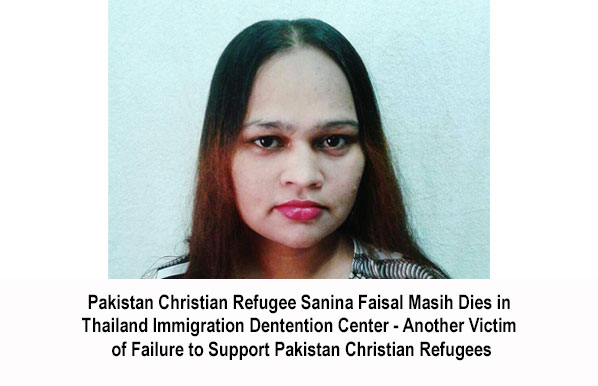
Another Pakistan Christian refugee died while waiting for action, and while languishing in the IDC jail.  R.E.A.L. has received the following report on the night of December 30, 2015, from our contact in Thailand.  “I want to share the sad demise of Sanina, wife of Faisal Masih; mother of two years old son, who was kept in IDC, Bangkok, Thailand. She was arrested by Thai police on December 20, 2015. No one knows the reason of her death. Her husband was told over phone by UNHCR, Bangkok, to control his emotions and get ready to hear a sad news. Earlier Sanina gave birth to a premature girl, who could not survive. Just consider, the condition of the father, who has just a two years old son, and no one around to support him at this hour of need.”

Another contact in Thailand states: “She was sick in Immigration Detention Center (IDC) on 24 December 2015. UNHCR had delayed two times her interview already. Nobody knew about her sickness except UNHCR AND IDC.”

Our contact in Thailand states: “As you remember that Immigration police raids and arrest men, women, children, young and old. They have no mercy for anyone and the conditions in Immigration Detention Centre (IDC) cannot be explained. The worse part of IDC is that there’s no proper standard of living. People live a miserable life there; they don’t get any proper food or medical help for critically sick people, nor enough space is there even to sleep. Men and women are kept separately and children have no access to their parents, no matter how old they are. They are kept in separate cells.”  “There are many heart breaking stories where the family members had become critically sick and the other family members couldn’t do much to save their family members.” “UNHCR is not supporting for medical assistance. I don’t have enough words to express the miseries of Pakistani Christians facing persecution on the hands of human rights protectors UNHCR office , Thailand. There is no one to raise voice against such brutality and inhuman behavior against Pakistani Christians in Bangkok, Thailand.”

Sanina-123015

Dr. Nazir Bhatti of the Pakistan Christian Congress has stated: “The shocking news of death of Sanina Faisal Masih in Immigration Detention Center IDC Bangkok have saddened Pakistani Christians; It is time to express unity to prevent such sad incident and to resolve issues of Pakistani Christian Asylum seekers: PCC is with leaders of our community in Bangkok to respond accordingly: We are waiting for their decision in this horrifying death of Christian refugee in IDC.”

R.E.A.L. extends its sympathies to the family of  Sanina Faisal Masih and shares the outrage of Pakistan Christian refugees and also those with a conscience on human rights on this matter.

R.E.A.L. stands with the Pakistan Christian refugees and their plight, and we continue to aggressively seek changes with the UNHCR, the Thailand government, and the U.S. government for their support.  Most of what R.E.A.L. has written on this is private communications on individual refugee cases.  But R.E.A.L. has seen a series of common trends, which need to change.

    1.  Pakistan Christian refugees to Thailand are being held to a different standard than other refugees around the world.  There is too often an attempt to find a reason to deny the refugee status instead of finding a way to help such refugees.  This is contrary to the rules of the UNHCR Resettlement Handbook.
    2. Pakistan Christian refugees in Thailand face persecution by immigration detention authorities and those involved in sweeping arrests may have to wait protracted periods for a UNHCR interview.  The overall UNHCR process is slow and denies all such refugees a reasonable chance at resettlement due to the extensive delays in processing.
    3. Pakistan Christian refugees who do not speak English, and who have been targets of anti-human rights “Islamic blasphemy” charges in Pakistan are being interviewed by Pakistan Muslim UNHCR representatives who speak Urdu.  Not surprisingly, such Pakistan Christian refugees are naturally intimidated and fearful to address that aspect of the details of threats against them.
    4. R.E.A.L. has noticed cases where actual violence, murder, and injuries somehow translate into decisions where there is “not a reasonable threat of violence” to the Pakistan Christian refugee, which in contrary to logic and contrary to the UNHCR Resettlement Handbook.  In the UNHCR Resettlement Handbook, Chapter 6, Resettlement Submission Categories, Section 6.3.2, page 251, the UNHCR uses the definition of violence from the World Health Organization: “Violence is the intentional use of physical force or power, threatened or actual, against oneself, another person, or against a group or community, which either results in or has a high likelihood of resulting in injury, death, psychological harm, maldevelopment, or deprivation.”
    5. R.E.A.L. has regularly noticed cases where excessive evidentiary requirements are being asked by UNHCR Thailand of Pakistan Christian refugees, which does not confirm to UNHCR regulations.   UNHCR Resettlement Handbook Paragraph 196 states: “Often, however, an applicant may not be able to support his statements by documentary or other proof, and cases in which an applicant can provide evidence of all his statements will be the exception rather than the rule. In most cases a person fleeing from persecution will have arrived with the barest necessities and very frequently even without personal documents. Thus, while the burden of proof in principle rests on the applicant, the duty to ascertain and evaluate all the relevant facts is shared between the applicant and the examiner. Indeed, in some cases, it may be for the examiner to use all the means at his disposal to produce the necessary evidence in support of the application. Even such independent research may not, however, always be successful and there may also be statements that are not susceptible of proof. In such cases, if the applicant’s account appears credible, he should, unless there are good reasons to the contrary, be given the benefit of the doubt.”  UNHCR Resettlement Handbook Paragraph 197 states “The requirement of evidence should thus not be too strictly applied in view of the difficulty of proof inherent in the special situation in which an applicant for refugee status finds himself.”
    6. R.E.A.L. has noticed many cases of Pakistan Christian refugees where the UNHCR Thailand has not exercised giving the “benefit of the doubt” on issues that one would typically give to fleeing refugees.  In the UNHCR Resettlement Handbook Section B(2) “Benefit of the Doubt of this Handbook,”  Paragraph 203 states: “After the applicant has made a genuine effort to substantiate his story there may still be a lack of evidence for some of his statements. As explained above (see Paragraph 196), it is hardly possible for a refugee to ‘prove’ every part of his case and, indeed, if this were a requirement the majority of refugees would not be recognized. It is therefore frequently necessary to give the applicant the benefit of the doubt.”
    7. R.E.A.L. has noticed numerous cases of Pakistan Christian refugees where the UNHCR Thailand is not considering the conditions of the country of the refugee applicant, contrary to the UNHCR Resettlement Handbook rules.    The UNHCR Resettlement Handbook Paragraph 42 specifically states that: “The competent authorities that are called upon to determine refugee status are not required to pass judgement on conditions in the applicant’s country of origin. The applicant’s statements cannot, however, be considered in the abstract, and must be viewed in the context of the relevant background situation. A knowledge of conditions in the applicant’s country of origin –while not a primary objective – is an important element in assessing the applicant’s credibility. In general, the applicant’s fear should be considered well-founded if he can establish, to a reasonable degree, that his continued stay in his country of origin has become intolerable to him for the reasons stated in the definition, or would for the same reasons be intolerable if he returned there.”   In addition, the UNHCR Resettlement Handbook Paragraph 43 also specifically states: “These considerations need not necessarily be based on the applicant’s own personal experience. What, for example, happened to his friends and relatives and other members of the same racial or social group may well show that his fear that sooner or later he also will become a victim of persecution is well-founded. The laws of the country of origin, and particularly the manner in which they are applied, will be relevant.”
    8. R.E.A.L. has direct knowledge that the UNHCR Thailand office is aware of these conditions, as R.E.A.L. has directly provided such background information to the UNHCR Thailand office.  R.E.A.L. provided such information to the UNHCR Thailand office on April 13, 2015, by email, including a spreadsheet of the attacks and persecution on Pakistan Christians to that time. On April 13, 2015, R.E.A.L. also provided information from other international organizations, including a study by the U.S. Commission on International Religious Freedom (USCIRF).  On October 30, 2015, R.E.A.L. provided the UNHCR Thailand office another updated study on the conditions of Pakistan Christians and religious minorities by the USCIRF from July 2015.  On November 3, 2015, R.E.A.L. provided the UNHCR Thailand office another study dated October 14, 2015, from the U.S. Department of State on the conditions of Pakistan Christian minorities.  On December 22, 2015, R.E.A.L. provided the UNHCR Thailand office the November 2015 issue of International Commission of Jurists (ICJ), which the UNHCR Thailand office follows on Twitter, where the ICJ issued a 60-page report entitled “On Trial: the Implementation of Pakistan’s Blasphemy Laws.”  The November 2015 ICJ report states (page 7), “Individuals accused of blasphemy continue to be vulnerable even after formally coming within the ambit of the criminal justice system. In many cases, blasphemy accused awaiting trial or serving sentences following convictions have been assaulted while held in custody and authorities have failed to protect them. Some have even been killed. In a few cases, police officials themselves have reportedly been the perpetrators.”
    9. Regarding the conditions within Pakistan for Pakistan Christians and the “blasphemy” law, R.E.A.L. provided the UNHCR Thailand office on December 22, 2015, excerpts from the November 2015 ICJ report, which refers to United Nations’ studies on this topic.   It is clear that United Nations did see such a threat to Pakistan Christians with the refugees country of origin, as early as 2012. The November 2015 ICJ report states that: “The UN Special Rapporteur on the Independence of Judges and Lawyers, for example, following a mission to Pakistan in 2012, found that ‘These laws serve the vested interests of extremist religious groups and are not only contrary to the Constitution of Pakistan, but also to international human rights norms, in particular those relating to non- discrimination and freedom of expression and opinion.’ (Report of the Special Rapporteur on the independence of judges and lawyers, Gabriela Knaul, 2012, UN Doc.A/HRC/23/43/Add.2, para 57, p. 13).”   On page 13 of this referenced United Nations report, it also states: “the blasphemy laws are abused to target Christians.”   As the United Nations has reported in its “Report of the Special Rapporteur on the independence of judges and lawyers, Gabriela Knaul, 2012, UN Doc.A/HRC/23/43/Add.2,” informality of such “blasphemy” charges and actual details about such charges, are typically contrary to widely practiced criminal law procedures in other parts of the world. As the United Nations states in its own report on this subject: “Reports of conflicts being resolved by informal justice systems, often at the grass-root or community level are distressing. Such informal dispute settlement systems are deeply rooted in conservative interpretations of tradition and/or religion and lead to conflict resolution and punishments which are in contradiction with laws in Pakistan, fundamental rights recognized in the Constitution, and international human rights standards.” (paragraph 82, page 16). Furthermore, the United Nations also reports that “Laws that are ambiguous can be applied in an arbitrary and discriminatory manner and impede the proper administration of justice.” (paragraph 60, page 13), and indicates this human rights crisis is further exacerbated by “the poor quality of investigations carried out by police services.” (paragraph 74, page 15). In this same report, the United Nations also states that “117. Blasphemy laws, Hudood Ordinances, and anti-Ahmadi laws, as well as any other discriminatory legal provision, should be repealed and replaced with provisions in conformity with Pakistan’s Constitution and the international human rights law instruments to which Pakistan is a party.”

R.E.A.L. believes to effectively honor the loss of such Pakistan Christian refugee victims as Sanina Faisal Masih, we must also concretely and specifically challenge the institutional and systemic failure to effectively support Pakistan Christian refugees who have fled to Thailand.  We urge the UNHCR Thailand office to follow the UNHCR Resettlement Handbook guidelines, spirit, and intent, and we urge the High Commissioner to see that this is happening.  We urge the government of Thailand, which itself has been a target of extremist violence, to show mercy to Pakistan Christian refugees fleeing from such extremists.  We urge the United States government to use it influence with the UNHCR and the Thailand government to show mercy, respect, and care for the tragic conditions of these Pakistan Christian refugees.  We urge the international Christian community to find resources and priorities to significantly assist these Pakistan Christian refugees, who are currently being helped by a handful of NGOs and individuals.

R.E.A.L. is continuing our communications with the UNHCR Thailand, other UNHCR offices, and U.S. government offices on individual cases, as well as the larger human right catastrophe of how Pakistan Christians are being neglected. We welcome your support on that human rights campaign.

UNHCR – Template Letter – for Pakistan Christian Refugees

United Nations High Commissioner for Refugees (UNHCR)
UNHCR Regional Representative in Thailand
3rd Floor, United Nations Building, Rajdamnern Nok Avenue, 10200 Bangkok, Thailand
Telephone: 66 2 288 1858
FAX: 66 2 280 0555
Email: thaba@unhcr.org, TANV@unhcr.org

CC: Director’s Office: Email: usane@unhcr.org

Department of International Protection
E-mail: hqpr02@unhcr.org

UNHCR –
I am writing you today as a private citizen due to my concern over the issue of Pakistan Christian refugees who have traveled in desperation to Thailand for safety. I am writing to ask you to reassess the UNHCR Thailand’s processes and effectiveness in fairly granting refugee status to desperate Pakistan Christian refugees who have traveled to Thailand as a last resort to obtain human rights, dignity, and security for themselves and their families.

These Pakistan Christian refugees have sacrificed their homes, their livelihoods, their friends, and their neighbors – their entire lives in their home country – out of desperation, due to their persecution and oppression in Pakistan due to their religion.

There is widespread documentation and proof of such persecution of Pakistan Christian minorities, including by reports of the U.S. Council on International Religious Freedom (USCIRF). The USCIRF declared in its 2015 report on Pakistan (issued in July 2015) “that the U.S. government should designate Pakistan as a ‘country of particular concern,’ as required under the International Religious Freedom Act (IRFA).” The USCIRF has documented a “well-founded fear of persecution” of Pakistan Christians based on their religious human rights, and it has also documented “serious threats to life, physical integrity, and freedom” of Pakistan Christians. This is due to the rampant persecution of religious minorities, including Pakistan Christians and their human rights, as described in their report, which you can read at:
http://www.uscirf.gov/sites/default/files/Pakistan%202015.pdf

In addition, the U.S. Department of State has recently reported on the oppression and persecution by Pakistan Christians, including use of the oppressive Pakistan “blasphemy law” to target Christians and minority religions by extremists who seek to bully such religious minorities.

In its October 2015 report, the U.S. Department of State has reported on Pakistan attacks by extremist mobs, such as a “mob of more than 3,000 persons burned some 100 Christian homes in Lahore’s Joseph Colony,” “the September 2013 bombing of Peshawar’s All Saints Church that killed at least 83 and injured more than 146,” and in November 2014 “in Kot Radha Kishan, Punjab, an estimated mob of 1,500 villagers accused a Christian couple of blasphemy and burned them alive in a brick kiln.” This official government report also describes their social disadvantages in education and every other facet of life, in Pakistan. These cases of persecution and violence against Christians are part of the official report of the U.S. Department of State, which you can see at:
http://www.state.gov/documents/organization/238716.pdf

In the UNHCR Resettlement Handbook, Chapter 6, Resettlement Submission Categories, Section 6.3.2, page 251, the UNHCR uses the definition of violence from the World Health Organization: “Violence is the intentional use of physical force or power, threatened or actual, against oneself, another person, or against a group or community, which either results in or has a high likelihood of resulting in injury, death, psychological harm, maldevelopment, or deprivation.”

I have seen from such official government reports that such cases of violence against Pakistan Christians (as you define in the UNHCR Resettlement Handbook) have been conducted by large mobs with dire and often fatal consequences. These are the types of threats of violence and death with Pakistan Christian refugees have fled from, and in desperation, driven them to flee to Thailand for sanctuary.

So I urge the UNHCR Thailand to fully and accurately assess the Pakistan societal threats of violence (and actual violence) against such Pakistan Christians who have been desperate enough to flee their homelands for Thailand. If the UNHCR Thailand does not fully and accurately assess such threats of violence against Pakistan Christian refugees seeking asylum, then the very mission of the UNHCR in refugee resettlement will be undermined.

I am disappointed that too often, I am seeing the results of Pakistan Christian refugees’ Refugee Status Determination (RSD) being denied by UNHCR Thailand for some administrative or trivial issue, which goes to the question of what should we expect from refugees? What should we expect from persecuted people, who are denied educational opportunities, and living in constant poverty and fear? Should we expect them to be brilliant and nimble debaters in interviews designed to probe for “inconsistencies,” rather than look with compassion and understanding at people who are literally running for their lives? Should we expect that the elderly, the sick, the exhausted, and the frightened will have perfect memories of every possible detail of every event in the lives they fled from?

It is unreasonable and unfair by anyone’s standards, and surely for an agency of compassion, such as the UNHCR, designed to support resettlement of the persecuted. Desperate Pakistan Christian refugees fleeing for safety should not then then be rejected by the very agency designed to protect their rights.
This has no place in the mission of the UNHCR.

I support the UNHCR’s mission, because I believe in the good work of the mission. My nation gives generously to the UNHCR as I also do as an individual to NGOs and other charity sources to support such refugees.

But when I give to support the UNHCR mission of protecting refugees, I do not do so for refugees to be ignored, rejected, and bullied. I give and support the UNHCR mission of protecting refugees, so that refugees will get the compassionate help and understanding that they need, in consideration of the desperate conditions under which they have fled their homeland.

I support this for Pakistan Christian refugees, but I don’t ask for this as any “special” treatment. I ask for the same treatment, the same courtesy, the same understanding, and the same human rights and dignity that I would expect any other refugee to receive.

I understand that the UNHCR has many cases to see and a limited staff. I recognize that is a challenge, which you have told the news media impacts your ability to expeditiously complete RSDs for Pakistan Christian refugees. However, the answer to this issue is in your own hands. There is no need to make the RSD process so protracted and so onerous in trying to probe for new arguments to deny asylum that it takes you years and years for each candidate. This is a problem of the UNHCR’s creation, and it is one you can solve, by taking a position of reasonable compassion and understanding in assessing these RSD applications, and using your judgment based on the knowledge you already have in interviewing such Pakistan Christian refugee applicants.

These Pakistan Christian refugee seekers clearly did not come to migrate to Thailand for no logical reason; the reasons for their fleeing from Pakistan are well documented by the USCIRF, by the U.S. State Department, by NGOs around the world, and by the news media on a near-daily basis. If the UNHCR Thailand chooses not to acknowledge all of this evidence of their conditions, then it is not only wasting the valuable funding of its donor nations in inefficiency, but it is also being unfair in its assessment of Pakistan Christian refugee applicants.

I urge you to re-evaluate your RSD processes and standards for such Pakistan Christian refugee applicants, so that I and the nation who my tax dollars funds, can (in good conscience) continue to fund the important work that the UNHCR has been put in place to perform. Remember, it is based on our shared commitment for the universal human rights and dignity for all, and our shared commitment for the rights of refugees, that the UNHCR’s important work is funded not just for these Pakistan Christian refugees, but also for refugees around the world. They and you should expect consistent, fair, and equitable standards to protect the rights, dignity, and security of all refugees.

Best Regards,

Thailand: Additional Arrests of Pakistan Christian Asylum Seekers

R.E.A.L. is now reporting on additional efforts by the Thailand government of Pakistan Christian refugees seeking asylum in Bangkok.  We learned of additional arrests during the week of September 10.  We reported on the first set of arrests, but in the interests of safety of the asylum seekers did not provide additional details to the public on further sets of arrests after that.

It is a challenge to determine how much information to share with the public in the interest of making people aware of the human rights issues, versus information which might jeopardize the safety of other Pakistan Christian asylum seekers.  For this posting, we will simply state there were other arrests after the most recent round of arrests on September 10.  We will continue to assess how much and what level of detail to release on a case-by-case basis.

As we stated in our September 10, 2015 posting, we urge those concerned about human rights to contact the Thailand and U.N. authorities that we have previously contacted and continue to contact.

11984561_1169269923100066_635598603_o

Thailand: Massive Arrest of Pakistan Christian Refugees

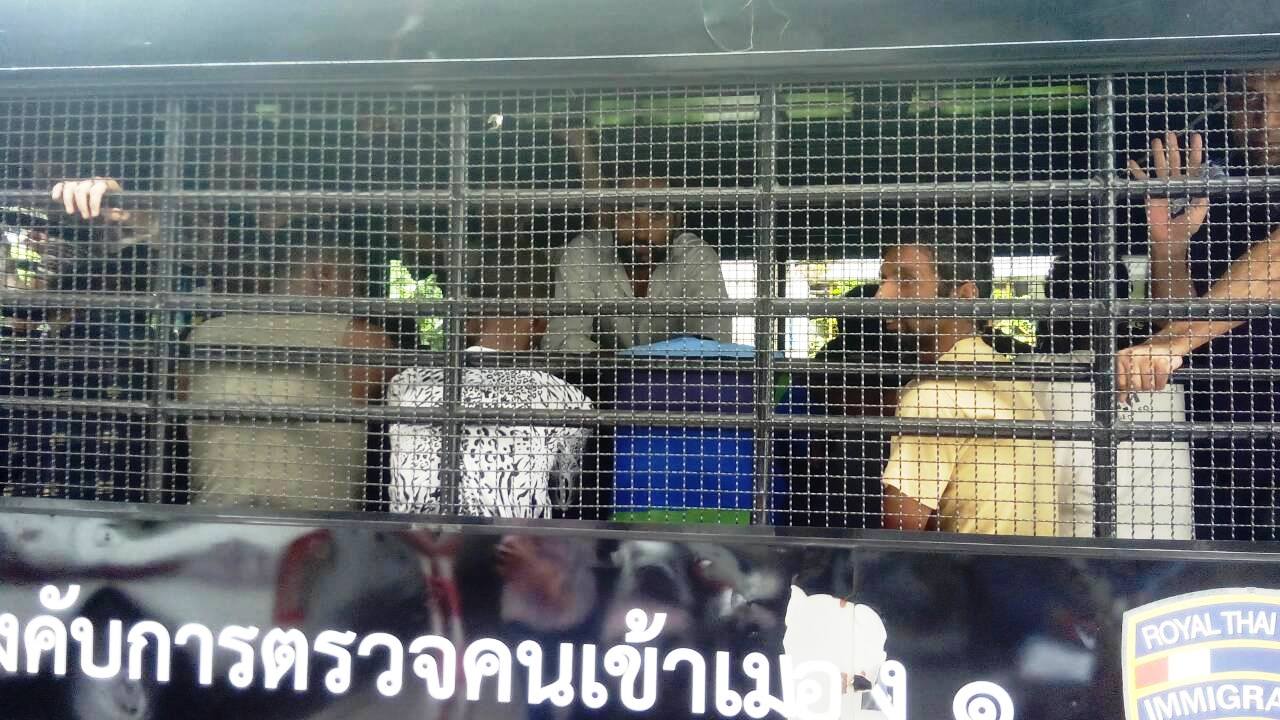
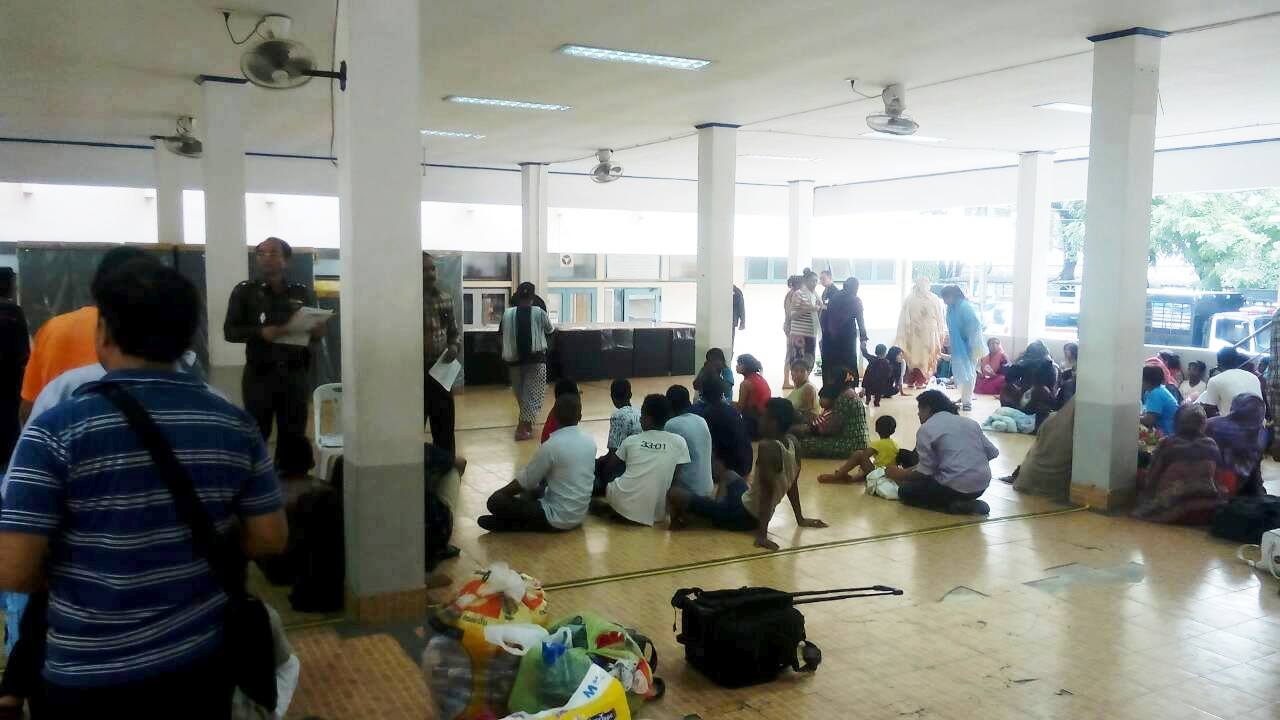
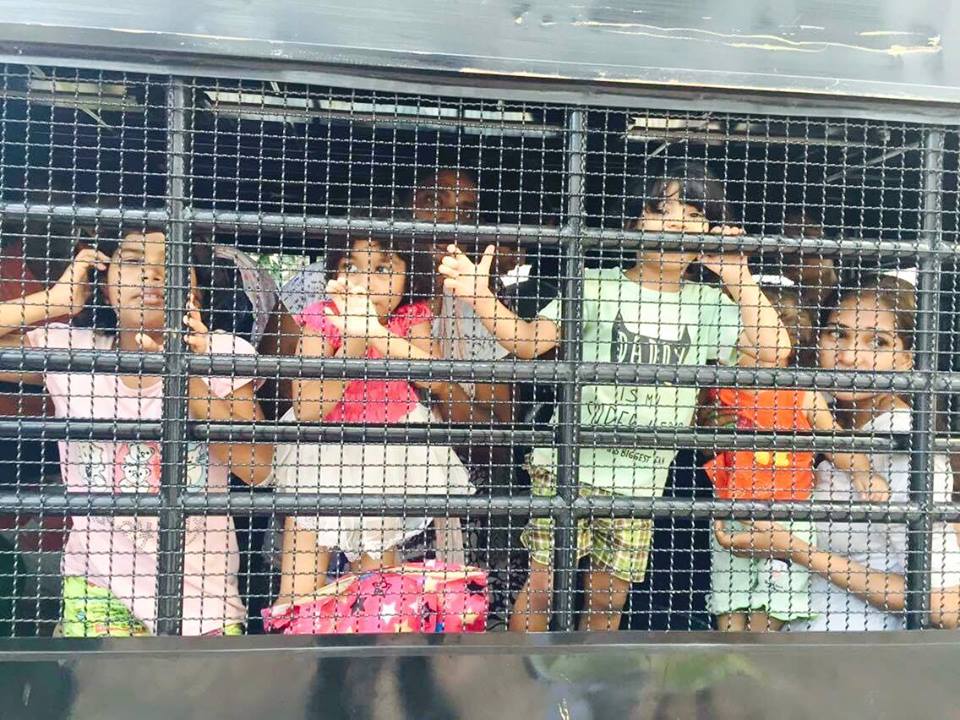
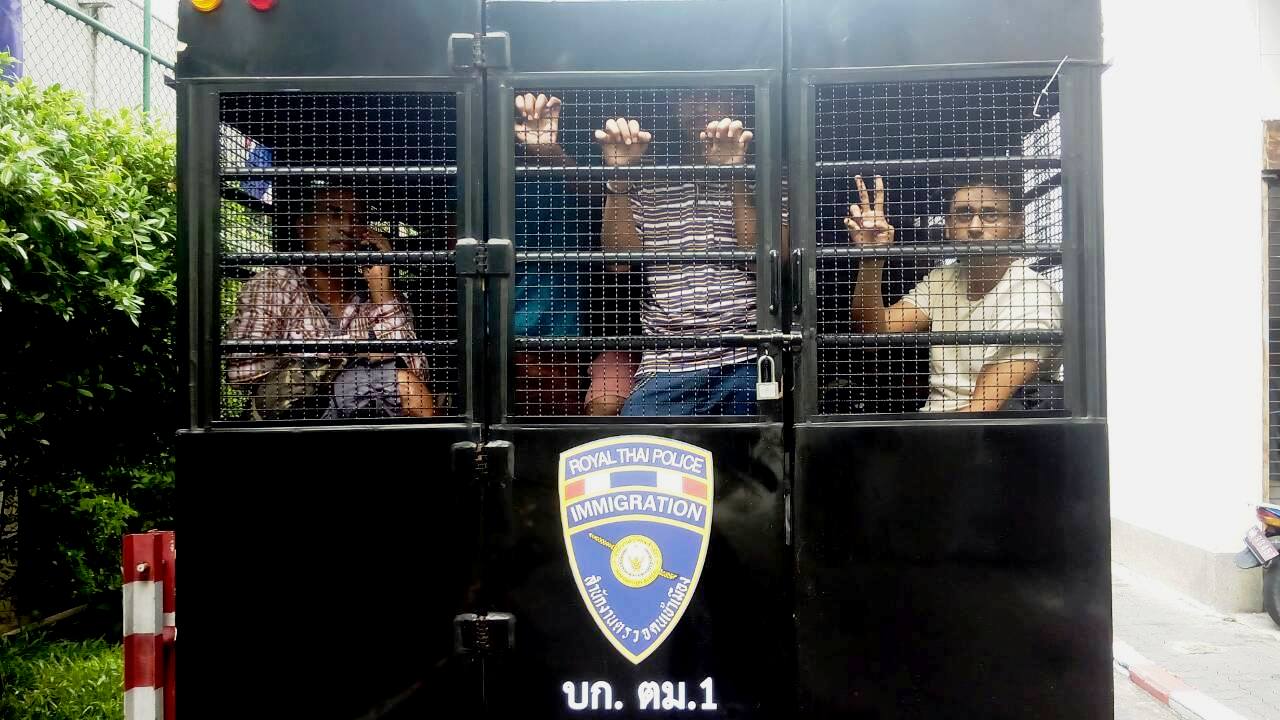
Bangkok, Thailand: Responsible for Equality And Liberty (R.E.A.L.) has received reports today (September 10, 2015) of massive immigration arrests of Pakistan Christian refugees seeking asylum, by the Thai police and the Thai army.    Reports indicate that these Thai authorities raided the Delight H condominium in Bangkok, and they arrested between 250 to 500 Pakistan Christian asylum seekers.  Reports indicate that the Thai authorities have been taking women, children, elderly, and men among the immigration arrests today, and taking these arrested Pakistan Christian asylum seekers to the over-crowded Immigration Detention Centre (IDC).

Pakistan Christians fled to Thailand to escape oppressive conditions in Pakistan where they were living under threats by extremists, who threatened violence against them for their Christian religion, including violence against Pakistan Christian churches and homes.  Pakistan Christians have frequently been attacked by extremists who seek to deny their religious freedom and seek to persecute and oppress them.  This has include arrests and of Pakistan Christians by the use of a “blasphemy” law, which extremists can use to harass and persecute others.  Reports state that another Pakistan Christian Pervaiz Masih was reportedly arrested in Punjab, Pakistan recently (September 1, 2015) in Pakistan on a false blasphemy charge created to harass him for his religious freedom.  The environment of Pakistan against Christians and specific threats to many Pakistan Christian individuals and their families have led them to flee to Thailand for asylum.

UPDATE:  Smartphones of the arrested refugees were taken by Thailand immigration authorities. Thailand immigration authorities are going to release breastfeeding mothers after negotiations with UNHCR staff.  R.E.A.L. will continue to provide updates as we receive reports.

11984561_1169269923100066_635598603_o

12011479_1169269983100060_2114190521_o

12005893_1169270079766717_1331840243_o

12005893_1169270079766717_1331840243_o

==========================

Government and Refugee Community Points of Contacts

The following are points of contact that we have reached on this topic within the government and the refugee community. These are being shared in the hopes that other human rights activists will also follow up with these individuals to make it clear that this is a shared concern for action on this urgent issue. If you have other useful / productive government contacts, please let us know at usa@realcourage.org, so that we can update this information.

Kingdom of Thailand
The Secretariat of the Prime Minister
Government House, 1 Phitsanulok Road, Dusit, Bangkok 10300
General Prayut Chan-o-cha, Prime Minister
FAX: 66 2 282 5131

Kingdom of Thailand
IMMIGRATION DIVISION 1
Chalermprakiat Government Complex
120 MOO 3, CHAENGWATTANA ROAD,SOI 7,
LAKSI, BANGKOK. 10210
Bangkok Immigration Comment Web Site
http://bangkok.immigration.go.th/en/base.php?page=comment

UNHCR Regional Representative in Thailand
3rd Floor, United Nations Building, Rajdamnern Nok Avenue, 10200 Bangkok, Thailand
Telephone: 66 2 288 1858
FAX: 66 2 280 0555
Email: thaba@unhcr.org

UNHCR, New York: The Director of UNHCR Office in New York, P.O. Box 20 Grand NY 10017, Grand Central, 10017 New York, NY, United States,
Telephone: 1-212-963-0032
Fax: 1-212-963-0074
Email: usane@unhcr.org

United Nations High Commissioner for Refugees
Case Postale 2500
CH-1211 Genève 2 Dépôt
Suisse (Switzerland)
Telephone: +41 22 739 8111
FAX: +41 22 739 7377


===========================================


Thailand : Terrorist Bomb Attack Near Hindu Shrine

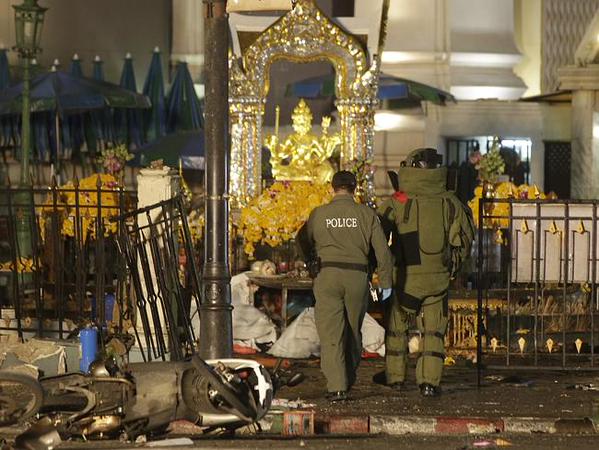
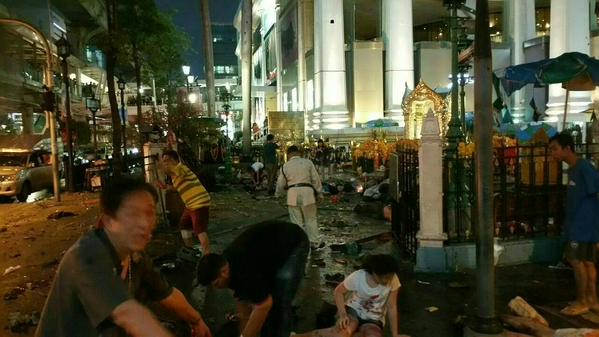
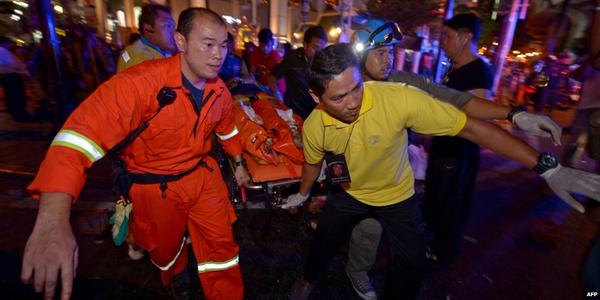
On August 17, 2015, a terrorist improvised explosive device (IED) bomb was used to attack an area in Bangkok, Thailand near the Erawan Shrine, a Hindu shrine.   The 3 kilogram bomb caused an  explosion near the Rajprasong intersection.  Bangkok Post has reported the “scale of the explosion set motorbikes and taxis ablaze inside the intersection and bowed the iron fence of the Hindu shrine outward. Casualties were immediate, with body parts scattered across the area, leaving broken glass and the smouldering wreckage of burned-out motorcycles behind. ”

The latest reports on the terrorist attack state that 20 were killed and 125 wounded, including foreign tourists, and a 5 year old Chinese boy.

Terrorist Attack in Bangkok - August 17, 2015 - near Hindu Shrine - CCTV at the moment bomb went off
Terrorist Attack in Bangkok – August 17, 2015 – near Hindu Shrine – CCTV at the moment bomb went off

Bangkok Post reported: “Police said the IED that exploded inside the shrine area was composed of three kilogrammes of TNT stuffed in a pipe and wrapped with white cloth. Its destructive radius was estimated at 100 metres. Its destructive radius was estimated at 100 metres. Authorities quickly recovered an electronic circuit suspected to be part of the device about 30 metres from the blast scene.”  National police chief Somyot Pumpunmuang told the Bangkok Post that he “condemned the bombing and said it was apparently intended to kill people and damage property because it was set to detonate when the shrine was crowded.”

Update: On August 18, 2015, the Thailand police released a photograph of a man that they have identified as the person who placed the terrorist bomb.  The suspect was dressed like a tourist, wearing yellow T-shirt, shorts and sandals.  In the CCTV footage, he is shown taking off his backpack and leaving it underneath a bench at busy area. Royal Thai Police spokesman Lt Gen Prawuth Thawornsiri said: “The yellow shirt guy is not just the suspect. He is the bomber.”  Reports indicate these terrorist attacks are not consistent with those in the Thailand south, which lasted over a decade and left 5,000 dead.   In addition, Sky News reports that “As police hunted the attackers Bangkok had a new bomb scare as a man threw a small explosive device from a bridge on the city’s Chao Phraya river, but it landed in a canal and no-one was hurt.”

Person identified by Thailand police as behind the Bangkok terrorist bombing of August 17, 2015
Terrorist Attack in Bangkok - August 17, 2015 - near Hindu Shrine
Terrorist Attack in Bangkok – August 17, 2015 – near Hindu Shrine

The Bangkok Post reported that the “Ratchaprasong intersection where the bombing occurred has been the site of massive political protests in the past decade and a target for bombers. Two bombs on the Ratchaprasong Skywalk outside the nearby Siam Paragon shopping mall in February injured two people and are believed to have been politically motivated. A car bomb exploded in the parking garage a Central Festival Koh Samui in April.”

Terrorist Attack in Bangkok - August 17, 2015 - near Hindu Shrine
Terrorist Attack in Bangkok – August 17, 2015 – near Hindu Shrine

The Bangkok Post also reported “Bangkok police detectives said ball bearings possibly packed with the explosive as shrapnel were found in the explosion area. They were six millimetres in diameter, the same size as those found at the scene of the botched bomb explosion set off by Iranian suspects on Sukhumvit 71, Bangkok, in February 2012.”

The United Nations issued a statement: “Secretary-General Ban Ki-moon and all of us at the United Nations were shocked to learn of the explosion in Bangkok today close to the Erawan shrine in Rajaprasong. The Secretary-General and the entire United Nations Country Team in Thailand as well as all United Nations personnel join together to expresses our condolences to the bereaved families and to the people and Government of the Kingdom of Thailand. We wish those injured a quick recovery. The United Nations is appalled at the loss of life of innocent civilians and hope that those responsible will be brought to justice. The United Nations in Thailand stands strongly with the Thai people during this difficult time.”

Terrorist Attack in Bangkok - August 17, 2015 - near Hindu Shrine
Terrorist Attack in Bangkok – August 17, 2015 – near Hindu Shrine

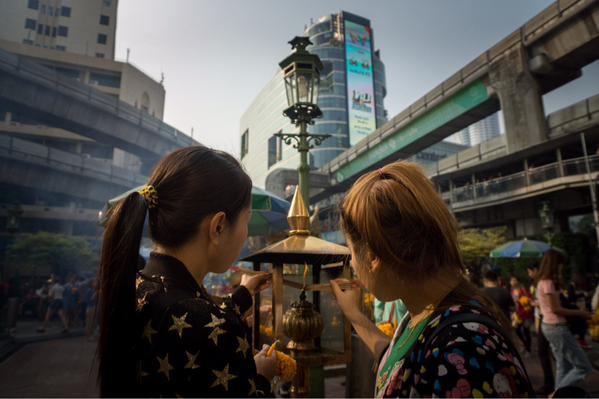
CNN reports that the “shrine houses a golden statue of Phra Phrom, the Thai representation of Brahma, the Hindu god of creation.”  “Thousands of worshipers visit the site each day, praying for everything from to good health to sporting results. They light incense sticks and wai (bow slightly with palms pressed together) to each of the four faces of the statue. For extra luck, worshipers pay respect and money to the shrine’s Thai dancers.”

Hindu-Shrine-before-attack
Hindu Shrine before attack

Terrorist and extremist violence which seeks to deny our universal human rights, our human dignity, and religious freedom has no boundaries. It can strike anywhere against anyone of any faith. Responsible for Equality And Liberty (R.E.A.L.) urges people of all faiths, all races, all ethnic backgrounds, all nationalities, all genders, and all identity groups to stand together united for our shared Universal Human Rights and defy those terrorists of every kind who would deny us the inherent freedom that we share together.