Thailand : Terrorist Bomb Attack Near Hindu Shrine

On August 17, 2015, a terrorist improvised explosive device (IED) bomb was used to attack an area in Bangkok, Thailand near the Erawan Shrine, a Hindu shrine.   The 3 kilogram bomb caused an  explosion near the Rajprasong intersection.  Bangkok Post has reported the “scale of the explosion set motorbikes and taxis ablaze inside the intersection and bowed the iron fence of the Hindu shrine outward. Casualties were immediate, with body parts scattered across the area, leaving broken glass and the smouldering wreckage of burned-out motorcycles behind. ”

The latest reports on the terrorist attack state that 20 were killed and 125 wounded, including foreign tourists, and a 5 year old Chinese boy.
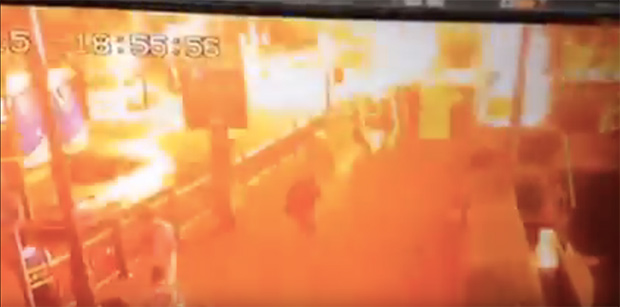
Terrorist Attack in Bangkok - August 17, 2015 - near Hindu Shrine - CCTV at the moment bomb went off
Terrorist Attack in Bangkok – August 17, 2015 – near Hindu Shrine – CCTV at the moment bomb went off

Bangkok Post reported: “Police said the IED that exploded inside the shrine area was composed of three kilogrammes of TNT stuffed in a pipe and wrapped with white cloth. Its destructive radius was estimated at 100 metres. Its destructive radius was estimated at 100 metres. Authorities quickly recovered an electronic circuit suspected to be part of the device about 30 metres from the blast scene.”  National police chief Somyot Pumpunmuang told the Bangkok Post that he “condemned the bombing and said it was apparently intended to kill people and damage property because it was set to detonate when the shrine was crowded.”

Update: On August 18, 2015, the Thailand police released a photograph of a man that they have identified as the person who placed the terrorist bomb.  The suspect was dressed like a tourist, wearing yellow T-shirt, shorts and sandals.  In the CCTV footage, he is shown taking off his backpack and leaving it underneath a bench at busy area. Royal Thai Police spokesman Lt Gen Prawuth Thawornsiri said: “The yellow shirt guy is not just the suspect. He is the bomber.”  Reports indicate these terrorist attacks are not consistent with those in the Thailand south, which lasted over a decade and left 5,000 dead.   In addition, Sky News reports that “As police hunted the attackers Bangkok had a new bomb scare as a man threw a small explosive device from a bridge on the city’s Chao Phraya river, but it landed in a canal and no-one was hurt.”
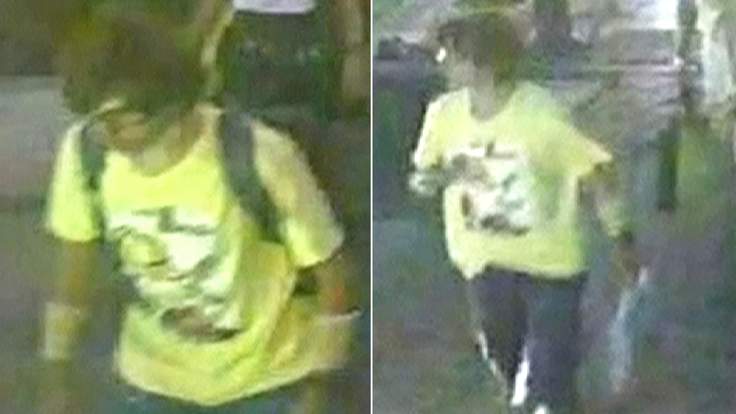
Person identified by Thailand police as behind the Bangkok terrorist bombing of August 17, 2015
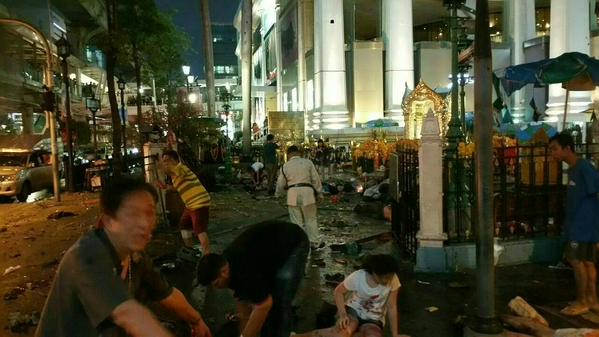
Terrorist Attack in Bangkok - August 17, 2015 - near Hindu Shrine
Terrorist Attack in Bangkok – August 17, 2015 – near Hindu Shrine

The Bangkok Post reported that the “Ratchaprasong intersection where the bombing occurred has been the site of massive political protests in the past decade and a target for bombers. Two bombs on the Ratchaprasong Skywalk outside the nearby Siam Paragon shopping mall in February injured two people and are believed to have been politically motivated. A car bomb exploded in the parking garage a Central Festival Koh Samui in April.”
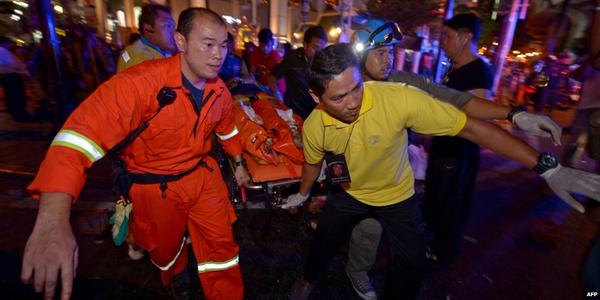
Terrorist Attack in Bangkok - August 17, 2015 - near Hindu Shrine
Terrorist Attack in Bangkok – August 17, 2015 – near Hindu Shrine

The Bangkok Post also reported “Bangkok police detectives said ball bearings possibly packed with the explosive as shrapnel were found in the explosion area. They were six millimetres in diameter, the same size as those found at the scene of the botched bomb explosion set off by Iranian suspects on Sukhumvit 71, Bangkok, in February 2012.”

The United Nations issued a statement: “Secretary-General Ban Ki-moon and all of us at the United Nations were shocked to learn of the explosion in Bangkok today close to the Erawan shrine in Rajaprasong. The Secretary-General and the entire United Nations Country Team in Thailand as well as all United Nations personnel join together to expresses our condolences to the bereaved families and to the people and Government of the Kingdom of Thailand. We wish those injured a quick recovery. The United Nations is appalled at the loss of life of innocent civilians and hope that those responsible will be brought to justice. The United Nations in Thailand stands strongly with the Thai people during this difficult time.”
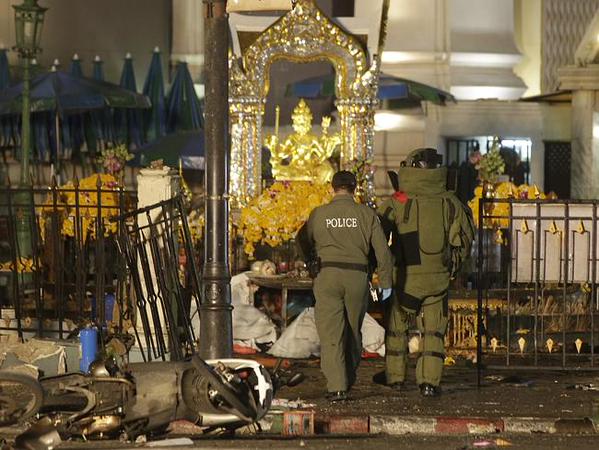
Terrorist Attack in Bangkok - August 17, 2015 - near Hindu Shrine
Terrorist Attack in Bangkok – August 17, 2015 – near Hindu Shrine

CNN reports that the “shrine houses a golden statue of Phra Phrom, the Thai representation of Brahma, the Hindu god of creation.”  “Thousands of worshipers visit the site each day, praying for everything from to good health to sporting results. They light incense sticks and wai (bow slightly with palms pressed together) to each of the four faces of the statue. For extra luck, worshipers pay respect and money to the shrine’s Thai dancers.”
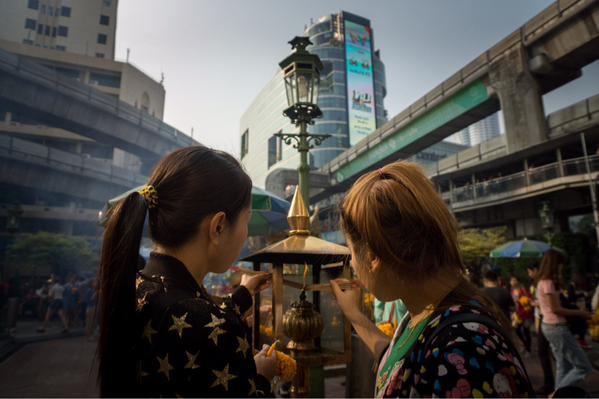
Hindu-Shrine-before-attack
Hindu Shrine before attack

Terrorist and extremist violence which seeks to deny our universal human rights, our human dignity, and religious freedom has no boundaries. It can strike anywhere against anyone of any faith. Responsible for Equality And Liberty (R.E.A.L.) urges people of all faiths, all races, all ethnic backgrounds, all nationalities, all genders, and all identity groups to stand together united for our shared Universal Human Rights and defy those terrorists of every kind who would deny us the inherent freedom that we share together.
African-Americans as Refugees and Human Rights

U.S. Immigration Defense Lawyer Raha Jorjani writes in Washington Post: “Could black people in the U.S. qualify as refugees?”  Raha Jorjani makes the case that such persecution of identity groups would justify others who came to America as protected refugees.  It is a powerful and important argument that human rights activists in America and around the world need to hear and understand.  Our support for the Universal Declaration of Human Rights is not simply for foreign nations, but it is for all nations, including the United States of America.  We cannot ignore such the epidemic of identity group persecution in America and believe we are doing good for human rights in the world.

Raha Jorjani writes in Washington Post:

“Suppose a client walked into my office and told me that police officers in his country had choked a man to death over a petty crime. Suppose he said police fatally shot another man in the back as he ran away. That they arrested a woman during a traffic stop and placed her in jail, where she died three days later. That a 12-year-old boy in his country was shot and killed by the police as he played in the park.

Suppose he told me that all of those victims were from the same ethnic community — a community whose members fear being harmed, tortured or killed by police or prison guards. And that this is true in cities and towns across his nation. At that point, as an immigration lawyer, I’d tell him he had a strong claim for asylum protection under U.S. law.

What if, next, he told me he was from America? Black people in the United States face such racial violence that they could qualify as refugees if they lived in this country.

Over the past decade, I’ve represented and advised hundreds of noncitizens facing deportation. Many feared persecution in their home countries and sought protection in the United States. To win them asylum status and the right to stay, I showed that my clients had a well-founded fear of future persecution by the government or by groups that the government was unable or unwilling to control. In one case, I successfully argued that if my client returned to his home country, he could be unjustly imprisoned and physically harmed on the basis of his religious beliefs. Black Americans know the risk of unjust imprisonment and physical harm all too well.

 According to U.S. asylum law, that persecution must be on account of race, religion, nationality, membership in a particular social group or political opinion. In many cases, courts have said that violence by police officers, unjust imprisonment, rape, assault, beatings and confinement constitute persecution. Even nonphysical forms of harm, such as the deliberate imposition of severe economic disadvantage, psychological harm, or the deprivation of food, housing, employment or other essentials, help make the case. In one instance, the U.S. Court of Appeals for the 9th Circuit ruled that an individual who had been arrested, held for three days and then falsely accused of a crime had been persecuted. In another case, it ruled that persecution included ethnic discrimination so severe that the petitioner was unable to find a job in his chosen field.

Does this sound familiar?

The United States claims to be a country that protects refugees, not produces them; a country that chastises nations with poor human rights records. But what of our own human rights record, which shows how far we still have to go in eradicating racial injustice and violence?

To make an asylum case for black persecution, I wouldn’t have to reach back to 400 years of slavery, lynching, segregation and Jim Crow. I would focus, instead, on the current prolific system of racist policing, mass incarceration and selective prosecution.

I might start by telling the story of Albert Woodfox, an African American man who has spent more than 40 years in solitary confinement as a result of a conviction that was recently overturned. The United Nations has called for an “absolute prohibition” on solitary confinement beyond a couple of weeks. Yet prison officials keep Woodfox locked away. While data on solitary confinement is notoriously hard to come by, a study from the University of Michigan shows that the practice disproportionately affects people of color.

African Americans make up just 13 percent of the U.S. population, but they accounted for 31 percent of people killed by police in 2012. According to a ProPublica analysis, black teenagers were 21 times more likely than white teens to be shot and killed by the police between 2010 and 2012. In the United States, there are 1.6 million black men in prison, on probation or on parole, double the number who were enslaved in 1850.

I’d remind the court that in 1985, the Philadelphia police dropped an actual bomb on the headquarters of MOVE, a black political organization, killing 11 black citizens, including five children, and destroying 61 homes, an act for which not one city official was prosecuted. That more recently, the subprime mortgage scandal — which for the most part has also gone unpunished —disproportionately victimized black communities. Blacks and Latinos weremore than twice as likely as whites to get those risky, high-cost loans.

I would cite the Justice Department’s findings that in Ferguson, Mo., courts engaged in intentional racial discrimination while administering the law. I would point out that black men receive prison sentences that are, on average, 20 percent longer than those of white men who committed the same crimes. That in some cities, police officers engage in racial profiling and unconstitutional stops on a routine basis. I would raise the fact that since 2010, 22 states have passed new voting restrictions thatdisproportionately affect black voters. While I probably wouldn’t need to, I’d also throw in that in 2013, the median wealth for white households was about $141,900, whereas for black households it was about $11,000.

This country is dangerous for black people. Black parents live with an ever-present fear that their children will become victims of state violence and terror on the basis of race.

Had they remained alive, Trayvon Martin, Eric Garner, Malissa Williams, Timothy Russell, John Crawford, Rekia Boyd, Michael Brown, Akai Gurley, Walter Scott, Ezell Ford, Mya Hall, Dontre Hamilton, Tamir Rice, Tanisha Anderson, Miriam Carey, Yvette Smith, Samuel Dubose and so many others would be able to demonstrate that they had more than a well-founded fear of persecution at the hands of their government or individuals whom their government was unable or unwilling to control.

Black Americans should not have to flee this country to seek refuge.”