The continuing injustice of Pakistan Christians struggling to seek asylum was publicized by the FOX News media on August 3, 2015 in an article entitled “Pakistani Christian refugees face ordeal in Thailand.” R.E.A.L. assisted the reporter Mary Kekatos in obtaining news sources and details. We urge the public to share this important information and to assist in obtaining financial assistance to Pakistan Christian refugees in Thailand.
“Pakistani Christians escaping to Thailand from persecution in their native country are not receiving the protection they so desperately need as they face poverty, arrest and possible deportation.
Thousands of Pakistani Christians have fled their homes due the country’s reported mistreatment of religious minorities. Fleeing to Southeast Asian countries due to how cheap and easy it is to maintain a tourist visa, these Christians soon discover they are not to be treated well in their new home either.
Because Thailand is not a signatory to the 1951 Refugee Convention or its 1967 Protocol, and does not have a formal national asylum framework, the Pakistani Christians are not treated as refugees or asylum seekers but as illegal immigrants. Often, Thailand will not grant asylum status to those declared genuine refugees by the United Nations High Commissioner for Refugees (UNHCR).
“The poor can’t and don’t escape but the middle and upper classes flee to Thailand,” said Wilson Chowdhry, chairman of the British Pakistani Christian Association, who has issued an appeal and a petition calling for help for the refugees. “[Back in Pakistan] they are doctors, lawyers, professors, politicians.”
“Pakistan’s blasphemy law has been used in a way to target religious minorities,” said Phil Robertson, deputy director of the Asia Division of Human Rights Watch in a separate interview. “There has been violence perpetrated against people accused of blasphemy. When facing that kind of persecution, many have no choice but to leave.”
Those fleeing Pakistan face tough roads. They are often stopped by border guards when suspected of being Christians even with a legal visa or plane tickets. Many are not allowed to cross the border until they have paid a bribe or a fine. When Raymond John and his family crossed the border, they had to pay the guards 112,000 Pakistani rupees ($1100).
“We refused twice and they would not let us pass but on the third time we finally paid,” John said.
In European countries and the United States, it can be an arduous and expensive process to apply for a tourist visa. Although easy to obtain one from Thailand, the Pakistanis’ stay is anything but easy. Upon arrival, the refugees realize they cannot attain citizenship and cannot buy property. Even if a Pakistani marries a Thai citizen, they are not granted legal citizenship and their status is returned to refugee upon their spouse’s death.
Farrukh Saif, head of the Farrukh Saif Foundation dedicated to helping persecuted Pakistani Christian refugees, has criticized the delay of the UNHCR to classify the Christians who have fled to Thailand as refugees, saying it affects the livelihood of those seeking asylum.
“According to a mandate, in 90 days they have to determine the status of these people as refugees, but in reality it can take four to five years,” he said. “If a minor, a child, cannot go to school for four to five years, what is his future? A whole generation of Pakistani Christians in Bangkok is being destroyed.”
UNHCR’s Field Media Officer for Thailand, Vivian Tan, said that by nature, refugee status determination (RSD) is time-consuming and labor-intensive.
“In many urban settings, the demand for RSD exceeds processing capacities. In Bangkok, UNHCR has been working to speed up processing times,” she said.
Refugees would agree that the process has been anything but speedy. Sunny Gil arrived in Thailand in August 2013 and was given an appointment with the UNHCR for an interview in May 2015 to be assigned refugee status. When the time came for the interview, however, it was postponed for a year.
“It is silly – the excuses that they give for postponing the interviews. It is such a big organization and they should be able to help us,” he said.
Additionally, because these Pakistanis do not have refugee status, they are not allowed to work and therefore have no legal income. They often make their money doing illegal jobs or begging and seeking charity from churches.
“We want to work and we want to earn and support our families on our own,” said Cyril Lamran of the Christian Asylum Seekers Association of Thailand and a refugee himself. “But they’re not giving us the opportunity for us to earn and not providing us basic human rights.”
Tourist visas last up to two months after which they can only be renewed if the applicant is working. Because, however, the Pakistani Christians are treated as illegal immigrants and are unable to work, their visas cannot be extended making them subject to arrest and detention at any point in time.
In March, upwards of 400 Pakistani Christian refugees were reported to have been arrested. Homes were raided by the Thai immigration police and the arrestees were taken to be held at the central jail or the Immigration Detention Center (IDC) in the capital of Bangkok.
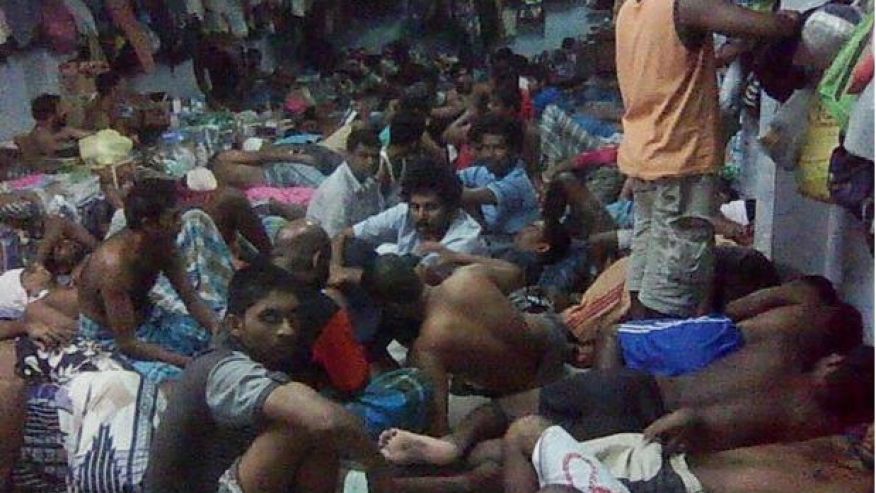
Former inmates speak of horrendous conditions including cramped cells, inadequate nutrition and children being incarcerated with adults. In the central jail, the men are bound in shackles and forced to stand in the hot sun. In the IDC, up to 200 people can be packed in a room meant for 100 leaving very little space to properly sleep. Many have since been released for up to a year until they get a proper visa, otherwise they face being put back in the IDC or being deported back to Pakistan.
While Gil said he could perhaps see why people were being sent to the IDC (his own sister-in-law was held in central jail and the IDC for one month), he could not understand the need to send refugees to the former.
“The central jail is for criminals, not asylum seekers, but they put us in jail like we are criminals,” he said. “Even though they are not signatory, there is something called human rights.”
Other concerns also plague these families. The refugees do not have the money to cover medical costs and multiple families often are forced to share a single room because they cannot afford the rent.
Currently, there are an estimated 4500 Pakistani Christian refugees living in Thailand and while they wait for help, activists stress the dire need for action to be taken, requesting the international community to hasten the determination process of the UNHCR.
“The UNHCR is the mother of human rights but they’re essentially denying human rights,” John said. “The West has to know the persecution the Christians face in Pakistan and in Thailand. Who will speak for us when those who speak will speak for the government?” “