Asia news media are reporting on the trial of three individuals involved with the firebombing of a Christian church.
Channel News Asia reports that the trial began on July 6 at the Kuala Lumpar sessions court, and the three men were charged with firebombing the Metro Tabernacle church in January 2010. It states that the three men on trial are Raja Muhd Faizal and Raja Muhd Idzham, and Azuwan Sahah Ahmad, and that they have been charged under “436 of the Penal Code for causing mischief with fire.” Catholic Culture and Vatican News are also reporting on this story. The Vatican News states “Fr Lawrence Andrew, Editor of the Catholic weekly Herald, believes that the men on trial did not act alone.”
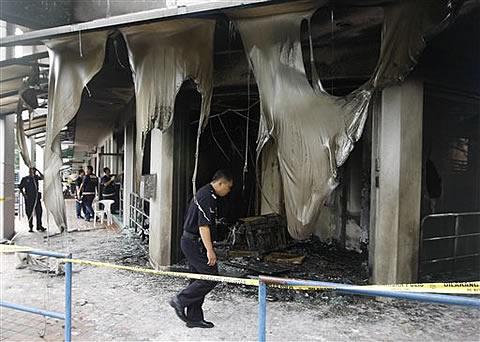
A Kuala Lumpur police officer inspects the damage to the Metro Tabernacle Church which was destroyed by a fire bomb in the Kuala Lumpur suburb of Desa Melawati,08 Jan 2010 (Photo AP)
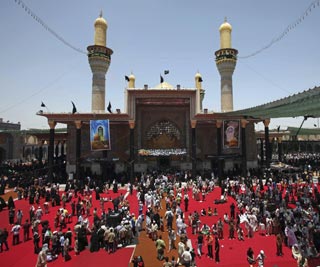
AFP/FA reports: “A suicide bomber wearing an explosives-filled belt murdered 28 Shiite pilgrims on Wednesday while five more were killed in bomb attacks against worshippers in Baghdad, a security official told AFP. The suicide attack occurred in Adhamiyah, a Sunni district across the Tigris river from Kadhimiyah, an area named after Musa Kadhim, the seventh of 12 revered imams in Shiite Islam, whom the pilgrims are honouring.”
U.S. Lance Cpl. Matthew A. Snyder, of Finksburg, Maryland - Died in Iraq
York Daily News reports that on July 7, 2010 “Members of the Westboro Baptist Church filed their response today with the U.S. Supreme Court to a petition by Albert Snyder asking the court to restore a $5 million verdict against the Rev. Fred Phelps and members of his congregation.”
“In their petition, the Phelpses are asking the court to uphold a 4th U.S. Circuit court of appeals ruling that overturned the jury verdict. The Phelpses said the 4th Circuit was correct to say their speech – protesting Marine Lance Cpl. Matthew Snyder’s 2006 funeral outside a Westminster, Md., Catholic Church and writing about Snyder on Westboro’s website – was protected under the First Amendment.”
….
“Albert Snyder, of Spring Garden Township, has said the Kansas-based Westboro Baptist Church invaded his privacy and intentionally inflicted emotional distress upon his family in their protest. His attorneys laid out their argument for the Supreme Court in briefs filed May 25. Supporters – including attorneys general for 48 states, a collection of U.S. senators, and several veterans organizations – filed amicus briefs a week later.”
“The court is expected to hear oral arguments in October.”
— The Snyder family is seeking donations to help them continue their suit.
— Synder family states: “Lance Cpl. Matthew A. Snyder, of Finksburg, Maryland, died from a non combat-related vehicle accident in Al Anbar province, Iraq. He was assigned to Combat Service Support Group-1, 1st Marine Logistics Group, I Marine Expeditionary Force, Twentynine Palms, California. Died on March 3, 2006. Matthew was 20 years old.”
“The family of Lance Corporal Matthew Snyder, US Marine Corps, has begun this civil lawsuit* against Mr. Phelps and certain members of the so-called Westboro Baptist Church to bring an end to the reign of terror and abuse that they inflicted upon the grieving families of US service members killed in defense of our nation. Using innocent children to deliver their twisted message of hatred and fear, the defendants in this suit have sought to attack the memory of our departed heroes, to strip their loved ones of their dignity, and to use abuse and intimidation as a tool for preventing surviving family members from reaching closure over their loss.”
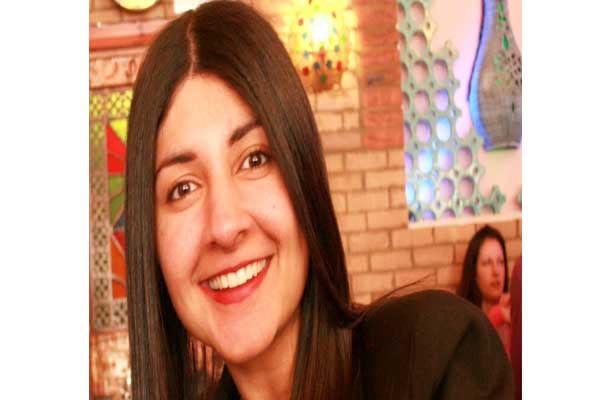
British Female Muslim Director of BMSD Explains the Need for Secular Democracy
Question to Tehmina Kazi: What are the reasons behind the title ‘British Muslims for Secular Democracy’ (BMSD)?
Response: We distinguish between procedural secularism and ideological secularism. Ideological secularism is the type of model that is practiced in France and Turkey, where we see for example headscarf bans in university and we want to distance ourselves from that kind of secularism. We support instead, procedural secularism where the state remains neutral but different faith groups and of no faith have the chance to express their voices in the public sphere and everyone gets an equal share of the public sphere. We also want to highlight the benefits of living in a democracy and how British Muslims can become more successful democratic actors.
Question: What is BMSD doing to engage with British Muslims on a grass-roots level?
Response: On a grass roots level, I am the facilitator for the Young Muslim Leadership Network which is being run by the Citizenship Foundation, so I facilitate monthly workshops for young people, mainly women actually and they talk about issues that are important to them and find individual ways to present these to policy makers. My group for example is filming a myth-busting documentary about Muslim women, busting myths about the hijab, talking about their career choices and educational aspirations. Also we do democracy workshops for refugees in East London and we talk to them about their civil rights.
Question: What does being a British Muslim mean to you?
Response: It means that you don’t see the two terms as mutually exclusive. You can be just as comfortable with your British identity and totally integrated at the same time by totally Muslim.
Question: Eight Muslim MPs were elected this year, three of them women. How will they affect change for Britain?
Response: They set a very important change as role models, especially for Muslim women because now Muslim women can look at MPs such as Rushanara Ali and Baroness Sayeeda Warsi, who is the first female Muslim in the cabinet and say that if they can do it, I can do it too.
The government’s Prevent agenda has isolated young Muslim males. What are the possible platforms on which they can counter these stereotypes?
There was a very good platform just this Sunday. There was a big public meeting in Birmingham, attended by Salma Yaqoob, Shami Chakrabarti from Liberty and Gareth Pierce, the human rights lawyer and there were a lot of Muslims present there and they aired their concerns. I don’t know if you’ve heard of the increased surveillance in residential areas in Birmingham and I’m a civil libertarian and me personally, I was very affected by this. The more we voice these issues by signing petitions, attending public meetings, going on TV programmes, radio programmes to explain why this is wrong and why this is wrong approach is important. We need to do more of these things.
Question: Why is it important that Muslim youth vote?
Response: Because if you don’t vote then you shouldn’t complain when you see MPs ignoring your interest and hot shod of your wishes and implementing things such as the surveillance in Birmingham and the 42-day detention period. It is the individual that can make these changes within themselves, such as writing a letter to an MP. It’s the apathy that is the biggest enemy to both Muslims and non-Muslims.
Question: There have been news reports of Muslim parents removing their children from music lessons in a south London school. Many Muslim parents want to instil specific Islamic principles in their child’s education. Do you think it is possible to negotiate this in a school setting?
Response: I don’t think they should have the right to withdraw their child from music lessons. Children benefit most from a well-rounded education. What we need to do is to educate the parents because there’s a big difference from Mozart and a rap song. There are already comprises being made for other lessons such as swimming, where you have girls only lessons and that’s fine. But with something as universal as music, I mean why would you want to withdraw your child from that? Next you’ll have children being withdrawn for all arbitrary reasons. This has been going on for a long time, and is worse in areas such as Bradford and Ealing.
Tehmina Kazi took up the position of Director of British Muslims for Secular Democracy in May 2009. Prior to joining BMSD, she was a Project Officer at the Equality and Human Rights Commission, where she worked on a ground-breaking inquiry into the Human Rights Act and its impact on public service delivery, undertaking research, writing policy briefings, facilitating focus groups and interviewing victims of human rights violations.
But while there may be no official remembrance activities, there are many whose lives and passion for democracy and freedom are living memorials to the July 7 victims, and whose efforts represent a new hope for the United Kingdom in the struggle of ideas.
We have been seeing increasing signs of hope and progress among British Muslims who are taking the lead in supporting secular democracy and human rights as a counter-message to extremists who seek to deny democracy and human rights. While some analysts believe that fighting terrorism can be measured by tactical achievements or failures, Responsible for Equality And Liberty (R.E.A.L.) believes that solutions will come from a consistent support for democracy and our universal human rights from the public, including British Muslim and pro-human rights groups in the struggle of ideas.
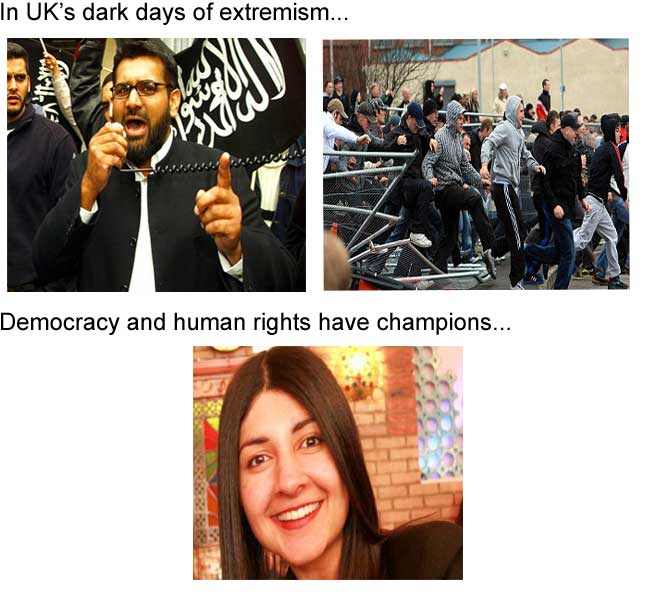
While groups such as Anjem Choudary’s Islam4UK and the Hizb ut-Tahrir United Kingdom groups denounce democracy and equality, and on the other extreme, groups such as the English Defence League and the Stop Islamisation of Europe groups are protesting Muslim houses of worship, there are alternatives from those such as the BMSD and its supporters who provide an example in consistent support of democracy, human rights, and human dignity for rest of the United Kingdom and the world.
We urge others in the United Kingdom to follow the example of groups such as BMSD and choose to consistently be responsible for equality and liberty.