British Female Muslim Director of BMSD Explains the Need for Secular Democracy
Question to Tehmina Kazi: What are the reasons behind the title ‘British Muslims for Secular Democracy’ (BMSD)?
Response: We distinguish between procedural secularism and ideological secularism. Ideological secularism is the type of model that is practiced in France and Turkey, where we see for example headscarf bans in university and we want to distance ourselves from that kind of secularism. We support instead, procedural secularism where the state remains neutral but different faith groups and of no faith have the chance to express their voices in the public sphere and everyone gets an equal share of the public sphere. We also want to highlight the benefits of living in a democracy and how British Muslims can become more successful democratic actors.
Question: What is BMSD doing to engage with British Muslims on a grass-roots level?
Response: On a grass roots level, I am the facilitator for the Young Muslim Leadership Network which is being run by the Citizenship Foundation, so I facilitate monthly workshops for young people, mainly women actually and they talk about issues that are important to them and find individual ways to present these to policy makers. My group for example is filming a myth-busting documentary about Muslim women, busting myths about the hijab, talking about their career choices and educational aspirations. Also we do democracy workshops for refugees in East London and we talk to them about their civil rights.
Question: What does being a British Muslim mean to you?
Response: It means that you don’t see the two terms as mutually exclusive. You can be just as comfortable with your British identity and totally integrated at the same time by totally Muslim.
Question: Eight Muslim MPs were elected this year, three of them women. How will they affect change for Britain?
Response: They set a very important change as role models, especially for Muslim women because now Muslim women can look at MPs such as Rushanara Ali and Baroness Sayeeda Warsi, who is the first female Muslim in the cabinet and say that if they can do it, I can do it too.
The government’s Prevent agenda has isolated young Muslim males. What are the possible platforms on which they can counter these stereotypes?
There was a very good platform just this Sunday. There was a big public meeting in Birmingham, attended by Salma Yaqoob, Shami Chakrabarti from Liberty and Gareth Pierce, the human rights lawyer and there were a lot of Muslims present there and they aired their concerns. I don’t know if you’ve heard of the increased surveillance in residential areas in Birmingham and I’m a civil libertarian and me personally, I was very affected by this. The more we voice these issues by signing petitions, attending public meetings, going on TV programmes, radio programmes to explain why this is wrong and why this is wrong approach is important. We need to do more of these things.
Question: Why is it important that Muslim youth vote?
Response: Because if you don’t vote then you shouldn’t complain when you see MPs ignoring your interest and hot shod of your wishes and implementing things such as the surveillance in Birmingham and the 42-day detention period. It is the individual that can make these changes within themselves, such as writing a letter to an MP. It’s the apathy that is the biggest enemy to both Muslims and non-Muslims.
Question: There have been news reports of Muslim parents removing their children from music lessons in a south London school. Many Muslim parents want to instil specific Islamic principles in their child’s education. Do you think it is possible to negotiate this in a school setting?
Response: I don’t think they should have the right to withdraw their child from music lessons. Children benefit most from a well-rounded education. What we need to do is to educate the parents because there’s a big difference from Mozart and a rap song. There are already comprises being made for other lessons such as swimming, where you have girls only lessons and that’s fine. But with something as universal as music, I mean why would you want to withdraw your child from that? Next you’ll have children being withdrawn for all arbitrary reasons. This has been going on for a long time, and is worse in areas such as Bradford and Ealing.
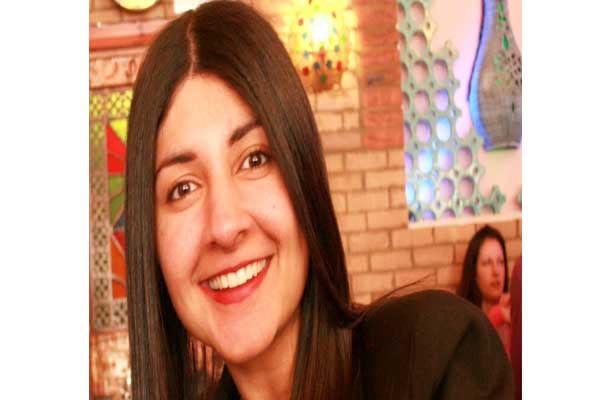
Tehmina Kazi took up the position of Director of British Muslims for Secular Democracy in May 2009. Prior to joining BMSD, she was a Project Officer at the Equality and Human Rights Commission, where she worked on a ground-breaking inquiry into the Human Rights Act and its impact on public service delivery, undertaking research, writing policy briefings, facilitating focus groups and interviewing victims of human rights violations.
But while there may be no official remembrance activities, there are many whose lives and passion for democracy and freedom are living memorials to the July 7 victims, and whose efforts represent a new hope for the United Kingdom in the struggle of ideas.
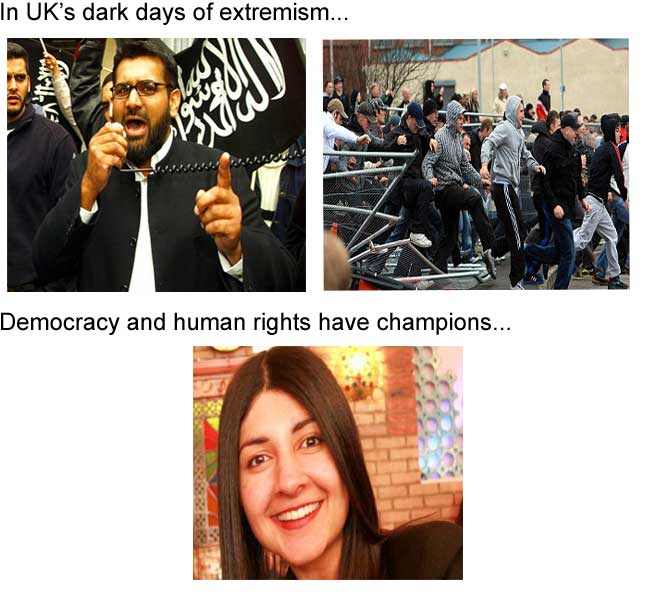
We have been seeing increasing signs of hope and progress among British Muslims who are taking the lead in supporting secular democracy and human rights as a counter-message to extremists who seek to deny democracy and human rights. While some analysts believe that fighting terrorism can be measured by tactical achievements or failures, Responsible for Equality And Liberty (R.E.A.L.) believes that solutions will come from a consistent support for democracy and our universal human rights from the public, including British Muslim and pro-human rights groups in the struggle of ideas.
While groups such as Anjem Choudary’s Islam4UK and the Hizb ut-Tahrir United Kingdom groups denounce democracy and equality, and on the other extreme, groups such as the English Defence League and the Stop Islamisation of Europe groups are protesting Muslim houses of worship, there are alternatives from those such as the BMSD and its supporters who provide an example in consistent support of democracy, human rights, and human dignity for rest of the United Kingdom and the world.
We urge others in the United Kingdom to follow the example of groups such as BMSD and choose to consistently be responsible for equality and liberty.
The British Muslims for Secular Democracy (BMSD) has issued a press release on its views supporting the barring of Imam Zakir Naik from the United Kingdom. BMSD stated that “British Muslims for Secular Democracy (bmsd) approves of the decision to exclude Zakir Naik from the UK, based on thorough research conducted by the Home Office,” stating that many of Zakir Naik’s “statements are not conducive to the public good. For example, he made this remark on Osama bin Laden in 2006: ‘If he is terrorising the terrorists, if he is terrorising America the terrorist, the biggest terrorist, every Muslim should be a terrorist.’ bmsd supports rigorous application of the exclusion policy to any international speaker who incites hatred and violence. However, it is also vital that the Home Office are consistent in their application of a tool as powerful – and potentially controversial – as exclusion. ”
Responsible for Equality And Liberty (R.E.A.L.) reported on May 31, 2010 on the plans of Zakir Naik to visit the United Kingdom and his history of promoting views that seek to encourage others to deny religious freedom.
In October 2009, BMSD challenged the anti-democracy organization Islam4UK and its planned “Sharia law” march in London. BMSD stated that “Our protest against Islam4UK is based on our belief in, and commitment to, those liberal values that define the British state. This includes legal and constitutional equality for all, equal rights for women and minorities, and religious freedom, including the right to be free of faith.” In December 2009, BMSD led a counterprotest against the further efforts of the anti-democracy organization Islam4UK.
In November 2009 and December 2009, BMSD was critical of the efforts of the Stop Islamisation of Europe (SIOE) organization goals to have protests outside the Harrow Central Mosque, stating that “fear-mongering and misinformation whipped up by these demonstrations poses a threat to all British citizens who wants to live in a harmonious society.” In BMSD’s letter to SIOE, it stated that “By demonstrating outside a mosque under the banner, ‘Stop the Islamisation of Europe,’ ordinary peace-loving British Muslims end up feeling threatened and have begun to believe that their fundamental right to practice their religion is being curtailed. In any case, Harrow is an exemplar of good community relations, facilitated by strong communication and co-operation between different faith communities and various agencies such as the police and the local council. Our Director Tehmina Kazi can testify to this, as she has lived in Harrow for over 20 years. Individuals affiliated with Harrow Central Mosque joined our counter-protest against Al Muhajiroun and their leading members wholeheartedly support the merits of secular democracy alongside bmsd. Your campaign is also fuelling the notion that somehow organisations such as SIOE are against all Muslims and the religion Islam in itself. This is being used by the extremist elements within Muslim communities to enhance their recruitment.”
— “Raise awareness within British Muslims and the wider public, of democracy particularly ‘secular democracy’ helping to contribute to a shared vision of citizenship (the separation of faith and state, so faiths exert no undue influence on policies and there is a shared public space).”
— “Encourage religious understanding and harmony, respect for different systems of beliefs, and encourage an understanding and celebration of the variety of Muslim cultures, values and traditions which are present in British society.”
BMSD states that it seeks to achieve these aims by:
— “Facilitating discourse and raising awareness of democracy particularly ‘secular democracy’ and its benefits.”
— “Facilitating broad and enlightened theological discourses, to enable British Muslims and the wider public to be better informed about the Islamic faith.”
— “Raising awareness of religious influence on UK domestic and foreign policies, particularly those which may lead to undue effect on civil liberties.”
— “Addressing Islamophobia and prejudice against Muslims and Muslim communities.”
— “Working with UK and global Muslim and other organisations, opposing radicalism and intolerant beliefs.”
— “Ensuring that politicians and community leaders encourage and practise transparency and ensure legitimate voting practices are followed.”
— “Engaging with marginalised Muslim communities, helping to identify root causes of deprivation and social exclusion, and help work towards a solution.”
— “Providing a lively and interesting social/educational programme which showcases the variety of Muslim histories, cultures, values and traditions in the UK today.”
— “Be responsive to the changing needs and pressures on succeeding generations of British Muslims and adjust and add to its programmes and projects accordingly.”
“British Muslims for Secular Democracy (bmsd) approves of the decision to exclude Zakir Naik from the UK, based on thorough research conducted by the Home Office. Dr Naik is a high-profile figure who has been elevated to a position of power and influence, and many of his statements are not conducive to the public good. For example, he made this remark on Osama bin Laden in 2006: ‘If he is terrorising the terrorists, if he is terrorising America the terrorist, the biggest terrorist, every Muslim should be a terrorist.'”
“bmsd supports rigorous application of the exclusion policy to any international speaker who incites hatred and violence. However, it is also vital that the Home Office are consistent in their application of a tool as powerful – and potentially controversial – as exclusion. ”
“Dr Shaaz Mahboob, Vice-Chair of bmsd, said: ‘This is an encouraging decision from the new Government. We would now like to see them take a similarly firm approach to far-right organisations that stir up racial hatred, and domestic extremists such as the newly-formed ‘Muslims Against Crusades,’ who hurled abuse at the Royal Anglian Regiment homecoming parade in Barking on 15th June 2010.’ ”
Notes to the editors:
“1. bmsd is made up of a group of Muslim democrats of diverse ethnic and social backgrounds, who support a clear separation between religion and the State.”
“2. bmsd’s mission statement: ‘To promote civic engagement, social inclusion, responsible citizenship and good governance particularly within constituent Muslim communities of Britain; in order to build an understanding of the shared values between all citizens to enable them to live in an inclusive, pluralist, secular and confident Britain.'”
“3. bmsd claims no mandate or false representative status. Our primary concern is democratic engagement not detailed theological analysis or debate. The level and depth of commitment to the doctrinal core and orthodoxy of the faith varies among Muslims as much as it does in members of other faith groups. bmsd founders wish to create a platform for alternative, diverse Muslim views, essential for a progressive, multi-layered, democratic identity that is not in conflict with itself or fellow citizens.”
“4. For details please visit http://www.bmsd.org.uk ”
Freedom of speech includes freedom to offend – but when a preacher’s words incite violence, there has to be some sanction
British Muslims for Secular Democracy (BMSD)'s Tehmina Kazi
“What do Dr Zakir Naik, Russian skinhead Pavel Skachevsky, far-right US talk show host Michael Savage, former Kahane Chai leader Mike Guzovsky and Kansas Baptist pastor Fred Phelps have in common? They are all on the list of people who have been banned from entering the UK.”
“Several commentators, like Inayat Bunglawala last week, have asked exactly what Naik has done to deserve such company. A quick internet search of his public statements throws up the following: ‘You heard the Muslims saying Osama Bin Laden is right or wrong. I reject them … We don’t know. But if you ask my view, if this is the truth, if he is fighting the enemies of Islam, I am for him. I don’t know what he’s doing. I’m not in touch with him. I don’t know him personally. I read the newspaper. If he is terrorising the terrorists, if he is terrorising America the terrorist, the biggest terrorist, I am with him … The thing is, if he’s terrorising a terrorist, he’s following Islam.’ Other incendiary remarks include: ‘Muslims in India would prefer the Islamic criminal law to be implemented on all Indians since it is the most practical’, ‘The Jews, by nature as a whole, will be against Muslims’, (Western Mail, 16 August 2006) plus an assertion that western women make themselves more susceptible to sexual assault by wearing revealing clothing.”
“While it is evident that most of Naik’s views are out of step with the values of any 21st-century liberal democracy, this in itself does not provide sufficient justification to exclude him from the UK. As Lord Justice Sedley stated in the notable high court judgment Redmond-Bate vs Director of Public Prosecutions [1999]: ‘Free speech includes not only the inoffensive, but the irritating, the contentious, the eccentric, the heretical, the unwelcome and the provocative, providing it does not intend to provoke violence. Freedom only to speak inoffensively is not worth having.’ Incitement to violence is a crucial caveat of this fundamental principle, and forms the basis of the Home Office’s ‘unacceptable behaviour’ policy. Proscribed actions on the list include the glorification of terrorism, provoking others to commit terrorist or criminal acts, and fostering hatred which might lead to inter-community violence within the UK. Therefore, the most problematic of Naik’s statements are the ones that appear to condone violence: ‘If a Muslim becomes a non-Muslim and propagates his/her new religion then, it is as good as treason. There is a ‘death penalty’ in Islam for such a person.’ Naik’s supporters have cited his freedom of speech as a reason for overturning this exclusion order, but would he take a similar stance if a famous ex-Muslim chose to convene a speaking tour in Pakistan, for example? Further, Najibullah Zazi, who was arrested in September 2009 for planning suicide attacks on the New York subway, is said to have become ‘enchanted’ with Zakir Naik before planning his attack.”
“My organisation, British Muslims for Secular Democracy, supports rigorous application of the exclusion policy to any international speaker who incites hatred or violence. However, it is also vital that the Home Office is consistent in its application of a tool as powerful — and potentially controversial — as exclusion. To its credit, the Home Office made a statement on Geert Wilders clarifying its position, after the Asylum and Immigration Tribunal overturned the ban on his entry to the UK in October 2009. Contrary to popular opinion, it wasn’t the Home Office but the tribunal that allowed Wilders into the country.”
“Supporters of Naik have jumped to his defence by claiming that his more controversial statements, like ‘Every Muslim should be a terrorist’, should be viewed in their proper context: ‘Every Muslim should be a terrorist. A terrorist is a person who causes terror. The moment a robber sees a policeman he is terrified. A policeman is a terrorist for the robber. Similarly every Muslim should be a terrorist for the antisocial elements of society, such as thieves, dacoits and rapists. Whenever such an antisocial element sees a Muslim, he should be terrified. It is true that the word ‘terrorist’ is generally used for a person who causes terror among the common people. But a true Muslim should only be a terrorist to selective people ie antisocial elements, and not to the common innocent people. In fact, a Muslim should be a source of peace for innocent people.'”
“This semi-clarification of ‘antisocial elements’ is all well and good, but what Naik fails to elucidate is exactly who the ‘common innocent people’ are. One would imagine that based on his other pronouncements, they don’t include apostates or gay people. In any case, such defences of Naik entirely miss the point. As a medical doctor and speaker whose lectures on Peace TV are broadcast to millions of Muslims across the world, he is in an incredibly powerful position. Therefore, he must bear total responsibility for every single word that leaves his lips (or his keyboard). Not only should Naik and other religious leaders be extremely careful with the terminology they use (as per the Qur’anic injunction, ‘Invite (all) to the way of thy Lord with wisdom and beautiful preaching; and argue with them in ways that are best and most gracious’), they should be prepared for any criticism that comes their way if certain individuals cite them as ‘inspirations’ and take their more controversial statements too literally. Many of Naik’s supporters point to his remarks condemning 9/11 and 7/7, but nothing less than a clear and consistent repudiation of the quotes mentioned in this article will do.”
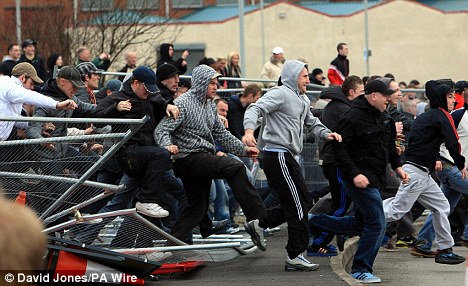
In the United Kingdom, we are concerned about the recent protests and violence by protesters among the English Defence League (EDL) on April 3 and on May 2, 2010, and their efforts to block the mosque in Dudley. While the EDL is pleased with their success in blocking the creation of a mosque in Dudley, the larger question that must be asked is what is the message the EDL is sending to the world on British commitment to freedom of religion?
Clashes: English Defence League protesters break through barriers during a demonstration through the streets of Dudley (Photo: Daily Mail/PA Wire - David Jones)
On May 28, 2010, the UK Guardian newspaper also reported on plans for future EDL protests at “Muslim centers,” including East London Mosque, Tower Hamlets, and Bradford this summer. The May 28 reports highlight a growing sense of anti-Muslim hatred, rage, and violence which is growing in the United Kingdom and which is targeting Muslims and Islamic houses of worship.
The UK Guardian reports and videos on an “undercover investigation” of the EDL shows supporters calling for hate against all Muslims, with chants such as “We All Hate Muslims,” use of racial slurs and profanities, and threats. The reports allege that the EDL is increasingly becoming infiltrated with others who hate, including Skinheads, Combat 18 Nazis, and other racists. Hate attracts hate.
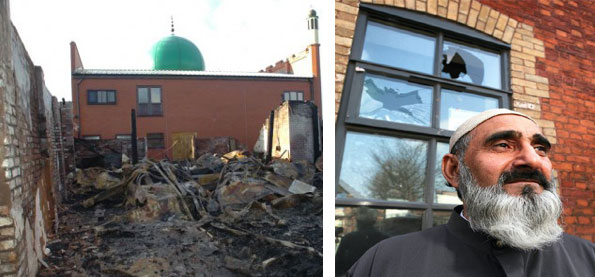
UK Mosque in Cradley (Photo: Express & Star) -- UK Mosque in Eccles (Photo: Manchester Evening News)
Any struggle or protest against religious extremism that uses hate and violence, attacks houses of worship, and attacks all individuals of one identity group without respect to diversity and individual views, is nothing less than a mirror image of another form of religious extremism.
Another group in the United Kingdom and Europe that is protesting mosques is the “Stop Islamization of Europe” (SIOE) group. The slogan of the SIOE group is that “Islamophobia is the height of common sense.” In the United Kingdom, the SIOE has had two protests in front of Harrow Central Mosque in September 2009 and December 2009. In the September 2009 SIOE protests at the Harrow mosque, there was violence between supporters and counter protesters, as SIOE protest supporters went to the mosque chanting “Muslims out.” In the December 2009 SIOE protest at the Harrow mosque, the SIOE reportedly refused the opportunity to dialogue with leaders of the Harrow mosque.
Responsible for Equality And Liberty (R.E.A.L.) shares the concern of challenging those who support abuse against women or any abuse of our universal human rights. But we understand that two wrongs do not make a right, and that seeking to protest houses of worship is not the way to gain the support of others on human rights issues. In fact, protesting houses of worship is a sure way to attract those committed to hate and violence.
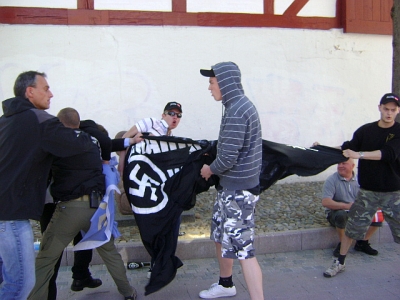
According to TV2 NORD, the Nazi DNSB group sought to raise its own banner with the Nazi swastika as part of its participation in the SIOE / SIAD protest against the Aalborg mosque. An embarrassed SIOE leader Anders Gravers then sought to remove the Nazi swastika banner from the protest march, which led to a scuffle.
Denmark: SIOE/SIAD March "No Mosque in Our Streets" Leads to Support by and then Confrontation with Denmark Nazi Group when Nazi Swastika Banner Raised
Certainly, anyone who has ever been involved with a public activity or protest is aware of the challenges of unwelcome participants who may seek to “hijack” an event. However, the lesson that SIOE should have learned is that its messages that “Islamophobia is the height of common sense” and “no mosques in our streets” are viewed as messages that Nazi groups can support. This is why those who challenge religious extremist and anti-human rights activities must have a human rights message, human rights leadership, and human rights consistency, that groups like the SIOE and the EDL will never offer the public.
What has the SIOE learned from this humiliating experience? Has it learned not to promote “Islamophobia”? Has it learned that hate only attracts hate? Has it learned that human rights issues cannot be addressed by promoting intolerance and hate? Unfortunately, all that the SIOE has learned is that it needs to have another protest against the Aalborg mosque because the May 21 march was not satisfactory. Like the EDL, the SIOE also has other protests against mosques planned for the summer of 2010, which it calls “hatecentrals,” while they cannot recognize the hatred in their own activities. SIOE plans another protest against a mosque in Copenhagen on August 28, 2010.
SIOE’s leader Anders Gravers, whose Denmark event attracted the support of the Nazi party, will also be coming to America to join in a New York City protest on June 6, 2010 against a mosque in NYC.
Human Rights Begins with Human Freedoms
Both the EDL and the SIOE groups claim to be protesting such existing and planned mosques to protest “radical Islam,” and in the case of the SIOE on behalf of “democracy.”
But who is the “radical” when they seek to stop others from having freedom of worship? What are the “democratic” values in seeking to intimidate others from seeking the right to believe at mosques? How can anyone be promoting human rights by seeking to deny freedom of conscience at a house of worship?
Since many such protesters claim to be Christian, what type of example do they think they are setting for those oppressed Christians in other parts of the world whose churches are regularly protested, worship services disrupted, worshipers attacked, and even churches targeted for terrorism? Are they determined to prove that they can be just as intolerant and disrespectful of our universal human rights regarding other people’s freedom of religion?
There is no caveat to these inalienable human rights, no asterisks, no qualifiers. Those who promote religious extremism of any kind may not respect these inalienable human rights. But those who reject, disrespect, and defy such universal human rights do not change the rights of all people, everywhere to such universal human rights.
If we are to defend such human rights, we must be consistent in our convictions for all people, not just for some people. We don’t have to like others, agree with others, or support other faiths – to recognize that the only way to fight for human rights is to be consistent in defending human freedom for all people, everywhere. People that we like and people like us are not the only ones with a right to believe and a right to freedom of worship. People we don’t like and disagree with have a right to believe. We either support universal human rights or not – there is no “relative” human rights just for some people, some times, in some places. But remember, even if we choose not to support such universal human rights, all people will still be entitled to them.
“British Muslims for Secular Democracy (BMSD) is alarmed and disappointed to learn that the extremist group Al Muhajiroun, in the guise of ‘Islam4UK,’ are planning to hold a procession through the streets of Wootton Bassett. This choice of venue is deliberate and designed to cause maximum offence and distress — particularly to the friends and families of fallen servicemen.”
“The vast majority of British Muslims — irrespective of their diverse views on particular armed conflicts — recognise that British soldiers continue to serve admirably in difficult circumstances, to make our country safer for all.”
“We deplore the politicisation of Wootton Bassett by reactionary political leaders, including Nick Griffin’s attempt to hijack a homecoming service last year to promote the BNP. We equally oppose this stunt by ‘Islam4UK,’ a group which organised a ‘Magnificent 19’ Conference in the immediate aftermath of 9/11 to praise the suicide murderers.”
BMSD will therefore write to “Islam4UK” later this week, urging them to cancel their protest and respect both the neutrality and military tradition of Wootton Bassett. In the event that ‘Islam4UK’ decides to proceed with its demonstration, BMSD plans to arrange a counter-protest along with a broad coalition of our partners.”
“Dr Shaaz Mahboob, Vice Chair of BMSD, says: “We stand shoulder to shoulder with the people of Wootton Bassett and the Armed Forces. The vast majority of British Muslims accept our Armed Forces are doing an admirable job under exceptionally difficult circumstances. It is only because of the sacrifice of these brave soldiers that extremists like ‘Islam4UK’ are able to protest freely. Anjum Choudary and his followers betray everything this country stands for and the very constituency they claim to represent, which is ordinary British Muslims. We plan to hold a counter-protest to demonstrate that ordinary Muslims are deeply opposed to the values of Islam4UK.”
[End]
“For details please visit http://www.bmsd.org.uk
For any further queries, please contact: Dr Shaaz Mahboob on shaaz@bmsd.org.uk or 07961365751 or Tehmina Kazi on 0207 631 4175”