America’s Forgotten Poor and the Need for Mercy

In the many struggles for human rights, dignity, and social justice around the world, too many are ready to forget about America’s poor and struggling.

If we prioritize mercy in our lives, we must open our hearts, our lives, our wallets, and our arms to all of our brothers and sisters who struggle to achieve human rights, dignity, and social justice anywhere in the world, including in the United States.  As our human rights are universal, so our compassion of mercy must also be universal to people of any identity group, any age, any gender, any race, any religion, any nationality.  The members of the human race are our brothers and sisters – all of them.

There are many struggling, some that we know, and some that we do not know.  All of them deserve our mercy, whatever help we can give, our encouragement, our prayers, and our respect as fellow human beings.  Our cause, our mission, must be a mission of mercy for all.  That is the heart of humanity that calls  for universal human rights for all.

In the political world, there are those find the battle over helping those struggling to be more important than merciful respect and caring for those who are struggling.  We must use political means in our government to pass laws and to take government action.  But every solution for human rights, dignity, and social justice begins with a human rights mission of mercy to help our fellow human beings – not because it is the politically correct thing to do, but because it is the right thing to do as fellow human beings.

In September 2011, the U.S. Census Bureau released a report that states that 15 percent are living in poverty conditions in America today.  The Associated Press goes on to report on people of all ages struggling to survive, one family in New Mexico after a husband lost his job at McDonalds, how they ended up living in homeless shelter.  It reports of elderly struggling to survive in trailers in rural America.

One in six of America’s elderly faces hunger and poverty.  As women statistically live longer than men, I have no doubt that this also means a number of struggling elderly women.

More than 1 in 5 children in America are living in poverty

— Significant racial minority poverty remains – Black Americans have a poverty rate of 27.4 percent, followed by people of Hispanic origin at 26.6 percent

There are numerous reports on poverty and homelessness in America.  That too is a human rights issue, as our human rights issues are to extend mercy and rights to all.

It may surprise some to know that most in America (51.4 percent) will live in poverty at some point in their lives.

In my own experience over many years, I have seen first hand the struggles of the homeless and the poor in America.  I thought I knew a great deal about poverty in America.  But over the past year, I have had to travel to many poor and rural parts of this nation.  I learned that I knew nothing about the degree of poverty in America.  Things are much, much worse than I thought I knew.

Some have wondered where I have been in gathering the press for global human rights events, over the past year.

I have been traveling, and I have been with the poor in this nation, hearing their struggles, listening to their pain, visiting their homes, and seeing the conditions in which they are forced to live.  I have been hearing the struggles of the elderly, I have been hearing the struggles of the young, and I have been hearing of the abuse of women of all ages in this nation.  I have been hearing how their conditions of poverty impacts their human rights and dignity.   In many areas of our nation today, the situation is dire, grim, and frightening.

I can understand how some can believe that these are not real human rights issues, they are not real women’s rights issues, they are not real children’s rights issues, they are not really an assault on human dignity and rights.  This is not Darfur, the Congo,  the struggles of religious minorities in Pakistan, Egypt, and elsewhere, the struggle for women’s rights in Saudi Arabia and other parts of the world, the struggles for rights and dignity in Communist China.  Some may wonder why Americans are complaining about such financial issues, when by outward appearance of some of the most affluent parts of America, there appears to be no problems.

But they have not seen what I have seen in America today.  They have not seen the frightening living conditions and inability of people to exercise their human rights, their freedom of speech, and the ability to get an education due to stark conditions of dire poverty in many parts of America today.   They have not seen the rats running in inhuman living conditions.  They have not seen the shacks in the woods that people are desperately clinging to so that they can survive.   They have not heard the cries of the cold, the hungry, the frightened, the hopeless, and the oppressed in many parts of America.

They have not heard the tears and the voices of women forced into sexual service so that they can be permitted to live in such shacks and horrible conditions in parts of America.   Like other parts of the world, here too in America we must also address the conditions of women whose human rights and human dignity are being systematically denied.

Like other parts of the world, these Americans too hope to get an education some day.   Like other parts of the world, these Americans too hope to have the right to live without fear of oppression from those who would seek to deny them their freedom of speech.  Like other parts of the world, these Americans too deserve our mercy, our compassion, and our respect.

We must address the poverty of human rights in America and around the world.

But we also must not ignore the poverty of existence that so many face daily in America and around the world, a poverty that makes it virtually impossible for many to exercise such human rights and a poverty that allows oppressors to deny them human rights.

In America, some would make light or political debates over such issues, but our brothers and sisters are genuinely suffering, and we must offer compassion, dignity, respect, and hope.

In America, however, some believe that this is a political issue, not a human rights or a human dignity issue.

It begins with a consistent commitment to MERCY.

On October 30, 2011, the widely-read and famous cartoonist Gary Trudeau published in his Doonesbury column in the Washington Post and other newspapers, a cartoon with a cartoon character which he states represents FOX News who states “America’s poor are like none before them.  Our poor can afford cable.  Over 25% have a dishwasher.  Many are fat, so you know they get enough to eat.  And they can get free health care at any emergency room!  Fact is, this country has the most pampered poor on the Earth – the envy of the rest of the world!”  Mr. Trudeau is known for his politically-oriented cartoons.

I am sure Mr. Trudeau  had a reason for his cartoon, and was seeking to be ‘satirical” or “funny,” and to pointedly mock FOX News.  I can see that perhaps Mr. Trudeau thought this would be shocking to some.  However, in America today, there are too many who would believe such an attempt at satire as truth.   Still the problem is not with FOX News, it is not with “Republicans” or the “right” as so many would have it.  It is not with corporations.   While America is suffering, the answers will not be found in pointing fingers, debating politics, and mocking others.

Addressing America’s poverty problem must being with our hearts first and our call for mercy, help, and support for all those suffering – from every group, from every political spectrum, and from any source.  We must remind others that we are all brothers and sisters in humanity – and we share the responsibility for equality and liberty.

We may have different approaches to solving the problem of poverty for different groups, families, and individuals.  But if we can address the truth of our shared respect and dignity for all human beings, we will begin to prioritize what really matters in our lives, in our groups, in our communities, in our laws, and in our government.

This is the challenge of viewing of fellow brothers and sisters in humanity through a political perspective versus a human rights perspective.

Americans, of all ages, the elderly, entire families, women, children, are suffering, struggling in America today.  There is nothing to satirize about that struggle, and there is nothing political about that struggle.

We will lead the struggle to help our brothers and sisters with our hearts and hands first. With our commitment to show such respect for others, the political answers will follow.  Our human rights answer must begin with Mercy. We must never forget those who continue to suffer in America, and our hearts need to go out to our brothers and sisters in America today.

Choose Love, Not Hate, Love Wins.

Choose Love, Not Hate - Love Wins

America as a Haven for Religious Freedom

Responsible for Equality And Liberty (R.E.A.L.) supports our universal human rights of religious freedom, freedom of conscience, and freedom of worship for all people.  R.E.A.L. rejects hatred and rejects the activities of those who seek to promote hatred towards identity groups and specific religions.

There are some today in America that have forgotten what America has meant as a haven for religious freedom, which is why our equality and liberty for all is one of the “truths we hold self-evident” in the defining declaration of what it means to be an American.

Fortunately, the United States Library of Congress provides an online exhibit called “America as a Religious Refuge: The Seventeenth Century,” to remind us of the historical importance as to why the United States Constitution and American law has sought to defend such freedom of religion.

The Library of Congress points out that “The religious persecution that drove settlers from Europe to the British North American colonies sprang from the conviction, held by Protestants and Catholics alike, that uniformity of religion must exist in any given society. This conviction rested on the belief that there was one true religion and that it was the duty of the civil authorities to impose it, forcibly if necessary, in the interest of saving the souls of all citizens. Nonconformists could expect no mercy and might be executed as heretics. The dominance of the concept, denounced by Roger Williams as ‘inforced uniformity of religion,’ meant majority religious groups who controlled political power punished dissenters in their midst. In some areas Catholics persecuted Protestants, in others Protestants persecuted Catholics, and in still others Catholics and Protestants persecuted wayward coreligionists.”

“Religious persecution, as observers in every century have commented, is often bloody and implacable and is remembered and resented for generations.”

“Many of the British North American colonies that eventually formed the United States of America were settled in the seventeenth century by men and women, who, in the face of European persecution, refused to compromise passionately held religious convictions and fled Europe. The New England colonies, New Jersey, Pennsylvania, and Maryland were conceived and established ‘as plantations of religion.'”

Those who fled Briton and Europe to the United States to avoid religious persecution were from a broad range of religions and religious backgrounds.  America served as a haven for such religious freedom for them.

The question Americans must ask is will we abandon the legacy and history of religious freedom guaranteed in our Constitution, as well as the freedom of worship and freedom of conscience that all deserve?   We urge all Americans, instead to support our Constitutional freedom and universal human rights.  Be Responsible for Equality And Liberty.

Join us in Washington DC at Freedom Plaza to stand up for our freedoms for on September 11, 2010.

We must never forget, as Americans where America’s first settlers came from, and why we made a decision to change the world by declaring our inalienable human rights of equality and liberty – for all – including freedom of religion, freedom of worship, and freedom of conscience.

Note that all images are credited to the Library of Congress.
http://www.loc.gov/exhibits/religion/rel01.html

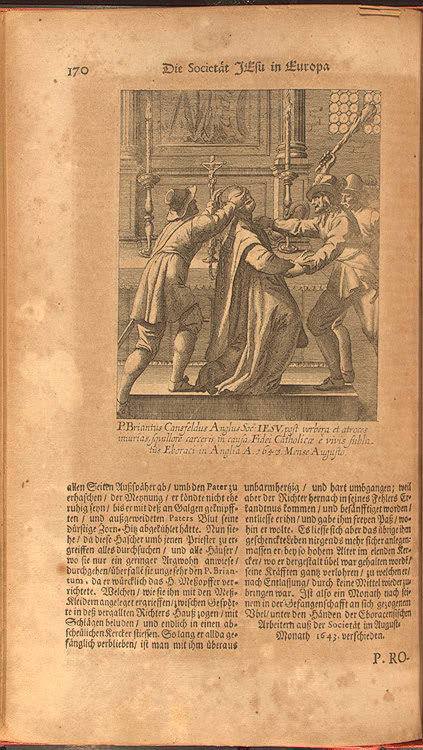
Persecution of Jesuits in England
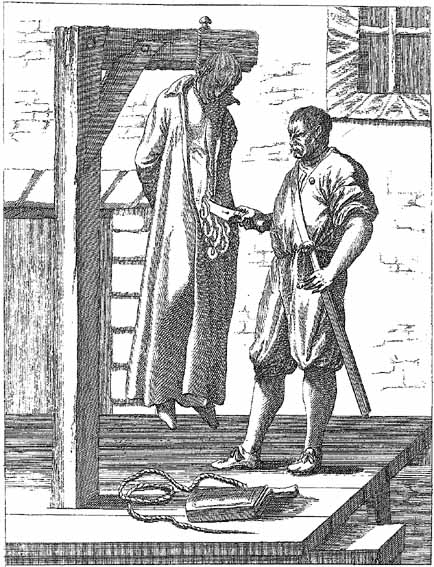
Persecution of Jesuits in EnglandIn the image on the left is Brian Cansfield (1581-1643), a Jesuit priest seized while at prayer by English Protestant authorities in Yorkshire. Cansfield was beaten and imprisoned under harsh conditions. He died on August 3, 1643 from the effects of his ordeal. At the right is another Jesuit priest, Ralph Corbington (Corby) (ca. 1599-1644), who was hanged by the English government in London, September 17, 1644, for professing his faith. (LOC)
A Jesuit Executed for His Beliefs
A Jesuit Executed for His Beliefs - Jesuits like John Ogilvie (Ogilby) (1580-1615) were under constant surveillance and threat from the Protestant governments of England and Scotland. Ogilvie was sentenced to death by a Glasgow court and hanged and mutilated on March 10, 1615. (LOC)
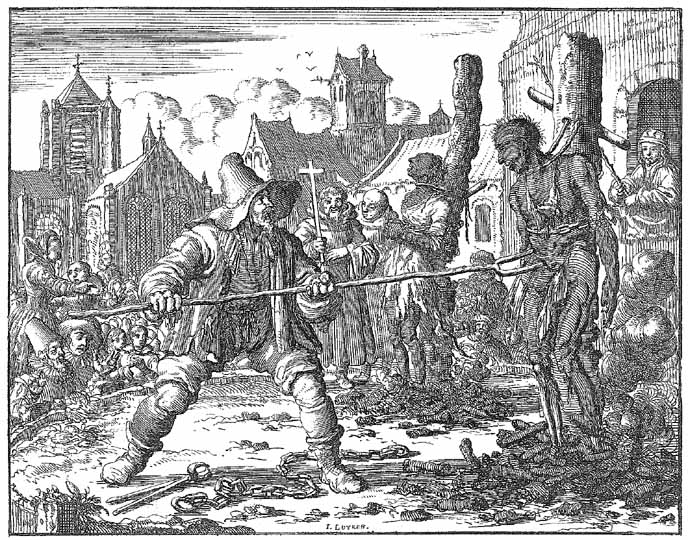
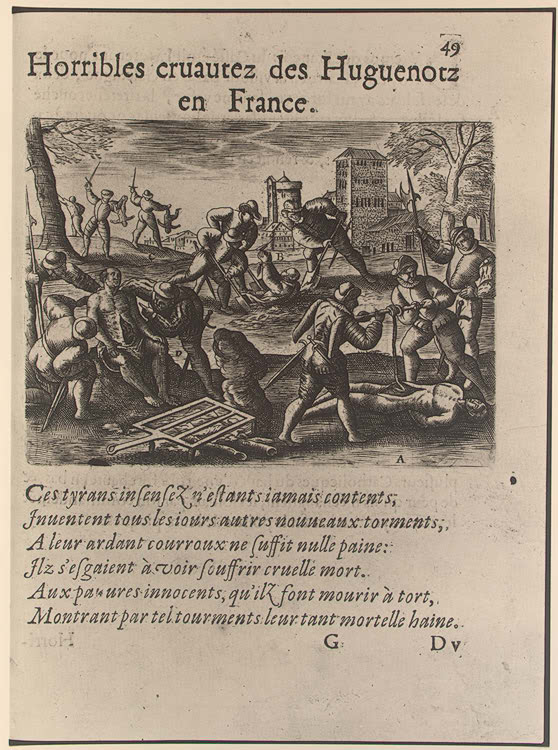
Execution of Mennonites
Execution of Mennonites - This engraving depicts the execution of David van der Leyen and Levina Ghyselins, described variously as Dutch Anabaptists or Mennonites, by Catholic authorities in Ghent in 1554. Strangled and burned, van der Leyen was finally dispatched with an iron fork. Bracht's Martyr's Mirror is considered by modern Mennonites as second only in importance to the Bible in perpetuating their faith. (LOC)
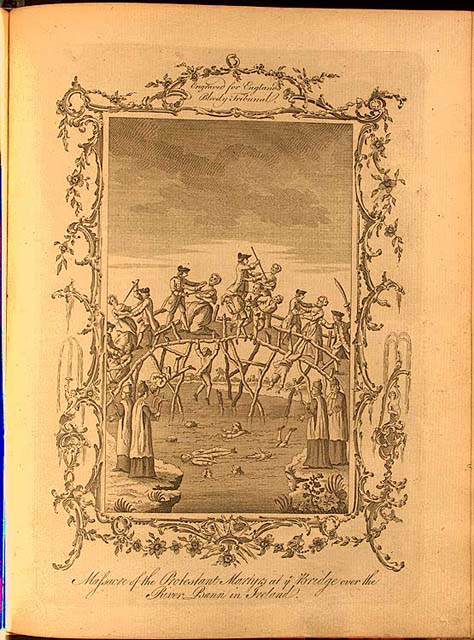
Drowning of Protestants
Drowning of Protestants - Shown here is a depiction of the murder by Irish Catholics of approximately one hundred Protestants from Loughgall Parish, County Armagh, at the bridge over the River Bann near Portadown, Ulster. This atrocity occurred at the beginning of the Irish Rebellion of 1641. Having held the Protestants as prisoners and tortured them, the Catholics drove them "like hogs" to the bridge, where they were stripped naked and forced into the water below at swordspoint. Survivors of the plunge were shot. (LOC)
Persecution of Catholics by Huguenots
Persecution of Catholics by Huguenots - In the areas of France they controlled, Huguenots at least matched the harshness of the persecutions of their Catholic opponents. Atrocities A, B, and C, depictions that are possibly exaggerated for use as propaganda, are located by the author in St. Macaire, Gascony. In scene A, a priest is disemboweled, his entrails wound up on a stick until they are torn out. In illustration B a priest is buried alive, and in C Catholic children are hacked to pieces. Scene D, alleged to have occurred in the village of Mans, was "too loathsome" for one nineteenth-century commentator to translate from the French. It shows a priest whose genitalia were cut off and grilled. Forced to eat his roasted private parts, the priest was then dissected by his torturers so they can observe him digesting his meal. (LOC)
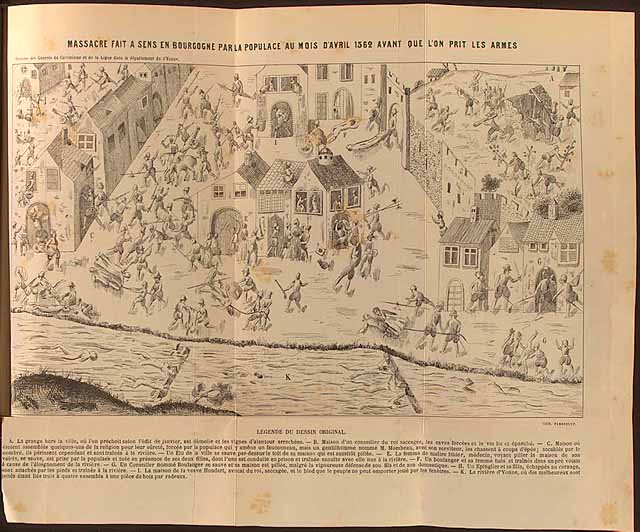
Persecution of Huguenots by Catholics The slaughter of Huguenots (French Protestants) by Catholics at Sens, Burgundy in 1562 occurred at the beginning of more than thirty years of religious strife between French Protestants and Catholics. These wars produced numerous atrocities. The worst was the notorious St. Bartholomew's Day Massacre in Paris, August 24, 1572. Thousands of Huguenots were butchered by Roman Catholic mobs. Although an accommodation between the two sides was sealed in 1598 by the Edict of Nantes, religious privileges of Huguenots eroded during the seventeenth century and were extinguished in 1685 by the revocation of the Edict. Perhaps as many as 400,000 French Protestants emigrated to various parts of the world, including the British North American colonies.  (LOC)
Persecution of Huguenots by Catholics - The slaughter of Huguenots (French Protestants) by Catholics at Sens, Burgundy in 1562 occurred at the beginning of more than thirty years of religious strife between French Protestants and Catholics. These wars produced numerous atrocities. The worst was the notorious St. Bartholomew's Day Massacre in Paris, August 24, 1572. Thousands of Huguenots were butchered by Roman Catholic mobs. Although an accommodation between the two sides was sealed in 1598 by the Edict of Nantes, religious privileges of Huguenots eroded during the seventeenth century and were extinguished in 1685 by the revocation of the Edict. Perhaps as many as 400,000 French Protestants emigrated to various parts of the world, including the British North American colonies. (LOC)
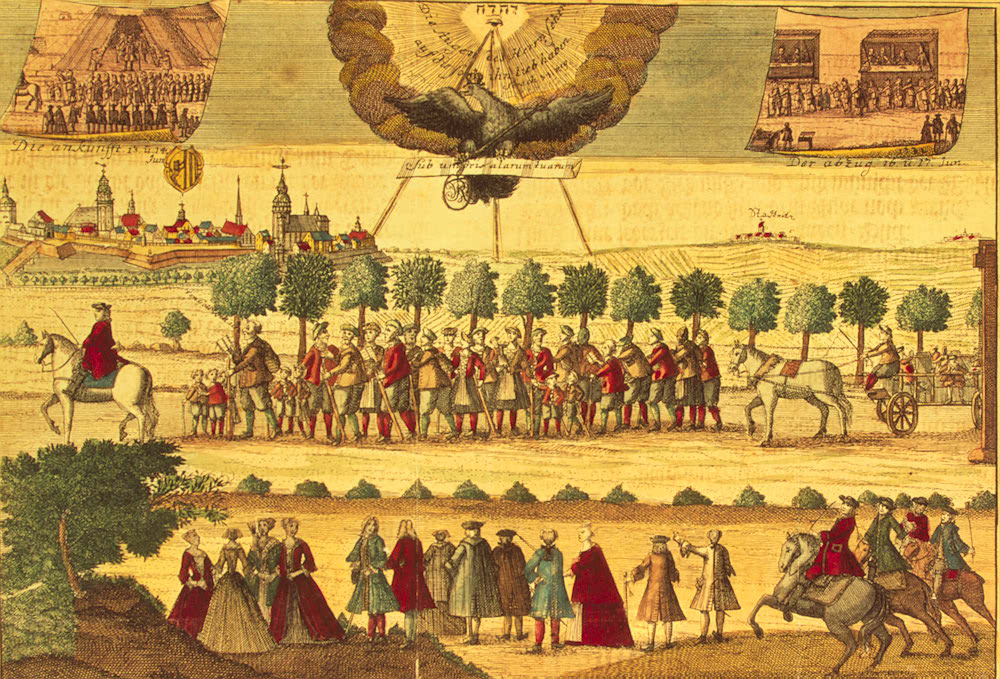
Lutherans Expelled Who Flee to America - The Expulsion of the Salzburgers - On October 31, 1731, the Catholic ruler of Salzburg, Austria, Archbishop Leopold von Firmian, issued an edict expelling as many as 20,000 Lutherans from his principality. Many propertyless Lutherans, given only eight days to leave their homes, froze to death as they drifted through the winter seeking sanctuary. The wealthier ones who were allowed three months to dispose of their property fared better. Some of these Salzburgers reached London, from whence they sailed to Georgia. Others found new homes in the Netherlands and East Prussia.

==================================

religious-freedom-matters

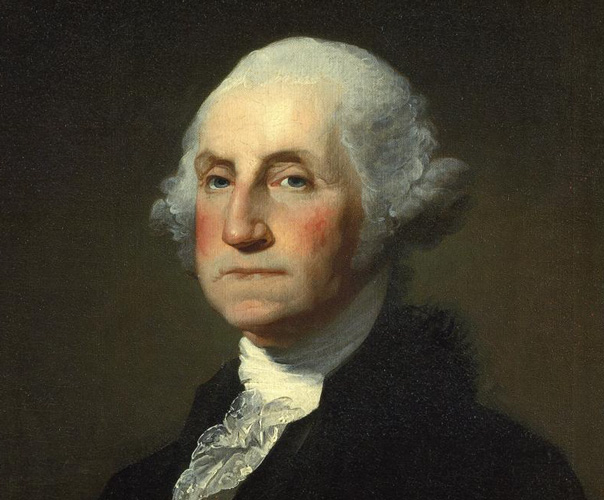
George Washington Quoted on Religious Liberty and Tolerance

During a visit to Newport, R.I., in 1790, a year before the Bill of Rights was ratified, President George Washington received a letter from Moses Seixas, warden of the Touro Synagogue.  President Washington replied, in part, to the the Touro Synagogue to state that:

August 1790 – George Washington: “The Citizens of the United States of America have a right to applaud themselves for having given to mankind examples of an enlarged and liberal policy: a policy worthy of imitation. All possess alike liberty of conscience and immunities of citizenship. It is now no more that toleration is spoken of, as if it was by the indulgence of one class of people, that another enjoyed the exercise of their inherent national gifts. For happily the Government of the United States, which gives to bigotry no sanction, to persecution no assistance requires only that they who live under its protection should demean themselves as good citizens, in giving it on all occasions their effectual support.”

— “May the father of all mercies scatter light and not darkness in our paths, and make us all in our several vocations useful here, and in his own due time and way everlastingly happy.”

United States President George Washington - 1789 - 1797
United States President George Washington - President: 1789 - 1797

=============================

Choose Love, Not Hate – Love Wins.