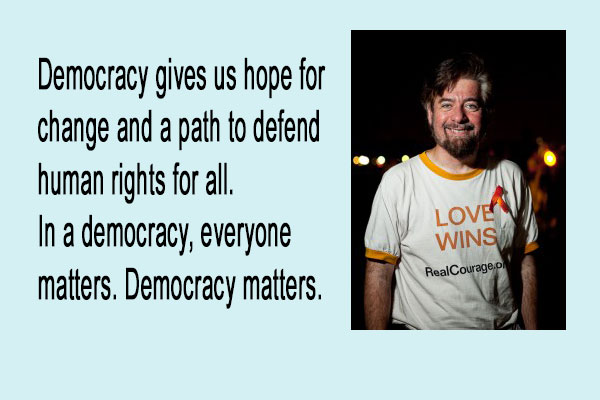
Democracy gives us hope for change and a path to defend the human rights for all. In a democracy, everyone matters. Democracy matters.
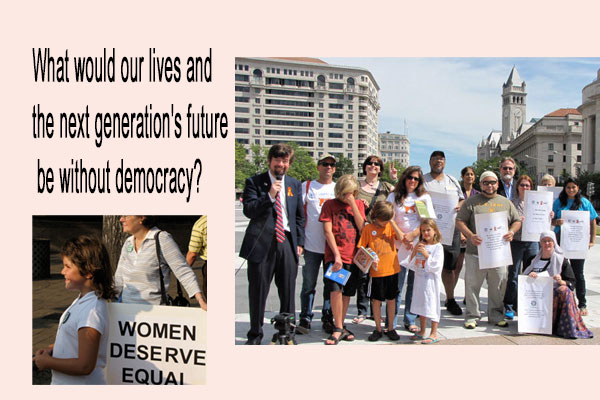
What would our lives and the next generation’s future be without democracy? Without the democratic ability to make our own decisions as free men and women, how can we defend our universal human rights of equality and liberty?
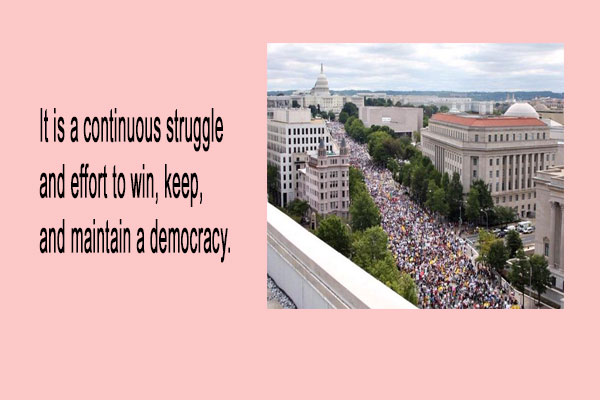
But the struggle for democracy is not one fight, not a single battle, one war for freedom, where victory is declared, and democracy is secured. It is a continuous struggle and effort to win, keep, and maintain a democracy. We need to continuously work to build a democratic society where the voices of the people can be heard, and where human rights for all are part of the democratic process. A “democracy” which does not respect the inherent human rights of others fails to understand that in a democracy EVERYONE MATTERS.
Democracies are not simply about majority votes. That is what majority oppressors with power would like the world to believe. That is what tyrants with an agenda want to people to believe, so they can deceive into accepting a dictatorship. They will attack the flaws of any individual democratic state and tell the world, “see this is what democracy leads to.”
The tyrants and the authoritarians take failures in democracies out of context. They only show the failures. They are silent about all the people trying to correct the failures. They don’t mention how people use their democratic freedoms to vote to promote change, to march for the rights of all, and how they protest together in the cause of democratic freedoms.
Tyrants particularly enjoy pouncing on the failures of democracy in America, which are widely publicized by Americans themselves (because they denounce such failures), and ignoring what people who love democracy seek to do to correct these failures.
In the tyrant’s propaganda against democracy, there is only slavery in America, without a Civil War; there is only Jim Crow laws, without a 15th Amendment to the Constitution; there is only denying women the right to vote, without a 19th Amendment to the Constitution; there is only Civil Rights challenges, without a Martin Luther King, Jr. and the generation that followed; there is only a failure to provide full Constitutional protection, without the campaign for Equal Rights Amendment (E.R.A.); there is only police abuse against African-Americans, without a campaign to hold law enforcement accountable and ensure that black lives and all lives matter.
Nor is this propaganda exclusive to denying democratic struggles in the United States of America. Tyrants will have similar half-truths in every other democratic country.
But the tyrants’ half-truths will only tell one side of the story. The goal of tyrants are to entice the discouraged, the disaffected, and those in despair from giving up on democracy altogether, but telling them only about democracy’s failures, and silencing discussion about democracy’s promise. The tyrants want people to give up hope on democracy and submit to their rule.
If there no other reason that compels you to struggle for democracy, take that vision to your heart. Can we be so selfish and heartless that we will not offer outstretched hands to bring back our brothers and sisters in despair on democracy from the clutches of tyranny? No, no. Those who love democracy know that our democratic freedoms and hopes are intended for everyone.
It is our responsibility to continue the struggle for democracy – for the generation today, and the the generations tomorrow.
Many don’t like the word “struggle.” It implies so much effort and work, and less of going with the natural flows in life. That’s right. It does and it is. While equality may be the natural law of humanity, we know that there have always been and will always be tyrants and bullies who seek to defy such natural law. We have seen the Dark Ages of the past, and it is our responsibility to help lead our society to the sunrise of a compassionate tomorrow.
Democracy must be compassionate. If in a democracy – everyone matters, then in a democracy – we must be compassionate to the suffering of our fellow human beings. How we can we believe they matter, if we don’t care about the suffering of others? Those who talk about democratic rights, but do not have democratic hearts, have lost sight of the meaning of democracy itself. They may know the tune, but they don’t understand the words or what they mean.
In our world today, our pace is so fast that we have often lost sight of compassion, of patience, and of kindness. We have forgotten that those too are part of our democratic ideals, if everyone matters. In a democracy, we must lead with our heart first.
We are rightfully an impatient people when it comes to abuses against our democracy and failures of our leaders. We may be frustrated and angry at those who would defy our democratic ideals. But even then, we must work for the democratic values of fairness and human rights for everyone – even those who do wrong. This doesn’t make us weak. It makes us stronger than any tyrant’s iron fist.
In today’s world, certainly there are many discouraged with our practices of democracy. But the greatest sign of the success of democracy are all the books and articles written by those who complain that it hasn’t yet met its goals, and complaining about its failures. Now THAT is democracy at work, that is the democratic freedom of speech, freedom of press, and freedom of expression that free men and women accept as part of their natural lives.
When we are discouraged, that is the most important time to channel our frustration into action. The greatest cure to democracy’s ills is the action by those who know that everyone matters and that democracy matters.
We may think democracy doesn’t need defenders, and that “someone else” will defend democracy. We may think that our individual passions, causes, and campaigns are more productive channels for our time and energy, because after all, everyone understands the need for democracy.
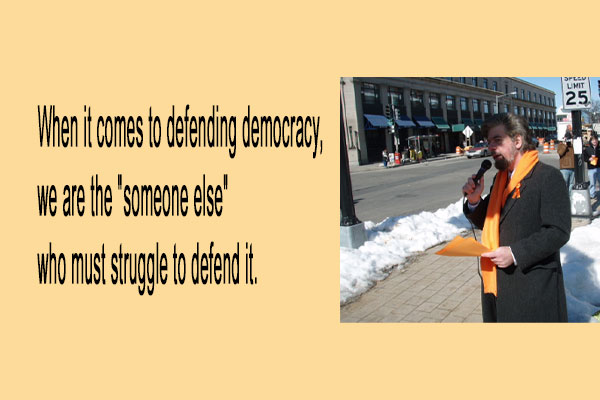
But that is not true. Our struggle for democracy itself is as essential as the air which we breathe. We cannot chose to wait for “someone else.” My brothers and sisters in humanity, when it comes to defending democracy, we are the “someone else” who must struggle to defend it. There is no cause more essential than democracy to freedom and our shared universal human rights.
In a democracy, we love our rights, but we must love our responsibilities even more. We cannot have human rights, without human responsibilities. When you stand for democracy, you are responsible for equality and liberty for your fellow human beings.
Sometimes you will need to take a stand on your own against those who seek the destruction of democracy. Remember you are never alone when you stand for democracy, equality, and liberty. Free man and women of the world stand behind you.
Today will be such a day for me. I need to stand alone against a determined foe of democracy. The extremist group Hizb ut-Tahrir (HuT) will be in the Washington DC suburb of Springfield, Virginia to recruit minds to persuade them to reject democracy. HuT is openly against democracy with a “No Democracy” campaign, and denial of human rights, rejection of women’s equality, and a goal to subjagate people under a religious dictatorship. But there are plenty of enemies of democracy. If it was not HuT, it would some other extremists against democracy. We must provide a challenge to those who seek the end to democracy.
In our busy, overwhelmed lives, it would be convenient to be silent in the face of the enemies of democracy. But if democracy matters for everyone, then does not democracy matter for those who seek to be recruited by tyrants?
The defense of democracy will not simply be made in air-conditioned conference rooms by people in business suits, and nicely organized meetings, who have their lunch catered.
No the defense of democracy must also be done on our feet, in the streets, when it is hard, when you can’t find a way or the time, and when it seems impossible. Free men and women don’t know the meaning of the word “impossible” in the defense of democracy.
We must continually struggle for democracy – because democracy matters for all of us. It is the foundation to defend our shared universal human rights. Democracy matters.
We must continue our struggle for democracy, because it is not just our rights that matter, it is also our shared responsibilities.
We are all responsible for equality and liberty.
And it is always another GOOD DAY to be Responsible for Equality And Liberty.
It must not be too controversial for dialogue on extremism to take a consistent stand and commitment on our shared universal human rights, or then we have missed the primary challenge. We will not defeat extremism with political compromise, but by unyielding commitment to our shared universal human rights – for everyone, for every religion, for every identity group.
Extremist violence begins with denying the human rights, dignity, and security of others. Weakness in ignoring this reality only gives strength to those who seek power through violence, rejecting those human rights which they believe have no defenders.
When we offer a “counter extremist narrative,” we must ask, and what is that narrative based on – if not our universal human rights? What would appeal to diverse extremists of different ideologies that would be effective, if it is not grounded in our shared universal human rights? The ideas of building awareness and seeking intervention of the problem of such violence makes sense, but if such intervention is not based on our shared human right rights, we must ask “based on what?”
The economic aspect of the countering violent extremism (CVE) summit is worthy of consideration for some, but it is not going to be the answer to many, and we must keep human rights as our top priority. The fact is that people who have “something to lose” are (in general) less attracted to extremist violence. People may have extremist views in private, but when they have a family to support, a job to keep, and community responsibilities, the appeal of extremist violence is countered by the practical realities of other responsibilities in their lives. It is true that jobs and economic opportunity won’t stop people from pursuing a path to terrorism domestically or globally, but such other responsibilities will provide a distraction for some.
However, we will not convince many extremists that on solution focused on “prosperity,” “progress,” and other general terms are going to cause them to stop pursuing extremist goals and activities. We must recognize that for those with a different view on human rights, our chief objective must be a counter argument that all of our shared human rights will suffer, if we are not consistent on human rights for everyone.
When we lead with a commitment to our shared universal human rights, we don’t need explanations of “nuances” in policies to challenge violent extremist activity. There is no nuance in the call for our shared universal human rights to challenge violent extremist behavior.
The United Nations’ Universal Declaration of Human Rights (UDHR), ratified in 1958, creates a written standards of human rights for the people of the world. The UDHR was followed by an international treaty, the International Covenant on Civil and Political Rights. These standards of human rights provide the international agreements to counter violent extremist behavior from any ideology and any part of the world. Our leaders need to be governing based on these standards, which they are consciously ignoring. Those nations which have not ratified such human rights standards need to be challenged as to why they will not accept such fundamental human rights for all people.
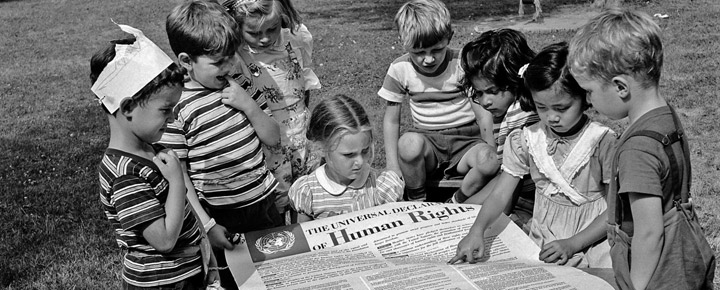
The Hope for Our Children Around the World - A Commitment to Our Shared Universal Human Rights (Source: United Nations)
While politicians typically focus on compromise, effective support of human rights requires consistency and sacrifice. Human rights campaigns are not a popularity contest, which appeals to politicians.
When we take a consistent stand on our shared universal human rights, the situation changes. We can challenge violent extremist activity by any ideology, because the activity is against our shared universal human rights. For example, from a human rights perspective, we must challenge both the terrorist activity by ISIS as well as the human rights abuses by Bashar al-Assad. Wrong is wrong, and our human rights matter in every instance.
A consistent stand is not the political one of making the “least bad choice,” but seeking support for shared human rights by all. If we really want to make change, if we really want to hear “grievances,” then this is where we start – consistency on our shared universal human rights.
It does not make sense for politicians and government leaders to extend an outstretched hand to groups known for extremist views, without urging them to support our shared universal human rights.
R.E.A.L. calls for a new summit, not of politicians, not of government leaders, but of individual leaders and identity group organizations to challenge violent extremist activity, who are willing to begin this discussion based on our shared universal human rights. R.E.A.L. calls for a summit based on support for our shared universal human rights, shared human dignity, and shared security.
We call for individuals and leaders to demand that our national leaders, our political leaders, and our representatives take a new view on challenging extremist activity, one where our share human rights is the focal point and the cornerstone, not swept aside as something we won’t talk about.
We call for national and global leaders to adopt and support the United Nations’ 1958 Universal Declaration of Human Rights (UDHR), and we call for leaders to use this as the basis to challenge and defy the ideologies of violent extremism in the United States of America and around the world.
The Universal Declaration of Human Rights is as relevant today as it was in the shadow of the atrocities by Nazi Germany, as described in its Preamble:
“Whereas recognition of the inherent dignity and of the equal and inalienable rights of all members of the human family is the foundation of freedom, justice and peace in the world,”
“Whereas disregard and contempt for human rights have resulted in barbarous acts which have outraged the conscience of mankind, and the advent of a world in which human beings shall enjoy freedom of speech and belief and freedom from fear and want has been proclaimed as the highest aspiration of the common people,”
“Whereas it is essential, if man is not to be compelled to have recourse, as a last resort, to rebellion against tyranny and oppression, that human rights should be protected by the rule of law,”
“Whereas it is essential to promote the development of friendly relations between nations,”
“Whereas the peoples of the United Nations have in the Charter reaffirmed their faith in fundamental human rights, in the dignity and worth of the human person and in the equal rights of men and women and have determined to promote social progress and better standards of life in larger freedom,”
“Whereas Member States have pledged themselves to achieve, in co-operation with the United Nations, the promotion of universal respect for and observance of human rights and fundamental freedoms,”
“Whereas a common understanding of these rights and freedoms is of the greatest importance for the full realization of this pledge,”
“Now, Therefore THE GENERAL ASSEMBLY proclaims THIS UNIVERSAL DECLARATION OF HUMAN RIGHTS as a common standard of achievement for all peoples and all nations, to the end that every individual and every organ of society, keeping this Declaration constantly in mind, shall strive by teaching and education to promote respect for these rights and freedoms and by progressive measures, national and international, to secure their universal and effective recognition and observance, both among the peoples of Member States themselves and among the peoples of territories under their jurisdiction.”
Article One of the UDHR provides the basis for challenging all violent extremist activity: “All human beings are born free and equal in dignity and rights. They are endowed with reason and conscience and should act towards one another in a spirit of brotherhood.”
We must have a summit of our fellow human beings, not based on political positioning, but based on our support of these shared universal human rights.
We urge all of our brothers and sisters in humanity to be Responsible for Equality And Liberty for all.
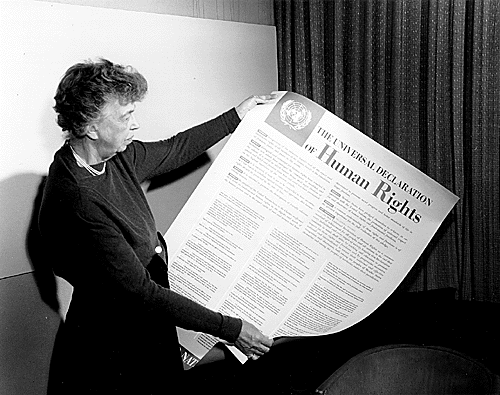
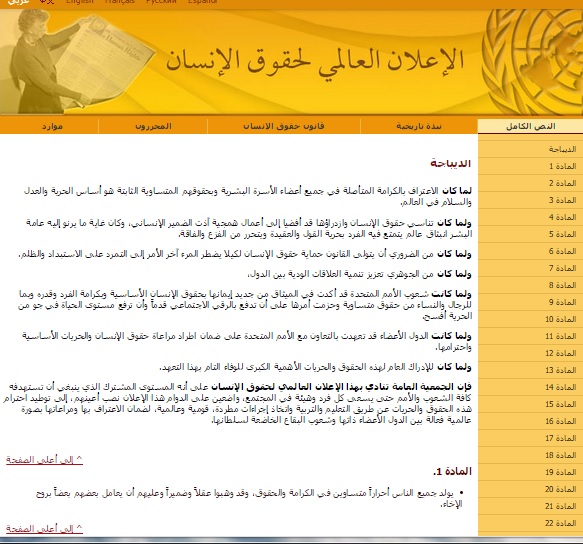
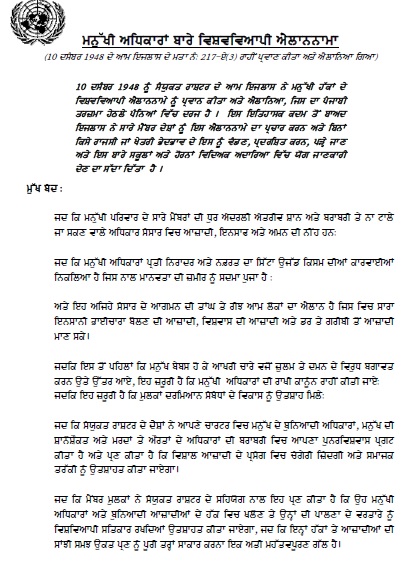
Eleanor Roosevelt Holding the Universal Declaration of Human Rights - in English (Source: United Nations)Universal Declaration of Human Rights Preamble - in Arabic (Source: United Nations)Universal Declaration of Human Rights Preamble - Punjab (Source: United Nations)
Most of us cannot imagine a life without loyalties. Our shared loyalties build trust, unity, community, and personal growth. It would be a sad life and grim world for us to have no devotion to any higher cause or larger community other than ourselves. But our loyalties begin with a shared respect and commitment to our values, ethics, integrity, safety, and most of all, our shared universal human rights. If we don’t have loyalty to those shared values and principles, we don’t have loyalty with our brothers and sisters in humanity at all.
Loyalty matters. Loyalty defines our lives and our characters as individuals.
Loyalty is never an excuse to allow the human rights abuses and suffering of others, or to excuse those whose actions have allowed the human rights abuses and suffering of others. That is not loyalty at all. That is disloyalty to the truths that we hold self-evident and the human rights values we all share as human beings.
Loyalty without values, without principles, without a commitment to our universal human rights has nothing to do with community. Such shallow expressions of “loyalty” are nothing more than gangs who seek to use their force to suppress the rights, the dignity, and the security of others. We have seen this throughout history, and we see this today. This shallow view of loyalty is devoid of a sense of responsibility for our shared universal human rights and dignity, putting the pride and ego of their clan above the dignity and decency of others, even the weakest and most vulnerable of our citizens.
Loyalty does not justify bullies. Loyalty does not just committing crimes and violence against the helpless among us. Loyalty is not an excuse for those who rationalize such anti-social behavior and anti-human rights behavior by others in their group. There is no loyalty in the actions of criminals, their co-conspirators, and those who rationalize their anti-social behavior.
A life without loyalties is a grim existence. This is why, as human beings, our community is more than our own self-interest. This is why we urge of all our fellow human beings to work in improving the priority of our shared universal human rights in our culture. This is why we urge all to be responsible for equality and liberty.
To those Americans and Christians unaware of the struggle of Egyptian Copts, minority Christians, and minority members of religious groups around the world, their struggle for human rights, dignity, and safety is a real one. The protection of these universal human rights are a shared struggle that we must have with minority Muslim, Jewish, Hindu, Sikh, Buddhist, and other brothers and sisters – who are oppressed around the world EVERY DAY. These minority rights for religious freedom and freedom of conscience of beliefs around the world – are not just minority rights – they are HUMAN RIGHTS. They are universal human rights that apply to all of our brothers and sisters around the world.
Supporters of the volunteer human rights group Responsible for Equality And Liberty (R.E.A.L.) have stood shoulder to shoulder supporting and praying with members of such minority groups, whose freedom of conscience, freedom of worship, dignity, safety, and lives have been constantly threatened. This is not the challenge for individual religious leaders. This represents a consistent threat to the universal human rights entitled to every human being.
We have stood by our Coptic Christian brothers and sisters over the years, as they have been oppressed, threatened, attacked, kidnapped, houses of worship violently attacked, and murdered. We have stood by our Pakistan Christian minority brothers and sisters, whose children have been attacked, women arrested, and churches burned. We have stood shoulder to shoulder with our Muslim brothers and sisters, when they have been attacked and threatened, their mosques attacked, their beliefs defiled, when they have been victims of terrorism in the United States and around the world. We have stood by our Jewish brothers and sisters as they have been attacked with venomous Anti-Semitism in this country, around the world, and as Israel has been violently attacked. We have stood by our Hindu brothers and sisters when they have fled for safety due to their religious oppression, and when their young women have been kidnapped, forced to deny their religion, and Hindus have been injured and killed. We have condemned and prayed with our Sikh brothers and sisters as they have been the victims of hate violence in the United States and around the world. We have stood by our Buddhist brothers and sisters in their call for peace and call for the right to practice their traditional religions in Asia. We have stood by the practitioners of the Falun Gong when they have been kidnapped, tortured, and killed in China.
There is no nation without a record and history of minority religious oppression, so let us remember that such abuses happen everywhere, and must be confronted everywhere, just as our human rights apply everywhere.
After the Holocaust and the defeat of Adolf Hitler, the nations of the world banded together to form the Universal Declaration of Human Rights (UDHR), setting a world standard to guarantee universal human rights, freedom of conscience, dignity, safety, and respect for people around the world, of every nationality and every religion.
When we see hate and violence – we must point to our shared commitment as human beings to such universal human rights – everywhere and without exception. It is the second part of this which confuses some people. They want to believe in such universal human rights – for themselves, for their identity group. But universal human rights apply to all of our brothers and sisters in humanity.
Our universal human rights also include our freedom of speech and our freedom of press. We may disagree with things that people say and write, but we must be consistent on our freedoms.
But freedom of speech and press is also a two way street. We too have the right to express ourselves. We have a right to call for peace and patience around the world, despite the loud voices that call for conflict and violence. To those of us who care deeply about the fate of Coptic Christian minorities, we also have the responsibility to disagree with those have created films that would make hateful comments against Islam. A commitment to human rights is not a mandate to attack others’ religions. Oppression does not justify venomous films that will spread hate and incite anger among many. We have our free speech, which we also share, and in our support of human rights, we disagree with such speech and such actions. At one Coptic rally at the White House three years ago, I met Morris Sadek, one of the reported promoters of this agitprop video on Islam. I am shocked, distressed, and discouraged by his actions and those of others in promoting this YouTube video “Innocence of Muslims.” It is wrong, counterproductive to anyone’s human rights, and I know that there are many leaders in the Coptic Christian community that spoke out against this film and these actions. Let us be clear, such actions will not promote human rights, will not promote freedom of conscience and religion, and will not help those genuinely oppressed religious minorities, such as the Coptic Christians.
The response to religious oppression anywhere in the world – should never be hate.
There is a real global problem with religious oppression around the world. Responsible for Equality And Liberty (R.E.A.L.) will continue to stand by our brothers and sisters in the Coptic Christian community, just like we do in the worldwide Christian community, Muslim, Jewish, Hindu, Buddhist, Falun Gong, and other communities to respect their universal human rights – without exception anywhere in the world.
Christian life is not cheap. But that is because no one’s life is cheap. We are all special and unique individuals, entitled to human liberty, human rights, safety, and human dignity. Those who ask if promoting videos of hate are Christian actions, should merely reflect on the commandment by Jesus Christ to “love one another.” This is the position that members of all religions of peace must take in responding to extremist views – anywhere in the world.
We stand by our brothers and sisters in humanity, and we have confidence that the minority of extremists and those stained by the disease of hatred, will ultimately be overshadowed by the bright light of our love, respect, trust, and hope in the dignity, decency, and love that we can find in humanity.
Choose Love, Not Hate. Love Wins.
Be Responsible for Equality And Liberty.
Hate Hurts Us All
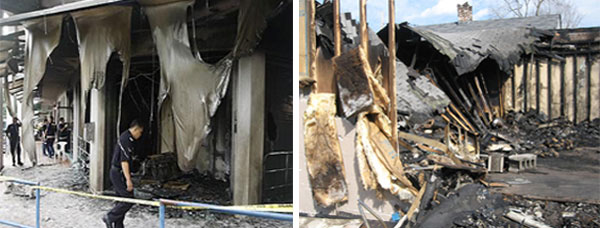
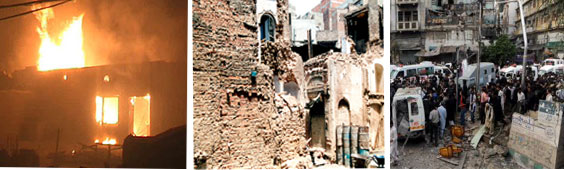
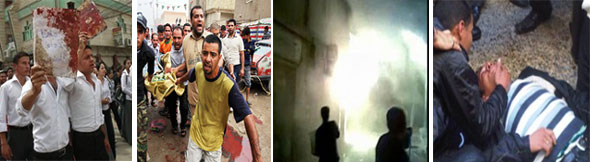
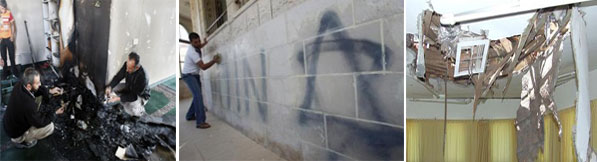
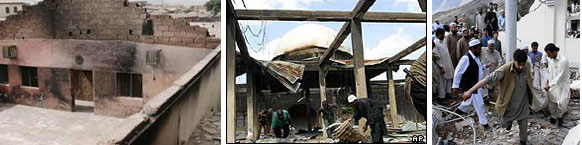
Can You Tell The Difference Between a Burned Church or a Burned Mosque? Church Burned Down in Malaysia -- Mosque Burned Down in United States -- Hate is HateCommunist China: Husan Church Destroyed (ChinaAid) -- Uighur Mosque and Kashgar Area Demolition (NYT)Pakistan: Mob Attack on Christian Churches and Homes, Destruction of Hindu Temple (Dawn), Bombing Attack on Muslim Shiites (Dawn)Malaysia Church Burned -- Indonesia Church Burned -- Indonesia Mosque BurnedAustralia: Photograph showing destruction at Hindu temple (Photo: Carlos Furtado) Middle East: Bombing Aftermath of Iraqi Christians (AP), Iraqi Shiite Mosques (London Times/Alice Fordham), Arson Attack on Egyptian Coptic Christians, and Terrorist Attack in January on Egyptian Coptic Christians (al-Masry al-Yom) West Bank Mosque Arson (Getty), Mosque Vandalism (Reuters), and Israel Synagogue AttackedNigeria Church Arson, Nigeria Mosque Arson (AP), Somalia Mosque Bombing (Trend)German Synagogue Arson (DDP), UK Mosque Arson, UK Mosque Vandalism (MEN), UK Synagogue VandalismIn America Today: Churches, Mosques (TIRCC), Synagogues, Other Houses of Worship Attacked
We can choose another direction. Choose Love, Not Hate. Love Wins.
Eleven years ago, terrorists attacked the United States of America killing over 3,000 in multiple attacks in New York City and Washington DC, as well as Shanksville, PA, where courageous Flight 93 passengers defied terrorists from using their plane as another bomb to kill others in the nation’s capital.
On this 9/11, as every year, we remember their loss and we remember the brave sacrifice of those who gave their lives to rescue others and prevent more attacks.
One tragic legacy of 9/11 has been the use of this attack on America by people around the world to rationalize their political views, to justify their hatred towards others, and to use the attack as a call for additional violence.
We will never forget those such as the British group Al-Muhajiroun who praised the 9/11 terrorists as the “Magnificent 19” and used the 9/11 attacks to call for more attacks on America, as well as to spread their ideology of hate. We have seen many, many around the world rally around the 9/11 attacks with a perverted glee. But we have also seen those who would use the 9/11 attacks to rationalize hatred and violence against people of other religions, other ethnic backgrounds, and other nationalities because they are viewed as “different” or “the enemy.” We have seen how such hatred can fuel the violence of individuals such as convicted Norwegian terrorist Anders Behring Breivik who used his hatred of Muslims to justify murdering 70 Norwegians.
Finally, we have also seen the sad use of the 9/11 attacks by some in politics, claiming the world would be different if only their political group was in power. In eleven bi-partisan years after the 9/11 attacks, the one concrete lesson we have seen is that the challenges and our response to the 9/11 attacks is not the responsibility for any one political group, but is the responsibility for all of us as human beings.
While the immediate security issues around the 9/11 attack made us question who we could trust, the targets of terrorist organizations have become clearer in the subsequent years. The target of terrorists is anyone who will not submit to their tyranny, their violence, and their hatred. The target of terrorists is not one nation, not one religion, not one identity group, not one race, but their target is the WORLD.
We have seen racial terrorists continue to attack, harass, threaten, and kill people of their own race, who will not submit to their views. We have seen political religious terrorists do the same. In the greater Middle East and Africa, while we see killing and deaths of Americans, Christians, Jews, Hindus, and all other identity groups, the majority of the casualties by such political religious terrorists are Muslims. We see this every week, and on some weeks, every day. Yesterday, over 100 people died in a day of terrorist car bombings and shootings in Iraq. This morning, in Turkey a suicide bomber attacked a police station. Terrorism did not “stop” after 9/11; it simply spread on the disease of hate throughout the world.
The reality is that the terrorist views that inspired the 9/11 attackers have resulted in such terrorists committing acts of violence and killing — mostly against Muslims. The terrorists’ world war against humanity means that religious extremists who claim to be acting on behalf of their view of “Islam” must kill fellow Muslims, who have become the majority of their victims. That is what hate can drive people to do.
But while they choose hate, we must choose love. While they seek the tyranny of extremism, we must defend the universal human rights for all of our brothers and sisters in humanity. While they seek destruction of humanity, we must assume responsibility to build human bonds. While they seek us on our knees, we must defiantly stand on our feet as human beings – free and equal in dignity and rights.
Over the past eleven years, the dialogue has changed from security solutions, military solutions, and even law enforcement solutions, to a greater focus on human rights solutions. We cannot build a fortress strong enough, an army strong enough, or law enforcement vigilant enough to protect everyone all the time. The Cold War strategy of endless war against one another has continued to lose favor among people in America and around the world. We increasingly spend less time identifying enemies, and more time building friends. Certainly, America’s security organizations have done everything they can to protect the nation. But it is not enough to defend our fellow human beings’ bodies. We must reach our fellow human beings’ hearts, minds, and conscience to renew and rebuild a commitment to shared human rights and respect for our brothers and sisters in humanity.
Over the years, we have seen the growing integration of groups from different religions and identity groups, Christian, Jewish, and Muslim, American and Pakistani, men and women, and every other group (religious, ethnic, and otherwise) working together to renew and rebuild this commitment to human rights – around the world. Where once attention was focused on the terrorists’ actions, now a growing attention is on those working for human rights and dignity.
In some parts of the world, dictators have been overthrown and others are on their way out. Where we see human rights abuses in those areas, there is no longer the convenient excuse of the dictator, and people must face the issues of human rights in their culture and national history. Like America and every other nation, we have to own our mistakes in human rights, and do something about them.
We have to be responsible for our shared human rights. We must cherish every day as another good day to be responsible for equality and liberty for one another.
There is hope to the worldwide challenge of terrorism that resulted in the attacks on 9/11.
That hope can be found in our shared commitment to our universal human rights, dignity, conscience, and safety for one another, and our common bonds as brothers and sisters in humanity.
Choose Love, Not Hate.
Love Wins.
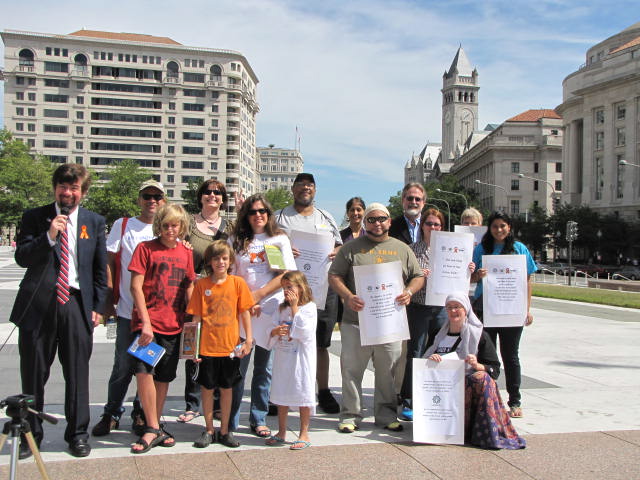
September 11 - People of All Faith Stood Together in Washington DC for Human Rights and Dignity
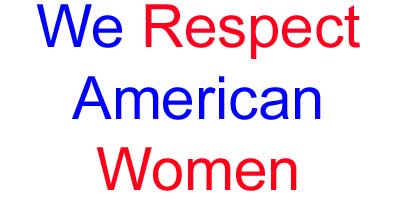
To the men of America – we need to demonstrate moral courage for our daughters, our sisters, our wives, and our mothers in America today.
We need to speak out and make it perfectly clear as men that we do not accept and we will not tolerate this type of despicable language and treatment of women in America, from any political corner or media figure – whether it is Rush Limbaugh or Bill Maher.
Women’s human rights and women’s inherent dignity as our sisters in humanity are not negotiable in political and public debates of any kind.
There is no political excuse, there is no rationale, there is no argument that justifies or rationalizes anyone in America or anywhere else treating our sisters in humanity without a shred of human decency and dignity.
This type of uncivil, gutter level discussion that we continue to hear about our sisters in humanity has no place in any type of dialogue on political, policy, religious, or public matters of any kind.
Yes, we know there will always those who express hatred and even misogyny.
But for every upraised fist of hatred, we must offer an outstretched hand of compassion and dignity to both our sisters and brothers in humanity — to show both our solidarity and our commitment to defending their universal human rights and their universal human dignity. We choose love, not hate.
When we reflect upon ourselves as human beings and as men, one of the essential elements that we must always be seeking is our conscience, and the courage to never let any circumstances and any conflict in our nation, our society, and our lives undermine the courage to keep that conscience a priority in our lives.
What are our lives worth without our conscience? What are all the things we do, all the things we build, all the things we obtain, if we lose the essence of what it means to be a human being, what it means to be a man, and what it means to be – an American.
Imagine how the rest of the world looks on American men today and wonders – will the men of America have the human decency to speak out in support of their daughters, their sisters, their mothers? Will the men of America have the courage of their conscience?
So I ask the men of America today – you have a voice, you have imagination, you have strength, and you have WILLPOWER. You can change the world. You can find time in your lives to stand up a moment to say to those who would attack, demean, and degrade the women of America.
You can find time to say to those who would dehumanize the women of America – and say ENOUGH.
We might differ on our political views. But we should never differ on the TRUTHS that we hold self-evident – that define us as Americans – that our sisters in America deserve the same equality, the same dignity, and same decency that any American deserves – without question, without reservation, and without exception.
Be responsible for equality and liberty – not just for us men, but also for our sisters in America and in humanity.
Show the world that we American men are NOT represented by the vulgar, disgraceful comments by media and political agitators attacking American women.
Put your name on the line – as one of the many millions of American men respecting women’s equality and dignity….
…simply because it is the right thing to do, it is the human thing to do, and it is the American thing to do.
Welcome and thank you for coming today!
It is another good to be Responsible for Equality And Liberty.
That is the name of our human rights coalition, Responsible for Equality And Liberty, and we are here today to invite our fellow human rights activists in a joint event where we remember the December 10, 1948 adoption of the Universal Declaration of Human Rights (UDHR) by the nations of the United Nations.
People around the world remember this human rights accomplishment as Human Rights Day, and there events going on around the world.
Here in Washington DC, Responsible for Equality And Liberty, has sought to also celebrate Human Rights Day here at the National Press Club, as we have done over the several years, with speakers on various human rights campaigns, to share our common bond together in our efforts to be responsible for our universal human rights for all people around the world.
Our common bond is our humanity. This includes the inherent human dignity and human rights for all people of all identity groups everywhere in the world that represent our universal human rights. We come from the nations of the world, from different races, different ethnic groups, different religions, different genders, and different identity groups – but our universal human rights apply equally to all – without exception, without reservation.
Our universal human rights are also based on our shared respect for one another as human beings. Such respect is essential in our human society. We find those who seek to be superior or arrogant in seeking rights for themselves that they would deny to others. But our universal human rights are based on shared respect for all people of all identity groups everywhere in the world. Our universal human rights require a commitment to being responsible for BOTH equality and liberty for all.
In our individual campaigns, we struggle with those who would seek to deny such universal human rights. We see extremist groups, totalitarian governments, and those with hate in their hearts seeking to deny human rights to others. Let us never forget this problem is one of human respect, first and foremost. If we are to RESPONSIBLE on this matter, we must treat all human beings with respect, even those with whom we disagree. The challenge we see in human rights is not only a challenge for individual campaigns, but it is a challenge for humanity itself.
So our combined campaigns for human rights must begin with a declaration of love and respect for our fellow human beings. The view with Responsible for Equality And Liberty is that we offer an outstretched hand, not an upraised fist – to all of our brothers and sisters in humanity.
Our common bond is our humanity and our common legacy must be one where we show our love and respect for one another, even as we challenge those who oppress, and even as we challenge those deny human rights and dignity to others. We must set an example. We must set a standard. We must offer a vision of the future based on hope.
We urge others to Choose Love, Not Hate. But we are not preaching about our own perfection, rather we are setting a goal for our society and ourselves with humility.
Our goal in our human rights campaigns must also be finding and building for the future of human society together.
That future must begin with a commitment to the most vulnerable among us, whether they are minorities in the race, religion, gender, ethnic background or other identity groups. It is easy to ignore those who are different. But the global danger is that we become arrogant and fail to respect their human rights. We have seen this around the world: in the United States, in Asia, in the Middle East, in Africa, in Europe. We have individuals who will speak today on campaigns to defend the human rights of minorities and other groups who are denied human rights based on perceptions in culture, including women in America.
Our future in human rights must also address the issue of the terrible poverty around the world, and the impact of this poverty on effectively denying the human rights of people. I also urge Americans to address this issue as well. Just a short drive from where we meet today, you can see some of the most dire circumstances of poverty and neglect. There are those who would seek to leverage such poverty to abuse the vulnerable in our society in America and around the world. To challenge the poverty in human rights around the world, we cannot also neglect the need to challenge the issue of poverty itself. Give where you can, help where you can. Use your declaration of love and respect to help those who need help.
If our commitment to the future must address the most vulnerable among us, then the most important part of that commitment is our children. Without our children, there is no future for human society. Our children are the future leaders of Earth, and we must set an example on human rights, respect, and love for one another – not just for our own sake – but also for our children’s future. I say “our children” because they are our shared responsibility and our shared future. We cannot just only expect the parents of our children to look out on their behalf, no more than only our parents looked out on our behalf. All of human society has a responsiblity to equality and liberty for our children, and all of human society has an obligation to safely protect and preserve our children, so that can live and grow to become the future leaders of our Earth.
But if we were to assess human society based on how its most vulnerable, we would a sorry story. Too few nations, including the United States of America, are signatories to the United Nations’ Convention on the Rights of the Child. A few weeks ago there was a separate event where people remember the ratification of the Convention on the Rights of the Child (CRC) on November 20, 1989.
If we are committed to human rights, we must first and foremost be committed to human rights for our children. Yet an endless parade of violence and abuse against children and young people continues throughout America and throughout the world.
On Monday of this week a 7 year old girl, Jorelys Rivera, was found murdered, sexually abused, and left in a trash bin. (Lifting her photo to the audience). This is the face of human rights in America and the world today. Our children are abused, raped, tortured, and killed in America and around the world with impunity. In Texas, children were killed by their own mother, after putting a Facebook posting warning of threats against them. In Pennylvania, institutional leaders ignored reports of repeated attacks and rapes of young boys for over a decade at the Pennsylvania State University, of which I myself am an alumnus.
This week in Afghanistan, a teenage girl who had been raped and imprisoned by the Aghan government as a result of being a victim, was finally given an oppportunity to be released from prison after 2 years, if she married her rapist.
Our disgrace in human rights for children are not just by criminals and extremists, it is by governments, it is by institutions, and it is by too many in society. This disgrace in human rights for children is only a reflection of the state of our society on human rights. We see extremist views from people who claim that they represent religious or cultural views justifying pedophilia and honor killings. On regular basis, such so-called “honor killings” frequently of young girls are reported at the international human rights group’s web site stophonourkillings.com. In the United Kingdom alone, there were 3,000 so-called honor killings last year.
This threat to our children affects all of us and all of in this room and the individual human rights campaigns represented here.
In Sudan and Darfur, children are killed, young girls are raped, children are starved, authorities refuse to let children learn about their culture, and some children are taught to become soldiers.
In Pakistan, we see an endless and horrifying oppression of young children, brainwashing by extremist of young minds, tying bombs onto children for terrorist acts, the abuse, rape, and murder of young Christian girls and other religious minitories, including a young girl Amariah Masih, who was murdered resisting an attempted rape and reported forced religious conversion.
In Balochistan, we have seen over 168 children who have “disappeared” and teenage boys killed as part of a brutal “kill and dump” campaign by authorities.
In China, only two months ago, the world saw heartless people continue to walk by as a two year old girl Yue-Yue was run over by a vehicle and left to die in the street. At the U.S. Congress a short drive away, I have sat and listened to testimony from young Chinese women forced into having abortions and heard reports of how the government instructed doctors to kill young babies. The Falun Gong, here with us today, could tell the story of how the children of their supporters are also oppressed, tortured, killed, and others left to be orphans or without parent as the Chinese Communist Party takes their parents away for their beliefs.
In Bahrain, I have a report from a few weeks ago of 5 children killed and hundreds of children subjected to excessive force by a brutal government that seeks deny democracy and human rights.
We such abuses too regularly, and it is easy to view such disgraces as statistics rather than as human beings, who are precious, unique, and loved.
My friends have also been asking why Responsible for Equality And Liberty has had less press conferences this year. One of my own personal focus has been dealing with people suffering in dire poverty in this nation and seeking to help them from their difficult living environment. This has included a teenage girl who came to me with her own story of abuse and I have been intervening to protect her and other American girls suffering from abuse as a result of their poverty, by those who seek to take their hope, dreams, and their innocence away.
They are all OUR children. They are all OUR responsibility for equality and liberty. Every one.
In the month of December, we see some people celebrating holidays of various sorts and some providing gifts to children.
I believe we can give them a special gift this year.
We must give the gift of our courage, our consistency, and our commitment for the universal human rights and dignity to all of our children around the world.
Some believe that abuses against our children are simply a law enforcement issue. Nothing could be further from the truth. If we are to be responsible as individuals in a human society, each of us must be responsible for the children that are our common bond and bridge to the future.
We must set an example for our children.
We must provide a beacon and symbol of hope for our children.
We must show that by our words and more importantly by actions, in the United States and around the world – to our children – and to each other…
Around the United States of America, people are remembering this day as “Patriot Day.”
Ten years ago today, terrorists attacked New York City, Washington DC crashing jets into buildings and murdering thousands. Another planned attack on Washington DC was thwarted in mid-air on Flight 93 by courageous people, and it crashed in Shanksville, Pennsylvania.
We remember.
But we do more than remember than tragedies and the loss of lives.
How many memorial services, how many funerals have you gone to that simply remember loss and death?
No, when we REMEMBER, we also and most importantly remember life. We remember dignity. We remember joyous days. We remember mercy. We remember our common bonds with one another. We remember not just death, but we remember what makes our lives worth living. We remember our hearts and our love for one another.
I believe we do have a destiny. I believe all of our lives are lived for a purpose. I believe that all of our lives have meaning and are special. Those whose lives were ended on 9/11 came from many different backgrounds, different religions, and different identity groups. For some, they died so that we here could live. For others, their last moments were of courage in seeking to save their fellow human beings. They included Todd Beamer, Steven Weinstein, Sophia Addo, New York Fire Department Captain Patrick J. Waters, Lydia Bravo, Army Major Wallace Hogan, NYPD Cadet Mohammad Salman Hamdani, and nearly 3,000 more. Their deaths from the terrorist attacks were not an end, and their lives will be remembered by Americans forever.
We remember our brothers and sisters on 9/11. We remember them and we reach out to them across the universe and across the heavens.
We miss them and we love them. We love them, no matter their names, no matter their ethnic group, no matter their race, no matter their gender, and no matter their religion.
Some worry that our love and compassion will be seen by others as weakness. Our love for one another is not a weakness, but it is the greatest strength in the world. It is a bond to holds fast our diversity around the globe into one singular and special human race.
In the Washington Post today, a writer writes that the 9/11 attacks were the “end of American innocence.” But in our nation and around the world, there are innocent children born every day, who are born into a world and a nation, where they are loved. We have opportunity for such innocent compassion to our fellow beings every day of our lives. So I don’t see any end to innocence in America, or anywhere in the world, I see the endless opportunity for innocent love towards one another.
There are some who ask, ten years later, isn’t it time for Americans to “get over” 9/11? Some of those people mean well. Some of those people are concerned about the divisions we have seen grow in our nation and the world. But we have a choice. As we remember the lives lost on 9/11, we also must continue the courage and dignity of those who were killed that day. We have the choice to remember 9/11 for the fearlessness and sacrifice that so many made to save their fellow human beings in New York City, in Washington DC, and on Flight 93 in the sky. We should never “get over” such profiles of courage, and we should use their inspiration today and every day.
Today, our nation and our fellow human beings must have a united message to those who seek to promote hate and violence.
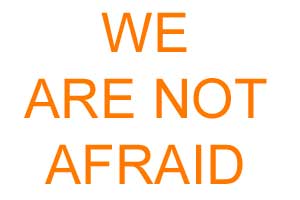
We are not afraid.
We don’t make that statement arrogantly, but simply as a statement of the truth in our hearts.
We won’t allow ourselves to be dragged into the fear and hate that undermines the joys and the blessings that we have in our lives.
We urge our fellow human beings to choose peace, not violence, to choose human dignity, not disrespect, and to choose love, not hate.
— Oslo and Finding the Courage to Change — A New Dialogue (Part II)
Once again, as I write this, there are those who claim to want to threaten my hometown and America’s national capital. We have seen it many times over the past 10 years. We have seen the barriers, the security procedures, the National Guard, and the police riding our subways with machine guns.
But once again, the path to peace anywhere in the world, Washington DC or New York City, the Middle East, Africa, Asia, and Europe – begins with a dialogue of peace.
Such a dialogue requires the courage to change the dialogue of the past and embrace the opportunities that we have to work together as fellow human beings to achieve change in our societies and our world.
At the end of July, I wrote of the terrorist attack in Oslo, Norway by confessed terrorist Anders Behring Breivik. I wrote about the need to comfort those who lost their lives and families of children whose lives were lost in the July 22, 2011 terrorist attack in Norway. I wrote of the need to balance our disagreements with dignity and compassion, and the lessons that we must continuously learn and teach from such violence.
At the end of August, I wrote details about the challenges of extremists in various groups. This includes extremists in the Anti-Islam group that Mr. Breivik claimed to represent as well as the Bin Ladenists who continue to commit and threaten terrorism around the world. My Christian friends reject the oppressive message and terrorist actions of Mr. Breivik, who sought to view himself as a “Christian crusader.” My Muslim friends reject the violence and hate of the Bin Ladenist movement. I embrace the efforts of all my brothers and sisters in humanity to pursue a path of compassion and human dignity.
These terrorists do not represent us, and we must not allow them to claim that they represent the “culture” of our faiths. It is the responsibility of people of such faiths to continue to make this clear to the world, not just with their words, but more importantly with their actions.
We must find the courage to seize the opportunity for a new dialogue on our freedom of speech and responsibility, to develop a new approach to our cultural ownership, to choose a new dialogue regarding religion and human rights, and to choose love, not hate not just in our hearts, but in our minds, in our words, and in our actions.
1. A New Dialogue on Freedom of Speech and Responsibility
We cannot have any dialogue without freedom of speech. When we fear to communicate and to disagree, then people stop talking and start plotting on how to overthrow “the other” (whoever that may be). So whether we agree on someone else’s views or not, let’s remember that if we deny their freedom of speech, we undermine the ability to build any type of dialogue in the future. I talk with a lot of people that I disagree with – in many different areas. Some people may choose to view me as an “enemy.” But I have no enemies; I only have brothers and sisters in humanity. That is what all must seek, no matter how disagreeable or how difficult that may be at times.
But while we work to support the freedom of speech for all, we must also work to build a greater sense of responsibility to use our words constructively. We can use our words to build, not destroy. We can use our speech to heal, not to divide. We can use our rhetoric to hope, not to hurt. We have a choice, and we also have a responsibility to our society.
We cannot legislate responsibility or our brothers’ and sisters’ thinking. They have universal human rights to say and think what they choose. While we have laws to protect people from violent threats and danger, the real work in building responsibility is by showing responsibility ourselves. We must spend less time pointing fingers and more time extending our hands in human fellowship. We must spend less time in dialogue with those who share our views, and more time listening to others with whom we disagree. We must set an example in being responsible for both freedom and dignity.
Building responsible speech in our societies is hard, grueling, thankless societal construction work. We will win no awards, get no supporters, obtain no donations, and get no accolades for the construction work of building respect and dignity for one another in our communications.
But imagine how our society would struggle if we had no construction of roads, of sidewalks, of building, of electricity. Imagine our homes with no windows or no doors. We depend on such thankless construction for our daily lives and our daily interaction with the world.
We must make a renewed commitment to such construction for peaceful, respectful construction in communications with our human brothers and sisters. A new dialogue begins with choosing to be responsible for showing dignity towards one another.
2. A New Approach to Cultural Owners
Imagine a home with no windows, no doors. It would be a tomb, or perhaps even a cell. In many parts of the world, our brothers and sisters in humanity live in such prisons. They are imprisoned for choosing freedom, for choosing dignity, and some simply because of their identity, including their religion. We see people of all types of faith imprisoned around the world in oppressive states for their faith, or by those who discriminate and oppress them for their faith.
But the jailers are also in jail themselves.
We must seek and work towards a new approach to cultural ownership, where our homes have windows and doors, where our cultural homes allow us to see and talk to one other, where our cultural homes allow the light of day and the stars at night.
Mr. Breivik’s terrorist attack was for what he called a “Christian culture,” and the Bin Ladenist movement seeks what they call an “Islamic culture.” My Christian and Muslim friends reject both extremist views. But we must do more than just reject extremism. We must also answer the more difficult questions in our societies about our insecurities regarding our cultures.
Many are adverse to change, and the globalist movement of the 20th century has caused many great concern. They fear local and traditional views will be challenged and even lost. Some have rationalized that the answer should be found in cultural tariffs to keep people of other cultures, other races, other ethnic backgrounds, other religions, other identity groups – OUT – of a culture that they don’t want to change.
But history has shown that the effort to build such cultural tariffs and cultural walls are doomed to failure. Oftentimes, such efforts have had catastrophic and horrific results. We have seen some examples with Adolf Hitler’s Nazi Germany, racist segregationists in the United States, Communist totalitarian nations, genocide in Darfur, and the endless waves of violence against religious minorities in the Middle East and Asia. History shows that the efforts to build walls around our cultures have many, many bad endings.
There is a great misunderstanding that comes with the closed minded views on isolated cultures. We have seen this with the manifesto of the terrorist Anders Breivik, who also used his attack (not unlike the Bin Ladenists) to reject what he calls multiculturalism. This misunderstanding comes from a basic confusion over what our responsibilities are involving multiculturalism.
Multiculturalism is not about submission or surrender. It is not about sacrificing our cultures. We do not have to agree or even like other cultures. Multiculturalism is not about any of that. The important point for human dialogue is simply that we show dignity and respect for others and their differences, regardless of whether we agree or whether we like them, simply because they are fellow human beings.
Fear and doubt can be greater motivators to build walls. But if we are serious about building security not just for this moment, but also for our children and the generations to come, we must build more doors and more windows. We must not be afraid to look outside.
A new dialogue begins with the realization that we must share our Earth together. Not only do we need to be heard, but also we need to be able to listen.
3. A New Dialogue on Religion and Human Rights
People of faith must seek the opportunity to build a new dialogue on religion and human rights. We have to reject the idea that our faith does not allow human rights, human freedoms, and religious freedom for our human brothers and sisters.
To people of all faiths, I ask you to look not only to your heart, but also to your soul. We must find something other than fear, hate, anger, bitterness, and rejection in ourselves, in our thoughts, in our words, and in our lives.
We are better, we are bigger, we are more decent than what we have seen in the dialogue over the past 10 years since the 9/11 attacks. We are more courageous than to let people of faith suffer in prison cells and in oppression around the world, simply because of their faith. We have more confidence in our faith than to seek to deny our brothers and sisters their own houses of worship and their freedom of conscience – anywhere and everywhere in the world, without exception, without caveat, without condition.
We have greater voices and greater power together than the extremists among us who would denigrate others, oppress others, and even cause harm and violence to others. We outnumber even the greatest mobs with torches, with our countless masses that can choose to stand for freedom and dignity for all.
We must not let the Breiviks or the Bin Ladenists speak for us. We must not our silence ever be interpreted as apathy, or God forbid, consent.
We do not pray for fear, we do not pray for hate, we do not pray for indifference, and we do not pray for weakness. To people of faith, I say that we must be who we say we are, and take the responsibility to live as courageously as we pray.
We must lose the mask that too many wear of cowardice, indifference, and despair. We are more powerful than that. We are people of faith, blessed by a higher power to give us guidance and courage.
We are not better than our fellow human beings, but we are blessed to offer the chance to reach out to our fellow human beings. We must never let ourselves believe that blessing is a license to reject, to oppress, to demean, to hate, and to hurt our fellow human beings. Our blessing of faith must be cherished like the gift that it is.
My Muslim brothers and sisters have stood by my side many times, in many forums. They have stood by me in women’s rights events, in challenging stoning, in standing for religious freedom, in defying violence and hate, and in remembering those who have lost their lives to extremists. They have shared their heart break with me over the abuse of Christians, other Muslims, and other religious minorities in many parts of the world. They have stood with me in challenging the Bin Ladenists and their views. While this may get little reporting by the news media, I know this is true, I have seen this over and over with my own eyes, and heard this with my own ears. We need to reach out to greater numbers of our brothers and sisters on these issues.
My Christian, Buddhist, Jewish, and Hindu brothers and sisters have also stood by me in these and similar human rights events, over and over again, in different parts of America, and in joint event for human rights in Europe. We still need to encourage more of our brothers and sisters to be involved in such issues.
I don’t offer a message for a new dialogue on religion and human rights based only optimism, but it is also based on years of personal experience witnessing this dialogue developing, seen with my own eyes and heard my own ears.
A new dialogue is developing and will continue to develop among people of many faiths and none at all – while we continue to remember our shared humanity, and while people of faith remember their shared blessing.
4. A Message to My Christian Brothers and Sisters
I am a Christian. Therefore, I also have a special direct message to my Christian brothers and sisters on this need to build a new dialogue of hope, respect, and dignity.
The terrorist attack of Anders Breivik and his calls for “Christian culture” was a deep insult to Christians around the world. A number of Christian commentators dismissed Mr. Breivik by stating that he was not really a Christian, but viewed himself as a “Christian agnostic” who liked what he viewed as the “cultural” traditions of Christianity, without actually having any faith.
While it is easy to dismiss Breivik, I would caution my Christian brothers and sisters not to do so too easily. While millions seek to promote a different type of “Christian culture” than the one that confessed terrorist Anders Breivik sought, he is not an “isolated incident.” There are too many others to believe this. We have seen the Hutaree, the racist “Christian Identity” movement, the African Lord’s Resistance Army (LRA), Ugandan extremists, and the Westboro Baptist Church. We have seen pastor after pastor join marches to deny religious freedom, and some who have led Qur’an burning campaigns. We have seen dozens of Christian pastors joining groups that seek to deny the rights of other religions. We have seen well-known pastors on television call for violence attacks on Washington DC, and some who have called for natural disasters as religious justifications to push a political agenda.
For every one of these extremists, there have been hundreds, thousands of Christians who actively reject their views. These very vocal extremists are a small fraction of Christians. But does that diminish our responsibility to reach out to them, counter their views, and offer a different dialogue?
So yes, it is no doubt that Mr. Breivik was not really a “Christian,” as we know it. But let us not get so arrogant to ignore the plank in our own eye, and the growing climate of intolerance, of disrespect, and even of violence that continues to grow in some corners of people who seek to redefine what we view as “Christian culture.”
While I may offer advice to my fellow Christians, let me be clear that I do not suggest that I am a “Christian leader” or an authority of any kind. Hardly. I am nothing of the kind. I am a poor sinner, weak, and imperfect. I am an average person, who has made enough mistakes to fill any book. But our God gives us all a chance, even to the least of us, to make a difference. If we believe in our Christian faith, our evangelism is not what we say, it is what we do.
What we do – is not enough. Not nearly enough. That is hard is to say and it is hard to hear, when we must feel that in this difficult world and economy that we do so much.
But whenever we believe we have right to be arrogant, disrespectful, cruel, and thoughtless, then we are allowing the definition of “Christian culture” to be undermined and attacked. Even a poor sinner like me can see this.
Our Christian culture is nothing if it is not first based on humility, respect, mercy, and kindness. We may suffer and struggle. We may be abused and disrespected. But to my Christian brothers and sisters, we have faith that Jesus Christ died on the cross for our sins and our opportunity for eternal life. Our Christian culture is a culture of sacrifice, selflessness, compassion, and love. It is not simply enough that we Reject Hate. To the Christian culture, it is also imperative that we Choose Love.
5. Our Unity and Dialogue in Our Shared March of Life
Whatever our identity group, our religion (or none at all), our nationality, our race, our ethnic group, or our gender, we are ONE. We march together every day of our life in solidarity. Our solidarity is in our lives together in the human race that we share.
That march of life that we take every day together around the world allows us to share the dawn, the sun, the sky, the sea, the air, and the stars together. Our home. Our shared Earth for all of us.
On some days, that march of life is a struggle, for others it is an adventure. To all of us, our march of life is a constant opportunity not only for ourselves, but also for our society and the future for all.
For our shared march of life, we need more than the stones of angry words. We also need the building blocks of respect, patience, and the willingness to listen, even (especially) when we disagree. We can grow beyond the history of where we have been and where we have failed, and we can work towards our possibilities of what we could achieve by respecting and gaining faith in one another.
The march of life requires more than closed cultures with border gates that prevent us from walking together. We need pathways to see and understand one another.
Our march of life together requires that we not only have faith, but that we demonstrate that faith in showing dignity, mercy, and respect to one another.
But most of all, our march of life requires more than just the faith in our religions (or none at all) or in our ideas. We need to work to build a new dialogue with our fellow human beings so that we can trust each other more. We have don’t have to agree with each other to respect each other. We don’t have to share each other’s views to love one another as fellow human beings.
Our march of life together does not just have to have the background of rush, confrontation, and conflict. Our march of life can be to a new anthem, a new dialogue of respect, compassion, and love for one another.
This new dialogue must not just be in our words, but also must be an internal dialogue as to how we think about each other, and how we act towards one another. We have seen enough violence, we have seen enough pain, we have seen enough suffering, and we have seen enough hate.
We can make another choice, and work to build a new dialogue for future generations.
We can choose a new dialogue based on respect, dignity, compassion, and love for one another.
This year, as so many mourn the 10th anniversary of the terrible terrorist attacks in America on 9/11, let us remember more than just victims. Let us honor their lives, their joys, and their hopes. Let us honor their dreams, their faith, and their hearts.
Let us Choose Love, Not Hate. Love Wins.
Orange Ribbon for Universal Human Rights - Responsible for Equality And Liberty (R.E.A.L.)
Many in the world are paralyzed by crushing hopelessness and fear in their lives.
They may be struggling from financial, health, family, or human rights issues. Those struggling may face situations or even other people who seek to threaten their health, their homes, their livelihood, and even their lives. This struggle with hopelessness and fear has no limits to one race, one religion, one ethnic background, one gender, one generation, or even one financial situation.
Hopelessness and Fear are great equalizers to human beings.
Hopelessness and Fear seek to attack us from within.
They seek to make us question not only our security and each other, but also they seek to make us question ourselves.
They will even drive some to the desperation of hate and violence. While we often dismiss those whose hearts are hardened by hate as simply lost, let us not forget they were not born into hate. They were taught hate and they were taught violence. The hate and violence of some is because of their own fears, their own insecurities, and their need to dominate others because they fear that they without domination their lives will hold no meaning.
We can and we must teach those consumed by hate and violence differently. But to do so, we must also overcome hopelessness and fear in our own lives, to set an example for others.
People of religious faiths are taught to reach to their faith in a higher power to believe in divine inspiration, strength, and even an afterlife. If you are a person of faith, it is vital that you use such faith to give you courage and strength.
Find a direction in your religion to love one another, and if you love one another, have the religious faith to also love yourself and those around you, even those who wish you ill. If your religion teaches forgiveness, then also find the religious faith to forgive yourself and those around you, even those who wish you ill.
I know how easy that is to say and how hard that is to do. When you feel that you have failed and that you are not where you believe you should be in life, you lose patience and courage with yourself. When you feel that others have failed you and even hurt you, then you may feel that such individuals do not deserve such love and forgiveness. But it is especially at these times, when love and forgiveness is the hardest to give and receive, that it is the most important to give and receive. This is really when love and forgiveness can truly make a difference in ourselves and in our society.
In addition to religious faiths, there is more than one type of faith. While those with religious faith have faith in God or the higher power that they believe in, there is also the need to find faith here on Earth as well, regardless of your beliefs.
We also need to have faith in ourselves, in one another, and in our shared human race that we will continue to survive, we will continue to show love and mercy towards one another, and that we will continue to have a future. Despite the sickness, the injustices, the travesties, the oppression, even the genocide of people by other people around the world, the human race marches on.
As a human race, the march of life continues.
This shared march of life should also give us hope and courage.
Certainly, in our individual situations where we feel fear and lose hope, it is often hard to see the value in this ongoing march of life.
We may be frustrated or despondent in our disagreements with others. But we can also choose to find courage that there is an endless opportunity for dialogue as fellow human beings.
We may grow fearful of our poverty, our failing health, and our age. But we can also choose to be thankful for the good days of the past and continue to appreciate the comfort of our fellow human beings in difficult times.
We may have heavy hearts over the loss of loved ones, friends, family, or the loss of relationships that brought great joy to our hearts. But we can also choose to be grateful for the comfort of our human family, and the endless relationships we can potentially have with them.
YOU ARE NEVER ALONE, no matter how lonely you may feel. Your brothers and sisters in humanity are there with you continuing the march of life for the human race.
We may be distraught at facing the dark door of death itself. But we can also choose to have the courage to remember that our end is not THE END. While the march of life for us may end, for other brothers and sisters in humanity, it is just beginning. Our human family will carry on somehow, as it has done over the years.
We may cringe at the growing darkness. But even in the darkest night, we can also choose give thanks for the light from the stars above.
You may think that you are forgotten, neglected, and alone. But somewhere in our shared Earth, there are those of your human brothers and sisters who send their love to you, whose hearts ache for you, who wish the best for you. They may not know your name, but they know YOU. They know you as a fellow human being, as a brother or sister in our human race. They may not be able to solve your problems, but there are human hearts that care about your problems, your fear, your hopelessness, your losses, and your struggles, even for those who hate.
There are those in your human family who seek to help others every day, and there are those in your human family who pray for those of all religions and those with none, simply because they love you as fellow human beings. They march alongside you, in the march of life.
From birth to death, we find ourselves in a march of life. That journey, like all journeys, may have rocks and difficult paths. That journey may find us at some point at an end from which we personally cannot recover. But our brothers and sisters in humanity will pick up the torch and keep the flame of the human spirit alive.
Our march of life is your march of life, a journey that we take TOGETHER.
Fear Not. You Are Not Alone.
In the March of Life, the Best is Yet to Come.
Orange Ribbon for Universal Human Rights - Responsible for Equality And Liberty (R.E.A.L.)