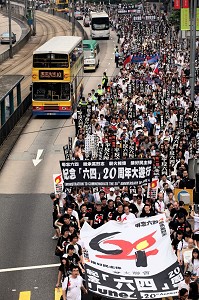
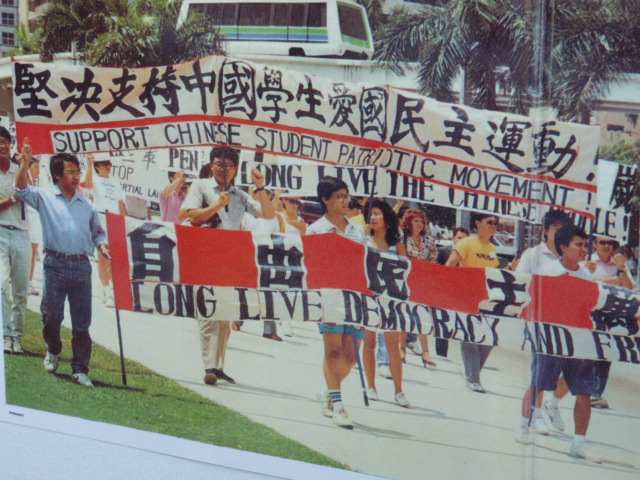
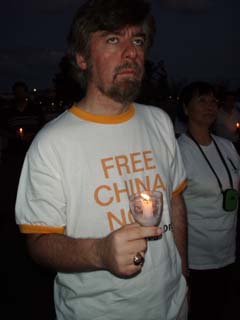
Epoch Times article - photo of May 31, 2009 Hong Kong Rally for Freedom
— “The Hong Kong Alliance in Support of Patriotic Democratic Movements of China held a grand march to commemorate the 20th anniversary of the June 4 Democratic Movement. Over 8,000 people joined the march on May 31, 2009.”
— “Szeto Wah, Chair of the Alliance, said that the number of participants reached an all time high. He believed it had something to do with HK’s Chief Executive Donald Tsang Yam-Kuen public misrepresentation of the Movement in a speech.”
— “The subject of the march on May 31 was ‘To inherit the will of the heroes and never forget June 4; to continue democracy that will be passed down for generations.’ At 3:30 p.m. the march started from Victoria Park in Causeway Bay. The march was led by dozens of 20-year-old young men who were born in 1989. It symbolized passing down the tradition of democracy.”
— “Those who joined the march included Szeto, founding chairman of the Democratic Party Martin Lee Chu-Ming, and former student democratic movement activist Xiong Yan. Xiong was sentenced to two years for joining the student movement in 1989 and exiled to the United States. Xiong became a lawyer and came back to HK with an U.S. passport.”
— “Xiong said he was very moved when seeing so many people support redressing the June 4 Movement. It reminded him of the student movement on Tiananmen in 1989. ‘When the Liberation Army fired at civilians early in the morning on June 4, 1989, I was there. I helped move the dead bodies. It was something I can not forget. It was horrific.’ Xiong believes the political system in China has not improved in the past 20 years.”
— “Li Lanju came from the United States to support this activity. He said, ‘Twenty years ago, I was a representative from the HK Federation of Students who went to Beijing to support the democratic movement. I was a student in Shue Yan College at that time. I was at Tiananmen on June 3 and 4. I witnessed the bloody suppression on Chang’an Boulevard. Many people I know also witnessed how tanks rolled over unarmed civilians and how soldiers shot students from behind.'”
— original article in Chinese
Wang Dan on Tiananmen in 1989: I’m proud
— “‘We lost a lot but we gained a lot too… I’m proud every time I think about it,’ Wang told AFP in an interview from Taiwan.”
— “Twenty years on he has no regrets over the tumultuous period that transformed him from a college student to a counter-revolutionary.”
— “Along with other student leaders like Chai Ling and Wu’er Kaixi, Wang led six weeks of peaceful protests from makeshift tents on Tiananmen Square, turning the movement into the biggest threat ever to Communist Party rule.”
— “‘We did not make sufficient preparation at the time,’ Wang said of his eventual capture and nearly seven years of imprisonment.”
— “A photo of Wang in Tiananmen Square epitomises youth in revolt. Microphone in hand, long floppy hair brushed away from big, round glasses, Wang thoughtfully harangues the crowd with a tense look on his face.”
— “At the time he was 20 years old.”
— “‘We are going to take back the powers of democracy and freedom from the hands of that gang of old men who have grabbed those powers away from us,’ Wang said in his first speech at the end of April 1989.”
(Communist China) Tiananmen mothers won’t let memory of their dead fade — Reuters: “Twenty years after her teenage son was shot by troops near Tiananmen Square in Beijing, Zhang Xianling is still trying to work out how many others died with him.”
— “‘China is on the road to democracy and the rule of law, but we don’t know how long that road will be … Before, I thought I would see the day, now I am not so sure,’ Zhang said in an interview in her comfortable living room, filled with books and her husband’s musical instruments.”
— “‘Now the economy is more developed. A lot of people just chase economic advancement, and don’t worry about politics.'”
— “Zhang’s son, Wang Nan, was a cheerful, bespectacled 19-year-old when he left a note on the night of June 3 to say he was going to join friends on Tiananmen Square.”
— “It took 10 days before his disinterred body was returned to his parents. His glasses were still on his face.”
— “Zhang founded Tiananmen Mothers with another woman, Ding Zilin, whose 17-year-old son was also killed. The group is trying to make a list of the dead and urge for a reassessment of the verdict that the movement was a ‘counter-revolutionary’ plot.”
— “They recently confirmed one more name, bringing their list of victims to 195. Zhang believes they have only identified about one-tenth of those killed.”
— “‘Our greatest hope is to be able to openly say it was wrong for the army to fire on people. Civil society should be able to participate in an investigation,’ Zhang said.”
— “Their quest is impeded by police surveillance, the mistrust of families of the dead and the demolition of Beijing’s traditional alleyways, which has scattered neighbors and made families harder to track down.”
— “The group issued a statement in the run-up to the 20th anniversary of the crackdown calling for an investigation, compensation and prosecution of those responsible.”
Hong Kong: Thousands march in Hong Kong to mark Tiananmen crackdown — AFP: “Thousands of protesters marched through Hong Kong today to commemorate the crackdown on pro-democracy demonstrations in Beijing 20 years ago, including one of the leaders from Tiananmen Square.”
— “Organisers said around 5,000 people rallied through the streets of the city to mark the anniversary of the military crackdown, which left hundreds, possibly thousands dead following weeks of protests in the capital.”
— “Among the marchers was Xiong Yan, a leading student protester during the 1989 demonstrations who now lives in exile in the United States.”
— “He was surprisingly allowed into Hong Kong yesterday. ”
— “Lee Cheuk-yan, a pro-democracy legislator in Hong Kong and one of the organisers of the annual march, said it was crucial that the city continued to mark the events of 20 years ago.”
— “‘We are the only place on Chinese soil that can commemorate June 4,’ he said.”
— “‘Hong Kong has become the conscience of China to remember … the crime of the Tiananmen Square massacre and push the regime (in Beijing) to admit their mistakes.'”
— “An annual candlelit vigil on Thursday is expected to attract tens of thousands.”
— “Xiong Yan, who was put on a list of the authorities’ 21 ‘most-wanted’ student protesters after the occupation of Tiananmen was broken up, spent two years in jail before being smuggled to the US via Hong Kong.”
— “His entry was unexpected because of China’s sensitive attitude to any criticism of the crackdown. Other 1989 campaigners have been refused entry in the past.”
— “‘I was very surprised as I have tried many, many times to come,’ said Xiong Yan,who arrived on last night, the first time he had set foot on Chinese soil in 17 years.”
— “‘I hope in the future I can not only go to Hong Kong, but also to Beijing,’ he added. “
— “In the early morning dew on April 4 this year, when 75-year old retired Shandong University professor Sun Wenguang set off in a hired taxi to the summit of Yingxiong Mountain to engage in his first legal act of public remembrance, he found he had acquired an escort of no fewer than nine police vehicles. As he decamped at the summit, he was greeted by a group of men in plain clothes: they threw him down a two-metre slope and set upon him for a good 10 minutes, breaking three of his ribs.”
— “Sun had made two errors. First, he had announced his intentions on bulletin boards around the university, an institution where he’s been harassed as a troublemaker for two decades now, ever since the upheavals of 1989. Second, he’d decided to exercise his new-found right to mourn by honouring the memory of China’s most famous non-person, former party secretary and premier Zhao Ziyang.”
China faces dark memory of Tiananmen — AFP: “Authorities in China are bracing for the 20th anniversary of the deadly June 4 crackdown on pro-democracy protests in Tiananmen Square, a pivotal moment that still haunts the nation.”
— “The way the government will likely mark the sensitive date on Thursday — with deafening silence — shows it is keenly aware of the emotional scars that remain after the army ended six weeks of peaceful rallies in central Beijing.”
— “China’s Communist leaders have made any discussion of the brutal quelling of the student-led demonstrations — in which hundreds, maybe thousands, were killed — taboo, but dissidents say the public could yet hold them accountable.”
— “‘People remember this date because they want the Communist Party to take responsibility for the crimes it committed,’ said 53-year-old Qi Zhiyong, who lost a leg after being shot by troops near Tiananmen Square.”
— “‘It reminds them the party will resort to unbridled violence whenever it feels threatened.'”
— “In a bid not to rankle the wary authorities, the main public commemoration planned for Thursday will probably be silent.”
— “Activist groups have called on citizens simply to wear white — the traditional colour of mourning — to honour those killed in the mayhem that erupted when tanks and troops rolled in to crush the protests.”
Estimated 150,000 Call for Democracy in Hong Kong
AP:
— “in Hong Kong’s Victoria Park, a crowd chanted slogans calling for Beijing to own up to the crackdown and release political dissidents. Organizers estimated its size at 150,000, while police put the number at 62,800.”
— “‘It is the dream of all Chinese people to have democracy!’ the throng sang.”
— “Hong Kong is one of the few places in China where the events of June 1989 are not off-limits, because the territory — returned by the British 12 years ago — operates under a separate political system that promises freedom of speech and other Western-style civil liberties.”
— “‘Hong Kong is China’s conscience,’ Hong Kong pro-democracy lawmaker Cheung Man Kwong told the demonstration.”
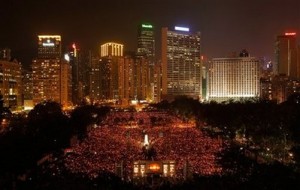
— “In the candlelight, speakers recalled the terrifying events in Tiananmen, where a military assault killed hundreds who had gathered for weeks in the square to demonstrate for freedom and even erect a makeshift statue of liberty. Those killed were eulogized as heroes in the struggle for a democratic China, their names read aloud before the crowd observed a minute of silence.”
— “‘Hong Kong is the only place where we can commemorate, and we have to repeat this every year so our younger generations don’t forget,’ said Annie Chu, 36, a Hong Kong tourism worker who says she has attended every vigil for the last 20 years”
Tens of thousands of people attend a candlelight vigil at Hong Kong's Victoria park Thursday, June 4, 2009, to mark the 20th anniversary of the June 4th military crackdown on the pro-democracy movement in Beijing. (AP Photo/Vincent Yu)
Daily Telegraph: Tiananmen remembered 20 years on
— “Fang Zheng’s last memory before he passed out was the sight of the bone popping out of his upper right leg as the Red Army tank rolled into him”
— “But he is convinced the protests were worth the sacrifice. ‘We exposed the brutality of the regime and we woke the consciousness of the Chinese people with our beliefs and courage,’ he said.”
— “And he is unperturbed by reports of apathy among Chinese students ahead of the anniversary. ‘The majority of young people don’t know what happened as there is no independent media,” he said. “We seemed apolitical before the 1989 protests and look what we achieved.'”
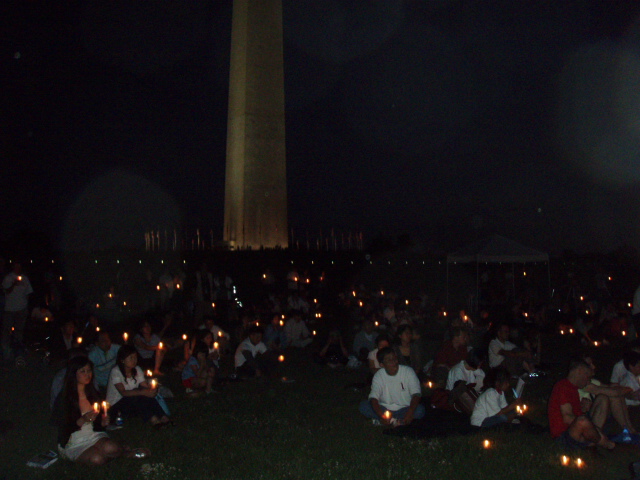
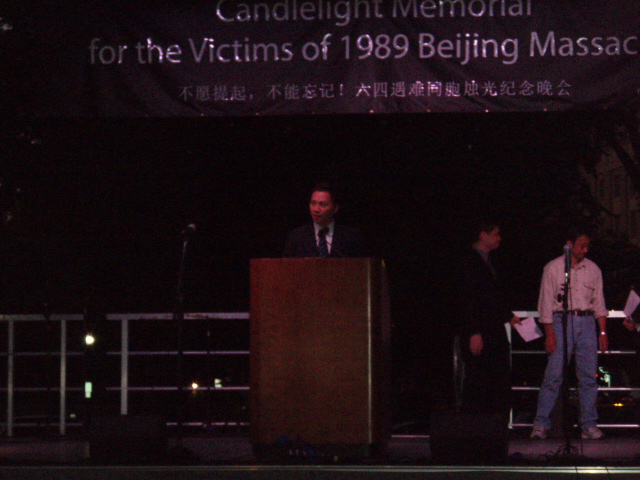
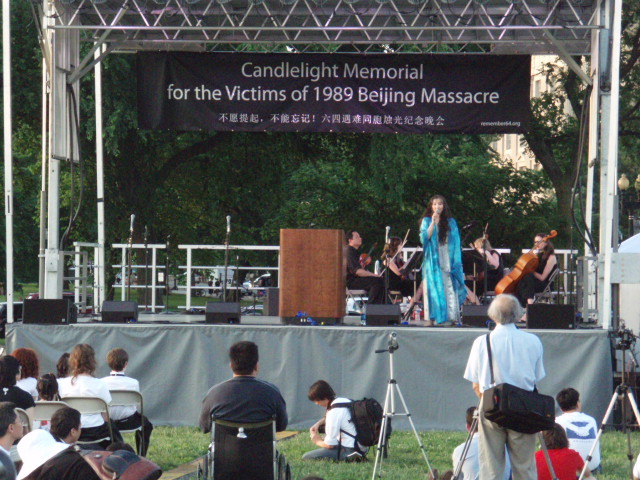
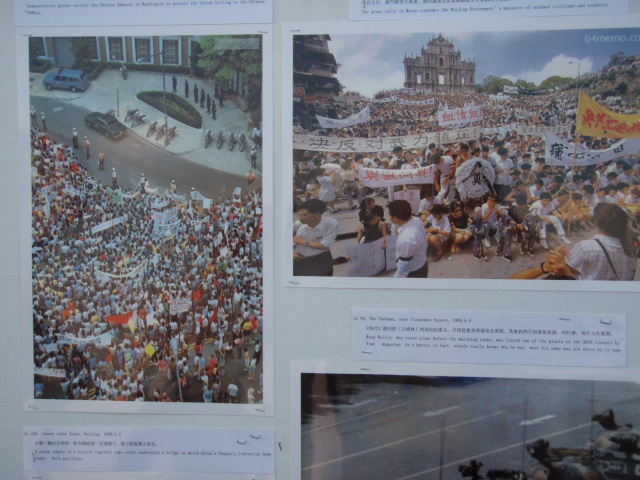
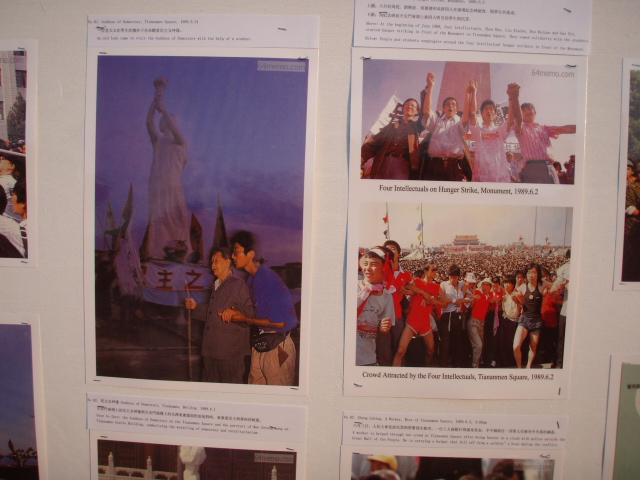
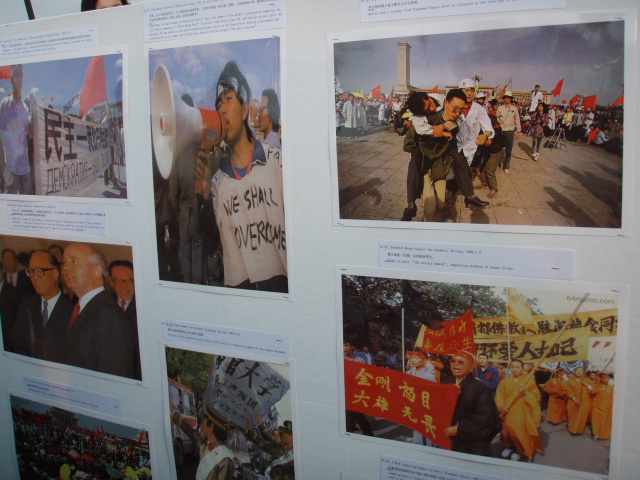
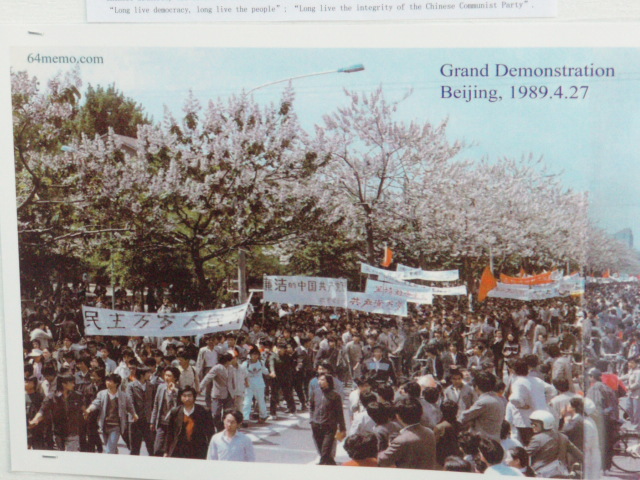
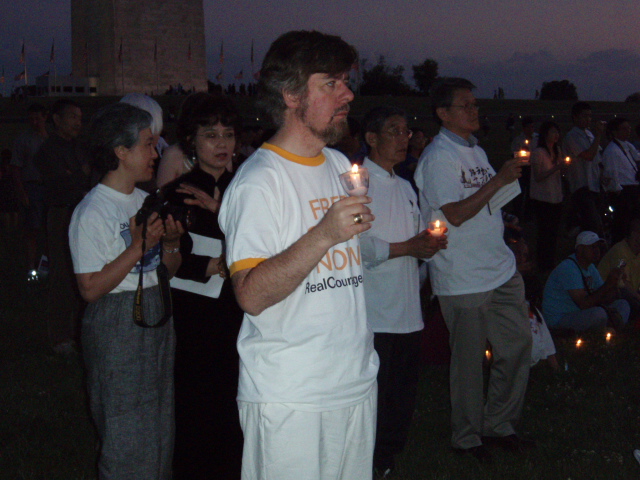
On May 30 near the Washington Monument in Washington DC, many people joined the candlelight memorial event sponsored by Remember64.org to see the photo exhibit of Spring 1989 events, listen to a concert by various musicians and a chorus, listen to speeches by guests, and to light candles remembering the martyrs for freedom killed on June 4, 1989 in Beijing.
May 30, 2009 Candlelight Vigil for Tiananmen Square Martyrs - DC's Washington Monument
An estimated 150-200 people attended the Remember64.org organization’s event near the Washington Monument on the evening of May 30, 2009. Attendees held lighted candles from dusk until 9:30 PM as the speakers recounted the events of the Tiananmen Square protests, speakers recounted the need to remember the protesters and their cause in fighting for freedom in China, and Ms. Bei Ming read the namesof the individuals known to be killed in the Beijing massacre of those protesting for freedom and democracy.
The Remember64.org organization had a photo display of many events that took place during the Spring 1989 protests in Tiananmen Square. From 7 to 8 PM, there was a concert by musicians Demian Yumei, Stacy Young, Zane, and Chris Davis. The Fairfax Choral Society Youth Chorus sang “Lift Thine Eyes” and “I Waited for the Lord.”
The speakers included:
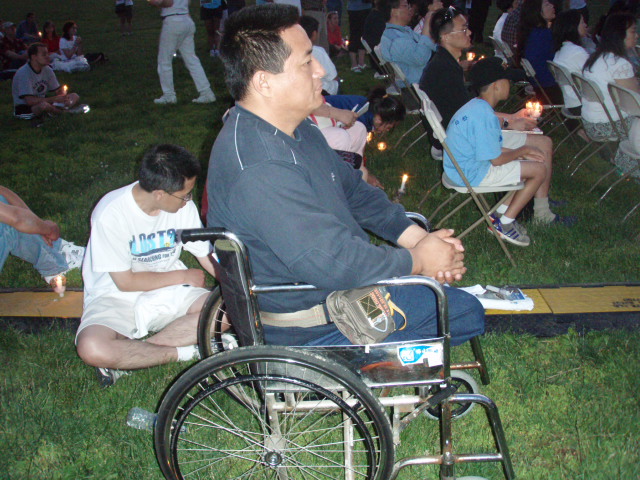
— Mr. Zheng Fang, former Tiananmen student, and a gold medalist and record holder of the All-China Paralympics Games. Mr. Zheng Fang lost both of his legs under the tracks of a tank during the Communist Chinese government’s massacre of the Tiananmen Square protests on June 4, 1989. Mr. Zheng Fang was presented with flowers by attendees at the event. Mr. Zheng Fang rescued a fainting female student during the tanks rolling over and killing Tiananmen Square protesters on June 4, 1989, but lost both of his legs as a result of his heroic efforts. Remember64.org writes that “In 1992, he won gold medals in discus and javelin throwing in the All-China Paralympics Games. However his dream of playing in Special Olympics was crushed. The Chinese government deprived him the opportunity to participate in the 2008 Paralympics because he has become a living symbol to the Beijing massacre.” I was privileged to meet Mr. Zheng Fang and shake the hand of such a living legend of heroism.
— Dr. Wang Dan, former Tiananmen student, and visiting scholar of Oxford University. Remember64.org writes that “Wang Dan was one of the most visible of the student leaders in the Tiananmen Square protests of 1989. After the June 1989 crackdown, he went into hiding and was arrested in 1990. He was sentenced to four years in prison in 1991. After being released on parole in 1993, he continued to write publicly and was re-arrested in 1995. He was sentenced in 1996 to 11 years. He was released on medical parole on 1998 and has been living in exile in the United States since. He received his Ph.D. from Harvard in 2008.” Dr. Wang Dan has called for all to wear white on June 4, 2009 “to remember the dead in a ‘white China.'”
— Dr. Wang Dan also made the following remarks during the May 30, 2009 candlelight vigil ceremony at the Washington Monument: “Why do we remember June 4, 1989? It was the brightest time in Chinese history 20 years ago, when thousands of students and civilians took to the streets to express their dream for democracy and freedom; it was the darkest moment in Chinese history on the day of June 4, 20 years ago, when the Chinese government resorted to bloody crackdown and machines of war, and suppressed the democratic movement. Today we remember June 4, because we must not forget those who died in the tragedy, who sacrificed their lives for their dream. They are the real heroes of our people. We remember June 4, because the 1989 democratic movement told the world that we Chinese are people of dignity; that we not only want to live a life of material abundance, but also a life of freedom and social justice. China has changed tremendously in the past twenty years. Among all those dazzling changes, some such as economic development justifying all social issues, such as the moral decaying of the society, are the direct consequence of the June 4 crackdown. Many things remain the same, such as the one-party rule and corruptions, which, again, are the direct consequence of the June 4 crackdown. We would not be able to understand the China of today without understanding ‘June 4, 1989.’ In the past twenty years, our pursuit of democracy has been met with countless obstacles and difficulties. However, we can stand here today and proudly declare that we are still holding on to our dream. This is our spiritual heritage of the 1989 democratic movement. Finally, I ask you to find all possible ways to appeal to people in China that, on this coming June 4, we shall all wear white to remember the dead in a ‘white China.'”
— Many of the attendees at the May 30 candlelight vigil were wearing white.
— Dr. Lee Edwards, Chariman, The Victims of Communism Memorial Foundation also spoke. Dr. Edwards reminded the crowd that the Victims of Communism Memorial Foundation also plans a candlelight vigil remembering the 1989 Beijing massacre at the Victims of Communism Memorial – at the intersection of Massachusetts Ave., NW, and New Jersey Ave., NW – on Wednesday evening, June 3, starting at 7 PM. The Victims of Communism Memorial has a replica of the “Goddess of Democracy” created by the Tiananmen Square protesters that was unveiled by the protesters on May 30, 1989. Dr. Edwards addressed his experience being invited to speak about American political views in Communist China, and addressing the failures of Communism including the deaths as a result of Mao’s Great Leap Forward, and also addressing the Tiananmen Square massacre. Dr. Edwards remarked that those listening in the assembly in Communist China refused to comment on the Tiananmen Square massacre. Dr. Edwards also called for the current Communist Chinese government leadership to acknowledge the Tiananmen Square massacre.
— Mr. Tao Ye, a co-founder of the Independent Federation of Chinese Students and Scholars in the U.S. (IFCSS) and a manager of the Tiananmen Mothers website also spoke. Per Remember64.org “Tiananmen Mothers, a group of mothers who pulled together after their children were killed, are direct bearers of this immense tragedy. The Tiananmen Mothers movement is the continuation and practice of the 1989 democratic movement, in the form of humanitarianism. Tiananmen Mothers is a classic example of the Chinese civil rights movement. Tiananmen Mothers is the trailblazer of the Chinese humanitarian movement. Tiananmen Mothers is the elaborator and propagator of modern values for ordinary people. Tiananmen Mothers is an indispensable civil force in this transforming stage of the Chinese society. Tiananmen Mothers is the first case of civil rights movement in modern China. It has subsisted in its native land for 20 years, from spontaneous assembly, to conscientious resistance, and finally, into the Non-Cooperation Movement of the Chinese Citizens. It is Tiananmen Mothers who have given faces to part of the Beijing Massacre victims, whose names we will read today. Each and every one of their testimonies is part of history. Their motto ‘Speak the truth; Never forget; Seek justice; Call on conscience’ is immortal.”
— The attendees lit their candles and the names ofthe known individuals killed in 1989 Beijing massacre were read by Ms. Bei Ming.
— Finally, the attendees were led by Demian and the Faifax Choral Society Youth Chorus in singing “We Shall Overcome.”
Additional Images of May 30, 2009 Candlelight Memorial:
Mr. Zheng Fang – Heroic Member of Tiananmen Square Protests who saved a life of a fellow protestor and lost his legs doing so
Mr. Zheng Fang - Heroic Tiananmen Square Protester
Dr. Wang Dan – Heroic Member of Tiananmen Square Protests who was imprisoned for his stand for freedom and democracy
Dr. Wang Dan - Heroic Tiananmen Square Protester
Musicians Performing at May 30 Candlelight Memorial
Example 1 of Photos of 1989 Protests Displayed by Remember64.org
Example 2 of Photos of 1989 Protests Displayed by Remember64.org
Example 3 of Photos of 1989 Protests Displayed by Remember64.org
Example 4 of Photos of 1989 Protests Displayed by Remember64.org
Example 5 of Photos of 1989 Protests Displayed by Remember64.org
Image of Crowd at Remember64.org Candlelight Memorial
We Pray for Peace at Remember64.org Candlelight Memorial