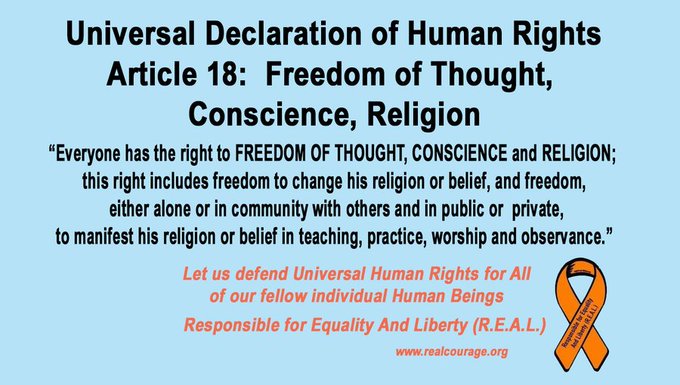
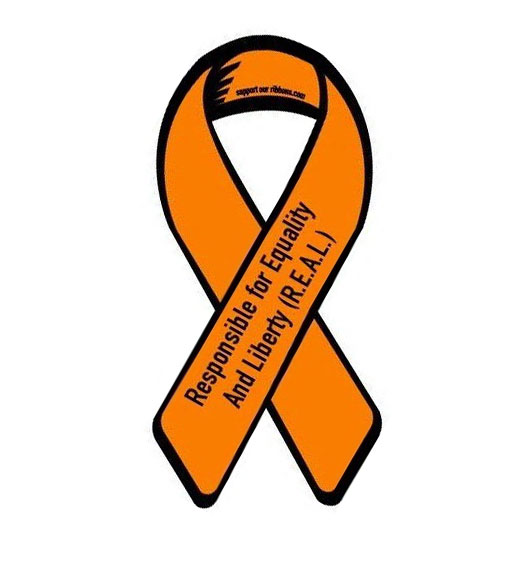
Responsible for Equality And Liberty (R.E.A.L.) advocates for the Universal Declaration of Human Rights (UDHR) on our shared Universal Human Rights of Freedom of Thought, Freedom of Conscience, and Freedom of Religion, (UDHR Article 18). R.E.A.L. notes the issuance of : interim report of the Special Rapporteur on freedom of religion or belief- “Freedom of religion or belief” A/76/380-“Attributes of Freedom of Thought.” This is posted at the United Nations website at: https://undocs.org/A/76/380. This interim report discusses: (a) freedom not to disclose thoughts; (b) freedom from punishment for thoughts; (c) freedom from impermissible alteration of thoughts; (d) enabling environment for freedom of thought. This interim report also discusses seven related issues: (1) torture or cruel, inhuman or degrading treatment or punishment; (2) surveillance; (3) coercive proselytism, anti-conversion and anti-blasphemy efforts; (4) intellectual freedom and education; (5) existing and emerging #technologies; (6) mental health; (7) conversion practices.
In addition with the global attacks on Freedom of Information, R..E.A.L. is also posting a copy of this interim report here at RealCourage.org.
R.E.A.L. also provides a link to this report in plain text format at: https://www.realcourage.org/freedom-of-religion-thought-un-10-2021-2/ (It seems wrong and counterproductive to require a shared report on Freedom of Thought to require a commercial company Adobe Acrobat to have an “account” to read the report.)
R.E.A.L. is encouraging public review and discussion of this interim report of the Special Rapporteur on freedom of religion or belief, on Freedom of Thought, Conscience, and Religion.
R.E.A.L. has been sharing this information on social media on Twitter at: https://twitter.com/realhumanrights/status/1499364992843460612
The mission for Responsible for Equality and Liberty has been to work in promoting a culture where mutual respect for our common universal human rights is part of our lives around the world. These include our universal human rights of life, security, safety, dignity, equality, and freedom as defined in the Universal Declaration of Human Rights (UDHR).
One of the most fundamental aspects of promoting human rights is being actively involved in defending these rights. That defense requires multiple methods: education, activism, defying oppressors, and defending those whose rights are being denied. Defense of human rights also includes the mission of law enforcement.
Local laws in free nations reflect such universal human rights. Where such laws do not reflect such universal human rights, it is our responsibility in democracies to get such laws changed. When it is not understood that the mission of law enforcement is in defending such human rights, history shows this is where nations get into trouble.
We cannot tell the world that we stand for human rights of oppressed people, but also say that when our brothers and sisters are being attacked by human rights violators and law breakers that we will just wait only for government law enforcement professionals to act.
If we think we have no role in law enforcement, then we are human rights hypocrites.
Some would think that speaking or acting when our brothers and sisters are attacked would be too brave, and perhaps that we should “mind our own business.” Being responsible is not “brave” at all. Our culture must work to make it clear that such responsibility is a basic part of being a citizen anywhere our world.
How could human rights activists not defy those criminals threatening human rights and associated laws? If we choose not to act with every little human rights abuser, how can we ever hope to have effective activism when confronting major human rights abusers? Our responsibility for human rights never comes from fear, but must always come from real courage. Every day. Everywhere. With no exceptions. If we need an army to protect the rights and law in our world, we are that army.
In the 21st century, we have also vividly been shown that the public cannot “outsource” the mission of law enforcement only to those government professionals.
If law enforcement is necessary to protect human rights, than support for law enforcement is not just the responsibility of government professionals. Law enforcement is also OUR responsibility. We have gotten away from this thinking. We have come not only to be dependent on government professionals, but also to believe we have no right to have a say in the enforcement of our own laws designed to respect our human rights. We have come to believe that this is someone else’s responsibility.
This misguided view has become so pervasive that even our government professionals within the police and courts have come to believe that indeed they are the only ones who can speak and act on law enforcement matters.
How can we surrender our role in law enforcement to only a limited number of government professionals versus a potential sea of human rights abusers and criminals? How? But this is the view of too many today.
Such government professionals cannot and will not be there all of the time when rights are abused and laws are broken. Building an ever larger army of such professionals in the delusional belief that will really ensure the protection of our rights and law is deceptive.
Who should stop a thug beating an elderly woman in the street?
Who should help protect a child being sexually abused, a woman being raped, or any of us being violently attacked?
Who should tell a thief to stop their actions, and take efforts to stop them or photograph them?
Why would this not be OUR responsibility as citizens?
Do we really think we should surrender our role in law enforcement in these areas?
Is this really just “someone else’s problem”?
Is this really only a problem for when the government professionals are available to act?
Thankfully for me as a child, such a “regular person” understood that we are all responsible for law enforcement. Mrs. O was an elderly black American woman in the public housing project where I grew up in Pennsylvania. I was a young boy delivering papers when I was knocked off my bicycle in the night by a criminal with a knife. The white criminal man came from behind me with a knife to my throat. He wanted my “collections” – a whole ten dollars.
Let me tell you, we almost never saw the police when I lived in the housing projects, and when we did, God love them, they were always too late. I understand many frustrated people on that topic. I know – I lived it too, and it in that case, it didn’t matter what your race was, we just were simply viewed as a “different class” of people. That is simply the way it was. Years, later, we eventually moved out of the project housing, and we still loved the police so much that my mother worked as a local policewoman, and I went to work at the FBI. We have loved the police. But we always understood that law enforcement is the responsibility for every citizen.
Mrs. O looked at the window in her house in the projects where I was being held at knife point. She could have done anything, and most would not blame her for looking away. She could have called the police, who everyone in “the projects” knew would show up when they felt like it. She could have let two white guys settle it out. She could have let some other, younger, neighbor deal with it. She could have rightly been afraid that the man with knife might do something to her, if not then, he could retaliate later. When we choose fear and indecision, we have so many options and choices.
But it was a dark winter night, and Mrs. O didn’t do any of those. She stepped outside in the cold dark unafraid, and with the sternest voice she could muster, she told that man to drop that knife and leave me alone. And he did and fled. So Mrs. O is always going to be my personal hero. But she wouldn’t view it that way at all. Not at all. It was simply the responsible thing to do. If she hadn’t been responsible, everything I have done to try to help in human rights or anything in my life might not have never happened. That’s how essential it is for us to be responsible for the law enforcement and human rights of our fellow human beings.
We don’t have to surrender to those violating our human rights and laws. We don’t have to depend on government professionals to solve all our problems in human rights and law enforcement. But this is more than just being responsible, we really need to rethink if we are taking the right approach to law enforcement in general.
Over the past decade or more, in the United States of America, we have come to think that we need to supersize our law enforcement agencies and their resources, mostly due to terrorist threats. The downside to this type of thinking is the idea that we can somehow “outsource” our individual responsibility for law enforcement. I can tell you from personal experience, and I am sure many of you could too, there is no way that we can do that. We need to all be responsible for law enforcement.
When considering law enforcement, the only “them” versus “us” that there should be are those who respect human rights and the law, and those who do not. It really must be that simple. That begins with the view that we are not waiting for someone with a badge to protect the rights and safety of our fellow human beings.
The other problem with the idea of a “standing army” of law enforcement government professionals is how to keep them effectively employed. We cannot have any such domestic law enforcement armies who become beholden to arrest rates and statistical averages to justify their professional employment.
The New York Post recently reported with horror that the NYPD will “only make arrests when they have to,” as if this was something bad. If we have so many idle police professionals who think that they need to be making arrests when they DON’T have to, we have a real problem there. Perhaps we need more citizens willing to stand up to criminals and less of a “standing army” looking for something to do to justify budgets and salaries.
In the local Washington DC area, especially over the past several years, I have witnessed excessive use of police activity for questionable productivity. Last week, I saw traffic stopped for miles as a 40 motorcycle police force delivered a police officer dressed as Santa Claus to some event. I am sure it was worthy, and I am certainly I am big fan of Santa Claus (!), but we really need to have some degree of balance in the use of our government resources. A “standing army” looking for something to do is going to increasingly do less to protect human rights and the law, and get more in the way of such human rights and disrupt public order. Our police should be busy enough that they do only arrest those they need to arrest. When we think that balance is a problem, we need to reconsider our professional resource allocations in law enforcement. But the fundamental answer has to be more involvement by the public in law enforcement. Professional law enforcement cannot and will not be everywhere.
The same city in Pennsylvania, where Mrs. O stood up against a knife-wielding attacker to save my life, has changed a great deal in the past decade. No doubt much of this is economic pressures. But there is something else, the growing view over time that law enforcement is someone else’s job. The street I moved to after leaving the housing projects has become a war zone, with gun fights in the street, and shooting in front of churches. In this city, the ice cream stands have become a haven for drug dealers and criminals. Elderly women are being robbed, beaten, raped, and killed for a handful of dollars – in broad daylight. Children are being regularly sexually abused by predators, starved to death by their parents, and thrown in the trunks of cars and abused by “upright parents.” Even a nun is raped in broad daylight. This is where I grew up. It makes me sick to my stomach. That is what happens when you abandon respect for human rights and law, and you surrender your law enforcement responsibility to the “professionals.”
The government professional police in this city? Well, they learned the lesson our nation is going to learn. There aren’t enough police, and there can’t ever be enough police. More badges wasn’t and isn’t the answer for effective large-scale law enforcement. The local area simply can’t afford it, and even if they could afford it, there wouldn’t be enough. Until more of the people have a zero tolerance attitude towards criminals, there couldn’t be enough police.
When you surrender your responsibility for law enforcement, you surrender an important part of being the citizen of a community. We in human rights need to be a part of that. Criminals are enemies of human rights. Criminal are enemies of the human rights of security, safety, dignity, liberty, and equality. Criminals have rejected those shared human rights priorities for their own rules and their own selfish priorities.
It is our responsibility to defy and stand up to such criminals, whether they are a thug on the street or they are Sudan’s Omar al-Bashir. A criminal is a criminal. A human rights violator is a human rights violator. They don’t need to just fear the enforcement by government law enforcement professionals. These criminals need to expect the rejection, the contempt, the disgust, and the active defiance by the citizens of the world. The answer to law enforcement is seen by looking in your mirror. They are our responsibility.
The answer to protecting human rights and stopping criminals is not simply more arrests, but more public rejection, contempt, and defiance to criminals. I wouldn’t be writing this, if Mrs. O hadn’t come out her door on that winter night. This type of story is repeated many times around the nation and the world. These stories of public law enforcement don’t make the headlines or the professional statistics, but without a public responsibility for law enforcement, we can’t possibly have enough police professionals to do their job.
Work in professional law enforcement is grim and demanding. When I worked in the FBI, every day was about murder, rape, sometimes finding out information on body parts of mutilated people to help find their bodies. It was about every amoral thief and psychopathic killers. That is very grim stuff. But with all due respect to those brave men and women in law enforcement, I disagree with the politicians who say that professional law enforcement is the “toughest job in the world.” We have people in every profession with the “toughest jobs,” including medical personnel dealing with the terminally ill, soldiers literally facing life and death situations, those trying to teach the disabled, those saving lives in our hospitals and clinics, and men and women working their hearts out every day to provide a basis for this nation and for this world to survive. They all have very “tough jobs.”
Our politicians need to stop denigrating every other profession, and politically positioning government professionals in law enforcement as the only exceptional position as the answer to crime. That is not true, and does no good for law enforcement and law and order. It perpetuates this misguided “blue” versus everyone else thinking.
Most dangerously, it perpetuates the misguided myth that without government professionals there would be no law enforcement. Wrong. If we are not sharing the “toughest job” of law enforcement, our social responsibility for one another needs to change.
Human rights and law enforcement are the responsibility for all of us. Everywhere. All the time.
Ladies and Gentlemen –
Good afternoon. My name is Mohamed Yahya, and I am a survivor of the genocide in Sudan and Darfur. I lead the Damanga Coalition for Freedom and Democracy. I would like to thank the UNHCR, the UN Office for Partnerships, and the Book Wish Foundation for the invitation to speak to you today. I am deeply moved and grateful that proceeds from the book “What You Wish For” will be used to develop libraries in Eastern Chad refugee camps where many of my fellow Sudanese refuges live. They need hope, they need dreams, and they need their culture and history. I too was a refugee from Sudan, before ultimately coming to this country, and so I can tell you it means a lot to me. This is a great initiative by the Book Wish Foundation, and we can’t thank you enough for this program to help provide libraries of books to help the lives of the surviving refugees in Chad. We express our great gratitude in your efforts to help Sudanese refugees in Chad who had lost hope in getting an education. With the ongoing genocidal war, they lost the lives of their loved ones, lands, farms, belongings, animals, and properties. We also extend our thanks to those you who visited Darfur and Chad several times, putting your lives in the front to save the lives of others, providing them with the necessary means for survival or education.
As human beings, we are inspired by our wishes, our ideas, and our dreams. Many of these we find in books. Books help us grow. Books help make us who we are. Books help give us freedom.
In the West, I have read books that speak of great ideas and philosophy, including writing by Nelson Mandela. I have read great poetry and I enjoy Edgar Allen Poe’s poetry. I have read great books of drama and struggle such as those by Leo Tolstoy. I have read great religious books from people of all faiths and different philosophers. I have read many inspirational and historical books from around the world and in different languages. These books tell great stories, provide great education, and inspire great ideas.
I ask you to imagine this. What if you were not allowed to read them? What if you were not allowed to read books, poems, history books about your culture and your heritage? Books help us grow. But what if someone refuses to let you read them? This is what has happened in Sudan and Darfur, under Sudanese President Omar Al-Bashir.
Imagine if someone tried to take your imagination, your history, your culture, and your books away from you? That has been the case in Sudan and Darfur.
Sudan’s Omar Al-Bashir has led a long genocide against people in Darfur and Sudan. But the genocide is not just killing my brothers and sisters there. The genocide is also trying to erase their culture, their heritage, their ideas, and their dreams.
Imagine if someone tried to prevent books on your culture, your history, and your dreams – to try to erase your identity. That is how genocide begins.
It is a crime against all of humanity, including all of you here. We need the genocide to stop, and we need to heal the Sudanese and Darfuri people who have suffered.
This is why the work you are doing with this initiative is so important not only just for the Sudanese refugees, but also for humanity. We thank you and humanity thanks you.
I wish to recognize all those involved who have sought to defend in some way, the struggle of the Sudanese and Darfuri people from the genocidal war. I wish to recognize all those even killed, raped, or kidnapped while performing their duties, from UN peace keepers to individuals, workers, staffers, teachers of the World Food Program, UNHCR, US AIDS, International Rescue Committee, Enough, Our Humanity In The Balance, Darfuri Associations, African Union, European Community, Physicians for Human Rights, I-ACT, Stop Genocide Now, Save Darfur, American Jews Service, Mia Farrow, human rights organizations, UNICEF, Save the Children, Red Cross, Doctors Without Borders, Darfur Interfaith Network, Eric Reeves, Humanity United, Responsible for Equality And Liberty, Change the World It Just takes Cents, American Jewish World Service, Jewish World Watch, Massachusetts Coalition to Save Darfur, Refugees International, Radio Dabenga, Amnesty International, US Holocaust Museum, Sudan Now,Africa Action, and more.
Someday, you too will be in the books of history. We need to finish the job to end the genocide and to bring freedom to Darfur and Sudan, so that those people will be allowed to read such books.
The Darfuri refugee camps have asked me to bring to your attention, including the UNSC and the US Mission through the UNHCR, the following actions that are urgently needed:
1- The Darfuri refugees are asking for a Non-Fly Zone over Darfur and all the affected areas to stop the Sudanese government’s bombings and protect their lives outside and inside camps and villages.
2- The Darfuri refugees are in need of help to build them more schools, libraries, and a refugees’ university near the Chad border with Darfur to absorb students, who might otherwise end up on the streets or become recruited as a child soldier after high school.
3- We appreciate your ongoing efforts for a peaceful settlement to the Darfur conflict. But the real lasting solution to Darfur conflict should start with justice. Therefore, we need you to support the ICC to bring Al-Bashir and all suspects to justice. Then peace will come and all refugees will peacefully returns back home.
4- We ask all to give full access to the humanitarian organizations and aid workers to reach all refugee camp with shelters, medicine, clean water and food supplies.
Once again we thank you all for your efforts and this wonderful initiative for libraries for the refugees. We share your commitment to ideas, learning, education, and hope for a future of peace, respect, dignity, and human rights for all people.
Mohamed Yahya
===========================
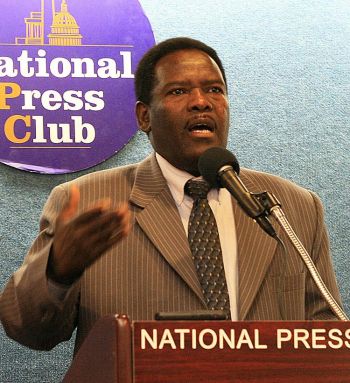
Mohamed Yahya, Damanga Coalition Speaks on Human Rights, at National Press Club on Human Rights Day Event, December 9, 2010 (photo: Epoch Times)
— Oslo and Finding the Courage to Change — A New Dialogue (Part II)
Once again, as I write this, there are those who claim to want to threaten my hometown and America’s national capital. We have seen it many times over the past 10 years. We have seen the barriers, the security procedures, the National Guard, and the police riding our subways with machine guns.
But once again, the path to peace anywhere in the world, Washington DC or New York City, the Middle East, Africa, Asia, and Europe – begins with a dialogue of peace.
Such a dialogue requires the courage to change the dialogue of the past and embrace the opportunities that we have to work together as fellow human beings to achieve change in our societies and our world.
At the end of July, I wrote of the terrorist attack in Oslo, Norway by confessed terrorist Anders Behring Breivik. I wrote about the need to comfort those who lost their lives and families of children whose lives were lost in the July 22, 2011 terrorist attack in Norway. I wrote of the need to balance our disagreements with dignity and compassion, and the lessons that we must continuously learn and teach from such violence.
At the end of August, I wrote details about the challenges of extremists in various groups. This includes extremists in the Anti-Islam group that Mr. Breivik claimed to represent as well as the Bin Ladenists who continue to commit and threaten terrorism around the world. My Christian friends reject the oppressive message and terrorist actions of Mr. Breivik, who sought to view himself as a “Christian crusader.” My Muslim friends reject the violence and hate of the Bin Ladenist movement. I embrace the efforts of all my brothers and sisters in humanity to pursue a path of compassion and human dignity.
These terrorists do not represent us, and we must not allow them to claim that they represent the “culture” of our faiths. It is the responsibility of people of such faiths to continue to make this clear to the world, not just with their words, but more importantly with their actions.
We must find the courage to seize the opportunity for a new dialogue on our freedom of speech and responsibility, to develop a new approach to our cultural ownership, to choose a new dialogue regarding religion and human rights, and to choose love, not hate not just in our hearts, but in our minds, in our words, and in our actions.
1. A New Dialogue on Freedom of Speech and Responsibility
We cannot have any dialogue without freedom of speech. When we fear to communicate and to disagree, then people stop talking and start plotting on how to overthrow “the other” (whoever that may be). So whether we agree on someone else’s views or not, let’s remember that if we deny their freedom of speech, we undermine the ability to build any type of dialogue in the future. I talk with a lot of people that I disagree with – in many different areas. Some people may choose to view me as an “enemy.” But I have no enemies; I only have brothers and sisters in humanity. That is what all must seek, no matter how disagreeable or how difficult that may be at times.
But while we work to support the freedom of speech for all, we must also work to build a greater sense of responsibility to use our words constructively. We can use our words to build, not destroy. We can use our speech to heal, not to divide. We can use our rhetoric to hope, not to hurt. We have a choice, and we also have a responsibility to our society.
We cannot legislate responsibility or our brothers’ and sisters’ thinking. They have universal human rights to say and think what they choose. While we have laws to protect people from violent threats and danger, the real work in building responsibility is by showing responsibility ourselves. We must spend less time pointing fingers and more time extending our hands in human fellowship. We must spend less time in dialogue with those who share our views, and more time listening to others with whom we disagree. We must set an example in being responsible for both freedom and dignity.
Building responsible speech in our societies is hard, grueling, thankless societal construction work. We will win no awards, get no supporters, obtain no donations, and get no accolades for the construction work of building respect and dignity for one another in our communications.
But imagine how our society would struggle if we had no construction of roads, of sidewalks, of building, of electricity. Imagine our homes with no windows or no doors. We depend on such thankless construction for our daily lives and our daily interaction with the world.
We must make a renewed commitment to such construction for peaceful, respectful construction in communications with our human brothers and sisters. A new dialogue begins with choosing to be responsible for showing dignity towards one another.
2. A New Approach to Cultural Owners
Imagine a home with no windows, no doors. It would be a tomb, or perhaps even a cell. In many parts of the world, our brothers and sisters in humanity live in such prisons. They are imprisoned for choosing freedom, for choosing dignity, and some simply because of their identity, including their religion. We see people of all types of faith imprisoned around the world in oppressive states for their faith, or by those who discriminate and oppress them for their faith.
But the jailers are also in jail themselves.
We must seek and work towards a new approach to cultural ownership, where our homes have windows and doors, where our cultural homes allow us to see and talk to one other, where our cultural homes allow the light of day and the stars at night.
Mr. Breivik’s terrorist attack was for what he called a “Christian culture,” and the Bin Ladenist movement seeks what they call an “Islamic culture.” My Christian and Muslim friends reject both extremist views. But we must do more than just reject extremism. We must also answer the more difficult questions in our societies about our insecurities regarding our cultures.
Many are adverse to change, and the globalist movement of the 20th century has caused many great concern. They fear local and traditional views will be challenged and even lost. Some have rationalized that the answer should be found in cultural tariffs to keep people of other cultures, other races, other ethnic backgrounds, other religions, other identity groups – OUT – of a culture that they don’t want to change.
But history has shown that the effort to build such cultural tariffs and cultural walls are doomed to failure. Oftentimes, such efforts have had catastrophic and horrific results. We have seen some examples with Adolf Hitler’s Nazi Germany, racist segregationists in the United States, Communist totalitarian nations, genocide in Darfur, and the endless waves of violence against religious minorities in the Middle East and Asia. History shows that the efforts to build walls around our cultures have many, many bad endings.
There is a great misunderstanding that comes with the closed minded views on isolated cultures. We have seen this with the manifesto of the terrorist Anders Breivik, who also used his attack (not unlike the Bin Ladenists) to reject what he calls multiculturalism. This misunderstanding comes from a basic confusion over what our responsibilities are involving multiculturalism.
Multiculturalism is not about submission or surrender. It is not about sacrificing our cultures. We do not have to agree or even like other cultures. Multiculturalism is not about any of that. The important point for human dialogue is simply that we show dignity and respect for others and their differences, regardless of whether we agree or whether we like them, simply because they are fellow human beings.
Fear and doubt can be greater motivators to build walls. But if we are serious about building security not just for this moment, but also for our children and the generations to come, we must build more doors and more windows. We must not be afraid to look outside.
A new dialogue begins with the realization that we must share our Earth together. Not only do we need to be heard, but also we need to be able to listen.
3. A New Dialogue on Religion and Human Rights
People of faith must seek the opportunity to build a new dialogue on religion and human rights. We have to reject the idea that our faith does not allow human rights, human freedoms, and religious freedom for our human brothers and sisters.
To people of all faiths, I ask you to look not only to your heart, but also to your soul. We must find something other than fear, hate, anger, bitterness, and rejection in ourselves, in our thoughts, in our words, and in our lives.
We are better, we are bigger, we are more decent than what we have seen in the dialogue over the past 10 years since the 9/11 attacks. We are more courageous than to let people of faith suffer in prison cells and in oppression around the world, simply because of their faith. We have more confidence in our faith than to seek to deny our brothers and sisters their own houses of worship and their freedom of conscience – anywhere and everywhere in the world, without exception, without caveat, without condition.
We have greater voices and greater power together than the extremists among us who would denigrate others, oppress others, and even cause harm and violence to others. We outnumber even the greatest mobs with torches, with our countless masses that can choose to stand for freedom and dignity for all.
We must not let the Breiviks or the Bin Ladenists speak for us. We must not our silence ever be interpreted as apathy, or God forbid, consent.
We do not pray for fear, we do not pray for hate, we do not pray for indifference, and we do not pray for weakness. To people of faith, I say that we must be who we say we are, and take the responsibility to live as courageously as we pray.
We must lose the mask that too many wear of cowardice, indifference, and despair. We are more powerful than that. We are people of faith, blessed by a higher power to give us guidance and courage.
We are not better than our fellow human beings, but we are blessed to offer the chance to reach out to our fellow human beings. We must never let ourselves believe that blessing is a license to reject, to oppress, to demean, to hate, and to hurt our fellow human beings. Our blessing of faith must be cherished like the gift that it is.
My Muslim brothers and sisters have stood by my side many times, in many forums. They have stood by me in women’s rights events, in challenging stoning, in standing for religious freedom, in defying violence and hate, and in remembering those who have lost their lives to extremists. They have shared their heart break with me over the abuse of Christians, other Muslims, and other religious minorities in many parts of the world. They have stood with me in challenging the Bin Ladenists and their views. While this may get little reporting by the news media, I know this is true, I have seen this over and over with my own eyes, and heard this with my own ears. We need to reach out to greater numbers of our brothers and sisters on these issues.
My Christian, Buddhist, Jewish, and Hindu brothers and sisters have also stood by me in these and similar human rights events, over and over again, in different parts of America, and in joint event for human rights in Europe. We still need to encourage more of our brothers and sisters to be involved in such issues.
I don’t offer a message for a new dialogue on religion and human rights based only optimism, but it is also based on years of personal experience witnessing this dialogue developing, seen with my own eyes and heard my own ears.
A new dialogue is developing and will continue to develop among people of many faiths and none at all – while we continue to remember our shared humanity, and while people of faith remember their shared blessing.
4. A Message to My Christian Brothers and Sisters
I am a Christian. Therefore, I also have a special direct message to my Christian brothers and sisters on this need to build a new dialogue of hope, respect, and dignity.
The terrorist attack of Anders Breivik and his calls for “Christian culture” was a deep insult to Christians around the world. A number of Christian commentators dismissed Mr. Breivik by stating that he was not really a Christian, but viewed himself as a “Christian agnostic” who liked what he viewed as the “cultural” traditions of Christianity, without actually having any faith.
While it is easy to dismiss Breivik, I would caution my Christian brothers and sisters not to do so too easily. While millions seek to promote a different type of “Christian culture” than the one that confessed terrorist Anders Breivik sought, he is not an “isolated incident.” There are too many others to believe this. We have seen the Hutaree, the racist “Christian Identity” movement, the African Lord’s Resistance Army (LRA), Ugandan extremists, and the Westboro Baptist Church. We have seen pastor after pastor join marches to deny religious freedom, and some who have led Qur’an burning campaigns. We have seen dozens of Christian pastors joining groups that seek to deny the rights of other religions. We have seen well-known pastors on television call for violence attacks on Washington DC, and some who have called for natural disasters as religious justifications to push a political agenda.
For every one of these extremists, there have been hundreds, thousands of Christians who actively reject their views. These very vocal extremists are a small fraction of Christians. But does that diminish our responsibility to reach out to them, counter their views, and offer a different dialogue?
So yes, it is no doubt that Mr. Breivik was not really a “Christian,” as we know it. But let us not get so arrogant to ignore the plank in our own eye, and the growing climate of intolerance, of disrespect, and even of violence that continues to grow in some corners of people who seek to redefine what we view as “Christian culture.”
While I may offer advice to my fellow Christians, let me be clear that I do not suggest that I am a “Christian leader” or an authority of any kind. Hardly. I am nothing of the kind. I am a poor sinner, weak, and imperfect. I am an average person, who has made enough mistakes to fill any book. But our God gives us all a chance, even to the least of us, to make a difference. If we believe in our Christian faith, our evangelism is not what we say, it is what we do.
What we do – is not enough. Not nearly enough. That is hard is to say and it is hard to hear, when we must feel that in this difficult world and economy that we do so much.
But whenever we believe we have right to be arrogant, disrespectful, cruel, and thoughtless, then we are allowing the definition of “Christian culture” to be undermined and attacked. Even a poor sinner like me can see this.
Our Christian culture is nothing if it is not first based on humility, respect, mercy, and kindness. We may suffer and struggle. We may be abused and disrespected. But to my Christian brothers and sisters, we have faith that Jesus Christ died on the cross for our sins and our opportunity for eternal life. Our Christian culture is a culture of sacrifice, selflessness, compassion, and love. It is not simply enough that we Reject Hate. To the Christian culture, it is also imperative that we Choose Love.
5. Our Unity and Dialogue in Our Shared March of Life
Whatever our identity group, our religion (or none at all), our nationality, our race, our ethnic group, or our gender, we are ONE. We march together every day of our life in solidarity. Our solidarity is in our lives together in the human race that we share.
That march of life that we take every day together around the world allows us to share the dawn, the sun, the sky, the sea, the air, and the stars together. Our home. Our shared Earth for all of us.
On some days, that march of life is a struggle, for others it is an adventure. To all of us, our march of life is a constant opportunity not only for ourselves, but also for our society and the future for all.
For our shared march of life, we need more than the stones of angry words. We also need the building blocks of respect, patience, and the willingness to listen, even (especially) when we disagree. We can grow beyond the history of where we have been and where we have failed, and we can work towards our possibilities of what we could achieve by respecting and gaining faith in one another.
The march of life requires more than closed cultures with border gates that prevent us from walking together. We need pathways to see and understand one another.
Our march of life together requires that we not only have faith, but that we demonstrate that faith in showing dignity, mercy, and respect to one another.
But most of all, our march of life requires more than just the faith in our religions (or none at all) or in our ideas. We need to work to build a new dialogue with our fellow human beings so that we can trust each other more. We have don’t have to agree with each other to respect each other. We don’t have to share each other’s views to love one another as fellow human beings.
Our march of life together does not just have to have the background of rush, confrontation, and conflict. Our march of life can be to a new anthem, a new dialogue of respect, compassion, and love for one another.
This new dialogue must not just be in our words, but also must be an internal dialogue as to how we think about each other, and how we act towards one another. We have seen enough violence, we have seen enough pain, we have seen enough suffering, and we have seen enough hate.
We can make another choice, and work to build a new dialogue for future generations.
We can choose a new dialogue based on respect, dignity, compassion, and love for one another.
This year, as so many mourn the 10th anniversary of the terrible terrorist attacks in America on 9/11, let us remember more than just victims. Let us honor their lives, their joys, and their hopes. Let us honor their dreams, their faith, and their hearts.
Let us Choose Love, Not Hate. Love Wins.
Orange Ribbon for Universal Human Rights - Responsible for Equality And Liberty (R.E.A.L.)
As a child, I remember my elementary school teachers condemning my search for balance in “social studies,” where I sought to understand the rationale behind different people’s views on topics of the day. I was taught, with great anger by my teachers that I had to take only one position, one side. I could not understand both sides of the argument and seek to find a solution that respected everyone. That was simply not acceptable to my public school teachers in the 1960s and 1970s; I had to take an inflexible stand on only one position. In “social studies,” I consistently had this challenge with my public school teachers.
In the 1970s, I remember being the only one in the classroom with a specific position on then President Richard Nixon, who was under attack due to the Watergate scandal. I was going to summer school to take extra classes during the summer so that I could take more classes during the regular school year. The “social studies” teacher was convinced in Nixon’s guilt, and while I personally and politically objected to Nixon, I wanted to find out the results of the investigation first. This made me a pariah to both those who hated Nixon and those defended Nixon. They shouted at me: How dare I wait for the investigation? How dare I not take a stand on Nixon?
For impressionable children, decades of being pressured by their teachers and pressured to reject FAIRNESS and BALANCE no doubt impacted some of my classmates. Perhaps if my teachers had been more subtle and less heavy-handed in their tactics to force me to reject fairness and balance, I too would have succumbed more in that area. But their tactics had the reverse impact, their forcing me to stop asking questions and understanding the view of others forced my mind to stay open, not closed.
But for how many of the Baby Boomer Generation in America was the very idea of “the middle ground” lost forever?
The effort to destroy the view of “the middle ground” remains a fixation in the minds of many.
We are told that:
— You are either right or wrong.
— You are either with us or against us.
— You are either part of the solution, or you are part of the problem.
— It is either my way or the highway.
— You are either Democratic or Republican, left or right, liberal or conservative.
This binary totalitarianism remains a choke point to our society in America and the world today — seeking a simplistic answer to every problem — that often does not exist.
In a nation and a world where education and understanding is essential to the long-term survival of the human race, we are taught that the greatest danger is “paralysis of analysis.” How dare we get caught up in THINKING, so much that we don’t act precipitously?
This rigidity of thinking seeks to silence discussion, end debate, and constrain the search for solutions – by offering only
In a culture of do, do, do, we need to stop sometimes and think, think, think.
America is an impatient nation, and sometimes we need to be impatient. But our young nation has to have learned by now that we can’t solve every issue through impatience and force disguised as “resolve and determination.”
There are many issues and problems that need human attention. Some can be solved quickly, some won’t be solved in the near term, and some simply need to be discussed so that human thinking on the issue can evolve.
But we won’t do that if we continue to teach generation after generation, decade after decade, that there is never any room for a middle ground in human understanding in our differences.
We are not binary calculators or computers. We are human beings. Let us defy a tyranny of the loudest and most impatient voices that seek to define our choices for us.
Let us instead try to use our human brains we have been blessed with to think of all of the solutions we can find to our problems and to preserving our universal human rights and dignity for all.
Most importantly, as fellow human beings in understanding human problems, let us treat one another with the respect and compassion that we would seek for ourselves.