R.E.A.L. Announcement August 30, 2017. In our commitment to human rights, security, and democracy, R.E.A.L. published a major 26 part analysis of the background and continuing threat of Anarchist, Anarcho-Communist terrorism and violence in America. This has represented a wide variety of bombings, shootings, suicide bomb, firebombs, and other terrorist attacks on American public. Regularly Anarcho-Communists hijack legitmate concerns to promote and incite violence, and the current “Antifa” campaign is intended to manipulate concerns on racism to promote an agenda of national violence and insurrection. We urge Americans to become educated on this issue, and reject such violence. Choose Love, Not Hate, Love Wins.
Category: Terrorism
Charlottesville and Continuing Challenge of Nazi Hate & Terrorism – 1 Killed, 34 Injured
R.E.A.L. sends its sympathies and prayers for all of the victims of violence and hate in Charlottesville, Virginia on August 11 and 12. R.E.A.L. calls for the American public to reject the forces of hate and violence, and condemn the ideologies of Nazi and white supremacist extremism.
R.E.A.L. has challenged Nazi anti-human rights extremist movement, since our founding, and has widely reported on the extremist views of these groups, including repeated acts of terrorism by some Nazi terrorist groups. R.E.A.L. has reported on the “war of ideas” with Nazis, as well as white and racial supremacist groups for many years. As a result, R.E.A.L. has regularly been the target of Nazi hate and death threats. To be specific, R.E.A.L. and its leadership has been the target of threats by members of National Vanguard Nazi Party, Stormfront, and other Nazi and white nationalist organiations for over a decade.
The Nazi slogans, images, that we have seen from attendees at a recent white nationalist movement in Charlottesville, Virginia event and subsequent riots have become normalized for too long, when they need to be viewed as unacceptable.
As we saw on the night of August 11 and then again on August 12, 2017 in Charlottesville, Virginia, groups such as the Vanguard America (VA) white nationalists marched to the Nazi chant “Blood and Soil,” which was popularized by Adolf Hitler’s Nazi Germany “Blut und Boden.” In Adolf Hitler’s time, this was ideology was linked to German racial purity and control over “its borders,” while at the same time Nazi Germany sought to take over the borders of other nations.
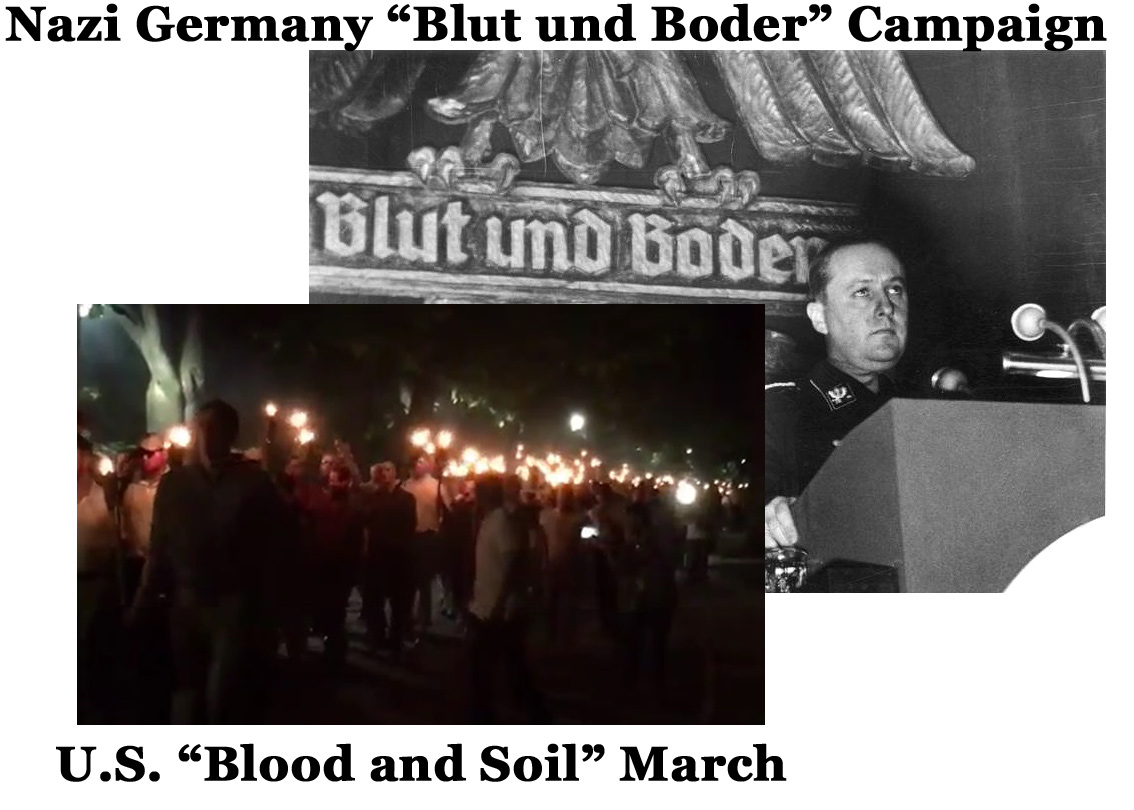
In the case of the American group “Vanguard America (VA),” they seek to make the United States of America as an exclusively white nation. The Vanguard America movement seeks to create an America that “is to be a nation exclusively for the White American peoples who out of the barren hills, empty plains, and vast mountains forged the most powerful nation to ever have existed.” Vanguard America is a member of the multi-state “Nationalist Front (NF)” Neo-Nazi organization. It is one of many other Nazi groups in the U.S., including the “National Vanguard” (formerly “National Alliance”) that is headquartered in Charlottesville, Virginia.
The Vanguard America group is not unlike other Nazi “Vanguard” groups, which have threatened R.E.A.L. for many years. The “Vanguard America” group also promotes vile anti-Semitic remarks and hate ideologies including posters titled “Beware the International Jew.”
In the United States of America, we have seen too many Nazi-inspired terrorist attacks over the past decade, including Washington, DC, Overland Park, Kansas, Oak Creek, Wisconsin, Oklahoma City, Oklahoma, Columbia, Tennessee, Lafayette, Louisiana, Bells, Tennessee, and links of the Charleston, South Carolina terrorist Dylann Roof to pro-Nazi ideology.
With the violence and the death of a counterprotester Heather Heyer, in Charlottesville, Virginia, it appears we now add it to this list of infamy. The police have charged James Alex Fields, Jr. of Ohio, who has been charged with held on suspicion of second-degree murder, and malicious wounding, and vehicular attack which led to one death and 19 injured.

Photographs in Charlottesville linked Mr. Fields to the Vanguard America group. The Charlottesville police chief indicated that the vehicle attack was “pre-meditated.” The FBI is investigating what many consider to be a terrorist attack. James Fields is scheduled to be arraigned on August 14, 2017.
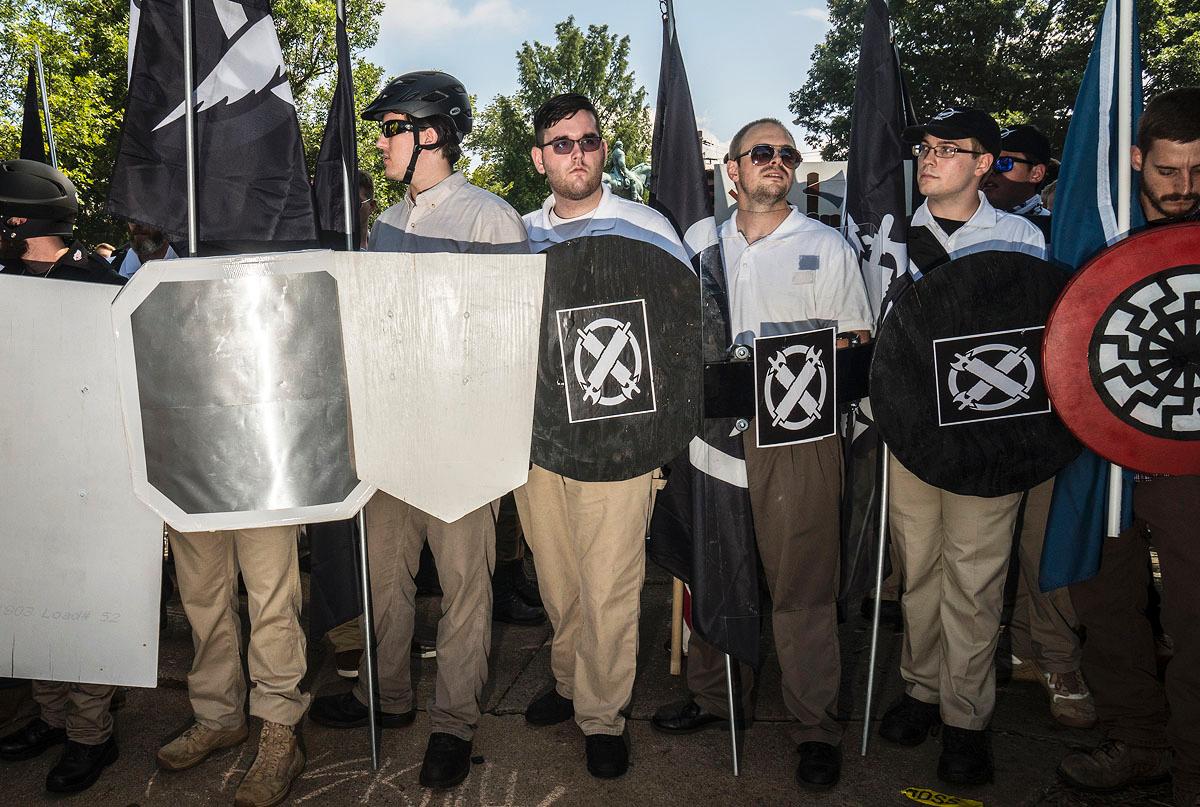
Mulitiple independent archive images and reports of James Fields’ social media had images of Adolf Hitler, and also repeated images of the fascist National Vanguard (Avanguardia Nazionale) flag used in Italy. The fascist National Vanguard (Avanguardia Nazionale) flag uses a Nordic Rune symbol “othala,” which stands for “ancestral inheritence.” R.E.A.L. notes that the Avanguardia Nazionale was reportedly a branch of the “New Order” (Ordine Nuovo); Ordine Nuovo was linked to several terrorist attacks in the 1960s and 1970s.
At the Charlottesville riots, a total of 34 were injured in violence and riots by Nazis, Anarchists, and other members of the public. Violence must continue to be rejected by all of those legitimately in support of our shared Universal Human Rights.
For years, R.E.A.L. has challenged the normalization of Nazi images and rhetoric, which many media found years ago to a source of mockery, including the Washingtonian and Vox. R.E.A.L. asked Benjamin Freed with the Washingtonian, if he planned to revisit the impact of such normalization of Nazi imagery, in the context of the tragedy at Charlottesville, and was told “no.” Others in human rights have told me that challenging the normalization of Nazi slogans and normalization of Nazi hate symbols were “not their fight.” They continue to fail to grasp that the ormalization of Nazi images and hate are wrong. Those who claim Nazi slogans and Nazi images are “not their fight” have been and continue to be WRONG. We work to support Human Rights for all people, of every race, every religion, every gender, every identity group.
But unlike some foreign media, who claim that the hate and violence we saw by Nazis and Anarchists in “Charlottesville is America everywhere,” R.E.A.L. knows this is not true. Such marginal anti-human rights extremists are a threat, but we must never forget that they are a fringe minority of the American public, who live peacefully in a diverse nation, who respect law and order, and who respect the human rights and Constitutional rights of their fellow Americans.
We challenge this threat by condemning and rejecting the normalization of Nazi, fascist, and anti-Human Rights views and ideology. As we have stated with other terrorist threats, the “front line” to fighting such threats begins with a “war of ideas,” not adopting our OWN extremist violence tactics in the street (which we have seen too often).
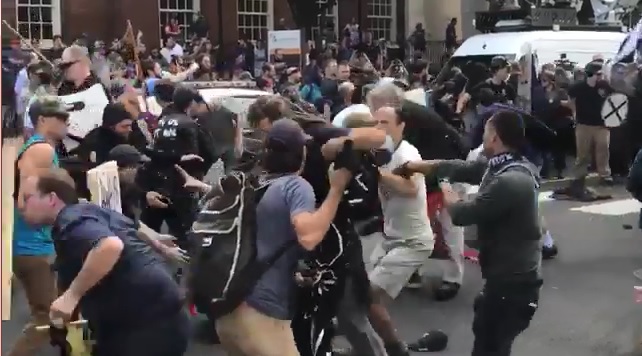
We challenge this threat by continuing to use peaceful means to reject such ideologies of hate, not encourage public violence, and not empower such hate-mongers.
But most importantly, we work to promote SHARED human rights, not replacing one extremist view with another, and not believing a different shade of authoritarian hate and violence will achieve progress.
Don’t be deceived by those who think Hate and Violence will stop Hate and Violence.
Be smarter than that.
Lead with your HEART, not your Hate.
R.E.A.L. is not, and will not, be AFRAID of white supremacists, fascists, and Nazis. We reject the view that we can promote human rights through our own version of hate and violence. We call for all people to release the hate in their hearts.
As you see violence fail, don’t forget to remember you saw real courage succeed.
We don’t need an upraised fist.
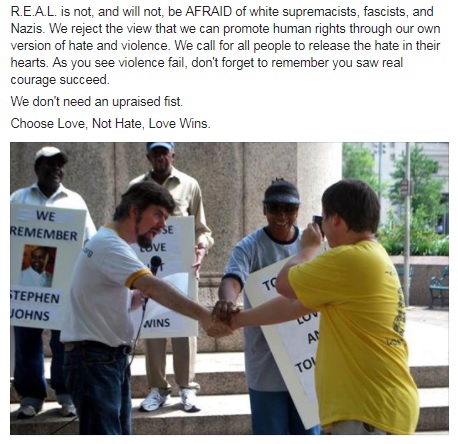
Choose Love, Not Hate, Love Wins.

Michigan – Terrorist Attack at Flint Bishop Airport
On June 21, 2017, Canadian Amor M. Ftouhi attacked uniformed airport police officer, Lt. Jeff Neville, with a 12 inch knife and stabbed him in the neck at the Flint Bishop International Airport. Amor M. Ftouhi, a Canadian citizen from Montreal, Quebec, has been in the U.S. legally since June 16, 2017. The terrorist weapon was “green handle and a black serrated blade and was marked Amazon Jungle Survival Knife.” The airport was evacuated shortly after the terrorist attack. The terrorist was subdued and Lt. Neville taken to the hospital for emergency treatment. The injured officer is in “satisfactory” condition, authorities said on the afternoon of June 21. The Detroit Free Press has been reporting that the “FBI says the stabbing of a police officer at a Flint airport Wednesday is being investigated as an ‘act of terror’.”
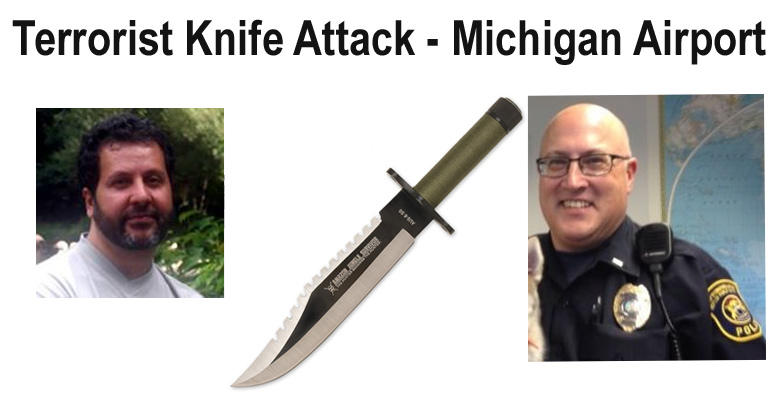
According to Lt. Jeff Neville’s LinkedIn page, he has worked at the airport since 2001 and is a former Genesee County Sheriff’s lieutenant. “I am responsible for overseeing the operations of law enforcement on the day to day”, he wrote.
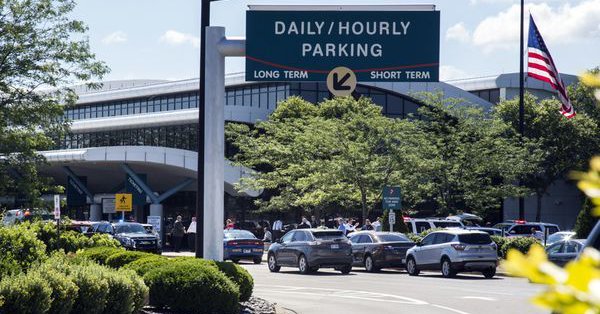
The U.S. Department of Justice filed a federal criminal complaint against a Amor M. Ftouhi today for the attack. The complaint states in part: “on the morning of June 21, 2017, an individual who was later identified as Amor M. Ftouhi used a large knife to stab a police officer at the airport. Specifically, the officer told me that Ftouhi walked up to a fully-uniformed police officer at a publicly accessible area of the airport, yelled ‘Allahu Akbar,’ pulled out a knife and stabbed the officer in the neck. After stabbing the police officer, Ftouhi continued to yell ‘Allah’ several times. He further exclaimed something similar to, ‘you have killed people in Syria, Iraq, and Afghanistan, and we are all going to die.’ The law enforcement officer was able to subdue Ftouhi, who asked the officer why he did not kill him. The officer also took all of Ftouhi’s possessions, which included identification documents for Amor M. Ftouhi.” “I have also spoken with another FBI agent who reviewed surveillance video of the airport premises, including the location of the stabbing. The agent informed me that at approximately 8:52 a.m., Ftouhi entered the first level of Bishop International Airport carrying a red duffle and a dark satchel bag. At approximately 9:10, Ftouhi went up an escalator to the second level of the airport. At the top of the escalator, Ftouhi turned left to go to a restaurant. At approximately 9:37:56, Ftouhi left the restaurant carrying both bags. Ftouhi entered a second-floor restroom at 9: 3 8: 15 and left at approximately 9:38:43 without either bag. At 9:38:48, Ftouhi attacked the officer and was subdued by other law enforcement shortly after.”
The Montreal edition of La Presse published a photograph of Canadian Amor M. Ftouhi with online reports about the terrorist attack.
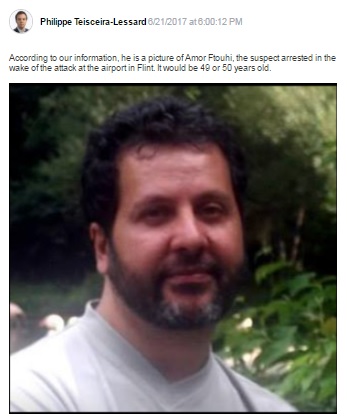
It appears likely that terrorist Amor Ftouhi intended the attack as former of terrorist martyrdom, and was surprised that he was not killed by police.
The Canadian RCMP and the SPVM police officers also agreed to assist in the investigation to terrorist Amor Ftouhi, and investigated two women associated with him. La Press reported on June 21 that the RCMP and SPVM “entered an apartment building in the East of the city in connection with the suspect. A security perimeter is in place.” La Press also reported that “[a]ccording to our sources, the Quebec suspect was not known to Canadian law enforcement authorities.” La Press states that NBC reported Amor Ftouhi “tried to get a gun to fire, but in vain. Then, he would have bought the knife used in the attack.”
According to the La Press report, the FBI initial investigation indicates belief that Amor Ftouhi acted alone. La Press quoted FBI special agent David Gelios: “We do not believe that other individuals were involved. We have no information that suggests a broader terrorist conspiracy, but it is very early in the investigation. We request search warrants for electronic equipment, for his vehicle. Only time can tell us if other people were aware of the plan, but for now we see it as a lone wolf. […] Obviously, he has a hatred for the United States.”
Amor Ftouhi’s social media background stated that he was originally from Tunisia, and that he followed Tunisian organizations. It also stated that he was previously a student at the Faculty at Humanities in Tunis. His social media account stated that his last job was with Industrielle Alliance, an auto and home insurance company with offices in Montreal and throughout Quebec. Amor Ftouhi’s Facebook social media friends posted a variety of online videos, including one recently of the extremist cleric Zair Naik.
=============
Responsible for Equality And Liberty (R.E.A.L.) rejects all terrorists attacks as an assault on the human safety and security, the human rights, of all of our fellow human beings. We urge all people to reject the tactics of terrorism, and to reject ideologies of extremism that de-humanize our fellow human beings, and allow extremists to believe that acts of terror are justifiable. They are never justifiable, and we call for all people to support our shared universal human rights, without qualification.
Alexandria Terrorist Attack and the Challenge of Political Extremism
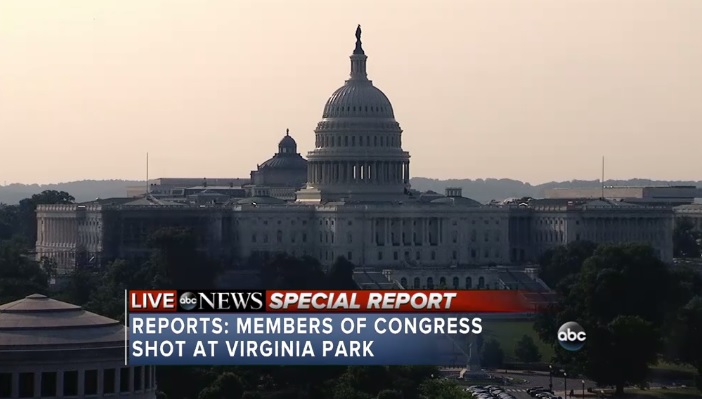
We need to call the June 14, 2017 attack on U.S. Congressional representatives and the public in Alexandria, Virginia what it is: “Terrorism.”
There is a difference between a random lunatic shooting someone and a political terrorist targeting a group. The terrorist attack in Alexandria, Virginia was not only a “shooting,” it was also a deliberate, terrorist attack, intended for targeted mass-murder and a political statement. It was as close to definition of terrorism as we get: violence intended to intimidate and in pursuit of political aims.
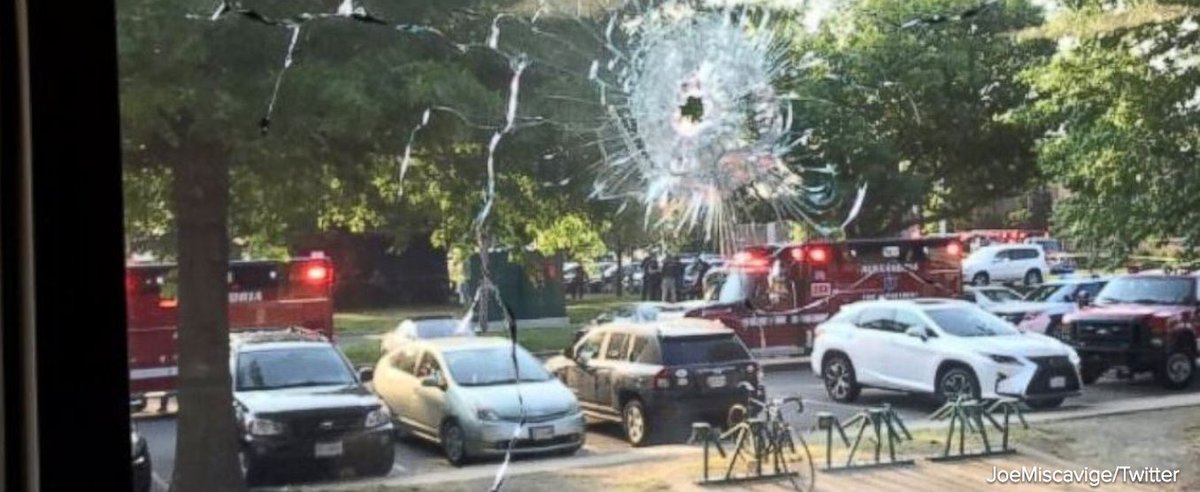
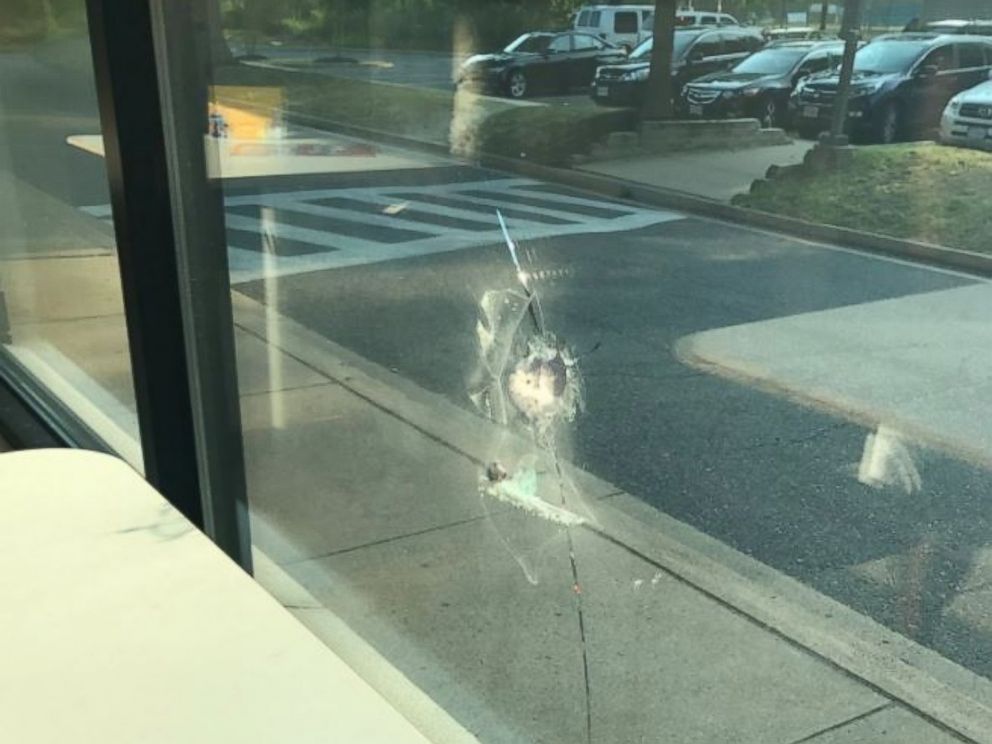
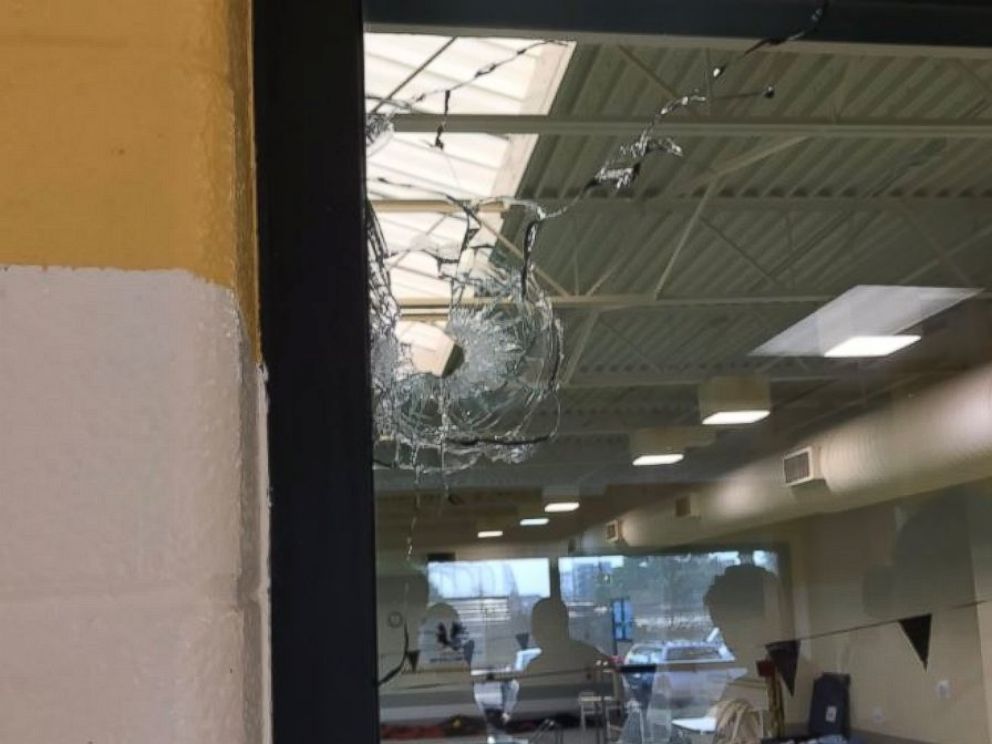
While all sane people respecting human life and dignity condemned the terrorist attack in Alexandria, we must also recognize that there were many who publicly defended, praised, and applauded the act of terrorism today. There were many political extremists defending such acts of terrorism in actually shooting at representatives of the U.S. Congress, and many publicly expressing regrets that there were not deaths in this terrorist act. Such political extremists do not care about the 10 year old son of Congressional Representative Joe Barton, who had to hide under a car in Alexandria to keep from being shot by a crazed terrorist. Political extremists don’t care about the police woman shot, the non-government individual shot, and the other victims. Political extremists don’t care about the YMCA being shot at with bullets flying through windows and even landing inside the building and the pool.
Like any other deranged extremist ideologies promoting terrorism, such political extremists have de-humanized these victims, the public, the children, the families nearby as expendable to justify their “cause.” What type of cause thinks that terrorizing children, shooting to kill our government officials, shooting to kill our police, shooting to kill anyone in the way… is any type of political cause for “justice” or “freedom”?
The threat of political extremist ideologies are no different than adherents of any other extremist ideologies, when they encourage, defend, incite, and promote violence on the behalf of such extremist views.
Such political extremism, and in this case, political anti-government extremism, is not simply disagreement, even passionate disagreement on political views. Such political extremism defends, excuses, and promotes openly inciting violence; it is just as dangerous to public safety, as any other extremist ideology.
While our law enforcement agencies will no doubt investigate this specific attack, so that they can find the appropriate legal terms they consider appropriate to apply, the American public must recognize this as an act of Political Extremist Terrorism. As of the date of publishing this, the FBI is still investigating this. They have not “declared” this as a “terrorist act.”
But we know that the Alexandria terrorist attack was done by a political extremist who targeted and sought to mass-murder individuals of another political viewpoint. The social media postings of the political extremist terrorist James T. Hodgkinson have been publicly available all day for anyone to see. It is clear that this terrorist targeted and shot the known victims because of their political beliefs: Congressman Steve Scalise, aide Zach Barth, security detail David Bailey and Crystal Griner, and Matt Mika. It also clear that political extremist terrorist James Hodgkinson planned to murder them all, using his automatic rifle. It was only the quick response of those in Congressman Scalise’s security details that prevented a total massacre by this terrorist.
A political extremist terrorist attack on Congressional representatives is simply that – a terrorist attack. It does not matter if the terrorist attack is by a religious extremist, a racial extremist, or a political extremist. Of course, it does not matter if a terrorist attack is on Republicans, Democrats, or any other group. Terrorism is terrorism. Wrong is wrong.
We don’t want to be judgmental. But there is a difference between being judgmental and being willfully blind. A terrorist is not just a “shooter” like a bank robber or any other criminal. Terrorists with a gun or any other weapon don’t look to injure, maim, and kill simply for some monetary gain or personal vengeance, but to terrorize and intimidate people of a particular group.
Yet what this terrorist attack in Alexandria reveals today goes much further than the murderous plans of terrorist James Hodgkinson. It represents a milestone in time, where the American public can no longer be in denial about this political extremist terrorist threat as a major public safety threat in America. It is time to stop the denial, the excuses, and the evasion about the political extremist terrorist threat in the U.S. Such terrorists have now clearly shed blood in an intended mass-murder terrorist attack.
Many who are non-partisan, and many who want to do everything we can to be fair and balanced, don’t want to acknowledge political extremism as an ideology which can incite violence. But denial of the burgeoning and out of control political extremist movement problem that the U.S. has will not simply “go away.” We have political extremist terrorists who use fire bombs, stab, assault, and beat those who they don’t agree with. The “tolerance” of such political extremist acts of terrorism have only made the public less safe and the extremist problem more severe, because political extremists increasingly believe there will not be real consequences for their acts.
The world shook its head at the recent revelation that the United Kingdom reportedly has 23,000 “known” Islamist extremists as a potential terrorist threat.
How many political extremists defending, promoting, praising, and calling for acts of terrorism does the United States believe that it has right now? Surely not “just” 23,000. The United States wishes its political extremist number was so small. And how many are “known”?
The United States might have 23,000 political extremists publicly calling for acts of terrorism or threats against the U.S. Government and the President of the United States – EVERY DAY – on social media and in public demonstrations. How many actual arrests have been made by U.S. law enforcement authorities of such political extremists calling for acts of violence and terrorism?
The United States is a nation in denial that does not even want to admit it has a political extremist problem. The U.S. has simply gotten too “used” to it. People regularly make political death threats, with little to no consequences. These are not some anonymous figures, hiding in “dark Web” areas with secret names. Hardly. These are political extremists using their full names and in public. Celebrities join in, and there are no consequences. Celebrities can hold up a bloody “head” of a beheaded figure of the U.S. President, and there are no consequences. Celebrities can defend and praise calls for acts of violence and terrorism as somehow “patriotic” and “just.” Without consequences, political extremists are simply emboldened to have increasingly more extreme and dangerous threats, leading us to the terrorist attack today.
The United States has a vigorous history of freedom of speech, which all free people must surely defend.
But the concept that the U.S. freedom of speech grants its citizens the “right” to threaten to murder, threaten to kill, threaten to bomb, and threaten to injure one another is so absurd and outrageous that it is beyond all logical reason. The suicidal argument that death threats by extremists are tolerable because they “didn’t mean it” is nothing less than a total abandonment of public safety standards. What part of the U.S. Constitution grants American citizens the right to threaten to kill and injure one another? How are threats of murder and bombing somehow “protected rights”?
Not just in the United States of America, but in any non-totalitarian nation, who has such “rights”? The “right” to threaten to murder, threaten to bomb, threaten to injure your fellow human beings certainly is not part of our Universal Human Rights.
In any sane, rational, nation with laws, we have a name for such actions: “a crime.”
But for the past year and half, we have seen too many essentially look the other way at what any rational person would consider “a crime.” Not surprisingly, when a society and its legal system normalizes such unabashed calls for open violence, people no longer believe there is anything “wrong” with such actions. For rational people who respect human rights, however, such threats are recognized to be nothing less than criminal acts.
The American government officials and leaders have been holding meetings and expressing “deep concern” about the use of social media to promote extremist views of the ISIS terrorist movement. The many thousands using social media to incite ISIS extremist violence must be brought to an end, as our legitimately concerned and troubled leaders state.
But when it comes to the many thousands and thousands of Americans using social media to incite political extremist violence, well, that’s a different story to our concerned leaders. After all, we wouldn’t want to offend the public’s “free speech rights,” would we, as political extremists call for murder, beheading, bombings, you name it. If a foreign Muslim woman got on an American stage and called for bombing the White House, she would expect to be led away in handcuffs. But when an American celebrity woman does the same thing, she is widely applauded, put on the mainstream media, and called an activist champion. This public threat of bombing a U.S. Government building to kill the U.S. President was applauded in public, not by merely a handful of political extremists, but by THOUSANDS in broad daylight. Such extreme, blatant hypocrisy and double-standards on law, acceptable speech, and public safety standards MUST end.
In politics, we don’t have to agree, we have a right to criticism and passionate debate. But there has to be a line between “passionate debate” and political extremism. Support for violence and death threats, calls for beheadings, support and praise for acts of terrorism has to be a boundary between debate and extremism. We need to recognize that this boundary exists between political disagreement and political extremism. We need to condemn those on any side that cross that boundary to openly praise, defend, and incite political extremist violence. In terms of the public’s rejection of such political extremist views, does it matter if such political extremism comes from the left, the right, or any other political spectrum?
The American public, its representative government, and its representative law enforcement can no longer allow political extremists to normalize calls for and incitement of violence. Calls for terrorism are not protected free speech, and terrorist acts are not a human right.
The only surprise about the June 14 terrorist attack in Alexandria, Virginia is how limited the casualties were thanks to quick-acting security.
The American public will likely not be as lucky in the next political extremist terrorist attack. What we do know, given the massive public praise, support, and defense of this terrorist attack in Alexandria by too many Americans on social media, is that without consequences, without challenging political extremists (like we would any other extremist threat), there is likely to be a NEXT time. With blood on the ground, the political extremists in America still don’t think that there is anything wrong in such acts of terrorism.
In our war against terror, we must also challenge the terrorists among us, and we must deny that terrorism is no different than patriotism.
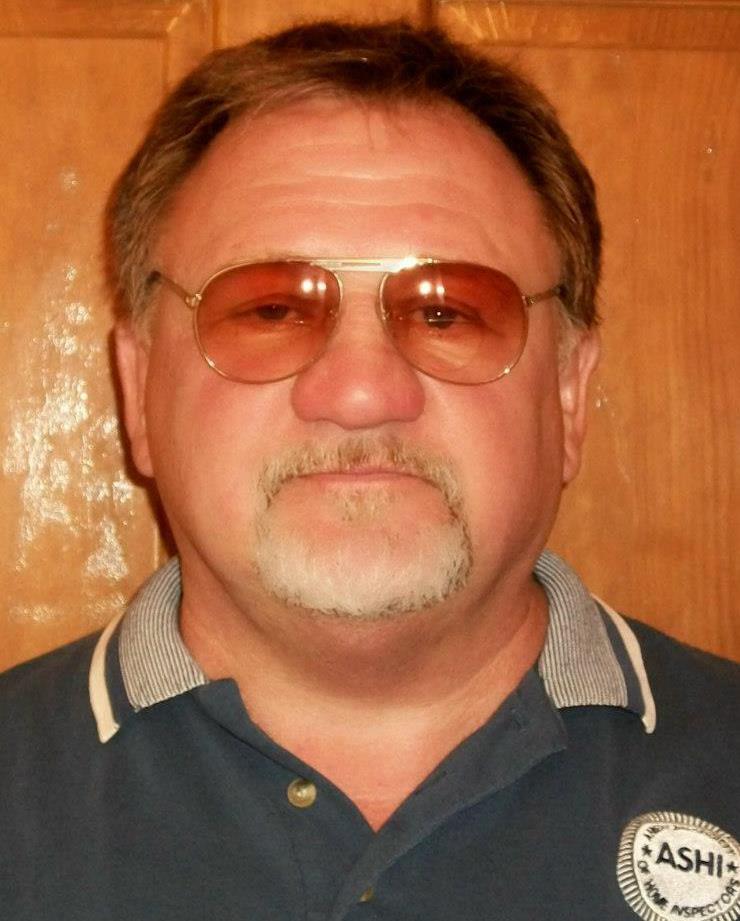
Political Extremist Terrorist James T. Hodgkinson (Facebook)
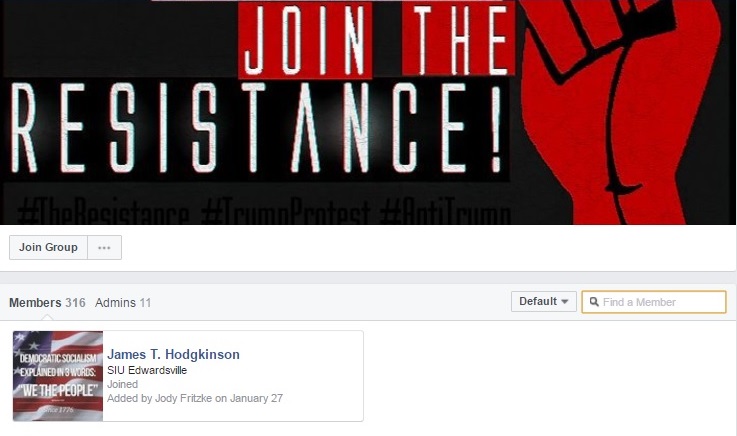
U.S. Law Enforcement “Leakers” Endanger Public Safety and Trust
U.S. law enforcement’s accomplishments are dependent on a shared law, shared mission of public safety and equal enforcement of the law, and dependent on the public trusting law enforcement organizations and agents. While in this case, the subject is about U.S. law enforcement, such basic standards apply in any free and democratic nation. A mission for public safety is dependent on public trust. Those that undermine public trust, don’t simply undermine trust in themselves or their agency, they undermine trust in all members of the law enforcement and justice community.
U.S. law enforcement communications with the news media must have the following primary objectives: (a) provide public and accountable reports on information essential to public safety, (b) provide public and accountable reports on progress on ongoing investigations and law enforcement activity without compromising sensitive and legal matters, (c) provide public awareness information on other general organizational information activities, such as meetings, events, facilities, etc. In a representative democratic nation, the law is enforced equally for all individuals, regardless of the political affiliation, identity group, or station in life.
We must expect our law enforcement, at every level, to be apolitical, just as we expect our military, our hospitals, and any other essential public safety organization.
Equality under the law is an essential art of public trust in law enforcement. Furthermore, that trust is dependent on public communications that confirm equality, fairness, and lack of bias in the values and standards shown by the law enforcement organization’s actions.
In a representative democratic nation, it is noticeable that none of the law enforcement communications objectives are: (1) spying, (2) planting rumors, (3) political targets, (4) seeking to undermine other government organizations or individuals. This is not the role of law enforcement in a representative democratic nation. The concept behind governance in a representative democratic nation is that our public officials and servants represent “the people,” not themselves, not their interests in shaping the nation to fit their views, not in political activism.
Those concerned about human rights regularly see such abuses of law enforcement authority with the news media in Communist totalitarian and other dictatorial nations, which have contempt and hate for representative democracy and public representation processes. In an anti-freedom, totalitarian nation the term “law enforcement” means “power enforcement” for the privileged and powerful. There is no intention of representing “the people,” but simply preserving power for the powerful, at any cost, and manipulating “the law” to read whatever the powerful want it to read. Those who care about human rights regularly protest such abusive forms of human persecution, and the persecutors use of “law enforcement” stage-actors abuse of law and justice to simply maintain, control, and manipulate power.
In the former Communist totalitarian East Germany, the East German secret police (Ministerium für Staatssicherheit aka “Stasi”) organization used a series of harassment tactics, or “Zersetzung” to infiltrate, spy, sabotage, and spread rumors about those they sought to prevent from gaining power. The Stasi tactics were part of late 20th century efforts to manipulate the public, up to the fall of the Berlin Wall in 1989. The massive 91,000 Stasi bureaucracy was three times the size of Adolf Hitler’s Gestapo. But given the post World War II environment, the Stasi needed to use subtler methods that concentration death camps for those that became “enemies of society.”
The Stasi police organization sought to psychologically isolate and trample its “enemies” using rumor, innuendo, and manipulating the minds of others. As researcher Max Hertzberg has written on Stasi Zersetzung tactics, its efforts at “intelligence from surveillance and the use of informants was rarely used to actually gain evidence for a prosecution.”
The Stasi “law enforcement” was not interested in actually prosecuting, but in spreading rumors through public and state-controlled media to undermine the credibility of individuals they opposed, and to create a sense of insecurity and paranoia in individuals they opposed. The Stasi tactics of “Zersetzung” method of spreading rumors would often use plausible untruths based on some real facts that would be difficult to refute.
In our world history, there is a good reason why in representative democracies, our law enforcement communications with news media focuses on verifiable facts that are specific to the law enforcement mission.
In my personal career, I worked many years ago with the Federal Bureau of Investigation (FBI). This knowledge of respect and sensitivity by those using law enforcement authority was well-known among all employees, no matter what your role was. Responsible individuals in law enforcement, including the FBI, are well aware of the essential need for focus on public and media communications consistent with respect for the law enforcement mission. They really don’t need to be told right from wrong, and what is appropriate in terms of media communications. They KNOW.
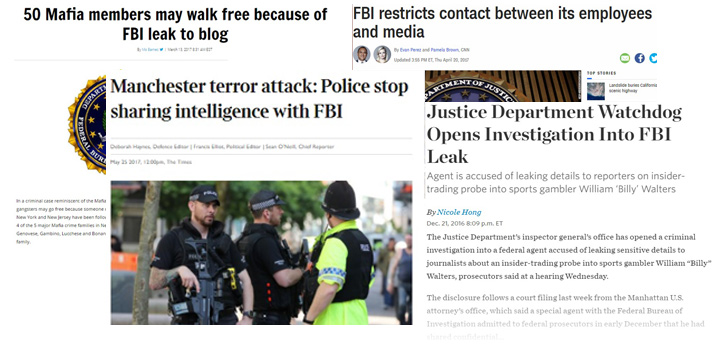
So, this week as the United Kingdom announced that it was going to stop sharing information with the FBI after a leak on an ongoing counterterrorism investigation that had taken so many lives in the UK, all of us connected in any form with a history in law enforcement must have been stunned. A reminder to all – one of the victims in the Manchester terrorist attack was an off-duty police officer. The importance of protecting counterterrorism information during an investigation of a terrorist mass-murder, including a fellow member of law enforcement, should not have to be explained to anyone. This breach of trust must be investigated.
There is no excuse for this, and unfortunately there has been no public statement by the Interim Director of the FBI Andrew McCabe on this subject. R.E.A.L. urges the Interim Director to make a clear statement how the FBI values and respects the law enforcement trust and the partner trust that it has with the citizens of the United States and our global partners. What is really missing is a lack of outrage, anger, and frustration heard from leadership in the FBI and law enforcement regarding leaks abusing law enforcement authority. I can tell you that, of the 30,000+ working for the FBI, they are chosen largely because of their commitment to integrity. I want to provide a voice for those others who we must hope share such outrage on this abuse of authority by leakers.
Three years ago, the U.S. Directive on National Intelligence (DNI) signed Intelligence Community Directive 119, under which intelligence information was to be protected from unauthorized disclosure, excluding whistleblower information on fraud. Part of the idea behind ICD 119 was to protect intelligence service “leakers” from being used to spread information to news media for political manipulation and persecution of individuals.
There are reports that the FBI is now modifying its media contact policies to limit media contacts to field office managers and public relations employees. Unfortunately, over the past several years, we have continued to see this problem with leaks. But even after the recently reported changes on media contact management, we are seeing increasing alleged reports from anonymous FBI individuals to the news media, including those making actual threats against other member of the U.S. government. In any representative democracy, a law enforcement agency whose members use the news media to make anonymous threats against anyone else – has to be completely unacceptable. The idea that law enforcement in any representative democracy can use such political tactics completely undermines the public trust and commitment to public safety, which is the mission of our law enforcement.
Let us also remind all members of law enforcement, yes, it is OUR law enforcement, not YOUR law enforcement. That is how a representative democracy works.
We are keenly aware of the dangers of politicizing law enforcement in a way that will undermine a consistent commitment to public safety and trust. But after this embarrassing disgrace involving the Manchester terrorist investigation and the very public statements by the U.K. that it would stop sharing counterterrorism information with the FBI, there needs to be a stronger position mandated and real action by the U.S. Attorney General on this issue.
We measure the value of our law enforcement in their commitment to equality and integrity to the law, not by cunning and political acumen. That is the hallmark of a democratic society.
A representative democracy, in the U.S., or any other country depends on not only the fidelity and bravery of our law enforcement to equal treatment of all cases under the law, it also depends on the integrity of our law enforcement to put the interest of public safety and public trust as their priority, and leave their personal and political aspirations out of the performance of the authority we have given them to represent us all.
Terrorist Threats and Need for a Public Safety Accountability Act
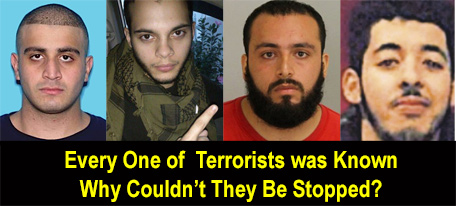
In challenging the destruction of terrorist threats on society, we not only need accountability for defying extremist ideologies that inspire terrorists and those who commit and assist in terrorist acts, but we also need accountability on those who have information on terrorist threats to public safety, but choose to withhold that information or fail to act on it to defend the public. In the United States of America, the United Kingdom, and other nations of the world, we need a clear, unambiguous law which defines such public safety accountability, with concrete, criminal, consequences for those that withhold information or those with such information that fail to act to protect the public.
As we witness continuing terrorist acts around the world, the most horrible truth is that too many know about terrorist threats to the public, but maliciously choose to do nothing to protect the public. The silence prior to such terrorist attacks on an unsuspecting society needs to stop. We need more than friendly slogans, “see something, say something,” to inspire confidence in public to play in active role in providing information on terrorist threats. We need to migrate from the casual volunteerism of “see something, say something” to a more severe “see something, say something, because it’s the law.”
Our legal systems must accommodate a new law that mandates accountability for those who know, but maliciously conceal such information, and those who know, but consciously fail to act on such information. Certainly, failure to provide information and failing to act on terrorist threats to the public is one of the most gross violations of “obstruction of justice” that we could imagine. Yet such “obstruction of justice” when it comes to information and action on terrorist threats happens on a regular basis, every single day, and even worse, it has too often been defended as part of public government policy.
People of conscience, and those committed to our universal human rights (which includes human security), must find the continuing malicious silence and inaction on terrorist threats as completely unacceptable. We must have a public safety accountability act to set expectations of a legal responsibility to provide information on terrorist threats, and to also expect accountability of our government to act on such threats. The public is threatened by sociopath terrorists which have no respect for law, and no concern about death, even their own. The idea that we can continue to allow such anti-life figures to kill and injure with impunity, while we have no accountability for those who could have stopped such acts, is the absolute height of social lack of responsibility and contempt for human rights.
The public safety of our citizens, our children, our families, our neighbors, our communities also should not be an afterthought to government authorities more concerned about intelligence spy-games than the real and present danger that such terrorist actors pose to public safety and lives. They have no right to play chess with the lives of our families, our children, and our communities. A cohesive, competent, and just society must demand accountability and consequences for malicious, Machiavellian, manipulations by those who have lost sight that our society is composed of other living, breathing human beings with dreams and purpose of their own.
In the United Kingdom today, we see children and families who have suffered yet another terrorist loss from a terrorist bombing atrocity this week. Civilized societies must not just ask, but must demand that the public provide information known to it regarding terrorist threats. It is also yet another discouraging case, where we learn that “intelligence” agencies knew about this terrorist mass-murderer of children, who apparently traveled to Libya to gain training, but he was never arrested for his involvement with Libyan extremists. Less than a year ago, Washington D.C. had a similar case of a Libya-trained ISIS terrorist supporter walking the street, but working as a police officer with the Washington subway system that hundreds of thousands regularly use, while this was known to the FBI. Our society must expect more from our fellow citizens, and those who work on our behalf in our governments.
As described in January 2017, R.E.A.L. has also proposed protective acts for human rights safety from those who have been engaged in terrorist planning, with a specific recommendation for a “Terrorism Prevention and Public Protection Act.” But our legal system must recognize that terrorist plots and terrorist training constitute criminal behavior. Our law enforcement should not have to wait until our children and public are murdered in the street by such sociopath terrorist actors, any more than we would wait for an arsonist plotting to burn down a building, must actually burn our public to death, before he is arrested. In view of the continuing global terrorist threats, our legal system must adopt some common sense respect for the public’s human rights, security, and dignity, to allow our society to continue to have cohesion and respect for the law, our authorities, and one another.
The inhuman cruelty and total disregard for life and public safety by 21st century terrorist actors cannot be fought only by a legal system designed for a 19th and 20th century world and criminal activity. We must recognize that modern, rapid terrorist threats demand that our legal system must move beyond passive non-consequentialism, which has been accepted by too many who shield those who enable harm by their malicious non-actions. The massive threat to public safety by the 21st century global terrorist movement networks is unlike previous criminal organizations and campaigns. We cannot continue to ignore wrongful conduct in our 21st century by malicious failure to act in providing information or failing to act, regarding terrorist threats to our public society.
This must require a new public act which imposes a pre-existing legal duty to act to the public to provide information, and to the government to act, on issues of public safety due to modern terrorist threats. Continuing to allow such duties to be “optional” ignores the very real and present, not hypothetical, instances of how such non-action enables harm. Those who choose to conceal information regarding terrorist threats and those in authority who choose not to act on information regarding terrorist threats must face more than social condemnation; they must face legal responsibility for their choices, as malicious and public endangerment.
The “rationale” for such malicious public endangerment by those empowering terrorists to act with impunity, by choosing to conceal such information regarding threats because to reveal this would make someone uncomfortable, inconvenient, or in the case of government agents, that such public endangerment was to help achieve additional “intelligence” or further investigations, must face real and concrete legal consequences, for such public endangerment to society.
The behavior of those who maliciously refuse to provide information on terrorist threats and those in authority who refuse to act to protect the public from terrorist threats, must be seen as engaging in malicious behavior against society, regardless of their rationale or justification. This is not to suggest that every person’s information about but genuine failure to understand information regarding a terrorist threat is malicious. Certainly, everyone learns small pieces of information that they do not recognize or maliciously conceal. A public accountability act would NOT call for criminal prosecution for random knowledge unknown by the public to impact a terrorist threat to society.
But let us be clear, unintentional concealment of information on terrorist threats is not the real problem that is facing our society regarding modern terrorism today. The terrorist actors who commit atrocities on our children, our families, our public, are regularly not criminal masterminds and agents. Most modern terrorists leave a trail, a definable trail, with very clear information seen by too many in the public, and incredibly, by unscrupulous individuals in our government agencies responsible for our protection. Too often, we see terrorist actors who are “known” to “intelligence” agencies. If they are that obvious, the public rightfully should ask why isn’t anyone who knew about such terrorists’ actions held accountable? In our modern society, they must be held accountable, which has become all too rare. In the United States, unless some other crime is committed, most of those who concealed or failed to act on knowledge of a terrorist threat, face no consequences for their malicious behavior against society.
In the 2011 “The Moral Status of Enabling Harm,” regarding the assessment of enabling harm, University of California Professor Samuel C. Rickless states that “the agent whose actions enable the victim’s death is described as the victim’s enemy. Persons who are described as enemies of those whose death they bring about intentionally are generally understood to be acting with malicious intent.” Professor Rickless further states that “[o]ur intuitions therefore count as evidence for the claim that malicious harmful enabling is morally equivalent to harmful doing, but they do not suggest that non-malicious harmful enabling is morally equivalent to harmful doing.” When facing the modern global threat of rapid terrorist violence to our public, we cannot ignore the necessity to codify and provide concrete consequences for those whose malicious behavior against public safety includes concealing information on terrorist threats or failing to act on terrorist threats.
Reckless disregard for public safety regarding terrorist threats to our public must be condemned by those that maliciously conceal information and by those that deliberately fail to act on such information. This recklessness costs lives, over and over again.
As we demand more from the public in making it their responsibility not to conceal information on terrorist acts, so we must also make it our government agencies’ responsibility to act on information regarding terrorist threats to protect the public. We must not allow protected, comfortable offices and conference rooms, to shield senior representatives of government from public outrage and the consequences of deliberately failing to act to protect the public. They must set an example for every one of our citizens. If they refuse that responsibility, they must be as accountable as any other citizen.
In the United States alone, the last three terrorist attacks were all by individuals “known” to U.S. law enforcement and intelligence. In each of these cases, members of the public came, despite endangerment to themselves, and warned the Federal Bureau of Investigation (FBI) about these terrorists. The excuses on the failure to act to protect the public sound hollow, when the innocent public lie dead and injured in the street. If there was this much “known” that the FBI was actually informed about these individuals, what else was known that was concealed by others? And why do we have no consequences for the failure to protect the public from terrorists?
Orlando ISIS terrorist Omar Mateen was “known” to the FBI and U.S. authorities. Omar Mateen committed the June 12, 2016 terrorist attack in Orlando, Florida, killing 49 Americans.
New York terrorist Ahmad Khan Rahami was “known” to the FBI and U.S. authorities, even his own father contacted the FBI about the threat he represented. Ahmad Khan Rahami committed terrorist attacks in September 19 and 20, 2016 in New York and New Jersey, injuring 29 Americans.
Fort Lauderdale terrorist Esteban Santiago-Ruiz actually went and told the FBI office in November 2016, that he had been watching ISIS terrorist videos and was being driven to attack and kill the public for ISIS. He was let go. On January 6, 2017, Esteban Santiago-Ruiz killed 5 and injured 6 in a terrorist mass shooting at the Fort Lauderdale airport, and an additional 36 were injured.
How can our authorities retain the confidence of our public to face the rapid, global terrorist network, if it fails to act to protect our public society from such known threats?
The most astounding story in 2016 in terms of terrorist threats was about the terrorist attack that did not happen, is about a known ISIS terrorist threat in Washington D.C., whose actions could have endangered the lives of many, many thousands of innocents. On August 2, 2016, the Washington D.C. news media announced the arrest of Nicholas Young, a Metro Police Department (MPD) police officer with the Washington Metropolitan Area Transit Authority (WMATA) subway system for providing material support to the ISIS terrorist movement. But there was no concern about the public’s safety to remove him from the MPD.
In the criminal complaint on ISIS support Nicholas Young, filed in court before federal Judge Theresa Carroll Buchanan, with sworn testimony by an FBI Special Agent David Martinez, it is documented that ISIS terrorist movement supporter and MPD police officer Nicholas Young had been under investigation since 2010. It is documented that Young had an AK-47 out of his window looking to shoot law enforcement in 2011. It is documented in 2011 that Young threatened to behead anyone who “betrayed” him and was looking to blow up automobiles. It is documented in 2011 that Young sought to attack the FBI and smuggle guns into a courtroom. It is documented in 2011 that Young sought to kidnap and torture an FBI special agent. It is documented in 2011 that Young traveled with terrorists (aka “rebels”) to Libya with arms, body armor, to overthrow the government there. (Of note, it is also documented that our DHS Customs and Borders Protection waved Nicholas Young with his military items right on through to Libya on the outbound trip.) In 2011, it is documented that Young had been meeting with a terrorist Amine El Khalifi, and warned him how to avoid the police; Amine El Khalifi planned a January 2012 suicide bomb attack on the U.S. Capitol building, and was arrested. In 2012, it is documented that Young sought to get revenge on those who warned the authorities about the U.S. Capitol suicide bomb plot. Throughout 2014, it is documented that Young repeatedly made plans to seek to join the ISIS terrorist movement, not just as a supporter, but to join their terror activities overseas. In 2015, it is documented how Young praised terrorist attacks in France by ISIS. Not long after his messages of support for ISIS terror attacks, it is documented that Young took his AK-47 to join other MPD police officers to “train” in shooting. In November 2015, it is documented how Young praised the Paris terrorist attacks by ISIS and how the West deserved such death and violence. It was not until 2016, when Young purchased gift cards to send to ISIS to help provide financial support, that eventually by August of 2016 that Young was arrested.
During all of this time, as the FBI knew about this, and Young remained as MPD police officer, endangering the safety of untold thousands on the WMATA Metro subway. Young told his fellow ISIS terrorist supporters by 2016 that “I have enough flags on my name that I can’t even buy a plane ticket without little alert ending up in someone’s hands,” but Young could remain on the WMATA MPD as a police officer, in a system with an average daily ridership with hundreds of thousands of riders. At the time of Young’s arrest, an anonymous “source” told ABC News, there was “no pending threat to the D.C. transportation system,” but how do we know this? How could someone in authority consider it anything less than a wildly irresponsible, malicious abrogation of public safety responsibility to allow an ISIS terrorist supporter (with terror training in Libya) to continue as a police officer for a major subway mass transit system?
After reading this, you might ask yourself, what exactly does it take to get arrested? Judge Buchanan never asked, why did it take you six years to arrest this terrorist figure. After a few local stories, the Washington D.C. media shrugged, and it was back to “business as usual.”
But a legal system that allows the malicious endangerment of the public from global terrorist actors must not be considered acceptable.
The public deserves protection from such sociopath terrorist figures, who not only have no respect for law, but have no fear of death itself. For full disclosure, R.E.A.L. respects our legal system, our law enforcement, and certainly our FBI, which it has directly aided for many years. But we need consistency and credibility in dealing with information regarding terrorist threats to the public.
We need to hold our public accountable for coming forward about terrorist threats to society, and we need to hold our government accountable to making arrests to protect the public from such terrorist atrocities. Anything less makes a true mockery of our legal system and our shared commitment to universal human rights.
Fresno Terrorist Attack and Link to NOI Extremist Ideology inspiring U.S. Terror Attacks
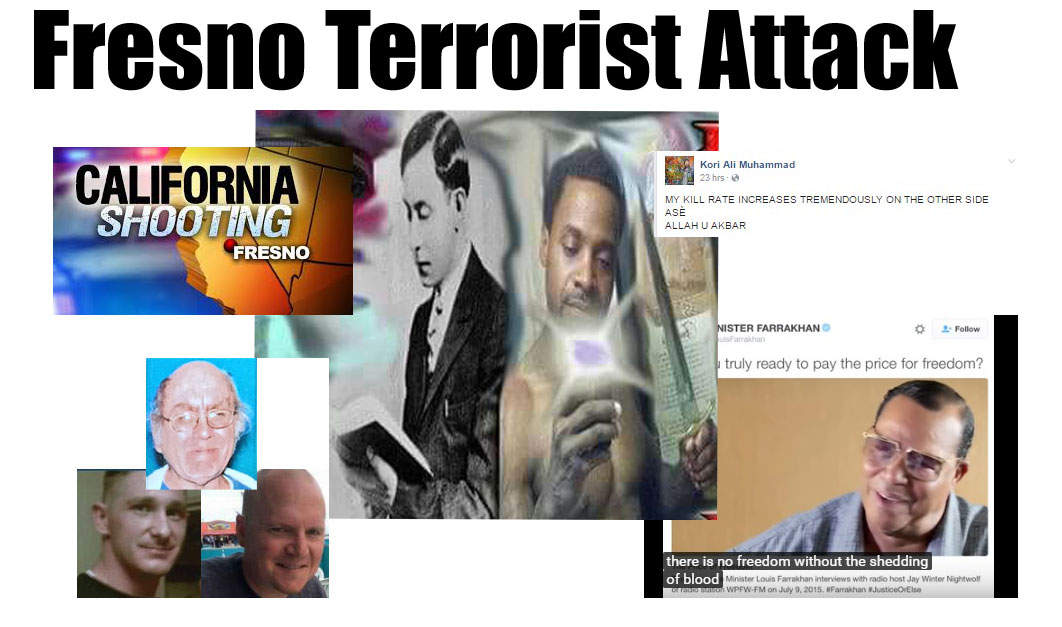
Responsible for Equality And Liberty (R.E.A.L.) regrets having to report about yet another terrorist attack in the United States of America, which took place in Fresno, California, on April 18, 2017. R.E.A.L. challenges all extremist ideologies and movements that reject our shared equality in universal human rights, and which too frequently are the ideological basis for inspiration of terrorist acts, intended to intimidate the public and government agencies. R.E.A.L. has also been very active in challenging racist hate, including leadership in activism for decades in challenging white supremacy. R.E.A.L. recognizes the most important avenue to defy both extremist hate and terrorism is to defend our shared human rights. R.E.A.L. urges those promoting extremist and racist ideologies to turn away from causes of hate and violence and to support our shared universal human rights for all people.
In the case of the April 18, 2017 attack in Fresno, based on R.E.A.L.’s own investigation of the Fresno terrorist Kori Ali Muhammad’s social media postings before his Facebook site was taken down, it is clear that this latest attack was inspired by the views and teachings of an extremist organization, the Nation of Islam (NOI). The influence of the NOI on Kori Ali Muhammad can also be seen on his currently active (at time of posting) Twitter account “BGODMAC.” (R.E.A.L. provided information on this case to industry counterterrorist analysts on April 18.)
The extremist NOI group’s leader Louis Farrakhan has repeatedly called for violence in America, praised pro-terror Libya leader Muammar Gadhafi, and repeatedly condemned the U.S. for taking military action against the terrorist Taliban, after the 9/11 attacks. The extremist group’s leader dismissed Al Qaeda terrorist leader Osama Bin Laden, as a “patsy” for an American “war on Islam.” Louis Farrakhan has also previously defended the actions of Fort Hood terrorist Nidal Hasan, who murdered 13 in 2009, as merely the actions of someone “insulted by your superior officers or by your fellow soldiers.” R.E.A.L.’s research has also shown that this extremist group has also clearly been a part of the inspiration for two other attacks in the U.S., which have taken place less than a year ago: a Dallas, Texas terrorist attack (5 killed, 11 injured) and a Baton Rouge, Louisiana terrorist attack (3 killed). The extremist NOI group has a membership both in the United States, as well as supporters and global reach in the United Kingdom, Europe, foreign affiliations, and participation in international events. Both the U.S. and U.K. branches of the NOI claim the 9/11 terrorist attack was an “inside job.”
On April 18, 2017, this latest terrorist attack took place in the streets of Fresno, California, with the targeted shooting of four white males, resulting in the death of three and the injury of one. Police arrested the confessed terrorist, 39 year old black American Kori Ali Muhammad, after Fresno police were alerted to the terrorist attack by acoustic gunshot detection technology sensors. He fired 17 rounds in less than two minutes, shooting his victims in the street. During the arrest, Kori Ali Muhammad, shouted “Allahu akbar,” or “God is greatest.”
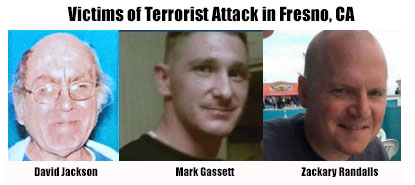
The victims killed in the April 18 terrorist attack were: Zackary Randalls, Mark Gassett, and David Jackson. R.E.A.L. extends its sympathies to the families and loved ones of all the victims of this terrorist attack. Zackary Randalls, 34 year old, a husband and father of two young children, was killed while sitting in his truck. Mark Gassett, 37 year old, a husband and father of two young boys, was killed while walking home carrying a bag of groceries from Catholic Charities. David Jackson, 58 years old, was sitting at a bus stop with other men, when the terrorist attack started. One of the bystanders reported that Mr. Jackson tried to reason with terrorist Kori Ali Muhammad, and then tried to flee, when he tripped over a curb at the Catholic Charities parking lot, and the terrorist laughed and repeatedly shot him, according to a witness. Terrorist Kori Ali Muhammad confessed to the murders. CBS News reported that a “police chief said Muhammad admitted the killings, didn’t show remorse and laughed as he recounted the rampage to investigators.”
Terrorist Kori Ali Muhammad was also arrested for shooting and killing an unarmed security guard Carl Williams III, who was also a white male. The Fresno Bee reported that victim Carl Williams was described by his sister as “the kindest soul,” and was “working two full-time jobs so he could buy a better home for his grandmother and trying to make his community better by volunteering and giving blood.”
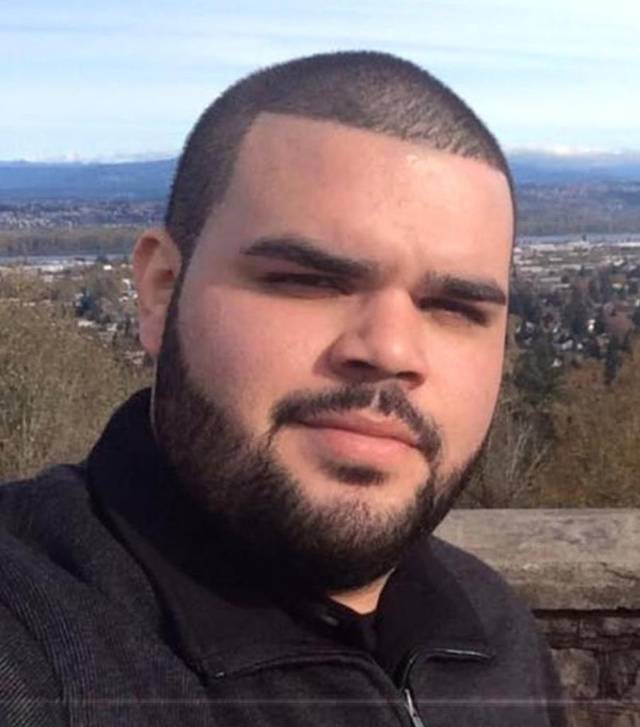
On April 21, 2017, Kori Ali Muhammad appeared in Fresno County Superior court on the charges for his crimes in Fresno. CBS News reported that Kori Ali Muhammad shouted about natural disasters that would befall America and calling for reparations for black Americans. (The mainstream media does not understand or care about the relationship of the call for such “natural disasters” as a common theme among NOI extremist teachings.) In the April 21 court arraignment, Kori Ali Muhammad was charged with the murder of Carl Williams. He is scheduled for a follow-up arraignment on the other charges on May 12, 2017. On April 22, 2017, Kori Ali Muhammad gave an interview to CBS47 news, where he stated that he wasn’t a terrorist, but confessed to the murders, and spoke of his hatred of “racist white men.” Reporter Matt Mendes asked, “So, you don’t regret killing four people?” “No,” Muhammad replied.
Investigations reported on the Fresno terrorist attack have ignored the obvious link to and inspiration by the NOI extremist group’s ideology. R.E.A.L. readily saw such links in its own research of the terrorist’s Facebook and other social media, hours after the Fresno terror attack. The overwhelming majority of media has also ignored such links, with some selectively reporting on comments during the court appearance, ignoring comments by Kori Ali Muhammad that would tie to the NOI extremist group, such as the regular call for “natural disasters” on America.
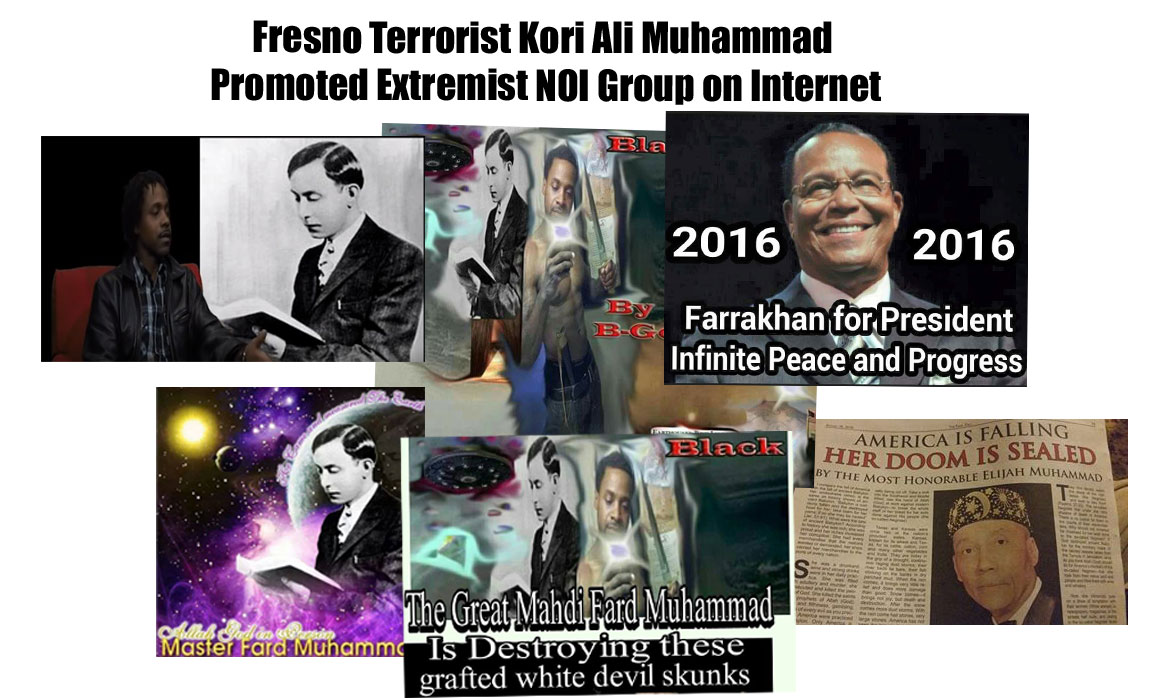
Less than a day before the April 18, 2017 terrorist attack in Fresno, terrorist Kori Ali Muhammad was posting NOI extremist views on Facebook about punishing “Yakub’s white devils,” threats of “natural disasters” to plague the United States (common in NOI teachings and speeches by Louis Farrakhan), and an image of NOI co-founder Wallace Fard Muhammad and himself together.
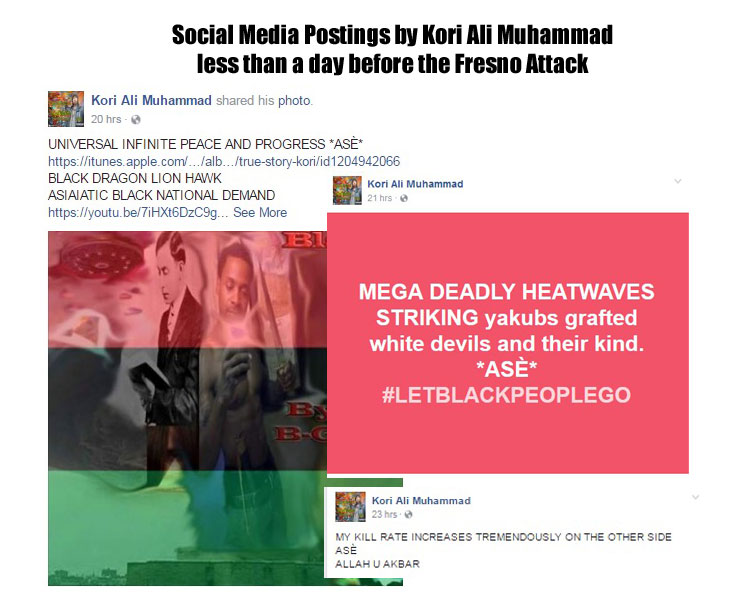
The NOI extremist group believes that an evil black scientist Yakub created the race of “white devils” from black human beings using a process called “grafting.” Inspired by the NOI extremist ideology, terrorist Kori Ali Muhammad repeatedly posted about the need to punish “grafted” “white devils” on Facebook and Twitter, before the Fresno terrorist attack.

Extremist NOI group’s leader Louis Farrakhan and the NOI founder have taught black Americans for years how such “white devils” were created by Yakub. As Farrakhan has stated in his speeches on such white “devils,” “you have to kill the devil.” NOI leader Louis Farrakhan has repeatedly also called for natural disasters to befall America.
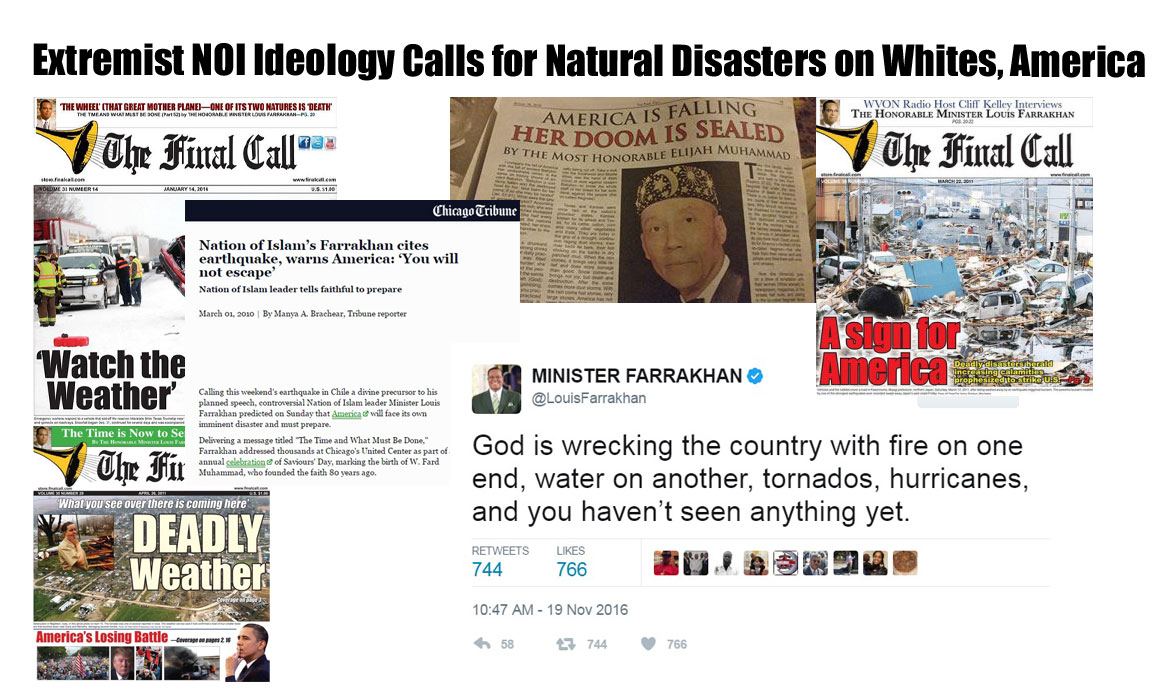
The same messages of hate calling for natural disasters from the NOI were posted on terrorist Kori Ali Muhammad’s Facebook site, which echoes his inspiration from NOI and Louis Farrakhan. In his postings, Kori Ali Muhammad frequently also used the African Yoruba term “Ase,” which is “a concept that there is power in our spirituality, words and feelings” allowing one to command it to be so.
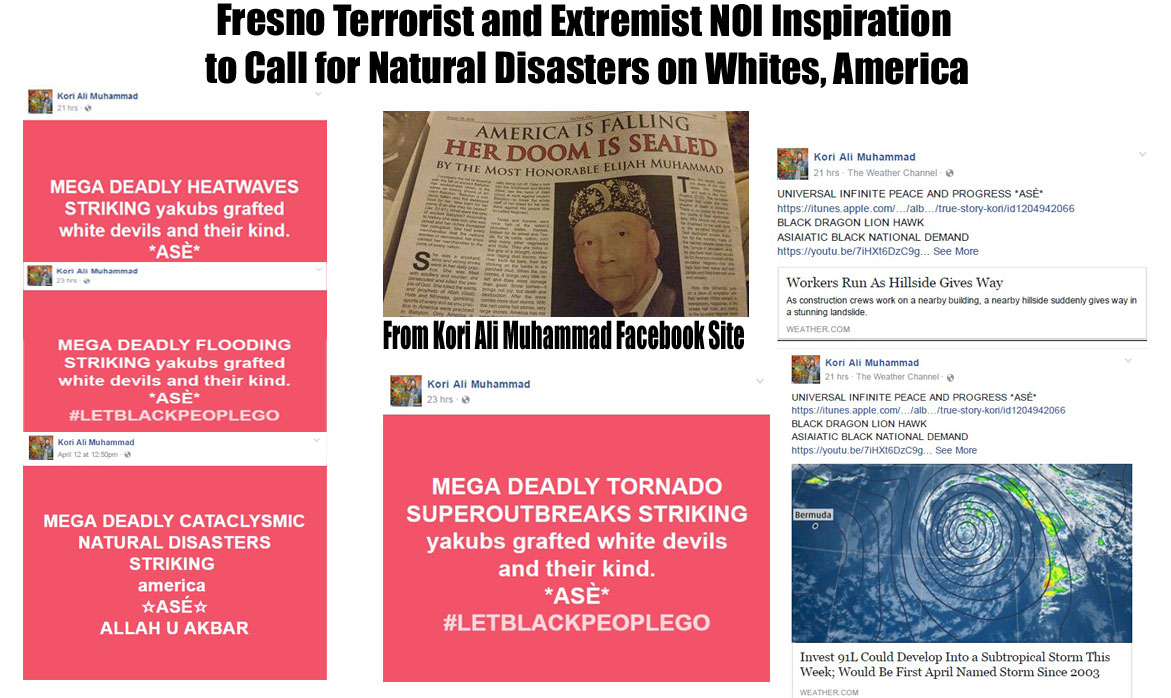
Fresno terrorist Kori Ali Muhammad’s Facebook postings also included attacks on Christianity, including hate images against the Catholic Pope, urination on “false images” of Jesus Christ, and a posting less than a day before the Fresno terrorist attack stating to “stop disrespecting your ancestors by depending on Jesus! We are real. He is made up.. only your ancestors died for you!”
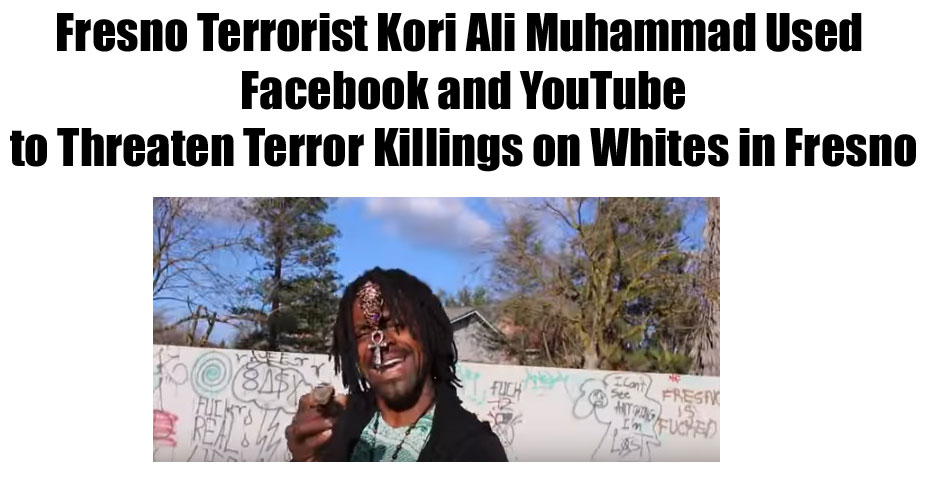
A month before the Fresno terrorist attack, Kori Ali Muhammad used YouTube and Facebook videos to issue the terrorist threat to shoot whites with “a bullet” in the head in Fresno on March 13, 2017. Neither Facebook nor YouTube considered such “rap” videos by Kori Ali Muhammad calling for terrorist threats of murder to be objectionable content. Even after the April 18, 2017 Fresno terrorist attack, YouTube has no interest in removing the terrorist threat video by Kori Ali Muhammad.
Kori Ali Muhammad regularly promoted the NOI extremist ideology on social media and Facebook, including calls for Louis Farrakhan to be the U.S. president, and numerous images with him and NOI co-founder Wallace Fard Muhammad. Kori Ali Muhammad also used an independent “urban” video program to be interviewed about the NOI and its impact on his life; this was linked under his “Mastermind” video series.
In addition, Fresno terrorist Kori Ali Muhammad also praised the July 7, 2016 terrorist attack by Micah Xavier Johnson in Dallas, Texas, which killed 5 and injured 11. On the now hidden Facebook postings, Kori Ali Muhammad praised the Dallas terrorist as “our hero, we stand with him,” and that “he loved us enough to kill and die for us. We honor him.” Fresno terrorist Kori Ali Muhammad further called for the murdered victims of the Dallas attack to “rest in pig” urine.
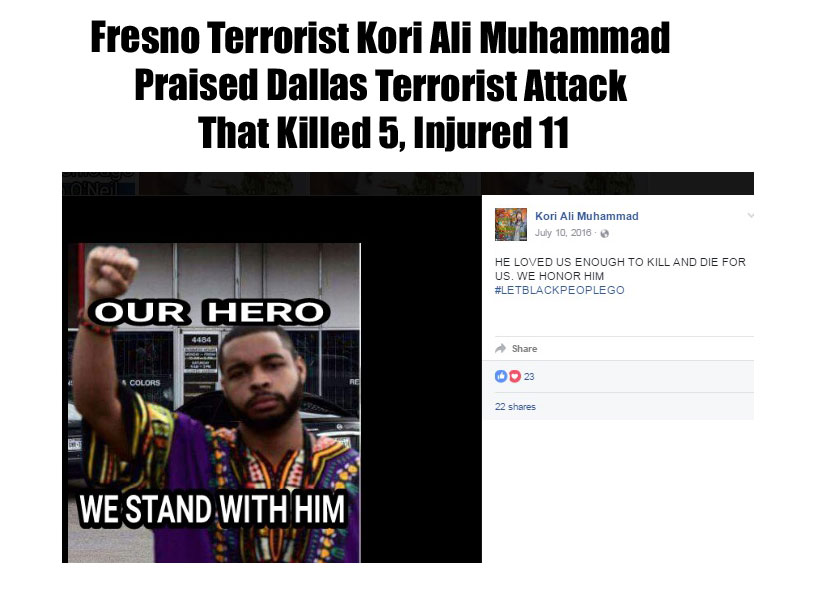
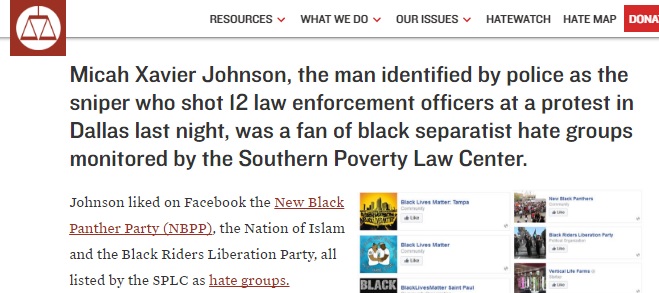
As R.E.A.L. reported in July 2016, Dallas terrorist Micah Xavier Johnson was also linked to the NOI extremist group. In 2016, the Southern Poverty Law Center (SPLC) and CBS News also found such a link to the NOI extremist group in Dallas terrorist Micah Xavier Johnson’s Facebook postings, and R.E.A.L. also identified a connection between Micah Johnson and a former member of the NOI, Richard Griffin. Micah Xavier Johnson was killed in a shootout with police after the terrorist attack.
Earlier in the same day (July 7, 2016) as the Dallas terrorist attack that night by Micah Johnson, NOI leader Louis Farrakhan re-posted a video of a July 2015 interview, where Mr. Farrakhan recorded calls for bloodshed.
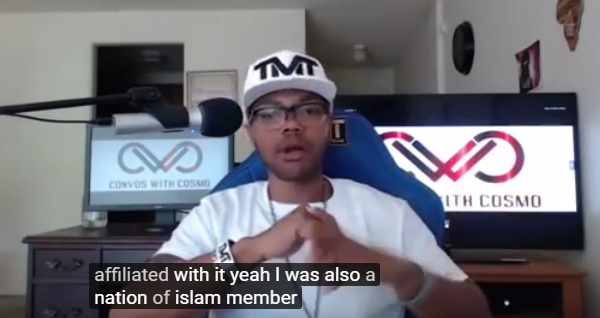
The Dallas terrorist attack also inspired another terrorist, Gavin Eugene Long, linked to the NOI extremist group, to commit another terror attack on July 17, 2016 in Baton Rouge, Louisiana, which resulted in the death of three police officers, including a black American police officer. Baton Rouge terrorist Gavin Long praised the terror attack in Dallas, during a video in which he claimed to be in Dallas. In a YouTube video, Gavin Long stated that he was a member of the Nation of Islam. Then, he pointed out that he wanted to clarify that “anything [that] happens with me,” only should reflect on him as an “alpha male,” not his affiliation with the NOI extremist group. After the terrorist attack, Gavin Long was killed in a shootout with police. When terrorist Gavin Long told the public to ignore his link to the NOI extremists, the media complied and completely ignored the link between Long and the NOI extremist group.
The Anti-Defamation League (ADL) has also reported on the history of the NOI extremist group and its history of calls for hate and violence. ADL writes that the NOI “has maintained a consistent record of anti-Semitism and racism since its founding in the 1930s,” and that under the leadership and guidance of Louis Farrakhan, the NOI has “used its programs, institutions, and media to disseminate its message of hate.” In addition, it states that the NOI has blamed the 9/11 terrorist attacks as a “false flag” attack by Israel, and NOI leaders also blamed the Charlie Hebdo terrorist attack in France on Jews. But the NOI extremist calls have gone beyond just hate and have openly called for violence.
This has included NOI leader Louis Farrakhan’s repeated calls in 2015 and 2016 for bloodshed. In a July 9, 2015 interview, which Louis Farrakhan re-posted in 2016 (the same day as the Dallas terrorist attack in 2016), the NOI leader promoted a video, “The Price of Freedom,” where Mr. Farrakhan recorded calls for bloodshed. In the video, the NOI leader Louis Farrakhan told his followers to embrace hate and violence, stating “God hates…I don’t why man thinks he is better than God,” “Don’t let this White man tell you that violence is wrong,” and that “there is no freedom without the shedding of blood.”
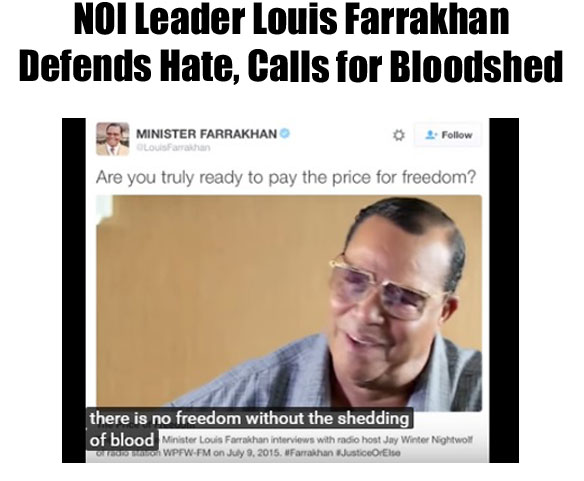
NOI leader Louis Farrakhan’s call for bloodshed and hate has been heard by too many, who have been inspired by the extremist ideology to commit acts of violence in rejection of our shared human rights and human liberties. The NOI extremist group’s ideology has been an inspiration for at least four terrorist attacks on the United States in recent years: Dallas, Baton Rouge, most recently Fresno, and prior to that, in the Washington D.C. metropolitan area as well.
One of the more notorious terrorists linked to the NOI extremist group was John Allen Muhammad, “the Beltway Sniper,” who was a member of the NOI. The Baton Rouge-born John Allen William joined the NOI in 1987, and reports still maintain that he helped provide security (this is disputed) for the 1995 NOI’s “Million Man March” in Washington, D.C. John Allen Muhammad and his co-conspirator killed 10 people in the Washington D.C. area in October 2002. Further investigation raised the death toll to 17, after it was discovered that he had also committed murders and robberies in the states of Alabama, Arizona, Florida, Georgia, Louisiana, Texas, and Washington. After his arrest, NOI leader Louis Farrakhan sought to distance the NOI from John Allen Muhammad’s terrorist acts, and denied that John Allen Muhammad was a part of security for the NOI event.
Across the United States from coast to coast, in California, Washington, Arizona, Texas, Louisiana, Georgia, Florida, Virginia, Maryland, Washington D.C., acts of terror and violence resulting in deaths have been committed by individuals who pursued a path of hate and violence, which the NOI continues to seek to encourage. This is the PRICE we pay for silence to extremist ideologies. When we fail to challenge those who promote hate and violence, the cost is ultimately in human lives.
You will notice the victims of killings by those linked to the extremist NOI ideology are not all white, there are black victims as well, men, women, fathers, mothers, people of all different faiths and backgrounds. The advocates of bloodshed find killing just too easy, and human life too cheap. The victims share one common bond: they are our FELLOW human beings, and they and their loved ones deserve more courage from our society in defending their human rights than this. They deserve more than conscious silence, deliberate misdirection, tactical legalities, and human rights community that is unwilling to aggressively defend human equality, because it is more afraid of offending someone than it is of defending the lives and human rights of our fellow human beings. We cannot simply be a human rights community of simply the pleasant issues, of politically expedient issues, and issues without controversy. Our defense of human rights will always be controversial because attacks on human rights are based on human conflict. In the case of the NOI extremist ideology, we must defend human equality.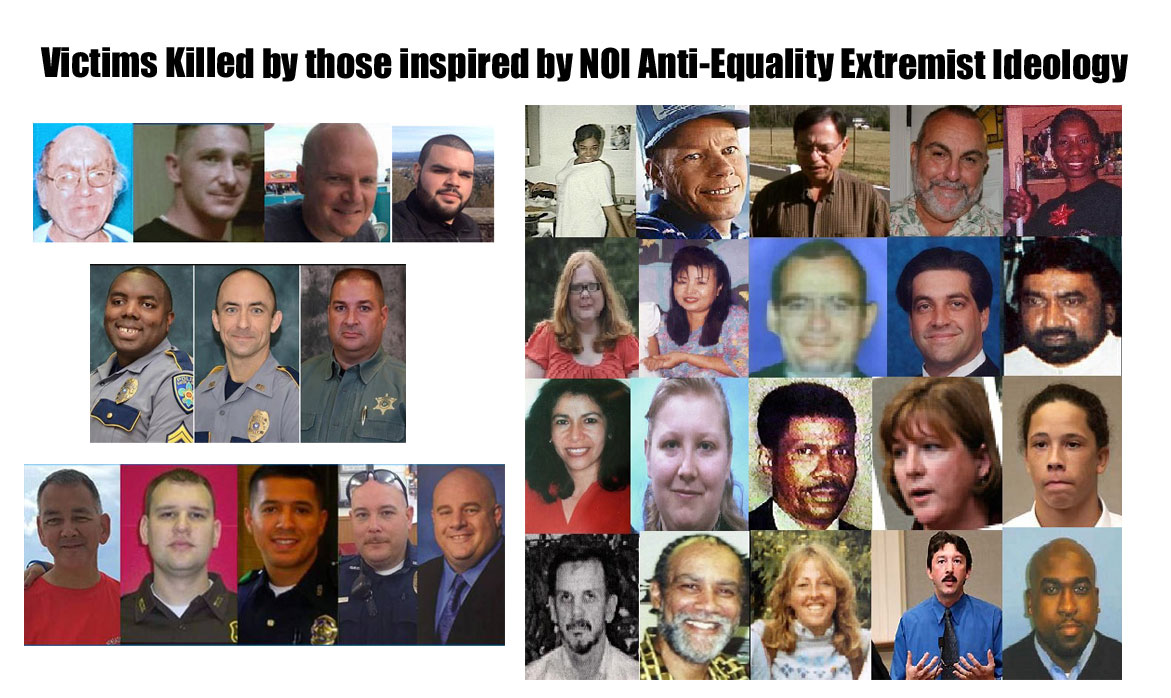
While Louis Farrakhan and NOI leaders may deny a role of its extremist ideology after individual terrorist attacks, the reality remains that the NOI extremist ideology begins with a rejection of basic human rights and human equality. The NOI ideology views the white race as inferior, “potential humans,” based on its concept that the white race was created from “grafting” by wizard “Yaku,” for the purpose of subjugating blacks. NOI extremist leader even told the Philadelphia Inquirer on March 19, 2000 that “White people are potential humans – they haven’t evolved yet.” The Inquirer sought to couch this in terms of racial discrimination. But it is more fundamental than this; with the NOI extremist movement, like too many other extremist movements, there is a basic rejection of human equality.
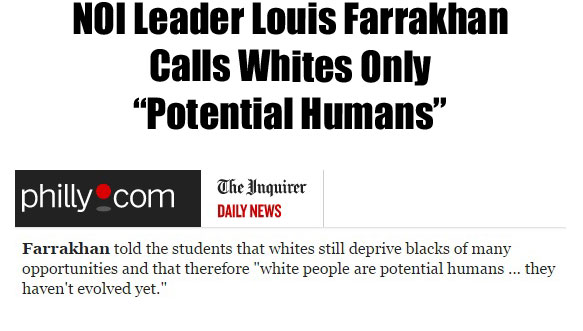
The SPLC writes that “NOI predicts an epic struggle in which the Nation of Islam will play a key role in preparing and educating the Original People, who ruled the earth in peace and prosperity until Yacub’s ‘blue-eyed devils’ came along to gum things up.” The NOI extremist ideology presents a longer term challenge that rejects the basic concept of human equality, and has clearly inspired those who will commit acts of terrorism based on that ideology to intimidate the public and the government. That is terrorism.
Tactical counterterrorism measures, police procedures, calls for “law and order,” etc. do not begin to work to challenge extremist views that reject that people who are different as not even human beings who deserve basic human rights. We must first start with a struggle of “ideas.”
This is where counter-extremist by human rights activists have such a vital role in challenging extremist ideologies that lead to terrorist acts. More than police and political tactics, military maneuvers, and security procedures, counter-extremism by human right activists must challenge and change extremist thinking. Our law enforcement and counterterror tacticians have views of “counterterrorism” which are based on legal evidentiary processes, based on the “last war” with Al Qaeda; too few clearly understand the problems associated with extremist ideologies that lead to “terrorist movements.”
Blind counterterror tacticians would reject any inspiration by the Nation of Islam’s ideology in these terrorist attacks, unless we have a signed document by Louis Farrakhan himself calling for a specific terrorist attack to an individual with clear criminal culpability, committing a terror attack at a specific time and place. They continue to view terrorism based on the “9/11 terrorist” model, used by Al Qaeda’s “cells,” of 15+ years ago. But we are increasingly seeing extremist ideologies and promoters of violent hate influencing those who commit acts of terrorism. Investigators in this Fresno attack not only cannot recognize it as “terrorism,” but also have no comment or question to the NOI extremist group. This conscious blindness prevents our society from moving forward to make progress to challenge extremism.
The mainstream media largely shares this same bias in being able to recognize that extremist ideologies inspire acts of terrorism. Too many mature human rights organizations also want to turn the other way at such difficult issues of extremist ideologies inspiring acts of terrorism. Such organizations do not want to challenge such issues either because they want to claim challenging extremist inspiration of terror is something that is not part of a “human rights agenda,” (when security, equality, and dignity are very much universal human rights).
To all those who respect human rights, we cannot make progress with extremist organizations who begin with a basic concept that people who are different from them simply are not even human beings and do not deserve equality.
Responsible for Equality And Liberty and its leadership has stood for 50 years in defense of black American’s civil and human rights. We understand, have challenged, and made change in defense of black Americans and other human beings. We urge our fellow human beings, who are black Americans or any other race, nationality, or identity group, to reject any ideology which begins with questioning the equality of your fellow human beings.
We know better than this. We ARE better than this.
We call upon NOI’s Louis Farrakhan to drop the burden of hate from his heart, end an advocacy of hate and violence, and we call upon those involved with the NOI extremist group to reject its anti-equality and anti-human rights message. The power of hate will always lose in the end, no matter what temporary victory its advocates believe they will achieve.
We are responsible, every single one of us in every nation, every day, for the defense of basic standards of dignity, equality, mercy, and security of our loved ones and our fellow human beings.
Together – we are Responsible for Equality and Liberty.
U.S. Journalist Arrested in Jewish Community Center Bomb Threats
The U.S. Department of Justice announced on March 3, 2017 that it had arrested Juan Thompson, from St. Louis, Missouri, for bomb threats against Jewish Community Center (JCC) offices across the country, against the Anti-Defamation League (ADL), and cyberstalking against a woman. Journalist Juan Thompson formerly was a reporter for DNAinfo, a reporter for The Intercept, and worked briefly for WBEZ public radio in Chicago. Juan Thompson was previously in the news when the public was informed that he had been falsifying news reports, creating fake email addresses, making up false quotes, and other fabrications, while reporting for The Intercept. On social media, Juan Thompson’s Twitter account included a number of hate-filled and racist attacks, including attacks on the woman who he was cyberstalking, including using her name in bomb threats against the JCC.

In the March 1, 2017 federal criminal complaint against Juan Thompson, the U.S. Department of Justice accused him of acting “with the intent to kill, injure, harass, intimidate, and place under surveillance with intent to kill, injure, harass, and, and intimidate another person, used the mail, any interactive computer service and electronic communication service and electronic communication system of interstate commerce, and any other facility of interstate and foreign commerce to engage in a course of conduct that placed that person in reasonable fear of the death of and serious bodily injury to that person and caused, attempted to cause, and would be reasonably expected to cause substantial emotional distress to that person.”
The federal criminal complaint provides some details of eight bomb threats against the Jewish centers, charged to Juan Thompson. It links Juan Thompson to a threat of a “C-4” bomb explosive against the Anti-Defamation League headquarters in New York City. The complaint links Juan Thompson to bomb threats against Jewish Community Center offices, including email statements that his cyberstalking victim “sought to kill as many Jews asap.” The complaint documents links to Juan Thompson to bomb threats against Jewish facilities and museums in California, Texas, New York, Michigan.
The federal criminal complaint against journalist Juan Thompson also states that he used his fake email addresses to threat to kill his cyberstalking victim, and that he used his cyberstalking victim’s name in threats against the Jewish center. The complaint also states that his cyberstalking including spreading false information about the victim, claiming the victim was engaging in child pornography, spreading nude images of the victim, and contacting the victim’s place of work and claiming that she was anti-Semitic.
U.S. Attorney Preet Bharara said: “Everyone deserves to be free from fear and discrimination based on religion, race, or ethnicity; that is fundamental to who we are as a nation.” U.S. Attorney Preet Bharara also stated: “Threats of violence targeting people and places based on religion or race – whatever the motivation – are unacceptable, un-American, and criminal. We are committed to pursuing and prosecuting those who foment fear and hate through such criminal threats.”
FBI Assistant Director-in-Charge William F. Sweeney Jr. said: “Thompson’s alleged pattern of harassment not only involved the defamation of his female victim, but his threats intimidated an entire community. The FBI and our partners take these crimes seriously. I would also like to thank the NYPD and the New York State Police, who continue to work shoulder to shoulder with us as we investigate and track down every single threat and work together to achieve justice for our communities that have been victimized by these threats.”
Juan Thompson used his social media Twitter account to claim that he was first visited by the FBI on February 10, writing the police “are out for blood.” But the threats reportedly not only continued, but actually accelerated after this, without any fear of consequences by the law. Juan Thompson’s social media Twitter account spread hatred and contempt in many of its messages, promotion of Communism, and calls for violence against the police, white Americans, and others, promoting messages such as the “Only thing these Devils understand is bloodshed.”
As this criminal complaint only addresses eight threats to Jewish centers across the United States, R.E.A.L. expects that an ongoing investigation remains in process, and that other suspects will also be charged for their crimes. This arrest should at least show those who seek to make such threats against others that law enforcement does take such threats seriously, and that no one is above the law.
R.E.A.L. also calls upon other U.S. news media and journalist organizations to take serious consideration of their actions and employees over the past year. We have seen repeated death threats from various media reporters, such as Steven Borowiec reporting for the L.A. Times calling for the death of Donald Trump, unparalleled libelous and vicious attacks, and open calls and incitement for public violence.

R.E.A.L. recently reported on a number of major news media outlets, with open calls for public violence in Newsweek, The Nation, The Independent, as well as incitement to violence in the Washington Post, New York Times, and Guardian.
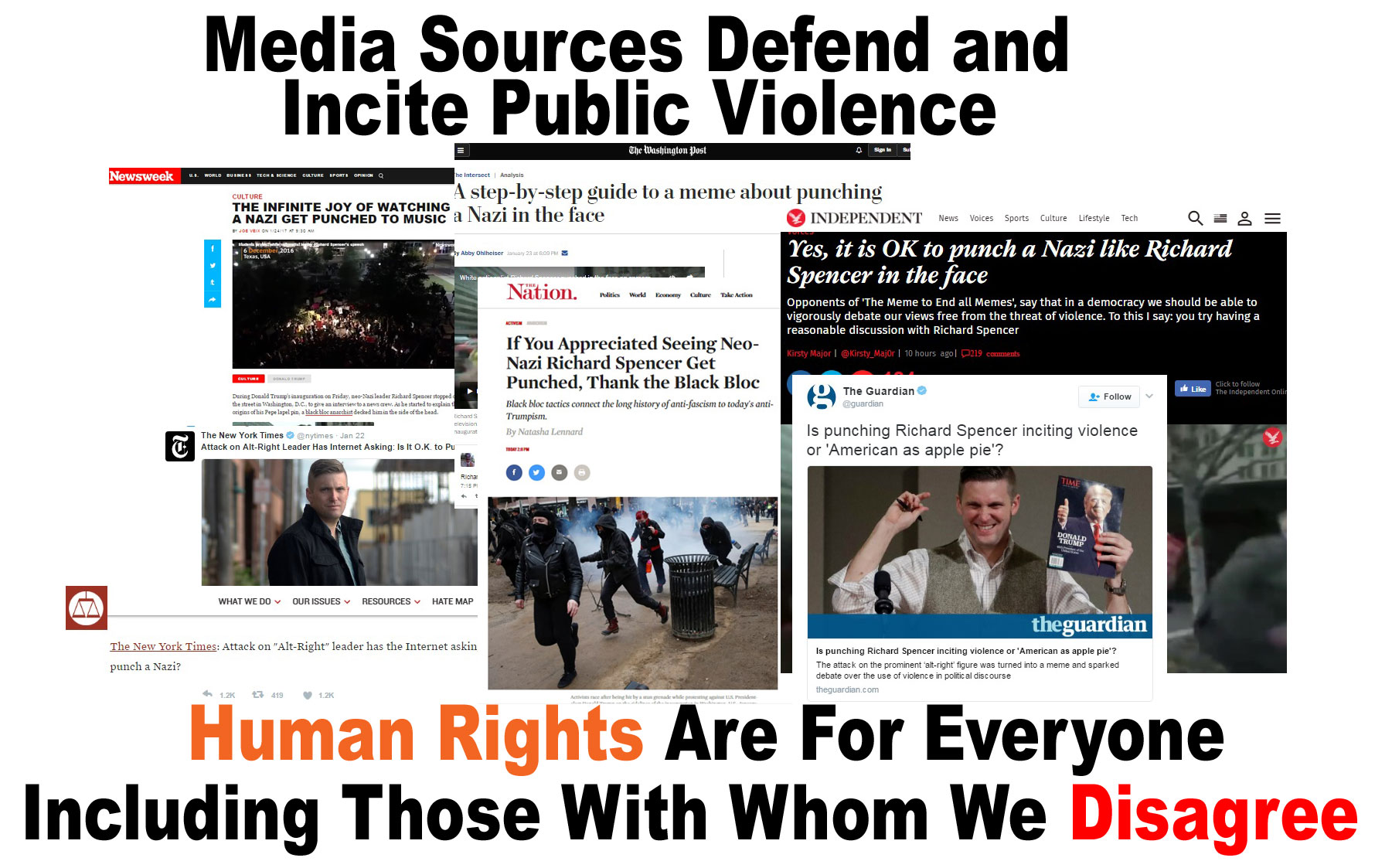
The advocates of our shared universal human rights will find it increasingly difficult to defend a free press, when too many members of that press are using their free press protections to call for criminal violence, and incite criminal violence. Today, we now see a member of the press now arrested for violent bomb threats and death threats.
What exactly is it going to take for responsible members of the U.S. media to wake up and to police their fellow journalists to use their free press role to report the news, instead of being involved in criminal threats against the public?
The U.S. media and journalist organizations must make it clear that they understand criminal threats against the safety of others is wrong, against the law, and not acceptable – EVER – for any news or media organization – and for any journalist.
R.E.A.L. calls for the U.S. news media and other journalist organizations to condemn and denounce all those calls for violence, threats of violence, and now, bomb threats, made by members of the journalistic community. We need a voice of responsibility from the new media community that respects that no one, including themselves, is above the law or the responsibility of our shared universal human rights.
USA: Preventing Terrorism by Countering Extremism with New Solutions and Thinking

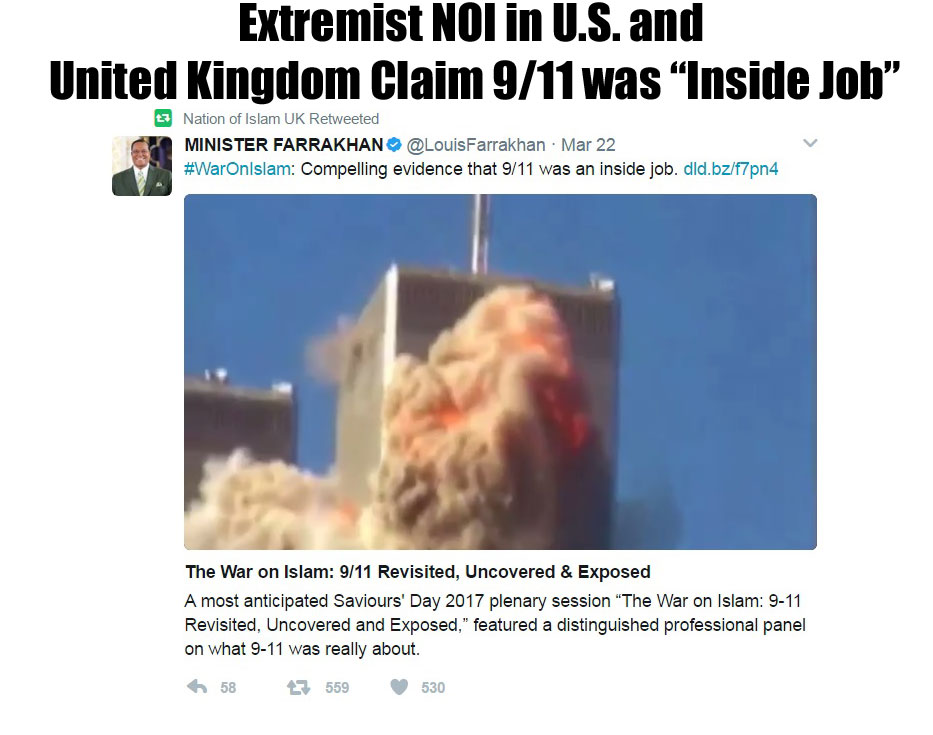
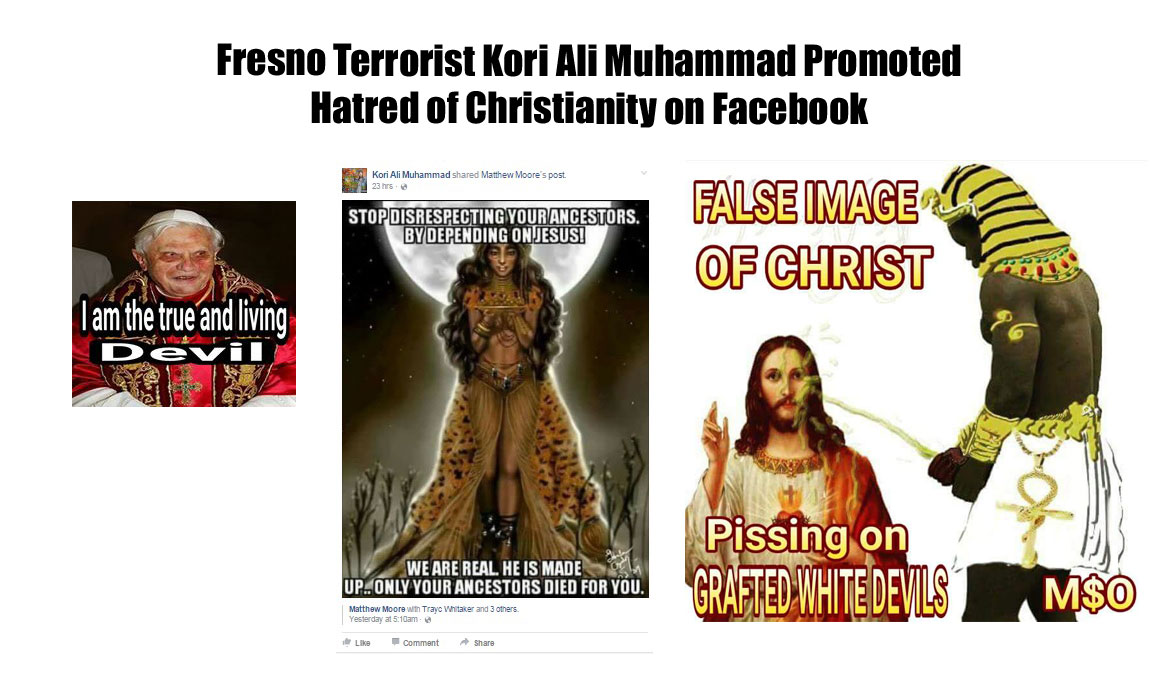
On September 9, 2008, U.N. Secretary-General Ban Ki-moon told an audience of survivors of terrorist attacks that he recognized terrorism “can affect anyone, anywhere… It attacks humanity itself.” In the struggle to protect the public from terrorism, we need a broader perspective than only the tactical actions and organizations where most of focus remains. We must respect that terrorism is attack on our shared human rights. Too many activists who support human rights are almost exclusively concerned about terrorist actors, rather than their victims. This backwards perspective would be rejected in another area of rights activism. We would not defend women’s rights by a defense of rapists and those committing sexual assault, but when it comes to those plotting and committing acts of terror, too many are unwilling to “judge” their contempt and assault on human rights. We need to work to reverse this backwards perspective as we see the evolution of terrorists into de-centralized “terrorist movements” with a growing attack on humanity across the world. Especially in the United States of America, we need to defend the American people from violent extremist bullies, who believe they can threaten and commit acts of violence without consequences.
In the United States of America, there needs to be a renewed urgency to reassess the approach to addressing domestic terrorist plots and threats. In a list of 88 (updated) terrorist plots and attacks on the U.S. over the past 8 years (listed in this report), 50 percent of these have occurred in the past two years (2015 and 2016). This is despite the rigorous efforts by the establishment media to discontinue the use of the word “terrorism” or “terrorist” in many reports. By failing to report on and address the evolving threat to the American homeland, members of the American public are at risk at being blind-sided by evolving, decentralized “terrorist movement” threat, coming 90 percent from U.S. citizens and residents, while the American government prioritizes a focus mostly on foreign terrorist threats and extremism. Furthermore, in the law of the U.S. Code, the overwhelming majority of the U.S. Code references are oriented towards “international terrorism” (144 references), rather than “domestic terrorism” (12 references).
The American public and its representative government need to also recognize that as time and the world changes, so do the types and organization of threats to our human rights, which include our safety. The American counterterrorist establishment and its community was largely expanded, as a result of the 9/11 terrorist attacks, 15 years ago. In the blur of a fast-moving world, it is easy to lose track on how much has changed in 15 years. The development of de-centralized “terrorist movements” with a majority of attacks from “lone wolf” or “inspired” individuals utilize tools for recruitment and planning that didn’t exist: YouTube, Twitter, Facebook, iPhones, ubiquitous video and encrypted global communications. While the world has changed, our establishment community has largely sought to fight only the “last war,” while offering only a dismissive and defeatist response to new terror threats as “inevitable.” Imagine, if America’s leadership stood at the smoking remains of the World Trade Center towers after 9/11, with such a shrug-should commitment to public, by telling them to just expect such attacks as “inevitable.” But this is the defeatist position where America finds itself today. Would this be our position on any other violation of human rights? That rape, murder, torture, child abuse, etc. are all just “inevitable”? Yet too many find such defeatist views acceptable on terrorism.
America also needs to reflect on commitment of resources used in fighting structured Foreign Terrorist Organizations (FTOs) abroad versus the need to protect its own citizens from “lone wolf” and terrorist movements in the U.S. homeland. Long-term American public confidence in counterterror and public safety organizations cannot be retained, while decentralized actors of “terrorist movements” and extremist ideologies act on a regular basis, and our massive FTO-based counterterrorism investment is helpless to prevent or discourage such attacks. As I will detail below, based on open source information in compiling a list of 88 terrorist attacks and plots on the United States homeland, 9 out of 10 terror plots/attacks are performed and planned by American citizens and residents, many with tenuous links to FTOs, such as ISIS – certainly not enough to get them regularly prosecuted for the attack/plot alone based on FTO-centric laws. Furthermore, over the past 2-3 years, such decentralized terrorist “movement” attacks by Americans has significantly increased, with 50 percent of terror attacks/plots in this reports’ listing over the past 2 years.
Furthermore, we need to clarify what “domestic terrorism” is, when such acts of terror by U.S. citizens are “inspired” by terrorist movement ideologies. If terrorist movement ideologies are global, does that make them “foreign terrorist” acts or “domestic terrorist” acts? For the United States in actually stopping terrorist attacks, this requires a documented link to a known “foreign terrorist organization” (FTO), such as ISIS or Al-Qaeda. Without such a link, the public safety imperative then falls back to carefully defined weapons and arms criminal violations, which don’t always result in convictions.
Challenging extremist ideologies which inspire violent terrorist acts must not only be a “major foreign policy goal of the United States,” it also must be a priority for American domestic public safety. While the U.S. government is and should be concerned about extremists in other parts of the world, we must not ignore the extremist threats that we face today in the United States right now. U.S. government representatives are more comfortable with addressing extremist challenges in other nations, where such representatives don’t face a pushback that extremists are merely exercising their “civil liberties.” We must reject the view that “difficult” balances and challenges to achieve consistency on domestic extremist and terrorist movements are “impossible.” Difficult challenges are often the most important challenges.
As terrorist movement capabilities and ability to act in the 21st century becomes a greater threat, so we must have thinking, processes, organizations, personnel, and laws, which will protect the public safety and security of the innocent public from their anti-human rights agenda of death and mayhem. From that perspective, I have drafted a series of concepts for review and discussion to consider changes to meet this urgent public threat. The focus here is on changes within the United States of America, but the ideas have applicability to any free state, which respects all of the human rights of our public. As we do with any major threat to human rights, our thinking and our solutions must by holistic and dynamic. U.S. government organizations must also make American public safety a continued priority, with a primary focus on U.S. threats. We cannot address significant challenges only with piecemeal and short-term tactical solutions which do not consider that things can change.
To protect our fellow Americans and these rights, we need to do more than reactively respond, after these rights are taken away and our citizens are killed or injured. We need to proactively prepare and protect our communities from those who brazenly seek to commit acts of terrorism. We need to show such movements of violence and hate that our defense of liberty and security can be as quick, nimble, and creative, as their determination to steal the rights, lives, and security of our citizens.
To focus the United States of America’s resources and energy on protecting Americans in the U.S. homeland with long-term strategies, I will recommend the following:
(a) New focus on human rights-based challenge extremist ideologies which inspire terrorism
(b) Reform of U.S. Code to provide additional definitions and laws regarding domestic “extremist and terrorist movements”
(c) Creation of a new commission to study the ISIS “terrorist movement” and other methods of decentralized terrorism, largely using local terrorists, as we have seen in America and 30 other countries
(d) Rejection of “acceptable losses” and “inevitability” of terrorism as a cruel and defeatist policy, which has no place in counterterrorism
(e) Re-assessment as to the number of actual U.S. citizens and U.S. residents which appear to represent the overwhelming number of real terrorist threats on U.S. homeland
(f) Candid assessment and solutions for dealing with gaps in America’s capabilities to deal with 21st century, terrorist movement-based terror threats and extremist ideology inspirations
(g) Creation of a new “Public Safety Act” to make it against the law for members of American law enforcement, public safety, military, or private security organizations to be supporters of violent extremist or terrorist organizations
(h) Reform of 18 U.S. Code Chapter 113B to ensure more laws which allow criminal prosecution for supporting domestic terrorist movements, as they do today for Foreign Terrorist Movements
(i) Creation of a new “Terrorism Prevention and Public Protection Act” to allow preventive measures to protect the American public from suspected terrorists, just like we have protective and restraining orders to protect the public from other threats
(j) Commitment to a U.S.-based “War of Ideas” to challenge extremist ideologies used to inspire terrorist movements and acts in the U.S.
(k) Re-Assessment of strategy, policy, and resources, to ensure that U.S. efforts are focused on protecting Americans first from terrorist and extremist threats
(l) Creation of a new American Counter-Extremist Service (ACES) to spearhead a U.S.-based “war of ideas” to challenge extremist ideologies, to de-radicalize individuals and communities, to promote a human rights-based respect for the safety and dignity of Americans, to leverage intelligence research and tips on terrorist threats from volunteers among the 300,000,000 American people — and give American citizens a chance to participate in defending their nation from extremists and terrorism, and set new standards of human rights in defying extremist ideologies of hate and violence against the United States of America. American history shows that the past “wars on extremism” have largely been won by getting the American public, at every level, enlisted to help in the “war of ideas” for human rights and human dignity. Where the American government cannot or is unable to act, the American public must challenge extremist views that threaten society, as we have done for centuries. But we need a new government perspective to share the concerns of the American people in defiance of violent extremism.
Certainly there is no question that we must challenge, defy, and destroy Foreign Terrorist Organizations, but we need to reevaluate our counterterror assumptions that the defeat of FTOs will stop domestic terrorist threats. We cannot be so convinced that we will defeat terrorist threats to the United States in foreign countries, while increasing numbers of terrorist plots and attacks are performed by U.S. citizens and residents. We cannot be prepared to fight and challenge extremists and terrorists anywhere in the world – other than the United States of America.
Americans should be confident the U.S. organizations and individuals from U.S. counterterrorism, homeland security, law enforcement, intelligence, and the military are selflessly sacrificing and dedicated to preventing terrorist attacks in the United States. But as the threat changes from “terrorist movements” and decentralized individual terrorists become a rapidly increasing threat to the American public, we must also consider change on the processes, thinking, resources, and approach to preventing extremist terrorism in the United States.
We must recognize that the “long war” with terrorism is focused on prevention, and discouraging growth of anti-human rights extremism. A tactical solution seeks to “buy time,” but as American has seen over the past 15 years, only using domestic law enforcement and foreign military tactics have very real limits, and in some cases, can be counterproductive. The anti-human rights ideologies of extremism are not “disenfranchised minorities” as some will argue, but anti-human rights minorities that reject basic standards for shared, cohesive, and most importantly SAFE societies. We have a social responsibility to protect the human rights of the victims targeted by such purveyors of terrorist hate, crime, and violence, just as we would consider the rights of any other type of hate, crime, and violence.
For example, in the United States, rational people would not be more concerned about the rights of Neo-Nazi terrorist bombers of those in the Neo-Nazi hate movement over the rights of victims which they seek to target. For certain, such Neo-Nazis are a minority, and as Americans, they have rights like others, but they do not have more rights and greater privilege of protection than their targets and victims. Sane and rational people will understand this. But this logic is reversed by some who seek to prioritize human rights protections for other extremist groups over their victims. We must not invert sanity in human rights and make the avowed enemies of human rights as a special protected “victim” class, while ignoring the very real victims of their terrorist acts. Such a backwards defense of “terrorists first” is a failure of consistency in respecting and in understanding human rights, and responsible members of American society much challenge and change such perversions of human rights standards.
These recommendations are offered as a starting point for a more comprehensive analysis; they do not suggest that the foreign terrorist threat has become less of a threat for the American people, as this information all comes from public open source records, which would not reflect classified threat information. However, it is clear that a more consistent approach to dealing with U.S.-based extremist and terrorist threat is needed, which is not dependent on the FTO-centric counterterrorism establishment. But what these recommendations seek to offer is a more coherent, holistic approach to dealing with the specific in-country extremist and terrorist threats, which case history shows is overwhelming from U.S. citizens and residents. It offers a human rights-based way to challenge those extremist ideas which continue to inspire terrorists, after our law enforcement makes arrests.
(1) The Terrorist Threat to Human Rights – Reclaiming Societal Understanding of Right vs. Wrong
The Universal Declaration of Human Rights (UDHR) does not give us a right to murder, to maim, to plot violence, and to commit acts of terrorism. In fact, the UDHR was created largely in response to the “barbarous acts” of state-sponsored terrorism by Nazi Germany, during World War II. Rather than a barrier to stopping such “barbarous acts” against our fellow human beings, the UDHR had a goal to promote “the foundation of freedom, justice and peace in the world.” The UDHR recognizes everyone “has the right to life, liberty and security of person.” Life, liberty, and security are not viewed as separate and competing concepts, but as a holistic foundation to allow us to exercise our rights in a free society.
In defending our shared human rights, even more fundamental than life, liberty, and security, is the necessary competence in society to understand the difference between right and wrong. Too many cultural analysts will argue that right and wrong are entirely dependent on the individual national culture where you live, that you belong to, or relate to. Such ethical relativism prevents “judgment” of those, who relativists argue simply have a “different culture” than ours. We face a quandary where we have those too many establishment groups claiming to represent “human rights,” which really only represent human rights for selected groups they believe deserve special sympathy. While it is practical to focus on specific campaigns, the challenge when it comes to extremist and terrorist threats comes when we see those who defend threats against the public as merely expressing relativist views on “religious and political debate.” Too often, we have seen those expressing defense of misogynist extremist defending cultural “relativity” that we need to “understand” abuse, rape, and even murder of some women, because of the cultural differences, the dress of women, etc. Cultural relativism actively works to undermine a consensus on human rights competence (right versus wrong) and consistency on extremist views. The selected arguments of cultural relativists are that there is no one standard on human rights, but there are multiple standards based on every different culture. This relativist argument leads to a conclusion that we cannot “judge” any extremist views as “right” and “wrong” are a relative illusion, framed only by our own culture and experiences.
Such relativism is a corrosive acid which works to destroy the foundation of a cohesive society. Members of society must trust that no matter how diverse and individual we may be, we have some basic societal shared values of right and wrong. We need more than simply “the law” to enforce every aspect of this. We are dependent on trust every day. Drivers need to believe that others will stop at red lights. Consumers need to trust that the food they purchase at the market is safe to eat. Investors need to believe that when they put money in a bank, it will still be there to withdraw when they need it. We have seen violations of all these “trusts,” and we do have some basic methods to protect the public. But in daily life, we depend on such trust, not that this trust is somehow “relative” depending on the particular views of other members of society, based on their politics or identity group. Such responsibility and dependence on TRUST is a great force of equality in a cohesive, free society.
So it is in trusting in the public safety from terrorist acts. Terrorism is the ultimate violation of societal trust. Private individuals may have extremist thoughts, but when they advocate and plan acts of extremist violence against other members of society, their private thoughts translate into public threats. Cultural relativists cannot debate away such advocacy, planning, and actions of extremist violence, as merely relative difference in political, religious, or other identity group values on human rights. Those genuinely supporting human rights must accept that extremist advocacy, planning, and actions of violence – is not only criminal, but also an attack on our shared universal human rights. We need more than law enforcement and lawyers debating over the “intent” of those planning, threatening, and acting on terrorism against the public. We also need the shared community of every identity group, as well as human rights activists sharing a common competence on public safety – and understanding the “right” versus “wrong” in extremist views and behavior. We need to agree that threatening the public is wrong – all the time – no matter what the frustrations or perceived rationale of the individual may be.
For too long, there has been the perspective that the only “human rights” we need to care about are for a narrow group of perceived persecuted individuals among selected identity groups in America. But human rights matter for all human beings, and U.S. Constitutional rights matter for all Americans, including their security and liberty. Americans are on the cusp of facing a growing number of violent terrorist movements and ideologies that want to kill and injure our fellow citizens, attack our children and families, and prevent us from exercising our rights. Those who plot and seek to commit such violent acts of terrorism do not share this commitment to human rights and human dignity.
We must have a narrative of judgment which shames and disgraces those involved in extremist groups and involved in terrorist acts. Anti-human rights extremists and terrorists are too infrequently shamed, and too often glamorized. One of the grave mistakes that the current practices make is the failure to shame and disgrace the anti-human rights extremists over their actions. In too much of the “media,” such extremist-inspired terrorists are built up with narratives showing them as powerful, clever, dangerous. The narrative of judgment, which those committed to human rights MUST have, is too often absent, the damage they do to families, the disgrace they bring to their families, the shame they provide to their identity group, is too often absent. In our worthy zeal to protect the privacy of victims and their families, there is not enough effort to sympathize with the victim’s loss and injury. Our “media” often only measures the damage to human rights by terrorist attacks based on the “body count,” has led to de-sensitized viewers who start to be numb to the tragedy of death and destruction by acts of terror. To work to defeat extremism, we need to recapture the hearts and souls of the public in recognizing the shame and disgrace of the terrorist’s actions. Furthermore, those twisted souls in the “media” who seek to make terrorists themselves into victims undermine our defense of human rights. Where else do we defend such criminals as victims, would these same “media” defend rapists and other contemptible, anti-human rights criminals as “victims”? We need to fight back against an amoral relativism, and reclaim a social conscience in human rights that recognizes “right” and “wrong” – without this we continue to lose “competence” in our society to interact with one another.
(2) Need for U.S. Code Reform on Domestic Extremist and Terrorist Movement Threats
Today, the U.S. law and government organizations maintain a predominantly foreign-based position and commitment of resources on terrorist threats. This is dramatically shown in the U.S. Code for federal law. Unlike “international terrorism” which has 144 references in the U.S. Code law, “domestic terrorism” is referenced only 12 times in the U.S. Code law. Continuing a largely 20th century thinking on counterterror (CT) measures, the CT establishment is not regularly pushing for changes to the U.S. Code, assuming that many of the U.S. domestic terrorists can be found to have some “link” to foreign terrorists organizations (FTOs). But for those mostly U.S. citizen/resident terror suspects without a well-documented “material support” to an FTO, the U.S. Code has very little in the way of actual domestic terrorist criminal charges, primarily because domestic terrorism itself has very limited references in the U.S. Code at all.
The primary legal reference specific to “domestic terrorism” is in 18 U.S. Code § 2331, which also provides the majority of its 20th century-based language in defining “international terrorism,” but in 18 U.S. Code § 2331(5), we finally have a starting point for defining “domestic terrorism.” Under 18 U.S. Code Chapter 113B, 18 U.S. Code § 2331(5) defines the “term ‘domestic terrorism’ means activities that (A) involve acts dangerous to human life that are a violation of the criminal laws of the United States or of any State; (B) appear to be intended—(i) to intimidate or coerce a civilian population; (ii) to influence the policy of a government by intimidation or coercion; or (iii) to affect the conduct of a government by mass destruction, assassination, or kidnapping; and (C) occur primarily within the territorial jurisdiction of the United States.”
In addition to the basic definition in 18 U.S. Code § 2331(5), the 12 references to “domestic terrorism” in the U.S. code law are for areas regarding grants for threat assessment, port security, chemical, biological, radiological, nuclear, and high-yield explosives response team, obstruction of proceedings before departments, agencies, and committees, BATF reorganization, fraud of identification documents, authority to use available funds, and similar topics.
18 U.S. Code § 2331(5) provides us with a starting point to move forward with legal and organizational changes to address the evolving domestic-centered and growing extremist “terrorist movements,” which are the basis for many “lone wolf” and small group attacks. The current U.S. Code, however, lacks a structure to deal with domestic “extremists” and “terrorist movements.” This 20th century thinking of terrorism as performed only by a structure group is contrary to the reality that we see with the overwhelming majority of terrorist threats (as documented in open source data) today. In the current U.S. Code, the law acknowledges “extremist” groups, but mostly associates them with foreign nations. Even in 50 U.S. Code § 2301 – Findings (on weapons of mass destruction), where the law acknowledges the existence of “extremist movements” and “terrorist movements,” it links this with dealing with weapons of mass destruction basically from foreign sources. 50 U.S. Code § 2301 (8) is a Congressional finding stating that: “The acquisition or the development and use of weapons of mass destruction is well within the capability of many extremist and terrorist movements, acting independently or as proxies for foreign states.”
America needs reform and modification of 18 U.S. Code § 2331(5) or other appropriate statute to recognize the existence of “extremist movement” and “terrorist movement” threats to the United States homeland. Other parts of 18 U.S. Code Chapter 113B may apply to “domestic terrorism” as defined by 18 U.S. Code § 2331(5). But the challenge of lack of domestic focus on legal measures to address extremist and terrorist movements, which are different than the 20th century based “terrorist group” thinking and laws, can represent a real hurdle to responsive and effective protection of the American public from this evolving “movement-based” domestic threats.
Consistently throughout the U.S. Code, we see an 20th century-based thinking on structured “terrorist groups,” rather than decentralized “terrorist movements.” One of the primary definition frequently used by intelligence community members (which also predominantly focus on foreign-facing threats) is found in 22 U.S. Code § 2656f(d)(2), under the Department of State’s regulations, which states: “the term ‘terrorism’ means premeditated, politically motivated violence perpetrated against noncombatant targets by subnational groups or clandestine agents.” This definition of “terrorism” is provided in this part of the U.S. Code to clarify the previous term in its definitions, which is “international terrorism.” Here we see the legal understanding of terrorism as perpetrated by “groups,” a phrase that is repeatedly referenced in other parts of this U.S. code, including 22 U.S. Code § 2656f(d)(3): “the term ‘terrorist group’ means any group practicing, or which has significant subgroups which practice, international terrorism.”
We can also see this in 8 U.S. Code § 1189- Designation of foreign terrorist organizations, which defines terrorist organizations based on foreign organizations. We see this in 18 U.S. Code § 2339D – Receiving military-type training from a foreign terrorist organization, which defines terrorists as “the term ‘foreign terrorist organization’ means an organization designated as a terrorist organization under section 219(a)(1) of the Immigration and Nationality Act.”
As the American public could see by an organized review of the evolving terrorist plots and attacks on the U.S. homeland, a growing threat to America comes from decentralized extremists acting within “terrorist movements,” rather than in the structured “foreign terrorist organizations,” which current American law, organizations, and resources are predominantly oriented to support. Our law and our thinking must change to meet the new challenges of this growing 21st century threat to America.
Specifically, I recommend the creation of a “Domestic Terrorist and Extremist Act of 2017” in Congress, which provides definitions for “extremist movement” and “terrorist movement” threats in the United States, just like the U.S. Congress is willing to recognize exists in foreign nations. The recommendation here would be to amend 18 U.S. Code Chapter 113B to include specific legal definitions that “terrorist” threats may include those within decentralized “terrorist movements,” and such terrorist acts may be inspired by “extremist movements.” To make other changes, we need to recognize the reality of today’s world, beyond the terrorist threats mostly perceived from the 20th century and in the immediate post-9/11 environment.
(3) Intelligence Means Thinking.
Depraved terrorist movement supporters are not smarter than the defenders of our shared rights, liberty, and security. They have come to believe they are. We must change that, and we need a new approach and commitment to harnessing domestic intelligence to challenge these threats to human rights and security. We need to re-imagine the word “intelligence” as “thinking” rather than “intrusive spying.” Let us remember that “intelligence” instead means the ability to THINK, to use strategy, to be creative, and to use and make judgment. We need to re-imagine the word “intelligence” to include “competence,” demonstrating an ability to understand “right” from “wrong.” We need to re-imagine the word “intelligence” to be more than the ability to process tactical check-off lists, a laundry list of acronyms, and threatening groups, but to also have the subjective ability to imagine new patterns, new tactics, and changes from what we have seen before.
To defy terrorist movements, we need to use our intelligence to actively protect the human rights of liberty and security, which are both part of the U.S. Constitution and the Universal Declaration of Human Rights. Americans cannot exercise their rights, freedom of speech, travel, employment, education, social life, worship, and every aspect of their daily lives, when the anti-human rights forces of terrorism seek to deprive them of their life, liberty, security, and other rights.
The American current approach to intelligence on terrorist and extremist threats is largely centered on government and official sources. Certainly, these sources do receive tips from private citizens, but the overarching message to the American people is that the U.S. government is the primary stakeholder for all matters dealing with extremists and terrorists. Selected university organizations, non-governmental organizations (NGOs) and some private individuals are welcome to provide input, but the perspective most Americans have is that our “Intelligence Community” (IC) and law enforcement are the ones completely in charge of extremist and terrorist issues. While the public may have concerns on extremism and terrorism, the Obama administration predominantly was uninterested in public views on this subject as not being “specialists.”
But the increasing number of American victims of terrorist and extremist attacks should have a say in our national public safety policies, resources, and processes. The threat to Americans is not merely a threat to a relative handful of establishment counterterror “specialists,” too many of which spent 9/11/2016 describing how terrorist attacks were “inevitable” with “lottery-winning” chances. In addition to the “experts,” American citizens have a right to their views on policies, practices, and resources to be used to challenge extremists and terrorists. The counterterror establishment community would be wrong to dismiss the intelligence and creativity of the 300,000,000 American people. Our intelligence in challenging extremist threats to the United States in the past, such as white supremacist terrorist threats, has not been dependent on a “counterterror specialist,” but based on the intelligence of American public understanding the difference between right and wrong, fair and unfair, and working together to challenge those who publicly held such extremist views to change.
I have seen too many in the counterterror establishment community wave off the interest and concerns of the American public too often on such matters. Let us not tie our entire “intelligence” to challenge extremism and terrorism to only the smallest fraction of “specialists” within the American society, but let us get the rest of our society involved in developing “intelligence” solutions on extremism and terrorism, for the overall benefit for all Americans.
(4) We Must Fight Today’s Terrorist Threat.
Our counterterrorist research groups, processes, personnel, laws, and government organizations are largely based on a response to the 9/11 terrorist attacks in 2001, over 15 years ago, and the 9/11 Commission Report published on July 22, 2004. The assessment and decisions were based on an understanding of “terrorist groups,” resources, and technology of 15 years ago. We still need to defy those threats, but also much has changed during those 15 years, which has blindsided even those at our highest executive office. President Obama infamously made the remarks in 2014 that the ISIS terrorist movement was simply a “JayVee” (“junior varsity”) league of terrorism, and certainly did not represent a serious threat to the nation. Lax thinking allowed a global terrorist movement to spread and represent a significant danger to the public.
15 years ago, we did not have Twitter, Facebook, YouTube, iPhones, and ready encryption sources for global mobile communications. 15 years ago, we didn’t have ubiquitous mobile video capture and storage for instant communication anywhere in the world. In the 21st century, a gap of 15 years to assess critical business policies and practices would be unthinkable, but when it comes to life and death matters of fighting terrorism, our establishment government leaders don’t see anything wrong with this. 15 years ago, much of the world was a significantly differently place, and certainly the terrorist threats and resources are vastly different.
We had thoughtful and considered studies on the terrorist problem – 15 years ago – which we have not significantly revisited, other than the occasional conference or debate. We have no corollary to the 9/11 Commission Report for this stage of the 21st century terrorist movement threats and challenges.
(5) ISIS Commission Needed to Assess Nationwide, Worldwide ISIS Threat.
Over the past 9 years, with the creation of the ISIS from the remnants of Al Qaeda Iraq and other groups, along with various new empowered extremist and terrorist groups, the terrorist threat and the problem of protecting the public has dramatically changed. The ISIS terrorist group acquired territory in multiple countries, which it called a caliphate, as well as a worldwide following of supporters. Some went to Syria, Iraq, Libya, but many, many more remained in their home countries. The strategies discussed about how to “defeat ISIS,” focused on military tactics that were necessary years ago. But years ago, ISIS evolved from a terrorist group to a “terrorist movement.” The tactics of counterterrorism might stop some activity of a “terrorist movement,” but were more based on “luck,” rather than a plan to actually address the evolved threat of terrorist movements.
While our thinking failed to evolve, the ISIS terrorist movement has used modern technology to become a global phenomenon, in the same way that other extremist terrorist movements have grown. Over a year ago, in December 2015, the FBI Director acknowledged that the ISIS terrorist movement was in every one of the 50 states of the United States. As of September 2016, the ISIS terrorist movement has had actual terrorist attacks in over 30 countries, and it continues to spread with limited strategies to stop it. Given the growing trend of ISIS terrorist movement attacks in countries other than Syria and Iraq, it is highly likely we will see a significant growth of such ISIS terrorist movement attacks in the United States of America and other western nations in 2017 and the years to come.
Despite this threat, there is no comparable “ISIS Commission Report,” or even an “ISIS Commission” to re-evaluate how to address a “terrorist movement” versus a “terrorist group.” It is at least four years too late to have such a study on the problem of ISIS, and the issue of terrorist “movements,” but an ISIS and Terrorist Movements Commission study could still provide valuable guidance in 2017. To date, our leaders have continued mostly, based on the rules and recommendations of the 9/11 Commission based on an attack 15 years ago for the threats that we have today. What part of our government, business, or our lives could we continue to perform – just like we did 15 years ago, without recognizing the need for significant change? Much of the world we know today was different 15 years ago. But when it comes to the life and death matter of challenging terrorist movements, our establishment counterterrorism community believes we don’t need to consider “change.”
(6) Challenging Terrorist Movements Begins with Rejecting Terrorism as “Inevitable.”
Too many in the establishment counterterrorism community now believe that terrorism should be “normalized” as something that we simply cannot “stop” and we “should just accept the inevitability” of terrorist attacks, as Tom Ridge stated on 9/11/2016, and which the West Point Combating Terrorism Center (CTC) Sentinel echoed on September 11, 2016. On the 15th anniversary of the 9/11 attacks, the West Point CTC published a reckless article that American threats from terrorism are simply “lottery-winning odds,” and that the need for urgent concern over growing terrorist attacks was unnecessary. America has gone from a nation fighting global wars against terrorism, to a shrug-shoulder “acceptable losses” policy that terrorism is “inevitable.” The nation needs both a sense of urgency and a focus on effectiveness when seeking to defy terrorist threats. Such defeatist views of “acceptable losses” to terrorists is a betrayal of the American government’s responsibility and accountability to protect the American public, defend their human rights, and preserve and protect the Constitution of the United States. We cannot think creatively, develop new strategies, and find methods to effectively combat terrorist movements, when our “experts” have given up the fight.
Our structures and tactics must recognize that defending against a “terrorist movement” is entirely different than defending against a structured “terrorist group.” Those concerned about the safety of America need to recognize that too many in the Obama administration simply have failed to grasp this vital distinction. We see those entrusted to public safety letting terrorists out on the street, with no follow-up, simply because they could not connect them to a specific “terrorist group,” despite their avowed and obvious support for “terrorist movement” views. Such tactical blindness allowed the recent terrorist attack in Fort Lauderdale, Florida, from an ISIS supporter that was known to the FBI (who originally planned an attack in New York City on New Year’s Eve).
Allowing a pervasive sense of hopelessness and helplessness in combatting terrorist movement attacks as “inevitable” invites lax thinking, processes, and practices. In what other profession would we accept such thinking? Would we accept thinking and statements by doctors to treat our sick who view that the death of patients was just “inevitable”? Would we accept thinking and statements by automobile mechanics to repair our vehicles who view that the crashing and accidents of cars was simply “inevitable”? We would not. But when it comes such matters of public safety as terrorism, too many in the public tolerate such thinking and statements from defeatist tacticians in the counterterror establishment.
In the case of the January 6, 2017 terrorist attack on the Fort Lauderdale airport, we had numerous “experts” from the establishment media as well as those commenting from the FBI, who could not possibly imagine what the motivation of Esteban Santiago was in shooting 5 Americans to death, and shooting another 6 of our citizens. Moments after his identity was discovered, many on social media quickly identified him. Using public background check tools, such as BeenVerified.com, within five minutes, I was able to pull up a social media photo of Esteban Santiago wearing a keffiyeh and making the ISIS finger gesture. For full disclosure, it really only took so long, because I had to set up a BeenVerified account, otherwise it might have not more than a minute. Before the FBI Anchorage office released Mr. Santiago, they could have done this. This was not a “long time ago” – this was in November that he was in their office talking about watching ISIS videos and being driven to plan attacks. If there was nothing there, they could have followed up in a few weeks. Even without this information, there should have at least been enough suspicion by the FBI Anchorage office to place Mr. Santiago on a No-Fly List, while they investigated. They could have made greater efforts on this. But they didn’t, and five Americans paid the price with their lives. FBI Director Comey has recognized that the FBI has had a “tough year,” but the toughest year has been had but those who have had to pay the price because of those in authority with a lack of vigilance and sense of urgency in stopping terrorists. If we have learned anything, let us commit to not one more American death, simply because we allowed ourselves to accept the defeatist fiction that terrorist attacks are “inevitable.”
When we start from a place that terrorist attacks are “inevitable,” then a sense of urgency to prevent them from happening is gone. Allowing this attitude to grow within the counterterror establishment has been reckless and irresponsible. How many lives will this recklessness end up claiming? Responsible Americans must reject such thinking and attitudes. We need new thinking, new resources, and new organizations for change to deal with the growing terrorist movement threats ahead.
(7) Terrorist Enemy Already Here in the United States.
There is significant discussion and solutions discussed about Foreign Terrorist Organizations (FTO) and the influence of foreign-headquartered terrorist such as ISIS. But along the way, especially over the past 10 years, a significant number of radicals found their way into the United States, and changes in technology evolved “traditional terrorist groups” into more de-centralized “terrorist movements.” We are on the cusp of yet another wave in the evolution of terrorism, where the decentralized “terrorist movement” using global technology and social media gains sufficient ideological guidance, inspiration, and terrorist training from international Internet sources, allowing them to be self-guiding and self-starting.
The United States must continue to defy terrorist threats from foreign countries, with terrorist movement leadership (in some cases today) in some foreign countries, and maintain secure borders and effective immigration screening to protect us from terrorist threats. We do need all of this. We must also never forget that Al Qaeda is far from gone, and the threat of mass casualty terror remains a challenge. Furthermore, as there are no doubt a number of American (and other nationality) ISIS and other extremist terrorist supporters in Syria, Iraq, and other countries, who will continue to provide some “command and control” for ISIS terrorist movement efforts, we cannot disregard foreign terrorist threats. For example, the ISIS Cyber Caliphate Army regularly issues personal details, addresses, and specifics on individuals in the U.S. targeted for “kill lists,” including law enforcement and military. But with a decentralized movement, for all we know, members of the Cyber Caliphate Army could already be operating here in the United States. Unlike a traditional, “disciplined” terrorist “group,” a decentralized terrorist movement is fighting a global war of ideas, and will find both terrorist actors and leaders in every individual nation.
In the 21st century, as the ISIS terrorist movement has proven by having decentralized terrorist attacks in 31 countries, terror supporters do not have to travel, be transported, or face the organizational risk of detection and capture that previous centralized terrorist groups faced. In fact, the primary lesson learned of the ISIS terrorist movement must be that it is a totally different evolution from the approach to past FTO-type terrorism and it increasingly reflects the approach to terrorist attacks previously used by less-determined white supremacist, Nazi, and other domestic extremist terrorist movements.
By using a terrorist movement with “nationals” inside a country, all of the risk points in organizing and planning attacks associated with travel are eliminated. The trade-off to terrorist movements is that they with more decentralized terrorist approaches is that they have less complex and less focused on mass casualties. But as we saw in Nice, France, a French ISIS terrorist was able to use a simple truck to murder masses of the public, a tactic which was later repeated in Berlin in December 2016. The idea of simply controlling traditional terrorist “weapons of mass destruction” do not stop terrorists with axes, knives, guns, trucks, etc. The idea of simply controlling traditional terrorist travel between countries does not prevent the many terrorists which are already radicalized and in-place within a country. In the United States, we must face the reality that many of the likely future terrorists will continue to be American citizens or residents.
(8) U.S.: Notable Terrorist Attacks/Plots Over Past 8 Years
The following provides a summary of 88 notable terrorist attacks and plots on the United States during the past 8 years. The overwhelming majority of these attacks and plots were from small organizations, members of “movements,” and “lone wolf” terrorists, rather than “traditional terrorist” FTO-organized and led terror group plots. This listing does not include all of the many arrested in the U.S. for plans to provide “material support” to ISIS or traveling to another country to support ISIS, Al Qaeda, etc. For example, although former Metro Transit Authority Police Department Officer Nicholas Young (and ISIS terrorist movement supporter) had met with one of Amine El Khalifi, who plotted to bomb the U.S. Capitol building in 2012, this following list will only include Moroccan citizen Amine El Khalifi and will not include U.S. citizen and former police officer Nicholas Young, because there is no open source information on a specific terror plot by Nicholas Young within the United States. There have been many other U.S. residents and U.S. citizens associated with supporting ISIS operations in Syria/Iraq, and planning to travel there – with at least 43 U.S. residents in 2016 linked to Islamist extremist terror and FTOs.
This following list, based on open source information, is those terrorists committing or plotting known attacks on the United States. One of the major challenges in informing the public is the establishment media’s decision to very rarely use the term “terrorism” or “terrorist,” except for mostly FTO-oriented attacks and plots. Therefore, the ability to capture the threads of terrorist movement challenges grows increasingly difficult, when counterterror establishment groups are relatively mum on such issues, and the media will not attempt to accurately report on them.
Among these 88 terrorist extremist attacks and plots on the U.S. (in this open source-based listing), the overwhelming majority of these are led and performed by U.S. citizens and U.S. residents. This listing shows 6 out of 88 terrorist attacks and plots led/performed by non-U.S. citizen/residents. A seventh plot included a Haitian immigrant among its other plotters. But the vast majority of 88 plots are led and performed by U.S. citizens and U.S. residents (based on open source data) on the U.S. homeland by American citizens and legal U.S. residents, with only a few of those U.S. citizen/resident-led 88 terror attacks/plots only including a U.S. resident, showing the overwhelming majority of terrorist plots led or supported by U.S. citizens. Yet a very significant amount of U.S. resources, personnel, and focus on terror-prevention is foreign focused. When essentially 9 out of 10 terrorist plots and attacks come from American citizens and residents, this approach and formula requires a further assessment. It is also notable that, of these 88 terror plots/attacks over 8 years, nearly 40 of these have been in the past TWO YEARS – 50 percent of the total. Clearly, we are seeing an evolution and dramatic increase in terrorist attacks and plots, despite determined efforts by the establishment media increasing not to refer to the word “terrorism” in news reports.
— Notable Terrorist Attacks/Plots on U.S. Homeland Over Past 8 Years (Open Source Data) —
1. 2009 New York City/Bronx bomb plot on Riverdale Jewish centers- James Cromitie, David Williams, Onta Williams – U.S. citizens, and Laguerre Payen – Haiti immigrant (Islamist extremists) **
2. 2009 Arkansas recruiting office attack: Abdulhakim Mujahid Muhammad – U.S. citizen (Al-Qaeda in the Arabian Peninsula – FTO)
3. 2009 Maine – Dirty bomb parts found in slain man’s home – James Cummings (white supremacist, Nazi)
4. 2009 United States Holocaust Memorial Museum attack: James Von Brunn – U.S. citizen (white supremacist/Nazi)
5. 2009 – New York City Subway bomb plot – Najibullah Zazi (Afghanistan national), Zarein Ahmedzay and Adis Medunjanin (U.S. citizens) – Al Qaeda — U.S. citizen Adis Medunjanin also attempted a suicide attack in January 2010 at NYC Whitestone bridge with his car *
6. 2009 Marine Corps Quantico Base plot – William Boyd (U.S. citizen) and Hysen Sherifi (U.S. permanent resident – Kosovo native) – part of “Raleigh jihad group”
7. 2009 Springfield, Illinois Federal Building car bomb plot – Michael Finton (Talib Islam) – U.S. citizen (Islamist extremist)
8. 2009 Fort Hood attack: Nidal Malik Hasan – U.S. citizen (Islamist extremist; I happened to see him at a Washington DC counterterrorism event at GWU)
9. 2009 Dallas Fountain Place bomb plot: Hosam Maher Husein Smadi – illegal immigrant from Jordan (Islamist extremist) *
10. 2009 Detroit Northwest Airlines Flight 253 bomb attempt: Umar Farouk Abdulmutallab – U.K. and Nigeria citizen (Al-Qaeda – FTO) *
11. 2010 Austin IRS attack: Joe Stack – U.S. citizen (extremist)
12. 2010 Pentagon attack: John Patrick Bedell – U.S. citizen (extremist)
13. 2010 Times Square car bomb attempt and plot: Faisal Shahzad – U.S. naturalized citizen (from Pakistan) – Taliban – FTO
14. 2010 Alaska – Military/Media plot: Paul and Nadia Rockwood – U.S. citizens (Islamist extremist)
15. 2010 West Memphis attack on police: Jerry and Joseph Kane- U.S. citizens (Sovereign Citizen Extremist – SCE movement)
16. 2010 Chicago Wrigley Field bomb plot: Sami Samir Hassoun – Lebanon citizen (Islamist extremist) *
17. 2010 Florida – pipe-bomb attack outside Islamic Center in Jacksonville – suspect Sandlin Matthews Smith shot dead in Oklahoma (Anti-Muslim Extremist)
18. 2010 Washington DC Metro bomb plot: Farooque Ahmed – U.S. naturalized citizen (Islamist extremist)
19. 2010 Portland – Christmas tree car bomb plot: Mohamed Osman Mohamud – U.S. citizen (Islamist extremist)
20. 2010 Catonsville, Maryland military recruiting center bomb plot: Antonio Martinez (Muhammad Hussain) – U.S. citizen (Islamist extremist)
21. 2012 Wisconsin Sikh temple attack: Wade Page – U.S. citizen (white supremacist/Nazi)
22. 2011 Multiple site bomb plots: Khalid Ali-M Aldawsari – Saudi Arabian student (Islamist extremist) *
23. 2011 Manhattan terrorism plot (NYC synagogue, Empire State Bldg): Ahmed Ferhani – U.S. resident and Algerian refugee, Mohamed Mamdouh – U.S. citizen (Islamist extremists)
24. 2011 Seattle United States Military Entrance Processing Command bomb plot: Joseph Anthony Davis (Abu Khalid Abdul-Latif), Frederick Domingue, Jr. (Walli Mujahidh)- U.S. citizens (Islamist extremists)
25. 2011 Fort Hood bomb plot: Naser Jason Abdo- U.S. citizen (Islamist extremist)
26. 2011 Pentagon and Capitol bomb plot: Rezwan Ferdaus- U.S. citizen (Islamist extremist)
27. 2011 NY/NJ police and post office bomb plot: Jose Pimentel (Muhammad Yusuf) – U.S. citizen (Islamist extremist)
28. 2011 Washington Spokane – terrorist bomb plot on Martin Luther King Jr. Day Unity March – Kevin William Harpham (Nazi white supremacist)
29. 2012 Tampa terrorist plot: Sami Osmakac – U.S. naturalized citizen (from Kosovo) (Islamist extremist)
30. 2012 U.S. Capital suicide bomb plot: Amine El Khalifi (aka Amine el Khalife)- Morocco citizen (Islamist extremist) *
31. 2012 FEAR militia plots in Georgia and Washington State, murder of 2: Michael Burnett, Anthony Peden, Christopher Salmon, Isaac Aguigui – U.S. citizen (militia extremists)
32. 2012 New York City plots: Raees Alam Qazi, Sheheryar Alam Qazi – U.S. naturalized citizens (from Pakistan) (Islamist extremist)
33. 2013 Anti-Government and Anti-Muslim X-Ray weapon terror plot: Glendon Scott Crawford, Eric J. Feight – U.S. citizens (extremists)
34. 2013 Kansas Wichita Mid-Continent Airport bomb plot: Terry Lee Loewen – U.S. citizen (Islamist extremist) – inspired by “Revolution Muslim” extremist group run by two individuals, one of which is now works for George Washington University Center for Cyber & Homeland Security (CCHS)
35. 2013 Boston Marathon bombing attack: Dzhokhar Tsarnaev – U.S. naturalized citizen (from Kyrgyzstan) and Tamerlan Tsarnaev – U.S. permanent resident, was in process of achieving U.S. citizenship (Russian and Kyrgyz citizenship)-both Islamist extremists
36. 2013 Los Angeles International Airport attack: Paul Anthony Ciancia – U.S. citizen (NWO extremist)
37. 2014 Arizona SuperBowl plot – Abdul Malik Abdul Kareem (arrested after Garland center attack links) – U.S. citizen (ISIS-inspired)
38. 2014 Overland Park Jewish Community Center attack: Frazier Glenn Miller, Jr. – U.S. citizen (white supremacist/Nazi)
39. 2014 New York Rochester plot to kill U.S. military members – Mufid A. Elfgeeh – naturalized U.S. citizen (from Yemen) (ISIS-inspired)
40. 2014 New York City hatchet attack: Zale Thompson- U.S. citizen (Islamist extremist)
41. 2015 Washington, DC. U.S. Capitol Terror Bomb Plot Attack: Christopher Lee Cornell- U.S. citizen (ISIS-inspired)
42. 2015 Northern Illinois military base terror plot: Hasan R. Edmonds (Illinois National Guardsman), Jonas M. Edmonds – U.S. citizens (Islamist extremist)
43. 2015 Garland Curtis Culwell Center attack: Elton Simpson – U.S. citizen (ISIS) and Nadir Soofi- U.S. citizen (ISIS) – father from Pakistan (possible FTO communications)
44. 2015 Charleston church attack: Dylann Roof – U.S. citizen (white supremacist)
45. 2015 New York – threats to attack “Islamberg” mosque in Hancock – Robert Doggart, U.S. citizen (radical anti-Muslim extremist)
46. 2015 New York Brooklyn – six ISIS supporters (from non-U.S.) locations arrested – Akhror Saidakhmetov (citizen of Kazakhstan) sought to also commit attack in U.S. (ISIS)
47. 2015 Chattanooga military installations attack: Muhammad Youssef Abdulazeez – U.S. naturalized citizen (from Jordan) – Islamist extremist
48. 2015 Boston police/activist beheading plots – Ussamah Abduiliah Rahim (aka Usaama Rahim) (shot), David Wright (aka Dawud Sharif Abdul Khaliq), Nicholas Rovinski – all U.S. citizens (ISIS-inspired)
49. 2015 NYC Independence Day pressure cooker bomb plot: Munther Omar Saleh, Fareed Mumuni (stabbed FBI agent) – U.S. citizens – ISIS inspired
50. 2015 NYPD pressure cooker bomb plot: Noelle Velentzas, Asia Siddiqui – U.S. citizens (ISIS-inspired)
51. 2015 Colorado Springs Planned Parenthood shooting – Robert L. Dear – U.S. citizen (radical anti-abortion)
52. 2015 San Bernardino center attack – Rizwan Farook – U.S. citizen, and Tashfeen Malik – U.S. permanent resident (by marriage) (ISIS-inspired)
53. 2015 Lafayette Louisana attack – movie theater attack by John Russell House, U.S. citizen (Nazi, white supremacist)
54. 2015 New York City Anti-Police Bomb and Stabbing Plot – attempted to stab FBI agent – Fareed Mumuni, Munther Omar Saleh – U.S. citizens (ISIS-inspired)
55. 2015 Massachusetts University pressure cooker bomb plot – Alexander Ciccolo aka Ali Al Amriki – U.S. citizen (ISIS-inspired)
56. 2015 Ohio U.S. Military Killing Plot – Terrence J. McNeil – sought to target 100 U.S. military in U.S. homeland – U.S. citizen (ISIS-inspired)
57. 2015 Maryland Plot similar to Garland attack – suspect had residence 2 miles from U.S. Army Aberdeen Proving Ground – Mohamed Yousef Elshinawy – U.S. citizen (ISIS-inspired)
58. 2015 Minnesota – Minneapolis shooting attack on BLM protest 4th precinct – Allen Scarsella, Joseph Martin Backman, Nathan Wayne Gustavsson,and Daniel Thomas Macey – U.S. citizens (charged with riots, assault, no fatal injuries) (white supremacist)
59. 2015 New York – Rochester – bomb maker leg injured while making bomb – Michael O’Neill, U.S. citizen (white supremacist, Nazi)
60. 2015 Pennsylvania – U.S. military attack and presidential assassination plot – Jalil Ibn Ameer Aziz – U.S. citizen (ISIS-inspired)
61. 2015 Minneapolis-St. Paul airport rocket-propelled grenade plot to attack passenger jets – Abdirizak Mohamed Warsame (previously had airport security clearance and worked on passenger jets) – U.S. citizen (ISIS-inspired) – also led a group of 10 Somali-American men from Minnesota who conspired to join ISIS in Syria.
62. 2015 Minnesota FBI death threats plot – Khaalid Adam Abdulkadir – Citizenship Unknown (ISIS-inspired)
63. 2015 California threat against Richmond mosque – William Celli – U.S. citizen (radical anti-Muslim extremist)
64. 2015 California mosque firebombing attack – Carl James Dial Jr. – U.S. citizen (radical anti-Muslim extremist)
65. 2015 Rochester New York restaurant plot – Emanuel L. Lutchman – U.S. citizen (ISIS-inspired)
66. 2016 Philadelphia police shooting- wounding police officer – Edward Archer – U.S. citizen (ISIS-inspired)
67. 2016 Oregon Malheur refuge federal building takeover – leader Ammon Bundy – total of 27 U.S. citizens – 1 killed, 12 pleaded guilty, 7 (including leaders acquitted) (Sovereign Citizen Extremists – SCE)
68. 2016 Northern Virginia plot – Mohamed Bailor Jalloh – U.S. naturalized citizen (from Sierra Leone) – ISIS-linked (FTO?) – Islamist extremist
69. 2016 Missouri – FBI and Secret Service death plots – Safya Roe Yassin – U.S. citizen (ISIS-inspired)
70. 2016 Northern Virginia Military Recruitment Center plot – Yusuf Wehelie – U.S. citizen (Islamist extremist) – originally arrested in Egypt, and was defended by CAIR group (2015 CAIR statement – http://bit.ly/2jtxJ6n)
71. 2016 Florida Jewish Synagogue bomb mass-murder plot – James Gonzalo Medina – U.S. citizen (ISIS-inspired, Islamist extremist)
72. 2016 Orlando nightclub attack – Omar Mateen – U.S. citizen (ISIS-inspired)
73. 2016 Arizona bomb and rifle attack plot on DMV and JCC – Mahin Khan – U.S. citizen (ISIS and Pakistan Taliban inspired)
74. 2016 Virginia – unnamed domestic plot – Mohamed Bailor Jalloh – U.S. citizen, former Virginia National Guard (ISIS-inspired) — arrested for material support to ISIS, NOT domestic plot
75. 2016 Washington D.C. and Virginia plots – Haris Qamar – U.S. citizen (ISIS-inspired)
76. 2016 Dearborn Michigan plot – Sebastian Gregerson (aka Abdurrahman Bin Mikaayl) – U.S. citizen (Islamist extremist) – also linked to Maryland imam providing weapons funding
77. 2016 Virginia beheadings plot – double stabbing in apartment – Wasil Rafat Farooqui (aka Wasil Farooqui) – U.S. citizen (ISIS-inspired)
78. 2016 Minnesota mall stabbing – Dahir A. Adan- U.S. citizen since 2008 – originally Somalia refugee (ISIS-inspired)
79. 2016 New York and New Jersey bombings – Ahmad Khan Rahami – naturalized U.S. citizen (Islamist extremist, inspired by ISIS, Al Qaeda)
80. 2016 Maryland – U.S. military shooting plot – Nelash Mohamed Das – U.S. permanent resident (from Bangladesh) (ISIS-inspired)
81. 2016 Indiana – terrorist plot for commit attack in U.S. – Marlonn Hicks – U.S. citzen (ISIS-inspired)
82. 2016 Kansas apartment and mosque – anti-Muslim terror plot – Patrick Stein, Gavin Wright, Curtis Allen – U.S. citizens (radical anti-Muslim extremists)
83. 2016 NYC Times Square Vehicle Attack plot – Mohamed Rafik Naji – U.S. permanent resident (from Yemen) (ISIS-inspired)
84. 2016 Ohio State University attack – Abdul Razak Ali Artan – U.S. permanent resident, Somalia refugee (Islamist extremist, inspired by ISIS, Al Qaeda)
85. 2017 Fort Lauderdale airport attack – Esteban Santiago – U.S. citizen (apparently ISIS inspired)
86. 2017 Washington DC – Anarchist terrorist violence
87. 2017 California – University of Berkely – Anarchist terrorist violence
88. 2017 California – Pasadena – attempt by unknown persons to throw explosive device in restaurant
(This listing does not include the September 2016 mass shooting attack by Nathan DeSai in southwest Houston (U.S. citizen, reportedly wearing a Nazi emblem)- injuring nine people, and the 2016 Cascade Mall shooting by Arcan Cetin (U.S. naturalized citizen, who would not address potential interest in ISIS) in Burlington, Washington – killing five people. While both cases are suspicious, at the current time, there is not sufficient open source information to indicate that these were intended to be acts of terror.)
As stated above, this listing of notable terror plots and attacks is not expected to be fully complete, especially as it is reliant on open source information and limited research resources. Certainly, we would expect that professional counterterror analysts, large research organizations, and those with access to classified information have more information and further details than a private citizen volunteer might have. It would be valuable to see a more detailed, unclassified version of such a threat listing from professional and responsible organizations. However, what this attempt at a listing does show is there is definitely a significant trend of increased decentralized “terrorist movement” threats, from U.S. citizens and residents, with a significant jump over the past two years of 2015 and 2016. One of the reasons for this is the structure of federal law enforcement complaints, where documented criminal charges often focus on supporting charges of material support to FTOs (to justify an arrest), and the aspects of plots on U.S. homeland are sometimes buried within the details of the complaint. Sometimes, you need to read a number of the criminal complaints to see such details. The real point of this detail is not to truly assess that there were 88 terror plot/attacks, or 90, or 100, or whatever, and same applies to the percentage estimates. The goal of this is simply to get some context of the threat. Whatever the final and complete (including classified information) is – it is a LOT. Furthermore, there are a LOT led by U.S. citizens, and there are a LOT within the past two years.
These significant trends and patterns are not being clearly communicated to the American public. Despite the continuing political divisions of too many Americans, we have a shared common goal in the safety and security of our families, neighbors, and fellow citizens. This information should be digested by the appropriate authorities with the development of a more robust, unclassified version, so that American public can consider the directions our nation needs to take for our shared safety and security.
(9) Essential Need for Change in Counterterrorism Commitment.
It is time that the United States of America recognizes that the processes, organizations, skills, and personnel to combat “traditional” terrorist organizations lack the speed, responsiveness, and imagination to challenge the growth of “terrorist movements.” We are facing new waves of terrorist movement violence, which will require strategic and creative measures to ensure the liberty and security of the American people.
As times change and threats to our shared Constitutional and human rights change, so our organizations, skills, and personnel must change to meet new and different threats. We have seen many changes over the past 15 years, since the 9/11 terrorist attack, which was structured by Al Qaeda “terrorist cells” and groups in 2001. We have concentrated most of our efforts thus far to build on the response to how to deal with that type of structured terrorist threat. The nation agreed that change was necessary, and once again, we must revisit the need for change. On October 8, 2001, the Office of Homeland Security (OHS) was instituted as a small department in the White House. The OHS did not stay as a White House function, nor did it limit its capabilities to the scope, skills, and personnel of its founding, but a year later, on November 25, 2002, instead became a larger Department of Homeland Security (DHS), based on the Homeland Security Act of 2002. The now 240,000 employees of the DHS focus on mostly on major disaster preparedness and response, based on the structured terrorist movement large efforts for mass-casualty terror attacks, such as the 9/11 attack 15 years ago, including “hardening” major terror targets.
So when ISIS terrorist movement attacks result in the deaths in “soft targets,” we see the DHS largely out of the dialogue, and most of the response is by Federal Bureau of Investigation (FBI) agents, responding to attacks after they happen. The FBI is also largely involved in the criminal investigation of terrorists who brazenly tell members of the community that they are planning terrorist attacks, and undercover FBI informants collect the evidence necessary to arrest such terrorist braggarts. As we have seen too often, the FBI regularly needs to collect extensive evidence proving a specific weapons violation or other criminal act, with carefully documented proof of links to specific named Foreign Terrorist Organizations (FTOs). Known terrorists get unobserved for extended periods if there is the perception that there is not an immediate threat, and even for those openly making such threat, such terrorists remain at large, while the FBI agents collect the right evidence necessary for a criminal prosecution.
We need the mass casualty preparedness and response capability of DHS and we need the federal law enforcement functions of the FBI. But the efforts over the past 15 years to apply those organizations to address structured “terrorist groups,” with known “terrorist cells,” and “foreign terrorist organizations,” have limited application to a nimble proactive protection from “terrorist movements.” We need to consider a new approach to preventing terrorist movement attacks, which are not necessarily a “mass casualty response” or an extended law enforcement investigation. The enemies of human rights and liberty are using this domestic intelligence gap in our thinking on how to stop terrorist movements from ramping up a new wave of terrorist attacks across America.
(10) Public Safety Act of 2017.
The most jaw-dropping example of the inability of past counterterror practices to modern terrorist movement threats can be seen in “foiled” and arrested terrorists, who were given significant periods to endanger the public, while “under investigation.” This is a fundamental flaw in the 9/11 Commission thinking to thwarting modern terrorist movement threats. This ongoing threat to public safety by those known to be a threat, but receiving simply “periodic” investigation, is taken to the highest level, when the suspect associated with a violent terrorist group is a member of law enforcement, military, or some other public safety group. We have seen an increasing number of terrorists, especially in the past year, with backgrounds in military training, including weapons training. The level of investigation for these individuals is not clear. But one case that is very clear is the case of a Washington DC area police officer, who was known to be a terrorist supporter for years.
In the case of the United States vs. Nicholas Young, the FBI was investigating Washington Metropolitan Area Transit (WMATA) subway Metro Transit Police Department (MTPD) officer Nicholas Young for nearly six years regarding his connections to known terrorists. As of April 1, 2011, the FBI knew of Young’s willingness to perform violent terrorist acts, yet Young remained as an MTPD officer, until his arrest on August 2, 2016 for documented material support and resources to the ISIS terrorist movement overseas. In the interim, Young traveled to Libya, trained with an AK-47 to attack, plotted kidnap and torture, associated with another terrorist who attempted to detonate a bomb in the Capitol. Young even trained with his AK-47 with another MTPD employee. But during all of this time of the FBI’s investigation of the ISIS-supporting police officer, Nicholas Young remained an active member of the police. This ISIS terrorist movement supporter wore a BADGE for years. Every day, there are an average of 836,800 riders on the Metro subway system. The DC Metro has an annual usage of 261,435,200 riders. Outside of the White House, the Pentagon, and the Capitol Building, it is probably the highest profile security threat in the nation’s capital, and unquestionably a threat to the Metro would have the highest threat to human life and safety.
The idea that we are tolerating members of police as supporters of terrorist organizations for YEARS is insane. The fact that too many FBI agents did not think it was insane is even worse. It should be no surprise to any American with sense that we MUST NOT tolerate our police and others in a public safety role, as supporters of the ISIS terrorist movement or any terrorist movement. We need a new federal law added to our Criminal Code or an Executive Act, which prohibits this, perhaps a “Public Safety Act of 2017.” Such a law could state in effect that: “No employee of any government or private security, police, military, or other public safety organization can remain employed in a position of public trust and public safety, while supporting or under investigation for supporting a violent terrorist movement.” A violation of this act would be prosecutable as a criminal act with mandatory jail time. I am sure there are those who will argue that our police and those in positions of public safety should have the “right” to support bloodthirsty, violent terrorist movements, and they will want to argue against such a new law in court. I say, let them. Pass such a bill, let them take it to the Supreme Court. If the Supreme Court thinks we can have terrorists on our police forces, then we need a new Supreme Court too. In the meantime, let us take the BADGES off of terrorists hiding in our police and public safety organizations – NOW.
Four of the last terrorists committing terror attacks in the United States were employed as security guards or working in security organizations – all of them recently wore badges: Omar Mateen – G4S security guard (Orlando ISIS terror attack killed 49, injured 53), Dahir A. Adan – Securitas security guard (St. Cloud ISIS terror attack injured 10), Ahmad Raham – Summit Security guard (NYC and New Jersey terror bombings), and Esteban Santiago – Signal 88 security guard (Fort Lauderdale terror shooting – 5 dead, 8 wounded). Dahir Adan even wore his security guard uniform, when he stabbed people for ISIS throughout the St. Cloud Crossroads Center shopping mall. He got victims because people TRUSTED him. The “Public Safety Act of 2017” would make it a criminal offense if these security agencies hired such individuals without a thorough background check. Furthermore, most of these security agency businesses provide background checks as a commercial service today. They simply don’t have the incentive to do rigorous background checks on those to whom they hand out a badge. This needs to change.
(11) Criminal Code Reform on Terrorist Acts Under 18 U.S. Code Chapter 113B – Domestic Terrorism Sections
As previously referenced, there is the need to reform the U.S. Code Chapter 113B, using the legal starting point of 18 U.S. Code § 2331(5) which provides a definition of “domestic terrorism” to expand on this to provide definitions on domestic “terrorist movement” and “extremist movement” threats to public safety. Once we modify this basic starting point in the U.S. Code, additional areas under 18 U.S. Code Chapter 113B need to acknowledge specific threats to domestic terrorist movements. Much of this part of the U.S. Code focuses on “international terrorism” and “foreign terrorist organization” (FTO) threats.
For example, this part of the U.S. Code includes: § 2332b – Acts of terrorism transcending national boundaries, § 2339B – Providing material support or resources to designated foreign terrorist organizations, § 2339D – Receiving military-type training from a foreign terrorist organization, etc. Other elements of this code are less restrictive, such as, § 2332a – Use of weapons of mass destruction, but too often they are used as replacements for charges when a direct link to an FTO cannot be established. We need a reassessment of this part of the U.S. Code to provide comparable and/or additional emphasis on “domestic terrorism,” including domestic terrorist movements.
With some exceptions, the overwhelming majority of this area of the U.S. Code comes from the mid-1990s, based on 20th century terrorist threats, with some updates in early 21st century, most of which haven’t been updated since 2004-2006 timeframe. But while this vital part of the U.S. Code has remained mostly stagnant, the world and terrorist organizations, structures, and threats have dramatically changed. The very technology behind global communications and terrorist recruitment has changed. Much of the world has changed, yet we have laws in the U.S. Code on terrorism, which was mostly based on 20th century terrorist threats. The U.S. desperately needs an overhaul of 18 U.S. Code Chapter 113B, to recognize the threats from terrorist movements, especially with domestic terrorist movements, actors, and groups. With too much of the references in the U.S. Code based only on a 20th century thinking that terrorism will only come from “foreign terrorists,” the ability to effectively identify, arrest, and prosecute domestic terrorists on charges of terrorism is less effective. In May 2016, the FBI announced the arrest of an ISIS supporter, James Gonzalo Medina, in Florida, who for many months had been planning a terrorist attack on the Aventura Turnberry Jewish Center synagogue. For quite some time, the unpredictable terrorist Medina planned to use an automatic weapon to shoot up the synagogue. An FBI undercover operator managed to convince Medina to use a bomb instead, so that the FBI could replace the bomb material with inert material and then arrest Medina on a weapons charge without directly endangering the synagogue. But there apparently was not sufficient proof of Medina’s direct connection to ISIS as a Foreign Terrorist Organization (FTO) to charge him with that. So the FBI was able to use a part of the 18 U.S. Code Chapter 113B, in §2332a(a)(2) “Attempted Use of a Weapon of Mass Destruction.” But for several months, the FBI had to let this threat develop against these families in a synagogue, because the FBI believed there was no effective U.S. Code charge to simply arrest Medina for plotting to commit the terrorist attack in the first place. I urge the public to read the complaint on this case, and see how Medina continued to want to act against the synagogue, but the FBI continued to try to “stall” him while they gained more evidence, and waited until Medina violated this specific statue of the U.S. Code. We need to also consider measures to PREVENT terrorist attacks as a priority. If Medina had grown impatient and attacked the synagogue or another site using other means, we would have a very different outcome to this case. Our civil liberties must include the freedom of worship without the threat of being gunned down or blown up. We cannot be increasingly dependent on luck and terrorist incompetence, as our significant tool in terrorist prevention.
With the rapid growth of U.S. domestic-centric, decentralized terrorists, we desperately need an update to 18 U.S. Code Chapter 113B, to allow for effective criminal charges against those plotting and committing domestic terrorist acts, who are not directly linked to the infrastructure of a FTO. The so-called “ISIS-inspired” terrorists are often not directly “linked” to a “terrorist group,” but when the threat is from a terrorist movement, rather than a 20th century style terrorist group, we are left grasping on how to deal with such criminals effectively.
Rarely do we see federal investigations specific to “domestic terrorist groups,” and this perception does not recognize the sea-change in terrorist movements that is underway today, with a wide variety of extremists, who are linked via the Internet and advanced 21st century Internet communications, social media, and develop “virtual organizations” based on the shared goals of a terrorist movement, rather the specific direction of titular “FTO” leader. Most recently, we have seen this with the convicted White supremacist terrorist Dylann Roof. White supremacist terrorist Roof was NOT charged with committing what was obviously a terrorist act in Charleston. One of the federal charges that he was convicted of was that he “used or threatened force to obstruct any person’s free exercise of their religious beliefs.” This white supremacist terrorist murdered 9 African-Americans, and our federal laws were dependent on this type of federal hate crime charge, because his act of terror took place in an African-American church. We need additions to our criminal code to support more ready charges of domestic terrorism, rather than be dependent on interpretation of weapons and “hate crimes” laws to gain convictions, and more importantly, to stop terrorist activity.
Not all such cases wind up with the success of the case of white supremacist domestic terrorist Dylann Roof, who essentially refused to defend himself. There are other cases, where failing to have modern criminal code protections allow terrorist threats to get right back out on the street. While every case will not result in necessary convictions, we need to amend the U.S. code to allow more laws to gain such convictions in the interest of the public safety when dealing with 21st century terrorist movements.
In Oregon in 2016, we saw 27 armed men and women, in support of the Sovereign Citizen Extremist (SCE) terrorist movement, take over by armed force the Malheur refuge and occupy it for 40 days. They damaged the refuge, created their own roads, threatened the public, and drove around public streets and courthouses with automatic weapons. Furthermore, they traveled with these weapons to nearby states to recruit more support and incite additional insurrection. The SCE terrorist movement specifically seeks to deny the legitimacy of the U.S. Government, and seeks to undermine, including by use of force of arms, the law of the land. For 40 days, these SCE terrorists were able to act without consequence from the law, including holding public press rallies, holding social media campaigns, and even involved in public meetings where children and others could have been endangered. During all of this time, law enforcement did nothing to stop them – a precedent of inaction whose ramifications could be catastrophic in the future. These SCE terrorists sought to use force to coerce the U.S. Government and the American people to give into their political objectives. But not a single one was charged with “terrorism.” Not one. Instead they were charged with “conspiracy and firearm charges.” Then even though these SCE terrorists took over a federal facility at gunpoint, threatened to kill, terrorized the Oregon public, including threats around a public courthouse, not a single domestic terrorist charge was made against them. Furthermore, seven of the SCE leaders who plead not guilty to the federal conspiracy and firearm charges that they did received were ALL ACQUITTED.
Too many in the counterterror establishment think that the current code of laws to deal with domestic terrorism is sufficient. But they depend on successful association of domestic terrorists with FTOs, or unquestioning criminal violations of arms or weapons of mass destruction to gain convictions. We must learn lessons from failure to have consequences for the Malheur facility occupation and the growing threat of decentralized terrorist movements to target the American people.
We need to have a U.S. Code infrastructure that reflects the terrorist threats Americans face today.
(12) Protective Measures on Terrorism and the U.S. Code
Another aspect of the challenges to U.S. Code Chapter 113B is that they are designed only for the long-term incarceration of those charged with specific and detailed crimes, with extensive investigation. Our current legal system is not designed to provide sufficient criminal code protections to stop or prevent terrorist attacks, but like most of the rest of the 9/11-based infrastructure, is designed on the response to terrorist attacks either after they happened or they are in a very detailed and mature stage.
Certainly, the U.S. law should not be in the business of allowing prosecution for thoughts or for casual reckless comments. But there is vast area between abuse of a legal system for “thought-crimes” and waiting for terrorists to have a sufficiently mature and well-developed attack or detailed FTO links, to stop them from acting.
Again, the 21st century priority in challenging terrorist movements needs to focus on prevention. In the 21st century, the speed and nimbleness with which terrorist movement actors can act to kill and maim is astounding. Our primary protection, thus far, has been a significant amount of incompetence by such terrorist movement actors, who as extremists, in acting impulsively and recklessly. Our shared public safety from domestic terrorism is too dependent on “luck” and the “terrorist movement” actor’s incompetence.
The U.S. courts have a legal history of using orders to protect the public safety. This is not an entirely new concept to American law. Every day, courts issue restraining orders or protective orders to protect a person or entity, and the general public, in response to claims involving alleged domestic violence, harassment, stalking, or sexual assault. The American legal system and American people view this to be a necessary part of our law for our shared public safety, not an egregious violation of such bad actors’ civil and Constitution rights.
In response to the 9/11 terrorist attacks, the United Kingdom updated its laws and created the Prevention of Terrorism Act 2005. Among the controversial aspects of this UK law was the creation of government powers to allow the Home Secretary to impose “control orders” on people who were suspected of involvement in terrorism. The act was condemned by some human rights groups, whose concern was violating the civil liberties of terrorist suspects. The Prevention of Terrorism Act and control orders were replaced in December 2011 by the UK Terrorism Prevention and Investigation Measures (TPIM) Act 2011. This replaced broad “control orders” with TPIM notices which can restrict the behavior of a terrorist suspect in terms of movement, financial activity, weapons, electronic communication, and communication with others.
To deal with the 21st century threat of terrorist movements, which are different than “terrorist groups,” preventing terrorist attacks requires some form of preventive measure to be able to restrict the behavior of terrorist suspects, just like have restraining and protective orders to protect the American public in other aspects of life. It is inconsistent with public law and policy to have a position where we can be protected from someone for stalking or harassment, but we cannot be protected from someone plotting to commit a terrorist act. We do not wring our hands over the danger to “civil liberties” of those who threaten to harass, rape, and stalk. It is inconsistent and intellectually dishonest to claim the danger to the “civil liberties” of terrorist suspects somehow deserve a greater attention and respect under the law. There is a middle ground on preventive measures that needs to be developed to protect the rights and safety of the American public. It also makes no sense that a terrorist movement suspect’s activity can be restricted in the United Kingdom, but a terrorist movement suspect can do whatever they want in the United States.
Our legal system already accepts this concept today with the use of the “No-Fly List” and the “Terrorist Watch List.” For those suspected or investigated of terrorist movement involvement, we need to use the “No-Fly” list to control their movements. If the FBI Anchorage office had done this in November 2016, Esteban Santiago would not have been able to commit a terrorist attack, just two months later, in Fort Lauderdale – killing five and injuring eight. The failure of law enforcement individuals to effectively use such preventive tools does not diminish the capability of such tools to prevent terrorism and protect the public. The American public accepts and recognizes the value of such preventive measures as the “No-Fly” list.
But the 21st century threat of terrorist movements are more complex than simply the terrorist act of 15 years ago, where organized Al Qaeda terrorists hijacked jet airplanes to commit acts of terrorist mass murder. In 15 years, the terrorist organizational structure and threat has evolved.
At a minimum, the United States needs a comparable preventive measure to expand on the “No Fly” listing that allows us to protect the public from fluid terrorist movement actors, suspected on plotting a terrorist attack.
I recommend that the U.S. Congress consider a new law, such as a “Terrorism Prevention and Public Protection Act of 2017,” which expands on existing law, policy, and prevention measures to allow at least temporary measures involving terrorist suspects, while investigation is completed, before we see another terrorist tragedy on American homeland. The new “Terrorism Prevention and Public Prevention Act” could be largely modeled around the United Kingdom’s TPIM act. It could also integrate other preventive tools used such as the No Fly List and Terrorist Watch List, to provide a legislative check and balance over such laws, and to allow the American public to make decisions over the laws needed for their overall security and liberty, not as competing – but as shared interests.
Furthermore, unlike the UK approach, I recommend an important modification to such a “Terrorism Prevention and Public Protection Act,” to include an oversight board of selected and cleared members from the justice community and the human rights community, to regularly review and assess if terrorism prevention and public protection measures are abusing Constitutional and human rights freedoms, and if so, to provide specific case recommendations for changes. America is an open and free society. We have the right to know what is going on and be active participants in our public safety decisions. But when we are defending our freedoms, we are defending all of our freedoms, including our security, our safety, and our right to exercise our freedoms without the threat and harassment of those who seek to deny such freedoms by terrorist acts, just like we use protective and restraining orders to protect the public from other dangers and threats to human rights.
(13) Integrated Law Enforcement and Public Roles in Protective Measures on Terrorism
The goal which Americans will increasingly face, if the growing domestic terrorist waves of 2015 and 2016 continue (or likely increase), will not be ones primarily of law enforcement or military objectives, but objectives with a priority on public safety and prevention of attacks. This will require an increasing integration within law enforcement agencies (federal, state, local) and among law enforcement and the public. While some suggestions are offered below on this, the real point of this is the need to reassess how federal, state, local law enforcement and public need to work to protect the public from domestic terrorists, and also how to coordinate in preventive measures as well.
As much of the establishment media’s political agenda has sought to obfuscate such growing “terrorism” by not using the word “terrorist” in ongoing reports, many Americans are not seeing this building wave of domestic terror. They have been taught that “terrorist attacks” focus on mass-casualties, and are part of organized “terrorist groups.” The growing domestic, decentralized terrorist threats (by individuals inspired by extremist movements) have not fully caught the attention of many of the American public YET. But as Americans saw in January 2017, a decentralized terrorist attack can readily strike a “soft target,” even an airport to QUICKLY kill and injure. (I urge the readers to see the video of the Fort Lauderdale attack for context on the speed of such an attack, which apparently happened in a few minutes at most. In less than the time it would have taken to read Mr. Santiago his “Miranda rights,” the terrorist attack was over.) As decentralized terrorist movements mature, domestic terrorist actors can modify their actions to avoid the “mistakes” from previous attacks, without being given an FTO-based “foreign terror” instructions and guidance. We have seen terrorists evolve, use new tactics, new weapons, all with little or no FTO “coaching.” Aggressive terrorists inspired by a decentralized terrorist movement do not need a “command and control” structure, “approvals,” or even extensive planning. This dynamic, high-speed, soft target, decentralized domestic terrorism is not the type of threat that the American counterterror establishment has primarily been designed to stop.
Our domestic counterterror protection for the public is based on lengthy investigations, research, evidence-gathering, etc. While our law-enforcement-centric counterterrorism operations are building case files, aggressive domestic terrorist movement actors can strike, strike, strike, and strike again. As they strike, our public safety from a law enforcement position is largely dependent on them making mistakes or the public noticing something is wrong. In 2002, John Muhammad and Lee Boyd Malvo committed a series of attacks over three weeks in the Washington DC, Maryland, and Virginia area, killing 10 people and injuring 3 over a three-week period. Law enforcement had the luck that the attackers left repeated clues and even notes to follow them, and even provided a detailed description of their crimes to a member of clergy. Based on the extensive amount of clues and leads that the attackers gave to law enforcement, a license plate for a car was identified, and the car was discovered by random by a member of the public in Maryland. We are dependent on “luck” in these cases, and from a law enforcement perspective, the hope is that such cases are infrequent.
But what happens when we have U.S. individuals inspired by a terrorist movement to attack parts of the country and their fellow Americans? Thus far, once again, our public safety is largely been dependent on luck and tips, as well as the brazen stupidity of terrorists announcing their crimes on the Internet before they attack. As we have seen in the summer of 2016, this has changed. The Orlando attack, the Minnesota attack, the New York/New Jersey bombings, the Fort Lauderdale attack all had little to no warnings, and clearly our current law enforcement-centric model was not able to stop any of these attacks. In most of these cases, however, federal law enforcement had been warned about the terrorist actor.
The value of hybrid domestic groups in law enforcement to stop terrorism is the ability of the local police to stop and arrest a domestic armed terrorist suspect in the act of committing the terrorist attack or after it was over. Our laws provide the flexibility to prevent us from having to wait for federal law enforcement to arrive on the scene for arrest of a terrorist actor in progress. But if attacks by aggressive decentralized terrorist movements continue, this reactive ability of local law enforcement to act will become strained. Do we also need to empower public citizens to have the ability to make “Citizen’s Arrests” of terrorist acts in progress? Is there a need to extend inconsistent state laws on “warrantless arrests” to be a federal legal right to all American citizens to protect them?
Once we also have laws for preventive measures to stop terrorist attacks from taking place, we also need to assess if expecting our limited federal law enforcement organizations will be sufficient to enforce such laws. This may become a criminal code right which is extended not only to federal law enforcement, but also to state and local law enforcement.
(14) A War of Ideas for Human Rights to Challenge Terrorism
If we want to stop terrorism, we must first challenge the extremist ideas that inspire terrorism. The struggle against terrorism is not, as too many think, an issue of weapons, investigations, arrests, security measures, and contingency plans. The struggle against terrorism begins with challenging extremist, anti-human rights IDEAS. To deal with an evolving terrorist movement threat in America, our first priority has to be to plan a “war of ideas” against extremist ideologies that inspire terrorism.
Currently, our U.S. resources in conducting “dialogue” on such topics are predominantly focused in trying to communicate with people in other countries. For example, the U.S. State Department has attempted a Twitter campaign of sorts, occasionally writing Twitter messages, focused on foreign events, to discourage people from joining ISIS, and the State Department and other agencies meet with foreign local leaders on such topics. In the U.S., the DHS has periodically held “engagement” events, but their venues have been counterproductive, and shocking to those who hold a pro-human rights against terrorism. This has included DHS booths at events next to extremists like the anti-democracy, anti-women’s equality group Hizb ut-Tahrir, without any “judgment” or challenge to such extremist views. But while DHS called for support of civil rights for selected identity groups, they did not take a stand on supporting consistency on human rights for all people – which is a fundamental aspect of any challenge to terrorism.
As the counterterror establishment seeks endless discussions on tactics about terrorism, there really is no foundation being set for a human rights-based “war of ideas” that defies and challenges the extremist views that inspire terrorism. This is especially necessary in the United States, as opposed to the primary emphasis in the past in foreign countries. The record of actual terrorist attacks show the overwhelming number of threats and attacks over the past eight years have come from U.S. citizens and residents.
To protect the American public from terrorist attacks in the United States, if we are going to have a war of ideas to challenge extremist views, it must take place – right here – in the United States. We are losing that war of ideas in the United States today, because it is not even being fought. Part of the mission of a U.S. domestic counterterrorism agency must be this “war of ideas,” not just in theory, or in comfortable conference rooms with reporters, but also in the field reaching communities and individuals that have been influenced and damaged by extremist radicals. Just as we saw in the 1960s struggling against the white supremacism of that era, this is where the REAL WORK gets done. Could you imagine if we had tried to fight white supremacism in America in the 1960s with meetings in Washington DC conference rooms using PowerPoint slides? But the equivalent of such a defeatist half-effort is considered standard procedure for today’s ideological challenges.
One establishment counterterror specialist stated in 2011 that since the United States did not have an equivalent to the UK’s Communities and Local Government Department, it needed to assign such roles to other government agencies to engage with communities, including “addressing local grievances.” One of the most powerful tools of the human rights community in challenging terrorist and extremist views is the ability to LISTEN. Where the opportunities and circumstances require, a “thinking”-centric domestic organization to challenge terrorism should engage and listen to local communities to guide our fellow American citizens and residents away from extremist and terrorist views.
But who would conduct such a “war of ideas” in modern America? Our foreign-based organizations would be inappropriate for U.S. domestic events, and given their inability to succeed overseas, they certainly won’t be able to succeed in the U.S. The DHS has a civil rights office, which is very polite and politically correct, and will send members of that office to “cultural” events, but it is not their mission to fight a “war of ideas.” The FBI has an Intelligence Directorate and Public Relations Office, which can essentially do the same thing as the DHS Civil Rights Office, but they too have no mission to fight a “war of ideas.” Our institutions of higher learning are lost in relativism; most of their nihilistic views can’t imagine anything worth fighting for, let alone lead a “war of ideas.” The few human rights groups who grasp this issue are so vastly overextended with their paltry volunteer resources they could barely last a week, and the larger human rights groups might consider the “war of ideas” should be in support of extremists! So basically, we really have no consistent leadership for a “war of ideas” in the United States.
Let’s think about this. How can we fight an ideologically-based threat to public safety in the United States without ANYONE consistently fighting a “war of ideas” against such extremist ideologies? The answer is obvious. We cannot. We have a war with no generals, no planners, no leaders, no war strategy, just random troops scattered all over, and we hope that we will get lucky. This war without a commander-in-chief cannot even get started.
The American government solution thus far has been basically just to abandon the idea of strategy altogether, except when it applies to terrorist threats in foreign countries, and even there, not really fight the ideology, but simply continue to throw troops, weapons, bombs, and tactic after tactic, until we basically expect the ideological enemy to stop fighting. With a massive influx of foreign-based focus on foreign terrorist group, leaders, and massive troop deployments, we were able to slow some of the foreign group based terrorist attacks on the U.S. homeland.
But terrorists have allowed time, lack of vigilance, and changes in technology to offer them new methods of fighting. While counterterror specialists once were able to address and dissect structured FTOs, their adherents, and discuss how to fight them overseas, now the “terrorist movements” using technology of mobile mass and encrypted communications have won new supporters, including self-starting “inspired” local terrorists in the United States, willing to conduct their own campaigns of terror.
As the world changes around them, our establishment counterterror tacticians have no answers for this evolved terrorist movement threat, so they simply shrug and tell the American public that such attacks are “inevitable.”
We can and we must do better. But this begins with changing the way we think about how we fight terrorism in America, and recognition that stopping terrorism in America first should be the U.S. government’s TOP priority.
(15) A Multi-Faceted Challenge to Counter Extremism
To those who are not familiar with U.S. history, let me share an important point of context. Dr. Martin Luther King, Jr.’s greatest victory was not in winning the hearts of his fellow African-Americans for whom he provided such leadership, but in winning the hearts of white Americans to motivate them to also work for CHANGE against the extremism of white supremacy. This is how we make change and challenge extremism – not in creating hatred and division, but in calling to our shared conscience and respect for all – by reminding all identity groups and individuals of our social responsibilities in defending human rights. We must identify and defuse terrorist violence threat to the America, but we also need to work, as some courageous private citizens are doing today, to try to convince groups at risk of influence by extremists that we need change to abandon extremist views to threaten our fellow citizens.
Unlike some senior political leaders who believe it is “you can’t change hearts,” I have seen first-hand that a counter movement to defy extremism can “change hearts.” Difficult work is not impossible work, and the difficult work is often the most important work. We cannot rely only on tactics of law enforcement and military actions to defy and prevent terrorism in America. We must use the American historical experience in “changing hearts” as our primary effort in countering extremist views. We must recover a sense of social “competence” to encourage a sense of “right” and “wrong” among our citizens in dealing with extremist views and inspiration of extremist terrorist violence. Dr. Martin Luther King, Jr. met with those who sought to commit violence and urged them to pursue social change using other means. In the 1960s war of ideas to challenge white supremacy, people at every part of society worked to build a renewed compact in a consistent social conscience to challenge and reject extremist views that looked at people who are different as “enemies.” We will not persuade or “change the hearts” of every extremist, but we need to work to change the hearts of more, and also make it clear that we will institute more comprehensive protective measures to prevent extremist terrorists from injuring and killing American people – in any identity group, any walk of life.
In challenging the source of terrorist violence, the idea that we can only focus on one source of extremist ideologies, undermines a “war of ideas” of extremist views. To counter extremism, we must speak to and seek to change extremists within multiple areas and multiple identity groups. This includes those who seek to spread race-based extremism, political-based extremism, religion-based extremism, hate group-based extremism, and gender-based extremism, among others. To those who believe such a broad focus is “impossible,” I can provide factual proof that such defeatist views are wrong. The U.S.-based volunteer group, which I lead, Responsible for Equality And Liberty (R.E.A.L.) has provided such multi-faceted challenge to extremist ideologies for the past 8 years. It is NOT impossible. It requires a discipline and willingness to be consistent on a commitment to our shared human rights, which goes beyond any one “political” partisan ideology and narrow activist group, and requires the ability to recognize that extremist views that call for persecution and violence of our fellow Americans, represents a threat to all Americans.
For too long, societal group unwillingness to have a consistent view to counter extremism is based on two false beliefs: (a) we can only challenge extremist ideologies that we view as a “real threat,” and (b) extremists represent a threat to just a narrow segment of society. This is wrong because our challenge to counter extremism is not solely focused on the views of extremists, but must primarily be focused on consistency in our shared values for human rights, integrity, safety, dignity. We cannot effectively defy extremists by only showing how “wrong” extremists are; we must also offer an alternative path, using the Universal Declaration of Human Rights, the U.S. Constitution, and other rights standards of conscience and integrity as a path forward. Furthermore, we see repeatedly that when such extremist inspirations end up as terrorist attacks in the United States – Americans of diverse identity groups are the victims. Terrorist attacks frequently do not end up with results of killing and wounding people of one identity group, but regularly attack victims of diverse identity groups.
The Nazi white supremacist terrorist attack at the Overland Park Jewish Community Center was to target Jewish-Americans; the victims of the terrorist attack were all Christian, white Americans. We frequently see this pattern repeated by extremist-inspired attacks: ISIS-inspired attacks result in injuries on Muslims, racial extremist-inspired attacks often result in victims of the racial extremist behind the attack. There are cases where terrorists manage to target only selected identity groups, but in many cases, terrorists’ inability to discriminate among victims in a diverse society, demonstrates that a diverse society has a shared public safety responsibility to challenge extremism inspiring terrorist violence. The narrow view that we can only counter some extremist views, and ignore others, misses the point that the most important change we need to prevent terrorism in America – is a heightened sense of social responsibility and shared respect for every American’s human rights.
(16) Counter-Extremist Struggle Begins with the Mind
The “war of ideas” begins with thinking. A frustrated, impatient public often wants aggressive action on terrorism. Thus far, in America, our public representatives have responded to this by encouraging and instituting with an endless array of tactics: law enforcement tactics, military tactics, data gathering tactics, building security tactics, airport security tactics, etc. There is no question that tactics as concrete measures of progress in public security have their place. But it is when we get caught up in the belief that the only answer to fighting terrorism is more tactics, and less thinking, that we fail to remember exactly what threat we are facing.
The immediate public sees the terrorist threat based on the tools and methods of terrorist actors: bombs, guns, suicide bombings, mass-murders in public places, etc. Too often, a frustrated public believes if we simply stop these tools and methods used by terrorists, we will improve our public safety. In the short-term, there is value to this in dealing with known or suspected immediate threats. In the long-term, focusing on these terrorist tools and methods alone misses the point. As today, some counterterror specialists urge increased security for “soft targets,” the question will remain at what point will we have “enough” tactics to stop terror threats? It is this endless focus on tactics only, which has led to the defeatist attitude among counterterror establishment figures that terror attacks are “inevitable.”
(17) Counterterrorism Roles of Existing U.S. Organizations.
Given the massive investment in existing U.S. organizations for counterterrorism, the idea that change might be needed may seem astounding to many in the public. But let’s consider what these existing groups actually do.
(a) American Intelligence Community Resources. We have over 21,000 government employees in the CIA and over 14,000 government employees in the NSA. That is just the tip of the iceberg in the foreign-centric intelligence community; the reality is that there are really over 100,000 employees and contractors in the overall intelligence community. The intelligence community’s resources include the National Counterterrorism Center (NCTC) (reporting to the Office of Director of National Intelligence – ODNI). The NCTC develops “strategic operational plans,” “analytic assessments,” “daily threat reporting” focused on WORLDWIDE threats. U.S. international intelligence organizations have information on terrorist threats, but they also have an agenda of their own to influence foreign affairs and impact domestic events to improve their ability to influence world events. Hopefully, in 2017, we will responsible actions by members of the Intelligence Community (IC), which will further the safety of the American people. But the foreign entanglements of such global-facing organizations lead too many of their operations to deal with global priorities, rather than actual U.S. national safety priorities. The international intelligence community also includes the the National Counterterrorism Center (NCTC) (reporting to the Office of Director of National Intelligence – ODNI). The NCTC develops “strategic operational plans,” “analytic assessments,” “daily threat reporting” focused on WORLDWIDE threats. 50 U.S. Code § 3056 describes the NCTC mission to “serve as the primary organization in the United States Government for analyzing and integrating all intelligence possessed or acquired by the United States Government pertaining to terrorism and counterterrorism, EXCEPTING intelligence pertaining exclusively to DOMESTIC terrorists and DOMESTIC counterterrorism” (emphasis added).
After the December 2015 San Bernardino domestic terrorist attack, President Obama met with NCTC, and then stated to the press assembled there that “we are in a new phase of terrorism, including lone actors and small groups of terrorists.” But our IC was designed based on FTO and international-based threats, and while President Obama ensured the public from the NCTC that there was no “specific and credible information” about future attacks, there really remained no genuine strategy to deal with U.S. terrorists inspired by “terrorist movements.” (No one in the press asked why President Obama was speaking at the NCTC, when this was a domestic terrorist attack.)
(b) Military Resources. Military organizations also have widespread global ability to act and to stop foreign actors who are a threat to American national security, but military organizations primarily exist for a military mission, not a public safety mission. Furthermore, based on the Posse Comitatus Act created in 1878 (18 U.S.C. § 1385), we have largely disabled the ability to use federal military personnel to enforce domestic policies in the United States, despite efforts in 2006 to expand the possible use of such resources, which are mostly available only on emergency basis. So the vast 1.4 million personnel in our U.S. military can provide efforts on FTO-based foreign terrorists, but virtually no support in dealing with “terrorist movement” U.S.-based terrorists. Unfortunately, an additional problem is an increasing number of U.S. terrorists have had U.S. military backgrounds and training. While these are the smallest conceivable number of our loyal military forces, the problem still exists. We can provide military training to people who can use that same training to attack the U.S. homeland, but we can’t use our same military to defend us from U.S.-based terrorist attacks.
(c) Homeland Security Resources. The Department of Homeland Security (DHS) was created in response to the 9/11 terrorist threat. Fifteen years ago, the perception most Americans had in the creation of the DHS was that it would have an aggressive role in “finding” and “preventing” terrorists. While this is still a part of the DHS, it has become such a large organization with 240,000 employees that this mission has become blurred. The DHS has become significantly a “coordination” and “research” group, with a primary focus on public safety associated with mass casualty events “from terrorism to natural disasters.” It focuses on science and technology, cybersecurity, nuclear detection, “aviation and border security to emergency response, from cybersecurity analyst to chemical facility inspector.” Among the major DHS components are the: 1. United States Citizenship and Immigration Services (USCIS), 2. United States Customs and Border Protection (CBP), 3. United States Coast Guard (USCG), 4. Federal Emergency Management Agency (FEMA), 5. Federal Law Enforcement Training Center (FLETC), 6. United States Immigration and Customs Enforcement (ICE), 7. Transportation Security Administration (TSA), 8. United States Secret Service (USSS), 9. Directorate for Management, 10. National Protection and Programs Directorate, 11. Science and Technology Directorate, 12. Domestic Nuclear Detection Office, 13. Office of Health Affairs, 14. Office of Operations Coordination, 15. Office of Policy… and yes… 16. Office of Intelligence and Analysis (I&A). For the DHS I&A, the LAST on its list of priorities is: “inform operators and decision-makers on effective means to Counter Violent Extremism.”
Among the 240,000 DHS employees, this includes 55,000 with the TSA, but it only has 852 employees in the DHS Office of Intelligence and Analysis (I&A).
For context, these groups within the DHS were not previously organized together, and a number of the technical and research functions were not clearly organized or didn’t exist. We have made progress with the DHS, in preparing for response to another mass casualty terrorist attack such as 9/11. Despite all of incredible efforts of the TSA’s 55,000 employees, on January 6, 2017, a terrorist was able to simply check a gun as part of his luggage, get off the plane, retrieve the gun from his checked luggage, and shoot 13 Americans at the Fort Lauderdale airport. We are prepared for the fight from 15 years ago. All of the red flags about Esteban Santiago were never filtered into a system which recognizes extremism as a threat. The struggle to stop terrorist movements and U.S.-based actors of today remains a challenge.
The 2002 National Strategy for Homeland Security called for a group to provide “a concerted national effort to prevent terrorist attacks within the United States, reduce America’s vulnerability to terrorism, and minimize the damage and recover from attacks that do occur.” The 2017 mission statement of the DHS is: “With honor and integrity, we will safeguard the American people, our homeland, and our values.” As America faces the evolution of “terrorist movement” threats, the word “terrorist” is not in the DHS mission statement.
(d) FBI and Law Enforcement Resources. Law enforcement organizations have ability to act to arrest individuals on such threats, but ultimately their primary mission is to build a case for a successful prosecution in a court of law. In support of counterterrorism objectives, the FBI maintains a National Security Branch (NSB) and an FBI Intelligence Directorate. In addition, at each of its 56 field offices, it maintains Field Intelligence Groups (FIGs), with Special Agents (SAs), Intelligence Analysts (IAs), Language Analysts (LAs), and Surveillance Specialists, all performing some degree of intelligence function, for the overall mission of law enforcement regarding terrorist threats. In the early stage of the U.S. FBI counterterrorism organizations, internal structures were largely divided by different groups of Foreign Terrorist Organizations (FTOs): some divisions investigated threats from Al Qaeda, other from Hezbollah, etc. This has evolved over time. But the overarching thinking in the CT establishment remains the same: we are fighting terrorism from outside foreign groups against America.
The primary objective of these FBI organizations is naturally to perform law enforcement-centric functions, even with the development of the FBI Intelligence Directorate and National Security Branch (NSB). The FBI has and no doubt will continue to argue that the FBI Intelligence Directorate (created in 2005) is sufficient and appropriate for U.S. counterterrorism operations. It will point out the stories of its successes, as it should. However, the issue here is not whether these FBI divisions, focusing on intelligence and counterterrorism, provide a valuable function and service (of course it does). But the challenge remains that these were mostly organized and then re-organized in response to the 9/11 terrorist attack of 15 years ago, and the evolution of terrorist movements and an inability to fight a “war of ideas.”
The FBI has approximately 35,000 employees; this includes about 14,000 special agents and 20,000 professional and administrative employees. The total number of FBI employees involved in intelligence and counterterrorism is classified information.
As we have over 1.4 million in the U.S. military, we also have approximately 1 million in the U.S. law enforcement community nationwide. While both provide a degree of support in fighting terrorism, the direct application to U.S.-based terrorist movement threats is more likely a reaction from a “surprised” U.S. law enforcement employee, who is now in the position to have to respond to some random, unanticipated attack somewhere in the nation. While the American public is grateful for our law enforcement’s response to such emergencies, such “firefighting” is not an ideological “war of ideas,” nor is it necessarily “preventing” such attacks, unless it is based on a tipoff from the public or by chance. State and local law enforcement join in “fusion center” with the FBI in sharing information on potential terrorist threats, and we need to continue such information sharing.
The development of hybrid groups, the FBI intelligence directorate, and fusion centers between groups, have all been productive steps, but the focus remains predominantly one of the following: (1) intelligence gathering, (2) law enforcement action, and (3) foreign military action. These are valuable and necessary, but the priority of STOPPING and preventing extremist terrorist attacks on U.S. soil is not the primary focus of such initiatives. Such groups would argue the opposite – from their perspective (key), they seek to stop terrorist attacks, but the fact is that most of their actions are focused to their mission area of specialty, or “swim lane.”
We need to develop more flexible intelligence gathering to PREVENT attacks and de-radicalize terrorists. If we do a comparison of intelligence resource, we could conclude that the U.S. has resources of 100,000 in the IC for intelligence on global terrorist threats and approximately 36,000 intelligence resources for U.S. based threats (assuming all of the FBI – which is not correct – and the nearly 1,000 with the DHS Office of Intelligence and Analysis). While this is a very rough comparison, my point is that, as a decentralized terrorist movement based threat continues to grow, such resources are unbalanced. We could conclude that we have 3 to 1 resource emphasis (or much greater disparity) in terms of foreign terrorist threats to U.S. based terrorist threats.
The “whack-a-mole” approach to killing foreign terrorist “leaders” in foreign nations provides a false sense of security and accomplishment. As one goes down, another one rises up. The approach to simply arresting U.S.-based terrorists also has a limited public safety function; while we remove that terrorist from committing an attack, the terrorist then finds a new body of available recruits among criminals in U.S. prisons. We need to find more creative, more holistic ways, at working to reduce extremist influence and ensure greater public safety. Without a holistic and effective strategy on dealing with U.S.-based terrorists, the predominant focus on foreign counterterror operations may or may not be yielding the results we need to keep the American public confident that such tactics are stopping U.S-based terrorism in the U.S. homeland.
Our gap among these resources to provide leadership in the “war of ideas” against domestic extremism represents a major flaw in the ability and strategy to protect Americans from extremist terrorist attacks. Who is going to fight, let alone LEAD a “war of ideas” to influence U.S. citizens and U.S. residents to reject extremist and terrorist ideologies? Not the IC, not the NCTC, not the military, not the DHS, not the FBI. So who? When faced with this massive gap, establishment counterterror specialists question “why should we fight a war of ideas in the first place?” This is followed by well-intentioned, but poorly-considered cultural relativism, and how we must not offend anyone within an extremist group, or a possible extremist, etc., and NOTHING gets done.
I know. I had such a discussion – face-to-face with establishment counterterror leaders at a conference 9 years ago. When I argued the need to fight such a “war of ideas” to challenge extremism, using my own experience and history in fighting white supremacism, I was dismissed, explained that I didn’t respect cultural relativity, and lectured that we should not “elevate” such “criminals” as terrorists to represent more than the criminal acts they perform. In essence, I was told by our CT specialists that we should ignore the terrorist extremist ideology, dismiss those who support it as simply “criminals,” and hope that we can encourage people to express extremist views peacefully. I was later told, and saw West Point Counterterror Center’s documents that urged that instead of challenge extremist views, we should “engage” politically with extremists, such as the Muslim Brotherhood, in finding a way to keep them committing violence. Too many in the American establishment counterterror community have been willing to “engage” to find political settlements with extremists, as long as they based in someone else’s country. So clearly these are not the resources to fight a “war of ideas” with extremists – of any kind.
To the larger counterterrorism community, certainly it is necessary to know about foreign terrorists, to arrest terrorists in the U.S., to plan on how to respond to major casualties, but first and foremost, the American public wants a government committed to makes its top priority to be reducing numbers of terrorist extremists and preventing such terrorist attacks.
(18) Priority in U.S. Public Safety and Preventing U.S. Extremist Terrorist Threats
The priority for any national security strategy in protecting a nation’s citizenry needs to be within the borders of its nation. That should be obvious, but the organization of the U.S. military, the Posse Comitatus statutes, and the development of major intelligence agency growth in response to World War II, with an emphasis on foreign threats, has put the U.S. on a uniquely narrow vision of national security being “foreign” threats. This was re-emphasized after the 9/11 terrorist attack 15 years ago, and the focus since on threats from Foreign Terrorist Organizations (FTOs). When many terrorists are being investigated today by the FBI, one of the primary drivers in the investigation is finding a link to support, funding, or involvement with FTOs, such as the ISIS terrorist movement, based on its foreign headquarters. The same holds for most other suspects linked to “terrorist groups.” As the argument went after 9/11, we went to fight the foreign terrorists in other countries so that we didn’t have to fight them here. But the reality 15 years later is that the majority of our terrorist threats come from other Americans.
There is no question we will always need coordinated relationships with our foreign intelligence community, our law enforcement community, and other organizations which part of America’s overall government resources. But these elements of our government will retain a focus and bias, natural to their mission, which may or may not coincide with the need of public safety in stopping terrorist attacks in the United States of America homeland. But if we look at the public safety issues in preventing domestic terrorism, based on the evolving decentralized terrorist movements, we see that our current establishment, while it provides answers for FTO-centric threats, increasingly is challenged by new threats of domestic terrorists, inspired by decentralized terrorist movements.
As previously described, I have provided an open source-based listing 76 terrorist extremist attacks and plots on the U.S. over the past 8 years. The overwhelming numbers of these attacks are planned or performed, nearly 9 out of 10, by U.S. citizens and U.S. residents. Furthermore, of these 76 terror plots/attacks over 8 years, 38 of these have been in the past TWO YEARS – 50 percent of the total. The American people need to be informed on these changes to what we previously perceived as “terrorist threats” – most of which are not coming from foreign nations, but coming from their neighbor down the street, or in the next city. This challenge to our assumptions on the “terrorist threat” requires some rethinking and reevaluation as to the organizations, processes, resources, and law to address what is becoming a largely “domestic terrorist threat.”
For example, the ISIS terrorist group long ago evolved beyond a single leader, a territorial area, and a singular direction. Instead, while President Obama viewed the ISIS terrorists as merely a “JayVee” group, ISIS evolved beyond any group into a transnational terrorist movement and ideology. This evolution is not as sudden as some might believe, as the ISIS terrorist movement is not based on some philosophy unique to ISIS leaders, but is simply the accumulation of multiple Islamist extremist terrorist ideologies which we have failed to combat in a “war of ideas.”
The failure to act on the ISIS terrorist group alone was merely the tip of a much larger establishment failure in challenging the ideas of extremism. The domestic terrorist threats we see in 2015 and 2016 are increasingly not simply based on a “foreign” ideology, but rather an extremist ideology against the United States and human rights, which our leaders have failed to challenge. So we see terrorists such as Ahmad Rahami, Dahir A. Adan, and others. Our counterterror specialists want to either define them as “disturbed” or associated with a specific FTO, but the reality is many of these Islamist extremist terrorists are not fighting FOR ISIS or Al Qaeda… they are fighting AGAINST the United States of America. That is their true cause. Like many other terror plotters and attackers, Ahmad Khan Rahami was inspired by the American Al Qaeda terrorist Anwar al-Awlaki, ISIS propagandists Abu Muhammad al-Adnani, and other extremists. Increasingly, American terrorists like Ahmad Rahman are acting as “inspired” terrorists on behalf of extremist ideologies and terrorist movements, rather than a structured FTO organization. Unlike the previous American ideological challenges with white supremacist extremism, the unwillingness to challenge the ideology of Islamist extremism, especially within the United States is the second aspect of the failure to act. Not only did the U.S. government fail to act to stop ISIS before it became large enough to become a transnational movement, it also failed to challenge the underlying extremist ideology which inspired ISIS.
It was the failure to challenge such extremist ideologies, which allowed American terrorist figures such as Anwar al-Awlaki to grow and develop a following in the United States and other parts of the world. In an ironic twist, the “foreign terrorist” Anwar al-Awlaki came from America to Yemen as exported terrorist, as an increasing number of other American extremists have left the United States and gone to Syria, Iraq, Libya. The inability to fight a war of ideas allowed these figures to go relatively unchallenged in America. American terrorist Anwar al-Awlaki previously served as imam at a mosque in Falls Church, Virginia, where he preached to three of the 9/11 terrorists. American imam Anwar al-Awlaki then provided guidance to other terrorists who sought to attack the United States, and fled to Yemen where Awlaki was killed. But let us not lose sight of an important fact: before he was known to join Al Qaeda, the American Islamist Extremist Anwar al-Awlaki accepted an extremist ideology as an American, and then he guided terrorist to attack the United States, including American Fort Hood terrorist Nidal Malik Hasan and Nigerian terrorist Umar Farouk Abdulmutallab, who sought to attack the United States in a 2009 airliner attack.
America’s continued counterterror assumptions and strategies that we need to prioritize mainly the fight against “foreign terrorist” flies in the face of: (a) overwhelming majority of U.S. terrorist attacks and plots that are by U.S. citizens and residents, (b) increasing number of foreign terrorist threats from Americans who seek to go to other countries and commit terror, (c) when we see Internet postings in support of ISIS, a significant percentage of them are coming from within the United States (second only to Saudi Arabia). Our counterterror intelligence and establishment is organized to fight a “foreign terrorist organization” threat, but as terrorist movements evolve, increasingly we see the threat from within the United States.
One of the recurring beliefs within the U.S. Government remains that our answer to domestic terrorism can be found with the destruction of Foreign Terrorist Organizations, and if we bomb them out of existence, our domestic terror threat will end. Did that work in Afghanistan in the war against the Taliban? Did the death of Osama Bin Laden or Anwar al-Awlaki end the threat of Al Qaeda? But even with the growth of global ideological “terrorist movements,” there remains the short-sighted confidence that if we only bomb ISIS out of existence in Syria, Iraq, Libya, that will end our domestic terrorist threat from the ISIS movement. The growing number of U.S. terrorist attacks by U.S. citizens and U.S. residents supporting decentralized movement shows that we need to reconsider our approach. Based on 20th century and post-9/11 thinking, America is prepared to fight terrorists and extremists from around the world – except in the most important place for its citizens: the United States of America.
(19) American Counter-Extremist Service (ACES) Concept – Watchmen on the Wall for Americans
Even with all of America’s counterterror resources, we still need to come up with a more holistic solution to ideologically inspired U.S. domestic terrorist movements and terrorists, using tools and organized based on 21st century realities of today. This challenge is not simply an international intelligence issue, a military issue, a public safety coordination issue, a border and airport detection issue, or a law enforcement issue. These partners all bring an “area of expertise” to the issue of defying U.S.-based terrorist attacks, but what is missing is a national-centric view on challenging the extremist ideologies and identifying more flexible methods of preventing such terrorist attacks on the U.S. homeland.
While Americans may have long served as “watchmen on the wall” for world freedom, we also need Americans to be “watchmen on the wall” to defy extremists in America who seek the destruction of freedoms and human rights for our fellow Americans.
We need a focus leading organization on the “war of ideas” to challenge extremist ideologies that seek to attack and defy the human rights of any of the American citizens. This war of ideas is not simply to challenge Islamist extremist ideologies, but also other known extremist ideologies with a history of threatening American citizens: white supremacist extremist, Sovereign Citizen Extremists (SCE), Anarchist extremists, Neo-Nazi extremists, black supremacist extremists, radical anti-Muslim extremists, and other avenues of documented extremist violence. With the growth of decentralized terrorist movements, we need counter-extremist leadership resources to challenge violent extremists before the next terrorist attack, rather than accepting such attacks as “inevitable.”
We need to do more than look for a “weapons criminal charge,” “explosives criminal charge,” or other criminal law statutes to find a way to challenge violent extremists when they: (a) seek violent attacks on American people based on a twisted religion-rationalized ideology, (b) seek to commit violence against people of other identity groups based on their race, nationality, religion, other identity, (c) burn down and attack houses of worship, (c) shoot, bomb, injure and kill people from other races based on their race or other identity group, (d) murder and threaten members of law enforcement and government because they don’t accept our legal system.
We believe in freedom of thought and freedom of speech. But we too have freedom of thought and freedom of speech. We need to challenge those who seek to promote extremist have and violence against our fellow Americans, who seek to deny our fellow Americans their Constitutional and human rights, and who seek to undermine our nation by claiming they have the freedom to call for violence and death against our fellow Americans, and we have no authority to challenge such extremist ideologies.
Politically correct or incorrect silence in the face of extremist threats against our fellow Americans is not an American virtue; it is simply an unwillingness to be responsible for the equality and liberty of Americans, which Americans have fought and died to defend. Rejecting this responsibility – while seeking to find endless tactics, security measures, and criminal statues, to deal with extremists’ violence attacks on society – is not a sign of tolerance and restraint. Failure to challenge extremism ideologies shows a willingness to accept that Americans’ human rights and Constitutional rights can be violently attacked by extremist bullies, without resistance by those responsible for their protection.
Extremist Omar Mateen murdered 49 Americans in cold-blood, and our U.S. government representatives worked to prevent publication about his extremist views, let alone challenge them. Extremist Dylann Roof murders nine African-Americans in a church because of their race, and we cannot call his crime a terrorist act, but need to find charges such as “used or threatened force to obstruct a person’s free exercise of their religious beliefs.” America’s representative government and its courts must defend all American’s Constitutional rights, even those of criminals. But in a war of ideas, America needs to do more than provide legal protections for the 1% of extremists and terrorists, it also must fight for ideas, values, human and Constitutional rights on the 99% of Americans who reject ideologies of hate and violence. We have many good and valuable counterterrorist organizations with diverse tactical missions, but we do not yet have a group to fight this necessary “war of ideas.”
While our established intelligence community, law enforcement, homeland security, and other organizations provide a largely “foreign terrorist” oriented response to fighting terrorism, America needs a counter-extremist service that sees such threats are merely different shades of the same type of extremist threats to American safety and human rights. If we believe as Americans that all of us are created equal, with the same rights to life, liberty, and the pursuit of happiness, then we cannot remain silent to extremist ideologies which seek to promote violence and aggressive hate, and divide and destroy our nation.
We need to push back as a nation and to communities across the nation, to make it clear that we challenge and reject all such extremist ideologies, and we must be willing to call for change in any racial, religious, political, ethnic, or other community, where extremists justify violence and aggressive hate against other Americans, as a means to inspire acts of terrorism.
The American Counter-Extremist Service (ACES) would provide a focused set of resources to push back against extremist ideologies and their violent domestic threats against our fellow Americans anywhere in the United States. The concept of ACES’ scope of responsibility would include: domestic counter-extremist strategy, community outreach, media and citizen engagement, legislative planning and coordination, and intelligence and public information coordination with law enforcement. ACES is not intended to replace any of the existing U.S. government organizations, but instead provide a centralized counter-extremist leadership role to work to discourage the growth of extremist ideologies, and work to prevent terrorist attacks from happening in the United States.
ACES would provide a non-traditional “intelligence” function, based on the true meaning of the word, “thinking,” rather than the perception that many in the American public have regarding traditional intelligence organizations. ACES would provide strategic analysts on areas of extremist ideologies (rather than isolated terrorist groups) as well as terrorist movements and their 21st century tactics to provide guidance to law enforcement and other domestic-centric U.S. government agencies for action.
ACES would lead the “war of ideas” and field work performing citizen engagement in American communities across the nation to challenge extremist ideologies. ACES would provide a first line of defense on social media, legacy media, and other venues to defend American human rights and Constitutional rights for citizens and groups threatened by violent extremists. ACES would send rights advocates to communities plagued by extremist ideologies to work to challenge and discourage violent extremist threats.
ACES would perform legislative planning and coordination to assist Congress and other U.S. government agencies to address news proposed domestic-terror based laws, including preventive measures, and additional new criminal code laws to deal with “domestic terrorism,” “terrorist movements,” and “extremist movements.” This would also provide planning and coordination with the U.S. Congress in the Public Safety Act of 2017 to prevent those in U.S. law enforcement, U.S. military, other public safety organizations and private security organizations from being advocates and members in violent extremist / terrorist organizations or movements.
ACES would also work aggressively with the public through social media and other forms of outreach to gather intelligence on domestic extremist threats and domestic terrorist plots – to share with appropriate U.S. government or other law enforcement agency to provide preventive action. ACES would have an open dialogue with the American people to obtain threat and security information on violent extremist / terrorist activity in the United States, as well as encouraging a position of respect for the dignity and safety of our fellow American citizens. ACES would also monitor open source information, including public meetings, social media, and other public communications by extremist groups and movements to identify threats or plots of domestic terrorism, and share this with U.S. government or other law enforcement agencies to investigate and prevent domestic terrorist threats.
In addition, ACES would work with a series of American human rights organizations on the extremist threats to make certain our human rights community understands and provides feedback on our national challenge to violent extremism.
To those who believe that we do not need a structure such as ACES, I urge them to provide a recommendation as to who they believe will wage the “war of ideas” to counter the extremist threats to our human and Constitutional rights. Because allowing the extremists to wage this war on the American people, our human and Constitutional rights, without any response, is simply undermining America’s freedoms and security to a growing domestic terrorist movement threat, which believes it can act with impunity. We are smarter, we are stronger, and we have more real courage than this.
The American public and its government can once again, work together, as we did in the 1960s in challenging white supremacism, to defy and defeat extremist threats in our nation.
(20) Defending Freedom Requires Ability to Adjust to Change
The United States of America is a nation built on and based on CHANGE. It is an inherent part of our national history and character. We began with the declaration that, to defend freedom, we must be willing to change. This is the most fundamental aspect of America’s identity. Americans do not welcome change which requires war or conflict. We need to face and accept the times in which we live.
In both America and the world, we see radical and dynamic change in the way people live, communicate, and interact, including the way violent extremists have leveraged these changes to try to stay one step in front of the law and our public safety organizations. We are allowing violent extremists to hold the public forum without our own defense of American rights, security, and freedoms. Violent extremists increasingly believe that their actions to promote and incite violence and aggressive hate against our fellow Americans will not be challenged. We need to show such extremists they are wrong and that America can and will defend the American people from violent extremist bullies.
We must not let our unwillingness to recognize and adjust to change — prevent us from our responsibility to protect the human rights, including the security, of the American people. In the nation’s hour of growing danger from violent extremism, we must not shirk from this responsibility, but welcome it.
Let us show the wisdom and courage in defending our fellow Americans and their rights from violent extremists. Let our ability to adapt and be fearless in the powerful currents of change, show a nation and its government that are worthy of their power and responsibility to defend the life, liberty, and the pursuit of happiness for all of the American people.
USA – When Political Violence Becomes Terrorism
In the United States of America today, public death threats were made against supporters of a political candidate. R.E.A.L. would condemn this in any other country, and in any other circumstance, and so R.E.A.L. also condemns public death threats against political supporters in the 2016 presidential campaign. Such violent threats to intimidate are the very definition of what we would consider “terrorism,” broadly defined as “the use of violence and threats to intimidate or coerce, especially for political purposes.”
In any other country and at any other time, such terrorist threats would be “news.” But when such threats are made against supporters of a political candidate considered unpopular by Establishment news media, this is ignored. To those who support our Universal Human Rights and who defy terrorism, this is nothing other than rank hypocrisy. Wrong is wrong. The death threats publicly written on the walls of a public building in Boston are nothing less than terrorist threats, and R.E.A.L. calls upon federal law enforcement to investigate them as such.
R.E.A.L. is and will remain a non-partisan group. HQ’d in the United States of America, this sometimes makes it difficult to report on human rights issues, as has been seen during the 2016 presidential campaigns. But one of our core commitments in Universal Human Rights remains our defiance to terrorism, and we have seen too many political extremists using terrorist threats and acts, as part of political intimidation in 2016.
R.E.A.L. does and will continue to reject terrorism from every source, no matter who or what that source of terrorist threat is.
In 2016, we have seen too many acts of political violence, which the U.S. Establishment mainstream media completely ignores. It has been a sickening spectacle to largely see federal law enforcement detached from rigorous prosecution of those engaged in such violence, riots, and other acts, which in any other circumstances would be considered terrorist in nature. Such political violence as we have seen in 2016 is intended to “intimidate,” it is intended to “coerce,” and sadly we have seen this over and over in 2016 from many different directions.
But part of this political violence has been the concentrated efforts by the Establishment media to demonize supporters of a political candidate. The New York Times recently published an inflammatory article calling such political candidates supporters “terrorists,” a minority magazine publication recently called for the candidate to “die,” and this past weekend a Los Angeles Times reporter called for the “death” of the political candidate.
We have seen too many political extremists mimic the ISIS terrorist organization by using Twitter and social media to make, what is now, becoming “routine” actual death threats against those that they don’t like politically. The number of brazen, unashamed, no fear of consequences, death threats that I have read with my own eyes on social media against political individuals is beyond calculation. There must be hundreds, thousands of such terrorist threats, which sickeningly have now become “normal” in the American political dialogue.
In recent weeks, we have seen a political office attacked by Molotov cocktail firebombs. We have seen gunshots riddle the homes of people with political signs in their lawns. We have seen political terrorist attacks on buildings in Texas, North Carolina, and Colorado in recent days.
We have seen seen violent physical attack after attack on people who are political partisans. One man was beaten with a crowbar for wearing a shirt showing his political preference. Another man chased down and beaten by a political mob in the streets in broad daylight for his political views. Yet another had his head sliced open from rocks and bottles in a mob attack. Political extremists have used sledgehammers to destroy property of a political candidate. Recently, an African-American homeless woman was threatened by a political extremist mob for seeking to defend property of a political candidate. The enraged political extremist mob shoved the homeless woman to the ground, stole her signs, and threatened to pummel her.
Political partisans have come to believe it is acceptable to spit on, throw eggs at, throw rocks at other human beings, when you disagree with them politically. Committing political property damage is now considered “fair” against those that they disagree with – people exchange tips and compare notes on their terrorist adventures in “keying” someone’s car over their political views (scratching and defacing it), breaking and destroying their property, stealing their property, smashing out windows. Recently, the Establishment Washington Post ran a laudatory article about one such criminal, a woman who felt justified to steal 40 signs of a political candidate she disagrees with.
In one political terrorist attack in 2016, the extremists tried to burn down the American flag along with the attack. That burned American flag provides the most accurate picture of how the American political dialogue and respect for law and order has degraded in 2016.
In all of this, any sane person must wonder WHERE ARE THE POLICE? There are a handful of arrests in some of these broad daylight attacks, but for the most part, there have been very few arrests and prosecutions, and almost no high profile arrests, except for the arrest of one man attempting a political assassination. But without a strong law and order to defend our shared human rights, including political freedoms for ALL PEOPLE – including those with whom we disagree – in 2016, we are seeing these rights increasingly under siege in the United States of America.
If we abandon all law, we cannot defend human rights.
If this was in any other country, the nations of the world would be horrified by such human rights abuses. If this was Communist China, Myanmar, North Korea, or some other oppressive nation, human rights activists would be writing and protesting about such human rights violations. The United Nations and human rights activists would be calling for an end to such violence and threats endangering democratic freedoms and human rights.
But when such political terrorism happens in the United States of America, in 2016, our public dialogue – as filtered by an Establishment Media – has allowed the public to believe terrorist threats, terrorist activity, and terrorist violence – is somehow “not so bad” – as long as it is done “for an accepted political view.”
“Normalizing” terrorism and political violence is the worst mistake Americans can make. We either believe in human rights, the law, and justice or we do not. We either reject terrorism or we do not. “Situational ethics” which allow us to think we can wink at terror and political violence when it “suits our needs” – are no ethics, no standards, and no commitment to human rights – at all.
Responsible for Equality And Liberty urges the American people, the institutions, the media, and government organizations to unequivocally reject terrorism, including political terrorism, and to unequivocally support our shared universal human rights.
If it seeks to continue as a democratic republic, the United States of America must be and must do better than this.