Myanmar State Security Involved in Human Trafficking of Rohingya Muslims

Responsible for Equality And Liberty (R.E.A.L.) has become aware of a new human rights report on the ongoing human rights crisis of Rohingya Muslims, which indicates that the Myanmar state security forces are “complicit in and profiting from” human trafficking of Rohingya Muslims refugees, seeking to flee from violence and persecution.

On November 7, 2014 the Fortify Rights group reported, “Myanmar state security forces are complicit in and profiting from the increasingly lucrative maritime human trafficking and smuggling of Rohingya Muslims from Myanmar’s Rakhine State, Fortify Rights revealed in a briefing released today. Since 2012, Myanmar state security forces in Rakhine State have collected payments from Rohingya asylum seekers fleeing Myanmar by ships operated by transnational criminal syndicates, according to information obtained by Fortify Rights. In some cases, the Myanmar Navy escorted boats operated by criminal gangs out to international waters.”

“Local Rohingya brokers mostly deliver payments to members of the Lon Thein riot police, Myanmar Police Department, Navy, and Army in amounts ranging from 500,000 kyat ($500 USD) to 600,000 kyat ($600 USD) per shipload of Rohingya asylum seekers in exchange for passage out to sea. In one case documented by Fortify Rights, the Myanmar Navy demanded 7-million kyat ($7,000 USD) from a criminal gang operating a ship filled with Rohingya fleeing to Malaysia. In other cases, members of the Myanmar Police Department took up to 15,000 kyat ($15 USD) per person directly from individual Rohingya passengers.”

“From September 2013 to October 2014, Fortify Rights interviewed more than 90 Rohingya men and women in Myanmar, Thailand, and Malaysia, many of whom fled the country between 2012 and 2014. Thousands more have fled in recent weeks.”

“Tens of thousands of Rohingya in Rakhine State are now preparing to board 50-to-100-person occupancy boats on the western coast of Myanmar. These boats transport Rohingya asylum seekers to larger ships in the Bay of Bengal that hold as many as 1,000 people. The vast majority of Rohingya who depart by sea soon find themselves in the custody of abusive human trafficking and smuggling gangs, who detain them in conditions of enslavement and exploitation.”

“Most Rohingya are fleeing persecution in Myanmar. Before boarding ships, they are generally not fully informed and, in many cases, are deceived about the treatment they will endure, additional costs, and other aspects of the journey to Malaysia. Many are sold multiple times and for a myriad of reasons, including for labor and sexual exploitation. Nearly all endure or witness torture, deprivation of food and water, confinement in extremely close quarters, and other abuses throughout their journey.”

“In 2012, civilians and state security forces razed Muslim villages in 13 of 17 townships in Rakhine State. More than 300,000 people — predominantly Rohingya Muslims — are now in need of humanitarian aid in the state, according to the United Nations Office for the Coordination of Humanitarian Aid. That includes 70,000 ‘food insecure’ people, 50,000 living in isolated villages, 50,000 in ‘host communities,’ and approximately 140,000 Rohingya and non-Rohingya Muslims living in more than 80 internally displaced person (IDP) camps. More than 100,000 Rohingya reportedly fled the country by sea in the last two years. Rakhine Buddhists also endured casualties and displacement in Rakhine State in 2012 on a lesser scale.”

“Scores of Rohingya who were displaced in Rakhine State told Fortify Rights that inadequate food, health care, and livelihood opportunities in the IDP camps as well as restrictions on movement and fear of future persecution contributed to their decision to flee Myanmar.”

“Moreover, more than 1 million Rohingya continue to be directly affected by persecutory state policies restricting their movement, marriage, childbirth, and other aspects of everyday life in Rakhine State. Rohingya who were not displaced by attacks in 2012 but still face persecution told Fortify Rights that they fled the country due to restrictions imposed by the state, including restrictions on freedom of movement, threats of violence, and ongoing pressure to abandon their ethnic identity.”

Fortify Rights’ report calls for action on Myanmar for the Trafficking in Persons (TIP) report by the U.S. Department of State.

“Trafficking in persons is prohibited under international law, and states have a duty to take action to combat trafficking. Human trafficking includes elements of deceit, exploitation, and abuse. Human smuggling, on the other hand, involves a ‘client’ consenting and paying to be transported across an international border.”

“In June 2014, Myanmar maintained its place on the United States Department of State’s tier-two watch list in the annual Trafficking in Persons (TIP) report. Myanmar has remained on the tier-two watch list through a system of waivers. Unless demonstrable changes take place in the next year, the country could be downgraded to tier-three status — the lowest designation reserved for countries failing to adequately combat human trafficking.”
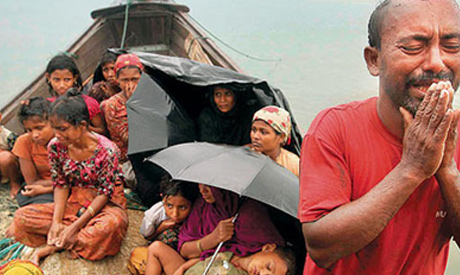
A Rohingya Muslim man who fled Myanmar to Bangladesh to escape religious violence, cries after he and others were intercepted in Taknaf, Bangladesh. (PHOTO AP)

Myanmar: Rohingya Muslims Persecuted, Killed, Flee

Reports continue to describe the ongoing persecution of Rohingya Muslims in Myanmar (aka Burma).  We urge the public to call for an end to this persecution, violence, and oppression.

Responsible for Equality And Liberty (R.E.A.L.) urges world leaders and people around the world stand in solidarity with the Rohingya Muslims in Myanmar (Burma) as our brothers and sisters in humanity in defense of their Universal Human Rights for human rights, human dignity, freedom of conscience, safety, and security.

R.E.A.L. has issued an on-line petition calling for an end to violence in Myanmar, respect for the Universal Human Rights of all people living in Myanmar, and an end to the persecution and targeted violence against Rohingya Muslims in Myanmar.
— 1. We call for an end to the violence in Myanmar by ANY group – of any religion or ethnicity. There is no “justified” violence which targets any religion or ethnic group – Muslim or Buddhist.
— 2. Our brothers and sisters in humanity of any group, any religion, any ethnicity, all deserve consistent Universal Human Rights, including their human rights of dignity, safety, and freedom – without exception.
— 3.We call for an end to oppression against Rohingya Muslims by government security forces and ethnic majority groups against Rohingya Muslims, who have faced a series of targeted attacks against their identity group.
— 4. R.E.A.L. urges the world governments, the media, and the public to become aware of the persecution and violence against Rohingya Muslims in the northern Rakhine State (NRS) in Myanmar (Burma). The Rohingya Muslims live in desperate refugee camp type of conditions and they represent one of the largest groups of stateless people in Asia. We urge the world governments, the media, and the public, to call for an end to the persecution and violence against Rohingya Muslims by government security forces and ethnic majority groups.

According to official records obtained by the media, 77 Rohingya Muslims were killed in recent violence.

The United Nations indicates that there are 800,000 Rohingya Muslims without citizenship in Myanmar. Reports state that Rohingya Muslims represent a large percentage of the displaced individuals in Myanmar. Amnesty International states that between 50,000 and 90,000 Muslim Rakhine, and Muslim Rohingya have been displaced.

The latest series of violence began on June 3, 2012 after a mob killed 10 Muslims after reports of a local rape in the predominantly Buddhist Rakhine state. Violence followed with the burning of 500 homes and killings on June 9, leading to a state of emergency declared on June 10.

On July 20, 2012, the Associated Press reported that “communal violence is grinding on in western Myanmar six weeks after the government declared a state of emergency there, and Muslim Rohingyas are increasingly being hit with targeted attacks that have included killings, rape and physical abuse,” according to Amnesty International. AP also reported that “Amnesty International accused both security forces and ethnic Rakhine Buddhists of carrying out new attacks against Rohingyas, who are seen as foreigners by the ethnic majority and denied citizenship by the government because it considers them illegal settlers from neighboring Bangladesh.”

Amnesty International Myanmar researcher Benjamin Zawacki states that a series of unlawful arrests have been made after a state of emergency was declared on June 10.  Amnesty International states: “Many Rohingyas and other Rakhine Muslims reported cases of physical abuse, rape, destruction of property and unlawful killings carried out by both Rakhine Buddhists and security forces. Authorities in Myanmar must take action to stop these acts and prevent future abuses from occurring.”

Australia’s Kourosh Ziabari reports on the history of the oppression of Rohingya Muslims persecution dating back to 1942, and the efforts of Rohingya Muslims to seek to flee to Bangladesh and Malyasia, which have not “warmly” received such refugees. Kourosh Ziabari writes that “It’s said that as a result of dire living conditions and discriminatory treatment by the government, some 300,000 Rohingyas have so far immigrated to Bangladesh and 24,000 of them have also escaped to Malaysia in search of a better life. Many of them have also fled to Thailand, but neither Bangladesh nor Thailand has received them warmly. Bangladesh is negotiating with the Burmese government to return the Rohingyas and Thailand has sporadically rejected them. There have been instances where boats of Rohingyas reaching Thailand have been towed out to sea and allowed to sink, sparking international anger among Muslims and non-Muslims.”

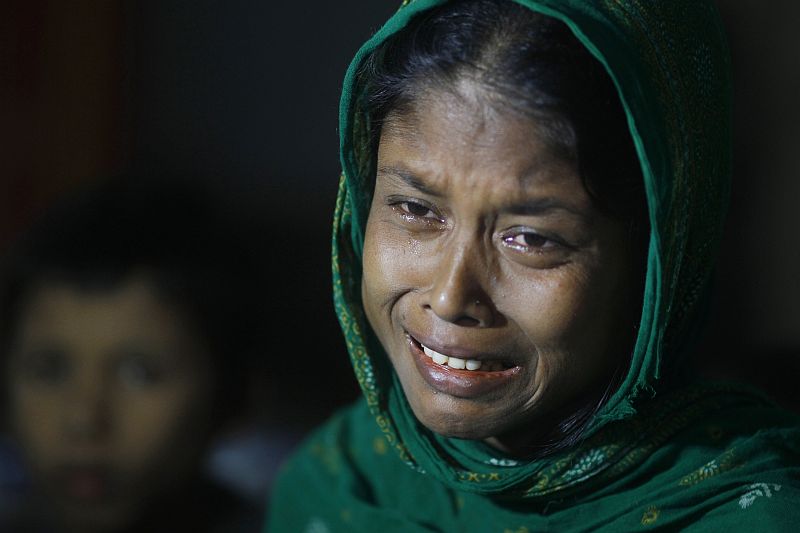
Rohingya Muslim woman whose husband was allegedly killed in Myanmar (AP Photo/Saurabh Das)

The July 27, 2012 briefing by the Office of the United Nations High Commissioner for Refugees (UNHCR) states that it has delivered aid to over 30,000 displaced people in Myanmar’s Rakhine state. The UNHCR report states that “An estimated 80,000 people are displaced in and around the towns of Sittwe and Maungdaw, according to UN and NGO assessments…. Some displaced Muslims tell UNHCR staff they would also like to go home to resume work, but fear for their safety. Movements are restricted in Sittwe, preventing IDPs and host families from earning a living as labourers, trishaw drivers and market sellers. Fishermen cannot reach the lagoon and the nearby waters are too rough for fishing. Some say they are running out of money and food. The sick now have to travel longer distances to access health care in the IDP camps. Pregnant women are also facing problems reaching hospitals.”

The Times of India reports that “the Rohingyas (Myanmar Muslims who mostly live in Arakarn region)… are considered by the UN as one of the most persecuted communities in the world.”

Human Rights Watch has also previously reported of Myanmar government efforts to require Rohingya Muslims to perform forced labor, and those who refuse are physically threatened and young children have been seen on forced labor teams.

The July 31, 2012 Times of India states that Rohingya Muslims are fleeing to Hyderabad. The Times of India reports “M Mandakini, field officer of United Nations High Commission for Refugees that is working in collaboration with the Cova in the city, said that many of them have taken shelter in Hafiz Babanagar and Kishanbagh where already a considerable number of Myanmar citizens reside.”

R.E.A.L. urges the the public to share the story of the Rohingya Muslims’ persecution with your fellow human beings, your government, and world organizations, to continue to pressure the government of Myanmar (Burma) and its people to urge them to share our Universal Human Rights of dignity, safety, and human freedom with Rohingya Muslims, and end their persecution.

Please share our online petition to raise a voice to Myanmar and its people on this issue.

Share this petition on Twitter as http://bit.ly/RohingyaMuslimRights

Our Universal Human Rights to apply to ALL of our brothers and sisters in every part of the world.

Choose Love, Not Hate. Love Wins.


Orange Ribbon for Universal Human Rights – Responsible for Equality And Liberty (R.E.A.L.)