U.S. law enforcement’s accomplishments are dependent on a shared law, shared mission of public safety and equal enforcement of the law, and dependent on the public trusting law enforcement organizations and agents. While in this case, the subject is about U.S. law enforcement, such basic standards apply in any free and democratic nation. A mission for public safety is dependent on public trust. Those that undermine public trust, don’t simply undermine trust in themselves or their agency, they undermine trust in all members of the law enforcement and justice community.
U.S. law enforcement communications with the news media must have the following primary objectives: (a) provide public and accountable reports on information essential to public safety, (b) provide public and accountable reports on progress on ongoing investigations and law enforcement activity without compromising sensitive and legal matters, (c) provide public awareness information on other general organizational information activities, such as meetings, events, facilities, etc. In a representative democratic nation, the law is enforced equally for all individuals, regardless of the political affiliation, identity group, or station in life.
We must expect our law enforcement, at every level, to be apolitical, just as we expect our military, our hospitals, and any other essential public safety organization.
Equality under the law is an essential art of public trust in law enforcement. Furthermore, that trust is dependent on public communications that confirm equality, fairness, and lack of bias in the values and standards shown by the law enforcement organization’s actions.
In a representative democratic nation, it is noticeable that none of the law enforcement communications objectives are: (1) spying, (2) planting rumors, (3) political targets, (4) seeking to undermine other government organizations or individuals. This is not the role of law enforcement in a representative democratic nation. The concept behind governance in a representative democratic nation is that our public officials and servants represent “the people,” not themselves, not their interests in shaping the nation to fit their views, not in political activism.
Those concerned about human rights regularly see such abuses of law enforcement authority with the news media in Communist totalitarian and other dictatorial nations, which have contempt and hate for representative democracy and public representation processes. In an anti-freedom, totalitarian nation the term “law enforcement” means “power enforcement” for the privileged and powerful. There is no intention of representing “the people,” but simply preserving power for the powerful, at any cost, and manipulating “the law” to read whatever the powerful want it to read. Those who care about human rights regularly protest such abusive forms of human persecution, and the persecutors use of “law enforcement” stage-actors abuse of law and justice to simply maintain, control, and manipulate power.
In the former Communist totalitarian East Germany, the East German secret police (Ministerium für Staatssicherheit aka “Stasi”) organization used a series of harassment tactics, or “Zersetzung” to infiltrate, spy, sabotage, and spread rumors about those they sought to prevent from gaining power. The Stasi tactics were part of late 20th century efforts to manipulate the public, up to the fall of the Berlin Wall in 1989. The massive 91,000 Stasi bureaucracy was three times the size of Adolf Hitler’s Gestapo. But given the post World War II environment, the Stasi needed to use subtler methods that concentration death camps for those that became “enemies of society.”
The Stasi police organization sought to psychologically isolate and trample its “enemies” using rumor, innuendo, and manipulating the minds of others. As researcher Max Hertzberg has written on Stasi Zersetzung tactics, its efforts at “intelligence from surveillance and the use of informants was rarely used to actually gain evidence for a prosecution.”
The Stasi “law enforcement” was not interested in actually prosecuting, but in spreading rumors through public and state-controlled media to undermine the credibility of individuals they opposed, and to create a sense of insecurity and paranoia in individuals they opposed. The Stasi tactics of “Zersetzung” method of spreading rumors would often use plausible untruths based on some real facts that would be difficult to refute.
In our world history, there is a good reason why in representative democracies, our law enforcement communications with news media focuses on verifiable facts that are specific to the law enforcement mission.
In my personal career, I worked many years ago with the Federal Bureau of Investigation (FBI). This knowledge of respect and sensitivity by those using law enforcement authority was well-known among all employees, no matter what your role was. Responsible individuals in law enforcement, including the FBI, are well aware of the essential need for focus on public and media communications consistent with respect for the law enforcement mission. They really don’t need to be told right from wrong, and what is appropriate in terms of media communications. They KNOW.
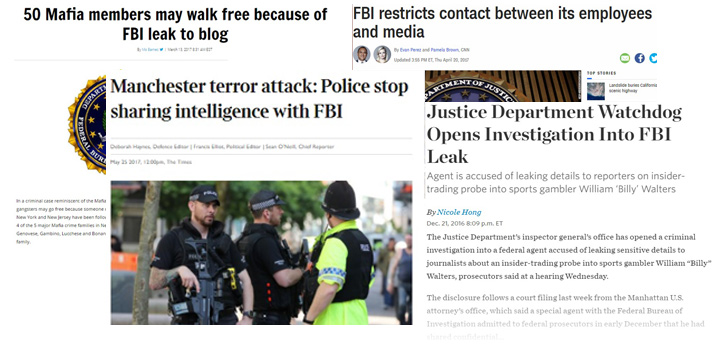
So, this week as the United Kingdom announced that it was going to stop sharing information with the FBI after a leak on an ongoing counterterrorism investigation that had taken so many lives in the UK, all of us connected in any form with a history in law enforcement must have been stunned. A reminder to all – one of the victims in the Manchester terrorist attack was an off-duty police officer. The importance of protecting counterterrorism information during an investigation of a terrorist mass-murder, including a fellow member of law enforcement, should not have to be explained to anyone. This breach of trust must be investigated.
There is no excuse for this, and unfortunately there has been no public statement by the Interim Director of the FBI Andrew McCabe on this subject. R.E.A.L. urges the Interim Director to make a clear statement how the FBI values and respects the law enforcement trust and the partner trust that it has with the citizens of the United States and our global partners. What is really missing is a lack of outrage, anger, and frustration heard from leadership in the FBI and law enforcement regarding leaks abusing law enforcement authority. I can tell you that, of the 30,000+ working for the FBI, they are chosen largely because of their commitment to integrity. I want to provide a voice for those others who we must hope share such outrage on this abuse of authority by leakers.
Three years ago, the U.S. Directive on National Intelligence (DNI) signed Intelligence Community Directive 119, under which intelligence information was to be protected from unauthorized disclosure, excluding whistleblower information on fraud. Part of the idea behind ICD 119 was to protect intelligence service “leakers” from being used to spread information to news media for political manipulation and persecution of individuals.
There are reports that the FBI is now modifying its media contact policies to limit media contacts to field office managers and public relations employees. Unfortunately, over the past several years, we have continued to see this problem with leaks. But even after the recently reported changes on media contact management, we are seeing increasing alleged reports from anonymous FBI individuals to the news media, including those making actual threats against other member of the U.S. government. In any representative democracy, a law enforcement agency whose members use the news media to make anonymous threats against anyone else – has to be completely unacceptable. The idea that law enforcement in any representative democracy can use such political tactics completely undermines the public trust and commitment to public safety, which is the mission of our law enforcement.
Let us also remind all members of law enforcement, yes, it is OUR law enforcement, not YOUR law enforcement. That is how a representative democracy works.
We are keenly aware of the dangers of politicizing law enforcement in a way that will undermine a consistent commitment to public safety and trust. But after this embarrassing disgrace involving the Manchester terrorist investigation and the very public statements by the U.K. that it would stop sharing counterterrorism information with the FBI, there needs to be a stronger position mandated and real action by the U.S. Attorney General on this issue.
We measure the value of our law enforcement in their commitment to equality and integrity to the law, not by cunning and political acumen. That is the hallmark of a democratic society.
A representative democracy, in the U.S., or any other country depends on not only the fidelity and bravery of our law enforcement to equal treatment of all cases under the law, it also depends on the integrity of our law enforcement to put the interest of public safety and public trust as their priority, and leave their personal and political aspirations out of the performance of the authority we have given them to represent us all.