Responsible for Equality And Liberty (R.E.A.L.) urges the Pakistan Government to reconsider efforts to ban and silence Internet access to the Pakistan people to the “Pakistan Christian Post” (PCP), led by Dr. Nazir Bhatti, which routinely provides a voice on Pakistan Christian minority human rights issues. The PCP also provided a regular defense of minority and global human rights, based on the Universal Declaration of Human Rights (UDHR). R.E.A.L. learned of the efforts to silence the PCP on July 16, 2018. Since 2001, the PCP has been a regular voice on issues such as the Pakistan Christian minority persecution by extremist and institutional forces.
Responsible for Equality And Liberty strongly urges the Pakistan Government and court system to reconsider such a ban. The extremist and anti-pluralist forces that routinely persecute and oppress religious minorities undermine Human Rights not only for minorities, but also for all Pakistan people.
A victory for intolerance is defeat for all Pakistan people.
Responsible for Equality And Liberty will continue to stand by the Pakistan Christian Post, and we offer our resources to continue to give them a voice to the Pakistan people.
Our UNIVERSAL Human Rights are not just for those we like and those like us – they are human rights for ALL people – including minorities in our societies. Our commitment to this is a commitment to be responsible for equality and liberty.
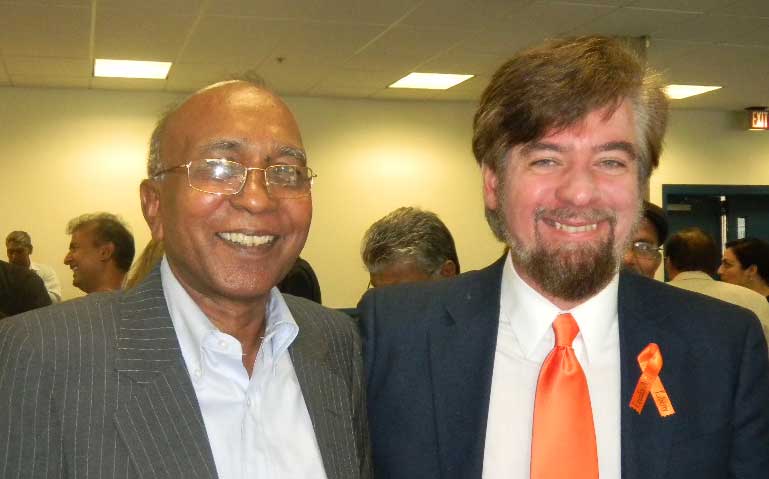
Pakistan Christian Congress’ Dr. Nazir Bhatti and Responsible for Equality And Liberty (R.E.A.L.)’s Jeffrey Imm
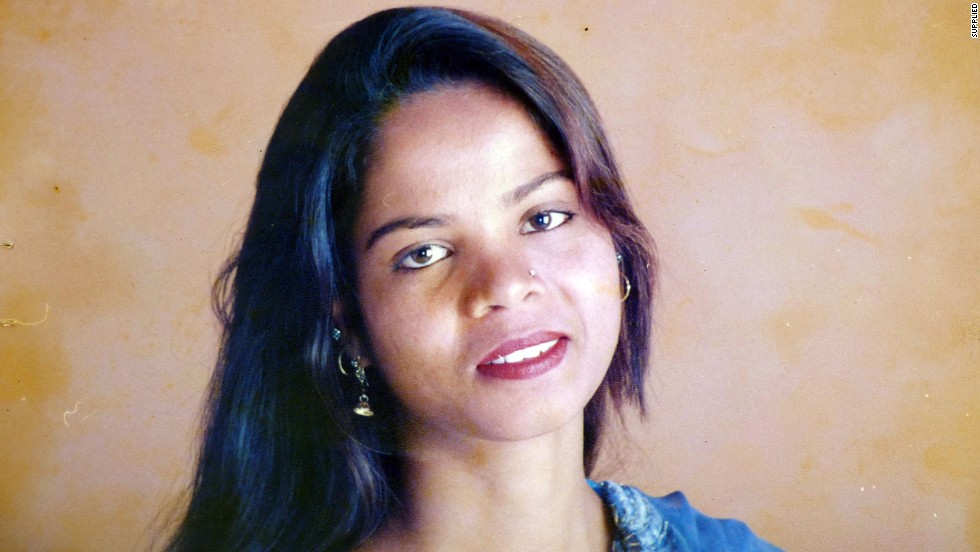
We call for the Pakistan government and Supreme Court of Pakistan to show mercy and release the unjustly imprisoned Pakistan Christian minority woman, Aasiya Noreen “Asia” Bibi, from prison.
Pakistan Christian minority woman, Aasiya Noreen “Asia” Bibi, unjustly arrested and in Pakistan prison for “blasphemy”
Asia Bibi, has spent the past 9 years in a Pakistan prison, charged with blasphemy, after angering majority faith women who objected to her drinking water from the same glass as them because she was a Christian minority. The outraged women that sought vengeance on this persecuted minority woman, used the Pakistan’s “blasphemy” laws to claim that she had defiled the name of Muslim prophet Mohammed, and their testimony was used to have her convicted, put in prison, and sentenced to death in 2010. Efforts to continue to appeal her case have not yet won her freedom, as this Pakistan Christian minority woman has remained in prison for 9 years. The Pakistan Christian minority woman has spent 9 years in prison for the “crime” of having a minority faith and angering women of the majority faith in drinking from the same cup of water, after picking fruit in the fields.
Excerpts from Asia Bibi’s memoir, “Blasphemy,” had been dictated to her husband from jail, who relayed it to French journalist Anne-Isabelle Tollet. In her memoir, Asia Bibi reported that it was on June 14, 2009, when she went to work in the falsa-berry harvest. She was allowed to participate in the fruit harvest if she picked more fruit than other women, because she was a persecuted Christian minority woman. She needed the money from the fruit picking and in the hot sun; eventually she grew tired and needed a drink of water. In her desperate thirst, she drank from an old metal cup by a bucketful of water, but when she did so the majority faith woman charged at her actions as “haram” and that since this Christian minority woman had drank water from the cup, now she was charged “now the water is unclean and we can’t drink it! Because of her!”
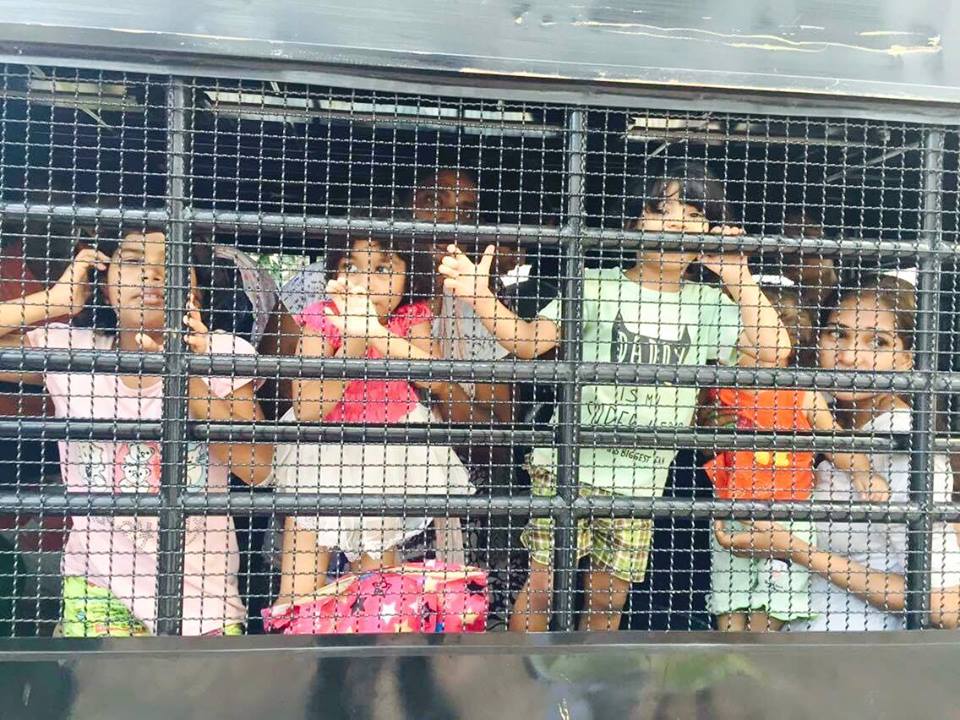
Five days later, on June 19, 2009, according to Asia Bibi’s memoir, she once again went fruit picking to raise money for her survival. But soon she found an angry mob coming after her. In her memoir, Asia Bibi wrote, “They all start yelling: ‘Death! Death to the Christian!’ and ‘We’re taking you back to the village! You insulted our Prophet! You’ll pay for that with your life!’.” Asia Bibi was beaten by a mob and taken to the police for her actions. Asia Bibi stated that she was innocent, but she was manhandled, tossed into a police van, and driven away to be put in Sheikhupura prison, where she has remained ever since.
As the United States Commission on International Religious Freedom (USCIRF) has documented, Asia Bibi was prosecuted under Section 295 C of the Pakistan Penal Code for blasphemy. She spent more than a year in jail. On November 8, 2010, a district court in Nankana Sahib, Punjab, sentenced her to death for blasphemy, the first such sentence for blasphemy handed down against a woman. The death penalty is permissible under Pakistani law. On October 16, 2014, the Lahore High Court dismissed her appeal and upheld her death sentence. Her lawyers plan to appeal to the Supreme Court. The USCIRF joins NGOs and human groups around the world in calling for Asia Bibi’s release.
Over the years, human rights groups have called for her protection and release from prison. As the anniversary of her June 19, 2009 arrest and imprisonment has come, human rights groups across the world are calling for Pakistan to respect justice, and release this innocent Christian minority woman, whose only “crime” was to seek a drink of water in the hot sun.
Global Human Rights and Non-Governmental Organizations (NGOs) calling for her release have come from the United Kingdom, the United States, Pakistan, Italy, and other countries, with global backing and support from citizens around the world.
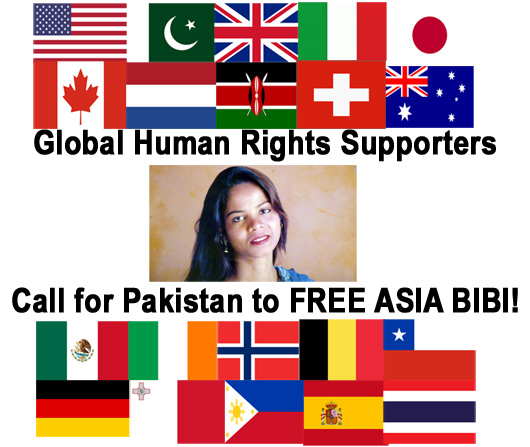
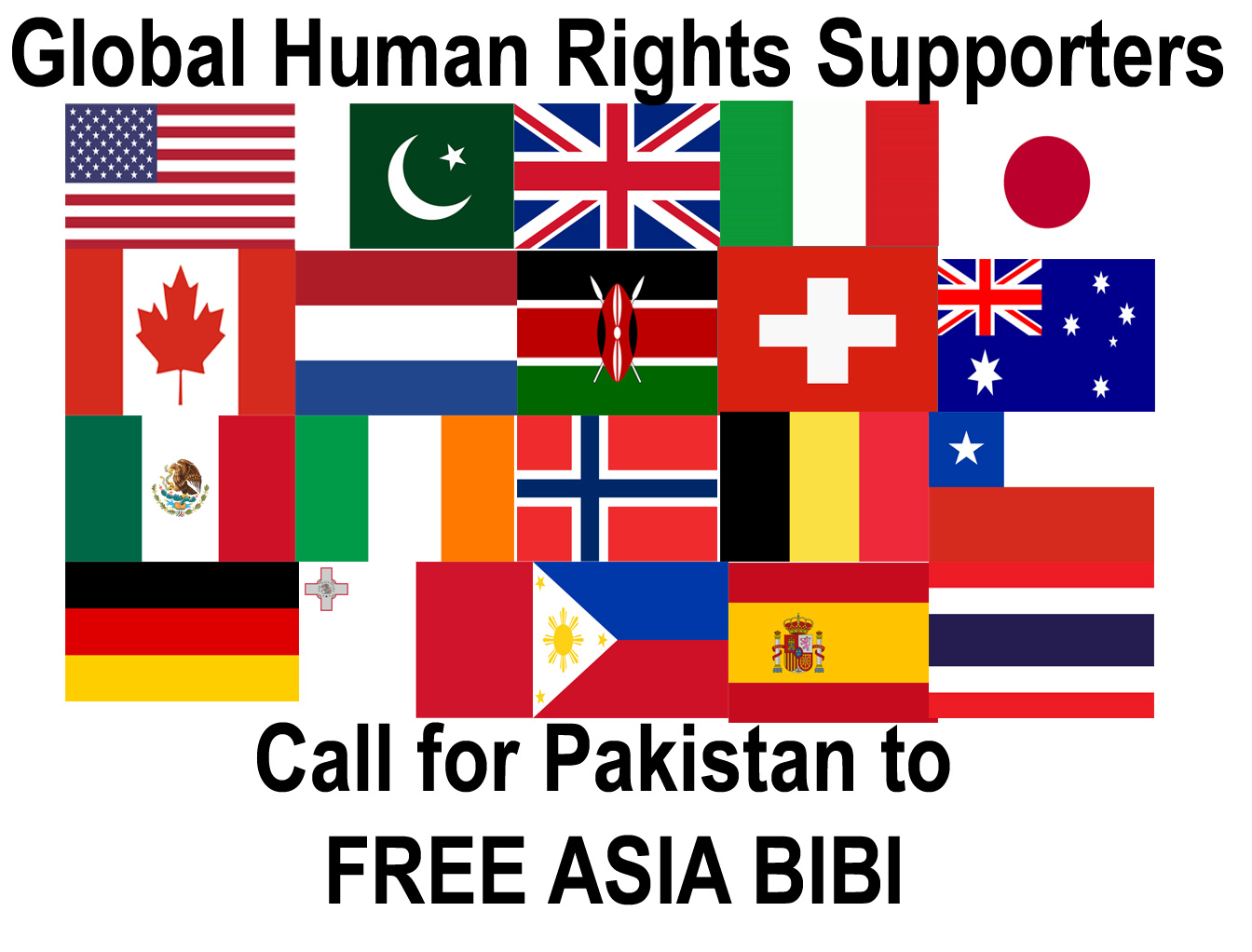
The United Kingdom-based British Pakistan Christian Association (BPCA) currently has an online petition calling for Pakistan to release Asia Bibi, signed by global human rights supporters in Pakistan, United Kingdom, the United States, Australia, Canada, Switzerland, Ireland, Spain, Norway, Netherlands, Germany, Belgium, Malta, Kenya, Japan, Philippines, Chile, Mexico, and Thailand.
Responsible for Equality And Liberty (R.E.A.L.) supports these international efforts to end the imprisonment and threats against the life of Pakistan Christian minority woman Asia Bibi, and we support her human rights and freedoms under the Universal Declaration of Human Rights (UDHR), signed by Pakistan and other nations of the world.
R.E.A.L. calls for all human rights groups and activists to reach out to the Pakistan government to the Pakistan Supreme Court to end this injustice and to FREE ASIA BIBI.
Under the Universal Declaration of Human Rights (UDHR), Asia Bibi and the people of the world have the universal human rights of freedom of conscience and right to fair and equitable protections in the courts. This includes UDHR Articles 11 and 18.
UDHR Article 11.
“(1) Everyone charged with a penal offence has the right to be presumed innocent until proved guilty according to law in a public trial at which he has had all the guarantees necessary for his defence.
(2) No one shall be held guilty of any penal offence on account of any act or omission which did not constitute a penal offence, under national or international law, at the time when it was committed. Nor shall a heavier penalty be imposed than the one that was applicable at the time the penal offence was committed.”
UDHR Article 18.
“Everyone has the right to freedom of thought, conscience and religion; this right includes freedom to change his religion or belief, and freedom, either alone or in community with others and in public or private, to manifest his religion or belief in teaching, practice, worship and observance.”
In the case of Pakistan Christian minority woman Asia Bibi, the Pakistan court system has denied her universal human rights under UDHR Article 11, seeking to try her based on hearsay evidence with no proof and assuming her guilt rather than her innocence. The Pakistan court system has also denied Asia Bibi her universal human rights under UDHR Article 18, seeking to allow targeted persecution of her under the Pakistan “blasphemy law” to oppress her due to her Christian minority faith.
Responsible for Equality And Liberty (R.E.A.L.) calls for the Pakistan Supreme Court and the Pakistan nation to uphold its international obligations under its commitment to the Universal Declaration of Human Rights as well as the International Covenant on Civil and Political Rights (ICCPR), which Pakistan is a signatory to. These same UDHR articles are found in the ICCPR Part III, Articles 14 and 18. Nations of the world are part of our shared Earth, our common global society, and international organizations that facilitate global trade, commerce, travel, and exchange of goods. Such nations that enjoy such global standing have a responsibility to adhere to agreed-upon global declarations and covenants on such human rights.
Global human rights activists in Pakistan and around the world are looking for the Pakistan court system to honor such global obligations and standards of human rights, dignity, and freedom for the people of the world. They are calling upon the Pakistan court and justice system to free Asia Bibi after these 9 years of unjust imprisonment.
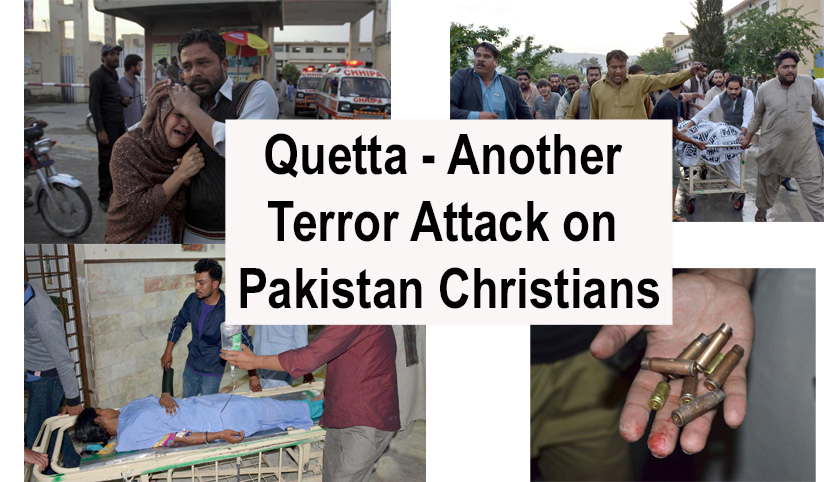
In a growing pattern of extremist activity in Pakistan, Pakistan Christian minorities were once again the targets of terrorist violence in Balochistan’s Quetta and a fire in Punjab’s Lahore on Sunday, April 15, 2018.
In Quetta, a terrorist attack on Pakistan Christian minorities targeted individuals leaving Christian church services in the Quetta neighborhood of Essa Nagri area. The terrorists used motorbikes to drive up and gun down Christians after church services. DIG Quetta Abdur Razzaq Cheema reported that the terrorists managed to flee the scene after the attack. Two Christian minorities, Rashid Khalid and Azhar Iqbal, have reported killed as a result of the terror attack, and at least five are reported injured. Police officer Javed Ahmed told the Associated Press that a young girl was among the wounded and that two others were in critical condition at a hospital.
The Quetta area is known to have a significant concentration of the Pakistan Christian minorities, and has been a target of terror attacks in the past, including repeated terror attacks by the ISIS terrorist movement on Pakistan Christian minorities, most recently on April 2, 2018 (the day after Easter) and on December 17, 2017 (the Sunday before Christmas). As the Pakistan Dawn media reports, the continuing practice of terror attacks on Christian minorities is growing in Pakistan.
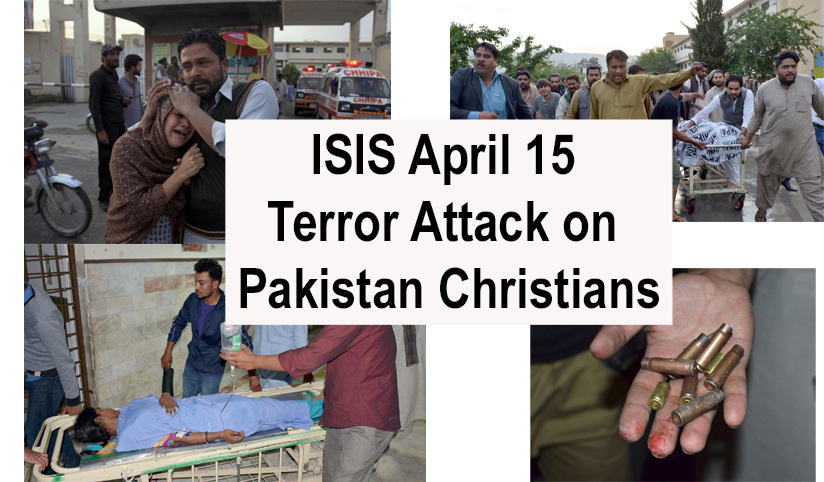
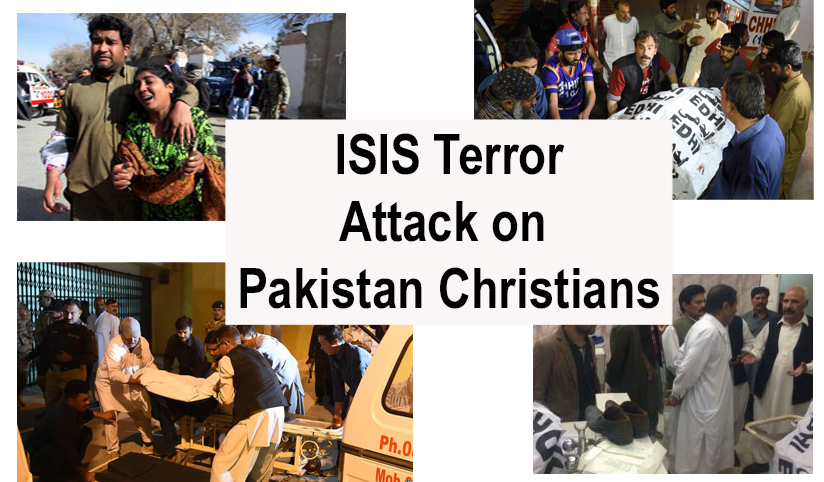
On the day after Easter, on Monday April 2, 2018, ISIS terrorists targeted Pakistan Christian minorities in Quetta killing four Christians in a rickshaw in a similar motorbike terror attack; the April 2 terror attack resulted in the murder of a total of seven individuals, including shooting of a 12 year old girl.
April 2, 2018 – ISIS Terrorist Attack on Pakistan Christians – Quetta
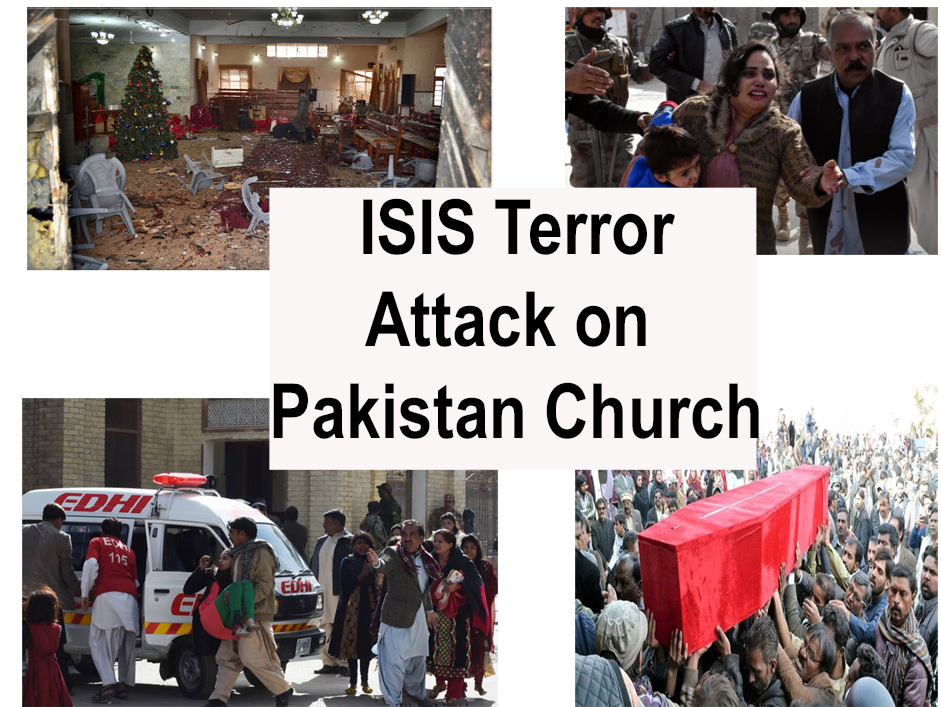
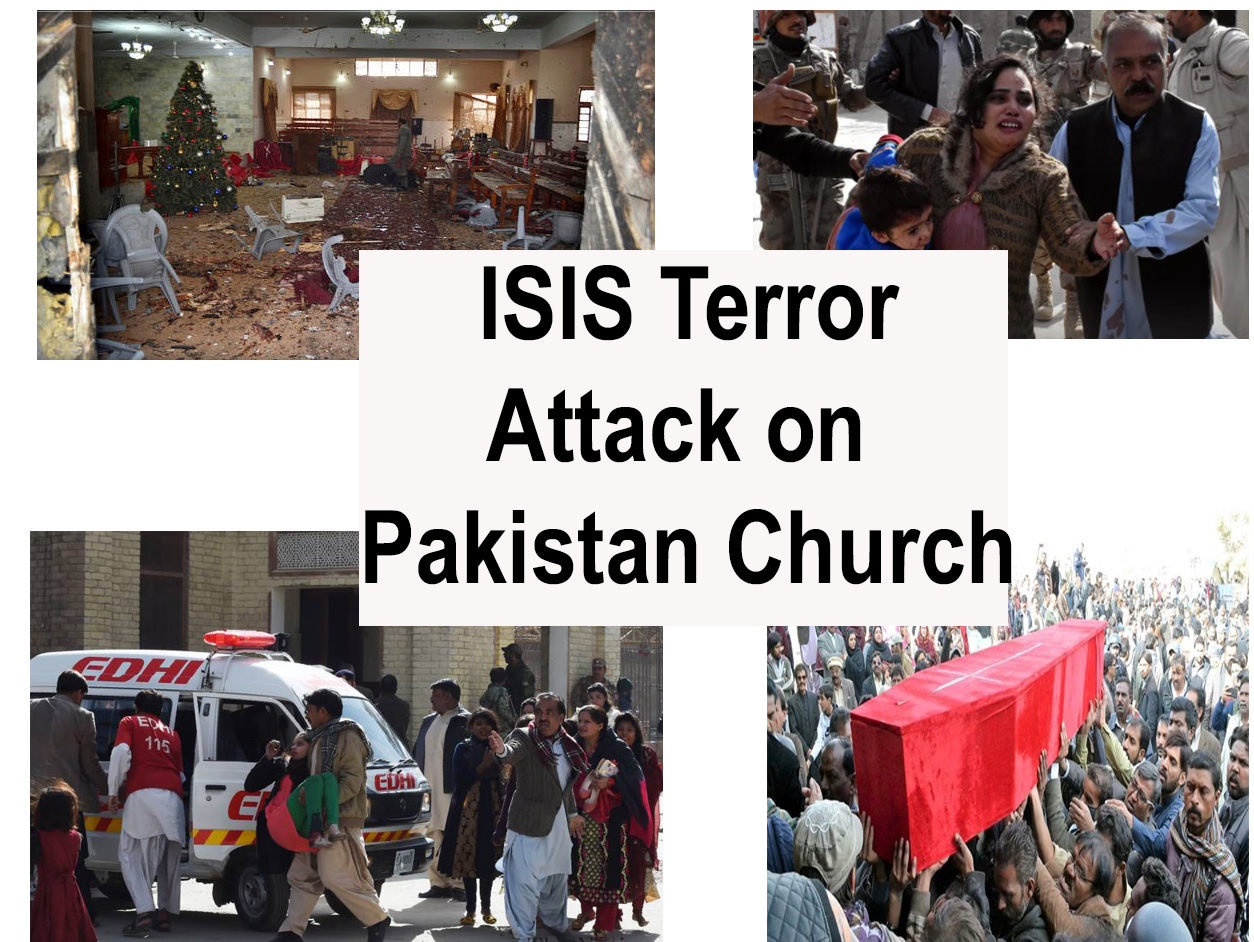
Quetta’s Christian minorities were also the target of an ISIS terrorist attack in December 17, 2017 with 9 murdered and 30 injured by a terrorist bomb attack on the Bethel Memorial Methodist Church on Quetta’s Zarghoon Road.
December 17, 2017 – ISIS Terror Attack on Pakistan Christian Church – Quetta
————
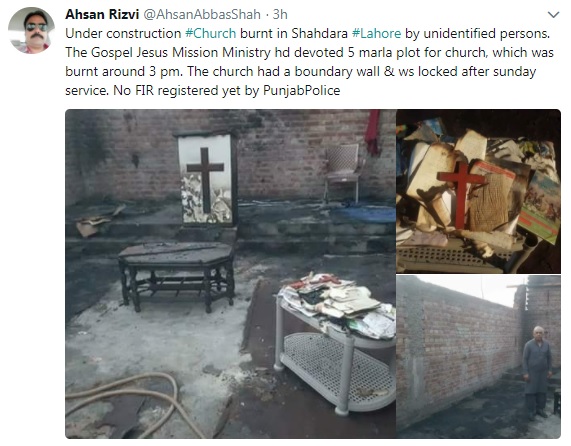
In the Shahdara area of Lahore, R.E.A.L. has also received multiple reports of a fire at a Christian minority church under contruction in an area to be developed for the Gospel Jesus Mission Ministry. Reports state that a tent was torched. The incident remains under investigation, but reportedly no First Incident Report has yet been registered by the Punjab Police.
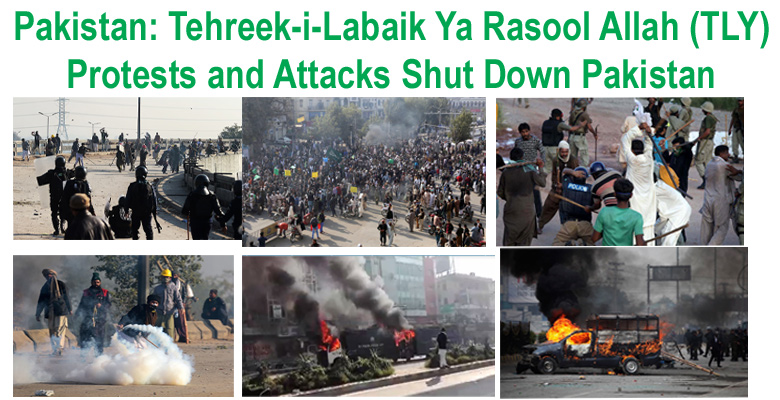
In addition, Lahore has been the scene of a growing extremist movement by the Tehreek-i-Labaik Ya Rasool Allah (TLYRA) and its Tehreek-i-Labbaik Pakistan (TLP) supporters. As R.E.A.L. reported in November 2017, these extremist movements sought to disrupt public activities in Lahore, Quetta, Islamabad and throughout Pakistan, including violent attacks on the police, and ultimately a SURRENDER by the Pakistan authorities.
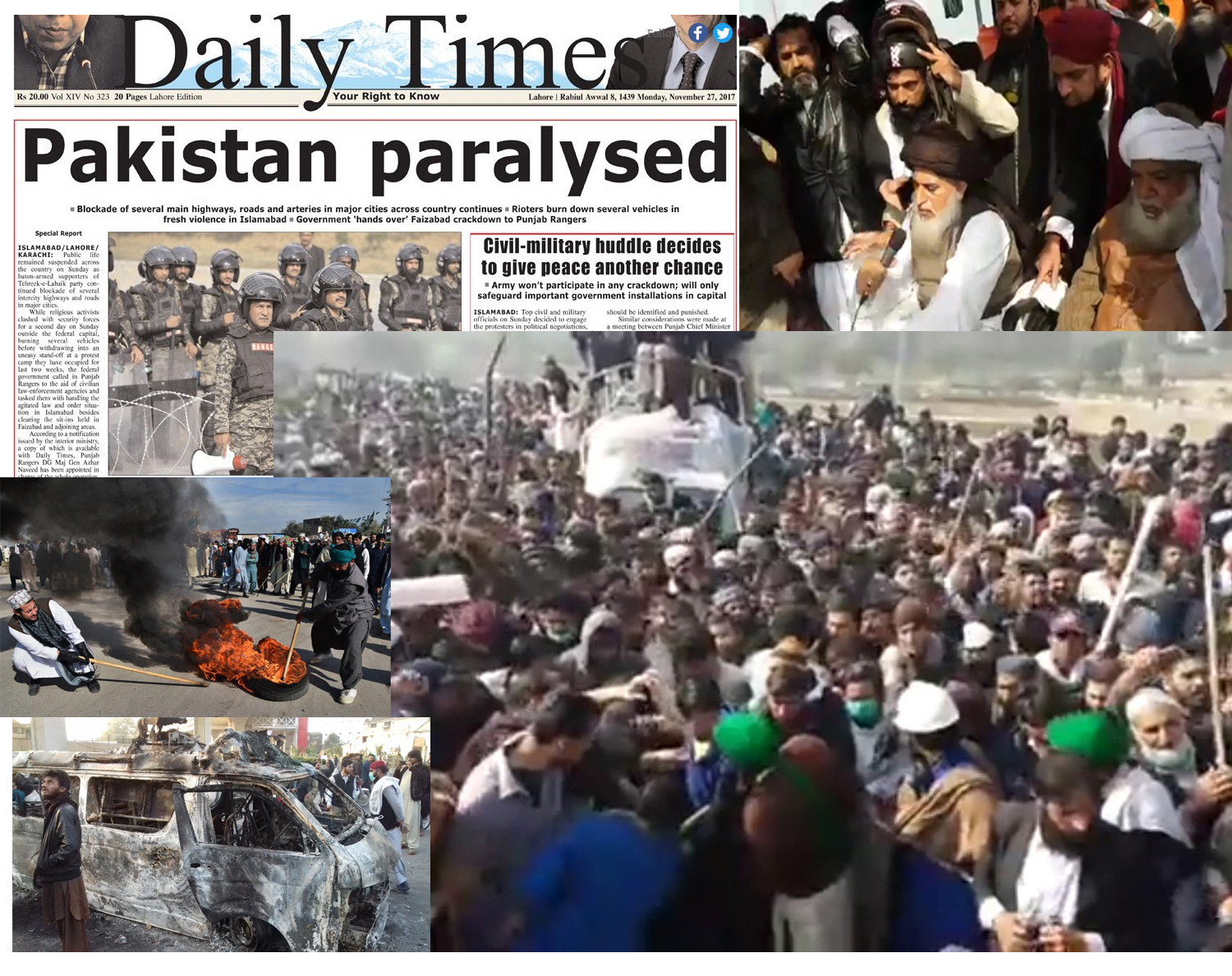
Extremist Group Tehreek-i-Labaik Violent Attacks and Disruption Across Pakistan – November 2017
Responsible for Equality And Liberty (R.E.A.L.) extends its condolences and prayers for the victims and loved ones of yet another horrific act of terrorism. Terrorism is an attack on the shared Universal Human Rights of all of our fellow human beings, and is assault on the Universal Human Rights of all people. We must all reject terrorism and the extremist ideolodgies and promoting such terror anywhere in the world.
On April 2, 2018, the world witnessed another ISIS terrorist movement attack targeting Christian minorities in Pakistan. The April 2 ISIS terrorist attack on Pakistan Christian minorities once again took place in the Balochistan province’s Quetta, where a number of Pakistan Christian minorities are concentrated. This attack took place the day after the Christian holiday of Easter Sunday on Monday April 2, 2018. ISIS terrorists on motorbike killed 7 people including murder of 4 Christian minorities in a rickshaw. Once again, the ISIS terrorist movement claimed responsibility for this terror attack.
“It appears to have been a targeted attack,” provincial police official Moazzam Jah Ansari told Reuters. “It was an act of terrorism.”
Responsible for Equality And Liberty (R.E.A.L.) extends its condolences and prayers for the victims and loved ones of yet another horrific act of terrorism. Terrorism is an attack on the shared Universal Human Rights of all of our fellow human beings, and is assault on the Universal Human Rights of all people. We must all reject terrorism and the extremist ideolodgies and promoting such terror anywhere in the world.
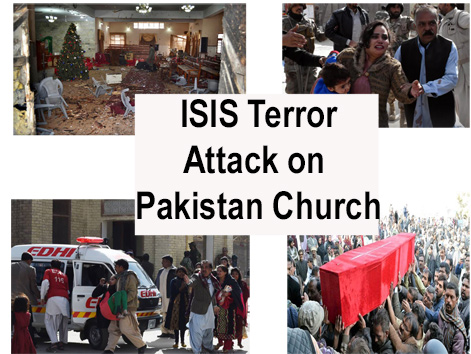
On Sunday, December 17, 2017, the ISIS terrorist movement committed a terrorist attack on a Christian minority church in Pakistan’s Quetta. The ISIS terror attack involved the use of two suicide bombers who targeted the Bethel Memorial Methodist Church, killing 11 and injured 57. The Sunday, December 17, 2017 Christian worship service was held on the week before Christmas, several hundred worshipers were at the Bethel Memorial Methodist Church, when an ISIS terrorist suicide bomber exploded his suicide bomb vest at the church hall’s entrance. A second ISIS terrorist suicide bomber attempted, but failed to detonate his explosive vest but was unable to accomplish such terrorist violence and a gun battle broke out between the terrorist and security forces. The ISIS Amaq News Agency reported that ISIS took responsibility for the terrorist attack.
CBS News reported: “Kal Alaxander, 52, said he was at the church with his wife and two children during the attack. ‘We were in services when we heard a big bang,’ he told the Reuters news agency. ‘Then there was shooting. The prayer hall’s wooden door broke and fell on us. We hid the women and children under desks.’ Fifty-seven people were wounded in the latest attack, including seven who were listed in critical condition, according to Wasim Baig, a spokesman for Quetta’s main hospital. A young girl in a white dress sobbed as she recounted the attack to Geo television, saying many people around her were wounded.Aqil Anjum, who was shot in his right arm, told The Associated Press he heard a blast in the middle of the service, followed by heavy gunfire. “It was chaos. Bullets were hitting people inside the closed hall,” he said.”
Christian minority father Sohail Yousuf told Christianity Today that “We had sung songs, and children had presented a Christmas program. Pastor Simon Bashir had finished his sermon, and we were moving towards the altar when we started hearing gunfire outside the church. We bolted all the doors and were praying that God would protect each of us. Then a suicide bomber blew himself up at the main door. The explosion shattered the door and injured many inside. When some rushed outside, they were injured by gunfire as the terrorists were on the church lawn. But soon the situation was brought under control by the volunteer church security guards and police present there.” Christianity Today reported that “Yousef’s 13-year-old daughter Mehak lost her life; her 16-year-old sister Wasiqa is in critical condition after an operation in Quetta’s Combined Military Hospital (CMH).”
————
Responsible for Equality And Liberty (R.E.A.L.) extends its condolences and prayers for the victims and loved ones of yet another horrific act of terrorism. Terrorism is an attack on the shared Universal Human Rights of all of our fellow human beings, and is assault on the Universal Human Rights of all people. We must all reject terrorism and the extremist ideolodgies and promoting such terror anywhere in the world.
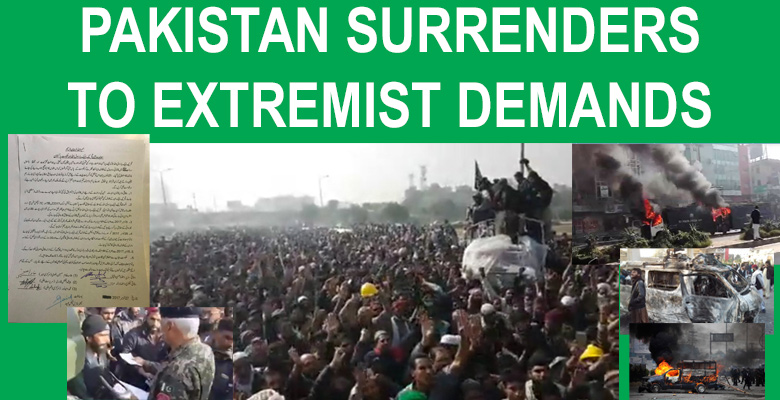
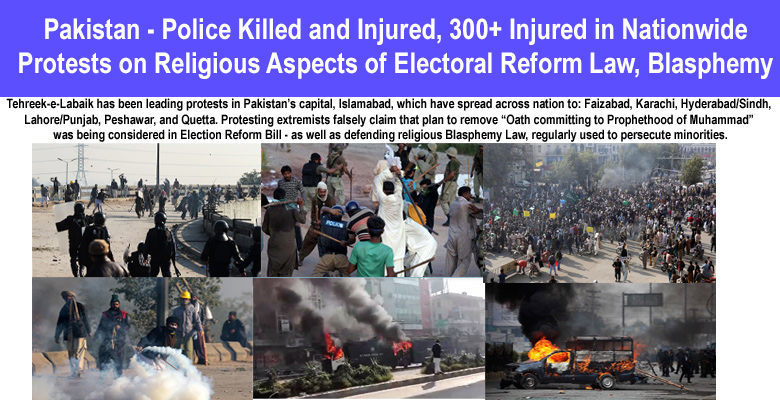
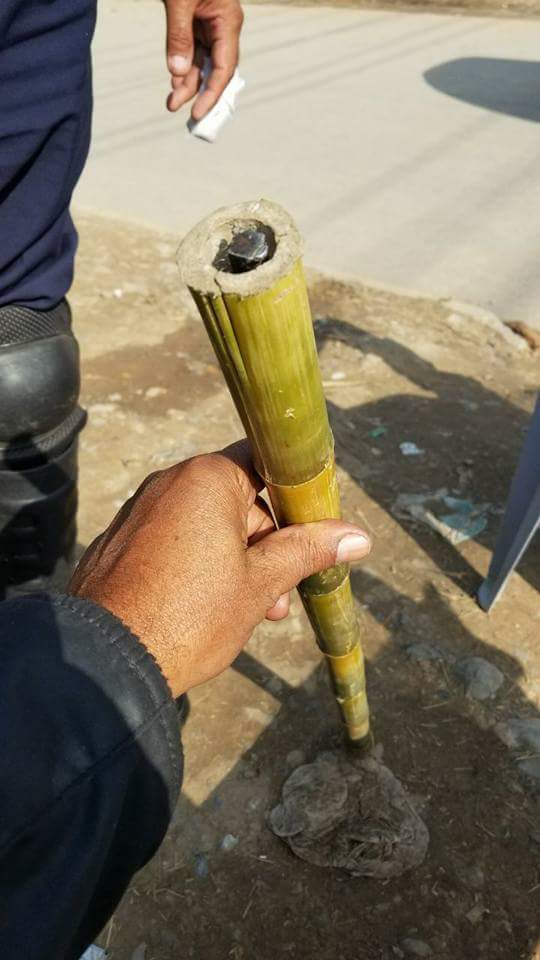
On November 27, 2017, the Pakistan Government surrendered to the demands of the Tehreek-i-Labaik Ya Rasool Allah (TLY)* religious political party and its supporters that had been allowed to paralyze streets in the Pakistan national capital of Islamabad and across the country. Violent protests led to the death of at least one police officer, 60 police injured, 45 Frontier Constabulary (FC) injured, 8 protesters killed, and 300 protesters injured. Four police vehicles were attacked, and at least one set on fire, and protesters created fires in the streets to create chaoas. Armed protesters beat Pakistan police with rocks, tear gas, slingshots, and metal rods hidden inside bamboo canes. Protesters damaged buses, cut down trees to block roads, and also attacked news media vehicles and set a Samaa television broadcasting van on fire. Pakistan police attempted to arrest and detain some of the protesters, reportedly detaining 150 protesters according to Dawn News. Attempts by police to stop protesters in disrupting law and order, by using tear gas, failed to do “unfavorable winds.”
On November 25 and 26, 2017, the TLY was joined by supporters of two other religious political parties: Tehreek-e-Khatm-e-Nabuwwat, and the Sunni Tehreek Pakistan. The protests, which started for three weeks in Islambad and Faizabad Inter-Change, spread to: Quetta, Karachi, Hyderbath/Singh, Sukkur, Umerkot, Mithi, Sujawal, Lahore/Punjab, Faisalbad, Gujranwala, Multan, Nakana Sahib, Mianwali, Gujrat, Sahiwal, Vehari, Toba Tek Singh, Murree, Peshawar, Khyber Pakhtunkhwa, Haripur, Mansehra, Dera Ismail Khan, Multan, Natha Khan Chowk, Sialkot, Sheikhupura. The protest crowd in the Pakistan capital Islamabad area alone grew (according to reports) from 1,000 to over 5,000.
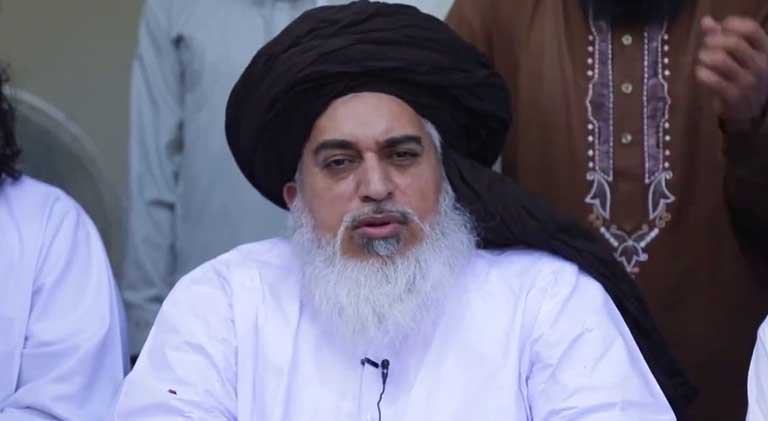
The protests were organized by TLY leader Khadim Hussain Rizvi, who used social media to help reach across Pakistan to spark religious protests.
Tehreek-i-Labaik Ya Rasool Allah (TLY) Leader Khadim Hussain Rizvi – Used Social Media to Organize Protests to Shut Down Pakistan Cities
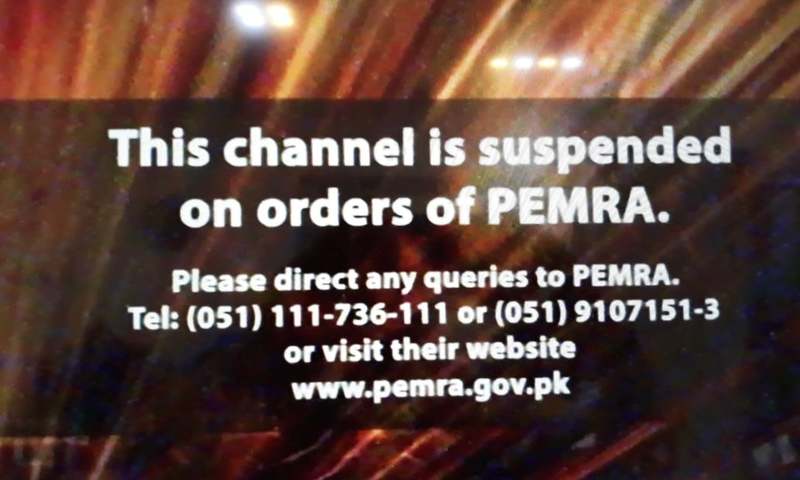
Efforts by the Pakistan government to shut down social media outlets were stymied by use of VPN technology around Internet sites, and effort by the Pakistan government to temporarily shut down news media only led to public fear and anxiety.
Pakistan Television Channels Were Shut Down by Pakistan Electronic Media Regulatory Authority (PEMRA)
Despite efforts by the Pakistan Police, the ability to maintain law and order during the protest was lost, and the Pakistan Army was called in to protect Islamabad to “secure main offices of the judiciary, Parliament House, Presidency and Prime Minister Houses, foreign missions, foreign office and other important installations,” according to Dawn News. However, the Pakistan Army made it clear that it did not consider its mission to address the ongoing national security issue created by the extremist protests. As the Pakistan Daily Times reports, “it was clear that the Army was not willing to face the protestors.” The level of public disruption that was allowed by the failure and/or fear of government leaders to challenge such protesters seeking to disrupt law and order in Pakistan, should not only trouble the Pakistani public, but also trouble allies to thePakistannucleararmed nation.
The TLY and its partner religious political group’s protests claimed that the Electoral Reform Bill of 2017 was offensive to their political view of Islam. The Pakistan Electoral Reform Bill of 2017 was intended to integrate 8 existing laws and streamline processes, but the TLY and religious parties felt that it did not have sufficient wording about potential political candidates’ “Oath committing to Prophethood of Muhammad.” The Federal Law Minister Zahid Ahmid stated that this oath was included, as part of the Pakistan government electoral basis to require political candidates to consent to the “finality of Prophethood” of Muhammad (Khatam an-Nabiyyin). But the explanations were not satisifactory to the TLY extremists, who argued that one word in the bill was reading “declaration” instead of “oath.” TLY extremists not only sought the resignation of Federal Law Minister Zahid Hamid, but also hundreds of TLY protesters in Islamabad were accusing Zahid Hamid of “blasphemy.”
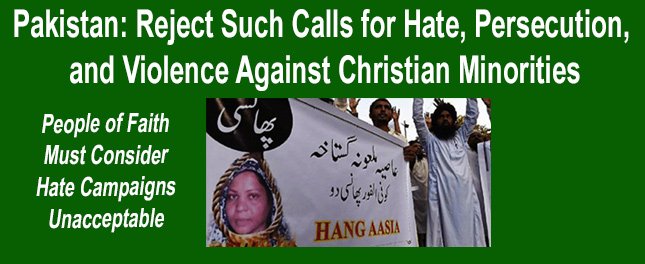
TLY extremists also alleged that Pakistan government officials were being weak on enforcing the Pakistan “Blasphemy Law” (Section 295 C of the Pakistan Penal Code), which is frequently used to persecute religious minorities, and protested with banners calling to “Hang Aasia” (sic). Christian minority woman Asia Bibi was falsely convicted of blasphemy in November 2010, sentenced to death, and who continues to seek appeal of this death sentence. TLY extremists also protested that Pakistan government officials were too weak on Ahmadi minority Muslims, who they believe should face further persecution.
Such calls by TLY protesters to call for persecution of religious minorities, and in particular, those reports that the Pakistan government has agreed to such TLY demands, should be questioned by the United Nation, and in particular, the UN High Commissioner for Refugees (UNHCR). Five years ago in 2012, the UNHCR issued a series of guidelines regarding persecution of religious minorities: “UNHCR Eligibility Guidelines for Assessing the International Protection Needs of Members of Religious Minorities from Pakistan, 14 May 2012, HCR/EG/PAK/12/02.” These UNHCR guidelines outline the status of Pakistan’s institutional persecution of religious minorities, including Pakistan Christians, Hindus, Sikhs, Ahmadi Muslims, Shiites, Sufis, Baha’is, which are targeted for persecution in Pakistan. These guidelines also address Pakistan’s use of the Pakistan Blasphemy Law to persecute and oppress individuals and religious minorities. Refugees who have fled from Pakistan should update the UNHCR on these new developments within the Pakistan government, due to the blatant surrender of authorities to TLY religious extremist political pressure.
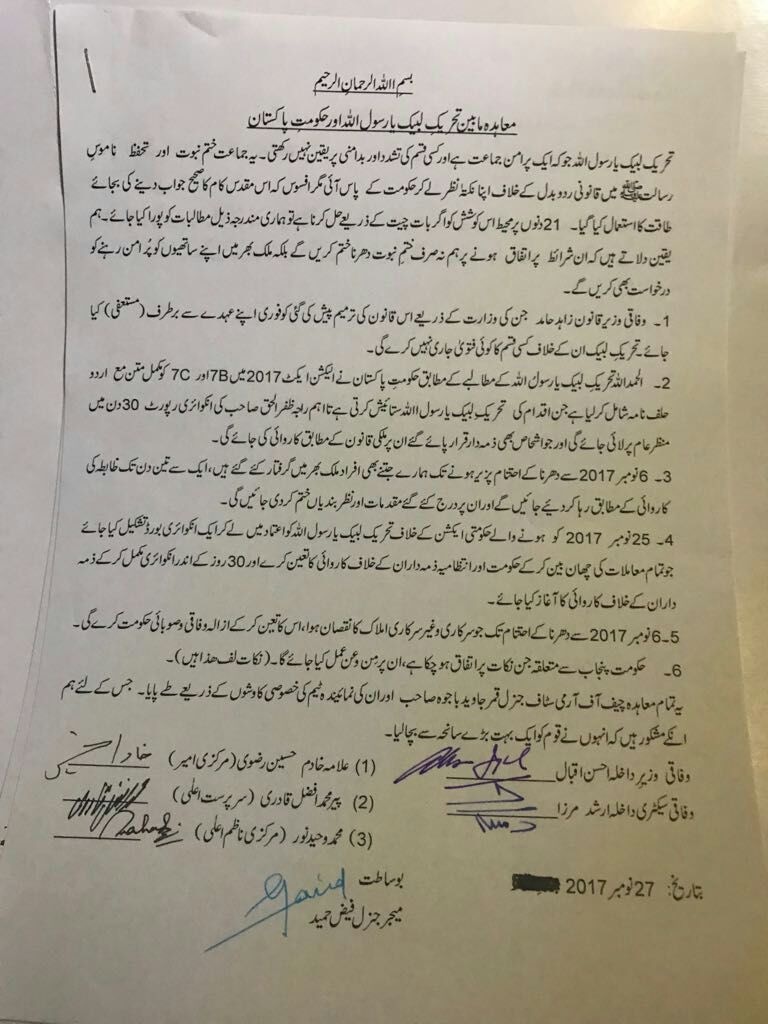
With the Pakistan government administration and police officials unable to develop a strategy to control the security sitution, the Pakistan government used the Pakistan Army as an intermediary to negotiate with the extremist protesters. On November 27, 2017, after negotiations between the TLY and the Pakistan government (including the Pakistan Army), TLY leader Khadim Hussain Rizvi held a press conference to call an end to the protests. According to TLY’s Khadim Hussain Rizvi, the Pakistan Government agreed to a series of 6 demands, including releasing those detained during the protests. Rizvi also stated that the Pakistan Army chief Qamar Javed Bajwa and Major Gen Faiz Hameed would be “guarantors for the agreement” of the TLY’s demands. Among those were the immediate resignation of Pakistan Federal Law Minister Zahid Hamid, who resigned in accordance with the TLY’s demands. Other TLY demands called for the Pakistan government compensating protesters for any loss of assets.
Pakistan Government’s November 27, 2017 Agreement to Demands of Tehreek-i-Labaik Ya Rasool Allah (TLY) (Urdu)
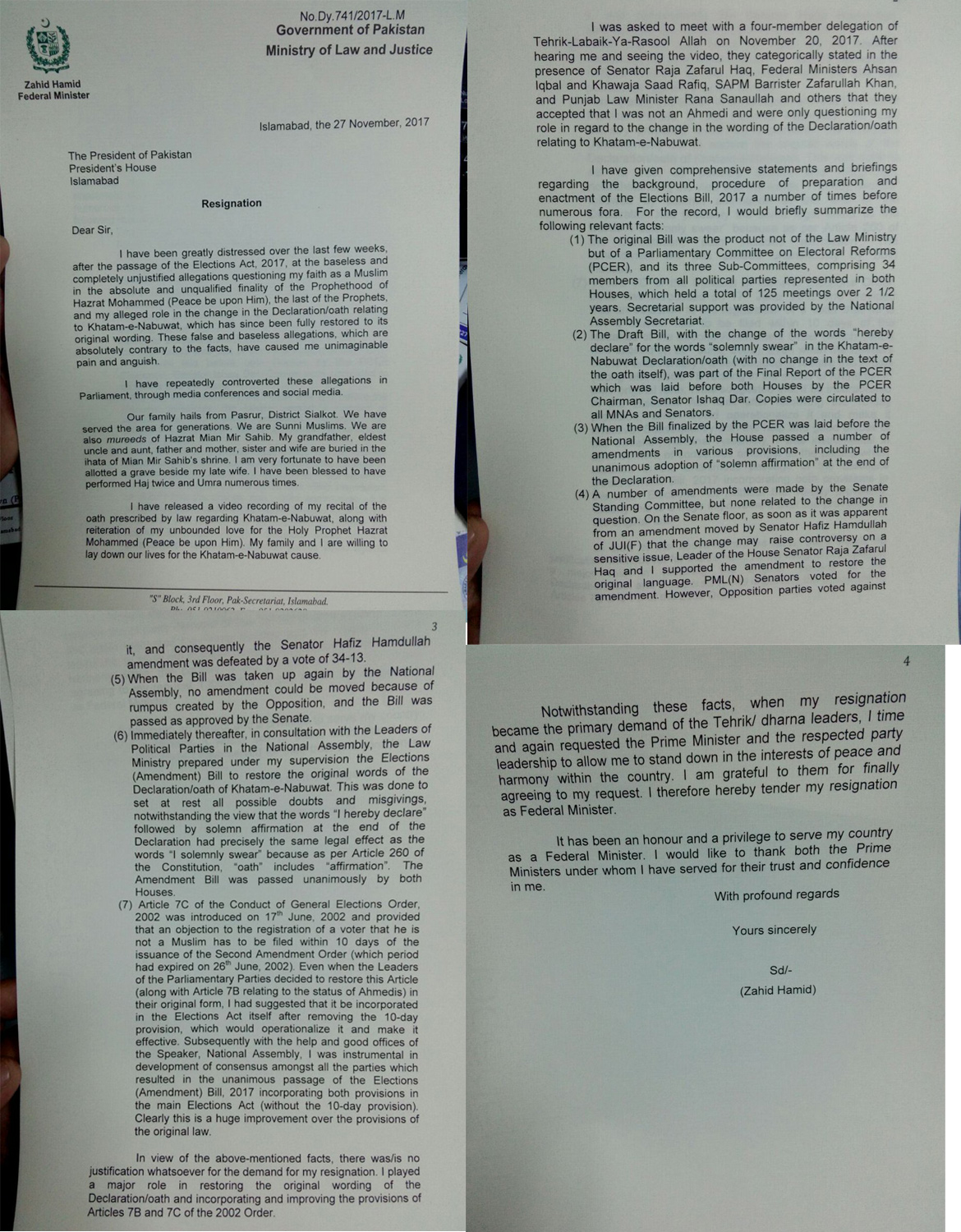
On the morning of November 27, 2017, the Pakistan Daily Times (PDT) issued an editorial calling for the Pakistan government to remain strong in the face of the TLY protester threats. The PDT wrote that surrendering to such demands would “mean that government officials can be forced into resignation by any group of armed thugs that can use force and attack ministers’ houses to push for its unconstitutional and illegal demands. It should be stated by the government in clear terms that no minister would resign on demands of such hooligans.” But on the same day, the Pakistan government did surrender to the TLY protester demands, and Federal Law Minister Zahid Hamid was forced to resign.
Pakistan Federal Law Minister Zahid Hamid Resignation Letter, November 27, 2017
On social media, Pakistanis posted a video of a Pakistan military figure passing out envelopes to (what appears to be) protesters. According to Dawn News, “Punjab Rangers DG Maj Gen Azhar Naveed oversaw the release of protesters and handed over cheques worth Rs1,000 to each released protester as fare for their travel home.” The Islamabad High Court criticized the Pakistan government’s role to use the Pakistan military to arbitrate with the TLY extremist protesters, with Justice Shaukat Aziz Siddiqui asking “Who is the Army to adopt a mediator’s role?” and “Where does the law assign this role to a major general?”
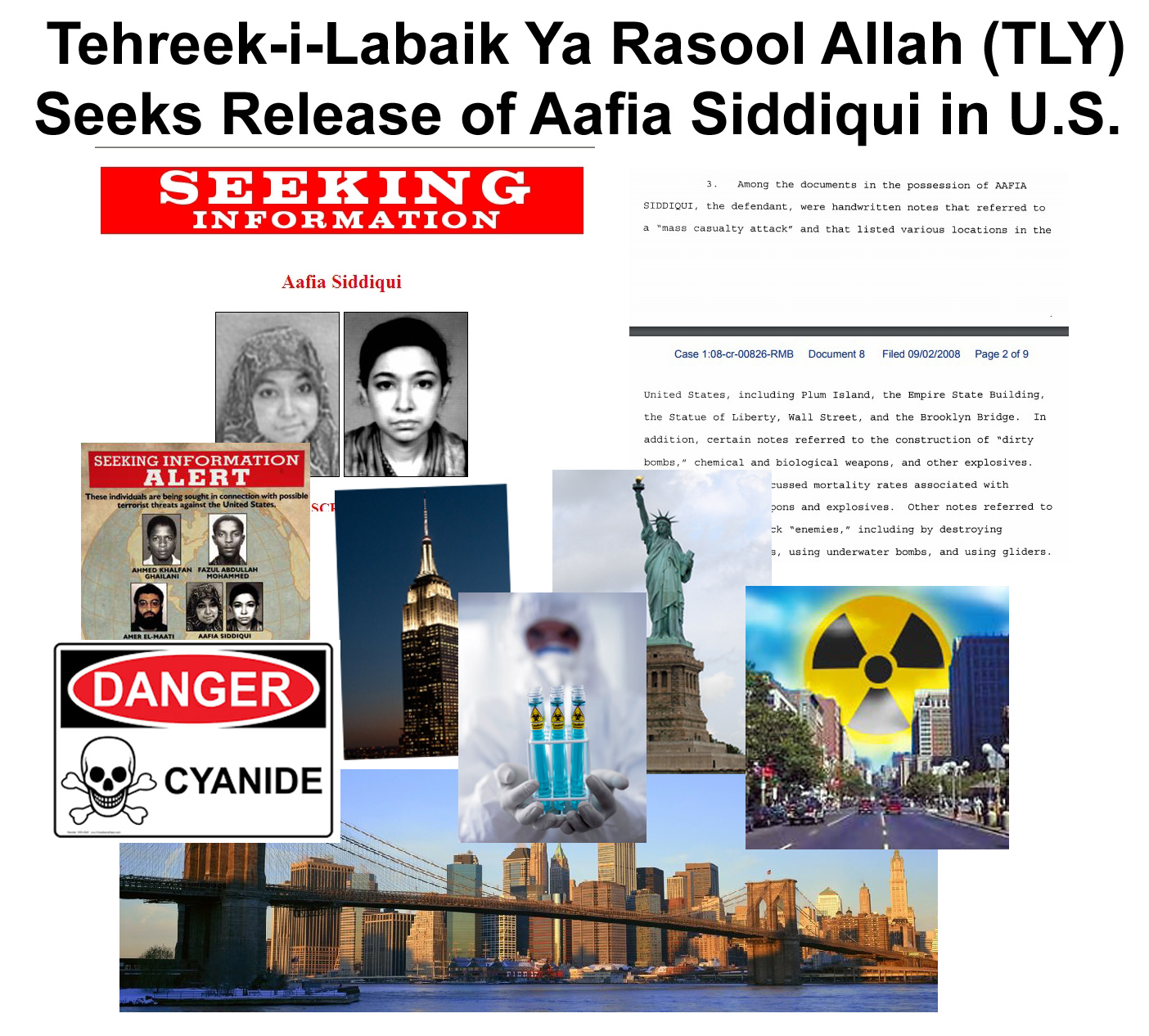
Other TLY demands, which they tell Dawn News that the Pakistan government has agreed to, address aggressive enforcement of the Blasphemy law used to persecute Pakistan Christians and other religious minorities, and investigation into government officials concerned about Ahmadi minority Muslims. Other TLY demands that they claim were accepted by the Pakistan government calls for seeking the U.S. to release a Pakistan woman, Aafia Siddiqui, convicted in the U.S. for shooting Americans, who was linked with“mass casualty” terror plots.
Pakistan Tehreek-i-Labaik Ya Rasool Allah (TLY) Leader Khadim Hussain Rizvi States Pakistan Government Agreed to Call for Terror-Linked Aafia Siddiqui’s Release
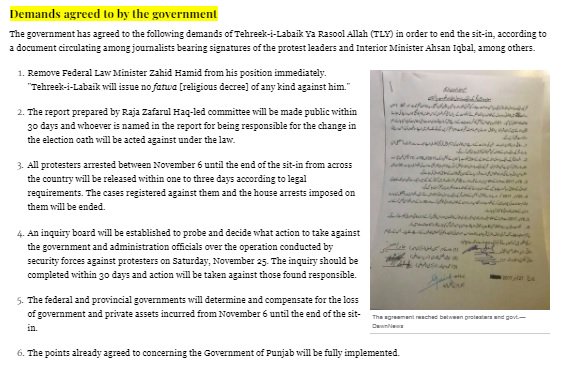
The six (6) demands of the TLY agreed to by the Pakistan government have been widely distributed in a document, signed by Pakistan Interior Minister Ahsan Iqbal, TLY leader Khadim Hussain Rizvi, Interior Secretary Arshad Mirza, two other protest leaders, and Major General Faiz Hameed, who facilitated the agreement. The six demands of the TLY agreed to by the Pakistan government, in a document with these signatures, are listed as:
“1. Remove Federal Law Minister Zahid Hamid from his position immediately. Tehreek-i-Labaik will issue no fatwa [religious decree] of any kind against him.”
2. The report prepared by Raja Zafarul Haq-led committee will be made public within 30 days and whoever is named in the report for being responsible for the change in the election oath will be acted against under the law.
3. All protesters arrested between November 6 until the end of the sit-in from across the country will be released within one to three days according to legal requirements. The cases registered against them and the house arrests imposed on them will be ended.
4. An inquiry board will be established to probe and decide what action to take against the government and administration officials over the operation conducted by security forces against protesters on Saturday, November 25. The inquiry should be completed within 30 days and action will be taken against those found responsible.
5. The federal and provincial governments will determine and compensate for the loss of government and private assets incurred from November 6 until the end of the sit-in.
6. The points already agreed to concerning the Government of Punjab will be fully implemented.”
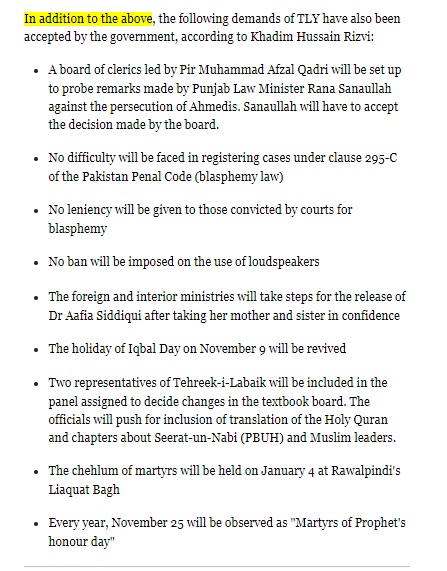
In addition, Dawn News reports on nine (9) additional TLY demands allegedly agreed to by the Pakistan government, including increased use of the “Blasphemy Law” to oppress individuals and persecute religious minorities (including Pakistan Christian minorities), calls for investigation into government leaders to urge further persecution of Ahmadi Muslim minorities, and calls for the release of a Pakistan woman, Dr. Aafia Siddiqui, convicted of shooting Americans, who has been linked to terrorist plans to attack the United States.
These additional TLY demands, which TLY leader Khadim Hussain Rizvi states the Pakistan government has agreed to include the following, as reported both by Dawn News and the Pakistan Daily Times:
“1. A board of clerics led by Pir Muhammad Afzal Qadri will be set up to probe remarks made by Punjab Law Minister Rana Sanaullah against the persecution of Ahmedis. Sanaullah will have to accept the decision made by the board.
2. No difficulty will be faced in registering cases under clause 295-C of the Pakistan Penal Code (blasphemy law)
3. No leniency will be given to those convicted by courts for blasphemy
4. No ban will be imposed on the use of loudspeakers
5. The foreign and interior ministries will take steps for the release of Dr Aafia Siddiqui after taking her mother and sister in confidence
6. The holiday of Iqbal Day on November 9 will be revived
7. Two representatives of Tehreek-i-Labaik will be included in the panel assigned to decide changes in the textbook board. The officials will push for inclusion of translation of the Holy Quran and chapters about Seerat-un-Nabi (PBUH) and Muslim leaders.
8. The chehlum of martyrs will be held on January 4 at Rawalpindi’s Liaquat Bagh
9. Every year, November 25 will be observed as ‘Martyrs of Prophet’s honour day’ ”
The increased calls for persecution of individuals under the Pakistan “Blasphemy Law,” should be concerning to those advocating for Human Rights and religious freedom of all people. It should be deeply concerning to Human Rights advocates that the TLY has obtained such support after its public calls for executing individuals and its reports to the Pakistan Daily Times and Pakistan Dawn, that the TLY has received agreement by the Pakistan government that blasphemy laws will be more aggressively pursued against vulnerable individuals.
Pakistan Protesters Calling for Execution of Christian Minority Woman Asia Bibi
The Blasphemy Law is regularly used to persecute religious minorities and other victimized by claims that they did or said something “blasphemous” against Islam. This law calls for the death penalty for individuals convicted on such laws, usually based on trumped-up or fabricated evidence. Some suffer for years in prison on such charges, seeking appeals, and even those who are released when found innocent face mob violence, including previous reports of those shot on courthouse steps. Media reports showed the current protesters with banners calling for the hanging of Christian minority woman Asia Bibi, who was convicted of blasphemy in November 2010, sentenced to death, and who continues to seek appeal of this death sentence. Christian minority woman Asia Bibi’s primary “offense” was sharing a water cup while working with extremist Muslim co-workers, who felt that her unclean touch of the water cup was offensive. This led to a dispute and fabricated charges against her in June 2009. She was imprisoned for over a year before being formally charged. TLY protesters have been openly protesting in support of Asia Bibi’s death.
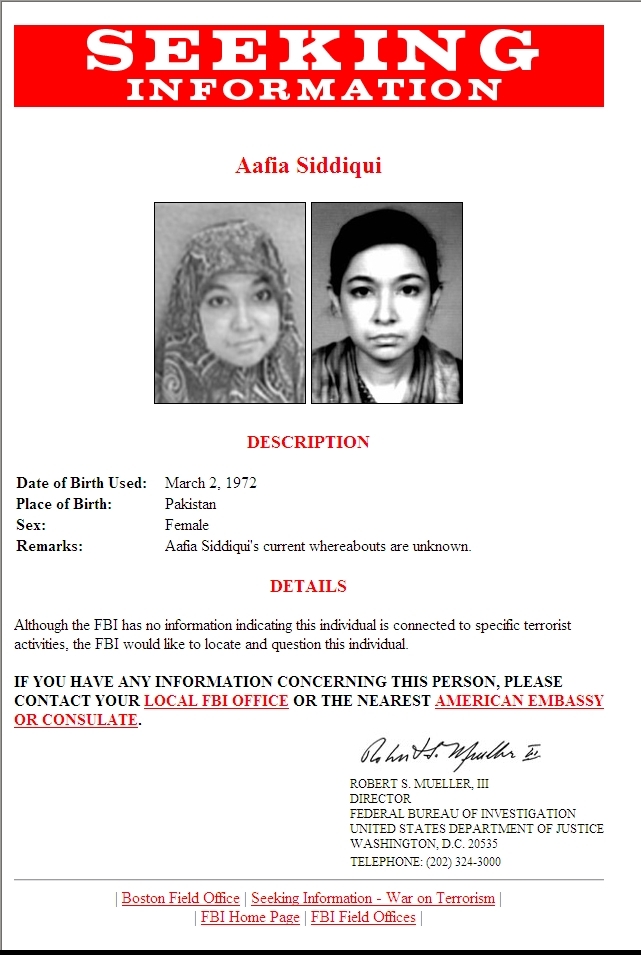
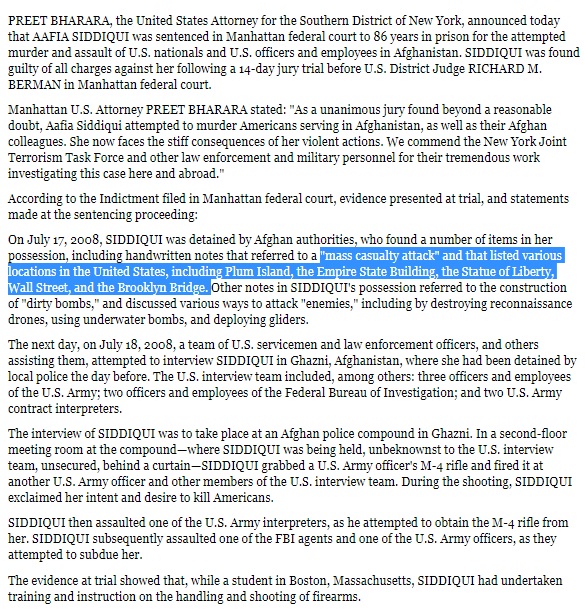
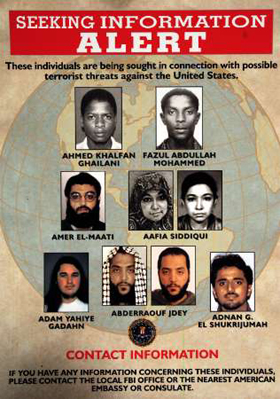
The American public should also be concerned about the calls by TLY leader Khadim Hussain Rizvi, which he claims to Dawn News, are supported by the Pakistan government, seeking the release of Dr. Aafia Siddiqui, who was convicted by U.S. courts after shooting Americans and attempting to murder them. Al-Qaeda-linked Aafia Siddiqui was one of several high-profile terror suspects sought by the FBI in the United States, where she had been operating, prior to her capture in Afghanistan. Afia Siddiqui was a graduate of the Massachusetts Institute of Technology (MIT), and obtained a Ph.D. doctoral degree from Brandeis University, where she taught a Biology Laboratory course. Media reports stated that Khalid Sheikh Muhammad, the alleged al-Qaeda chief planner of the 11 September attacks, named Afia Siddiqui as an Al-Qaeda operative. Khalid Sheikh Muhammad was related to Afia Siddiqui, as her second husband’s uncle. According to the U.S. Government, Aafia Siddiqui had a role in assisting terrorists to “rent houses and provide administrative support for the operation,” including organizing travel documentation for Pakistani national Majid Khan in Baltimore, Maryland, whose role was to bomb gasoline stations and poison water reservoirs in America. In U.S. courts, Aafia Siddiqui was convicted of attempted murder of U.S. nationals, officers, and employees, assault with a deadly weapon, carrying and using a firearm, and three counts of assault on U.S. officers and employees. According to the complaint against Pakistan woman Aafia Siddiqui, she was arrested with notes on plans for terrorist attacks on “various locations in the United States, including Plum Island, the Empire State Building, the Statue of Liberty, Wall Street, and the Brooklyn Bridge,” as well as plans on “construction of ‘dirty bombs,’ chemical and biological weapons, and other explosives.” She was also arrested with two pounds (900 grams) of sodium cyanide in a glass jar.
Responsible for Equality And Liberty (R.E.A.L.) has previously reported on UK-based groups that have praised terrorists, including the 9/11 Al-Qaeda terror attack on the U.S., which have campaigned for the freedom of convicted terrorists. According to the London Times, this included a “women’s network [that] is using macabre images on social media to raise funds for convicted terrorists and their families,” including Pakistan Dr. Aafia Siddiqui.
Pakistan media figures have considered the Pakistan government’s inability to manage law and order in the face of the TLY religious political protests across the nation. During the protests, Dawn’s Zahid Hussain wrote: “The use of religion as a policy tool by the state and its confluence with politics has divided the nation along sectarian lines and fueled bigotry. The ongoing siege of the capital presents a serious challenge to not only the government but also the state” and “The authorities have not learnt from the consequences of the policy of appeasement.”
Pakistan Express Tribune’s Kamran Yousaf warns of religious extremism in Pakistan as a form of “Frankenstein’s monster,” writing “Our state and its inaction allowed ordinary individuals and groups to become monsters.” Mr. Yousaf states that despite security improvements in the military,”the battle against extremism has unfortunately not even been kicked off. We have not only failed to stem the tide of extremism but in reality whatever little gains we may have achieved are now being reversed.” “The tragic part is that we haven’t learnt any lesson from the past and as a consequence has allowed yet another individual to become larger than life character. Who is Khadim Hussain Rizvi and how has he risen to prominence within no time? Not long ago, he was just an ordinary cleric teaching at one of the seminaries in Lahore.” “The problem is that the path he has chosen to venture into politics is dangerous. He is openly inciting people to violence and ridiculing judiciary and other institutions. ” “This leaves us with a legitimate concern: are we paving the way for yet another monster?”
Pakistan Daily Times (PDT) writer Obed Pasha wrote on November 27 that TLY protesters led by Khadim Hussain Rizvi were not defied due to “widespread tacit support they have from a substantial portion of the society” in Pakistan, who “sympathize with Khadim Hussain’s cause.” PDT writer Pasha stated that the “fact of the matter is that the masses have chosen religious bigotry to unite for collective action,” and that a series of successful political religious extremists have “not only weakened the state machinery, but also legitimized the use of religion to achieve political goals in the society.”
Responsible for Equality And Liberty (R.E.A.L.) suggests to the Pakistan government, the frustrated among the Pakistan public, and those who believe in equality, liberty, and democratic processes another direction: Choose Universal Human Rights.
The path of religious extremism is only one path that Pakistan could choose. Other alternatives could be to reconsider the position of Pakistan in making its rights and legal systems dependent on pluralistic values that show true respect and confidence in freedom of religion and faith, rather than an insecurity that demands religious extremist control all political and legal futures in Pakistan. A faith and culture that is strong should also be strong enough to respect others and understand others without the fear-based extremism that demand total and unquestioning obediance to extremist views, and which will use violence and disruption if its adherants do not get their way. Surely such appeasement of extremism undermines the foundational capabilities for democracy and democratic principles.
Pakistan is a signatory to the Universal Declaration of Human Rights (UDHR) (signatory as part of December 10, 1948 United Nations process), as well as the International Covenant on Civil and Political Rights (ICCPR) (signed 2008, ratified 2010). The ICCPR is the legal treaty to the UDHR. Within the UDHR, Article 18 states: “Everyone has the right to freedom of thought, conscience and religion; this right includes freedom to change his religion or belief, and freedom, either alone or in community with others and in public or private, to manifest his religion or belief in teaching, practice, worship and observance.” This is part of the ICCPR as well, as part of its own Article 18, which states “1. Everyone shall have the right to freedom of thought, conscience and religion. This right shall include freedom to have or to adopt a religion or belief of his choice, and freedom, either individually or in community with others and in public or private, to manifest his religion or belief in worship, observance, practice and teaching. 2. No one shall be subject to coercion which would impair his freedom to have or to adopt a religion or belief of his choice. 3. Freedom to manifest one’s religion or beliefs may be subject only to such limitations as are prescribed by law and are necessary to protect public safety, order, health, or morals or the fundamental rights and freedoms of others. 4. The States Parties to the present Covenant undertake to have respect for the liberty of parents and, when applicable, legal guardians to ensure the religious and moral education of their children in conformity with their own convictions.”
When ratifying the ICCPR, Pakistan stated that “The Government of the Islamic Republic of Pakistan reserves its right to attach appropriate reservations, make declarations and state its understanding in respect of various provisions of the Covenant at the time of ratification.” Pakistan’s reservations to such universal human rights under the UDHR and ICCPR have included the following reservation (June 27, 2011) regarding Article 18: “shall be so applied to the extent that they are not repugnant to the Provisions of the Constitution of Pakistan and the Sharia laws.”
Pakistan is also a member of the Organization of the Islamic Conference (OIC) which created its own version of a human rights declaration, titled the “Cairo Declaration on Human Rights in Islam (CDHRI)” adopted on August 5, 1990. Unlike the other universal human rights documents, the OIC’s version of “human rights” denies religious freedom, making human rights dependent on the interpretation of Islamic Sharia law by individual OIC’s states’ members. As stated in CDHRI Article 24, “All the rights and freedoms stipulated in this Declaration are subject to the Islamic Shari’ah.” As stated in CDHRI Article 25, “The Islamic Shari’ah is the only source of reference for the explanation or clarification of any of the articles of this Declaration.” But even within Shari’ah there are interpretations by scholars. Why cannot confidence, rather than fear be an interpretation? Why cannot respect for others, rather than “compulsion” in religion not be an interpretation?
If Pakistan’s majority faith and religious culture is secure, then it should not need such artificial demonstrations of piety and rejection of pluralism to defend it. It is time for Pakistan to recognize the foundational problems that it faces in its version of democracy and human rights, and understand that democratic values and human rights must be universal, to be responsible for the future of the diverse people and needs in Pakistan, and to be responsible in Pakistan’s future with the world.
Courage and confidence in equality, not surrender and fear of extremists, offers a real pathway for peace and prosperity for Pakistan’s future. No nation can build a proud nation for its children, if on any day, a handful of extremists can readily drag it to its knees. We urge the people and government of Pakistan to stand up and reject the attacks on democracy and representative government by such extremists.
We urge Pakistan and its people to be Responsible for Equality And Liberty.
(* NOTE: The TLY is also referred to in English media as Tehreek-e-Labaik Pakistan, Tehreek Labbaik Ya Rasool Allah, Tehreek-e-Labaik Ya Rasool Ullah, “TLYP,” “TLYR”.)
In Pakistan, extremist religious supporters of three religious political parties: Tehreek-e-Labaik Pakistan, Tehreek-e-Khatm-e-Nabuwwat, and the Sunni Tehreek Pakistan, have been engaged in protests and violence starting in Pakistan’s capital Islamabad and spreading to other parts of the country. One of the groups, Tehreek-e-Labaik Pakistan (aka “TLY,” Tehreek Labbaik Ya Rasool Allah, Tehreek-e-Labaik Ya Rasool Ullah, “TLYP,” “TLYR”), has been led by firebrand cleric Khadim Hussain Rizvi, who continues to led protest activities and rally individuals armed with sticks and rods in the Islamabad capital. TLY group chief Khadim Hussain Rizvi has used social media to call for the protests and actions by supporters across Pakistan. The protests in Pakistan’s capital, Islamabad, and have blocked the blocking Faizabad Inter-Change for approximately three weeks. TLY protests have spread to other parts of the nation, and violence between protesters and the Pakistan police has increased, including protesters attacking police with iron and wooden rods, stones, setting police vehicles on fire, and starting fires in the streets. The protests and violence have spread to other parts of the country, and reports are being issued from Pakistan media of plans to restrict media reporting on the disruption.
The violent protests have attacked reported changes in electoral reform law, but also called for threats against religious minorities, including execution of Christian minority woman Asia Bibi for “blasphemy,” and anti-Ahamdi Muslim minority placards. Fires, attacks on police vehicles, injuries, and death have been reported as a result of the increasingly violent protests, which have led to the death of at least one police officer killed, over 60 police injured, 45 Frontier Constabulary (FC) injured, 8-10 protesters killed, and 300 protesters injured.
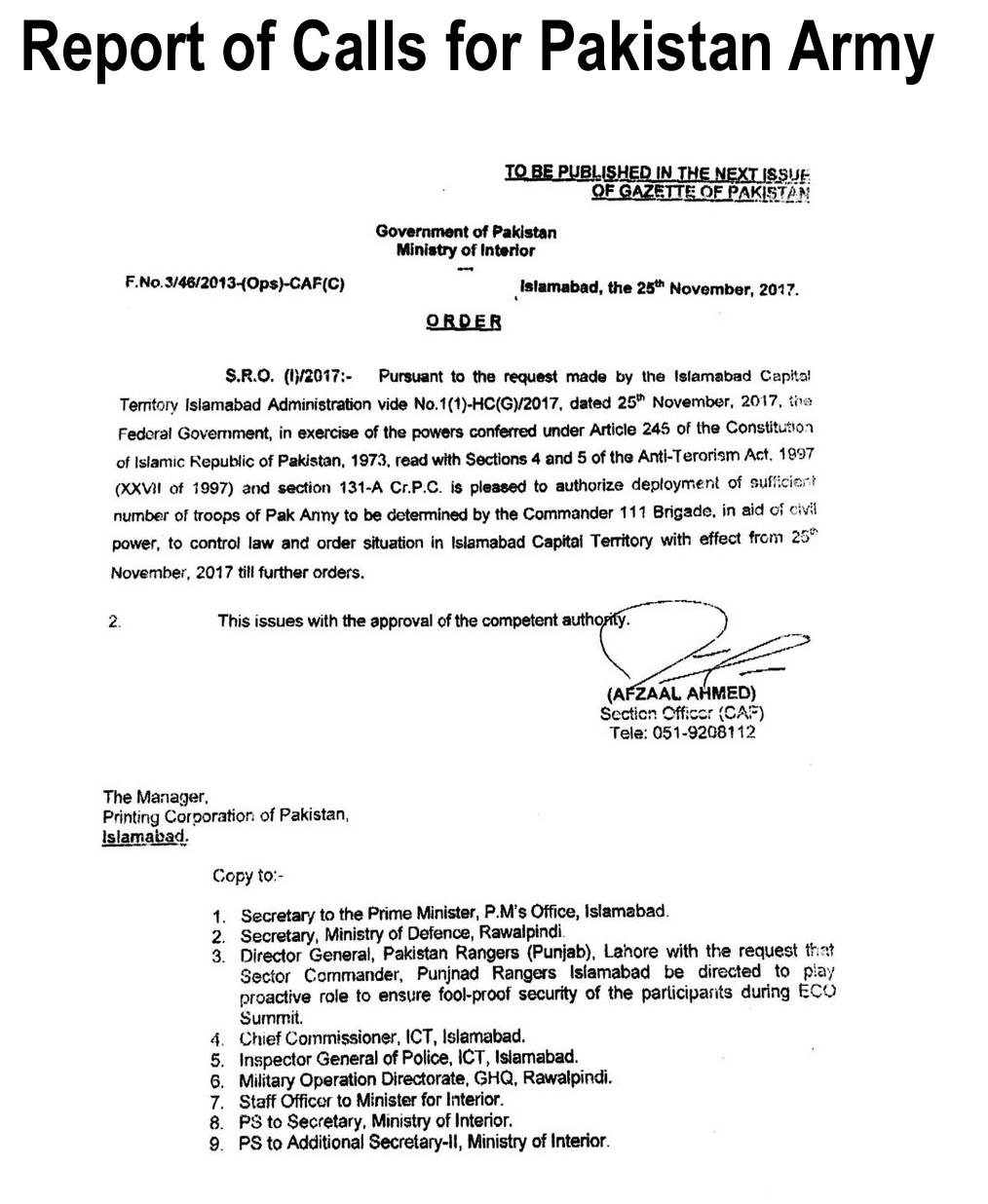
The recent protests and violence which began in Pakistan’s national capital of Islamabad, have continued to spread. The current protests and disruption has led to over 5,000 protesters seeking to disrupt Islambad and other parts of Pakistan, including: Faizabad, Karachi, Hyderabad/Sindh, Lahore/Punjab, Peshawar, Quetta. Multiple reports are also stating that a call has been made by the Pakistan Federal Government to authorize the use of the Pakistan Army “to control law and order situation in Islamabad Capital Territory.” Reports stated that Pakistan military authorities were used to help contain protest violence. According to Dawn, “The federal government on Saturday evening ordered the deployment of the army in Islamabad under Article 245 of the Constitution to aid civilian law-enforcement agencies in securing the capital, following the ‘suspension’ of the day-long crackdown against religious protesters camped out at Faizabad Interchange.”
According to the New York Times, Dawn, and other reports, electronic media and television media have been restricted from reporting on the violent protests. The Pakistan Electronic Media Regulatory Authority (PEMRA) blocked live television coverage of protests. The New York Times reports: “At one point, the electronic media regulating authority took all television news networks off the air in most parts of the country, and Facebook, Twitter and YouTube were also inaccessible, amid concerns that live coverage of the police action was inflaming religious sentiments.”
The TLY extremist and protester groups are telling their leaders to “use VPN” as ways to work around the PERMA blocks on social media.
Pakistan Television Channels Shut Down by akistan Electronic Media Regulatory Authority (PEMRA)
Numerous reports of violence and disruption were reported across the Pakistan.
In Islamabad, protesters continued to occupy the Faizabad Bridge which connects Rawalpindi and Islamabad through the Islamabad Expressway and Murree Road, with a reported growth in the number of protesters from 1,000 to 5,000. Additional protesters joined the Islamabad protest mob using Murree Road, Rawal Dam and Express Highway. Reports continue to state that TLY leader Khadim Hussain Rizvi is leading protesters armed with rods and sticks. Protesters have used rocks and rods on the police, as well as tear gas shells. Some are concealing their identity with masks. Police vehicles and police vans have been attacked and set on fire. Protesters have cut down trees to block highways, and have burned tires in the streets, as well as attacked police, attacked FC personnel, and set police vehicles on fire. The latest reports state that Islamabad’s Red Zone and Diplomatic Enclave were sealed off with containers to prevent protesters from entering the area.
In Quetta, protestors sought to disrupt and cause traffic jams in Hockey Chowk, and protesters sought to demonstrate against the security and law enforcement agencies seeking to restore order.
In Karachi, at least 23 were injured included 2 policemen, some with gunshot wounds. Pakistan Dawn quoted police officer Malir SSP Rao Anwar Ahmed stating: “One of the men among the protesters was armed with SMG rifle, who resorted to firing on the policemen, resultantly Memon Goth SHO Gulzar Tunio and constable Sabir sustained bullet wounds.” Throughout Karachi, there were reports of protesters creating fires and burning tires. Protests in Numaish Chowrangi created disruptions of traffic in the area for hours. Major affected areas were reported to include Teen Talwar, Boat Basin, Nipa, Sohrab Goth, Shahrah-i-Faisal near Stargate and Nursery, Hub River Road and Hassan Square.
In Hyderbath/Singh area, traffic was blocked by protesters including in the Haider Chowk area, as well as the National Highway near Khairpur. Protests occurred outside the Badin Press Club and in Sukkur, Umerkot, Mithi, and Sujawal.
In Lahore/Punjab, significant protests in Shahdara, Imamia Colony, and other areas led to closing roads and blocking roads from Lahore to Gujranwala, including Faisalbad. Protests occurred in nine other cities throughout Punjab province ( Gujranwala, Multan, Nakana Sahib, Mianwali, Gujrat, Sahiwal, Vehari, Toba Tek Singh and Murree) and motorists were stranded due to traffic congestion on the Lahore-Islamabad Motorway. Pakistan Today reported that the police prescence was difficult to discern, in their report: “Lahore police go missing as religious activists lay siege to Faisal Chowk.”
In Peshawar, protesters blocked King’s Road and created major traffic blockages in the area. They burned tires at a major protest rally causing smoke and fire. Other protests developed in four other areas throughout Peshawar, including Khyber Pakhtunkhwa, Haripur, Mansehra and Dera Ismail Khan.
In Multan, four protest rallies were led by Sunni Jamaat activists.
In Natha Khan Chowk, protesters set a vehicle on fire.
In Sialkot, protesters attacked the home of Law Minister Zahid Hamid with rocks.
In Sheikhupura, PML-N lawmaker Javed Latif was attacked and injured by protesters, when he attempted to negotiate with them. Protesters also attacked the home of PML-N’s former interior minister Chaudhry Nisar.
Social media reports have provided additional information that a number of the protesters are actually armed with weapons that are concealed. One example shown is how metal rods are hidden inside “bamboo poles” and then used as weapons when not seen by photographers.
Social Media Showing Metal Rods Hidden Inside Protesters’ “Bamboo Poles”
A primary reason given by TLY group chief Khadim Hussain Rizvi and supporting protesters for such public disruption has been to call for the resignation of Pakistan Law Minister Zahid Hamid, after claims that a Electoral Reform Bill did not include a clause regarding belief in the finality of Prophethood of Muhammad (Khatam an-Nabiyyin) as part of the revised electoral reform act, regarding “Oath committing to Prophethood of Muhammad.” However, reports have show the both the proposed and previous verisions of the amended Electoral Reform Bill included this “oath” to consent to the “finality of Prophethood” of Muhammad. Law Minister Zahid Hamid denied the TLY allegations about the removal of this part of the proposed law, stating, “God forbid, we can’t even think of doing such a thing.” The intent of the Electoral Reform Bill was to combine eight different laws pertaining to elections to avoid legal confusion. One of the “controversial” aspects of the Electoral Reform Bill was a clause to prevent politicians that are disqualified from holding public office to lead political parties.
In addition, protesters have been protesting against religious minorities with particular targets on Pakistan Christian Asia Bibi and against Ahmadi Muslims. Protesters carried banners calling for the execution of Pakistan Christian minority woman Asia Bibi for “blasphemy.”
Pakistan Protesters Calling for Execution of Christian Minority Woman Asia Bibi
In Lahore, Pakistan Today reported that “Hundreds of protesters, including members of the Lahore Bar Association (LBA), carrying anti-Ahmedi placards and batons thronged the Faisal Chowk to register their protest against the operation in Islamabad.” “Protesters were also of the view that Punjab Law Minister Rana Sanaullah and Federal Law Minister Zahid Hamid should resign as the former is ‘friends with Ahemdis’ while the latter ‘is an Ahmedi’.”
Those protesting in defense of the religious “Blasphemy Law,” Section 295 C of the Pakistan Penal Code, in Pakistan, which is regularly used to persecute religious minorities and other victimized by claims that they did or said something “blasphemous” against Islam. This law calls for the death penalty for individuals convicted on such laws, usually based on trumped-up or fabricated evidence. Some suffer for years in prison on such charges, seeking appeals, and even those who are released when found innocent face mob violence, including previous reports of those shot on courthouse steps. Media reports showed the current protesters with banners calling for the hanging of Christian minority woman Asia Bibi, who was convicted of blasphemy in November 2010, sentenced to death, and who continues to seek appeal of this death sentence. Christian minority woman Asia Bibi’s primary “offense” was sharing a water cup while working with extremist Muslim co-workers, who felt that her unclean touch of the water cup was offensive. This led to a dispute and fabricated charges against her in June 2009. She was imprisoned for over a year before being formally charged.
Responsible for Equality And Liberty (R.E.A.L.), an advocate for universal human rights, urges the Pakistan government to reject policies of appeasement in dealing with extremist protesters throughout Pakistan, but also to re-examine Pakistan’s position on human rights in addressing the roots of such extremism. R.E.A.L. notes the commentary by Zahid Hussain who states: “The use of religion as a policy tool by the state and its confluence with politics has divided the nation along sectarian lines and fueled bigotry. The ongoing siege of the capital presents a serious challenge to not only the government but also the state” and “The authorities have not learnt from the consequences of the policy of appeasement.” While R.E.A.L. agrees with Mr. Hussain on this, the foundational issue comes back to the false idea that Pakistan can have a separate set of universal human rights, a different vision of democracy, and a view of religious tolerance that fundamentally rejects religious diversity and pluralism. The root of this problem will not go away for Pakistan.
Pakistan is a signatory to the Universal Declaration of Human Rights (UDHR) (signatory as part of December 10, 1948 United Nations process), as well as the International Covenant on Civil and Political Rights (ICCPR) (signed 2008, ratified 2010). The ICCPR is the legal treaty to the UDHR. Within the UDHR, Article 18 states: “Everyone has the right to freedom of thought, conscience and religion; this right includes freedom to change his religion or belief, and freedom, either alone or in community with others and in public or private, to manifest his religion or belief in teaching, practice, worship and observance.” This is part of the ICCPR as well, as part of its own Article 18, which states “1. Everyone shall have the right to freedom of thought, conscience and religion. This right shall include freedom to have or to adopt a religion or belief of his choice, and freedom, either individually or in community with others and in public or private, to manifest his religion or belief in worship, observance, practice and teaching. 2. No one shall be subject to coercion which would impair his freedom to have or to adopt a religion or belief of his choice. 3. Freedom to manifest one’s religion or beliefs may be subject only to such limitations as are prescribed by law and are necessary to protect public safety, order, health, or morals or the fundamental rights and freedoms of others. 4. The States Parties to the present Covenant undertake to have respect for the liberty of parents and, when applicable, legal guardians to ensure the religious and moral education of their children in conformity with their own convictions.”
When ratifying the ICCPR, Pakistan stated that “The Government of the Islamic Republic of Pakistan reserves its right to attach appropriate reservations, make declarations and state its understanding in respect of various provisions of the Covenant at the time of ratification.” Pakistan’s reservations to such universal human rights under the UDHR and ICCPR have included the following reservation (June 27, 2011) regarding Article 18: “shall be so applied to the extent that they are not repugnant to the Provisions of the Constitution of Pakistan and the Sharia laws.”
Pakistan is also a member of the Organization of the Islamic Conference (OIC) which created its own version of a human rights declaration, titled the “Cairo Declaration on Human Rights in Islam (CDHRI)” adopted on August 5, 1990. Unlike the other universal human rights documents, the OIC’s version of “human rights” denies religious freedom, making human rights dependent on the interpretation of Islamic Sharia law by individual OIC’s states’ members. As stated in CDHRI Article 24, “All the rights and freedoms stipulated in this Declaration are subject to the Islamic Shari’ah.” As stated in CDHRI Article 25, “The Islamic Shari’ah is the only source of reference for the explanation or clarification of any of the articles of this Declaration.”
This creates a fundamental division and conflict between OIC nations respecting the CDHRI, and other nations of the world respecting the UDHR/ICCPR. It creates a continuing flashpoint in dealing with broad human rights issues on an international basis, where the very definition of “universal human rights” has a different interpretation in Pakistan and other OIC nations. The concept of those seeking to run for political office in other nations around the world, having to make a commitment or an oath to a specific religious viewpoint, would appear fundamentally un-democratic and an institutional attack of democratic processes. But throughout Pakistan today, TLY protesters are violently protesting and burning police vehicles based on a rumor that such non-religious democratic electoral reform could even have been considered. Furthermore, some TLY protesters are also using this unrest to further defend the abuses by the Pakistan “Blasphemy Law,” which is regularly used to persecute religious minorities and others.
We urge that the Pakistan police will get this unrest and violence under control, but this is yet another example of the dangerous lack of stability that Pakistan must resolve in basic agreement on human rights and democratic processes along with the rest of the world. Long term solutions are not just police action, not simply Army action, and not further efforts to appease violent extremists. The only long term solution for Pakistan to meaningfully address such violence is to build a pluralistic respect for universal human rights for all people of all faiths, without dependence on religious sanctions to operate basic national law and regulations on a daily basis. As with all nations, the values, ethics, and mores (including religious mores) of its people are powerful influences on law and legislation. But for adherents to the majority religion, the demonstration of real piety and religious conscience would be provide laws that allow for respect to all Pakistan citizens of all faiths and views, without the insecure need for “compulsion” in religion.
As a nuclear weapon-armed modern nation (with an estimated 120 nuclear bomb warheads), Pakistan and the Pakistan people must consider both its national and its global responsibilities. Like the rest of the world, the Pakistan people have suffered from violence and terrorism. It remains essential for Pakistan and the world to continue to challenge terrorism. But terror tactics draw their inspiration from extremist views and values, and too many extremists continue to wield influence in Pakistan today, as we can clearly see in the streets of Pakistan, as the Pakistan police themselves lie injured and killed in the streets today.
Pakistan must come to realize that modern technology, modern weapons, and engagement with the rest of the world is a two-way street. Pakistan cannot simply take what it wants from our global modern age, and live as if the rest of the modern world does not exist, including our shared universal human rights. Growing technological and business interdependence with simultaneous denial on global standards of human rights is a strategy for Pakistan’s national disruption, security challenges, and both internal and external strife. Like all nations, Pakistan has the right to defend its culture, its majority religion, and its values. But the dependence on a completely separate set of “universal human rights” that reject the religious freedom and diversity of others will continue to be a weakness in the Pakistan national identity. Pakistan’s position in dealing with the TLY and the violent protesters is to tactically stop street violence, but to ignore the foundational problems that lead to such issues.
Pakistan must reassess its reservations to the Universal Declaration of Human Rights (UDHR) and the International Covenant on Civil and Political Rights (ICCPR), and reconsider its dependence on a Cairo Declaration on Human Rights in Islam (CDHRI), which demands a religious-based “universal human rights” code. If Pakistan’s majority faith and religious culture is secure, then it should not need such artificial demonstrations of piety and rejection of pluralism to defend it.
The time must come, to stop the violence in Pakistan, and take a real stand against extremism movements in Pakistan, by fully and completely supporting all of the Universal Declaration of Human Rights, including Article 18. Pakistan could be begin this process by fully ratifying the Universal Declaration of Human Rights, rather than merely being a signatory to it. R.E.A.L. urges the government of Pakistan to reconsider its dependence on the CDHRI, and to fully ratify the Universal Declaration of Human Rights and to remove its “reservations” to the International Covenant on Civil and Political Rights. With the Human Rights Day approaching on December 10, this could be a move for Pakistan to begin to bring its stance on universal human rights in line with the rest of the world.
For Pakistan Christian refugees seeking asylum in Thailand, R.E.A.L. recommend they become familiar with the following processes, rules, and guidelines:
R.E.A.L. views persecution of Pakistan Christian refugees to be consistent with the guidelines set by the UNHCR to consider refugee persecution, as described in the United Nations Handbook and Guidelines on Procedures and Criteria for Determining Refugee Status (HCR/1P/4/ENG/REV. 3). It is R.E.A.L.’s contention that, in accordance with Part One, Section B. Interpretation of terms, Subsection (2)(b) Persecution, paragraph 51, such cases fit the definition of “persecution,” which clearly applies to this case as defined by the facts of the case and the circumstances of his country of origin, as very clearly seen by past events and highlighted by recent events in the persecution of Pakistan Christians. Paragraph 51 clearly states that “From Article 33 of the 1951 Convention, it may be inferred that a threat to life or freedom on account of race, religion, nationality, political opinion or membership of a particular social group is always persecution. Other serious violations of human rights – for the same reasons – would also constitute persecution.” We have seen from the case of Pakistan Christian refugees based on religious persecution as a Christian by extremists, and the ongoing threats to this Pakistan Christian refugee, that such persecution is a threat to life and freedom based on his Christian religious minority status.
R.E.A.L. further notes the applicability of the May 14, 2012 UNHCR Eligibility Guidelines for assessing the international protection needs of members of religious minorities from Pakistan (HCR/EG/PAK/12/02), Section C.1, and the known threat documented in the UNHCR Eligibility Guidelines regarding threats to religious minorities from blasphemy laws. This includes the UNHCR statement that Blasphemy accusations sometimes spark assaults, assassinations and mob attacks.” It remains our concern that this will be the case in this specific Pakistan Christian refugee’s case.
I also want to point out that the UNHCR Eligibility Guideline in Section IV. “Eligibility for International Protection, A. Potential Risk Profiles, (2). Christians,” recognizes that “Criminal provisions, particularly the blasphemy laws, are reportedly used by militant organizations and members of some Pakistan Muslim communities to intimidate and harass Christians, as well as to exact revenge or settle personal or business disputes.” This section also recognizes that “In many instances, the authorities are reportedly unable or unwilling to protect the lives and properties of Christians, or to bring the perpetrators of such violence to justice.” It further recognizes that “There are allegations of collusion between law enforcement authorities and Muslim clerics” in regards to such persecution of Pakistan Christians.” The UNHCR has previously concluded in such UNHCR Eligibility Guidelines that “In light of the foregoing, UNHCR considers that members of the Christian community, including those targeted by Islamic extremist elements or charged with criminal offences under the blasphemy provisions, victims of bonded labour, severe discrimination, forced conversion and forced marriage, as well as Christians perceived as contravening social mores, may, depending on the individual circumstances of the case, be in need of international refugee protection on account of their religion or membership of a particular social group.”
— UNHCR Guidelines, Paragraph 51 – Religious Persecution of Pakistan Christians Must Constitute Persecution for UNHCR. Paragraph 51 clearly states that “From Article 33 of the 1951 Convention, it may be inferred that a threat to life or freedom on account of race, religion, nationality, political opinion or membership of a particular social group is always persecution. Other serious violations of human rights – for the same reasons – would also constitute persecution.”
— UNHCR Guidelines, Paragraphs 42 and 43 – Assessment of Country of Origin as Factor for Pakistan Christian Refugees. R.E.A.L. has communicated to UNHCR evaluators on the need to effectively assess the dangerous conditions for Pakistan Christian refugees in their country of origin. This is also defined in the UNHCR Resettlement Handbook. The UNHCR Handbook Paragraph 42 specifically states that: “The competent authorities that are called upon to determine refugee status are not required to pass judgement on conditions in the applicant’s country of origin. The applicant’s statements cannot, however, be considered in the abstract, and must be viewed in the context of the relevant background situation. A knowledge of conditions in the applicant’s country of origin –while not a primary objective – is an important element in assessing the applicant’s credibility. In general, the applicant’s fear should be considered well-founded if he can establish, to a reasonable degree, that his continued stay in his country of origin has become intolerable to him for the reasons stated in the definition, or would for the same reasons be intolerable if he returned there.” The UNHCR Handbook Paragraph 43 also specifically states: “These considerations need not necessarily be based on the applicant’s own personal experience. What, for example, happened to his friends and relatives and other members of the same racial or social group may well show that his fear that sooner or later he also will become a victim of persecution is well-founded. The laws of the country of origin, and particularly the manner in which they are applied, will be relevant.”
— UNHCR Guidelines, Paragraph 196: Level of Proof for Refugees – UNHCR Resettlement Handbook, Part Two, Procedures for the Determination of Refugee Status, Section B. Establishing the Facts. Paragraph 196. “Often, however, an applicant may not be able to support his statements by documentary or other proof, and cases in which an applicant can provide evidence of all his statements will be the exception rather than the rule. In most cases a person fleeing from persecution will have arrived with the barest necessities and very frequently even without personal documents. Thus, while the burden of proof in principle rests on the applicant, the duty to ascertain and evaluate all the relevant facts is shared between the applicant and the examiner. Indeed, in some cases, it may be for the examiner to use all the means at his disposal to produce the necessary evidence in support of the application. Even such independent research may not, however, always be successful and there may also be statements that are not susceptible of proof. In such cases, if the applicant’s account appears credible, he should, unless there are good reasons to the contrary, be given the benefit of the doubt.”
— UNHCR Guidelines, Paragraph 197 – Requirement of Evidence – UNHCR Resettlement Handbook, Part Two, Procedures for the Determination of Refugee Status, Section B. Establishing the Facts. Paragraph 197. “The requirement of evidence should thus not be too strictly applied in view of the difficulty of proof inherent in the special situation in which an applicant for refugee status finds himself.”
— UNHCR Guidelines, Paragraph 203: Benefit of the Doubt in Refugee Cases – UNHCR Resettlement Handbook, Part Two, Procedures for the Determination of Refugee Status, Section B. Establishing the Facts. Paragraph 203. “After the applicant has made a genuine effort to substantiate his story there may still be a lack of evidence for some of his statements. As explained above (Paragraph 196), it is hardly possible for a refugee to ‘prove’ every part of his case and, indeed, if this were a requirement the majority of refugees would not be recognized. It is therefore frequently necessary to give the applicant the benefit of the doubt.”
— UNHCR Guidelines, Paragraph 203 and Section 6.3.2 – Definition of Violence and Impact of Violence on Refugee Decisions – UNHCR Resettlement Handbook, Part Two, Procedures for the Determination of Refugee Status, Section B. Establishing the Facts. Paragraph 203. “After the applicant has made a genuine effort to substantiate his story there may still be a lack of evidence for some of his statements. As explained above (Paragraph 196), it is hardly possible for a refugee to ‘prove’ every part of his case and, indeed, if this were a requirement the majority of refugees would not be recognized. It is therefore frequently necessary to give the applicant the benefit of the doubt.”Definition of Violence by UNHCR in Pakistan Christian Refugee Cases. In those cases, where UNHCR evaluators have also dismissed actual reports of violence and violent threats against Pakistan Christian refugees, R.E.A.L. has brought to their attention that the UNHCR Resettlement Handbook calls for a clear definition of violence. In the UNHCR Resettlement Handbook, Chapter 6, Resettlement Submission Categories, Section 6.3.2, page 251, the UNHCR uses the definition of violence from the World Health Organization: “Violence is the intentional use of physical force or power, threatened or actual, against oneself, another person, or against a group or community, which either results in or has a high likelihood of resulting in injury, death, psychological harm, maldevelopment, or deprivation.” We must challenge UNHCR decisions that give the perception of a different definition of violence when it comes to Pakistan Christian refugees.
— Commitment to Purpose of Resettlement and “Benefit of the Doubt.” The UNHCR Resettlement Handbook states that: “Resettlement is a vital instrument of protection and durable solution. Resettlement under UNHCR auspices is geared primarily to the special needs of refugees under the Office’s mandate whose life, liberty, safety, health or other fundamental human rights are at risk in the country where they sought refuge.” The Handbook also states: “Refugees may be denied basic human rights in a country of refuge; their lives and freedom may be threatened by local elements driven by racial, religious or political motives, or by attacks and assassinations directed from the outside. The authorities in the country of refuge may be unable or unwilling to provide effective protection. In such circumstances, resettlement becomes not a solution of last resort, as it has often been called, but a principal objective.” We must expect UNHCR RSD decisions to be consistent with the overall need by such refugees to find resettlement based on a reasonable “benefit of the doubt” that such refugees have made such claims based on a desperate situation.
For Pakistan Christian refugees seeking asylum in Thailand, R.E.A.L. recommend they become familiar with the following processes, rules, and guidelines:
R.E.A.L. views persecution of Pakistan Christian refugees to be consistent with the guidelines set by the UNHCR to consider refugee persecution, as described in the United Nations Handbook and Guidelines on Procedures and Criteria for Determining Refugee Status (HCR/1P/4/ENG/REV. 3). It is R.E.A.L.’s contention that, in accordance with Part One, Section B. Interpretation of terms, Subsection (2)(b) Persecution, paragraph 51, such cases fit the definition of “persecution,” which clearly applies to this case as defined by the facts of the case and the circumstances of his country of origin, as very clearly seen by past events and highlighted by recent events in the persecution of Pakistan Christians. Paragraph 51 clearly states that “From Article 33 of the 1951 Convention, it may be inferred that a threat to life or freedom on account of race, religion, nationality, political opinion or membership of a particular social group is always persecution. Other serious violations of human rights – for the same reasons – would also constitute persecution.” We have seen from the case of Pakistan Christian refugees based on religious persecution as a Christian by extremists, and the ongoing threats to this Pakistan Christian refugee, that such persecution is a threat to life and freedom based on his Christian religious minority status.
R.E.A.L. further notes the applicability of the May 14, 2012 UNHCR Eligibility Guidelines for assessing the international protection needs of members of religious minorities from Pakistan (HCR/EG/PAK/12/02), Section C.1, and the known threat documented in the UNHCR Eligibility Guidelines regarding threats to religious minorities from blasphemy laws. This includes the UNHCR statement that Blasphemy accusations sometimes spark assaults, assassinations and mob attacks.” It remains our concern that this will be the case in this specific Pakistan Christian refugee’s case.
I also want to point out that the UNHCR Eligibility Guideline in Section IV. “Eligibility for International Protection, A. Potential Risk Profiles, (2). Christians,” recognizes that “Criminal provisions, particularly the blasphemy laws, are reportedly used by militant organizations and members of some Pakistan Muslim communities to intimidate and harass Christians, as well as to exact revenge or settle personal or business disputes.” This section also recognizes that “In many instances, the authorities are reportedly unable or unwilling to protect the lives and properties of Christians, or to bring the perpetrators of such violence to justice.” It further recognizes that “There are allegations of collusion between law enforcement authorities and Muslim clerics” in regards to such persecution of Pakistan Christians.” The UNHCR has previously concluded in such UNHCR Eligibility Guidelines that “In light of the foregoing, UNHCR considers that members of the Christian community, including those targeted by Islamic extremist elements or charged with criminal offences under the blasphemy provisions, victims of bonded labour, severe discrimination, forced conversion and forced marriage, as well as Christians perceived as contravening social mores, may, depending on the individual circumstances of the case, be in need of international refugee protection on account of their religion or membership of a particular social group.”
— UNHCR Guidelines, Paragraph 51 – Religious Persecution of Pakistan Christians Must Constitute Persecution for UNHCR. Paragraph 51 clearly states that “From Article 33 of the 1951 Convention, it may be inferred that a threat to life or freedom on account of race, religion, nationality, political opinion or membership of a particular social group is always persecution. Other serious violations of human rights – for the same reasons – would also constitute persecution.”
— UNHCR Guidelines, Paragraphs 42 and 43 – Assessment of Country of Origin as Factor for Pakistan Christian Refugees. R.E.A.L. has communicated to UNHCR evaluators on the need to effectively assess the dangerous conditions for Pakistan Christian refugees in their country of origin. This is also defined in the UNHCR Resettlement Handbook. The UNHCR Handbook Paragraph 42 specifically states that: “The competent authorities that are called upon to determine refugee status are not required to pass judgement on conditions in the applicant’s country of origin. The applicant’s statements cannot, however, be considered in the abstract, and must be viewed in the context of the relevant background situation. A knowledge of conditions in the applicant’s country of origin –while not a primary objective – is an important element in assessing the applicant’s credibility. In general, the applicant’s fear should be considered well-founded if he can establish, to a reasonable degree, that his continued stay in his country of origin has become intolerable to him for the reasons stated in the definition, or would for the same reasons be intolerable if he returned there.” The UNHCR Handbook Paragraph 43 also specifically states: “These considerations need not necessarily be based on the applicant’s own personal experience. What, for example, happened to his friends and relatives and other members of the same racial or social group may well show that his fear that sooner or later he also will become a victim of persecution is well-founded. The laws of the country of origin, and particularly the manner in which they are applied, will be relevant.”
— UNHCR Guidelines, Paragraph 196: Level of Proof for Refugees – UNHCR Resettlement Handbook, Part Two, Procedures for the Determination of Refugee Status, Section B. Establishing the Facts. Paragraph 196. “Often, however, an applicant may not be able to support his statements by documentary or other proof, and cases in which an applicant can provide evidence of all his statements will be the exception rather than the rule. In most cases a person fleeing from persecution will have arrived with the barest necessities and very frequently even without personal documents. Thus, while the burden of proof in principle rests on the applicant, the duty to ascertain and evaluate all the relevant facts is shared between the applicant and the examiner. Indeed, in some cases, it may be for the examiner to use all the means at his disposal to produce the necessary evidence in support of the application. Even such independent research may not, however, always be successful and there may also be statements that are not susceptible of proof. In such cases, if the applicant’s account appears credible, he should, unless there are good reasons to the contrary, be given the benefit of the doubt.”
— UNHCR Guidelines, Paragraph 197 – Requirement of Evidence – UNHCR Resettlement Handbook, Part Two, Procedures for the Determination of Refugee Status, Section B. Establishing the Facts. Paragraph 197. “The requirement of evidence should thus not be too strictly applied in view of the difficulty of proof inherent in the special situation in which an applicant for refugee status finds himself.”
— UNHCR Guidelines, Paragraph 203: Benefit of the Doubt in Refugee Cases – UNHCR Resettlement Handbook, Part Two, Procedures for the Determination of Refugee Status, Section B. Establishing the Facts. Paragraph 203. “After the applicant has made a genuine effort to substantiate his story there may still be a lack of evidence for some of his statements. As explained above (Paragraph 196), it is hardly possible for a refugee to ‘prove’ every part of his case and, indeed, if this were a requirement the majority of refugees would not be recognized. It is therefore frequently necessary to give the applicant the benefit of the doubt.”
— UNHCR Guidelines, Paragraph 203 and Section 6.3.2 – Definition of Violence and Impact of Violence on Refugee Decisions – UNHCR Resettlement Handbook, Part Two, Procedures for the Determination of Refugee Status, Section B. Establishing the Facts. Paragraph 203. “After the applicant has made a genuine effort to substantiate his story there may still be a lack of evidence for some of his statements. As explained above (Paragraph 196), it is hardly possible for a refugee to ‘prove’ every part of his case and, indeed, if this were a requirement the majority of refugees would not be recognized. It is therefore frequently necessary to give the applicant the benefit of the doubt.”Definition of Violence by UNHCR in Pakistan Christian Refugee Cases. In those cases, where UNHCR evaluators have also dismissed actual reports of violence and violent threats against Pakistan Christian refugees, R.E.A.L. has brought to their attention that the UNHCR Resettlement Handbook calls for a clear definition of violence. In the UNHCR Resettlement Handbook, Chapter 6, Resettlement Submission Categories, Section 6.3.2, page 251, the UNHCR uses the definition of violence from the World Health Organization: “Violence is the intentional use of physical force or power, threatened or actual, against oneself, another person, or against a group or community, which either results in or has a high likelihood of resulting in injury, death, psychological harm, maldevelopment, or deprivation.” We must challenge UNHCR decisions that give the perception of a different definition of violence when it comes to Pakistan Christian refugees.
— Commitment to Purpose of Resettlement and “Benefit of the Doubt.” The UNHCR Resettlement Handbook states that: “Resettlement is a vital instrument of protection and durable solution. Resettlement under UNHCR auspices is geared primarily to the special needs of refugees under the Office’s mandate whose life, liberty, safety, health or other fundamental human rights are at risk in the country where they sought refuge.” The Handbook also states: “Refugees may be denied basic human rights in a country of refuge; their lives and freedom may be threatened by local elements driven by racial, religious or political motives, or by attacks and assassinations directed from the outside. The authorities in the country of refuge may be unable or unwilling to provide effective protection. In such circumstances, resettlement becomes not a solution of last resort, as it has often been called, but a principal objective.” We must expect UNHCR RSD decisions to be consistent with the overall need by such refugees to find resettlement based on a reasonable “benefit of the doubt” that such refugees have made such claims based on a desperate situation.