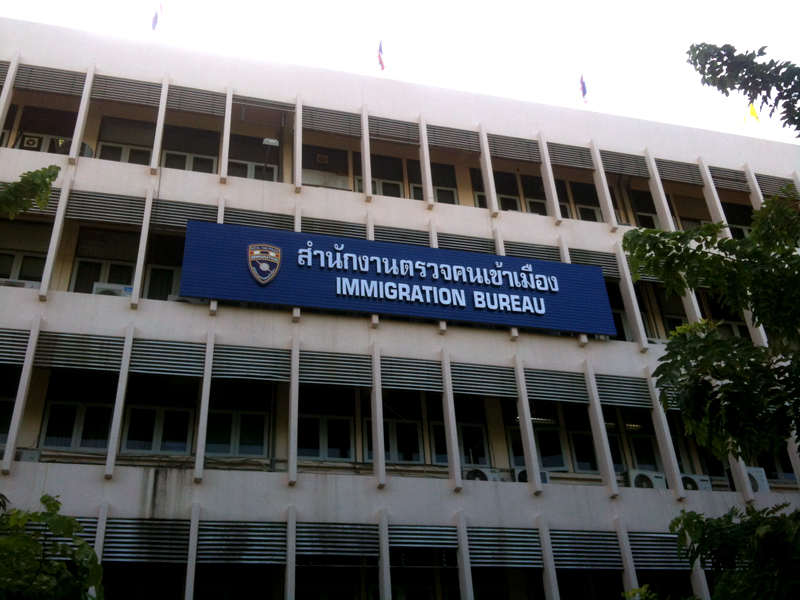
Responsible for Equality And Liberty (R.E.A.L.) has received a communication from the Pakistan Christian refugee community in Thailand that is seriously ill in the Bangkok Immigration Detention Center and who needs hospital treatment.
The individual’s name and contact information is as follows:
Full name: Noshad Young
Immigration detainee number: 8689
Immigration detention room number: 3
Our contacts in the refugee community state that Mr. Noshad Young is seeking medical treatment. They are reporting that Noshad Young is a heart patient, whose health has been deteriorating over the past month. They are reporting that he has been unable to eat for days, has blisters in his mouth, and is suffering from continuous anal discharge. His family tells the refugee community that his health is in serious jeopardy at this time, and that he is facing a life or death situation.
Our sources in the refugee community state that Mr. Young was taken into custody two and a half months ago, when he went to the immigration detention center to see his son. The reports state that he was taken into custody and his bail was canceled without notification.
Our human rights organization asks that you urgently contact the UNHCR Thailand office and the Thailand Embassy in your nation to get help for this refugee in the Immigration Detention Centre, to get him medical treatment.
We urge the international community to contact
You can reach the UNHCR Thailand office at:
United Nations High Commissioner for Refugees (UNHCR)
UNHCR Regional Representative in Thailand
3rd Floor, United Nations Building, Rajdamnern Nok Avenue, 10200 Bangkok, Thailand
Telephone: 66 2 288 1858
FAX: 66 2 280 0555
Email: thaba@unhcr.org
March 17, 2016 Genocide Declaration on ISIS and Call for Immediate Halt to Any Pakistan Christian Refugee Deportations from Thailand
On March 17, 2016, the United States of America State Department declared that persecution and violence against minority Christians by the international ISIS (aka IS, ISIL, Daesh) movement was designated as “genocide” and “crimes against humanity.”
Given the continuing threat of such genocide and crimes against humanity in the greater Middle East, including ISIS growth in the nation of Pakistan, human rights and non-governmental organizations, and friends of the United Nations and the Kingdom of Thailand, are calling for the Thailand government to immediate halt any plans for the deportation of any Pakistan Christian refugees from Thailand to Pakistan, where the forces of ISIS are increasing in number and influence.
Human rights and non-governmental organizations also call for the United Nations High Commissioner for Refugees (UNHCR) Thailand office to immediately re-assess any Refugee Status Determinations (RSD) denied to such Pakistan Christian refugees, and to immediately halt any activities leading to deportation, which could expose such refugees to the threat of growing genocide in the region. We call for the UNHCR Thailand to grant such refugee candidates new RSD hearings, while their cases are re-assessed to determine if they are in alignment with Refugee Resettlement Handbook requirements, and to assess the growing risk of denying refugees protection from those supporting genocide of such religious minorities.
The growing threat of genocide must be a matter for serious consideration by all organizations, nations, and individuals of conscience. This is further complicated by existing institutional persecution of Pakistan Christians and other religious minorities, including to the “blasphemy laws,” which has been condemned in reports by the United Nations (Report of the Special Rapporteur on the independence of judges and lawyers, Gabriela Knaul, 2012, UN Doc.A/HRC/23/43/Add.2, para 57, p. 13), and in the November 2015 report by the International Commission of Jurists (ICJ), provided to the UNHCR and the Kingdom of Thailand government. In the United Nations report, the United Nations Special Rapporteur has stated “the blasphemy laws are abused to target Christians.”
The state of persecution has allowed the growth of the ISIS terrorist movement to spread and expand, not only from its current genocide in Syria and Iraq, but also to expand with the nation of Pakistan.
On March 2, 2016, the Associated Press stated that: “Here in Karachi, Pakistan’s largest city, IS loyalists have set up their strongest presence, carrying out multiple attacks in the past year and setting up networks.” On February 10, 2016, Pakistan media The Nation reported that “Giving a briefing to the Senate Standing Committee on Interior about Intelligence Bureau’s counter-terrorism operation, the Director General of the country’s top civilian intelligence agency said Daesh is emerging threat in Pakistan as all other militant groups have soft corner for it.” On February 18, 2016, the Diplomat reported: “The Director General of Pakistan’s Intelligence Bureau (IB), in a recent testimony given before a Senate committee, admitted that the Islamic State (IS) was posing a serious threat to the security of the country.” On February 11, 2016, the Nation reported that: “Intelligence Bureau Director-General Aftab Sultan yesterday testified before a Senate committee that hundreds of fighters from Pakistan were joining” the ISIS movement. On November 10, 2014, ABC reported that “DAISH claims to have gathered 10-12 thousand followers from Hangu and Kurram Agency.”
We have already seen repeated ISIS terrorist attacks against religious minorities in Pakistan. Given the environment of persecution of religious minorities and the rise of an international movement seeking genocide against Pakistan Christians and other religious minorities, we call to conscience of the Kingdom of Thailand and the UNHCR that it would be wrong to deport such religious minority refugees back to be endangered by the growing forces of genocide.
The UNHCR must respect the challenge of genocide, in accordance with the United Nations international commitment to the Convention on the Prevention and Punishment of the Crime of Genocide, adopted by Resolution 260 (III) A of the United Nations General Assembly on 9 December 1948. We urge the UNHCR Thailand office to make decisions on Pakistan Christian and other religious minorities, not to endanger them to the ISIS and other extremist forces of genocide. With the March 17, 2016 designation of ISIS genocide of Christian minorities by the U.S. Department of State, we urge the UNHCR to re-assess refugees coming from areas where ISIS threats are growing against such refugees.
Furthermore, we note the statement, also today, March 17, 2016, by United Nations Secretary-General Ban Ki-moon: “Human rights abuses by violent extremists directly assault the UN Charter and the Universal Declaration on Human Rights.” We agree and urge that all refugees endangered by such violent extremists get equal protection, including the Pakistan Christian refugees and Pakistan religious minority refugees who have fled to Thailand.
The Kingdom of Thailand also has a history of ethical stands of conscience, in accordance with its national respect for human rights, as well as international law which it supports. Such commitment to ethical stands on human rights has included the Kingdom of Thailand signature of the 1998 Rome Statute of the International Criminal Court on October 2, 2000. It has included the Kingdom of Thailand signing the Geneva Conventions I through IV, since December 29, 1954. The Kingdom of Thailand voted to adopt the Universal Declaration of Human Rights (UDHR) on December 10, 1948, and has been a signatory to the International Covenant on Civil and Political Rights (ICCPR) since October 29, 1996.
The Kingdom of Thailand’s ethical stand against the common enemy of terrorism includes being a signatory to numerous international acts renouncing terrorism, including the: Convention Against the Taking of Hostages 1979, Convention for the Suppression of Terrorist Bombings 1997, Convention for the Suppression of the Financing of Terrorism 1999.
We call for the UNHCR Thailand office and the Kingdom of Thailand to respect the full impact of this designation of ISIS genocide and crimes against humanity for Christians and other religious minorities. We urge them do not permit the endangerment of Pakistan Christians and other religious minorities who have fled to Thailand from persecution in Pakistan, and where the ISIS forces of genocide are growing every day.
Pakistan Christian Congress, Dr. Nazir Bhatti
Responsible for Equality And Liberty (R.E.A.L.), Jeffrey Imm
British Pakistan Christian Association (BPCA), Wilson Chowdhry Ilford
On March 11, 2016, Responsible for Equality And Liberty (R.E.A.L.) founder Jeffrey Imm spoke with the UNHCR Thailand office Senior Protection Officer on the plan for 2016 UNHCR Urban Verification cards. This public statement is to provide a summary of the discussion for asylum seekers and refugees in Thailand, including Pakistan Christian asylum seekers and refugees, whose human rights have been supported by a number of organizations, including the Pakistan Christian Congress, British Pakistan Christian Association, R.E.A.L., and many others.
On February 12, 2016, R.E.A.L. and the Pakistan Christian Congress met with the Thailand Embassy in Washington DC and expressed our concern about the arbitrary arrest of Pakistan Christian asylum seekers and refugees who were waiting for refugee status determination decisions. It was expressed by the Thailand government that they understood our concerns and wanted to work to make improvements on this issue, as well as ensuring bail opportunities for any refugees arrested by immigration authorities.
R.E.A.L. learned this week that the UNHCR Thailand and the Thailand government held talks and agreed to introduce new UNHCR digitized Urban Verification cards to refugee applicants in Thailand, including Pakistan Christian refugees, as a method to more effectively identify such refugees to Thailand immigration authorities.
R.E.A.L. followed up in a telephone conversation with UNHCR Thailand on March 11, 2016 regarding the UNHCR Urban Verification cards. The purpose of R.E.A.L.’s discussion with UNHCR Thailand was to discuss the interests and concerns of refugees on the new Urban Verification cards, so that R.E.A.L. could provide a public statement to such refugees on this.
R.E.A.L. was told by the UNHCR Thailand Senior Protection Officer that the goal of these UNHCR Urban Verification cards are to provide a more consistent and reliable means for the Kingdom of Thailand immigration authorities to verify the identify of such refugee applicants, as opposed to only using the older paper-based UNHCR certificates. R.E.A.L. was told that the Thailand immigration authorities would more readily recognize the UNHCR Urban Verification cards as more genuine identification papers, which could be readily verified, along with biometric information on the card (photograph, fingerprint, iris scan).
R.E.A.L. was told the intent of such UNHCR Urban Verification cards is to ensure more verifiable and clear refugee identification documents, as an improvement over paper-based UNHCR certificates, which can get worn and faded over time, and which may not be as readily recognized. In addition, paper-based certificates could be more easily forged, whereas the UNHCR Urban Verification Card will provide a more reliable source of identification to Thailand immigration authorities.
The new digitized UNHCR Urban Verification cards will also have a Quick Response Code (QR Code), which is a form of a matrix barcode. This will allow ready identity verification using scanning by mobile devices, such a mobile phone.
R.E.A.L. communicated concerns that were heard from some refugees based on a history of fear and persecution, and concern that new identification documents could be used to aid in deportation of refugees. UNHCR Thailand assured R.E.A.L. that was not at all the intention of the Urban Verification Cards, and that these cards were simply intended to provide a modern, reliable, and most importantly, verifiable, means of identification for refugees, wherever it was needed, and especially with immigration authorities.
In addition, R.E.A.L. also wants to clarify that Urban Verification Cards are not official Thailand Government identification cards; they are UNHCR identification cards. These cards are not a work permit, a visa, and they do not change the status of refugee applicants.
The UNHCR Thailand office expressed to R.E.A.L. that the Urban Verification Cards have been successfully used by refugees in other parts of the world. In July 2015, in South Sudan, 3,400 refugees received such digitized identity cards in Western Equatoria. Since the launch of such digitized identification cards in June 2014 in Africa for Congo, Central African Republic, and Sudanese refugees, 10,000 refugees have received such digitized identity cards.
The UNHCR wanted to deploy such Urban Verification Cards for refugees in Thailand to help address security and identification needs of both the refugees and Kingdom of Thailand. The objective of the UNHCR is to more widely utilize such digitized UNHCR Verification Cards in other areas as well.
Obtaining the UNHCR Urban Verification Cards is a mandatory requirement for asylum seekers and refugees. The UNHCR will call all asylum seekers and refugees for individual appointments during the period of March 14 through May 8, 2016. It will be the responsibility of asylum seekers and refugees to come to the UNHCR Thailand office with all family members on the date/and time of the appointment to obtain such UNHCR Urban Verification Cards.
Later in March, R.E.A.L. will also have a follow-up conversation with UNHCR Thailand on human rights issues, which we briefly discussed with the UNHCR Thailand office. It is R.E.A.L.’s understanding that the UNHCR has expressed the desire to work with the Thailand Government for improvements in the circumstances and freedoms of asylum seekers and refugees. R.E.A.L.’s position will remain our core focus on the protection of refugees’ universal human rights, based on the Universal Declaration of Human Rights (UDHR). R.E.A.L. is also working to achieve follow-up discussions with the Kingdom of Thailand.
By necessity, some details on follow-up discussions will need to remain between those involved, as understandings and joint efforts for productive change mature. R.E.A.L. will certainly work to publicly share any specific commitments to change that will make a difference in the human rights and lives of refugees.
R.E.A.L. wants to thank all of those who continue to work tirelessly to improve the human rights of Pakistan Christian refugees; any progress that is achieved is thanks to the tireless efforts around the world by you.
As the eyes of the world have remained focused on global refugee problems, the plight of Pakistan Christian refugees in Thailand is ignored by most of the major news media. Pakistan Christians have fled to Thailand to escape Pakistan religious persecution, violence, attacks, threats, and spurious charges of “blasphemy” (which often results in extra-judicial attacks).
Responsible for Equality And Liberty (R.E.A.L.) has been regularly communicating with the United Nations High Commissioner for Refugees (UNHCR) Thailand Office, UNHCR HQ, Thailand government, the U.S. Embassy, U.S. Citizenship and Immigration Services (USCIS) since early 2015 on a regular basis on this issue. We have provided them with facts, figures, statistics, laws, regulations, case histories, and extensive details to justify their need for action. But too often, the needs of Pakistan Christian refugees are being ignored, and they are left in dire and desperate condition, many arrested and left in Thailand Immigration Detention Centres (IDC), while the UNHCR puts them on a waiting list to be interviewed. They desperately need help, funds, medical care, food, and support. This remains a major human rights crisis. Groups such as the Pakistan British Christian Association (PBCA) have on the ground support in Thailand to help such Pakistan Christians, and they need your help but the need is more than what NGOs alone can perform. We need real action by the UNHCR.
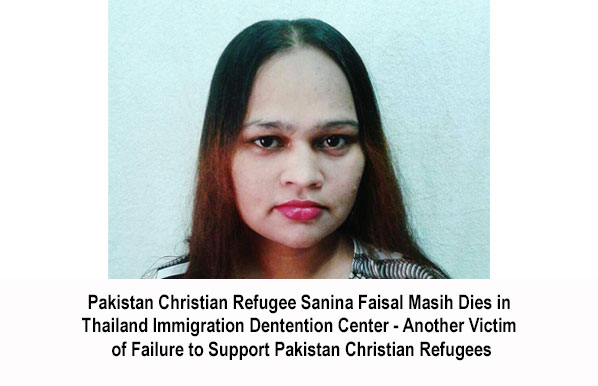
Another Pakistan Christian refugee died while waiting for action, and while languishing in the IDC jail. R.E.A.L. has received the following report on the night of December 30, 2015, from our contact in Thailand. “I want to share the sad demise of Sanina, wife of Faisal Masih; mother of two years old son, who was kept in IDC, Bangkok, Thailand. She was arrested by Thai police on December 20, 2015. No one knows the reason of her death. Her husband was told over phone by UNHCR, Bangkok, to control his emotions and get ready to hear a sad news. Earlier Sanina gave birth to a premature girl, who could not survive. Just consider, the condition of the father, who has just a two years old son, and no one around to support him at this hour of need.”
Another contact in Thailand states: “She was sick in Immigration Detention Center (IDC) on 24 December 2015. UNHCR had delayed two times her interview already. Nobody knew about her sickness except UNHCR AND IDC.”
Our contact in Thailand states: “As you remember that Immigration police raids and arrest men, women, children, young and old. They have no mercy for anyone and the conditions in Immigration Detention Centre (IDC) cannot be explained. The worse part of IDC is that there’s no proper standard of living. People live a miserable life there; they don’t get any proper food or medical help for critically sick people, nor enough space is there even to sleep. Men and women are kept separately and children have no access to their parents, no matter how old they are. They are kept in separate cells.” “There are many heart breaking stories where the family members had become critically sick and the other family members couldn’t do much to save their family members.” “UNHCR is not supporting for medical assistance. I don’t have enough words to express the miseries of Pakistani Christians facing persecution on the hands of human rights protectors UNHCR office , Thailand. There is no one to raise voice against such brutality and inhuman behavior against Pakistani Christians in Bangkok, Thailand.”
Dr. Nazir Bhatti of the Pakistan Christian Congress has stated: “The shocking news of death of Sanina Faisal Masih in Immigration Detention Center IDC Bangkok have saddened Pakistani Christians; It is time to express unity to prevent such sad incident and to resolve issues of Pakistani Christian Asylum seekers: PCC is with leaders of our community in Bangkok to respond accordingly: We are waiting for their decision in this horrifying death of Christian refugee in IDC.”
R.E.A.L. extends its sympathies to the family of Sanina Faisal Masih and shares the outrage of Pakistan Christian refugees and also those with a conscience on human rights on this matter.
R.E.A.L. stands with the Pakistan Christian refugees and their plight, and we continue to aggressively seek changes with the UNHCR, the Thailand government, and the U.S. government for their support. Most of what R.E.A.L. has written on this is private communications on individual refugee cases. But R.E.A.L. has seen a series of common trends, which need to change.
Pakistan Christian refugees to Thailand are being held to a different standard than other refugees around the world. There is too often an attempt to find a reason to deny the refugee status instead of finding a way to help such refugees. This is contrary to the rules of the UNHCR Resettlement Handbook.
Pakistan Christian refugees in Thailand face persecution by immigration detention authorities and those involved in sweeping arrests may have to wait protracted periods for a UNHCR interview. The overall UNHCR process is slow and denies all such refugees a reasonable chance at resettlement due to the extensive delays in processing.
Pakistan Christian refugees who do not speak English, and who have been targets of anti-human rights “Islamic blasphemy” charges in Pakistan are being interviewed by Pakistan Muslim UNHCR representatives who speak Urdu. Not surprisingly, such Pakistan Christian refugees are naturally intimidated and fearful to address that aspect of the details of threats against them.
R.E.A.L. has noticed cases where actual violence, murder, and injuries somehow translate into decisions where there is “not a reasonable threat of violence” to the Pakistan Christian refugee, which in contrary to logic and contrary to the UNHCR Resettlement Handbook. In the UNHCR Resettlement Handbook, Chapter 6, Resettlement Submission Categories, Section 6.3.2, page 251, the UNHCR uses the definition of violence from the World Health Organization: “Violence is the intentional use of physical force or power, threatened or actual, against oneself, another person, or against a group or community, which either results in or has a high likelihood of resulting in injury, death, psychological harm, maldevelopment, or deprivation.”
R.E.A.L. has regularly noticed cases where excessive evidentiary requirements are being asked by UNHCR Thailand of Pakistan Christian refugees, which does not confirm to UNHCR regulations. UNHCR Resettlement Handbook Paragraph 196 states: “Often, however, an applicant may not be able to support his statements by documentary or other proof, and cases in which an applicant can provide evidence of all his statements will be the exception rather than the rule. In most cases a person fleeing from persecution will have arrived with the barest necessities and very frequently even without personal documents. Thus, while the burden of proof in principle rests on the applicant, the duty to ascertain and evaluate all the relevant facts is shared between the applicant and the examiner. Indeed, in some cases, it may be for the examiner to use all the means at his disposal to produce the necessary evidence in support of the application. Even such independent research may not, however, always be successful and there may also be statements that are not susceptible of proof. In such cases, if the applicant’s account appears credible, he should, unless there are good reasons to the contrary, be given the benefit of the doubt.” UNHCR Resettlement Handbook Paragraph 197 states “The requirement of evidence should thus not be too strictly applied in view of the difficulty of proof inherent in the special situation in which an applicant for refugee status finds himself.”
R.E.A.L. has noticed many cases of Pakistan Christian refugees where the UNHCR Thailand has not exercised giving the “benefit of the doubt” on issues that one would typically give to fleeing refugees. In the UNHCR Resettlement Handbook Section B(2) “Benefit of the Doubt of this Handbook,” Paragraph 203 states: “After the applicant has made a genuine effort to substantiate his story there may still be a lack of evidence for some of his statements. As explained above (see Paragraph 196), it is hardly possible for a refugee to ‘prove’ every part of his case and, indeed, if this were a requirement the majority of refugees would not be recognized. It is therefore frequently necessary to give the applicant the benefit of the doubt.”
R.E.A.L. has noticed numerous cases of Pakistan Christian refugees where the UNHCR Thailand is not considering the conditions of the country of the refugee applicant, contrary to the UNHCR Resettlement Handbook rules. The UNHCR Resettlement Handbook Paragraph 42 specifically states that: “The competent authorities that are called upon to determine refugee status are not required to pass judgement on conditions in the applicant’s country of origin. The applicant’s statements cannot, however, be considered in the abstract, and must be viewed in the context of the relevant background situation. A knowledge of conditions in the applicant’s country of origin –while not a primary objective – is an important element in assessing the applicant’s credibility. In general, the applicant’s fear should be considered well-founded if he can establish, to a reasonable degree, that his continued stay in his country of origin has become intolerable to him for the reasons stated in the definition, or would for the same reasons be intolerable if he returned there.” In addition, the UNHCR Resettlement Handbook Paragraph 43 also specifically states: “These considerations need not necessarily be based on the applicant’s own personal experience. What, for example, happened to his friends and relatives and other members of the same racial or social group may well show that his fear that sooner or later he also will become a victim of persecution is well-founded. The laws of the country of origin, and particularly the manner in which they are applied, will be relevant.”
R.E.A.L. has direct knowledge that the UNHCR Thailand office is aware of these conditions, as R.E.A.L. has directly provided such background information to the UNHCR Thailand office. R.E.A.L. provided such information to the UNHCR Thailand office on April 13, 2015, by email, including a spreadsheet of the attacks and persecution on Pakistan Christians to that time. On April 13, 2015, R.E.A.L. also provided information from other international organizations, including a study by the U.S. Commission on International Religious Freedom (USCIRF). On October 30, 2015, R.E.A.L. provided the UNHCR Thailand office another updated study on the conditions of Pakistan Christians and religious minorities by the USCIRF from July 2015. On November 3, 2015, R.E.A.L. provided the UNHCR Thailand office another study dated October 14, 2015, from the U.S. Department of State on the conditions of Pakistan Christian minorities. On December 22, 2015, R.E.A.L. provided the UNHCR Thailand office the November 2015 issue of International Commission of Jurists (ICJ), which the UNHCR Thailand office follows on Twitter, where the ICJ issued a 60-page report entitled “On Trial: the Implementation of Pakistan’s Blasphemy Laws.” The November 2015 ICJ report states (page 7), “Individuals accused of blasphemy continue to be vulnerable even after formally coming within the ambit of the criminal justice system. In many cases, blasphemy accused awaiting trial or serving sentences following convictions have been assaulted while held in custody and authorities have failed to protect them. Some have even been killed. In a few cases, police officials themselves have reportedly been the perpetrators.”
Regarding the conditions within Pakistan for Pakistan Christians and the “blasphemy” law, R.E.A.L. provided the UNHCR Thailand office on December 22, 2015, excerpts from the November 2015 ICJ report, which refers to United Nations’ studies on this topic. It is clear that United Nations did see such a threat to Pakistan Christians with the refugees country of origin, as early as 2012. The November 2015 ICJ report states that: “The UN Special Rapporteur on the Independence of Judges and Lawyers, for example, following a mission to Pakistan in 2012, found that ‘These laws serve the vested interests of extremist religious groups and are not only contrary to the Constitution of Pakistan, but also to international human rights norms, in particular those relating to non- discrimination and freedom of expression and opinion.’ (Report of the Special Rapporteur on the independence of judges and lawyers, Gabriela Knaul, 2012, UN Doc.A/HRC/23/43/Add.2, para 57, p. 13).” On page 13 of this referenced United Nations report, it also states: “the blasphemy laws are abused to target Christians.” As the United Nations has reported in its “Report of the Special Rapporteur on the independence of judges and lawyers, Gabriela Knaul, 2012, UN Doc.A/HRC/23/43/Add.2,” informality of such “blasphemy” charges and actual details about such charges, are typically contrary to widely practiced criminal law procedures in other parts of the world. As the United Nations states in its own report on this subject: “Reports of conflicts being resolved by informal justice systems, often at the grass-root or community level are distressing. Such informal dispute settlement systems are deeply rooted in conservative interpretations of tradition and/or religion and lead to conflict resolution and punishments which are in contradiction with laws in Pakistan, fundamental rights recognized in the Constitution, and international human rights standards.” (paragraph 82, page 16). Furthermore, the United Nations also reports that “Laws that are ambiguous can be applied in an arbitrary and discriminatory manner and impede the proper administration of justice.” (paragraph 60, page 13), and indicates this human rights crisis is further exacerbated by “the poor quality of investigations carried out by police services.” (paragraph 74, page 15). In this same report, the United Nations also states that “117. Blasphemy laws, Hudood Ordinances, and anti-Ahmadi laws, as well as any other discriminatory legal provision, should be repealed and replaced with provisions in conformity with Pakistan’s Constitution and the international human rights law instruments to which Pakistan is a party.”
R.E.A.L. believes to effectively honor the loss of such Pakistan Christian refugee victims as Sanina Faisal Masih, we must also concretely and specifically challenge the institutional and systemic failure to effectively support Pakistan Christian refugees who have fled to Thailand. We urge the UNHCR Thailand office to follow the UNHCR Resettlement Handbook guidelines, spirit, and intent, and we urge the High Commissioner to see that this is happening. We urge the government of Thailand, which itself has been a target of extremist violence, to show mercy to Pakistan Christian refugees fleeing from such extremists. We urge the United States government to use it influence with the UNHCR and the Thailand government to show mercy, respect, and care for the tragic conditions of these Pakistan Christian refugees. We urge the international Christian community to find resources and priorities to significantly assist these Pakistan Christian refugees, who are currently being helped by a handful of NGOs and individuals.
R.E.A.L. is continuing our communications with the UNHCR Thailand, other UNHCR offices, and U.S. government offices on individual cases, as well as the larger human right catastrophe of how Pakistan Christians are being neglected. We welcome your support on that human rights campaign.
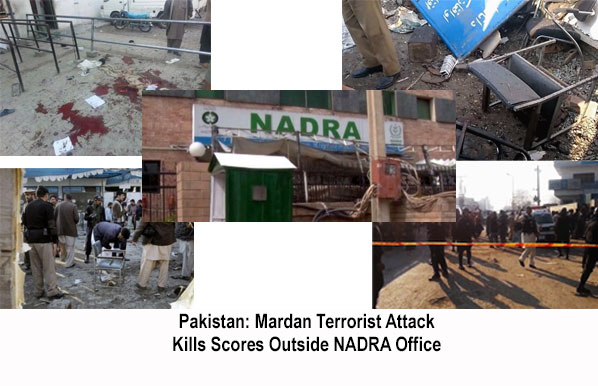
In Pakistan on December 29, 2015, a terrorist suicide bomber killed scores of people at the office of National Database and Registration Authority (NADRA) in Mardan. Media reports state that the terrorist was riding a riding an explosive-laden motorcycle, and was stopped by security when he tried to enter the courtyard area of the office area.
The terrorist detonated the bomb on the motorcycle killing one of the security guards, Parvez Shaheed, and impacting the hundreds of people standing in line outside the NADRA building. The police authorities state that the terrorist used 10 kilograms of explosive material in the terrorist bombing.
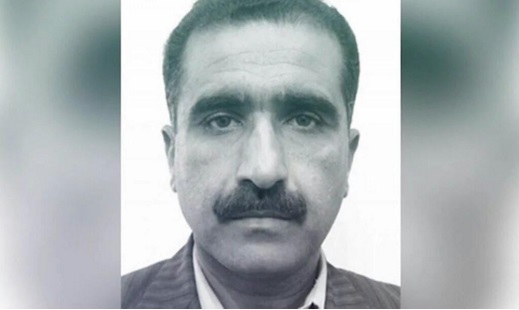
Parvez Shaheed, security guard, at NADRA stopped suicide bomber from getting closer to office, and was killed.
At the time of this posting, the Pakistan Tribune is reporting that 26 have been killed and 50 injured. The toll may increase due to the severity of the terrorist attack, with some of the injured in critical condition. The Pakistan Tribune reports that “[h]undreds of people were standing in queues to acquire Computerized National Identity Card (CNICs) and other public documents at the time of the attack.”
The terrorist attack clearly killed numerous Muslims in Muslim-majority Pakistan.
The Voice of America reports that a group formerly affiliated with the Taliban, that has now joined with the ISIS terrorist group, has assumed responsibility for the terrorist attack. The Voice of America report states: “Jamaat ul-Ahrar, which is part of the Tehreek-e-Taliban Pakistan (TTP) umbrella militant group and has reportedly joined forces with IS, has claimed responsibility for the bombing. Pakistani officials have consistently denied that IS has a presence in the country. But several recent attacks by IS-affiliates have kindled fears that the militant group has been successful in making inroads into a nation ripe for IS activities. Pakistan’s counterterrorism authorities on Tuesday told VOA that they arrested a group of 13 suspected militants operating a recruiting and training facility for IS in Punjab state.” In March 2015, reports stated that Jamaat ul-Ahar was working with people supportive of the IS group “Islamic State of Khorasan” (ISK). There has continued to be conflictswithin the Pakistan Taliban groups in a power struggle for leading terrorist hate. Another report states the VOA has been told by the Pakistan Taliban that they were not associated with the attack.
Prior to this attack, the NADRA had been in the news for a totally different reason. It has also come to R.E.A.L.’s attention that the NADRA had also verified the CNIC of Tashfeen Malik, who was one of the ISIS supporter terrorist in the December 2 terrorist attack in San Bernardino, California.
———————-
Responsible for Equality And Liberty (R.E.A.L.) stands in support of our universal human rights for all, and we stand in defiance against those, including terrorist and hate groups, which seek to attack such universal human rights, dignity, and security for all.
We cannot support human rights, if we also do not reject those who seek to rob our brothers and sisters in humanity of their lives and security, which are also our universal human rights.
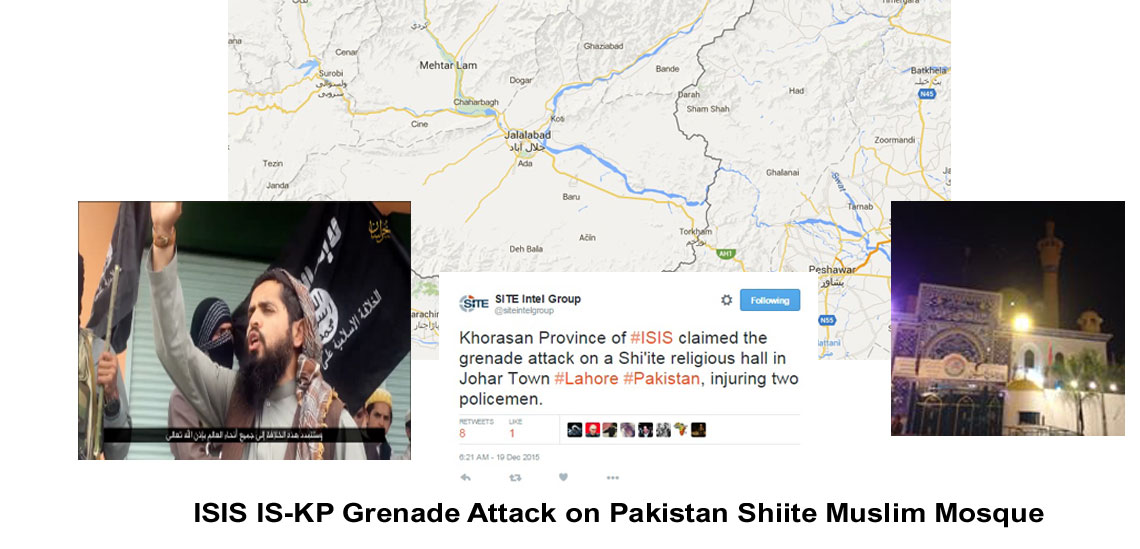
Responsible for Equality And Liberty (R.E.A.L.) has learned from news media and counterterrorist research organizations have reported a grenade attack reportedly by the ISIS so-called “Khorasan Province” (IS-KP) branch, based in the Afghanistan eastern Nangarhar province, on minority Shiite Muslims in a mosque in Johar Town, Pakistan. Two have been injured in the terrorist grenade attack.
The terrorist grenade attack on Shiite Muslims was initially described by News Tribe as an attack on “the imambargah Idara Minhaj ul Hussain” in “in Johar Town Phase 2.” The report continued to state “[a]ccording to police, unknown persons riding a motorcycle lobbed a hand grenade at the imambargah and sped away. Two people, who suffered wounds, were shifted to a nearby hospital.”
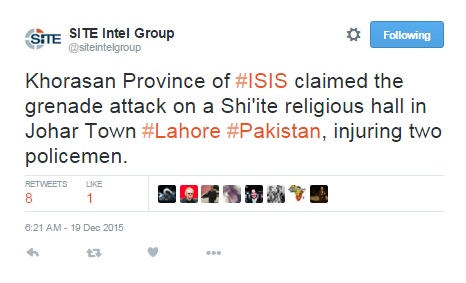
The SITE Intelligence Group reported on December 19, 2015, that the ISIS IS-KP ground claimed credit for the Pakistan terrorist grenade attack on Shiite Muslims in Pakistan. SITE reported: “Khorasan Province of #ISIS claimed the grenade attack on a Shi’ite religious hall in Johar Town #Lahore #Pakistan, injuring two policemen.”
This appears to be part of a continuing trend of terrorism in both Afghanistan and Pakistan by the ISIS so-called “Khorasan Province” (IS-KP) branch.
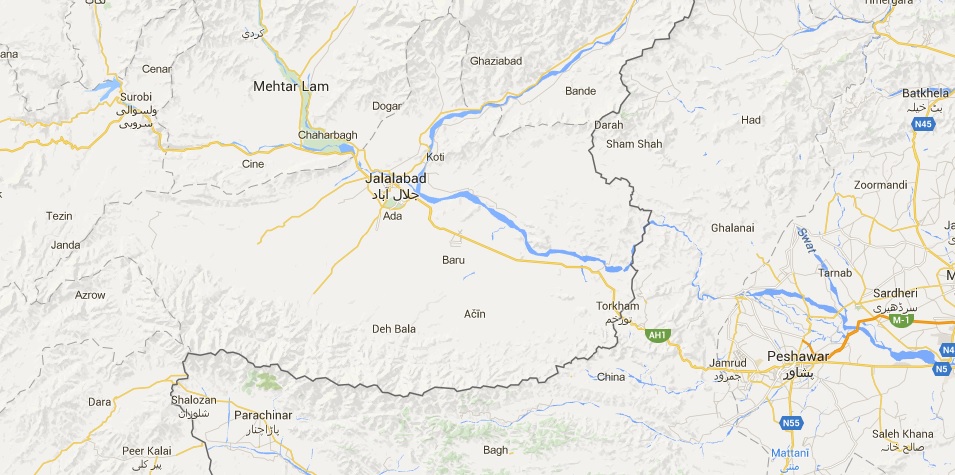
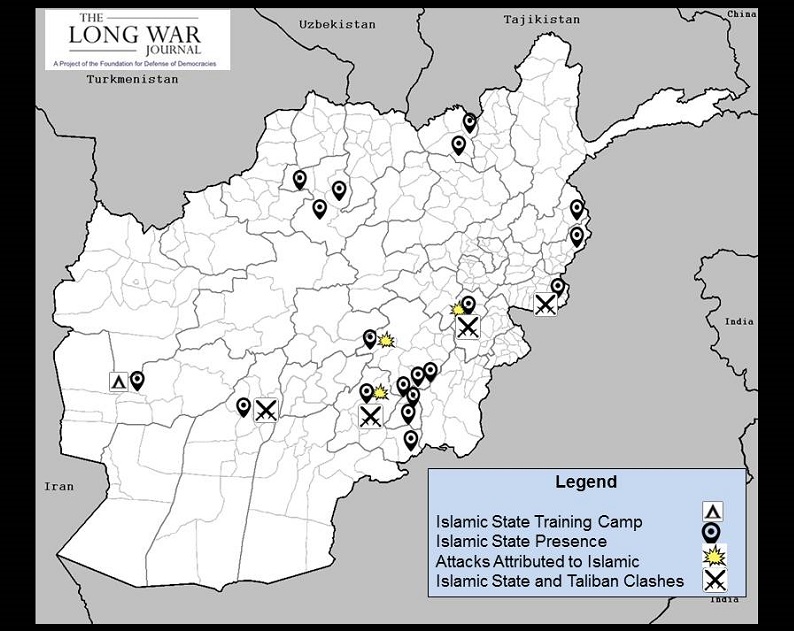
The ISIS so-called “Khorasan Province” (IS-KP) branch, based out of Afghanistan’s eastern Nangarhar province, has been expanding. In March 2015, the Long War Journal published a map of nearly 20 ISIS IS-KP branches in Afghanistan.
ISIS IS-KP – Screen shot of Video of Extremist Rally
The U.S. Department of Defense recently reported about this new ISIS so-called “Khorasan Province” (IS-KP) group gaining influence in Afghanistan, as R.E.A.L. has previously reported.
Nangarhar Province, with a capital of Jalalabad, on the eastern border of Afghanistan with Pakistan
This new report of the Johar Town attack would indicate that IS-KP is continuing to extend its terrorist activities across the border of Afghanistan into Pakistan.
On December 5, 2015, another ISIS IS-KP terrorist grenade attack was reported in Punjab. On December 5, the SITE Intelligence Group reported that this same ISIS IS-KP group claimed credit for a grenade attack on the Sargohda offices of Express News, which is in the Pakistan Punjab province.
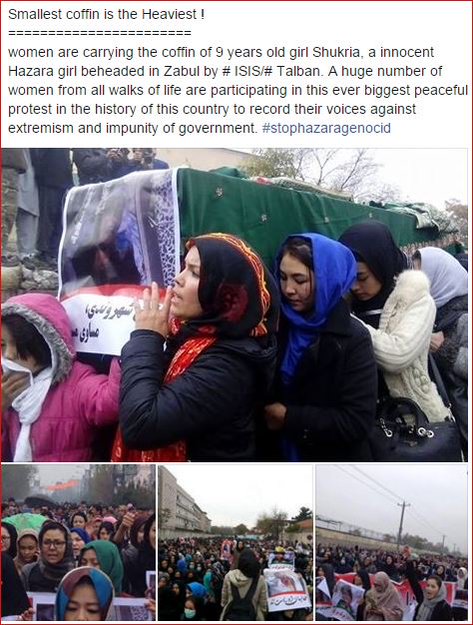
On November 7, 2015, a reported public beheading of seven Hazara ethnic Shiites in Afghanistan was reportedly attributed to ISIS. Hazara.net reported “There are seven Hazara victims —including a 13 year old boy, two women and 9 year old girl— all from the village of Damarda, Jaghori district of Ghazni province. According to interview by victim’s father (9 year old Shukria), the abductees were captive for 27 days before they were ‘beheaded’.” Some Hazara Shiites are uncertain whether the responsibility for this crime is exclusively ISIS or ISIS and Taliban.
Funeral of Hazara Ethnic Shiite Child Murdered by Terrorists
On October 9, 2015, another ISIS IS-KP terrorist attack targeted a Shiite religious hall in Kabul, Afghanistan. SITE Intelligence reported that this same IS-KP group attacked a Shiite religious hall in Kabul. The SITE Intelligence Group is providing subscription level reporting on ISIS IS-KP attacks.
In April 2015, the Associated Press reported that: “Mohammad Mohaqiq said two former Taliban leaders, who switched allegiance to the rival ISIS group, were responsible for the abduction of 31 members of the minority Shiite Hazara community on Feb. 24 in southern Zabul province.”
——————
Responsible for Equality And Liberty (R.E.A.L.) stands in support of our universal human rights for all, and we stand in defiance against those, including terrorist and hate groups, which seek to attack such universal human rights, dignity, and security for all.
We cannot support human rights, if we also do not reject those who seek to rob our brothers and sisters in humanity of their lives and security, which are also our universal human rights.
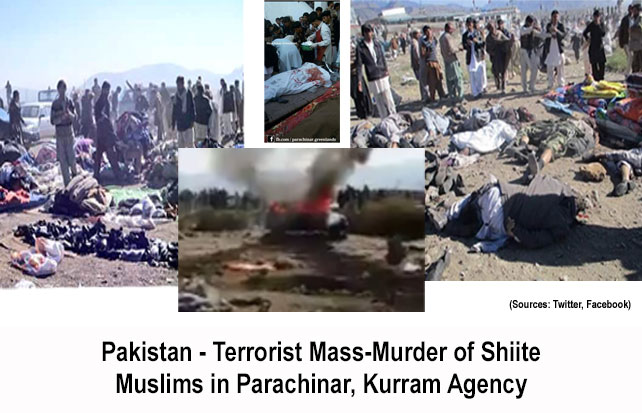
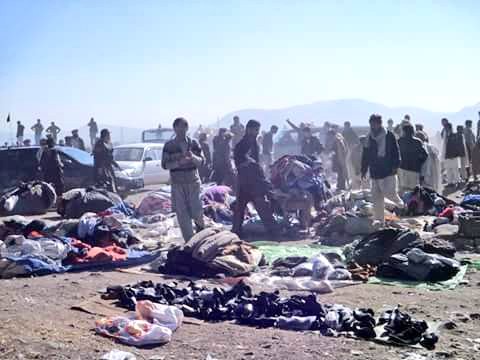
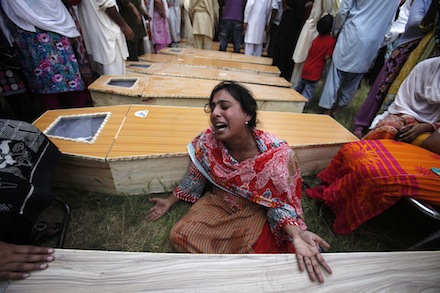
On December 13, 2015, terrorists targeted religious minority Shiite Muslims with a bomb, which has killed and wounded scores of people at the Landa Bazar in the Tal Adda area of Parachinar, in Kurram Agency, Pakistan. The Parachinar market bomb blasting was believed to be a remote controlled and detonated bomb, so that the terrorist could escape. The police and ambulances were on the scene, trying to cordon off and control the area, and a bomb squad was investigating the bombing.
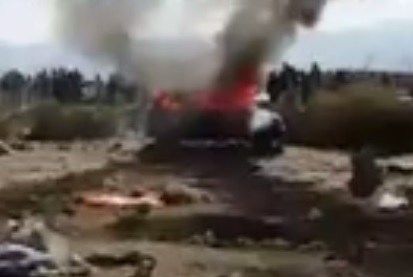
In a video posted online after the terrorist attack, smoke and flames could be seen coming out of a white vehicle, which looked some type of van or bus. Another video showed the chaos of the aftermath of the attack.
Video posted online showed flames and smoke coming out of a vehicle (Source: FB/Parachinar.Greenlands)
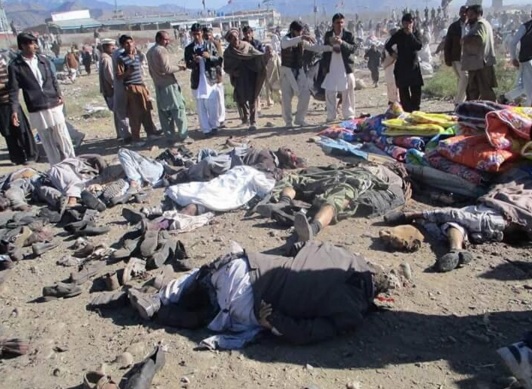
Pakistan television showed debris, clothing, and wounded throughout the market after the bombing, with the surviving market goers fleeing the area. The bodies of those killed and injured were taken to Agency Headquarters Hospital, according to reports.
Terrorist attack on Shiite Muslims at Landa Bazar in the Tal Adda area of Parachinar, in Kurram Agency, Pakistan (Source: Twitter)
The market is predominantly Shiite, and so the victims are overwhelming Shiite Muslims. At 1 PM local time, Waqt News and The Nation News reported that there were 23 dead and 60 injured. That death toll was expected to rise, as at least 10 of the injured were critically injured.
Terrorist attack on Shiite Muslims at Landa Bazar in the Tal Adda area of Parachinar, in Kurram Agency, Pakistan (Source: Twitter)
On Twitter, people in the area shared their knowledge of the attack.
One stated: “There was no security in market of #Parachinar at the time of blast. Political Administration need to change! ” Another referred to the terrorist attack as “Car Bomb explosion Hits #Shiite majority area #Parachinar #Pakistan.
23 martyred. Over 50 wounded. #ShiaGenocide. ”
While at the moment of this posting, no specific terrorist group has claimed this attack, Responsible for Equality And Liberty (R.E.A.L.) urges the Pakistan people and people of the world to remember this is the price of the world’s continuing silence and weakness in challenging the ideologies of extremism that believe such attacks on religious minority Shiites are sickeningly “justified.”
Responsible for Equality And Liberty (R.E.A.L.) urges the Pakistan people and people of all faiths and identity groups to recognize that such religious persecution of minorities and associated violence of terrorist affects all people. It is also another reminder of how such extremist terrorists, who claim to be acting on their view of “Islam,” attack and murder other Muslims, and we have seen again and again, in Pakistan and around the world.
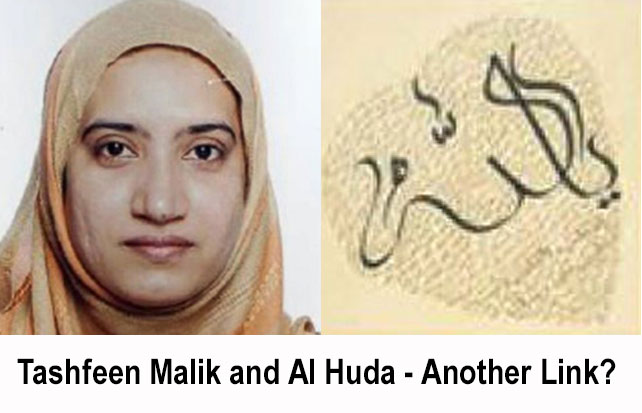
Dawn/AFP Report: California shooter studied at Al-Huda institute: teacher MULTAN: The woman who, with her husband, shot dead 14 people in California last week attended one of the most high-profile religious teaching centres for women in Pakistan, a teacher at the Al-Huda institute told AFP Monday.
Tashfeen Malik, 29, studied at the Al-Huda Institute in Multan, which admits middle-class women and also has offices in the US, the UAE, India and the UK, the teacher at the teaching centre who gave her name only as Muqadas said.
“It was a two-year course, but she did not finish it,” the teacher Muqadas said. “She was a good girl. I don’t know why she left and what happened to her.”
The teacher did not say when Malik studied at the Al-Huda institute, but fellow classmates at the Bahauddin Zakariya University said she had attended the institute after classes at the university, which she attended from 2007-2013.
Farhat Hashmi’s organisation, Al-Huda institute, has no known extremist links, though it has come under fire in the past from critics who say its ideology is extremist in nature.
Malik and her husband Syed Farook, 28, went on a killing spree at a social services centre in San Bernardino. Investigators suspect that Malik, who went to the United States (US) on a fiancee’s visa and spent extended periods of time in both Pakistan and Saudi Arabia, may have radicalised her husband.
The probe is trying to establish if she had contact with radicals in either country.
An administration official at the academy in Multan said he could neither confirm nor deny that Malik had studied there, and said he would discuss the issue with management.
“But we have nothing to do with it (the shooting) and are not responsible for our students’ personal acts,” he added.
One of Malik’s former classmates at the Bahauddin Zakariya University in Multan, where she studied pharmacology, told AFP she had attended the institute after classes, saying she “drastically changed” during her time there.
“Gradually she became more serious and strict,” said the student, requesting anonymity.
A second university student who also requested anonymity confirmed the account.
Pakistan has pledged to crack down on religious seminaries suspected of being breeding grounds for intolerance or even fostering extremism, with the country’s information minister Pervez Rashid terming them “universities of illiteracy and ignorance”. However the government’s efforts to rein in madrassas have prompted anger from many clerics.
Update – December 7, 2015: DAWN news reports that terrorist Tashfeen Malik was also linked to Al-Huda, stating: “The woman who, with her husband, shot dead 14 people in California last week attended one of the most high-profile religious teaching centres for women in Pakistan, a teacher at the Al-Huda institute told AFP Monday. Tashfeen Malik, 29, studied at the Al-Huda Institute in Multan, which admits middle-class women and also has offices in the US, the UAE, India and the UK, the teacher at the teaching centre who gave her name only as Muqadas said.”
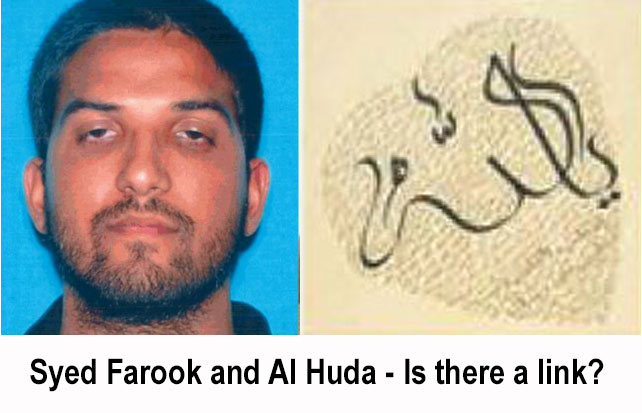
Regarding the December 2, 2015 the San Bernardino, California attacks, the primary suspects were named as Syed Farook, 28, and Tashfeen Malik, 27, who were killed in a shootout hours after an attack at the Inland Regional Center in San Bernardino, which led to 14 killed and 17 wounded. Syed Farook’s brother-in-law, Farhan Khan spoke at a press conference held by the Council on American-Islamic Relations (CAIR) late Friday night, where he stated “I just cannot express how sad I am for what happened today.” NBC News interviewed San Bernardino Police Chief Jarrod Burguan, and reported that he said “a motive in the shooting has not been determined.” Syed Farook has been reported as a U.S. citizen, and reports have stated his parents were immigrants from Pakistan.
On a follow-up report, the UK Telegraph news media reports on that “[i]n 2006, Rafia Farook, who records indicate is Farook’s mother, filed in a Riverside court for divorce from her husband, also named Syed Farook.”
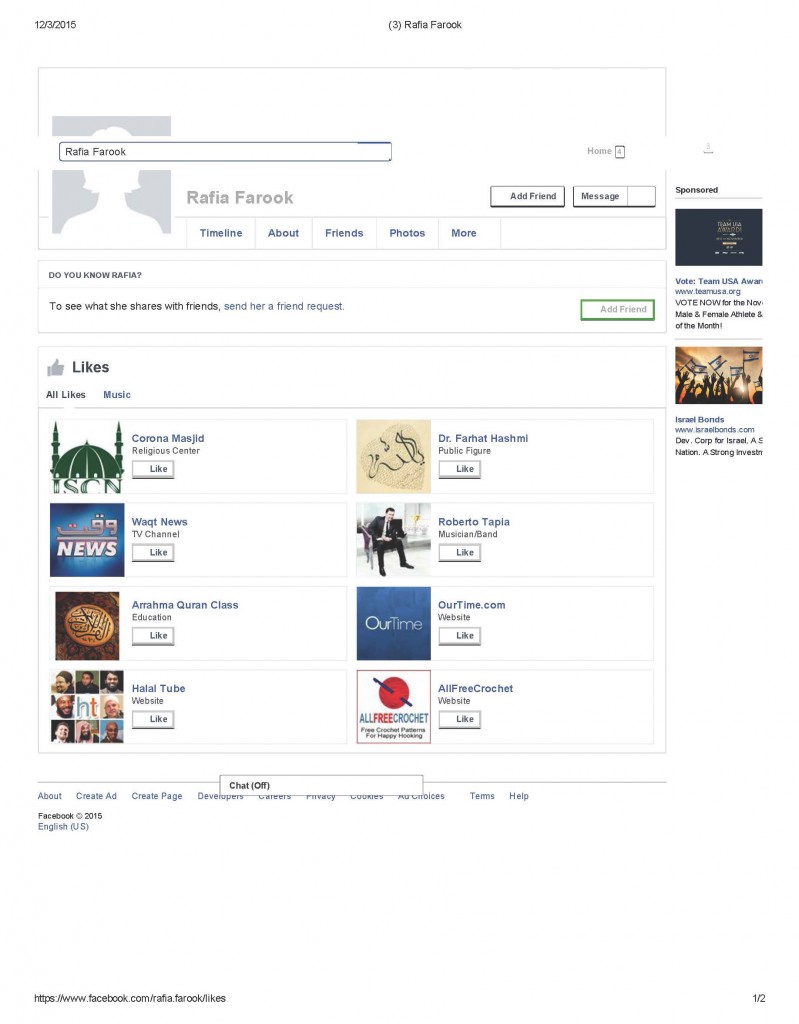
Al Huda Logo on Facebook, liked by relative of terror suspect (Source: Facebook)
On Facebook, a Rafia Farook was listed (now offline) who was related to, had the same friends and relatives, and attended the same local mosque as San Bernardino reported terror gunman Syed Farook. Rafia Farook’s Facebook friends also included Syed Farook’s brother-in-law Farhan Khan, who spoke at the CAIR December 2 late night press conference after the San Bernardino attack. Their Facebook sites and most of their friends have been taken offline. However, before that happened, we learned that this same Rafia Farook liked the “Dr. Farhat Hashmi” Facebook site which promoted her teachings of the Al Huda Institute.
This is significant because of the frequently controversial positions of Dr. Farhat Hasmi and her Al Huda International Welfare Foundation (“Al Huda”), which have been the source of news reports by the National Public Radio, Pakistan news media, and Canadian news media.
On April 7, 2010, the National Public Radio (NPR)’s Asma Khalid provided a news report on Dr. Farhat Hashmi and her religious schools of Al Huda International Welfare Foundation (“Al Huda”) in Pakistan, entitled “Religious Schools Court Wealthy Women In Pakistan.” In the report, Asma Khalid wrote that “[i]n Pakistan, wealthy women have been returning to Islam and finding comfort in Al Huda, a new network of religious schools. The students insist the faith they are studying is peaceful and tolerant. But critics hear echoes of Taliban ideology in what the schools preach.”
Faiza Mushtaq was interviewed by Asma Khalid for her review of the “Al Huda” phenomenon, which she was writing about for a paper at Northwestern University stating: “These women come to Al Huda, spend a year or two years getting a diploma. And then these women go back to their hometowns or to their own neighborhoods, use the same sort of education materials, the course plans, Farhat Hashmi’s lecture tapes, and start offering a diploma course of their own.”
Asma Khalid reported that there were 200 branches of the “Al Huda” school, and stated at one such school “Here, like all of the Al Huda branches, the focus is the Quran. Students learn line-by-line translations and analysis. They learn about the importance of mercy and forgiveness -nothing political and nothing violent. It’s a stark contrast from the extremist rhetoric taught in some schools.” Asma Khalid continued that the Al Huda movement was a social movement ” a movement in the sense that it goes beyond individual transformation, ultimately has a vision of what it wants a Pakistani society to look like.”
Asma Khalid stated that “That scares some people in Pakistan, like Nadeem Paracha. He’s a columnist for the popular English-language newspaper Dawn. He says Farhat Hashmi may use gentle words but deep down, she’s an extremist. Her orthodoxy echoes the Taliban’s vision for Pakistan.”
Al Huda leader Dr. Farhat Hashmi provides her own web site of lectures and commentary. Dr. Farhat Hashmi was listed by the The Royal Islamic Strategic Studies Center of Jordan as one of the “World’s 500 most Influential Muslims in 2012.”
In the NPR report by Asma Khalid, Dawn Newspaper columnist Mr. Nadeem Parcha told Ms. Khalid that regarding the Al Huda movement that “I don’t care about if they call themselves soft Muslims or whatever. They are playing an equally destructive role. If the Taliban are playing a destructive role in a political manner, then these preachers are playing a very destructive role in a culturally and social manner.” NPR’s Asma Khalid concluded that Dr. Farhat Hashmi “insists that she preaches tolerance, not tyranny. But not everyone believes her. Hashmi’s classes exist in a climate of religious anxiety here in Pakistan. It’s a place where suicide bombers are ripping through markets in the name of Islam. And it’s a place where born-again, bourgeois Muslims are muddling the very idea of what it means to be a modern woman.”
Wikipedia reports that Dr. Farhat Hashmi “was formerly a lecturer and assistant professor at the Faculty of Usul-al-Din at International Islamic University, Islamabad.” In the report, it also quotes a report from the Pakistan Daily Times which stated “During a sermon when asked by a woman what a wife should do if her husband was unwilling to help her destitute parents, Hashmi promptly quoted An-Nisa, 34 (Chapter Al Nisa, verse 34) of the Quran, arguing that the wife should comply with her husband’s wishes, ‘no matter what, as he was her divinely appointed imam.'”
Four months after the NPR report on Al Huda, on August 19, 2010, Muslim Link Paper wrote a rebuttal to the NPR article, stating : “Area Muslim women responded to recent allegations that a famous female Islamic lecturer was promoting extremism, calling the media reports baseless. Dr. Farhat Hashmi’s Al-Huda International Welfare Foundation, an Islamic, educational institute that gives to the needy and also provides Islamic learning to women of all ages around the world through online lectures, was accused of promoting an ‘orthodoxy’ that ‘echoes the Taliban’s vision for Pakistan’ in an April 5, 2010 National Public Radio (NPR) segment. ‘I don’t see how those allegations could fit’, said Samiyah Mustafa from Rockville, 18, in an interview with the Muslim Link. She took an Al-Huda International Foundation course in January 2009 and finished it one month ago… The ‘sorority of Al-Huda’, as one sister in Saudi Arabia puts it, were dismayed to hear the institute being accused of breeding terrorism. ”
The Muslim Link article also drew some angry responses from commenters who stated they were Muslim women, who disagreed with and objected to Dr. Farhat Hashmi’s Al Huda campaign.
Tehmina Murtaza commented: “Farhat Hashmi has turned religion into a business. Women need to get educated and contribute towards science and math and business etc and not just dedicate their lives to propagating the ulhuda\’s version of religion. It is possible to be both a good Muslim and contribute to society. ”
Seema Kurd commented: “She should put more emphasis on teaching men how to respect women. This way misery in many muslim countries for women will end. Many muslim countries treat women like trash. There are forced marriages, honor killings, female children are being killed before they are born. Why can’t Ms, Hashmi see that. Thousands and thousands of women are being slaughtered every day in so call muslim countries. She should promote education for women and help poor women by giving them sholarships. A burka, veil, hijab, or abaya does not protect women. We should strongly teach young boys to respect females from an early age, so they should not look at other women as sex objects. I totally dislike her teachings. We all should be taught arabic in schools so we are able to read and understand Quran. No one can tell fellow muslims what the Quran says, s/he should be able to read and understand it. We women should not regards men as Gods. In Islam men and women are equal, and they should work together to bring up a family and respect each others friends, relatives, and parents.” (Quoted without editorial changes.)
In 2003, the Pakistan Daily Times also reported a letter from a Yasser Latif Hamdani who was concerned about broadcasts of Dr. Farhat Hashmi’s lectures in India: “To the horror of every right thinking Pakistani, ARY has started broadcasting the self-styled Islamic scholar Dr Farhat Hashmi’s lectures. Not only is she misleading the young women of Pakistan by preaching a puritan and narrow interpretation of Islam, her lectures are now being aired directly into India where Pakistan is already seen as a close-minded extremist nation. Dr Farhat Hashmi’s interpretation of Islam is very retrogressive, which is in stark contrast to the dynamic nature of the Islamic faith. For example, the topic of discussion at one of her recent lectures aired by ARY was ‘The status of laughing in Islam’. She all but declared laughing to be completely haraam and a major sin. According to her, the time spent laughing and being happy, would be better spent remembering Allah. Is Islam really as stifling as Dr Hashmi makes it out to be? Dr Farhat Hashmi and others like her represent a disturbing trend and may have an adverse impact on the women’s movement in Pakistan. Women in Pakistan have always stood up for their rights despite all odds, and fought off the bigotry of fanatical religious leaders. Now they are being betrayed by one of their own kind, who has capitulated and joined the ranks of those who wish to uphold the conservative and stifling set-up of a patriarchal society.”
The Pakistan Friday Times has provided a report by the Director at the South Asia Free Media Association, Khaled Ahmed, titled “A decade of millennial change,” where he expressed concern about growing extremism in Pakistan. Khaled Ahmed wrote: “The tragedy of 9/11 was reinterpreted and even rich women of Pakistan following the Al Huda movement of Farhat Hashmi heard from her that Osama was a ‘soldier of Islam’ and took it to heart. There was some English-Urdu divide but no one was willing to own the part Pakistan had played in providing Al Qaeda its launching pad of global terrorism in Pakistan.”
Khaled Ahmed has also made this same claim in the Pakistan Tribune: “India’s Zakir Naik and Pakistan’s lady proselytiser Farhat Hashmi, have called Osama bin Laden a soldier of Islam.” (I have found no confirmation for such a statement written in English from Farhat Hashmi.)
Khaled Ahmed, wrote in an article for the Pakistan Tribune, the “Daughters of Al Huda,” that “[w]e are wrong to look for terrorist tracts in the madrassa. The suicide bomber is not made through syllabi but through isolation from society. When we wish to produce a normal citizen we begin by socialising the child. Anyone withdrawing from society by rejecting its norms is ripe for the plucking by the terrorists. The residential madrassa does that. In Islamabad, a number of female ‘dars’ groups are busy doing that in varying degrees.” “Al Huda ladies wear hijab and abaya and are found in the big cities. They are usually well-heeled, using the group-isolating dars activity to reinvent personal identity through ‘discovery’ of Islam. Al Huda was founded in 1994 by Farhat Hashmi and husband Idrees Zubair, both PhDs from Scotland’s famous centre of Islamic learning, the University of Glasgow. Farhat, from Sargodha, where her parents were both members of Islami Jamiat Tulaba, is steeped in the ‘dars’ of the Jamaat-e-Islami and Maulana Maududi’s thought.”
Khaled Ahmed referenced a book by Ms. Sadaf Ahmad, an assistant professor at the Lahore University of Management Sciences (LUMS) in Lahore, entitled, Transforming Faith: The story of Al Huda and Islamic Revivalism among Urban Pakistani Women (Syracuse University Press 2009), which studies the Al-Huda movement. The book describes its focus as “In Transforming Faith, Sadaf Ahmad deftly explores how Al-Huda is fostering a new generation of educated, urban, middle-class women to become veiled conservatives. She offers an engrossing and sensitive account of how the school’s aggressive recruiting methods through informal religious study groups and a one-year degree program combined with the school’s techniques of persuasive teaching methods have turned Al-Huda into a social movement.”
Khaled Ahmed reported from this book that “Al Huda ladies began to alarm with their rejection of society. Some orthodox Muslims began to ask questions. The author found Al Huda graduates to be ‘very intolerant and judgmental toward people who were different from them’ (p 193). Mr. Ahmed also reported “The Canadians are probably worried because Farhat thinks Osama bin Laden is an Islamic warrior.” In his review of Ms. Sadaf Ahmad’s book on Al Huda, he stated that the “author opines: ‘They react strongly to her statements, such as her claim that the 80,000 Pakistanis who died in the 2005 earthquake did so because they were involved in immoral activities and had left the path of Islam, and fear that her brand of extremist Islam will further marginalise their Muslim communities within the country’ (p 196).”
In 2005, the Pakistan Daily Times also reported: “Farhat Hashmi, the controversial Pakistani Islamic fundamentalist, says those who died in the October 8 Pakistan earthquake were punished by God for their ‘immoral activities’.”
Farhat Hashmi began her Western operations in 2004, with a sponsorship in Canada, out of Toronto. In 2005, the Pakistan Daily Times reported that: “A Pakistani who sees Dr Hashmi’s arrival in Canada as ‘bad news’ for the community, told Daily Times that she has been in the country now for close to a year and in 2004, she and her husband ran Quran ‘courses’ in a mosque run by the Islamic Circle of North America (ISNA), a nationwide conservative group with close ties to the Jamaat-i-Islami in Pakistan and similar ideologically motivated groups elsewhere.”
In June 2006, after twelve Pakistanis and Bangladeshis were arrested in a significant terrorist bomb plot in Canada, the Pakistan Daily Times reported with concern about the growth of Dr. Farhat Hashmi’s schools in the West, in this case in Canada. The Pakistan Daily Times stated: “Pakistan needs to worry too because of the image its Islamists are giving it. Pakistan’s ‘rich man’s preacher” Farhat Hashmi, after making a lot of money off the penitent upper crust, has landed in Canada and bought property for her big Islamic institution. The school is the latest extension of Al-Huda International which Dr Hashmi founded in Pakistan in 1994 after graduating with a PhD in Islamic studies from the University of Glasgow. The school now counts more than 10,000 graduates and she has offered lectures to women in Dubai and London. She has moved to Toronto with her husband and family ‘in response to demand from young women in the city to gain a deeper understanding of Islam’. For a nominal fee of $60 a month, students attend classes four days a week for five hours a day. The moderate Muslims of Canada call her Wahhabi because of her unbending doctrines. ‘Hardline’ political Islam has been leveraged in Canada with Saudi-Wahhabi funds. A 2004 study found that millions of dollars were funnelled to extremist Islamic institutions. It said Saudi Arabia spent hundreds of millions of dollars to fund 210 Islamic centres and 1,359 mosques around the world, including in Canada. It cited an official Saudi report in 2002 that stated ‘King Fahd donated $5 million for the cost of an Islamic Centre in Toronto, Canada, in addition to $1.5 million annually to run the facility.’ The Saudi factor has since faded away but the ‘zone of contact’ of Pakistanis with their Arab brethren remains the mosque, facilitated by the English language, not available as effectively in the Arab world where a large number of expatriate Pakistanis live.”
In 2006, the Pakistan Daily Times also reported that “Farhat Hashmi, founder of the ultra-conservative Al-Huda centres, who moved to Canada nearly two years ago with her family has been told by Canadian immigration officials to leave the country but so far has failed to do so.” The Pakistan Daily Times reported that “Hashmi is operating classes attended by upscale, generally idle and mostly affluent Pakistani women and impressionable teenagers. Her reactionary teachings, which many see as bordering on retrogressive interpretations of Islam, have set a challenge to liberal sections in the Muslim Canadian community in Toronto, which is already trying to cope with increasing difficulties triggered by the recent arrest of 17 youngsters, almost all Pakistanis, on terrorism charges.”
No additional information has been available on her immigration issues with Canada, although it appears she is still living in Canada. She was to work for Islamic Society of North America Canada (ISNA Canada), but reportedly ISNA could not afford her salary.
A report in January 2011 by the Toronto Star stated that an audit of ISNA Canada identified mismanagement of $600,000 in donations, and indicated that funds designated for the poor were not reaching them. The Toronto Star reported: “Devout Muslims donated hundreds of thousands of dollars to one of Canada’s largest Islamic organizations on the promise that the cash would be used to help the poor. But only one in four dollars donated to a special pool of money at the Islamic Society of North America Canada (ISNA Canada) actually reached the needy.” The Toronto Star reported: “The organization had a world-renowned Islamic scholar on its payroll, despite her not actually working for ISNA, in a bid to help her immigrate to Canada, the audit revealed. Farhat Hashmi had been invited to come from Pakistan to deliver lectures several times throughout the mid-2000s. ‘This is a serious violation of the (Canadian Revenue Agency) rules and immigration rules to hire someone just in the books to help get through immigration,’ the auditor’s report said.”
But there has been no impact on Al Huda’s operations or growth in Canada, Pakistan, or the west.
The Pakistan Daily Times has remained concerned about the influence of Al Huda, however, and reported that: the “wave of fundamentalist thinking among largely middle class Canadian Muslims has received a fillip from Al-Huda founder Dr Farhat Hashmi who recently immigrated to Toronto. According to Farzana Hassan, a Toronto-based freelance writer, ‘As if the conservative push to uphold faith-based arbitration in Ontario was not enough of a blow to progress in Canada, another version of Muslim fundamentalism has recently begun to consolidate its foothold on Canadian soil, particularly in the greater Toronto area. Although Dr Farhat Hashmi is a well-known theologian with a doctorate from the University of Glasgow, she epitomises hard-core, doctrinaire orthodoxy – a worldview which appears to be gaining strength as a result of ambitious funding from certain quasi-governmental organisations in Saudi Arabia and Yemen.'”
The Pakistan Daily Times report also quotes comments from Farzana Hassan, “[a]ccording to Ms Hassan, writing in the California-based outlet, Islam Today, Dr. Hashmi has come to wield “tremendous influence on the hearts, minds and souls of South Asian Muslim women, some of whom come from avowedly secular backgrounds.” The newest Canadian venture of Dr. Hashmi’s Al-Huda foundation involves the launch of a one-year diploma programme, aimed at producing female Muslim role models as ‘paragons of virtue and piety in every respect.’ Ms Hassan argues that this translates into ‘utter subservience, bigotry and ignorance,’ as those ‘trapped within such a programmed and brainwashed mentality refuse to recognise oppression to begin with, and if perchance they do, they justify it, citing examples of ‘inherent’ gender differences and ‘male superiority.'”
Raheel Raza, writing in American Thinker on November 8, 2008, stated that “In Mississauga, Ontario, a woman by the name of Farhat Hashmi runs an Islamic school for girls. Hashmi wears a full niqab (face covering) and encourages young girls to emulate her. She is known for promoting a very conservative Islamic ideology that is based on Wahhabism. She, like other Islamists is in favor of Sharia in Canada.”
Another Pakistan commenter criticizes the “anti-Shia poetry published by Dr Farhat Hashmi Salafi on her Facebook page has been written by notorious pro-Taliban hate cleric Taqi Usmani Deobandi in order to malign sacred Muharram rituals of Shia and Sunni Muslims.”
=================
As Responsible for Equality And Liberty (R.E.A.L.) noted at the beginning of this posting, the San Bernardino police are still investigating the cause of what appears to us to be a wanton terrorist attack on helpless and innocent people. As others have said, in the view of the human loss, any rationale for such a tragedy seems less consequential. However, as R.E.A.L. would do with any known and/or suspected extremist attack, we believe it is the obligation of those committed to standards of human equality, human rights, and human dignity to identify and challenge extremist views from any source: by gender, by race, by nationality, by identity group, by religion, when the safety and security of our human rights, and our most precious human right of life, is threatened.
We urge the supporters of Al Huda to accept the Universal Declaration of Human Rights (UDHR) without qualification and exception, and to speak out on the attack in San Bernardino, and if they reject extremist views to make such rejection publicly very clear. There are clearly many concerns, much of which come from other Muslims, other Muslim women, people of Pakistani origin, and others, too many to simply ignore.
United States Department of State’s International Religious Freedom Report for 2014 regarding Pakistan, and the ongoing persecution of Pakistan Christians and other Pakistan religious minorities.
This report is publicly available to the world at: