Daily Telegraph reports:
Sonya Battla, the first designer to show, presented a collection that she said celebrated strong women. She dismissed the fact that in more conservative parts of the country, her designs might get women driven out of town or stoned to death.
“I’m a very brave woman,” said the 38-year-old designer. “I’m not going to be scared and no one’s going to judge me.”
Taliban militants have killed more than 300 in the past month in a bloody campaign of bombings and assassinations. Attacks on markets, universities, the army general headquarters in Rawalpindi and police stations in Lahore show the Taliban can reach seemingly ever corner of the country.
But the fashion world was determined to stage its shows.
“Life has to go on,” said Samar Mehdi, 35, another young designer who studied fashion at Bristol University. “And this is a way to tell the people want our lives to stop that ‘No, we won’t let you.'”
The shows were held at the Marriott Hotel in Pakistan’s financial capital under strict security. The event – originally scheduled for October – planned to introduce designers and models from abroad, but the fragile security situation has left organisers counting on local talent.
A model presents a creation by Pakistani designer Aiesha Varsey during the Pakistan Fashion Week in Karachi on November 4, 2009. Pakistan's fashion week began on November 4 with an opulent opening ceremony, against a backdrop of militant violence and secu Photo: AFP
— “LAHORE: Rejecting any changes to the Namoos-e-Risalat Act — or the blasphemy law — religious parties have warned the government that they will not accept any move to repeal or amend the law.”
— “The Jamaat Ahl-e-Hadith Pakistan and the Tehreek Tahafuz-e-Haqooq Ahl-e-Sunnat — which hold more sway in Lahore, Multan and southern Punjab compared to other areas of the province — organised religious conventions on Saturday to ‘condemn’ suggestions by the government to amend the act.”
— “Addressing one of the conventions, Jamaat Ahl-e-Hadith Pakistan chief Hafiz Abdul Guffar Ropari and leaders Hafiz Abdul Wahab Ropari and Maulana Muhammad Abdullah refused to accept any changes to the law. They said the government must not amend the law ‘if it wants to remain in power.’ They said those who believed in Islam would come out onto the streets if a single change was made. The Tehreek Tahafuz-e-Haqooq Ahl-e-Sunnat also organised a conference, and central party leaders — including Haji Abdul Majeed Saifi, Mufti Muhammad Asif Naumani, Mufti Muhammad Afzal Chishti and Mian Ghulam Shabbir Qadri — censured the government the government for sending the Blasphemy Act to a National Assembly standing committee for revision.”
— “Washington, D.C. (November 3, 2009)–International Christian Concern (ICC) has learned that on October 31, two prominent Islamic political parties warned the government of Pakistan not to amend or repeal the blasphemy law. The law has been a major cause of violence against Christians.”
— “According to The Daily Times, Jamaat Ahl-e-Hadith Pakistan and the Tehreek Tahafuz-e-Haqooq Ahl-e-Sunnat, mainstream political parties with large supporters, threatened to call for protests if the law is altered. The Daily Times quoted Hafiz Abdul Guffar Ropari, the leader of Jamaat Ahl-e-Hadith Pakistan, as saying that the government of Pakistan must not amend the law ‘if it wants to remain in power.’ ”
— “Pakistan’s blasphemy stipulates that defaming the Islamic prophet Mohammed or desecrating the Qur’an is punishable by death and life imprisonment respectively.”
— “Muslims have used the law to repeatedly incite violence against Christians. In August, a Muslim mob killed 11 Christians and burned down over 40 Christian homes following false allegation of desecration of the Qur’an in the Pakistani city of Gojra.”
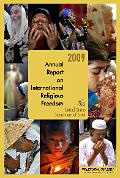
— “Muslims also have been the victims of the blasphemy law. According to the State Department’s report on International Religious Freedom, in 2008 alone, 17 Muslims and 25 Ahmedis were arrested for allegedly violating the blasphemy law.”
— “ICC’s Regional Manager for Africa and South Asia, Jonathan Racho said ‘It’s unfortunate that political parties stand in the way of repealing the blasphemy law which has been misused against Christians, Muslims, and Ahmedis. We urge the government of Pakistan to end the misuse of blasphemy laws by repealing it once and for all.’ “
A Brampton woman who claims she’ll be a victim of an honour killing if deported to Pakistan will open the door for other women to seek refuge if she’s allowed to stay here, her lawyer says.
Roohi Tabassum, 44, claims she will be killed by her ex-husband because she left him and came to Canada and works as a hairsytlist touching men’s hair. He is also outraged that she may have a boyfriend, which she denies.
“This is a landmark case and a lot of people are awaiting the outcome,” her Toronto lawyer Max Berger said recently.
“There are many cases of domestic abuse being heard by the immigration and refugee board.”
Berger said there other people in similar situations who may file refugee claims.
He appeared before a Federal Court of Canada judge last Wednesday seeking a judicial review to kill the deportation order issued against Tabassum. The judge will issue a written decision in weeks.
“Honour killings are well known in Pakistan,” Berger said.
Citing U.S. statistics, Berger told an immigration board that as many as 1,500 women were killed in 2007 in honour killings in Pakistan.
Tabassum was smuggled into Canada from the U.S. in 2001 and filed a failed refugee claim. She faces deportation to the U.S., then to Pakistan.
She has said she faced criticism for going public with her plight. She has also received much support.
NDP MP Irene Mathyssen this month called on immigration minister Jason Kenney to keep Tabassum in Canada.
“I am saddened that this woman’s life remains in limbo and that the minister seems uninterested in protecting her,” she said on her website.
Tabassum’s cousin was the victim of an honour killing after she refused an arranged wedding to an older man.
Officials of the Canada Border Services Agency said Tabassum has had her hearings and must leave Canada.
The 2009 report by the World Economic Forum has listed predominantly Islamic nations in the bottom of their 2009 annual Global Gender Gap (GGG) Index. This included such major nations as Pakistan (ranked 132 out of 134), Saudi Arabia (ranked 130 out of 134), Iran (ranked 128 out of 134), Egypt (ranked 126 out of 134), and Turkey (ranked 129 out 134). Yemen, which is 99 percent Islamic, was the bottom ranked nation as 134 on the Global Gender Gap Index. The only nation not predominantly Islamic in the bottom of the Global Gender Gap index was Benin.
(NOTE: In “Updated Later Reports” below, R.E.A.L. has provided links to reports in later years for comparison purposes by other researchers.)
In addition, the 2009 World Economic Forum Global Gender Gap Index report does not include rankings on a number of significant and predominantly Islamic nations where women are oppressed. Somalia (population of nearly 10 million) was not included in the index. Endless numbers of reports of the stonings and extremist abusesof womenhave been reported in Somalia in the past year, including the stoning to death of a 13 year old girl based on “Sharia law” in October 2008. Sudan (population of nearly 41 million) was also not included in the World Economic Forum Global Gender Gap Index. Among other nations, Afghanistan (29 million) and Iraq (29 million) are also not included in this Global Gender Gap Index. With the index not reporting on these 109 million, the desperate fate of an estimated 50 plus million women are not included in this Global Gender Gap index report.
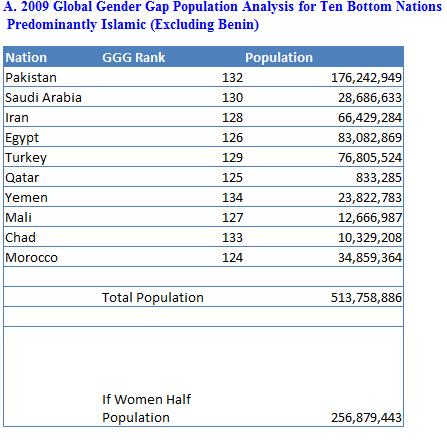
Even with these significant exclusions from the Global Gender Gap index report, the bottom 10 index nations (excluding Benin), which are all predominantly Islamic nations, represent a population of over half a billion individuals. These include Yemen (134 out of 134), Chad (133), Pakistan (132), Saudi Arabia (130), Turkey (129), Iran (128), Mali (127), Egypt (126), Qatar (125), Morocco (124). If women represent half of the population in these nations, then these bottom 10 predominantly Islamic nations demonstrate the ongoing oppression of an estimated 250 million women.
In March 2009, IPS interviewed WEF’s Global Gender Gap (GGG) co-author Saadia Zahidi about the findings of these gender gap reports. In the IPS interview, the reporter asked Saadia Zahidi why wealthy nations such as Saudi Arabia and other Gulf states were not among the nations at the higher end of the gender gap index, quoting a previous GGG report that stated “rich countries have more education and health opportunities for all members of society.” In the IPS interview, Saadia Zahidi replied: “We don’t have an explanation for this. Some people, when they look at how we have broken this up, say it is so because of Islam. But I am not sure we can say that. With the lowest scores we see different countries with different incomes, religions and cultures. In the middle of the list, you have Indonesia (93), which is doing much better than Saudi Arabia (128), for example.”
In the March 2009 interview, Saadia Zahidi was referencing the 2008 report standings, as in 2009, Saudi Arabia is now ranked at 130 out of 134; Indonesia remains ranked at 93 out of 134, which WEF’s Saadia Zahidi views as the “middle of the list.”
The Global Gender Gap report makes no reference as to how the impact of extremist behavior and ideologies regarding women and equality in such nations have any role in such gender gaps.
The June 2009 U.S. State Department report on global human trafficking also shows a number of the nations in the bottom of the Global Gender Gap (GGG) index as nations with the worst records on human trafficking as well. (Note – a number of poorly ranked nations on human trafficking, such as Sudan, Afghanistan, Iraq, are simply not referenced in the GGG index.) The State Department report states that “According to the ILO, the majority of people trafficked for sexual exploitation or subjected to forced labor are female.”
Tier 3 Nations on Human Trafficking also in the bottom of the Global Gender Gap Index include:
– Saudi Arabia — GGG rank 130 out of 134
– Iran — GGG rank 128 out of 134
– Syria — GGG rank 121 out of 134
– Malaysia — GGG rank 101 out of 134
– Mauritania — GGG rank 119 out of 134
Tier 2 Watch List Nations on Human Trafficking also in the bottom of the Global Gender Gap Index include:
– Pakistan — GGG rank 132 out of 134
– Algeria — GGG rank 117 out of 134
– Yemen — GGG rank 134 out of 134
– United Arab Emirates — GGG rank 112 out of 134
– Egypt — GGG rank 126 out of 134
Tier 2 Nations on Human Trafficking also in the bottom of the Global Gender Gap Index include:
– Jordan — GGG rank 115 out of 134
– Turkey — GGG rank 129 out of 134
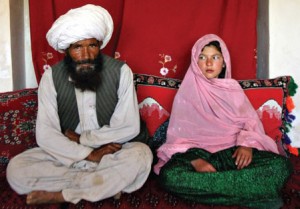
Image from State Dept 2009 Human Trafficking Report, section “Gender Imbalance in Human Trafficking”
Press Coverage on Global Gender Gap Report:
The Associated Press has reported on this survey that: “At the bottom of the list were Qatar, Egypt, Mali, Iran, Turkey, Saudi Arabia, Benin, Pakistan, Chad and Yemen in last place with a score of 46.1 per cent.” The AP report also quoted the World Economic Forum’s founder and executive chairman, Klaus Schwab, who stated: “Girls and women make up one half of the world’s population, and without their engagement, empowerment and contribution, we cannot hope to achieve a rapid economic recovery nor effectively tackle global challenges such as climate change, food security and conflict.”
— Links to Key Gender Gap Country Profiles and Highlights
— 1. Gender Gap 2009 Report on Pakistan – Ranked 132 out of 134 Countries
— Pakistan – Islamic Republic, 96 percent Islamic
— Pakistan Population Estimate: 176,242,949
— 2. Gender Gap 2009 Report on Saudi Arabia – Ranked 130 out of 134 Countries
— Saudi Arabia – Islamic Absolute Monarchy, 97 percent Islamic
— Saudi Arabia Population Estimate: 28,686,633
— 3. Gender Gap 2009 Report on Iran – Ranked 128 out of 134 Countries
— Iran – Islamic Republic, 98 percent Islamic
— Iran Population Estimate: 66,429,284
— 4. Gender Gap 2009 Report on Egypt – Ranked 126 out of 134 Countries
— Egypt – 80 to 90 percent Islamic
— Egypt Population Estimate: 83,082,869
— 5. Gender Gap 2009 Report on Turkey – Ranked 129 out of 134 Countries
— Turkey – “the CIA World factbook states that 99.8% of Turkey’s population are nominally Muslims”
— Turkey Population Estimate: 76,805,524
— 6. Gender Gap 2009 Report on Qatar – Ranked 125 out of 134 Countries
— Qatar – 77 percent Islamic
— Qatar Population Estimate: 833,285
— 7. Gender Gap 2009 Report on Yemen – Ranked 134 out of 134 Countries
— Yemen – 99 percent Islamic
— Yemen Population Estimate: 23,822,783
— 8. Gender Gap 2009 Report on Mali – Ranked 127 out of 134 Countries
— Mali – 90 percent Islamic
— Mali Population Estimate: 12,666,987
— 9. Gender Gap 2009 Report on Chad – Ranked 133 out of 134 Countries
— Chad – 54 percent Islamic
— Chad Population Estimate: 10,329,208
— 10. Gender Gap 2009 Report on Morocco – Ranked 124 out of 134 Countries
— Morocco – 98.7 percent Islamic
— Morocco Population Estimate: 34,859,364
— 11. Gender Gap 2009 Report on Benin – Ranked 131 out of 134 Countries
— Benin – Predominantly Christian, 24 percent Islamic
— Benin Population Estimate: 8,791,832
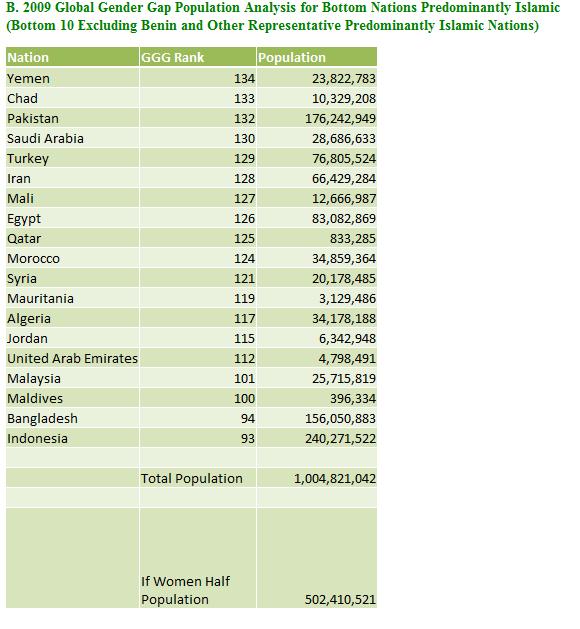
— Other Nations of Concern that are predominantly Islamic: — Syria – ranked 121 — population 20,178,485
— Mauritania – ranked 119 – population 3,129,486
— Algeria – ranked 117 — population 34,178,188
— Jordan – ranked 115 — population 6,342,948
— United Arab Emirates – ranked 112 – population 4,798,491
— Malaysia – ranked 101 — population 25,715,819
— Maldives – ranked 100 — population 396,334
— Bangladesh – ranked 94 — population 156,050,883
— Indonesia – ranked 93 — population 240,271,522
VOA Report: US Religious Freedom Report Hits Speech Curbs
— VOA reports: “The U.S. State Department’s annual report on world-wide religious freedom, released Monday, was critical of what it says are international efforts to limit free speech in the name of combating defamation of religion. The Organization of the Islamic Conference, or OIC, has been pushing such anti-defamation measures in U.N. bodies.”
— “The State Department report says the United States deplores actions that show disrespect for religious traditions, including Islam.”
— “But it says the broad anti-defamation measures being sought by the Islamic Conference would have the effect of curbing debate about religious issues and should be discarded in favor of outreach and government defense of religious freedom and free speech.”
— “The comments were the most prominent to date by the United States on efforts led by the OIC to get anti-defamation resolutions approved in the U.N. General Assembly and the U.N. Human Rights Commission.”
— Report Executive Summary Excerpts:
— “Multilateral, Global, and Regional Challenges to Religious Freedom”
— “In addition to these country-by-country concerns, the wide spectrum of efforts to undermine the right to religious freedom extends to multilateral, regional, and global fora. For instance, over the past decade, the Organization of the Islamic Conference (OIC), an inter-governmental organization comprising 57 states with majority or significant Muslim populations, has worked through the United Nations (UN) to advance the concept of ‘defamation of religions’ by introducing annual resolutions on this subject at the UN Human Rights Council and UN General Assembly. While the United States deplores actions that exhibit disrespect for particular religious traditions, including Islam, we do not agree with the “defamation of religions” concept because it is inconsistent with the freedoms of religion and expression.”
— “The United States understands the primary concern of the resolution to be the negative stereotyping of members of religious groups, particularly minority groups, and the contribution of such stereotypes to disrespect and discrimination. The United States shares concerns about the impact of negative stereotypes and believes that such stereotyping, particularly when promoted by community, religious, or government leaders, contributes to disrespect, discrimination, and in some cases, to violence. The United States, however, believes the best way for governments to address these issues is to develop robust legal regimes to address acts of discrimination and bias-inspired crime; to condemn hateful ideology and proactively reach out to all religious communities, especially minority groups; and to defend vigorously the rights of individuals to practice their religion freely and to exercise their freedom of expression.”
— “The forcible return of individuals from another country to face persecution or abuse in their home country in retribution for their religious activism is also of grave concern to the United States. During the reporting period, the Government of China reportedly sought the forcible return of several Muslims living in other countries, including Syria; during previous periods it had done so with Muslims living in Saudi Arabia and Pakistan. Some had reportedly protested restrictions on the Hajj and encouraged other Muslims to pray and fast during Ramadan. There were credible reports that the Government of China tortured and, in some cases, executed individuals who had been forcibly returned, including some who advocated for religious freedom. Similarly, the Government of Uzbekistan continued to pursue the extradition of suspected Uzbek religious extremists from third countries, particularly from Kyrgyzstan, Russia, and Ukraine, including those who had sought asylum. During the reporting period, at least two individuals seeking political asylum in Kyrgyzstan were forcibly extradited to Uzbekistan and imprisoned on religious extremism charges.”
Afghanistan
— “The Constitution states that Islam is the ‘religion of the state’ and that ‘no law can be contrary to the beliefs and provisions of the sacred religion of Islam.” In 2004, the Constitution accorded Shi’a and Sunni Islam equal recognition. It proclaims that “followers of other religions are free to exercise their faith and perform their religious rites within the limits of the provisions of law.” The Government took limited steps to increase religious freedom; however, serious problems remained. In April 2009 President Karzai signed a controversial law limiting the rights of women from the Shi’a minority. International partners of Afghanistan objected strongly to the law. The President agreed to suspend enactment of the law until the Ministry of Justice had reviewed and amended it. The review process was ongoing at the end of the reporting period. Although the Government and political leaders aspire to a national environment that respects the right to religious freedom, the residual effects of years of jihad against the former Soviet Union, Taliban rule, civil strife, popular suspicion regarding outside influence of foreigners, and still weak democratic institutions hindered the realization of this aspiration. Intolerance was manifested in harassment and occasional violence against religious minorities and Muslims perceived as not respecting Islamic strictures. Within the Muslim population, relations among the different sects continued to be difficult. Non-Muslim minority groups, including Christians, Hindus, and Sikhs, continued to face incidents of discrimination and persecution. Many citizens understand conversion as contravening the tenets of Islam and Shari’a, and most local Christians do not publicly state their beliefs or gather openly to worship.”
Egypt
— “The Constitution provides for freedom of belief and the practice of religious rites, although the Government places restrictions on these rights in practice. Islam is the official state religion, and the principles of Shari’a (Islamic law) are the primary source for legislation. The status of respect for religious freedom by the Government declined somewhat during the reporting period, based on the failure to investigate and prosecute perpetrators of increased incidents of sectarian violence. There were some positive developments, however, including actions by the courts and the Ministry of Interior that opened the door for the possibility that all of the country’s Baha’is would eventually be issued national identification documents that contain a dash or the term “other” in the religious affiliation field. The Government continued to sponsor “reconciliation sessions” following sectarian attacks, which generally precluded the prosecution of perpetrators of crimes against Copts and prevented their recourse to the judicial system for restitution. This practice contributed to a climate of impunity that encouraged repetition of the assaults. Members of non-Muslim religious minorities officially recognized by the Government generally worshipped without harassment. Christians, however, and members of the Baha’i Faith–which is not recognized by the Government–face personal and collective discrimination in many areas. The Government detained members of Islamic religious minority groups, including Quranists and Shi’a, and detained and harassed some converts from Islam to Christianity and pressured them to revert to Islam. One Christian convert told U.S. officials that government authorities had raped her. A court sentenced a Coptic priest to five years of hard labor for officiating at a wedding between a Copt and a convert from Islam who allegedly presented false identification documentation. There continued to be religious discrimination and sectarian tension in society during the period covered by this report, and Egypt’s quasi-governmental National Council on Human Rights expressed concern in its fifth report, released in May 2009, over growing sectarian tension, including the burning of an unlicensed Coptic Church and of homes belonging to Baha’is.”
Indonesia
— “The Constitution provides for freedom of religion, and the Government generally respected religious freedom in practice; however, ongoing government restrictions, particularly among unrecognized religions and sects of the recognized religions considered ‘deviant,’ were significant exceptions. In some cases, however, the Government tolerated discrimination against and the abuse of religious minorities by societal groups and private actors. Some groups used violence and intimidation to close at least nine churches and 12 Ahmadiyya mosques, and many perpetrators were not brought to justice. Even though the central Government holds authority over religious matters, it did not try to overturn any local laws that restricted rights guaranteed in the Constitution. Members of minority religious groups continued to experience some official discrimination in the form of administrative difficulties, often in the context of civil registration of marriages and births or the issuance of identity cards.”
Iran
— “The Constitution provides that ‘other Islamic denominations are to be accorded full respect’ and recognizes the country’s pre-Islamic religious groups–Zoroastrians, Christians, and Jews–as ‘protected’ religious minorities. Article 4 of the Constitution states that all laws and regulations must be based on Islamic criteria. Despite constitutional guarantees, in practice those who are not Shi’a Muslims faced substantial discrimination. Respect for religious freedom in the country continued to deteriorate. Government rhetoric and actions created a threatening atmosphere for nearly all non-Shi’a religious groups, most notably for Baha’is, as well as for Sufi Muslims, evangelical Christians, and members of the Jewish community. Reports of government imprisonment, harassment, intimidation, and discrimination based on religious beliefs continued during the reporting period. Baha’i religious groups reported arbitrary arrest and prolonged detention, expulsion from universities, and confiscation of property. Government-controlled broadcast and print media intensified negative campaigns against religious minorities, particularly Baha’is, during the reporting period. President Mahmoud Ahmadinejad continued a virulent anti-Semitic campaign, questioning the existence and scope of the Holocaust. Sufis faced an increasing repression campaign including arbitrary arrest and detention, confiscation of property, and defamatory attacks in newspapers and in sermons by Shi’a clerics. The Government vigilantly enforced its prohibition on proselytizing by some Christian groups by closely monitoring their activities, closing some churches, and arresting Christian converts. Laws based on religious affiliation continued to be used to stifle freedom of expression, including through imprisonment of public figures.”
Iraq
— “The Constitution guarantees freedom of thought, conscience, and religious belief and practice for Muslims and non-Muslims alike. The Government generally endorsed these rights, but violence by terrorists, extremists, and criminal gangs restricted the free exercise of religion and posed a significant threat to the country’s vulnerable religious minorities. Radical Islamic elements from outside the Government exerted pressure on individuals and groups to conform to extremist interpretations of Islam’s precepts; sectarian violence, including attacks on clergy and places of worship, hampered the ability to practice religion freely. The Government’s growing will and capacity to challenge its militant opponents resulted in a decrease in the overall level of violence and the Government became increasingly successful in restoring security, in a generally nonsectarian manner, throughout the country. Since 2003 the Government has generally not engaged in the persecution of any religious group, calling instead for tolerance and acceptance of all religious minorities. The overall magnitude of sectarian violence declined during the reporting period, but numerous incidents occurred. The general lawlessness that permitted criminal gangs, terrorists, and insurgents to victimize citizens with impunity affected persons of all ethnicities and religious groups, and the mass-casualty attacks primarily targeted the majority Shi’a population. Very few of the perpetrators of violence committed against Christians and other religious minorities in the country have been punished; arrests following a murder or other crime are rare.”
Malaysia
— “The Constitution of Malaysia provides for religious freedom; however, other constitutional provisions designate Islam as “the religion of the Federation,” define all ethnic Malays as Muslim, give the Government authority to regulate Islamic religious affairs, and prohibit the propagation of other faiths among Muslims. In general, there were few reports of societal abuses or discrimination based on religious affiliation, belief, or practice. Malaysia maintains a dual legal system with both secular and Shari’a courts, the latter of which have jurisdiction over the Muslim population in certain civil matters. Shari’a courts generally prohibited those officially registered as Muslims from legally converting to another faith. Those who attempted conversion were deemed “apostates” and sometimes sent to religious “rehabilitation” centers, where they received coerced religious instruction. The Government maintained a list of 56 “deviant” Islamic sects, and members of these and other banned groups may also be subject to “rehabilitation.” Officials at the state level sometimes interfered with mosque activity by using mosques to convey political messages, preventing certain imams from speaking, and overseeing the content of sermons. Religious minorities remained generally free to practice their beliefs. Nevertheless, over the past several years, many have expressed concern that the civil court system has gradually ceded jurisdiction to Shari’a courts, particularly in areas of family law involving disputes between Muslims and non-Muslims. Religious minorities continued to face alleged violations of property rights and limitations on religious expression. The Hindu community continued to express concern about the demolition of Hindu temples.”
Nigeria
— “The Constitution provides for freedom of religion, including freedom to change one’s religion or belief and freedom to manifest and propagate one’s religion or belief through worship, teaching, practice, and observance. The Constitution prohibits state and local governments from adopting a state religion or giving preferential treatment to any religious or ethnic community, but the Constitution also provides that states may establish courts based on common law or customary law systems. Twelve northern states use Shari’a courts to adjudicate criminal and civil matters for Muslims and common law and customary law courts to adjudicate cases involving non-Muslims. The Government generally respected religious freedom in practice, although local political actors stoked sectarian violence with impunity, occasionally using religion as a catalyst. Violence, tension, and hostility between Christian and Muslim communities increased, as political and socioeconomic conflicts often divided persons along religious lines and were expressed in the targeting of religious symbols and spaces. Sectarian violence, exacerbated by indigene/settler laws, discriminatory employment practices, livelihood differences, and resource competition, was particularly acute in the Middle Belt and served to heighten tensions between religious groups, even in parts of the country that did not experience the violence. Religious differences often paralleled and exacerbated differences between ethnic groups. While the law prohibited religious discrimination in employment and other practices, some private businesses continued to discriminate on the basis of religion or ethnicity in their hiring practices. In many communities, Muslims or Christians who converted to another religion reportedly faced ostracism by members of their former religion.”
Pakistan
— “The country is an Islamic republic; Islam is the state religion, and the Constitution requires that laws be consistent with Islamic principles. Despite some positive steps to improve the treatment of religious minorities during the reporting period, discussed in Part III, serious problems remained. Law enforcement personnel abused religious minorities in custody. Security forces and other government agencies did not adequately prevent or address societal abuse against minorities. Discriminatory legislation and the Government’s failure to take action against societal forces hostile to those who practice a different religious belief fostered religious intolerance, acts of violence, and intimidation against religious minorities. Specific laws that discriminate against religious minorities include anti-Ahmadi and blasphemy laws that provide the death penalty for defiling Islam or its prophets. The Ahmadiyya community continued to face governmental and societal discrimination and legal bars to the practice of its religious beliefs. Members of minority Islamic sects also claimed governmental discrimination. Freedom of speech is subject to “reasonable” restrictions in the interests of the “glory of Islam.” Relations among religious communities were tense. Societal discrimination against religious minorities was widespread, and societal violence against such groups occurred. Non-governmental actors, including terrorist and extremist groups and individuals, targeted religious congregations. A domestic insurgency led by Sunni Taliban elements increased acts of violence and intimidation against religious minorities and exacerbated existing sectarian tensions. Imposition of extremist religious views on the majority Muslims loomed large as a threat throughout the reporting period due to the increased activity of an extremist insurgency, particularly in the Swat Valley. In various incidents, Muslims with liberal views, particularly women, were asked to follow a strict version of Islam and were threatened with dire consequences if they did not abide by it.”
Saudi Arabia
— “Freedom of religion is neither recognized nor protected under Saudi law and it is severely restricted in practice. The Government confirmed that, as a matter of policy, it guarantees and protects the right to private worship for all, including non-Muslims who gather in homes for religious services. This right was not always respected in practice and is not defined in law. The King’s official title is “Custodian of the Two Holy Mosques,” reflecting the importance the royal family attaches to upholding Islam within the country as a central pillar of its legitimacy, both domestically and within the global Muslim community. The deep connection between the Al-Saud family and the religious establishment results in significant pressure on the state and society to adhere to the official Saudi interpretation of Islam and conservative societal norms. Some Muslims who do not adhere to this interpretation faced significant political, economic, legal, social, and religious discrimination, including limited employment and educational opportunities, underrepresentation in official institutions, and restrictions on the practice of their faith and on the building of places of worship and community centers. The largest group affected was the Shi’a. Moreover, the public practice of non-Muslim religions is prohibited, and the Commission for the Promotion of Virtue and Prevention of Vice (CPVPV) continued to conduct raids on private non-Muslim religious gatherings. Although the Government also confirmed its stated policy to protect the right to possess and use personal religious materials, it did not provide for this right in law or practice. There were fewer charges of harassment and abuse at the hands of the CPVPV than in previous years, but incidents of CPVPV excesses continued to cause many non-Muslims to worship in secret, for fear of the police and CPVPV. Saudi textbooks continued to contain overtly intolerant statements against Jews and Christians and subtly intolerant statements against Shi’a and other religious groups, notwithstanding Government efforts to review educational materials to remove or revise such statements.”
Somalia
— “Although the Transitional Federal Charter provides for religious freedom, there were limits on the extent to which this right was respected in practice. The Charter establishes Islam as the national religion, and proselytizing for any religion other than Islam is strictly prohibited. Moreover, statutes and regulations provide no effective recourse for violations of religious freedom. The independent regions of Somaliland and Puntland establish Islam as the official religion. On May 10, 2009, the Transitional Federal Government (TFG) ratified legislation to implement Shari’a law nationwide. In practice, the TFG does not have the capacity or mechanisms to implement the legislation uniformly. The TFG generally did not enforce legal protections of religious freedom. There was a decline in the status of respect for religious freedom during the reporting period, primarily as a result of extremist militias taking control over significant territory in the country. Militia groups, particularly those associated with the U.S.-designated Foreign Terrorist Organization al-Shabaab, often imposed through violence a strict interpretation of Islam on communities under their control. In religiously motivated violence, al-Shabaab destroyed the tombs of revered Sufi clerics and killed clerics, civilians, and government officials of Sufi orientation. In targeted assassinations, members of these extremist groups killed TFG officials and allies they denounced as non-Muslims or apostates. There were also reports that individuals who do not practice Islam experienced discrimination, violence, and detention because of their religious beliefs. There were no public places of worship for non-Muslims in the country. A political process to establish peace and stability in the country continued.”
Sudan
— “The Interim National Constitution (INC) provided for freedom of religion throughout the country; however, the INC enshrined Shari’a as a source of legislation in the north, and the official laws and policies of the Government of National Unity (GNU) favor Islam in the north. The Constitution of Southern Sudan provides for freedom of religion in the south, and other laws and policies of the Government of South Sudan contributed to the generally free practice of religion in the 10 states of the south. Although the GNU generally did not vigorously enforce its strictest restrictions on religious freedom, it generally did not respect religious plurality and continued to place some restrictions on Christians in the north. Even so, unlike in prior reporting periods, Christian churches in the north reported that they held regular religious services and large holiday celebrations without government interference. There were some reports of societal abuses and discrimination based on religious affiliation, belief, or practice, and religious prejudices remained prevalent throughout the country.”
— Executive Summary on China
— “The Constitution protects only “normal religious activities,” and officials have wide latitude to interpret the meaning of ‘normal.’ Citizens do not have the ability to bring legal action based on the Constitution’s guarantees of religious freedom. The Government officially restricts legal religious practice to the five (Buddhist, Taoist, Muslim, Catholic, and Protestant) state-sanctioned “patriotic religious associations.” The treatment of religious groups varied significantly among different religions and different locations. During the reporting period, officials continued to scrutinize and in some cases interfere with the activities of religious and spiritual groups. In some areas government officials violated the rights of members of unregistered Protestant and Catholic groups, Uighur Muslims, Tibetan Buddhists, and members of groups the Government determined to be “evil religions,” especially the Falun Gong. The Government strongly opposed the profession of loyalty to religious leadership outside the country, most notably the Pope and the Dalai Lama. Government officials asked some unregistered Protestant house churches in Beijing to stop meeting during the 2008 Olympic Games.
— China – Tibetan Autonomous Region and Xinjiang Uighur Autonomous Region
The Government’s repression of religious freedom remained severe in Tibetan areas and in the Xinjiang Uighur Autonomous Region (XUAR). Religious adherents in the XUAR, the Tibetan Autonomous Region (TAR), and other Tibetan areas suffered severe restrictions on religious activity, as a consequence of the Government’s tendency to conflate concerns about separatism and religious extremism with peaceful expressions of religious beliefs and political views. In the XUAR, the Government’s concerns also included terrorism. After the March 2008 protests in the TAR and other Tibetan regions, the Government harshly criticized the Dalai Lama and accused him of instigating the protests. Ethnic Tibetans and Uighurs had difficulty obtaining passports from the Government, limiting their ability to travel abroad for religious purposes. Tibetan Buddhist monks and nuns also reported that they were frequently denied registration at hotels, particularly during sensitive times, including the period around the Beijing Olympics.
Communist North Korea
— “Although the Constitution provides for “freedom of religious belief,” genuine religious freedom does not exist, and there was no change in the extremely poor level of respect for religious freedom during the reporting period. The Government severely restricted religious freedom, including organized religious activity, except that which was supervised tightly by officially recognized groups linked to the Government. Some foreigners who have visited the country stated that services at state-authorized churches appeared staged and contained political content supportive of the regime. The 2008 Korean Institute for National Unification White Paper indicated that the regime used authorized religious entities for external propaganda and political purposes, and that citizens were strictly barred from entering places of worship. Defectors reported the regime increased its investigation, repression, and persecution of unauthorized religious groups in recent years. Despite these restrictions, reports indicated contacts with religious personnel both inside the country and across the border in China appeared to be increasing. In June 2009 South Korean activists reported that Ri Hyon Ok was publicly executed for distributing Bibles in the city of Ryongchon near the Chinese border. She was allegedly accused of spying and organizing dissidents. These claims could not be independently verified. An estimated 150,000 to 200,000 persons were believed to be held in political prison camps in remote areas, some for religious reasons. Prison conditions are harsh; torture and starvation are common. Refugees and defectors who had been in prison stated that prisoners held on the basis of their religious beliefs generally were treated worse than other inmates.”
— “Thank you, Mr. Chairman, for convening this hearing on this important and timely issue. For a number of years, the U.S. Commission on International Religious Freedom has been monitoring closely, and speaking out against, the campaign by some countries to create a global blasphemy law through the passage of UN resolutions against the so-called ‘defamation of religions.'”
— “While they may sound tolerant and progressive, these resolutions do not solve the very real problems of persecution and discrimination suffered by the adherents of many religions around the world. Rather, they exacerbate these problems. The “defamation of religions” concept promotes intolerance and human rights violations, creating wide latitude for governments to restrict free expression and religious freedom. In addition, the concept deviates sharply from the historically rooted object of international human rights protections by addressing the interests of religious institutions and interpretations, rather than the rights of individuals. ”
— “Although the ‘defamation’ resolutions purport to protect religions generally, the only religion and religious adherents that are specifically mentioned are Islam and Muslims. Aside from Islam, the resolutions do not specify which religions are deserving of protection, or explain how or by whom this would be determined. The resolutions also do not define what would make a statement defamatory to religions or explain who decides this question. For its part, the OIC appears to deem any criticism of Islam or Muslims to be religiously defamatory speech — a view that goes well beyond the existing legal concept of defamation, which protects individuals against false statements of fact that damage their reputation and livelihood.”
— “In terms of states’ practices, there is no universal international approach toward ‘defamation of religions.’ The UN High Commissioner for Human Rights conducted a survey in 2008 and found no common understanding of the concept among those countries that said they had laws on the issue. Instead, the laws surveyed addressed ‘somewhat different phenomena and appl[ied] various terms such as contempt, ridicule, outrage and disrespect to connote defamation.'”
— “What should we glean from this narrow focus on Islam and the ambiguity of the applicable legal standard? For the Commission, it signals that the ‘defamation of religions’ resolutions are a poorly veiled attempt to export the repressive blasphemy laws found in some OIC countries to the international level. Under these laws, criminal charges can be levied against individuals for defaming, denigrating, insulting, offending, disparaging, and blaspheming Islam, often resulting in gross human rights violations. In Pakistan, for example, the domestic law makes blasphemy against Islam a criminal offense subject to severe penalties, including death. Extremists have abused these broad provisions to intimidate members of religious minorities, including members of disfavored minority Muslim sects, and others with whom they disagree, and unscrupulous individuals have found them to be useful tools to settle personal scores. Blasphemy allegations in Pakistan, which are often false, have resulted in imprisonment on the basis of religion or belief, as well as vigilante violence resulting in the death of accused individuals.”
— “The ‘defamation of religions’ resolutions usually come before the UN General Assembly in the fall and the UN Human Rights Council in the spring, and they continue to pass each year in each body. Yet there is some good news to report: the international community is starting — though I would stress only starting — to understand the problems with these resolutions. The last three times they were considered the votes in favor decreased from a majority to a plurality of members. At both the March 2008 and March 2009 Human Rights Council sessions, as well as the December 2008 General Assembly, the combined number of no votes and abstentions outnumbered the yes votes, although the resolutions still passed. The Commission hopes that this trend will continue when the expected ‘defamation of religions’ resolution comes before the General Assembly later this fall. To that end, we are working on a number of fronts, including with various Members of Congress, to encourage UN member states to oppose these resolutions. The Commission welcomed Secretary Clinton’s recent remarks in New York affirming the United States’ continued opposition, and we urge the State Department to continue vigorously to engage all governments to urge them to vote no.”
— “Like any smart tactician that detects a weakening of support, the OIC is diversifying its push for banning certain forms of speech by reaching into other venues and masking its objective through other language. The OIC sought, but failed, to insert language against the ‘defamation of religions’ in the outcome document of the April 2009 Durban Review Conference. Instead, a compromise was reached to include a phrase deploring ‘the derogatory stereotyping and stigmatization of persons based on their religion or belief.’ This is a somewhat better approach because it focuses on individuals, not religions, and does not attach legal prohibitions or punishments.”
— “The OIC also has attempted to include the ‘defamation of religions’ concept into UN resolutions dealing with the freedom of expression. At the most recent UN Human Rights Council session, the United States worked with Egypt to jointly sponsor a compromise freedom of expression resolution that sought to find common ground between the ‘defamation’ proponents and opponents. Like the Durban II Conference document, this resolution does not mention ‘defamation of religions,’ but rather focuses on negative religious stereotyping, thereby rightly keeping the focus on individuals rather than belief systems. It also does not call for any laws against such stereotyping, but instead expresses concern about it.”
— “However, many in the human rights community were surprised by the United States’ co-sponsorship of this resolution because it condemned ‘any advocacy of national, racial or religious hatred that constitutes incitement to discrimination, hostility or violence’ and called on states to ‘take effective measures, consistent with their international human rights obligations’ to address such advocacy. Having just returned from Commission delegations to the European Union and Holy See, I know that many of our EU partners were equally surprised. The language on advocacy of hatred constituting incitement is taken from Article 20(2) of the International Civil and Political Rights, or ICCPR. Article 20(2) also requires states to enact laws against such incitement — a requirement on which the United States has placed a reservation to the extent that doing so would violate U.S. constitutional free expression guarantees. To be sure, the U.S./Egypt resolution does not expressly call for legal prohibitions, and therefore does not run afoul of the U.S’s reservation, and the U.S. previously has supported UN resolutions on religious intolerance and discrimination that condemned incitement but did not require laws against it.”
— “But the Commission is concerned that this use of the incitement language is a Trojan Horse for the ‘defamation of religions’ efforts. The United States and other supporters of free expression therefore must remain vigilant against attempts to conflate ‘defamation of religions’ and Article 20(2) incitement. In addition to seeking a new anti-blasphemy norm through the ‘defamation’ resolutions, the OIC has argued in various UN contexts that speech insulting or criticizing religions is outlawed under existing international law norms against incitement — citing ICCPR Article 20(2).”
— “Article 20(2) has always been and should continue to be a limited exception to the fundamental individual freedoms of expression and religion meant to protect individuals from violence or discrimination, not to protect religious beliefs from criticism. The United States should recognize that the defamation proponents’ efforts to redefine and significantly broaden this provision are of serious concern.”
— “National or international laws purporting to ban criticism or ‘defamation’ of religions are not the solution to the very real problems of religious intolerance and discrimination. In fact, such prohibitions do more harm than good, as evidenced by the human rights abuses perpetrated under them in countries such as Pakistan. The United States should continue strongly to oppose, and urge other UN members to oppose, both the ‘defamation of religions’ resolutions and all efforts to reinterpret ICCPR Article 20(2) to encompass allegedly religiously defamatory speech.”
“Expert: UN resolutions would create ‘global blasphemy law'”
— Christian Post reports: “The so-called ‘defamation of religions’ UN resolutions would create a ‘global blasphemy law,’ the chair of the US Commission on International Religious Freedom warned on Wednesday.”
— “USCIRF Chair Leonard A Leo testified to Members of Congress on the Tom Lantos Human Rights Commission that although the resolutions proposed by the Organization of the Islamic Conference sounded ‘tolerant and progressive,’ they would in reality ‘exacerbate’ religious persecution and discrimination around the world.”
— “Although the ‘defamation’ resolutions purport to protect religions generally, the only religion and religious adherents that are specifically mentioned are Islam and Muslims,’ pointed out Leo, who noted USCIRF has been closely monitoring the resolutions for several years.”
— “‘Aside from Islam, the resolutions do not specify which religions are deserving of protection, or explain how or by whom this would be determined.'”
— “Out of concern that the resolutions would be abused to oppress religious minorities in Muslim-majority countries, Christian as well as secular human rights groups launched several campaigns this year alerting UN members to the potential danger of such proposals.”