Olympic Values and North Korea’s Crimes Against Humanity

In the current Olympic Charter, the “Fundamental Principles of Olympism” state that the Olympic values seek to create a way of life based on “social responsibility and respect for universal fundamental ethical principles,” and “promoting a peaceful society concerned with the preservation of human dignity.”

Yet when it comes to the crimes against humanity committed and continuing by the North Korea totalitarian state, and documented in a United Nations report in February 2014 too many are willing look the other way on such fundamental principles and human dignity.

In 1936, Nazi Germany held the Olympic Games in Berlin. The Olympic Charter at that time in 1933 did not address such fundamental ethical principles, and human dignity, which is also an inherent part of the Universal Declaration of Human Rights (UDHR), agreed to by the charter nations of the United Nations on December 10, 1948. The UDHR was created after the defeat of Nazi Germany and the Axis powers in the second World War, with the charter nations calling for universal human rights and human dignity in response to “disregard and contempt for human rights have resulted in barbarous acts which have outraged the conscience of mankind.”

At the time of Nazi Germany’s hosting of the Olympics, Hitler had already begun the concentration camp system and Anti-Jewish racial laws had been enacted. The world began to know about The Holocaust in 1942, but the danger of “normalizing” Nazi Germany was clearly understood by those who sought to protest the U.S. and other nations’ participation in the 1936 Olympics, and called for a boycott. This call for a boycott failed, and U.S. and other nations of the world made a historic mistake in legitimizing a criminal regime, by their participation. The U.S. Holocaust Memorial Museum (USHMM) reports about the immediate consequences of the failure of the boycott of the 1936 Olympics: “Once the boycott movement narrowly failed, Germany had its propaganda coup: the 49 nations who sent teams to the Games legitimized the Hitler regime both in the eyes of the world and of German domestic audiences…. With the conclusion of the Games, Germany’s expansionist policies and the persecution of Jews and other ‘enemies of the state’ accelerated, culminating in World War II and the Holocaust.” We could have taken a stand with Nazi Germany in 1936 on the Olympics, and refused to “normalize” Hitler’s Germany. But the world nations decided to look the other way at an aggressive fascist, dictatorship, in its desperation for peace. We must take responsibility for that failure and learn from it.

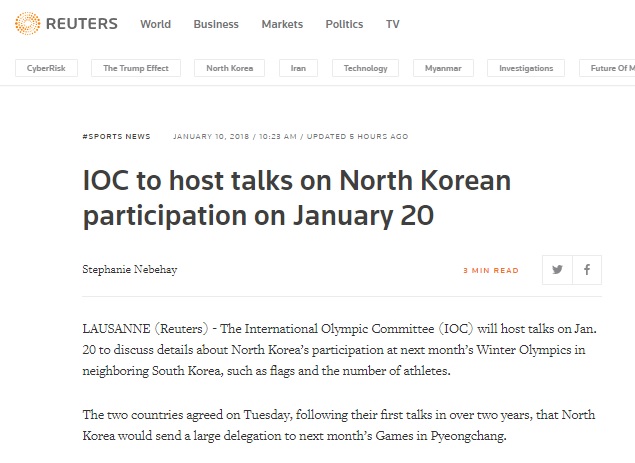
We must Choose Courage, and refuse to make the same mistake regarding Communist totalitarian North Korea’s continuing crimes against humanity. On January 9, 2018, South Korea representatives decided to invite totalitarian North Korea to join the February 2018 Winter Olympic Games in PyeongChang, South Korea. The decision by South Korea to invite North Korea, in view of North Korea’s continuing crimes against humanity and global aggression, to join the 2018 Olympics rejects the fundamental principles of Olympism described in the Olympic Charter, which the International Olympic Committee (IOC) is responsible for upholding. On January 10, 2018, the IOC stated that IOC president Thomas Bach was host talks on January 20, 2018 in Lausanne, Switzerland, between the national Olympic committees of totalitarian North Korea and South Korea, as well as the IOC.

What must it take for the nations of the world, the United Nations, and international organizations such as the IOC, which claim to uphold values of human rights and dignity, to choose the courage to judge that the crimes against humanity by another nation’s leadership are simply unacceptable?

In 1936, we did not choose courage when faced with Nazi Germany and the Olympics.

Now again, in 2018, we are not choosing courage when faced with totalitarian North Korea and the Olympics. But unlike 1936, there is no excuse for the IOC and the world nations, regarding the shared values under the UDHR, the Olympic Charter. There is also absolutely no excuse of any kind for those who claim that they “didn’t know” of the crimes against humanity by North Korea.

We know. The world knows. But it chooses not to speak out for fear of being unpopular, of being judgmental, and of questioning those who seek “peace” at any cost to human rights and dignity, even empowering and legitimizing a totalitarian regime whose unspeakable atrocities have shocked the weary conscience of a jaded world.

We can evade, avoid, and change the subject on this failure of our global moral conscience, but the long arm of history and responsibility will come back to haunt those who fail to speak out in outrage.

In the case of totalitarian North Korea, the world cannot claim such ignorance regarding North Korea’s crimes against humanity, nor can the world pretend to ignore the global threats that the emboldened North Korea regime has made against the world. For many decades, the world and human rights organizations, including Responsible for Equality And Liberty (R.E.A.L.), have reported about the human rights atrocities and crimes against humanity by the North Korea totalitarian regime. Leading organizations like the North Korea Freedom Coalition (NKFC) and the U.S. Committee for Human Rights in North Korea (HRNK) have spent many years organizing public information campaigns in the U.S., South Korea, and around the world to inform the public and to gain international resistance to the crimes against humanity by North Korea.

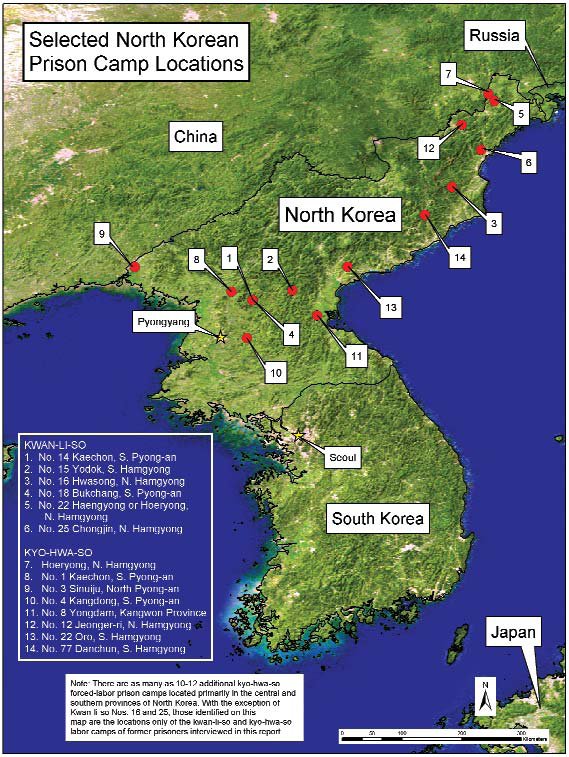
Since 2004, the NKFC has been reporting on “an estimated 3 million North Koreans have perished under North Korea’s brutal dictatorial regime since the mid-1990s,” the North Korea starvation tactics against its own people, and how the North Korea totalitarian leadership “arbitrarily detains, tortures, and executes its citizens, including children, in a large network of prison/labor camps.” Since 2003, the NKFC has been reporting on the “The Hidden Gulag: Exposing North Korea’s Prison Camps” of totalitarian North Korea’s concentration camps, and numerous other reports on North Korea human rights atrocities.

Yet even if the world was not aware of decades of these and other global human rights campaigns to inform the world about the North Korea leadership’s crimes against humanity, in 2013, the United Nations undertook an active investigation of such atrocities against human rights and dignity. On March 21, 2013 the United Nations Human Rights Council established the Commission of Inquiry (COI) on Human Rights in the Democratic People’s Republic of Korea (DPRK – North Korea). The COI was established based on U.N. Resolution A/HRC/RES/22/13, which mandated the body to investigate the systematic, widespread and grave violations of human rights in North Korea. The U.N. COI on Human Rights in North Korea presented its written report (summary and detailed) with its findings and recommendations to the Human Rights Council on February 7, 2014, which it discussed in a news conference on February 17, 2014.

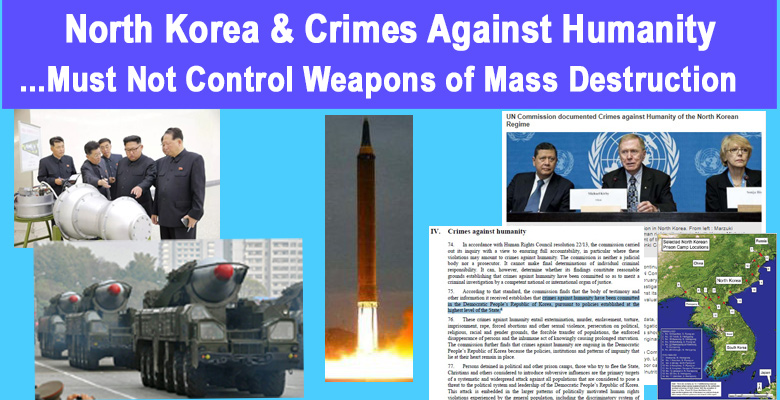
In the release of the extensive United Nations COI February 7, 2014 reports on human rights violations by North Korea, the U.N. COI found the totalitarian Communist North Korea regime to be responsible for “crimes against humanity.” The U.N. COI concluded that “the commission finds that the body of testimony and other information it received establishes that crimes against humanity have been committed in the Democratic People’s Republic of Korea, pursuant to policies established at the highest level of the State.

“These crimes against humanity entail extermination, murder, enslavement, torture, imprisonment, rape, forced abortions and other sexual violence, persecution on political, religious, racial and gender grounds, the forcible transfer of populations, the enforced disappearance of persons and the inhumane act of knowingly causing prolonged starvation. The commission further finds that crimes against humanity are ongoing in the Democratic People’s Republic of Korea because the policies, institutions and patterns of impunity that lie at their heart remain in place.” “Persons detained in political and other prison camps, those who try to flee the State, Christians and others considered to introduce subversive influences are the primary targets of a systematic and widespread attack against all populations that are considered to pose a threat to the political system and leadership of the Democratic People’s Republic of Korea. This attack is embedded in the larger patterns of politically motivated human rights violations experienced by the general population, including the discriminatory system of classification of persons based on songbun.” “In addition, the commission finds that crimes against humanity have been committed against starving populations, particularly during the 1990s. These crimes arose from decisions and policies violating the right to food, which were applied for the purposes of sustaining the present political system, in full awareness that such decisions would exacerbate starvation and related deaths of much of the population.” “Lastly, the commission finds that crimes against humanity are being committed against persons from other countries who were systematically abducted or denied repatriation, in order to gain labour and other skills for the Democratic People’s Republic of Korea.”

The U.N. COI concluded that “The gravity, scale and nature of these violations reveal a State that does not have any parallel in the contemporary world. Political scientists of the twentieth century characterized this type of political organization as a totalitarian State: a State that does not content itself with ensuring the authoritarian rule of a small group of people, but seeks to dominate every aspect of its citizens’ lives and terrorizes them from within.” Furthermore, the U.N. COI concluded “The fact that the Democratic People’s Republic of Korea, as a State Member of the United Nations, has for decades pursued policies involving crimes that shock the conscience of humanity raises questions about the inadequacy of the response of the international community. The international community must accept its responsibility to protect the people of the Democratic People’s Republic of Korea from crimes against humanity, because the Government of the Democratic People’s Republic of Korea has manifestly failed to do so.”

During the news conference announcing the release of the report on February 17, 2014, Mr. Michael Kirby, Chair of the Commission of Inquiry on Human Rights said that: “These are the ongoing crimes against humanity happening in the DPRK which our generation must tackle urgently and collectively. The rest of the world has ignored the evidence for too long. Now there is no excuse because now we know.” “At the end of the Second World War, so many people said ‘If only we had known…!’ Now the international community does know…. there will be no excusing a failure of action.” The commissioners also wrote a letter to Kim Jong Un informing the North Korean ruler that they would be recommending referring his country to the International Criminal Court (ICC). This was “to render accountable all those, including possibly yourself, who may be responsible for the crimes against humanity referred to in this letter and in the commission’s report.”

As the world learned about the United Nations Commission report on North Korea’s documented “crimes against humanity,” North Korea did not participate in the 2014 Winter Olympics in Sochi, Russia, while it participated in the 2016 Summer Olympics in Brazil.

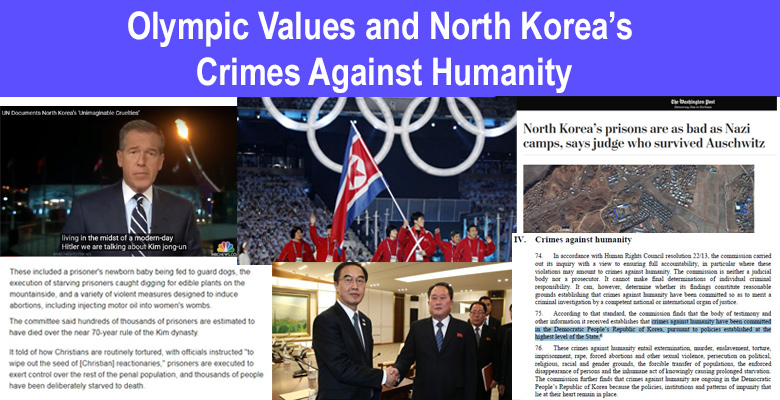
With the 2014 Winter Olympics as its background, NBC News reported on the United Nations Commission report on North Korea, with NBC News stating “so there will be no mistake, that we are living in the midst of a modern day Hitler, we are talking about Kim Jong Un, the young leader of North Korea.”

Nor was the last of such reports of the human rights atrocities by totalitarian Communist North Korea leaders and their Supreme Leader, Kim Jong Un, which has shocked the world by extermination tactics, starvation tactics, murder, rape, mutilation, and terror, as well as threats of global nuclear bomb and Electromagnetic Pulse (EMP) attacks against nations across the world, including the U.S., South Korea, and Japan.

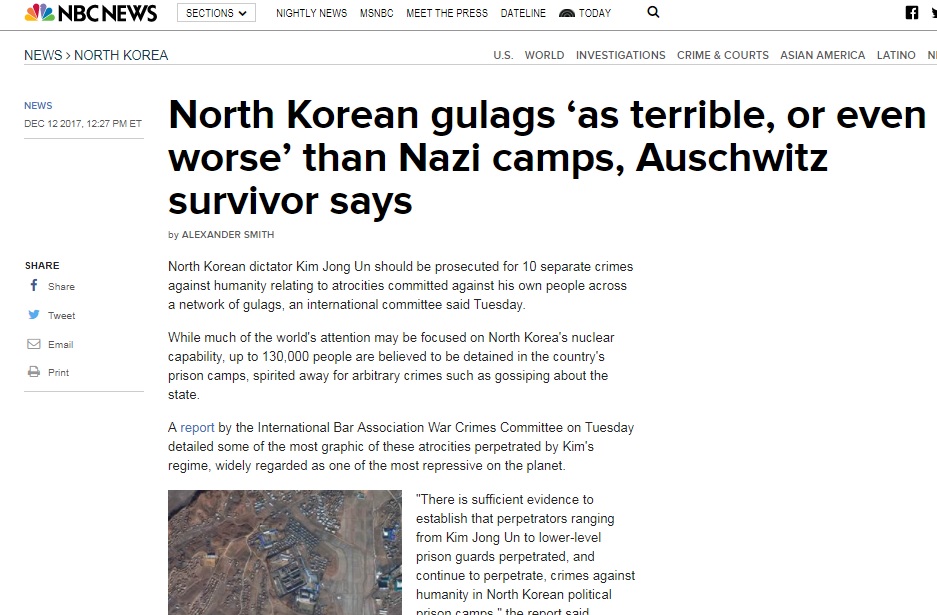
On December 12, 2017, NBC News also reported on continuing reports from War Crimes Committee of the International Bar Association (IBA) of human rights atrocities reported by North Korea defectors, describing “generations of forsaken North Koreans, that have “endured unspeakable crimes against humanity while the world community has sat on the sidelines, well aware such crimes were and continue to be committed.”

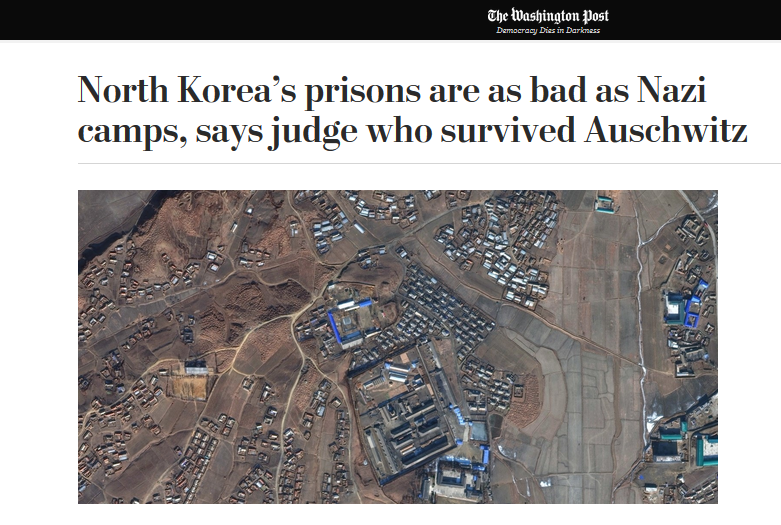
The IBA reported about the totalitarian North Korea regime’s routine practice of murder, executions after being raped or for being pregnant, executions for taking food, executions for attempting to escape concentration camps, executions for in order to set example, torture, infanticide of infant babies, extermination and mass killings, persecution, forced labor, starvation, deprivation of food, clothing, and medical treatment, rape, sexual violence, forced abortion, enforced disappearance, enslavement, and more. NBC News reported on December 12, 2017 that “Thomas Buergenthal – a renowned judge on the committee and a survivor of Auschwitz – told The Washington Post that North Korea’s gulags ‘are as terrible, or even worse’ than the Nazi camps he experienced as a child.”

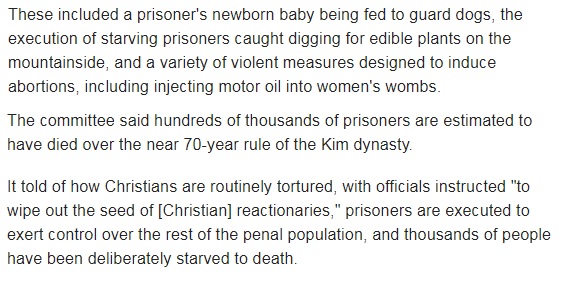
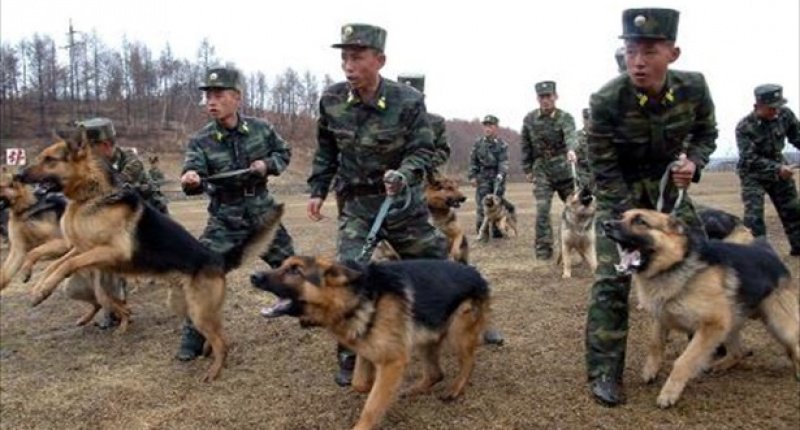
The December NBC News report stated “North Korean defectors told the committee about some of the individual atrocities they witnessed. These included a prisoner’s newborn baby being fed to guard dogs, the execution of starving prisoners caught digging for edible plants on the mountainside, and a variety of violent measures designed to induce abortions, including injecting motor oil into women’s wombs.” NBC wrote that the “International Bar Association’s report described itself as an ‘unofficial follow-up’ to a landmark United Nations inquiry in 2014, which said North Korea’s atrocities were ‘strikingly similar’ to the crimes committed by the Nazis.”

Excerpt from December 2017 NBC Report on North Korea’s Crimes Against Humanity

The IBA War Crimes Committee’s report states that “Former prison guard Ahn Myong-chol saw a prisoner’s baby – most likely fathered by a high-ranking official – fed to dogs and killed.”

Despite such inhuman atrocities against our fellow human beings, international affairs and “security” pundits including those that claim to speak for U.S. “intelligence,” seek to reassure the world that North Korea’s leadership is “rational,” and that we can and should have measured discussions and negotiations of matter of global and regional security…. as if we didn’t hear any of the horrific crimes against humanity routinely and frequently reported about North Korea.

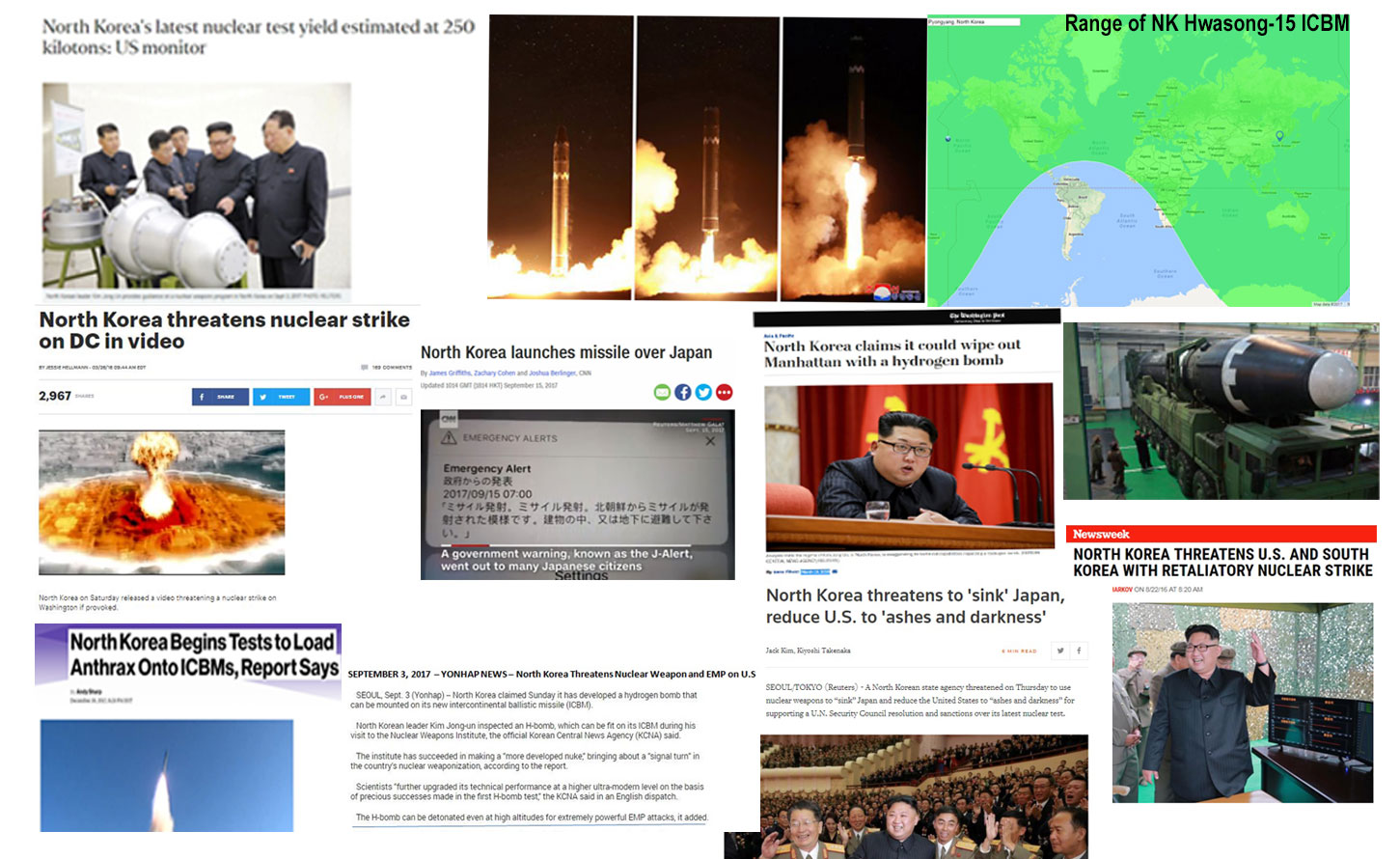
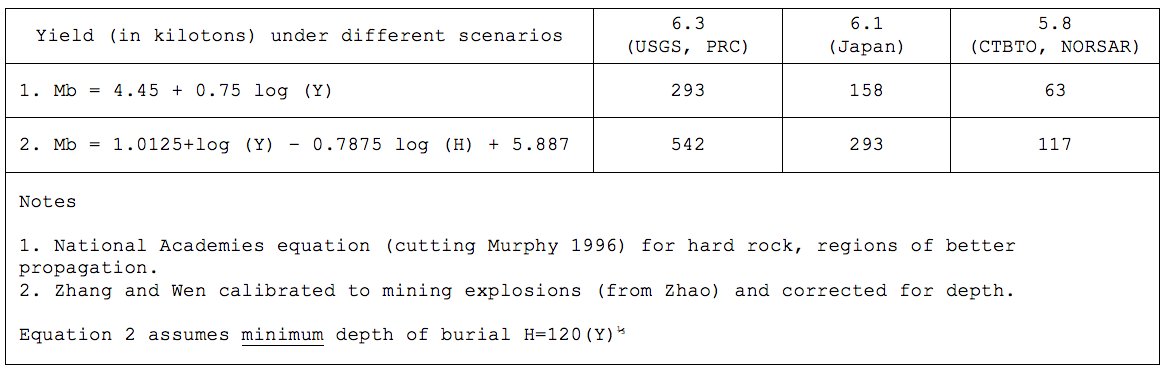
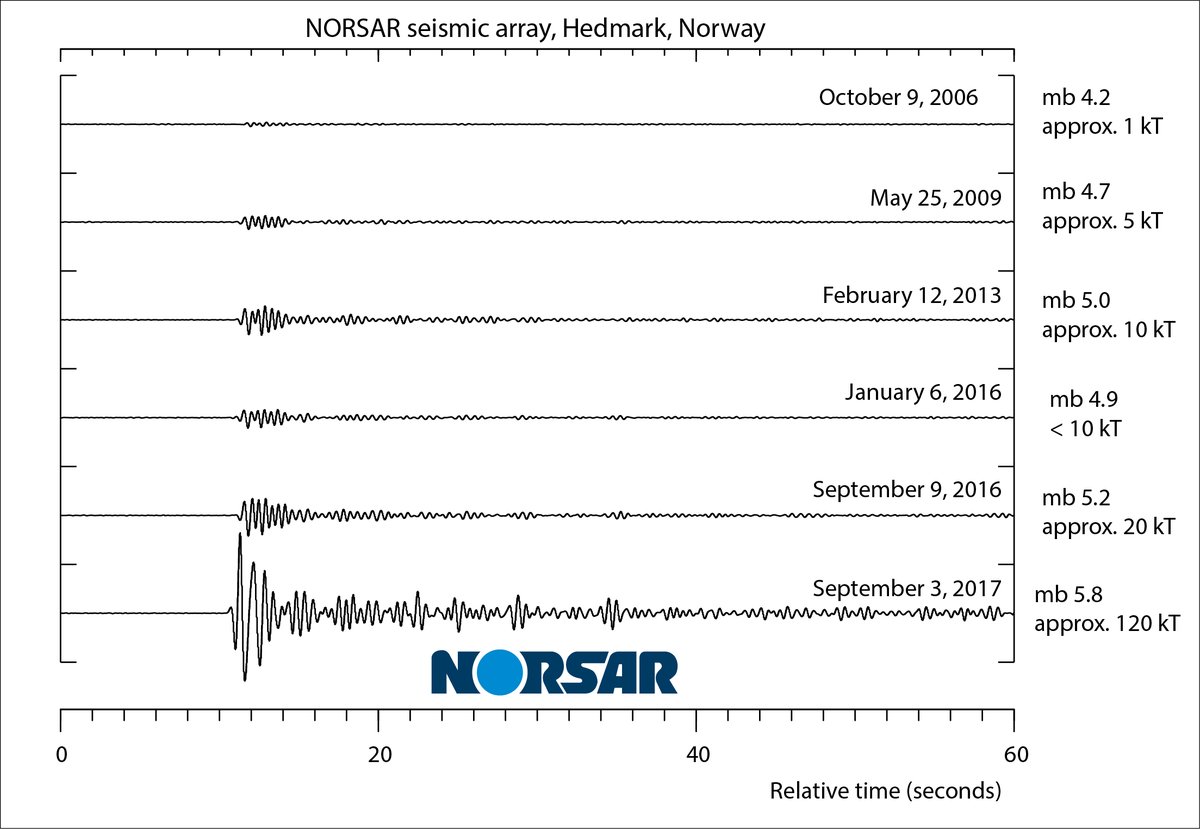
We are expected to ignore the pattern of North Korea’s testing of nuclear bombs since 2006, and its September 3, 2017 latest nuclear bomb test estimated at 250 kilotons, as well as North Korea’s documented threat also on September 3, that it would also use nuclear bombs for “high altitude EMP (Electromagnetic Pulse)” attacks. At the same time, we are also supposed to ignore North Korea’s aggressive pattern of Intercontinental Ballistic Missile (ICBM) tests, which as of November 29, 2017, its Hwasong-15 ICBM can reach essentially almost all of the Earth, as well its aggressive submarine launched missile (SLBM) program, and recent reported testing with anthrax and chemical weapons.

Communist North Korea’s Continuing Global Threats to World Peace

So in the face of such continuing crimes against humanity and global aggression, what is the response of the International Olympic Committee (IOC) and South Korea?

Their response is to invite North Korea to join in the Olympic Games in South Korea.

Surrender is Not Discussion

The “outrage exhaustion” of the world and the desperation for any avenue of peace is understandable. Every day, the world learns of new criminal acts of violence, hate, and contempt to our human rights, human dignity, and human lives. But for those who respect our shared human rights, there must be some boundary of moral integrity that we must judge actions and atrocities as unacceptable, regardless of our “disconnect” from “world events” or “politics.”

There are those who state officials in South Korea view North Korea’s potential participation in the Olympics as a “turning point” for talks on other security issues.

Responsible for Equality And Liberty (R.E.A.L.) sees the surrender in inviting North Korea to have participation in the Olympic games, despite its well documented crimes against humanity, as a “turning point,” as well, but not the turning point that some pundits and some South Korea officials might. R.E.A.L. sees the 2018 Olympics invitation to embolden totalitarian North Korea, despite its documented crimes against humanity and despite its nuclear and EMP threats, to be a “turning point” much like the 1936 Olympics was to embolden Nazi Germany.

Given the grave threats of weapons of mass destruction by North Korea against the world with nuclear, biological, chemical, and EMP weapons, the world understandably is looking for avenues to pursue peace. There is “no peace without justice.” The idea that we can turn a blind eye to North Korea’s crimes against humanity in the unrealistic hope that North Korea’s dictator will surrender his nuclear weapons and missile dishonors the credibility and integrity of world powers and international organizations. Turning a blind eye to North Korea’s crimes against humanity undermines the shared values of human rights and human dignity on which any genuine peace must be built.

There is always value in discussions, but we know from history what legitimizing a criminal totalitarian regime leads to.  We support discussions, but not surrender on moral integrity or security. The argument that we do not know about North Korea’s atrocities, or that the crimes of other nations are somehow equivalent to the inhuman crimes against humanity by the North Korea authorities fools no one. Make no mistake, we know it is wrong.

There are those who believe such Olympic participation to legitimize the infamous, totalitarian North Korea regime, will work to help further “peace in our time.” We have heard this before, and the pathway of moral relativism does not lead to peace, because its foundation rejects the human rights and human dignity on which the peace in a cohesive society must be built.

When we surrender on human rights in desperation for peace at any cost, to those responsible for crimes against humanity, we only empower those criminals who believe we do not have the courage to work for human rights and dignity, that is necessary for any lasting peace. Human rights and dignity cannot be honored with a relativism that blindly and deliberately ignores crimes against humanity.

South Korea, the IOC, the United States of America, the world nations, and the world’s athletes know better. The world athletes in the Olympics should not be forced to disgracefully compete against those from criminal nations that throw infant children to be eaten by guard dogs. If we have lost the ability to even judge THIS as wrong, then such refined principles as sportmanship and fairness in the Olympics or any other part of life are also long abandoned as well. As human beings, we must have the ability to recognize that crimes against humanity are unacceptable to all people, in every nation, and in every area of expertise.

Responsible for Equality And Liberty (R.E.A.L.) calls for the South Korea and the IOC to change their stance on the participation of totalitarian North Korea in 2018 Olympic Games in PyeongChang. R.E.A.L. also calls for the world athletes and world nations to boycott the 2018 Olympic Games in PyeongChang, if North Korea is allowed to participate, in violation of the Olympic Charter’s fundamental principles on “social responsibility” and “human dignity.”

We know better than this. We are better than this. Let us take a stand on moral integrity when it comes to the 2018 Winter Olympics and the crimes against humanity by totalitarian North Korea. Condemn North Korea’s crimes against humanity, reject its participation in the 2018 Winter Olympics, or boycott the 2018 Winter Olympics. The world must stand by its commitment to “Never Again.”

History will remember our choices.

Choose Courage.

=======================

References

Olympic Charter – September 2017 – English

Olympic Charter – 1933 – English

January 10, 2018 – Yonhap News: “S. Korea wants to hold working-level talks with N.K. on Olympics this week”

January 10, 2018 – Yonhap News: “PM: N. Korea expected to send 400-500 people to PyeongChang Olympics”

January 10, 2018 – Reuters: “IOC to host talks on North Korean participation on Jan 20”

North Korea at the Olympics

Universal Declaration of Human Rights (UDHR)

United Nations – Commission of Inquiry on Human Rights in the Democratic People’s Republic of Korea

February 17, 2014 – U.N. Commission of Inquiry Press Conference – Video Except

Report of the Commission of Inquiry on human rights in the Democratic People’s Republic of Korea -­ A/HRC/25/63 – English (summary, 36 pages)

Report of the detailed findings of the Commission of Inquiry on human rights in the Democratic People’s Republic of Korea -­A/HRC/25/CRP.1 – English (detailed, 372 pages)

NBC News – February 17, 2014 – (Broadcasting at Sochi Olympics): “UN Documents North Korea’s ‘Unimaginable Cruelties'”

NBC News – December 12, 2017 – “North Korean gulags ‘as terrible, or even worse than Nazi camps, Auschwitz survivor says”

Washington Post – December 11, 2017: “North Korea’s prisons are as bad as Nazi camps, says judge who survived Auschwitz”

North Korea Freedom Coalition (NKFC)

The Committee for Human Rights in North Korea (HRNK)

HRNK: The Hidden Gulag – latest edition

International Bar Association (IBA) War Crimes Committee – North Korea: the international response

International Bar Association (IBA) War Crimes Committee – Report: Inquiry on Crimes Against Humanity in North Korean Political Prisons

R.E.A.L. Blog Postings on North Korea

February 5, 2013 – New York Times: a “new propaganda video, posted Sunday on a Web site and a YouTube channel that serve as outlets for North Korean state media, shows a computer-animated representation of Lower Manhattan in flames as bombs rain down.”

July 29, 2014 – AFP: “North Korea threatens nuclear strike on White House”

May 7, 2015 – Independent: “North Korea threatens nuclear attack on US” – “A North Korean official claims the country has long range missiles”

September 9, 2016 – CNN: “North Korea’s nuclear tests are getting more powerful”

March 13, 2016 – Washington Post: “North Korea claims it could wipe out Manhattan with a hydrogen bomb” – North Korea: “If this H-bomb were to be mounted on an intercontinental ballistic missile and fall on Manhattan in New York City, all the people there would be killed immediately and the city would burn down to ashes”

March 26, 2016 – CNN: “North Korea threatens nuclear strike” – North Korea: “If the American imperialists provoke us a bit, we will not hesitate to slap them with a pre-emptive nuclear strike”

March 7, 2016 – North Korea Times: “North Korea nuclear war threat over US-South Korea military exercises”

March 27, 2016 – North Korea threatens nuclear strike on DC in video

September 3, 2017 – KCNA: “Kim Jong Un Gives Guidance to Nuclear Weaponization”

September 13, 2017 – Straits Times: “North Korea’s latest nuclear test yield estimated at 250 kilotons: US monitor”

September 13, 2017 – Reuters: “North Korea threatens to ‘sink’ Japan, reduce U.S. to ‘ashes and darkness'”

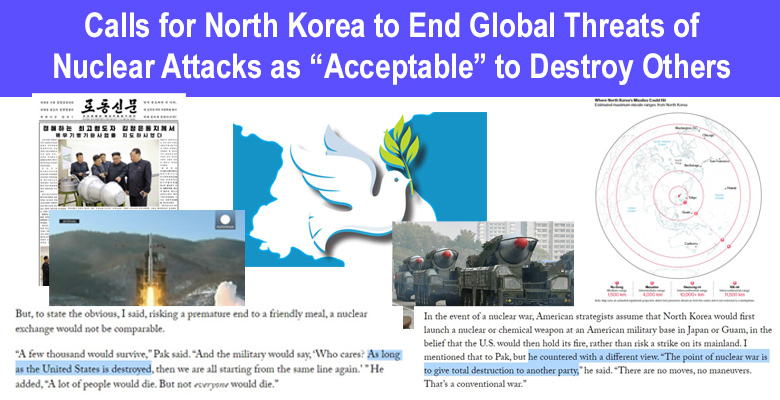
September 12, 2017 – North Korea States Nuclear War Acceptable To Destroy USA, Threatens Other Nations

November 5, 2017 – North Korea’s EMP Catastrophic Terror Threat Against The World

November 28, 2017 – Business Insider: “North Korea just tested a missile that experts say could reach anywhere in the US”

November 29, 2017 – Washington Post: “North Korea could now almost certainly strike London or Berlin.”

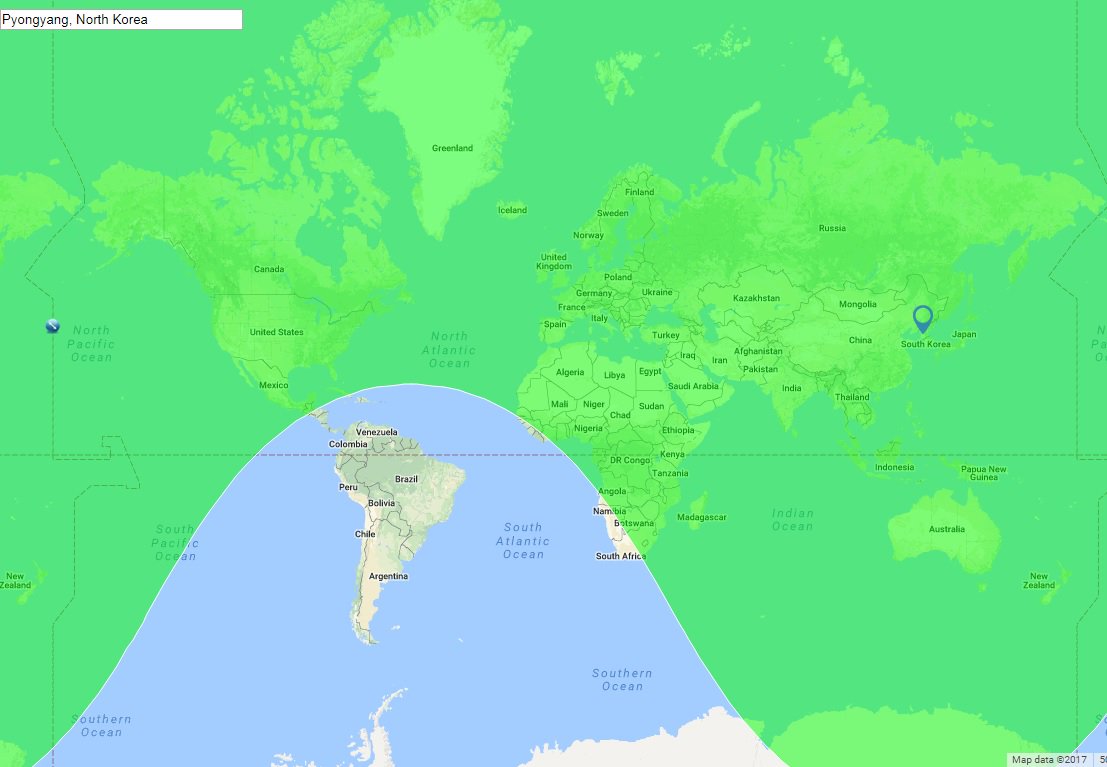
November 30, 2017 – Hwasong-15 missile est ability to hit targets within 13,000 kilometers. Image radius from Pyongyang.

November 30, 2017 – 38 North: “The New Hwasong-15 ICBM: A Significant Improvement That May be Ready as Early as 2018”

December 1, 2017 – 38 North: “North Korea’s Submarine-Launched Ballistic Missile Program Advances: Second Missile Test Stand Barge Almost Operational”

December 19, 2017 – Bloomberg: “North Korea Begins Tests to Load Anthrax Onto ICBMs, Report Say”

USHMM – The Nazi Olympics Berlin 1936

April 17, 2017 – The Independent: “Allied forces knew about Holocaust two years before discovery of concentration camps, secret documents reveal”

=====================================

North Korea’s EMP Catastrophic Terror Threat Against the World

Responsible for Equality And Liberty (R.E.A.L.) has been reporting on threats to human rights and security of people persecuted by the totalitarian North Korea government, as well as the world conflicts impacted by the North Korea security threats. A key issue that is not getting recognition, however, was a catastrophic terror threat by North Korea, which is threat not only to its people, the region, and the United States, but is also a catastrophic terror threat to the world.  To those unfamiliar with R.E.A.L.’s mission, R.E.A.L. represents non-partisan, non-political, human rights activist volunteers with a focus on defending our shared universal human rights, including the human right of security.  Among other topics, R.E.A.L. routinely has reported on terror threats to the shared human rights of our fellow human beings.  While R.E.A.L continues to urge Communist North Korea to seek peace, North Korea’s terror threats must also be acknowledged and rejected by responsible nations and people of the world.

For decades, Communist North Korea has threatened its neighbors and the world from its isolated totalitarian state, which has been known largely for well-documented “crimes against humanity” against its own citizens. Much of the world got used to ignoring and dismissing such threats. But on September 3, 2017, the North Korea’s thermonuclear bomb test demonstrated substantially increased nuclear bomb capability, with estimations in the possible bomb yield ranging from 120 kilotons to 250 kilotons. It has greatly concerned many in the public and the world. As a result of that bomb testing, the world’s focus has mostly been on the ability of North Korea to use a thermonuclear bomb for a surface blast to kill many thousands of people in a concentrated area, with fallout affecting others based on the wind direction; it is a grave concern to those committed to global human rights and security.

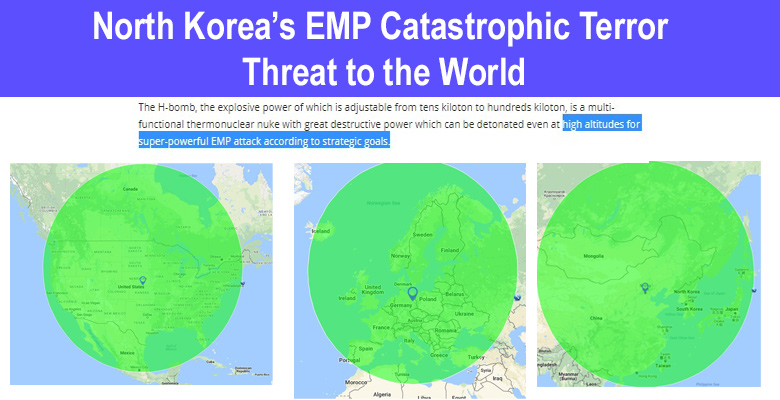
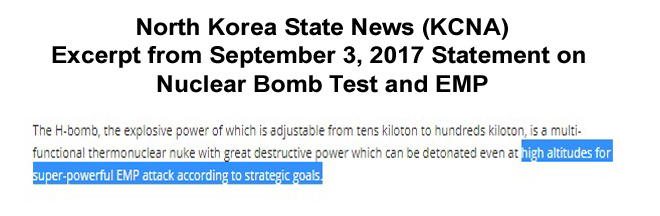
Along with its expanded nuclear bomb capability on September 3, North Korea also gained another first – by announcing itself as the first nation threatening, capable, and likely willing to use a high altitude Electromagnetic Pulse (EMP) bomb. As part of the September 3, North Korea state news (KCNA) report (screenshot) of its nuclear bomb test entitled “Kim Jong Un Gives Guidance to Nuclear Weaponization,” North Korea stated that it is willing to use its enhanced nuclear bomb capability to produce a high altitude Electromagnetic Pulse blast (EMP, also abbreviated as HEMP). North Korea used KCNA to state: “The H-bomb, the explosive power of which is adjustable from tens kiloton to hundreds kiloton, is a multi-functional thermonuclear nuke with great destructive power which can be detonated even a high altitude for super-powerful EMP attack according to strategic goals.”

North Korea’s high altitude “super-powerful” EMP threat is the same type of catastrophic, massive terror threat, as those threatening to poison food and water supplies, spread biological or chemical weapons, in areas which not only could go beyond cities, states, but even across borders. This is the main part of the security issue, which keeps getting buried in details on missiles, ships, timelines, and personalities. The September 3 North Korea boast of a “super-powerful” EMP threat was nothing less than a catastrophic terrorist threat against the world. We must recognize catastrophic terror threats as unacceptable threats against our shared universal human rights and security.
Can you imagine a nation-state proudly issuing a public press release about its new “super-powerful” ability to poison food and water supplies, to spread weaponized airborne versions of smallpox, plague, anthrax, or to release cyanide, ricin, chlorine chemical gas to poison many people? The sane world would rightfully condemn such a statement by any nation with horror and outrage. But North Korea’s terror threat statement of being willing to release a high altitude EMP weapon on the world was largely met with indifference by the world’s media, and politicians demanding that other nations be more understanding in respecting North Korea. Would pundits have made the same statements if the press release with EMP terror threat had been issued by ISIS, rather than North Korea? Would anyone really expect to be able to effectively negotiate with leaders that seek to boast about the ability to commit such mass terror attacks on the world?

The concept of a high altitude EMP blast would be to shoot a nuclear missile high up into the atmosphere and detonate it there; for this purpose, high altitude is defined as 40 to 500 kilometers (20 to 300 miles) above the Earth’s surface. The high altitude nuclear explosion would not have the physical destructive impact of a nuclear bomb surface blast, nor would it have any “fallout” (which comes from radioactive soil after a surface blast). But the high altitude nuclear explosion would send out a series of electromagnetic pulse broadband, high amplitude waves (invisible like radio waves) that would damage or destroy the electrical infrastructure, wiring, and electronic devices over a broad area. The EMP blast has three types of signals, as I will summarize based on a description by scientist Dr. Jack Liu. The first would be an E1 signal that is extremely fast, created by the nuclear blast’s gamma radiation ripping electrons out of the atmosphere, sending them down to Earth at nearly the speed of light, and impacted by the Earth’s magnetic field to create an electromagnetic pulse over a broad area. The second would be an E2 signal, created by gamma and neutron collisions, which would have an impact similar to lightning. The third would be an E3 signal lasting up to hundreds of seconds, creating impacts like a geomagnetic storm, that would impact major long line electrical conductors, and other electrical infrastructure.

A high altitude EMP bomb would likely destroy the electrical infrastructure used for the survival and lives by many, many millions of people, including crippling the infrastructure of a population not only in a local target area, but across a regional or national area, and even possibly across multiple national borders, depending on where it was launched. Many EMP analyses also believe that high altitude EMP pulses at the E1 level would also damage wiring and miniaturized Integrated Circuits (ICs). ICs are small square flat pieces of semiconductor material, typical silicon, on which thousand or millions tiny resistors, capacitors, and transistors are “integrated.” This technological innovation allowed massive change in the way the public lives and functions, as this miniaturization revolution allowed computer and electronics to become part of nearly every area of life. To provide context on such miniaturization, the original computer, ENIAC, was the size of three or four double decker buses and was thousands of times less powerful than a laptop computer today.

This IC revolution allowed most of the technology changes that are not only part of modern society, but more importantly, modern society has become dependent on to effectively function. People are dependent on ICs every day, but since they rarely actually see them inside their electronics, television, radio, automobiles, telephones, banking systems, even many public toilets and sinks, they never think about them, but simply take for granted that they will work. A high altitude EMP blast, as proudly threatened by North Korea, would change that. ICs are ubiquitously used in mobile telephones, computers, and many other forms of electronics. But electrical infrastructure and personal electronics are the tip of the iceberg in the extensive use of ICs throughout society in the 21st century. Such electronics and ICs are widely integrated within every aspect of society: medicine, banks and financial institutions, farms and food stores, retail services, utilities, public transportation, emergency services, law enforcement, sanitation. The vast use of ICs as part of modernization in the 21st century comes with one very specific weak spot, such electronics and ICs are particularly vulnerable to high altitude EMP blasts.

Numerous studies and Congressional testimony has been provided on the such EMP threats to the U.S. Government over the past 30+ years. Many of the early studies were done using data gathered from 1950s, 1960s nuclear bomb tests in secluded or ocean areas, during a time when electronic and communication systems did not have the ICs in widespread use, as they are today. (The first patent for an IC was not granted until 1961.) So much of the “EMP testing” that we have is either based on world electrical and electronic environments that were significantly different, or in controlled laboratory environments that can only simulate a very finite range of possibilities. So we have different scientists that have come up with a range of testimony and findings on high altitude EMP attacks and the impact on society. There is a good deal of classified research on this topic, which unfortunately is not available to the public; R.E.A.L. urges the U.S. government to reconsider the impact of such level of classification and the need to inform the public on such catastrophic threats. However, I have collected the unclassified, public source testimony and studies presented on this topic. They are gathered at:
http://www.emergencysafety.org/emp-research-and-testimony/

Consistently, most scientists believe that a high altitude nuclear blast in the atmosphere would release damaging EMP pulse waves that would impact and destroy wiring, electrical infrastructure, and many “personal electronic” devices. There is some debate over whether and to what extent, an EMP blast would impact automobiles, airplanes, and vehicles, and whether their electronics have enough “shielding” to prevent EMP pulse waves damaging them. Most scientists I have read believe there will be impact of a high altitude nuclear blast on transportation electronic systems.  But should a high altitude EMP blast affect transportation systems, we can be certain there will be significant public disruption and conflict.

Given the difficulty in seeking to “replicate” such a dangerous threat to society, with a high altitude nuclear bomb with gamma rays ripping electrons out of the atmosphere and impacted by the magnetic field of the Earth, there is only so much testing (and so much “proof”) that can actually be done to completely understand the full affects.  The extreme danger of such atmospheric testing is some of the EMP scientific analyses has to be done by scientific modeling. We have results of an actual 1962 high altitutde nuclear blast atmospheric test (Starfish Prime test) that discovered it could create EMP impacts as far as over 800 miles away in that test, with an impact that “drove much of the instrumentation off scale.”  But even in 1962, at the early days of the IC technology just receiving a patent,  a high altitude EMP test over the middle of the ocean impacted electrical systems, telecommunication systems, aircraft radios, and utilities over 800 miles away.  Lowell Wood, a physicist and expert on EMP at Lawrence Livermore National Laboratory, told Congress in 1999 (October 7, 1999: “EMP Threats to the U.S. Military and Civilian Infrastructure”) that: “Most fortunately, these tests took place over Johnston Island in the mid-Pacific rather than the Nevada Test Site, or the electromagnetic pulse would still be indelibly imprinted in the minds of the citizenry of the western U.S., as well as in the history books.” “As it was, significant damage was done to both civilian and military electrical systems throughout the Hawaiian Islands, over 800 miles away from ground zero.”

A high altitude EMP blast is very different from a low altitude, microwave-based EMP attacks. In 2008, the Congressional Research Service (CRS) reported on both High Altitude EMP (HEMP) attacks, and what were considered to be more “likely,” terrorists using surface level, low altitude microwave based devices to create a localized EMP affect. The low altitude microwave-based EMP attack is to create a local disruption, and vehicles are not likely to be affected by such EMP attacks, and the power and strength of a High Power Microwave (HPM) EMP attack is not as powerful as a high altitude EMP (HEMP) attack. In terms of this specific threat from North Korea, unfortunately, most of the limited preparedness efforts have been focused on recovering from a ground level microwave attack, rather than a high altitude EMP blast affecting a wide area.

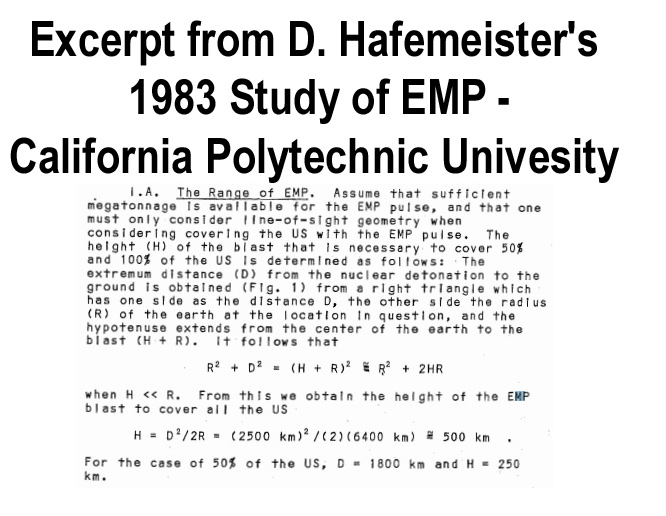
The affected area of a high altitude EMP blast differs among scientists, and as previously stated, most of the research on this is classified, so there is only a limited amount of public information available as unclassified for the public. According to a 1983 study done by D. Hafemeister (California Polytechnic University), as referenced by MIT’s Dr. Jack Liu in May 2017, the larger the nuclear explosion, the greater the affected area. Dr. Liu then estimated that a high altitude EMP blast at an “optimum height” would result in a correlation of blast yield to area covered, with a 250 kiloton blast covering a radius of 250 km (155 miles) and 1 megaton blast (currently not demonstrated as being part of North Korea’s capabilities) covering a radius of 1,000 km (621 miles). This would likely be the most “conservative” estimate.  Based on my review of Hafemeister’s study, I believe he intended the optimum height to be 300 miles/500 km.

If you look at the details of D. Hafemeister’s 1983 EMP study, however, Hafemeister also estimated that a high altitude EMP blast at 310 miles (500 km) in the atmosphere over the United States would affect the entire nation, and at 155 miles (250 km) in the atmosphere would affect half of the U.S.  As with much of the unclassified reports on such EMP research, the public is provided the minimum detail; based on this, it appear that Hafemeister estimated this based on use of a 1 megaton nuclear blast.  Dr. Liu does not mention this part of D. Hafemeister’s study in his analysis of potential EMP threat.
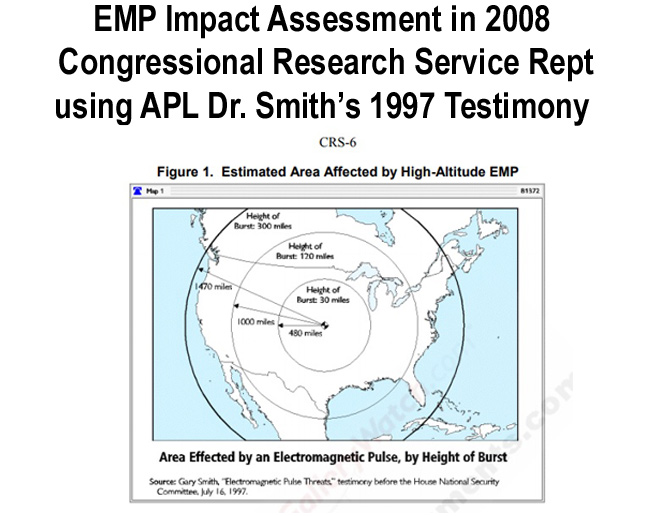
The March 26, 2008 Congressional Research Service (CRS) study (Order Code RL32544) on High Altitude EMP blast impacts has a more dire prediction in terms of a footprint of a high altitude EMP blast. On page 6, Figure 1 of this 2008 CRS study “Estimated Area Affected by High-Altitude EMP,” it provides an impact map from a 1997 Congressional EMP study stating that a blast at 30 miles in the atmosphere would affect a radius of 480 miles, at 120 miles in the atmosphere would affect a radius of 1,000 miles, and at 300 miles (500 kilometers) in the atmosphere would affect a radius of 1,470 miles.  This CRS figure refers to 1997 Congressional public, unclassified testimony provided by Dr. Gary L. Smith, Director, Applied Physics Laboratory (APL), Johns Hopkins University, on the topic “Threat Posed by Electromagnetic Pulse (EMP) to U.S. Military Systems and Civil Infrastructure.”   Based on Dr. Smith’s analysis, high altitude EMP blasts in the center of the U.S., could not only affect an extended part of the U.S., and concluded in his 1997 testimony on EMP “that a burst on the order of 500 kilometers [310 miles] in altitude can cover the entire continental United States.”   Notably, Dr. Smith also testified that the EMP threat was “not terribly burst-strength dependent.”  Dr. George W. Ullrich, Deputy Director, Defense Special Weapons Agency, provided similar views in his 1997 testimony on EMP threats: ” For example, if a megaton class weapon were to be detonated 400 kilometers [248 miles] above Omaha, nearly the entire contiguous 48 States would be affected with potentially damaging EMP experience from Boston to Los Angeles, from Chicago to New Orleans.”  In terms of EMP blast yield, to the extent it may be found to be consistent with nuclear blast “yield” (scientists do not agree on this), it is notable that current nuclear bomb test studies indicate that North Korea “only” has achieved nuclear bomb capability of 120 kiloton to the latest estimate of 250 kiltons, not yet 1 megaton (MT) thus far.  (However, new intelligence relayed to the public in October 2017 indicates that such estimates may be underestimating the EMP threat, due to new “Super-EMP warheads.”)

As shown in the impact study graphic included in the 2008 CRS study using Dr. Smith’s 1997 testimony, such a high altitude EMP blast could also impact most of Canada and Mexico as well as the United States, with the maximum coverage in that analysis being 1,470 miles (2365 kilometers).   Based on this study and scientific analysis, such a blast over Nebraska, U.S., with a coverage range of 1,470 miles, could reach from Mexico City, Mexico into the Canadian Northwest Territories.
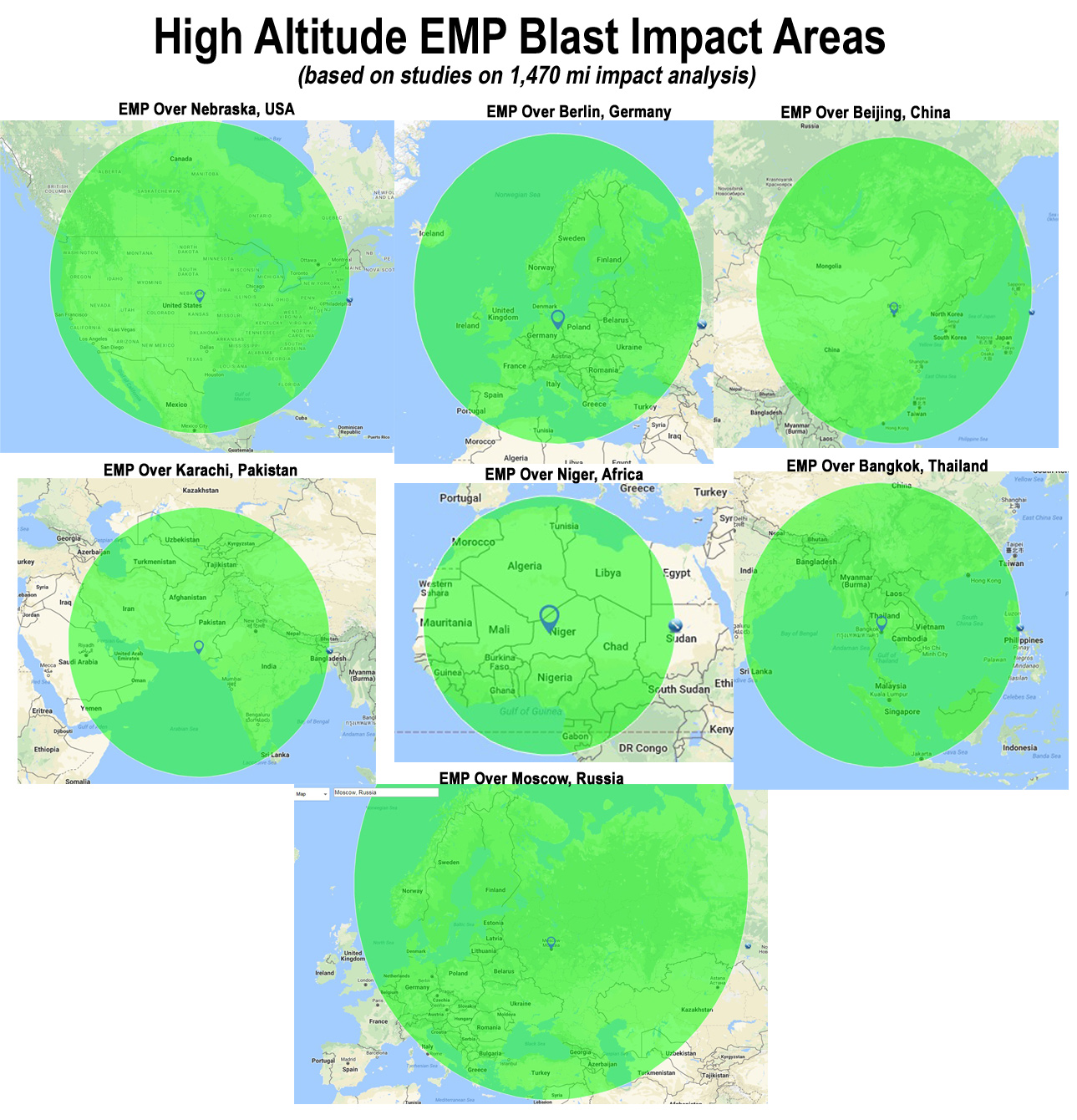
United Kingdom-based London Center for Public Policy Research and other researchers have published similar dramatic 1,470 mile high altitude EMP impact assessments.  If Dr. Smith, Dr. Ulhrich, and others assessing potential distance of a high altitude EMP blast impact are correct, what would be the impact of a 1,470 mile (2365 kilometers) coverage area be around the world?  The world media frequently forgets the large geographic size of the United States; the analysis of 1,470 mile potential coverage of a high altitude EMP blast is more than a regional or national threat, but represents a global terror threat. 

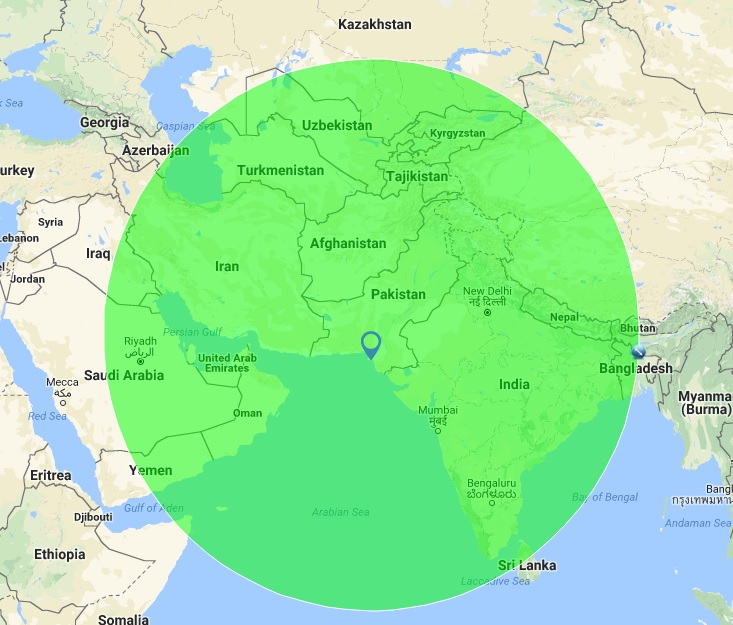
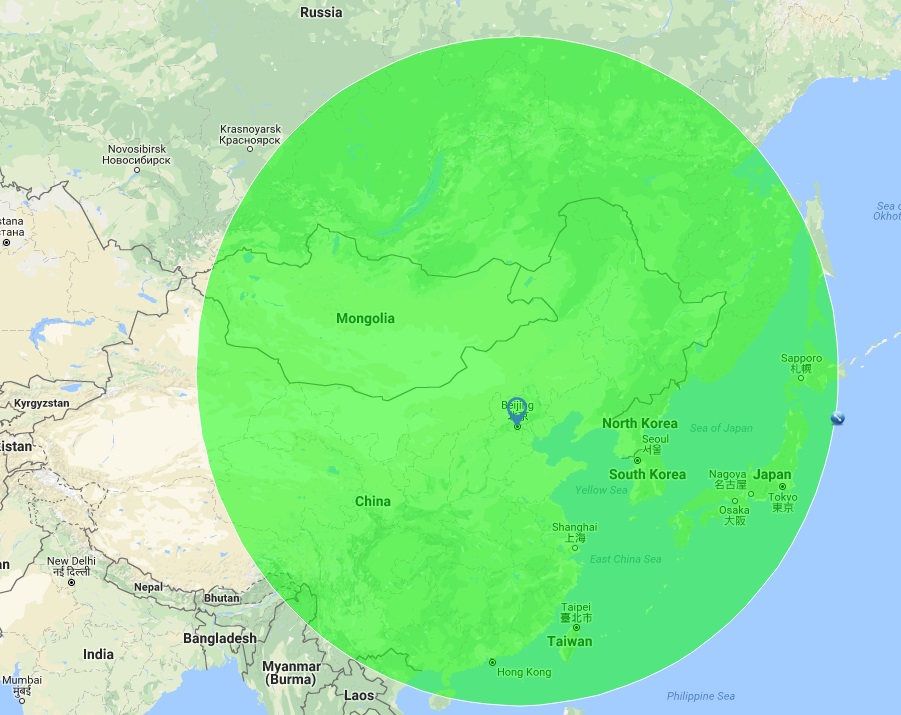
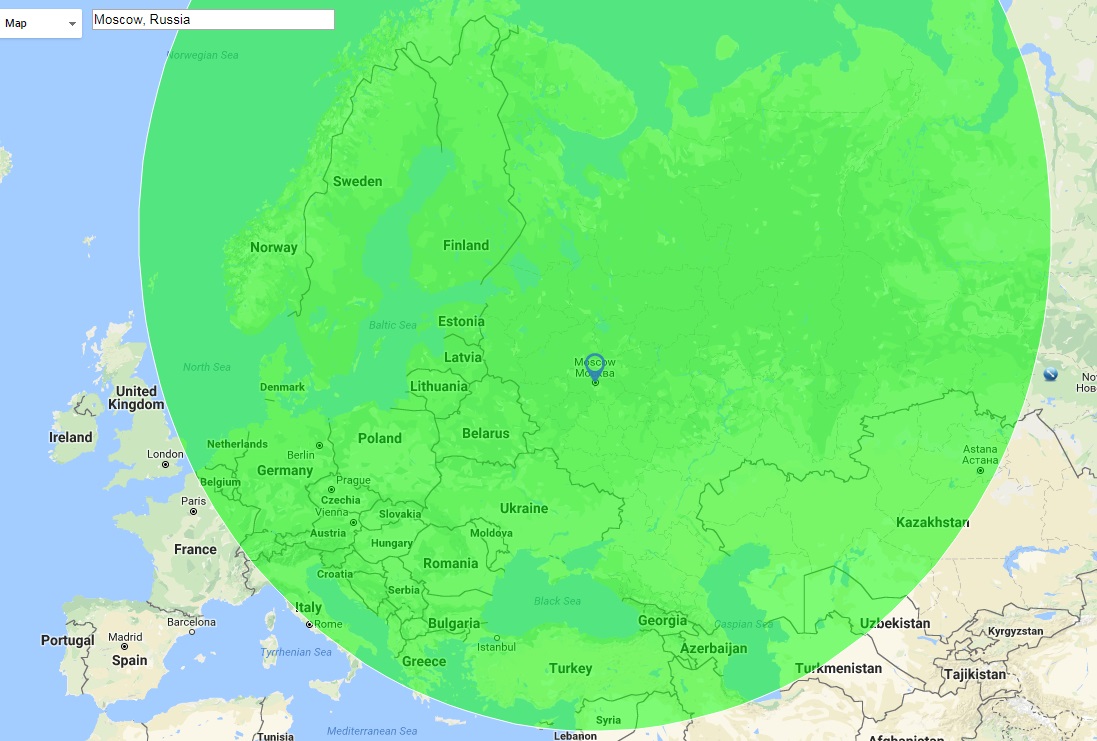
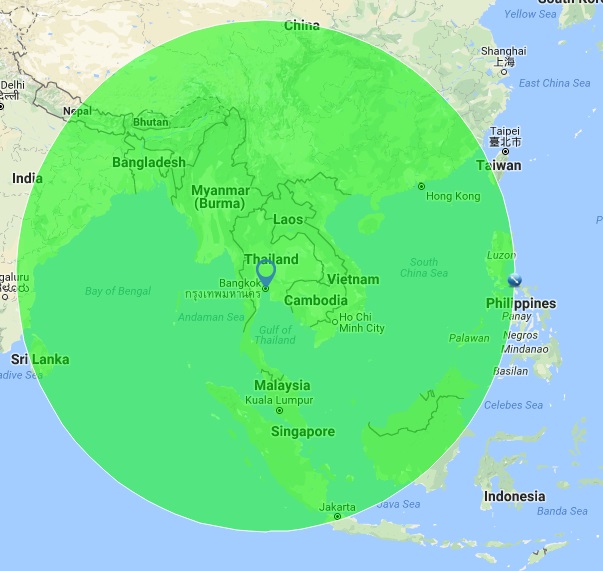
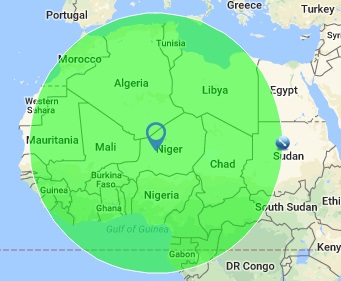
While many write about such studies and their impact on the United States, such a global threat would similarly impact any other part of the world.   To provide context of such a global threat, I have provided impact, using the 1,470 (2365 km) coverage estimate described by numerous scientists of a high-altitude EMP burst at 300 mile above the Earth.  Based on such a 1,470 mile EMP impact area assessment, such a high altitude EMP blast coverage centered above Berlin, Germany would impact ALL of Western Europe, Sweden, Norway, Finland, Denmark, Poland, Germany, Austria, Belarus, Ukraine, Romaina, France, Italy, Spain, Greece, Turkey, Spain, Portugal, including the United Kingdom and Ireland, all the way to Iceland, and across the Mediterranean Sea into Africa (Tunisia, Algeria, Morocco).  Such a 1,470 mile high altitude EMP blast coverage centered above Karchi, Pakistan would impact from Bangladesh to most of Saudi Arabia and Iraq, the Arabian Sea, from Kazakhstan to Sri Lanka.   Such a 1,470 mile high altitude EMP blast coverage centered above Beijing, China, would impact much of Asia, from parts of Russia to Myanmar,  Taiwan, North and South Korea, and Japan.  Such a 1,470 mile high altitude EMP blast coverage centered above Moscow, Russia, would impact Russia and much of Eastern Europe, Ukraine, Lithuania, Latvia, Estonia, Modova, Romania, Bulgaria, Serbia, Kazakhstan, Uzbekistan, Turkmenistan, Georgia, Azerbaijan, and most of Europe including, the northern regions of Norway, Sweden to the southern parts of Greece and Italy, reaching France and the border of the United Kingdom, and south beyond Turkey into Syria.  Similar results would be found with a blast over Bangkok impacting much of Asia, reaching from China to Jakarta, Indonesia, and with a blast over Niger, Africa, impacting much of North Africa from Gabon, Congo, Sudan, reaching north into the Mediterranean Sea all the way to Malta, and from Egypt through most of the Western Sahara.
These calculations and assessment by Dr. Smith, Dr. Ulhrich, and others, are part of a range of scientific assessments.  Yet even the most “conservative” assessments, such as Dr. Jack Liu’s interpretation of D. Hafemeister’s 1983 EMP study, also would demonstrate a catastrophic impact at any part of the world targeted by such a high altitude EMP blast.  Based on Dr. Liu’s assessment, a 250 kiloton high altitude nuclear blast would have an EMP affect over 250 kilometers, or 155 miles.  This too shows an international impact of high altitude EMP blasts, while not as far reaching in sheer miles, still impacting many millions of people across cities, states, and even across borders of different nations.

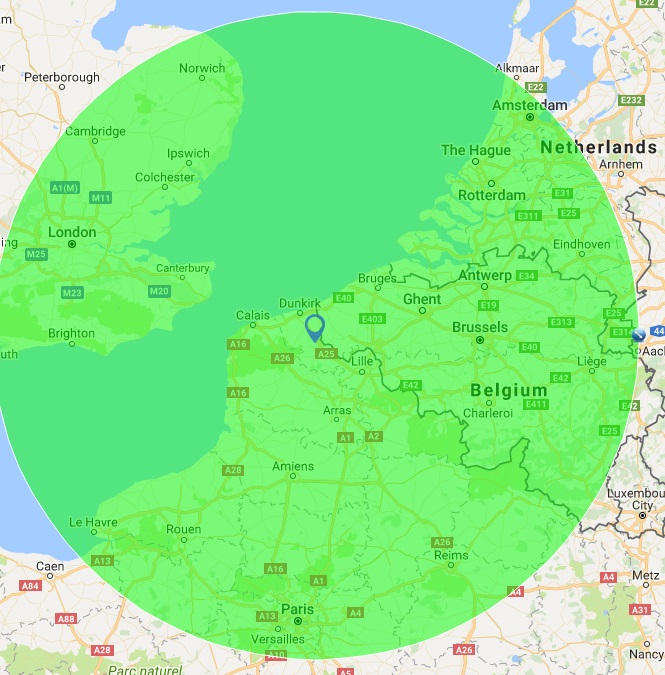
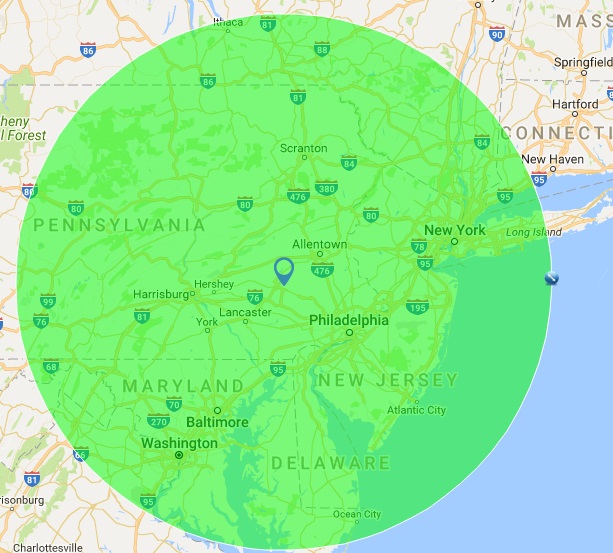
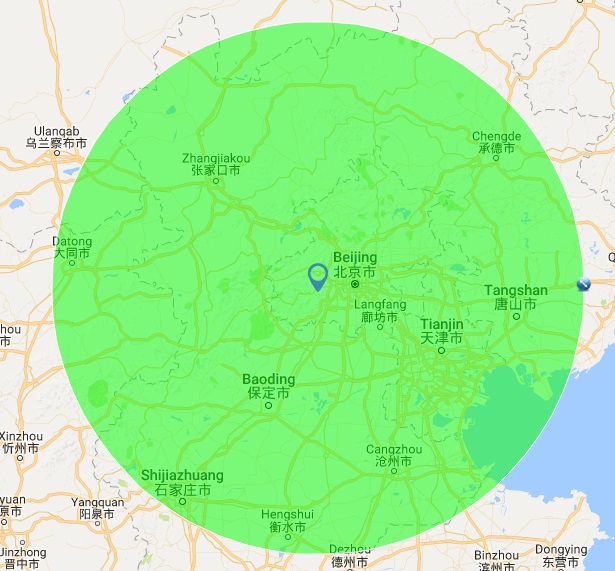
Based on such a 155 mile EMP (250 km) impact area assessment, such a high altitude EMP blast coverage centered above Dunkirk, France would impact most of France, Belgium, Netherlands, and a significant part of the United Kingdom across the English Channel, including major cities of Paris, London, Brussels,  Antwerp, Rotterdam, The Hague, and Amsterdam affecting a combined population of over 28.9 million people.  Such a 155 mile high altitude EMP blast coverage centered above Reading, Pennsylvania (USA) would impact Washington DC, New York City, Philadelphia, Baltimore, MD, Atlantic City, NJ, Connecticut, and Delaware, all the way north to Ithaca, New York, affecting a combined population of over 32 million people. Such a 155 mile high altitude EMP blast coverage centered above slightly east of Beijing, China would impact major Chinese population centers, including Beijing, Shijiazhuang, Langfang, Tianjin, Cangzhou, Baoding, Hengshui, affecting a combined population of over 73.9 million people.   Any one of these single EMP attacks would affect more than the entire population of North Korea (25 million).
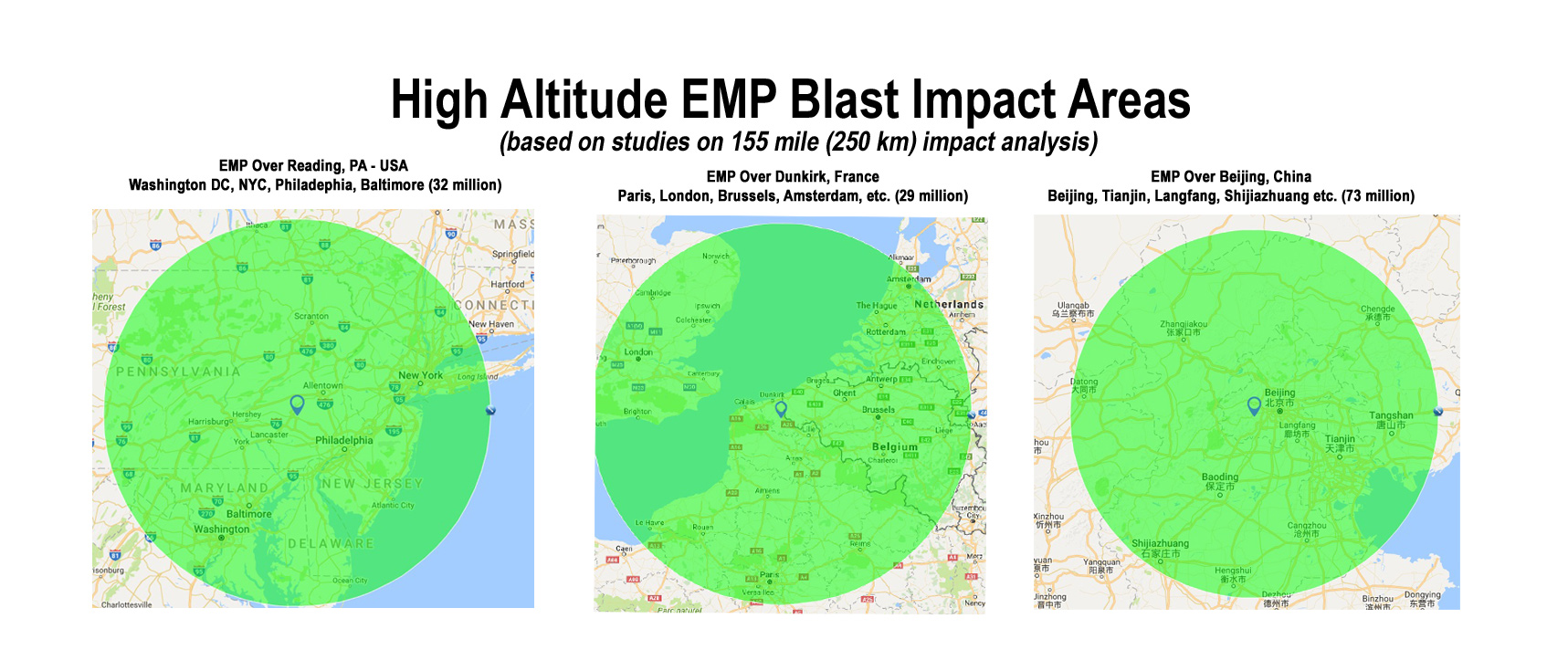
Regardless of the scientific study, analysis, or modeling used, the basic conclusions of a high altitude EMP blast, as boasted by North Korea on September 3, 2017, remains the same: the resulting impact would be a catastrophic terror attack on our fellow human beings – anywhere in the world.  The world must denounce the terror threat and contempt for human life shown by North Korea in its threat against humanity.

North Korea’s September 3, 2017 high altitude EMP blast terror threat is not simply a threat to its regional neighbors or the United States – it is a catastrophic terror threat against the WORLD.

The concept of state-based, transborder, truly “catastrophic terror” threats remains an ongoing struggle to understand and appreciate in security, military, and human rights organizations and the public.  The public hears little discussion or education on such challenges, and the concept of  “catastrophic terror” is not part of most of public’s consideration of geopolitical, security, and human rights issues.  The public is used to relatively contained terror threats that are bound to very limited areas, certainly no larger than a city or cities (with multiple attacks) at the worst.  The concept of catastrophic terror threats, impacting multiple cities, large widespread areas, are typically the worst-case views of Chemical, Biological, Nuclear, and Radiological (CBRN) analysts, seeking to plan for ways to prevent, stop, or contain airborne threats for a regional area, which thus far, the world has seen few examples of truly catastrophic terror.  The primary concern thus far in such planning has been for biological and radiological (e.g., “dirty bomb”) weapons.

What these CBRN security planners have to address catastrophic terror threats in these circumstances that you typically would not have in a high altitude EMP catastrophic terror attack is TIME.  With radiological weapons, radiation sensors would detect changes in atmosphere and allow alerts for the public to go inside within minutes and find areas of protection.  With biological weapons, spreading sickness provides a physical alert of time, and biological detection devices again provide the public with a margin of safety for containment and control.

High altitude EMP blast waves travel at nearly the speed of LIGHT.  A missile can reach from North Korea even to the remote United States within 30 minutes (or less).  By the time, it is understood that it is an EMP blast, it will be too late, the EMP damage will be done nearly instantly, as the EMP waves travel at the nearly the speed of light and would affect the targeted area almost immediately.  The luxury of TIME that is provided with most other catastrophic terror attacks is readily not provided in an EMP attack, and the nature of an EMP attack is such that it would shut down and prevent methods for any communication or warning nearly instantly after the EMP blast.  It is a uniquely difficult catastrophic terror threat to manage, and its global threat anywhere in the world must not underestimated.

In his 1997 testimony, APL Director Dr. Smith stated: “The EMP threat is unique in two respects. First, its peak field amplitude and rise rate are high. These quantities depend upon the rate of rise and the energy of the gamma ray output of the weapon. These features of EMP will induce potentially damaging voltages and currents in unprotected electronic circuits and components.  Second, the area covered by an EMP signal can be immense. As a consequence, large portions of extended power and communications networks, for example, can simultaneously be put at risk. Such far-reaching effects are peculiar to EMP. Neither natural phenomena nor any other nuclear weapon effects are so widespread.”  Dr. Smith also estimated that the EMP blast’s electric field would be “on the order of 50 kilovolts per meter with a rise time on the order of 10 nanoseconds and a decay time to half maximum of about 200 nanoseconds” (50,000 volts per meter) which is double the 25,000 volts per meter in D. Hafemeister’s 1983 study, referenced by Dr. Jack Liu and others.

On October 12, 2017, the U.S. Congress received new unclassified testimony that indicated that North Korea had obtained “Super-EMP” nuclear warheads with the capability with four times the EMP blast’s electric field as estimated by California Polytech’s D. Hafemeister, and double the EMP blast’s electric field as estimated by APL’s Dr. Smith, with the capability of an EMP blast electric field of 100,000 volts per meter.  Such new intelligence publicly provided to the U.S. Congress in October 2017, indicates that North Korea has obtained so-called “Super-EMP” nuclear warheads, designed to maximize a high level of gamma rays to generate EMP E1 pulses which would arrive over a target area at nearly the speed of light. This breakthrough may make previous EMP threat studies obsolete, as they were based on studies of nuclear EMP affects many decades ago, not the current EMP capabilities, that we now know that North Korea has today. According to such new intelligence, the North Korea “Super-EMP” nuclear warheads have EMP capabilities of “over 100,000 volts per meter.”

On October 12, 2017, Dr. Peter Vincent Pry, former Chief of Staff of the Commission to Assess the Threat to the United States from Electromagnetic Pulse (EMP) [aka “EMP Commission”], described a different threat challenge altogether. According to Dr. Pry, U.S. intelligence had learned that North Korea had obtained “Super-EMP warhead[s], capable of generating high intensity EMP fields over 100,000 volts per meter.” According to Dr. Pry’s October 12, 2017 testimony, “In 2004, two Russian generals, both EMP experts, warned the EMP Commission that the design for Russia’s Super-EMP warhead, capable of generating high intensity EMP fields over 100,000 volts per meter, was ‘accidentally’ transferred to North Korea. They also said that due to ‘brain drain,’ Russian scientists were in North Korea, as were Chinese and Pakistani scientists according to the Russians, helping with the North’s missile and nuclear weapon programs. In 2009, South Korean military intelligence told their press that Russian scientists are in North Korea helping develop an EMP nuclear weapon. In 2013, a Chinese military commentator stated North Korea has Super-EMP nuclear weapons.” “Super-EMP weapons are low-yield and designed to produce not a big kinetic explosion, but rather a high level of gamma rays, which generates the high-frequency E1 EMP that is most damaging to the broadest range of electronics. North Korean nuclear tests, including the first in 2006, whose occurrence was predicted to the EMP Commission two years in advance by the two Russian EMP experts, mostly have yields consistent with the size of a Super-EMP weapon. The Russian generals’ accurate prediction about when North Korea would perform its first nuclear test, and of a yield consistent with a Super-EMP weapon, indicates their warning about a North Korean Super-EMP weapon should be taken very seriously.”

One of the challenges in effective reporting on this terrorist threat remains the minimization of such a risk, based on years of counterterrorism thinking on this from a low altitude, microwaved-based EMP threat, or the years of “Cold War” era dismissal of this from the U.S.S.R., based on an agreed upon policy of mature government command and control resources on why we would reject “mutually assured destruction.”

So the terrorist threat of a high altitude EMP blast from a “rogue” nuclear nation has not really been taken very seriously, as the potential actors who might perform such an attack either did not have anything close the capability of this, or had a mature enough military infrastructure to respect the consequences.

So the high altitude EMP blast threat has not been taken seriously until now with the isolated, totalitarian nation of North Korea. Yet even today, a number of factors prevents the public from fully appreciating the terror threat that North Korea represents not only to the region and to the U.S., but to the world.

Thus far, the inability for the public to take this North Korea terror threat seriously is compounded by a number of factors: (1) an unwarranted belief that North Korea does not have significant missile launch capability, (2) an overconfidence that we can consistently eliminate missile threats from North Korea and that North Korea’s ability to target specific cities with a nuclear missile is limited, (3) political partisan personalities viewed as the “real threat” rather than the North Korea years of determination to develop weapons capabilities across many U.S. administrations, (4) the failure to understand that North Korea plans to not only survive a nuclear exchange but win it, (5) the denial that there is “no proof” that an EMP blast will affect electric infrastructure and electronics, and (6) the failure to understand that North Korea’s threat, especially its EMP terror threat is not only a threat to the U.S., but to the world.

Underestimation of North Korea Weapons Capability. The belief that North Korea does not have significant missile launch capability is grounded in Western arrogance and largely disrespect for the North Korean leader Kim Jong Un, as well as some degree of unstated racist views towards North Koreans as “backwards.” Such denial of North Korea weapons capability has increasingly been shown to ignore or be behind publicly demonstrated facts, and a high altitude EMP blast 300 miles in the atmosphere doesn’t sound so impossible when one considers that North Korea launched a missile 2,300 miles into the atmosphere just three months ago. On July 28, 2017, North Korea fired an ICBM missile (Hwasong-14) at an elevated trajectory of 3,700 kilometers (2,300 miles) high and for a distance of 1,000 kilometers (621 miles). On a flatter, standard trajectory, this missile would have traveled along a significantly broader distance, up to 10,400 kilometers (6,500 miles), and some analysts believe North Korea is currently building capability for missile strike of 11,700 kilometers (7,250 miles). Based on a standard trajectory of such a distance, this would have given North Korea the capability to hit deep within the mainland U.S. For context, from a fixed launch made within the North Korea soil, a launch of a missile reaching 6,500 miles could target Chicago, while a missile reaching 7,250 miles could readily target anywhere on the East Coast, including Washington DC (6,850 mi), NYC (6,750 mi), and Boston (6,700 mi). The July launch basically provided evidence that North Korea was only about 200-300 miles away in terms of missile technology of a direct strike on the United States East Coast.  It should be noted than on May 2017, two months before the July missile launch, there was still a widely believed perception that North Korea’s missile capability could only reach to a distance of 3,000 miles.  Furthermore, also as of May 2017, experts on North Korea were still reporting that North Korea’s nuclear bomb capability was only 20 kilotons and assessing threats based on this dramatically outdated intelligence, but by September 3, this was re-assessed as 120 kilotons and shortly thereafter as 250 kilotons.  The North Korea experts have repeatedly underestimated North Korea’s weapons capabilities.
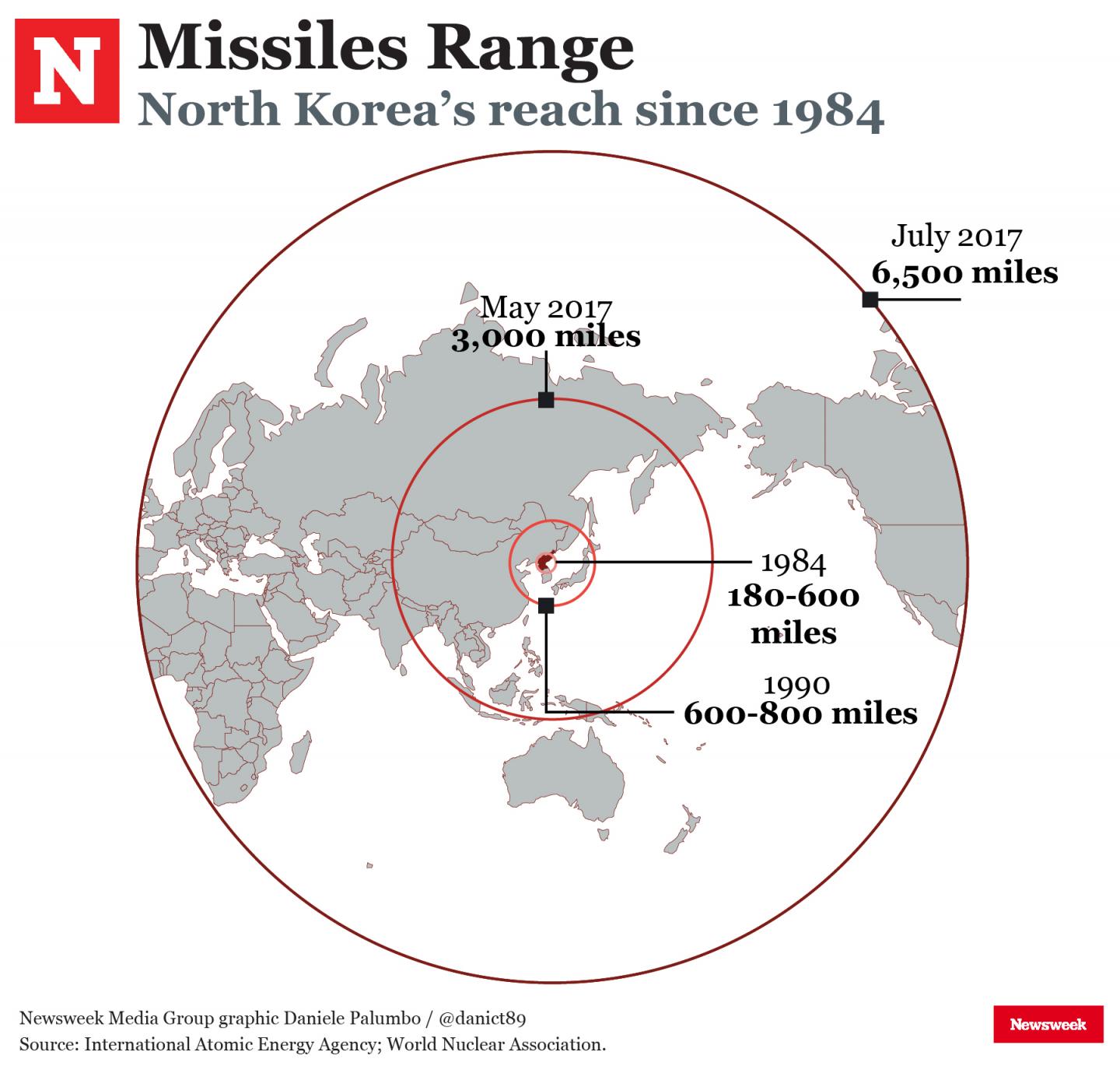
On October 20, 2017, the CIA Director Mike Pompeo warned that North Korea is on the cusp of being able to hit the U.S. with a nuclear missile. He stated “They are close enough now in their capabilities that from a U.S. policy perspective we ought to behave as if we are on the cusp of them achieving.” “We are not out of time… But we are running out of time.” NK News reported that he remarked “U.S. intelligence on the progress of Pyongyang’s nuclear and ballistic missile development was imprecise, he stipulated, saying that ‘when you’re now talking about months, our capacity to understand that at a detailed level is in some sense irrelevant’.” North Korea has demonstrated the ability to have missile launches at high altitudes over land masses; the North Korea September 15, 2017 missile launch over the Japanese island of Hokkaido, was reported as 475 miles in the atmosphere (770 kilometers) over Japan at the apogee of its flight path.   Another limitation that the U.S. has on the missile challenge is the belief that North Korea’s mobile missile launching capability is only limited to launches from its mainland, when it has been continuing to improve and test on Submarine Based Launch Missiles (SBLM) for a long time, with a fleet of a reported 60 submarines.  Too many in the U.S. are overconfident that only land-launched North Korea missiles can be easily targeted by U.S. missile intercept defenses, with the assumption that North Korea can only launch high altitude missiles over Guam towards the U.S., and that our intercept defenses can be sufficient to deal with a cluster of missiles that could be launched with a nuclear and/or nuclear EMP missile within a missile cluster.  Individuals interviewed in defense roles continue to state that they believe the North Korea still has a significant amount of development yet to complete in missile guidance and re-entry capability.  This confidence does not take into consideration that for a high-altitude EMP missile, re-entry and missile guidance for pinpoint surface attacks are not a necessity.

Missile Defense and Complex, Catastrophic Terror Threat. Given the vast expenditures in missile defense systems, Americans certainly do seek to have confidence in their effectiveness in stopping missiles launched at the United States. However, that confidence should also be based on an understanding of what such defense systems actually do. Shipboard Aegis systems are designed to target specific types of missiles, and are designed to defend thousands of square kilometers. However, to be able to shoot down a missile such as the one launched by North Korea on September 15, 2017 over Japan with an apogee of 475 miles in the atmosphere, a U.S. ship with a Aegis missile defense would need to be virtually in North Korea waters and would have to be ready to strike nearly instantly with the short 1-to-2 minute timeframe to “chase” such a missile in the air at such altitudes. THAAD and Patriot missile defenses are designed for missiles coming down, in the post-mid-course or terminal phases. So essentially other than planning to have perfect readiness and success with Aegis, the U.S. missile defense is largely dependent on the Ground-Based Midcourse Defense (GMD) interceptors based in Alaska and California. In July 2017, the Washington Post reported that Pentagon’s leading weapons tester, the Directorate of Operational Test and Evaluation, found that in staged tests, the GMD system took out test missile in 10 out of 17 tests, and a recent CBS “60 minutes” interview suggested that the GMD interceptor system was showing a “55 percent success rate”  in terms of its defensive capabilities. Most importantly, to understand in the case of the North Korea EMP threat, the missile needs only to explode in the atmosphere. It does not have to have “re-entry” capability like other nuclear surface missiles, nor does it need to have a precision “targeting” system to hit a specific targeted city.

Politics and the Actual North Korea Threat. We know from history that terrorist violence against the public impacts people from every political viewpoint, which is why it is essential that terror threats be impartially assessed based on public safety issues, not political concerns or partisan views.  In the politically charged atmosphere of the United States, political partisans (and particularly the U.S. political media) are more focused on U.S. President Trump than on the ongoing North Korea terrorist threat situation. The reality is that the North Korea terror threat will exist no matter who is in public office in the U.S., and it is a threat that has been building for many decades across multiple administrations controlled by different political parties.  There are those who are more interested in proving President Trump is “wrong” on anything as their real priority, rather than objectively assessing the situation that has been developing for a long time with North Korea, including a nuclear bomb and missile tests during President Obama’s administration. On November 4, 2017, New York Times writer Nicholas Kristof wrote: “Trump didn’t create the problem, and it’s real: We should fear North Korea’s gaining the capacity to destroy U.S. cities. Eerily, on my last visit, North Koreans repeatedly said that a nuclear war with the U.S. was not only survivable but winnable.” Mr. Kristof is neither a fan of President Trump, nor is he “conservative.” But in a charged political world, there is reality that some facts actually exist as facts, regardless of one’s political viewpoints. North Korea has been working to develop such aggressive weapons capabilities for a long-time, including working with Pakistan nuclear physicist Abdul Qadeer Khan, which Mr. Khan admitted to in 2004, and which began as early as 1993. North Korea did not simply begin its nuclear bomb ambitions in 2017 after President Trump took office, but has been actively involved in seeking to develop nuclear bombs for decades. These historical facts are conveniently forgotten by the U.S. political media when reporting on the North Korea’s nuclear bomb and ICBM breakthroughs in 2017, as if these are “sudden” advancements, rather than the achievements of decades of work, testing, and determination by North Korea. The idea that North Korea could threaten not only nuclear bomb attacks, but also a high altitude EMP threat, which could impact a much larger segment of the world, and the focus remains primarily on the U.S. administration, demonstrates how significantly the U.S. media is failing to recognize the very real and serious security and human rights threat that North Korea presents to the world.

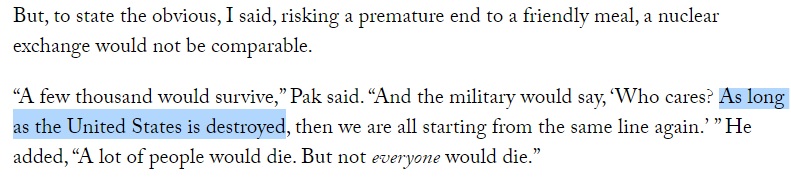
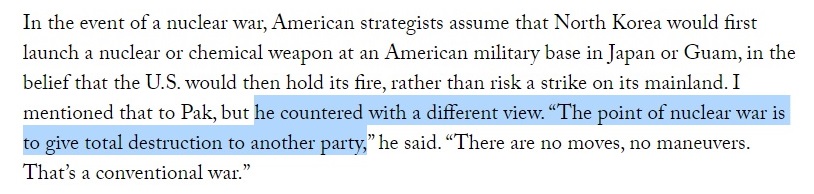
North Korea Confidence in Winning Nuclear Exchange.  Multiple U.S. media figures have interviewed North Korea government leaders with astonishment over the North Korea lack of concern, even confidence, in a nuclear war with the United States.  The message that Americans are failing to understand is that there are leaders in North Korea that not only expect to “survive” a nuclear war exchange with the United States, but also to be victorious in such a war.   Such report have come from Nicholas Kristoff (New York Times)and Evan Osnos (New Yorker). The NYT’s Nicholas Kristof wrote that North Korea governments leaders view “nuclear war is imminent but survivable.” “This military mobilization is accompanied by the ubiquitous assumption that North Korea could not only survive a nuclear conflict, but also win it.” In addition, according to Kristof, the North Korea people also believe this: “Ryang Song-chol, a 41-year-old factory worker, looked surprised when I asked if his country could survive a war with America. ‘We would certainly win,’ he said.” Kristof has also appeared on NBC television sharing this report.

The New Yorker’s Evan Osnos reported a similar discussion with North Korea government representatives, including North Korea Foreign Ministry’s Pak Song Il, who told Osnos “‘A few thousand would survive,’ Pak said. ‘And the military would say, ‘Who cares? As long as the United States is destroyed, then we are all starting for the same line again.’ He added, ‘A lot of people would die. But not everyone would die.” Osnos also wrote: “In the event of a nuclear war, American strategists assume that North Korea would first launch a nuclear or chemical weapon at an American military base in Japan or Guam, in the belief that the U.S. would then hold its fire, rather than risk a strike on its mainland. I mentioned that to Pak, but he countered with a different view. ‘The point of nuclear war is to give total destruction to another party,’ he said. ‘There are no moves, no maneuvers. That’s a conventional war.’ ”

Like other extremists, the North Korea state-based terror views global threats using nuclear and EMP devices to further the cause of their goals in Korean unification as well as mass violence and destruction towards any that oppose their ambitions.  North Korea does not need nuclear weapons or EMP blasts for “deterrence” in preserving its regime, any more than it has needed such weapons of mass destruction over the past 64 years since the armistice (July 27, 1953) in the Korea War to preserve the North Korea regime.  North Korea has had deterrence for all of these decades by its armed proximity to U.S. ally nations, which it has regularly threatened to use its existing weapons against such area U.S. ally nations, as methods of North Korea world policy.  The claims that it now needs such advanced weapons to ensure “deterrence” are based on those unfamiliar with history.

False Claims of Lack of “Proof” of EMP Threats.  Despite the magnitude of a nuclear dictatorship threatening to use a high altitude EMP weapon against the world, there are those who find a receptive U.S. media in claiming there is no real “proof” that EMP weapons are a threat.  On November 1, 2017, Wired Magazine’s Brian Barrett provided a voice to such dismissal of EMP threats in an article entitled “North Korea’s Plenty Scary Without an Overhyped EMP Threat.”  Wired Magazine used to be focused on technology issues, but in recent years, has migrated to focus on cultural and political topics.  Brian Barrett focuses his explanation on how EMP is an “overhyped threat,” by referencing to a 91-year old former Maryland Congressman Roscoe Bartlett, who Brian Barrett believes has exaggerated the EMP threat.  (Mr. Bartlett lives in a remote location, not dependent on electronic technology.)

Wired writer Brian Barrett has ready access to all of the scientific testimony, is aware of the 1962 Starfish Prime testing, and is aware of documented studies and testimony from physicists and scientists, so there is no lack of information in this case.  It is simply Wired writer Brian Barrett’s choice to believes the way to “prove” that EMP is “overhyped” is by targeting a retired politician.  This is the challenge with an increasing political focus of U.S. media on virtually every topic.  But when it comes to catastrophic terror threats, such political tunnel vision is more than short-sighted, but it is openly dangerous in public policy discussions.   Wired writer Brian Barrett also interviews Dr. Peter Pry, but Barrett seeks to reject Dr. Pry’s views because the EMP Commission that Dr. Pry was leading did not get funds for continuing in FY 2018.

Ignoring most of the other physicists, scientists from John Hopkins’ Applied Physics Laboratory, California Polytechnic University, and MIT associated with EMP studies, Wired writer Brian Barrett also interviews two other individuals, Philip Coyle and  Sharon Burke.  Philip Coyle is a senior science fellow at the Center for Arms Control and Non-Proliferation, and is not an expert in EMP studies, but this is primary “expert” that Wired journalist uses to try to discredit EMP threats (which we know for a fact since 1962 exist).  Barrett concludes simply that Coyle is “skeptical as to the true impact of the type of nuclear-based attack outlined by the EMP Commission.”  Barrett quotes Coyle as stating “I don’t know how the proponents of EMP get such huge results. I just don’t follow their logic.”  Wired writer Brian Barrett does not state what “huge results” that Philip Coyle doubts or what “logic” he is questioning, he just simply provides such a vague quote as his type of “proof” that “people” question EMP threats and moves on.  Wired writer also quotes Sharon Burke with the New America Foundation, who states “There’s still not proof that it would destroy a wide area of electrical equipment today,” ignoring the actual test results seen in the 1962 high altitude Starfish Prime nuclear test, and repeated documented testimony from  Dr. Gary L. Smith, Director, Applied Physics Laboratory (APL), Johns Hopkins University, Dr. George W. Ullrich, Deputy Director, Defense Special Weapons Agency, and others who actually had direct knowledge of such tests and EMP impacts.

One of the repeated recommendation of EMP scientists and physicists was that the Defense Department improve its protection and readiness for electrical equipment from an EMP blast.  Reportedly efforts to do so have been scaled back or halted in recent years. New America Foundation’s Sharon Burke, quoted by Wired writer Brian Barrett, as claiming there is “no proof” of the EMP threat, also previously served in the Assistant Secretary of Defense for Operational Energy in the Obama administration.   In her statements of the lack of “proof” by high altitude EMP nuclear blasts, Sharon Burke (and Wired writer Brian Barrett) conveniently neglect to mention that meaningful tests would be prohibited under the Comprehensive Nuclear-Test-Ban Treaty, signed by the United States in 1996.

As to the issue of “proof” of consequences of a high altitude EMP nuclear blast, the only true scientific “proof” would be to have more high altitude nuclear EMP blasts (which we cannot do under the 1996 Comprehensive Nuclear-Test-Ban Treaty.)  We also haven’t done such tests, due to a lack of interest or unwillingness to gather information, but for the obvious reason that the tests done thus far demonstrated a significant danger and risk to public safety and electrical infrastructure, that full scale public “testing” would be a threat to the public to repeat.  Like other terror threats, we do not need to do full scale public testing of every threat to recognize the danger.  We do not regularly conduct public radiological “dirty bomb” tests.  We do not regularly conduct weaponized smallpox or anthrax tests on the public, or conduct cyanide or ricin chemical weapon tests in public conditions to ensure that we have absolute “proof” that they will “work.”  As high altitude EMP blasts actually interact with the Earth’s atmosphere and magnetic fields, the idea that without more “proof” in the field, we can’t really believe it is a threat is reckless. Scientists conduct laboratory tests to mimic conditions to the extent possible, but the argument that with “field tests” of any terror threats, we don’t have “proof” of the threat is not rational.

Failure to Grasp EMP as a Global Threat.  The idea that a high altitude EMP blast is an American problem is as illogical and irresponsible as suggesting that any other type of terror threat, natural disaster, and threat to our shared human rights of security is limited only to one geographic area or region.  The reality is that a terror threat or any type of natural disaster can endanger the public in any part of the world, and our shared human rights of security should gain the focus of human rights activists on the lives and safety of people anywhere in the world threatened by weapons and acts of terror.   As R.E.A.L. has pointed out such high altitude EMP blasts, even with the most conservative estimates, can impact not only millions in diverse cities, states, and regions, but also in multiple countries with a single high altitude EMP blast.  High altitude EMP weapons represent a global terror threat to all of the world.  Among other nations of the world facing catastrophic terror from such weapons, R.E.A.L. points to Communist China to reconsider even the most conservative EMP terror weapon would have over the Beijing area, and the likely 73 million impacted by such an attack.  It is troubling to see the failure of security analysts to bring such an obvious incentive to China’s attention in dealing with the North Korea threat to world peace and security.

The concept that a high altitude EMP blast is a “military weapon” is as misguided and reckless as the idea that weaponized anthrax, ricin, cyanide, or other banned weapons are acceptable as anything less than weapons of terror in the 21st century.  We have international conventions which explicitly ban the use and stockpiling of such weapons by responsible nations for military purposes, but we have yet to ban the use of high altitude EMP weapons.  We recognize other banned weapons as used by those supporting acts of terror, and it is time to recognize high altitude EMP weapons as the same type of banned weapon, as biological and chemical weapons, only to be used by terrorist actors.

R.E.A.L. has not sought to provide this description of the North Korea call for a catastrophic terror threat using high altitude EMP blast as anything more than to recognize that this is a terror threat, and moreover, it is a global terror threat, not just a terror threat to the United States of America.  With that basis, there is enough serious threat information on high altitude EMP blasts that those supporting our shared human rights and security need to take such a catastrophic terror threat seriously.   Terror attacks rarely target individuals of only one political or identity group, despite the intent of terrorist actors.  We know all too well the painful lessons of failing to take terror threats seriously, and the U.S. and the world has paid the price in suffering and the loss of innocents lives repeatedly.

We can learn our lessons from the past.  We can work as nations to have better infrastructure and individual preparedness against such threats. The nations of the world can also unite in their determination that those individual terrorist actors, or state sponsors of terror such as North Korea, know that the world will not accept and will not stand by as threats or acts of catastrophic terror are made against our fellow human beings.

To North Korea and its leaders, as R.E.A.L. has repeatedly stated and implored in your language to you, we urge to stop your path of threats of catastrophic terror and nuclear bomb violence against the world, and renounce such unnecessary and suicidal weapons of mass destruction that will bring no peace to your nation, the region, or the world.


North Korea Crimes Against Humanity and Weapons of Mass Destruction

Responsible for Equality And Liberty (R.E.A.L.) has long supported the human rights and dignity of North Korea people, and those held captive and kidnapped by its totalitarian government. It is astounding that in the political partisan charged environment of 2017, so many are willing to ignore and forget the ongoing Crimes Against Humanity by the Communist North Korea government, its leadership, and as documented not only by the United Nations, but also by defectors from that totalitarian regime.

Humanity cannot simply “forget” an unrepentant totalitarian regime which continues to commit, and has a long history of Crimes Against Humanity.   The long history of horrific murders, concentration camps, and inhuman treatment against its own citizens should give ethical pause to those who believe North Korea can be responsible and restrained once it has nuclear weapons of mass destruction.

On March 21, 2013, the United Nations Human Rights Council announced that it had “established the Commission of Inquiry on Human Rights in the Democratic People’s Republic of Korea (DPRK). Resolution A/HRC/RES/22/13 mandates the body to investigate the systematic, widespread and grave violations of human rights in the Democratic People’s Republic of Korea, with a view to ensuring full accountability, in particular for violations which may amount to crimes against humanity.” The U.N. stated that among the violations to be investigated were “those pertaining to the right to food, those associated with prison camps, torture and inhuman treatment, arbitrary detention, discrimination, freedom of expression, the right to life, freedom of movement, and enforced disappearances, including in the form of abductions of nationals of other States.”

In 2014, the United Nations provided a report on these North Korea Crimes Against Humanity, by the UN Commission of Inquiry (COI) on the human rights situation in North Korea.  It issued a 36 page summary, and a nearly 400 page report of its full findings.  As the International Society of Human Rights (ISHR) reported, “Since the UN experts were denied entry to North Korea, the Commission interviewed 80 witnesses in public hearings and 240 people behind closed doors in Seoul, Tokyo, London and Washington on the situation in North Korea.” The U.N. commission’s public hearings are still available for the public to see.

The U.N. commission’s report summarized “crimes against humanity” by the North Korea government. The U.N. commission reported that: “the commission finds that the body of testimony and other information it received establishes that crimes against humanity have been committed in the Democratic People’s Republic of Korea, pursuant to policies established at the highest level of the State.” It stated “These crimes against humanity entail extermination, murder, enslavement, torture, imprisonment, rape, forced abortions and other sexual violence, persecution on political, religious, racial and gender grounds, the forcible transfer of populations, the enforced disappearance of persons and the inhumane act of knowingly causing prolonged starvation. The commission further finds that crimes against humanity are ongoing in the Democratic People’s Republic of Korea because the policies, institutions and patterns of impunity that lie at their heart remain in place.” “Persons detained in political and other prison camps, those who try to flee the State, Christians and others considered to introduce subversive influences are the primary targets of a systematic and widespread attack against all populations that are considered to pose a threat to the political system and leadership of the Democratic People’s Republic of Korea. This attack is embedded in the larger patterns of politically motivated human rights violations experienced by the general population, including the discriminatory system of classification of persons based on songbun.” “In addition, the commission finds that crimes against humanity have been committed against starving populations, particularly during the 1990s. These crimes arose from decisions and policies violating the right to food, which were applied for the purposes of sustaining the present political system, in full awareness that such decisions would exacerbate starvation and related deaths of much of the population.” “Lastly, the commission finds that crimes against humanity are being committed against persons from other countries who were systematically abducted or denied repatriation, in order to gain labour and other skills for the Democratic People’s Republic of Korea.”

The UN Commission of Inquiry on the human rights situation in North Korea concluded that: “Systematic, widespread and gross human rights violations have been and are being committed by the Democratic People’s Republic of Korea, its institutions and officials. In many instances, the violations of human rights found by the commission constitute crimes against humanity. These are not mere excesses of the State; they are essential components of a political system that has moved far from the ideals on which it claims to be founded.”

The U.N. commission concluded: “The gravity, scale and nature of these violations reveal a State that does not have any parallel in the contemporary world. Political scientists of the twentieth century characterized this type of political organization as a totalitarian State: a State that does not content itself with ensuring the authoritarian rule of a small group of people, but seeks to dominate every aspect of its citizens’ lives and terrorizes them from within.”

The U.N. commission further concluded that “The Democratic People’s Republic of Korea displays many attributes of a totalitarian State: the rule of a single party, led by a single person, is based on an elaborate guiding ideology that its current Supreme Leader refers to as ‘Kimilsungism-Kimjongilism’. The State seeks to ensure that its citizens internalize this guiding ideology by indoctrinating citizens from childhood, suppressing all political and religious expression that questions the official ideology, and tightly controlling citizens’ physical movement and their means of communication with each other and with those in other countries. Discrimination on the basis of gender and songbun is used to maintain a rigid social structure that is less likely to produce challenges to the political system.” “The key to the political system is the vast political and security apparatus that strategically uses surveillance, coercion, fear and punishment to preclude the expression of any dissent. Public executions and enforced disappearance to political prison camps serve as the ultimate means to terrorize the population into submission. The State’s violence has been externalized through State-sponsored abductions and enforced disappearances of people from other nations. These international enforced disappearances are unique in their intensity, scale and nature.” “Today, the Democratic People’s Republic of Korea finds itself surrounded by a world that is changing rapidly in political, economic and technological terms. These changes offer opportunities for incremental social change within the State. Inresponse, the authorities engage in gross human rights violations so as to crack down on ‘subversive’ influences from abroad. These influences are symbolized by films and soap operas from the Republic of Korea and other countries, short-wave radio broadcasts and foreign mobile telephones. For the same reason, the State systematically uses violence and punishment to deter its citizens from exercising their human right to leave the country. Persons who are forcibly repatriated from China are commonly subjected to torture, arbitrary detention, summary execution, forced abortion and other forms of sexual violence.”

The U.N. commission also concluded: “A number of long-standing and ongoing patterns of systematic and widespread violations, which were documented by the commission, meet the high threshold required for proof of crimes against humanity in international law. The perpetrators enjoy impunity. The Democratic People’s Republic of Korea is unwilling to implement its international obligation to prosecute and bring the perpetrators to justice, because those perpetrators act in accordance with State policy.” “The fact that the Democratic People’s Republic of Korea, as a State Member of the United Nations, has for decades pursued policies involving crimes that shock the conscience of humanity raises questions about the inadequacy of the response of the international community.” The commission further called for action by the International Criminal Court (ICC): “The Security Council should refer the situation in the Democratic People’s Republic of Korea to the International Criminal Court for action in accordance with that court’s jurisdiction. The Security Council should also adopt targeted sanctions against those who appear to be most responsible for crimes against humanity.”

Michael Kirby, Chairman of the UN Commission on North Korea, stated at a press conference after the commission issued its report on February 17, 2017: “These are the ongoing crimes against humanity happening in the DPRK which our generation must tackle urgently and collectively. The rest of the world has ignored the evidence for too long. Now there is no excuse because now we know.” “At the end of the Second World War, so many people said ‘If only we had known…!’ Now the international community does know…. there will be no excusing a failure of action.”  The Chairman of the U.N. Commission also directly linked Kim Jong Un to these Crimes Against Humanity, stating: “as all lines of authority stop at the Supreme Leader the question was also presented to the commission as to whether the Supreme Leader of DPRK Kim Jong Un would or may himself be responsible for the Crimes Against Humanity.”  The Chairman of the U.N. commission stated that as they were “not a prosecutorial body,” it was not their role to make that determination, but now the world had the facts and report on the Crimes Against Humanity in North Korea.

Over the years, endless reports of witnesses of such Crimes Against Humanity by North Korea have come forward to speak, as reported by the BBC, the Daily Mail, and many other media sources. Former North Korea prison guard Lim Hye-jin reported on the routine murders, torture, beheadings, and setting people on fire alive in the North Korea concentration camps.  The many witnesses reported of endless and merciless Crimes Against Humanity by North Korea in these concentration camps.  Some have compared the Communist North Korea concentration camps to Adolf Hitler’s horrific death camps.  But one escapee, Kang Chol-hwan,  stated that the protracted torture in North Korea camps had a different focus: “While Auschwitz’s goal was rapid, industrial-style extermination, Yodok prolongs the suffering over three generations. ‘The purpose of Yodok is to be but one facility that helps sustain the regime and cleanse the North Korean people of any freedom of thought.'”  According to One Free Korea, “The Committee for Human Rights in North Korea estimates that North Korea holds as many as 120,000 people in its system of concentration and detention camps, and that 400,000 people have died in these camps from torture, starvation, disease, and execution.”

Communist North Korea Concentration Camps

After the terrorist murder of Kim Jong Nam using chemical weapon VX by North Korea in Malaysia airport in 2016, the Voice of America reported that: “In 2014 the United Nations General Assembly voted to refer North Korea to the International Criminal Court (ICC) for crimes against humanity, after a Commission of Inquiry report documented ongoing atrocities in North Korea that include incarcerating over 120,000 people in political prisons, as well as systematic abuses that included torture, enslavement, rape and murder. The measure has since stalled in the U.N. Security Council, where the Pyongyang’s allies, China and Russia, are believed to be preventing it from coming to a vote.”

On March 24, 2017, the U.N. Human Rights Council passed a resolution (without a vote) to authorize the use of criminal justice experts to develop legal approaches in the eventual prosecution of North Korea for these crimes against humanity. Yet nothing has happened on this, and in the interim, the Communist North Korea totalitarian nation accused of such Crimes Against Humanity continue to develop more and more advanced nuclear weapons of mass destruction.

The protracted history of Communist North Korea’s totalitarian government, its use of an ethnic nationalism based on minjok concept of racial superiority (analyst Brian Myers calls it “race-based paranoid nationalism”), and its well-documented Crimes Against Humanity must be taken seriously as a priority by the international community.  The idea that Communist North Korea is being permitted, due to the continuing failure of Communist China and Russia to act on serious sanctions and international law, to stop the growth of such Crimes Against Humanity, while simultaneously failing to stop Communist North Korea’s ambitions for nuclear weapons of mass destruction, is nothing less than contempt for international human rights and security.  The growing threats by Communist North Korea to commit attacks on Japan, South Korea, the United States, and any others that might halt its aggressive ambitions, must be challenged and rejected.

R.E.A.L. calls upon the international community, including Communist China and Russia, to take meaningful and significant steps to stop the nuclear weapons of mass destruction sought by North Korea, which has been documented in committing Crimes Against Humanity.

R.E.A.L. calls upon the people in North Korea to reject the direction of their leaders in seeking to make war and violence against the world, and to sacrifice the lives of North Korea people as acceptable. Such calls for violence and threats are an attack on our shared human rights, and the North Korea public who have long suffered under terrible conditions deserve the same basic human rights as the rest of the world’s public, under our shared universal human rights. Our human rights of security are not the right to threaten to attack and destroy people and nations around the world. R.E.A.L. urges the North Korea public to call for an end to these threats and calls for violence.
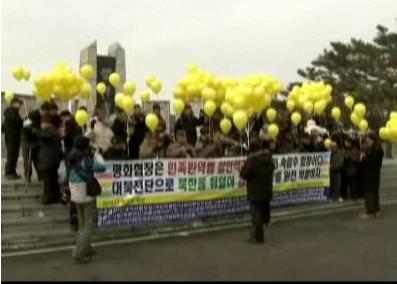
Choose Love, Not Hate. Love Wins.

North Korea States Nuclear War Acceptable to Destroy USA, Threatens Other Nations

Responsible for Equality And Liberty (R.E.A.L.) calls for responsible and ethical citizens in the nation of North Korea to stop efforts by its leadership to continue to promote global violence. We have seen many threats by North Korea to attack other countries around the world in recent weeks and months, most notably a North Korean missile that flew over the island of Hokkaido of Japan on August 28, 2017, and repeated threats to launch missiles against the United States of America (USA) in Guam and the USA mainland. R.E.A.L. urges the North Korean people that the path to progress is through peace and respect for our shared human rights.

Japanese media Asahi Shimbun reported on September 11, 2017 that its sources in North Korea indicate that the Communist nation is threatening cyberattacks on South Korea, Japan, and the USA.

But most notable is a new New Yorker report, for its September 18, 2017 issue, entitled “The Risk of Nuclear War with North Korea,” by political journalist Evan Osnos, recounting his discussions and experience during a recent visit within North Korea. Within this long and nuanced article, Mr. Osnos has discussions where representatives of the North Korea government and military seek nothing less than the destruction of the USA, as one of their main goals in pursuing missiles and nuclear bombs, which can threaten the world.  To those who simply read the introduction of this 42 page report, this would not be clear.  The introduction provides the standard U.S. political media narrative, how the Communist North Korea’s decades of threats are primarily aggravated by the current U.S. administration, etc.
Yet much further into the report (pages 22-23), we see a totally different and essentially important fact: North Korea government and military representatives believe that a full-scale nuclear war is not only survivable, but may be acceptable if it results in the destruction of the USA.

Pak Song Il, of the North Korea Government’s Foreign Ministry’s Institute for American Studies, was the guide for U.S. political journalist Evan Osnos. In a moment of brutal candor, Pak Song Il told Evan Osnos that a full scale nuclear war with the USA was survivable, and the North Korea military would consider such a war acceptable to achieve the “destruction of the United States.”

North Korea Government’s Pak Song Il repeatedly states that such full scale nuclear destruction of the USA would be a North Korea objective. At one point in the article, Pak Song Il explains that such total destruction is the only point of such nuclear war.

On pages 22 and 23 of the article, Evan Osnos writes that Americans assume “[i]n the event of a nuclear war, American strategists assume that North Korea would first launch a nuclear or chemical weapon at an American military base in Japan or Guam, in the belief that the U.S. would then hold its fire, rather than risk a strike on its mainland.” Evan Osnos continues: ” I mentioned that to Pak, but he countered with a different view. ‘The point of nuclear war is to give total destruction to another party,’ he said. ‘There are no moves, no maneuvers. That’s a conventional war.'”

Evan Osnos continues this line of question: “[a]t lunch, I asked Pak, ‘If your country would be destroyed in a nuclear exchange, why are you really entertaining the idea?’ North Korea, he said, is no stranger to devastation: ‘We’ve been through it twice before. The Korean War and the Arduous March’—the official euphemism for the famine of the mid-nineties. ‘We can do it a third time.’ ”

Screenshot: “The Risk of Nuclear War with North Korea,” New Yorker, Evan Osnos, pp 22-23

Evan Osnos tries to understand, but the point is his world-view does not allow him to understand that there are those in North Korea that would consider nuclear war, including on North Korea as acceptable to “destroy” the United States. Evan Osnos writes: “But, to state the obvious, I said, risking a premature end to a friendly meal, a nuclear exchange would not be comparable. ‘A few thousand would survive,’ Pak said. ‘And the military would say, ‘Who cares? As long as the United States is destroyed, then we are all starting from the same line again.’ ‘ He added, ‘A lot of people would die. But not everyone would die.'”

Screenshot: “The Risk of Nuclear War with North Korea,” New Yorker, Evan Osnos, pp 22-23

R.E.A.L. urges world and American security advisors concerned about global human rights and security to ask serious questions about this increasingly aggressive and violent position from Communist North Korea. There is a urgent need to recognize that such aggression can quickly be turned on other people around the world, and it must be discouraged by those responsible activists and leaders in human rights.

R.E.A.L. calls upon the people in North Korea to reject the direction of their leaders in seeking to make war and violence against the world, and to sacrifice the lives of North Korea people as acceptable. Such calls for violence and threats are an attack on our shared human rights, and the North Korea public, who have long suffered under terrible conditions deserve the same basic human rights as the rest of the world’s public, under our shared universal human rights. Our human rights of security are not the right to threaten to attack and destroy people and nations around the world. R.E.A.L. urges the North Korea public to call for an end to these threats and calls for violence.
Choose Love, Not Hate. Love Wins.

Communist North Korea Threat of EMP and Nuclear Weapon to World Human Rights

Responsible for Equality And Liberty (R.E.A.L.) has warned for many years of the human rights in Communist totalitarian North Korea. R.E.A.L. has reported about the North Korea concentration camps, starvation of vulnerable public and abandonment of children in North Korea. We have seen the singular focus of Communist North Korea’s development of weapons of mass destruction. North Korea’s primary ideologies is one of “tanil minjok” (pure race), which seeks a warlike “minjok” against the rest of the world.  This is an excuse for war by the North Korean dictator; it is not true and not based in reality. It similar to the same rationale that the Axis powers used during World War II.
Starving Orphans in Communist North Korea

R.E.A.L. calls upon responsible members of the North Korea society to bring an end to growing efforts at violence in their nation today.

R.E.A.L. Publicly Call for North Korea to Renounce its Nuclear Weapon Ambitions and Threats against the World Public

The current threat of a North Korea nuclear bomb or use of it as an Electromagnetic Pulse (EMP) device is a threat to the world. Not only are such nuclear bomb weapons a threat to world peace, the calls by the North Korea government to use such a weapon for a “super-powerful EMP attack” has the capability of threatening the lives of many more individuals, including those vulnerable individuals depended on the shared electrical grid dependent on such resources for their survival.

On September 3, 2017, the Government of North Korea (DPRK) made such a threat, using its KCNA news agency in a report entitled “Kim Jong Un Gives Guidance to Nuclear Weaponization.” In the report, the North Korea government stated that Communist dictator Kim Jong Un met ith “senior officials of the Department of Munitions Industry of the Central Committee of the Workers’ Party of Korea (WPK) and scientists of the Nuclear Weapons Institute before being briefed on the details of nuclear weaponization. The institute recently succeeded in making a more developed nuke, true to the strategic intention of the WPK for bringing about a signal turn in nuclear weaponization.” It further stated: “The scientists further upgraded its technical performance at a higher ultra-modern level on the basis of precious successes made in the first H-bomb test. The H-bomb, the explosive power of which is adjustable from tens kiloton to hundreds kiloton, is a multi-functional thermonuclear nuke with great destructive power which can be detonated even at high altitudes for super-powerful EMP attack according to strategic goals.”

KNCA Text on September 3, 2017 with Communist North Korea Government Threat

Some “experts” told the New York Times, they are skeptical of the North Korea’s full “hydrogen bomb” level of testing.

While many believe this to be a threat targeted towards only the United States of America (U.S.A.), the reality is the Communist North Korea threat is a threat to world peace for all people and all nations. As recent research shows, the expanded North Korea threat will target all nations, both in nuclear strikes and possible EMP destruction. On July 21, 2017, North Korea fired a missile at an elevated trajectory of 3,700 kilometers (2,300 miles) high and for a distance of 1,000 kilometers (621 miles). On a flatter, standard trajectory, this would be a significantly broader distance, up to 10,400 kilometers (6,500 miles), and some analysts believe North Korea is building capability for missile strike of 11,700 kilometers (7,250 miles).

Estimated Current Range of Communist North Korea Missiles Threat to World

A high-altitude EMP attack could be achieved by a nuclear weapon detonated at 30-400 kilometers altitude above the atmosphere. On July 21, 2017, the world discovered that this was definitely a possible threat by the Communist North Korean government, and one that it could possibly achieve quickly and without warning.

The North Korea September 3, 2017 threat to use a EMP and nuclear attack on the public is a massive threat of public human rights and safety, especially given the documented history of the North Korean government’s willingness to use Nazi-like crimes against humanity against their own citizens.

We must not exaggerate the danger of an EMP strike to every electronic device. But the threat of an EMP strike does not have meaningful testing in our modern age. The destruction of masses of vulnerable electrical grids, is not only an act of war, but also an act that would inevitably become an act of mass casualty terrorism, not in moments, but prolonged over months through societal and infrastruction distruption to vulnerable individuals.

The April 2008 “The Report of the Commission to Assess the Threat to the US from EMP Attack” states: “When a nuclear explosion occurs at high altitude, the EMP signal it produces will cover the wide geographic region within the line of sight of the detonation. This broad band, high amplitude EMP, when coupled into sensitive electronics, has the capability to produce widespread and long lasting disruption and damage to the critical infrastructures that underpin the fabric of U.S. society.”

The March 26, 2008 Congressional Research Service (CRS) report “High Altitude Electromagnetic Pulse (HEMP) and High Power Microwave (HPM) Devices: Threat Assessments” states: “Study for A HEMP attack directed against the Unites States continent might involve a one-megaton nuclear warhead, or a smaller one that is specially-designed, using a burst several hundred miles above the mid-western states to affect computers on both coasts. However, creating a HEMP effect over an area 250 miles in diameter, an example size for a battlefield, might only require a rocket with a modest altitude and payload capability that could loft a relatively small nuclear device. If a medium or higher range missile with a nuclear payload were launched from the deck of a freighter at sea, the resulting HEMP could reportedly disable computers over a widearea of the coastal United States.”

High Altitude EMP Impact – 1997 Study included in March 2008 CRS Report

Based on physics and mathematically assessments, MIT Engineering Graduate Dr. Jack Liu has assessed the following updated general formula, in a detailed technical study on this issue: “D = Y, where D is the maximum damage distance expressed in kilometers and Y is the yield of the blast in kilotons.”  Previous North Korea nuclear bomb tests were estimated at 20 kilotons.  EMP impacts would yield  an estimated EMP impacted area, per Dr. Liu, as follows: “a 20 KT bomb detonated at optimum height would have a maximum EMP damage distance of 20 km; a 1 MT (1,000 KT) bomb would damage out to 1,000 km”  (621 miles).   On September 3, 2017, initial studies by NORSAR came to the conclusion that the September 3, 2017 nuclear bomb had a damage yield of 120 kilotons.  If this NORSAR estimate of 120 KT is correct and Dr. Liu’s formula is correct, this would give the EMP threat of 120 km area (74 miles).  However, we have limited intelligence on the true range of such threats based on attacks at high altitudes.

At the time of posting, the issue of the seismic activity of the September 3, 2017 North Korea nuclear bomb test is not clear and not settled.  While NORSAR had estimated that the seismic event resulting from the North Korea nuclear bomb test as 5.8, US stated this (as did China) as 6.3, Japan as 6.1, Russia states as 6.4.  According to Arms Control analyst Jeffrey Lewis, he initially reported, “Just for reference: 5.6 is ~100 kilotons. 6.3 is a megaton. Just using Mb=4.05+.75Log(W). YMMV.” And further stated: “6.3 puts us up around a megaton. That would be a staged thermonuclear weapon folks.”  Many hours later, he came up with a wide range of kiloton ranges from 63 kilotons (KT) to 542 KT, based on the various calculations. He further explained the different types of equations.  (Note: Ankit Panda writes “seismic event magnitudes are measured on the moment magnitude scale. *Not* the Richter scale.”

Jeffrey Lewis review of different equations used in assessing Nuclear Bomb test based on seismic information


Initial Seismic Assessment of North Korea Nuclear Bomb Test (6.3), and Aftershock (4.1)


NORSAR estimated of Communist North Korea nuclear bomb blast

R.E.A.L. calls for global efforts to stop the aggressive campaign by Communist North Korea’s threatening the security and human rights of people around the world, including significant cooperation by China and Russia in ending this threat.

R.E.A.L. also calls for the North Korea people to stop such efforts at violence by their government and threats against the world.  Vulnerable individuals around the world are threatened by such aggressiveness.  We urge the North Korean people to stop the escalation of violence against the public human rights and security.
Choose Love, Not Hate.  Love Wins.


North Korea: 70 Years of Communist Totalitarian Denial of Human Rights, Democracy, and Religious Freedom

In support of our shared universal human rights, Responsible for Equality And Liberty (R.E.A.L.) urges those who care about human rights, dignity, equality, democracy, and freedom, including freedom of religion, to use the 70th anniversary of the Communist totalitarian oppression of North Korea — as a renewed change to promote human rights and support for those suffering from this Communist oppression.

We urge human rights activists to use the Communist October 10 celebration of oppressing our fellow human beings in North Korea, not with our upraised fists, but with our outstretched hands in urging the people of North Korea to reject such dictatorial rule and reject the denial of their shared human rights with the rest of the world.  For those people of faith, we urge you to pray for those who suffer from hunger, torture, despair, and violent death, and whose spirits have been crushed by the endless Communist totalitarian efforts to deny any freedom at all.

We urge you to support human rights coalitions and groups, such as the North Korea Freedom Coalition (NKFC), which we have promoted since 2010, and other groups, including the Korean Church Coalition (KCC), the International Coalition to Stop Crimes against Humanity in North Korea (ICNK) and NGOs Open Doors and the Jubilee Foundation.  R.E.A.L. will continue to report on the human rights violations of Communist North Korea and its crimes against humanity.

On October 10, 2015, the Communist totalitarian government of North Korea will celebrate “Party Foundation Day,” which allegedly celebrates the 1945 founding of the “Workers’ Party of Korea” (WPK), which is the ruling political party in the so-called “Democratic People’s Republic of Korea” (DPRK aka North Korea). It is also the ONLY political party in the Communist totalitarian nation.

In fact, the celebration is actually of the October 13, 1945 founding of the North Korean Bureau of the Communist Party of Korea (NKB–CPK) (also known as the Central Organizing Committee of the Communist Party of North Korea), which over time evolved to become called the Worker’s Party of North Korea, and then the Workers’ Party of Korea (WPK), with a goal of Communist unification of both North and South Korea under its Communist dictatorship.

North Korea's Communist Dictator Builds Missiles to Threaten the World, while North Korean People Suffer and Starve
North Korea’s Communist Dictator Builds Missiles to Threaten the World, while North Korean People Suffer and Starve

The challenge we face is the need to reject the falsehoods spread by those who claim that they are providing “socialist” or “workers” rights, even that they are promoting “democratic” values by denying freedom, denying human rights, and denying democracy. The falsehood that the WPK was for “worker’s rights” is shown by the dictatorship in North Korea and other Communist nations. In such Communist totalitarian nations, the dictators argue that the workers must be “led” by party “chairman,” or in the case of Communist North Korea, the workers must have a “Great Leader,” which have been the dictatorial “Eternal General Secretary.” The North Korean government was ruled first by dictator Kim Tu-bong (1946-1957), then by dictator Kim Il-sung (1957-1980), then by dictator Kim Jong-il (1980–2011) who was succeeded by his son Kim Jong-un in early 2011, who is the current Communist dictator of North Korea.

The consequences of the North Korea’s Communist dictatorship has been the destruction of human lives, human rights, human freedoms, and freedom of religion. The support of our Universal Human Rights must include our support for inherent human dignity of our fellow human beings. But without democracy, human rights, and freedom, there really is no opportunity for human dignity.

The heroic leader of the North Korea Freedom Coalition (NKFC), Suzanne Scholte, told us in 2009 on Human Rights Day (December 10) when NKFC issued a report showing how North Korea rejected the Universal Declaration of Human Rights (UDHF):  “When the General Assembly of the United Nation’s adopted this Declaration on December 10, 1948, it cited in the preamble that ‘disregard and contempt for human rights have resulted in barbarous acts which have outraged the conscience of mankind. This statement is certainly descriptive of what is happening in North Korea every day, and we hope by releasing this report on how North Korea fares under the 30 Articles of this Universal Declaration that it will outrage the conscience of mankind to press for human rights for the citizens of North Korea.”

The U.S. Commission on International Religious Freedom (USCIRF) states in its 2015 report that “North Korea remains one of the most oppressive regimes in the world and among the worst violators of human rights. The government tightly controls all political and religious expression and activities, and it punishes those who question the regime.”   The North Korea Freedom Coalition reports that: “North Koreans lack almost every human right. The government regulates speech, opinion, thought, press, information, employment, movement, location of residence, food rations, assembly, association, religion, and even the right to life.”  We have seen the vicious public executions of North Koreans, some for offenses as minor as watching South Korean movies or possessing a Bible.

It has been estimated that 3 million North Koreans have died under North Korea’s brutal dictatorial regime since the mid-1990s. The North Korean Communist government withholds food rations to entire regions to starve families to death. The vast majority of North Korean citizens who live outside of Pyongyang, the capital of North Korea, continue to suffer from hunger and malnutrition. The North Korea Freedom Coalition also reports that: “The international community became aware of food shortages in North Korea in 1991. It is reported by 1997, only 6% of the population was receiving food through the Public Distribution System (PDS). North Korea continues to rely heavily on international food aid, however, there are doubts that some of the food aid is reaching those in desperate need. Children suffer the worst, particularly orphans. In 2003, it was reported that 42% of North Korean children suffer from chronic malnutrition, resulting in drastic height and weight differences with children from the South.”

Starving Orphans in Communist North Korea

In April 2012, the Tokyo Shimbun newspaper reported that “from December 2011 until April 2012, twenty thousand people have starved to death in South Hwanghae Province,” which is about ten percent of the area’s population. The article also states that “in some regions, over one thousand people starved to death in one day.”

hqdefault

The Communist North Korean government regularly detains, tortures, and executes its citizens, including children. The North Korean government maintains a series of forced-labor prison camps, including remote political prison camps (Kwalliso). It is estimated by The International Coalition to Stop Crimes against Humanity in North Korea (ICNK) that more than 10,000 people die in the prison camps every year. According to U.S. News & World Report, more than 400,000 people have perished in the camps in the last forty years. There are more than 200,000 North Koreans incarcerated, including children, who face torture and other cruel, inhuman, or degrading treatment. Prisoners are forced to work in slave-like conditions and many prisoners die in the camps because of starvation, lack of medical care, abuse by guards, and unhygienic living conditions. Prisoners are refused trials.

The North Korea Freedom Coalition reports that: “Prisoners are brutally treated in these institutions with testimonies from North Korean defectors describing the application of torture techniques, hard labor, starvation, forced abortions, infanticide, families of up to three generations imprisoned, detention without judicial process, public executions, chemical and medical experimentation on prisoners, and gas chambers, resulting in thousands of deaths.”

North Koreans Rounded Up for Prison Camps (Source: U.S. News and World Report)

As  Lamont Colucci reports on the Communist North Korean concentration camps, “their names, like Auschwitz, and Cabanatuan, should resonate with everyone, but do not. These camps, with names like Kaechon, Yodok, Pukchang, and Hoeryong, should inspire revulsion, disgust, and condemnation. These are places where torture, infanticide, starvation, and executions are daily occurrences.  In an effort to outdo his Maoist and Leninist forebears, the Kim dynasty created a camp system whereby the so-called offender is not the only one condemned, not even the immediate family, but often the generation above and below. It is therefore common for those labeled with that totalitarian catch-all favorite of the Soviets and the Chinese, ‘enemies of the state,’ to be small children and elderly grandparents. The existence of these camps is unacceptable to anyone whose faith in God, and whose belief in human rights and human liberty exist in any way, shape, or form.”

Reports state North Korea military train dogs to viciously attack and maim prisoners

Last year, a 2014 report was issued by the U.N. Human Rights Council Commission of Inquiry (COI) on such Communist concentration camps and crimes against humanity, including the testimony of 80 witnesses of Communist North Korean atrocities. The United Nations report describes families being murdered, mothers, children being killed. One witness told them: “In front of all the inmates, political prisoners, and in front of my father and myself, my mother and older brother were publicly executed.” ““My mother was hanged in front of me and my father.”

The U.N. COI reported on the witness of “Jee Heon A, a victim of forced repatriation and forced abortion in DPRK, recalls a rare moment when a baby was born in the detention center in the city of Chongjin of Hamgyong Province. The joyous moment took a tragic turn when a security agent told the new mother that she must drown her own child. The mother pleaded for her baby’s life. ‘But this agent kept beating this woman, the mother who just gave birth,’ Jee Heon A said. ‘And the mother, with her shaking hands, picked up the baby and put the baby face down in the water. The baby stopped crying and we saw water bubbles coming out of the mouth of the baby.'”
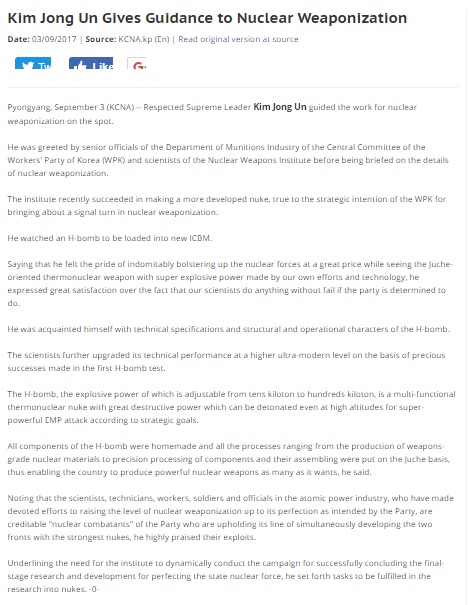
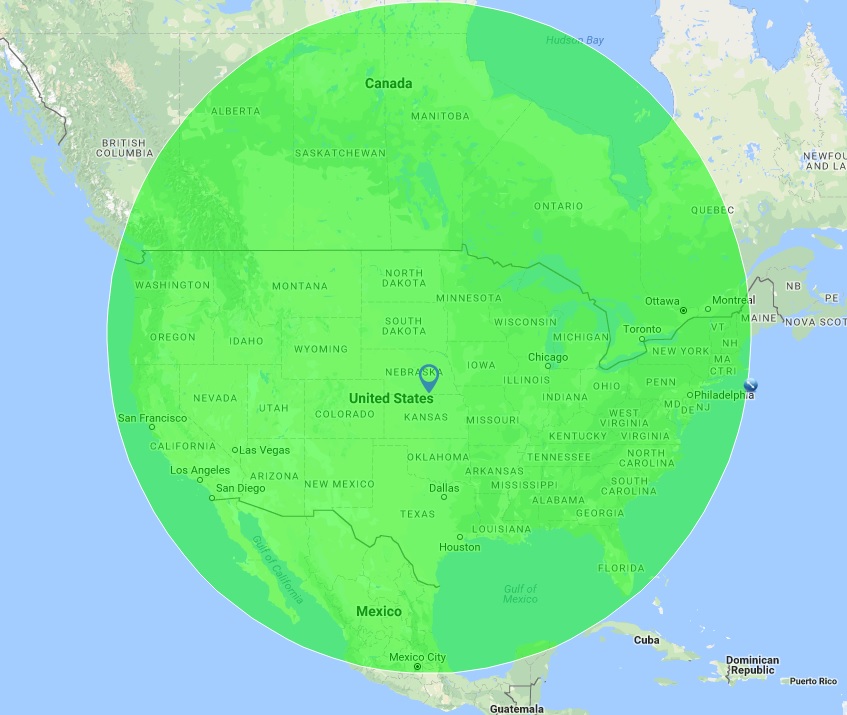
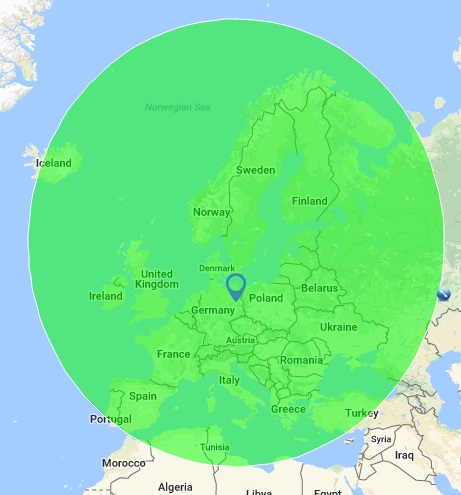
In addition, the U.N. COI conducted confidential interviews with over 240 witnesses who did not appear in public for fear of reprisals. The U.N. states that the “unprecedented report of the Commission of Inquiry on Human Rights in the DPRK documents in great detail the wide-ranging array of crimes against humanity being committed in the country. The report was presented to the UN Human Rights Council’s 25th Session in Geneva, Switzerland. ‘The gravity, scale and nature of these violations reveal a State that does not have any parallel in the contemporary world,’ the report states.”

North Korea military kick and beat political prisoners

The detailed U.N. COI report is found at “Report of the detailed findings of the commission of inquiry on human rights in the Democratic People’s Republic of Korea -­ A/HRC/25/CRP.1.”  The chairman of the report, Judge Michael Kirby, wrote a letter directed at the dictator of North Korea informing him that the report would recommend referral of this evidence to the International Criminal Court (ICC).

Religious freedom is denied in Communist North Korea. North Korea is officially an atheist state, consistent with the Communist ideology. The Communist North Korean government policy is to deny the individual’s ability to choose and to manifest his or her religious belief. The Communist regime oppresses the religious activities of unauthorized religious groups.  The U.N. COI report states that “The State considers the spread of Christianity a particularly serious threat…People caught practicing Christianity are subject to severe punishments in violation of the right to freedom of religion.”

The USCIRF 2015 report on North Korea states that “Genuine freedom of religion or belief is non-existent. Individuals secretly engaging in religious activities are subject to arrest, torture, imprisonment, and sometimes execution. North Koreans suspected of contacts with South Koreans or with foreign missionaries, particularly in China, or caught possessing Bibles, reportedly have been executed.   While it is
challenging to document the full scope and scale of the government’s repression of religious freedom, growing information available through firsthand accounts from
defectors and refugees makes it clear that the violations taking place are systematic, ongoing, and egregious. Thus, USCIRF again recommends in 2015 that North
Korea be designated a ‘country of particular concern,’ or CPC, under the International Religious Freedom Act (IRFA). The State Department has designated North Korea a CPC since 2001, most recently in July 2014.  North Korea has long maintained absolute control through systematic repression and the cultivation of widespread political fear. The government indoctrinates its people with the Juche ideology, the Kim family cult of personality, which requires absolute obedience to the Kim family and to the overall state. This pseudo-religious, socialist mentality suppresses the expression of individualized thought, belief, and behavior. North Korea has traditions of Buddhism and Confucianism, and before the Korean War had a sizable Christian population, earning Pyongyang the nickname ‘the Jerusalem of Asia.'”

It is currently estimated that more than 50,000 Christians are locked inside concentration camps because of their faith, where they are systematically subjugated to horrible treatment such as unrestrained torture, mass-starvation and even imprisonment and death by asphyxiation in gas chambers. This entails that a staggering 20% of the Christian community in North Korea live in concentration camps. The number of Christians being murdered for their faith seems to be increasing as times goes by because in 2013 the death toll was 1,200 and in 2014, this figure doubled rendering it to close to 2,400 martyred Christians.

The NGO Open Doors maintains Communist North Korea as the leading oppressor of Christians and “North Korea is ranked No. 1 on the World Watch List of the 50 countries where persecution is most extreme.” Open Doors states the “god-like worship of the leader, Kim Jong-Un, and his predecessors leaves little room for any other religions and Christians face unimaginable pressure in every sphere of life. Meeting with other Christians is virtually impossible. Anyone discovered engaging in unauthorized religious activity is subject to arrest, arbitrary detention, disappearance, torture and/or execution. Those Christians who attempt to return to North Korea from China are sentenced to life in prison or executed. Leader Kim Jong-Un purged 10,000 North Koreans last year, including some Christians.”

Human rights groups have also sought to get the U.S. government to pass bills to enforce stricter sanctions on North Korea, such as H.R. 1771, which did not pass the U.S. Senate, and which has been replaced by a new House Bill H.R. 757 in 2015.  The motivation is clearly not yet there to get this completed by the current government leaders, and we must urge Americans in human rights to urge their representatives to take a leadership role on this.

Responsible for Equality And Liberty (R.E.A.L.) urges those reading this to use the Communist North Korean “holiday” of October 10 not just as a remembrance of their success in oppressing our fellow human beings, but also as an opportunity to reach out to those oppressed by such Communist dictators and work for their freedom and liberation from tyranny, including those whose freedom of speech and conscience are denied.

As founder of R.E.A.L., I am grateful to have had opportunities to contribute to  the great work of the NKFC and other human rights activists for those suffering in North Korea.   One of the most inspirational moments in my life was the opportunity to join a prayer rally at a Korean Christian church in Northern Virginia to pray for strength and liberation of the oppressed people of North Korea.  To people of faith, I urge you to use October 10, not just as a grim reminder, but also as an opportunity to pray united for those who have no freedom of religion, who have freedom of speech, and who know right for such free prayer together.

As Dr. Martin Luther King, Jr. once said, the “arc of the moral universe is long, but it bends towards justice.”  Amidst the darkest night of injustice, dictatorship, oppression, persecution, and crimes against humanity in Communist North Korea, let our voices of human rights, and confidence that moral justice and freedom will ultimately prevail provide a light to other brothers and sisters across the seas.

October 10 and EVERY DAY is another GOOD DAY to be Responsible for Equality and Liberty.

South Korea: Human Rights Activists Launch Thousands of Balloons with Leaflets Promoting Freedom and Criticizing North Korea’s Communist Regime (Photo: NDTV Video Report)


Yes, We Can.

R.E.A.L.'s Orange Ribbon Campaign for Equality And Liberty
R.E.A.L.’s Orange Ribbon Campaign for Equality And Liberty

Freedom House Announces Worst for Human Rights – 9 OIC Nations, 5 Communist Nations, Burma, Eritrea, and Belarus.

Freedom House has announced its list of the “worst of the worst” human right violators in a report issued on June 3, 2010, which include three nations that are members of the U.N. Human Rights Council Saudi Arabia, Libya, Communist China, and Cuba).  The Freedom House list includes 9 Organization of the Islamic Conference (OIC) nations (Somalia, Sudan, Turkmenistan, Uzbekistan, Libya, Saudi Arabia, Chad, Guinea, and Syria), 5 Communist nations (North Korea, Communist China, Cuba, Laos, and the territory of Tibet under Communist Chinese jurisidiction), Burmese/Myanmar, Equatorial Guinea, Eritrea, and Belarus.

Leaders of Some of "Worst" Nations for Human Rights:  OIC's Sudan President Omar Al-Bashir, Communist China's CCP General Secretary Hu Jintao, Burma/Myamar's Senior General Than Shwe
Leaders of Some of "Worst" Nations for Human Rights: OIC's Sudan President Omar Al-Bashir, Communist China's CCP General Secretary Hu Jintao, Burma/Myamar's Senior General Than Shwe

The Freedom House Press Release states that:

“Nine countries and one territory are judged to have the worst human rights conditions, receiving the lowest possible score of 7 (based on a 1 to 7 scale, with 1 representing the most free and 7 representing the least free) on both political rights and civil liberties: Burma, Equatorial Guinea, Eritrea, Libya, North Korea, Somalia, Sudan, Turkmenistan, Uzbekistan and Tibet.”

“An additional 8 countries and 2 territories score only slightly better, with a score of 7 in political rights and a score of 6 in the civil liberties category: Belarus, Chad, China, Cuba, Guinea, Laos, Saudi Arabia, and Syria.”

“The event included a release of the results by Freedom House director of advocacy, Paula Schriefer and remarks by Mr. Mamadi Kaba, President of RADDHO-Guinea, a leading Guinean human rights organization. Mr. Kaba is part of a delegation from Africa, sponsored by Freedom House, which is attending the Human Rights Council session to lobby for greater human rights in Africa. Of the 20 countries identified in the report, 6 are from Sub-Saharan Africa, including Guinea.”

“‘While it is shameful that three of the ‘Worst of the Worst’ regimes now actually sit on the Council (China, Cuba and Saudi Arabia) and a fourth (Libya) was just elected, we nonetheless call on the member states of the Council to fulfill their mandate and take actions to address the systemic abuses in these countries,’ continued Schriefer.”

“Since the Council was first established in 2006 to replace the widely discredited UN Commission on Human Rights, only a handful of ‘Worst of the Worst’ states — Burma, Guinea, Somalia, Sudan and North Korea — have been the focus of resolutions or special sessions by the UN body.”

Press Release: Freedom House Reveals the World’s Worst Human Rights Abusers

Full Report: Freedom in the World 2010 – Worst of the Worst

Organization of the Islamic Conference (OIC) Members

R.E.A.L. Reports on Communist Totalitarianism

R.E.A.L. Reports on Communist China

R.E.A.L. Reports on North Korea

R.E.A.L. Reports on Radical Extremism

R.E.A.L. Reports on Sudan

Wikipedia Report on Hu Jintao

Wikipedia Report on Than Shwe

Wikipedia Report on Omar Al-Bashir

Omar Al-Bashir (Photo: AFP/Getty Images)
Sudan's Omar Al-Bashir -- Architect of Genocide (Photo: AFP/Getty Images)

United States Commission on International Religious Freedom (USCIRF) Report on Religious Freedom

United States Commission on International Religious Freedom (USCIRF) Eleventh Annual Report on Religious Freedom in the World Released
— recommending “13 nations–Burma, China, North Korea, Eritrea, Iran, Iraq, Nigeria, Pakistan, Saudi Arabia, Sudan, Turkmenistan, Uzbekistan, and Vietnam–be named ‘countries of particular concern,’ or CPCs.”
— Watch List Nations: Afghanistan, Belarus, Cuba, Egypt, India, Indonesia, Laos, Russian Federation, Somalia, Tajikistan, Turkey, Venezuela
— USCIRF concerned about religious based violence and breakdown in justice – known as impunity
— “USCIRF has seen the effects of impunity firsthand—particularly on vulnerable minority religious groups—during fact-finding trips to Egypt, Nigeria, and Sudan. USCIRF also has monitored the state’s failure to punish private, religiously-motivated violence in Afghanistan, Eritrea, India, Iran, Iraq, and Pakistan.”
Press Release

Adobe PDF of report

uscirf

Pakistan, 12 others named violators of religious freedom

Egypt: US religious freedoms report finds support among local activists

Nigeria among worst violators of freedom

In American foreign policy, why religious freedom matters

Religious persecution is widespread, report warns

Religious Freedom Group Sees Rise In Persecution

North Korea Freedom Week to Be Held in Seoul April 25-May 1

Press Release from North Korea Freedom Coalition

North Korea Freedom Week to Be Held in Seoul April 25-May 1

— see also Human Rights Group Launches “North Korea: 50,000 for 50,000” Campaign

(Apr 14 2010) Seoul…North Korea Freedom Week will kick off on April 25 as a week to promote the freedom, human rights, and dignity of the North Korean people.  The event, which has been organized by the North Korea Freedom Coalition annually since 2004 in Washington, D.C., will be held for the first time in Seoul, South Korea.  North Korean defectors and South Korean leaders and activists are organizing exhibits, a major rally, seminars, press conferences, prayer vigils and other events all focused on highlighting the misery the Kim Jong-il regime has inflicted on the people of North Korea, as well as citizens of South Korea, Japan and other countries.

NKFW 2010 will begin with a prayer service hosted by the North Korean defector churches and the opening of the North Korea Genocide Exhibit and will conclude with a balloon launch from the DMZ which will include radios, money, and a special message about the Universal Declaration of Human Rights.  The message will point out that the same year the United Nations adopted this declaration in 1948 was the same year that Kim Il Sung came to power to ensure that North Koreans were denied every single one of these universally accepted rights.

“With the increasing ability for North Koreans to learn about the outside world, it is fitting that North Korea Freedom Week will be held in South Korea for the first time,” said Kim Seung Min of Free North Korea Radio.  “North Koreans are increasingly finding out that their misery is a direct result of the Kim Jong-il regime, not South Korea and America as we were brainwashed from birth to believe.”

Special events during the week will focus on the North Korean gulag, the trafficking of North Korean women, the abduction by the regime of South Korean and Japanese citizens, and other topics.

Dr. Hyunuk Kim, who is chairing the Rally for North Korea Freedom Week, added, “Our songs and prayers for freedom and human rights in North Korea from Seoul will be heard around the world and in North Korea, leading to a dramatic change in North Korean society.”  Describing North Korea as the world’s coldest land and the world’s largest gulag, Dr. Kim said, “We must keep moving forward and strong until we meet the day when the spring sunshine finally finds itself in North Korea.”

Warning that it was a crime to remain apathetic in the face of one of the world’s worst human rights violations in history, Professor Yon Hee Lee, who is organizing the NKFW prayer vigil, warned, “We cannot remain silent as this tragedy continues or we will face God’s judgment.”

“Our hope is that North Korea Freedom Week will empower the 17,000 strong North Korean defectors in South Korea, awaken the consciousness of the world that the human rights conditions in North Korea must be addressed, and inform all who are suffering north of the DMZ that we will work together until the day their freedom, human rights and dignity are realized,” said Seoul Peace Prize Laureate, Suzanne Scholte, who is Co-Chairing NKFW with Professor Hwang Jang-yop.

“We are very proud that so many defectors, who have been part of the North Korea Freedom Week delegations each year, are now taking the lead in sponsoring events throughout the week, and we are deeply grateful to the South Korean NGOs and leaders who are also organizing events,” she added.

Simultaneously with events being held in Seoul, Open Doors-USA, will be organizing prayer events for North Korea throughout the USA.

A complete list of events follows below.

NORTH KOREA FREEDOM WEEK 2010 SEOUL, KOREA

Sunday, April 25 – Saturday, May 1

SCHEDULE OF EVENTS

[Week-long event] Sunday, April 24th to Saturday, May 1st

ALL DAY EVENT – North Korea Human Rights Exhibit

Every Day — 10 AM – 5 PM  North Korea  “Ah, the Warm Country in the South!” (The North Korea Genocide Exhibit)

Host: North Korea Genocide Exhibit, Moon Gook Han (sgf2002@hanmail.net)

Location: Seoul Gallery, Seoul Press Center 1st Floor

Transportation: Subway – Line 1 or 2, City Hall Station Exit 4; Line 5, Gwanghwamun Station Exit 5

[Week-long event] Sunday, April 25th to Saturday, May 1st

ALL DAY EVENT – North Korea Human Rights Photo Exhibit

Host:  NKHR Young Adult’s Coalition, Han Nam Soo/Strategy Center Youth Group, Choi Young Jin

Location:  Various colleges/universities in Seoul

[Throughout the week during NKFW2010]

Sunday, April 25th

2PM – 4PM Prayer Service led by North Korean Defector churches

Hosts:  North Korean Church Coalition, Pastor Kang Cheol Ho of Saetu Church (kangch214@hanmail.net); Pastor Lim Chang Ho of Jangdaehyun Church (limchangho@gmail.com); New Pyongyang Full Gospel Church

Location:  Saeteo Church, Shinjung-Dong 337 Mokdong 2Cha Woosung APT B-sangga 4th Floor

Transportation: Subway – Line 5, Mok Dong Station Exit 5; Line 2, Yangcheon-Gu Office Station and then Bus – no. 6617 Last Stop

3 PM – Ribbon Cutting Ceremony for North Korea Human Rights Exhibit

“Ah, the Warm Country in the South!” (The North Korea Genocide Exhibit)

Host: North Korea Geneocide Exhibit, Moon Gook Han

Location: Seoul Gallery, Seoul Press Center 1st Floor

Transportation: Subway – Line 1 or 2, City Hall Station Exit 4; Line 5, Gwanghwamun Station Exit 5

Monday, April 26th

10AM – NK Gulag Inmate List Press Release & Witness Testimony

Host:  NK Gulag, Kim Tae Jin, Jung Gwang Il, Jee Hae Lee (jhlee.nkgulag@gmail.com)

Location:  Seoul Press Center, 19th Floor

Transportation: Subway – Line 1 or 2, City Hall Station Exit 4; Line 5, Gwanghwamun Station

2PM – North Korean Human Rights Digital Screening

Host: Abductee & Defectors Human Rights Coalition, ICCNK, Do Hee Yoon

Location:  Seoul Metro Art Gallery, Hyehwa Metro Station

Transportation: Subway – Line 4, Hyehwa Station

Tuesday, April 27th

ALL DAY 10AM – POW/Abductee, Abduction-related Conference

Host:  POW/Abductee Int’l Coalition, Lee Mi Il (milee625@hanmail.net), Professor Nishioka

Location:  NK Democracy Committee Office, Gang-Nam-Gu Nonhyeon-Dong 216-2 Harim B/D 4TH Floor

Transportation: Subway – Line 7, Hakdong station

Time TBD –  Open Invitation Forum:

“Kim Jong Il Regime’s Inhumane & Savage Rule:  Elite North Korean Defectors’ Testimonies”

Host:  ICCNK, NK Intellectuals Solidarity, Do Hee Yoon (dhy21c@hanmail.net), Kim Heung Gwang

Location:  Seoul Press Center, 20th Floor

Transportation: Subway – Line 1 or 2, City Hall Station Exit 4; Line 5, Gwanghwamun Station Exit 5

5PM – Suzanne Scholte’s Special Lecture at Sejong University

Host:  Sejong University (w3@sejong.ac.kr)

Location:  Sejong University, Seoul

Transportation:  Subway – Line 7, Children’s Grand Park Station

Wednesday, April 28th

1:30PM – North Korean Women Defectors Human Rights Seminar

Host:  CNKWR Coalition for North Korean Women’s Rights, Kang Su Jin (frogreen79@naver.com)

Location:  National Assembly Building, Yoido

Transportation:  Subway – Line 9, National Assembly Station

2:30PM – National Rally for North Korea Freedom Week 2010

Host:  International Forum for Foreign Policy & National Security, Dr. Kim Hyunwook (khubosco@hanmail.net)

Location:  Seoul Station

Transportation:  Subway – Lines 1 & 4, Seoul Station

Wednesday, April 28th to Saturday May 1st

2PM – Reading the Names of 8,400 Abductee & POWs (Pep-Rally & Name Reading)

Host:  Abductee & Defectors Human Rights Coalition, ICCNK, Do Hee Yoon (dhy21c@hanmail.net), Bae Jae Hyun (mission2china@hanmail.net)

Location:  Pagoda Park, Jongno-Gu

Transportation:  Subway – Lines 1,3,5, Jongno-3-ga Station

Thursday, April 29th

7:30AM – North Korean Human Rights Forum (Guest Speaker: Suzanne)

Host: International Forum for Foreign Policy & National Security, Dr. Kim Hyunwook  (khubosco@hanmail.net)

Location:  Karak Hotel, 2nd Floor

Transportation:  Subway – Lines 8, Karak Market Station

1PM – Debate for Human Rights of North Korean Defectors:  How Much Has Improved?

Host:  Democracy Strategy Center, Kang Cheol Hwan

Location:  Community Chest of Korea, Jung-Gu

Transportation: Subway – Line 1 or 2, City Hall Station Exit 3, 12; Line 5, Gwanghwamun Station Exit 6

8PM – North Korean Human Rights Prayer Vigil

Host: International Forum for Foreign Policy & National Security, ICCNK  (khubosco@hanmail.net)

Location: Balsandong Catholic Church

Transportation: Subway – Line 5, Ujangsan Station Exit 3

Friday, April 30th

10AM – Protest at the Embassy of China in Seoul

Host:  NKFW2010 Planning Committee

Location:  Chinese Embassy, 54, Hyoja-Dong, Jongno-gu, Seoul

Transportation:  Subway – Line 3, Gyeonbokgung Station

1PM – North Korea Human Rights Act-related International Conference

Host:  PSCORE People for Successful COrean REunification , Kim Young Il (youngilkim78@naver.com)

Location:  Seoul Press Center, 20th Floor

Transportation: Subway – Line 1 or 2, City Hall Station Exit 4; Line 5, Gwanghwamun Station

4PM – Crossing Screening & Lecture of NK Defector

Host:  Student Group of Yonsei University  (yeahys@hanmail.net)

Location: Yonsei University

Transportation:  Subway, Line 2, Sinchon Station

6:30PM – Meeting with Chairperson of National Human Rights Commission of Korea, Byung-Chul HYUN

Participators: Suzanne and other 6 people

8PM – North Korea Freedom Week 2010 Prayer Vigil

Host:  Esther Prayer Movement for North Korea, Professor Lee Yong Hee  (yhlee@kyungwon.ac.kr)

Location:  Shinil Church, Joong-Gu Shin-Dang 4-Dong, 347-298, Seoul

Transportation:  Subway – Line 3, 6, Yaksu Station; Line 5, Cheonggu Station

Saturday, May 1st

Afternoon [Exact Time TBD] – Balloon Launch into North Korea

Host:  Fighters for Free North Korea FFNK, Park Sang Hak  (berojapark@hanmail.net)

Location:  Freedom Bridge, Imjingak, Paju City, Kyonggi Province

Transportation:  Gyeongui Rail Line, Imjingak Station

FOR USA – OPEN DOORS NKFW RELATED EVENTS, VISIT http://members.opendoorsusa.org/images/content/pagebuilder/NK2010/

FOR NKFW UPDATES VISIT WWW.NKFREEDOM.ORG AND HTTP://CAFE.NAVER.COM/NKFW

Human Rights Group Launches “North Korea: 50,000 for 50,000” Campaign

Human rights group OpenDoors has launched a message writing and public awareness campaign for those suffering under totalitarian oppression in Communist North Korea.  The 50,000 refers to estimated 50,000 being held in North Korean Communist prison camps.

On the web page for the North Korea freedom campaign, they urge the public to “type a radio message below and broadcast hope into North Korea! Many North Koreans possess small transistor radios and through a program hosted by North Korea Free Radio your letter will be read in North Korea!”
They have also been spreading a public awareness campaign on Facebook. On Facebook, they describe their “North Korea: 50,000 for 50,000″ Campaign as”

“50,000 fans standing with”
“50,000 people in isolation in”
“NORTH KOREA.”

“OUR MISSION”
“To send a message to the people of North Korea that they are not alone.”

“THE PROBLEM”
“It is estimated that around 50,000 North Koreans are in prison camps.”

“OUR GOAL”
“To send 50,000 radio messages into North Korea telling the North Koreans that there are 50,000 people standing with them in their suffering.”

“YOUR PART”

“Become a fan.”

“Invite all the friends you can.”

“Send a short message to be translated into Korean and broadcasted over North Korean airwaves to tell 50,000 people they are not alone.”

OpenDoors is also encouraging individuals to host prayer vigils on North Korean freedom, and provides public information about people around the world who are hosting such vigils.

OpenDoors' Human Rights Campaign: "North Korea: 50,000 for 50,000"

See also other R.E.A.L. reports on North Korea

See also other R.E.A.L. reports on totalitarianism

free-korea-now