Introduction: Responsible for Equality and Liberty (R.E.A.L.) represents a coalition of individuals that come together periodically to challenge human rights abuses and to promote human rights. To be consistent on such universal human rights, at times, we must also raise controversial issues as well. It is easy to be brave from a distance. But if we believe in the inalienable human rights of equality and liberty for all, sometimes we need to get close to issues that challenge our fellow human beings. We hope to offer solutions of peace, respect, and hope to all. We support the universal human rights of all people of all identity groups and all religions, without exception, without caveat.
====================================
I reject the views of the Anti-Islam movement, and I respect the religious liberty of all human beings, including my Muslim brothers and sisters in humanity. But I also reject the silence from our society, media, and our institutions on too many on extremists who rationalize oppression of human rights, hate, and violence based on the extremist views on what they believe justifies a religious “culture.” The failure to consistently address both extremist views will continue to lead to increasing human rights and security challenges in the United States and around the world.
In the past month, we have seen mirror images of ideological terrorists in Europe and in the United States: terrorist Anders Behring Breivik in Norway and failed terrorist Naser Abdo in Texas. Both terrorists believe they represent opposite ideological views, but they represent a common threat to our human rights and security.
The common argument by both ends of the spectrum has been an ideological view toward creating closed “cultures.” Both the Anti-Islam movement and the Bin Ladenist ideologues have rationalized terrorism to support closed cultures that they believe are not only more important than human rights, but also more important even than human lives. Furthermore, the neglect by media, our governments, international agencies, too many counterterrorists, and too many human rights groups to seriously discuss this problem is the fear of offending anyone’s view of “culture.”
Our cultures do matter. But our shared universal human rights and human dignity are what truly unite us as a human race. Our shared human rights are not only the basis for cultures of life and dignity, but also the basis for security and peace.
1. The Breivik Terrorist Attack
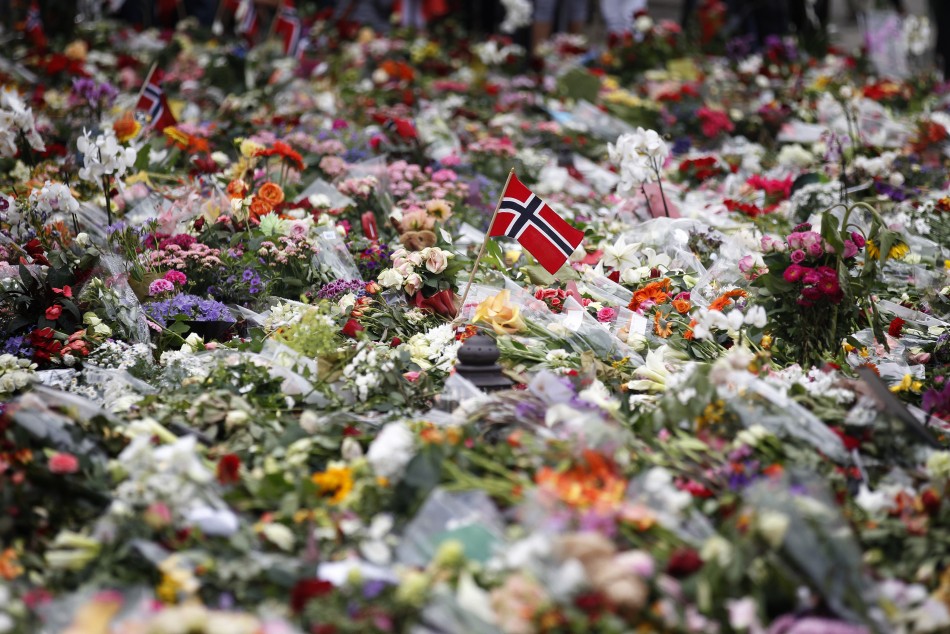
On July 22, 2011, 77 children, women, and men were killed in Olso, Norway at the hands of a terrorist who claimed that his actions were to promote his Anti-Islam views. As that nation remembers the loss of their fellow citizens and loved ones, it is past time to have a more serious reflection on the ideological claims of the confessed Oslo terrorist Anders Behring Breivik, and the consequences of his ideological views.
The week after the terrorist attack, the mainstream media discovered a video that Breivik made and a “manifesto” that he sent out on email. It listed a number of Anti-Islam leaders and writings by others, and the news media latched onto the Anti-Islam leaders, blaming them as individuals for Breivik’s terrorist activities. The Anti-Islam leaders defended themselves and rejected such associations, stating they were opposed to violence.
There is no question that Mr. Breivik is the individual responsible for and accountable for his crimes and terrorism. He and he alone is accountable for his actions, his cruel and vicious murder of women, children, and others. He is not a hero, but a criminal. He is not a visionary, but a common killer.
But Breivik’s use of the Anti-Islam ideology for violence is not the isolated incident that some believe, and it is important for human rights and security that it is addressed. His violent terrorism may have been the first, but he is not alone in his calls for violence among Anti-Islam activists. Breivik’s July 22 attack is not the first violence we have seen from the Anti-Islam campaigns.
The Anti-Islam movement is not only growing in numbers, it also is increasingly becoming a security and human rights challenge itself.
2. The Growing Challenge of the Anti-Islam Movement
After the 9/11 attacks, a number of Americans, and then Europeans began to fear future attacks from violent individuals who shared the extremist ideology of Osama Bin Laden. They sought to understand the ideology and rationale behind such attacks. Some sought to consistently challenge a Bin Ladenist extremist ideology which would use Islamic religious views to rationalize human rights and security threats. But as the mainstream media, governments, and traditional human right groups ignored this, some became more hard-lined in their thinking and political in their organization. This created a significant divide among people with this concern. Some remained concerned about Bin Ladenist ideologies and their followers; others sought to blame Islam itself for such terrorism and abuse of human rights. This latter group began to form an Anti-Islam movement.
With the example of the success that American Tea-Party style activism found with conservative politicians, some Anti-Islam activists began to start to build a political movement of their own. (This began less than a year after our own R.E.A.L. human rights coalition had started to offer a consistent view on human rights issues.)
There are many who have been outraged by the actions of Bin Ladenists. The outrage towards such extremists was coupled with a sense of abandonment and fear, in believing that traditional government and human rights groups were not concerned about the Bin Ladenist ideological views. As those with Bin Ladenist views have sought to threaten human rights and security, some have gravitated towards populist leaders in the Anti-Islamic movement.
In Europe, groups such as the Stop Islamisation of Europe (SIOE) and the English Defence League (EDL) were created. In the United States, the SIOE sought to create a version of their group in the United States called the Stop Islamization of America (SIOA) two years ago. R.E.A.L. has been on the record as objecting to the SIOA and its message since the creation of the SIOA.
The Norway terrorist Anders Breivik used the ideas from such Anti-Islam groups as the rationale for his July 22 terrorist acts. I have read much of Mr. Breivik’s “manifesto,” and I have seen his video that he released prior to his terrorist attack. There are a number of familiar names and familiar images. Anti-Islam terrorist Breivik has praised the SIOE and praised the EDL. In Breivik’s Anti-Islam manifesto, he quoted original SIOA leader D.L. Adams, as well as current SIOA leaders Robert Spencer and Pamela Geller. In addition, Breivik references European philosophers, and even counterterrorist analysts such as Evan Kohlmann, who have I met, and I know that Mr. Kohlmann adamantly rejects an Anti-Islam view. I have no doubt that Mr. Spencer (who was widely quoted in the Breivik manifesto) and others referenced in Breivik’s manifesto, were shocked and horrified by this, as any sane individual would be.
I have met Mr. Spencer and neither he nor Ms. Geller are the demons that the media have sought to portray them as. While I disagree with their views and their strategy, I have no doubt that they genuinely believe that what they are doing will protect American human rights and security. I met with Mr. Spencer several years ago and I shared his concern about those rationalizing human rights abuses in some parts of the world based on some extremist individuals’ and groups’ interpretation of Sharia.
The difference that Mr. Spencer and I have is that he believes the extremists are correctly interpreting Islam and Sharia. I believe that Muslims around the world all practice Islam differently and I know many Muslims who reject the views of extremists and Bin Ladenists who seek to deny human rights – based on any rationalization, including religious ones. We must support those who would promote human rights and dignity from within any religion and any identity group.
While I think Spencer and Geller are wrong in their Anti-Islam ideology and their approach, their voices once sought to challenge human rights abuses and terrorist threats from those who would rationalize their acts based on their extremist views of Islam. To gain attention from an apathetic public and government, they have pursued a political approach, taking over as the leaders of the SIOA group in the United States and seeking to align with political leaders. Two years ago, the original SIOA had only a few fringe members that sought to disrupt a Muslim prayer meeting on Capitol Hill. A year later, with the SIOA leadership taken over by Spencer and Geller, the SIOA led a massive protest with politicians against the Coroba House Islamic Center, and went on to coordinate anti-mosque campaigns elsewhere.
The emphasis moved from a concern about violent “jihad” and human rights concerns to political affiliations with other Anti-Islam activists groups, and a growing tolerance of Anti-Islam extremists – regardless of their tactics.
At the same time, the SIOA’s original sponsors, the SIOE began leading protests against mosques throughout the United Kingdom and Europe. The EDL then began even greater protests with larger public presence, which has drawn growing angry mobs. This attraction to anger has taken arguments that once condemned extremists and turned such groups into becoming havens for extremists themselves.
3. The Anti-Islam Movement’s Anger Attracts Hate and Violence
The political mass movement of the Anti-Islam movement has garnered greater populist support, but without a positive focus and with an emphasis on outrage, it has sometimes attracted not only angry, but also violent individuals.
The debate has also led to many in the Anti-Islam movement to shift from defending human rights to defending Western “culture” or “Western civilization.” This has led to their movement attracting individuals who will seek to “defend” such cultural views, using any means necessary – including some who promote hate and violence.
Frustration within the Anti-Islam movement has led individuals to move from outrage over human rights to alliances with those who will use even violence to defend what they view as Western “culture.”
Years ago before she led the SIOA, Pamela Geller sought sympathy for “honor killing” victims and led a fund-raising effort for a headstone for the unmarked grave of a girl Aqsa Parvez, who was a victim of such an “honor killing.” I donated to that cause out of concern for mercy and respect for the dead; whether that was naive or not, I felt pity for that child. As much as I disagree with Ms. Geller today, I appreciate what she did for Aqsa Parvez. There is no “honor” in murder, and “honor killings” are nothing than that – murder.
There is also no “honor” in promoting those who seek violence against innocent people. In 2010, SIOA leader Pamela Geller also repeatedly promoted and recruited for the English Defense League (EDL). The EDL is a British group whose mob protests have resulted in bricks thrown at police, mobs attacking restaurants of helpless public, engaging in street fights, attacking the press, and mob violence across the United Kingdom. Their violent supporters are more than a few isolated extremists, as some would contend. The EDL’s leader, while claiming to promote a “Christian culture,” does so while using obscene language in his public speeches and has his own history of violence.
The Norweigian terrorist Breivik repeatedly praised the EDL, praised the SIOE, and he sought to join the SIOE group, which created the American SIOA group. The SIOE group states it rejected Breivik’s membership from their Facebook web site, but what the SIOE fails to ask itself is why individuals such as the terrorist Breivik sought to join their cause. In June 2010, the same SIOE attracted Nazi supporters who sought to join their protest against a mosque in Denmark.
The SIOA leaders, including Mr. Spencer, have stated they rejected Mr. Breivik’s violence and indicated that they have never supported any violence. That certainly appears to be true. However, it is not the entire story.
In February 2010, Robert Spencer’s JihadWatch, which for years condemned terrorism, then issued an article dismissing an American terrorist attack in Austin, Texas as “simply Going Out With A Bang,” which we rejected. (Austin terrorist Joe Stack’s views were that “violence not only is the answer, it is the only answer.”)
In April 2010, Geller and Spencer took over the leadership of the SIOA political group. The populist campaign attracted angry individuals in the United States, just like it did in Europe. In the United States, the SIOA marches became angry shouts and epithets, with SIOA supporters harassing even Egyptian Christian Copts at the 9/11 protest.
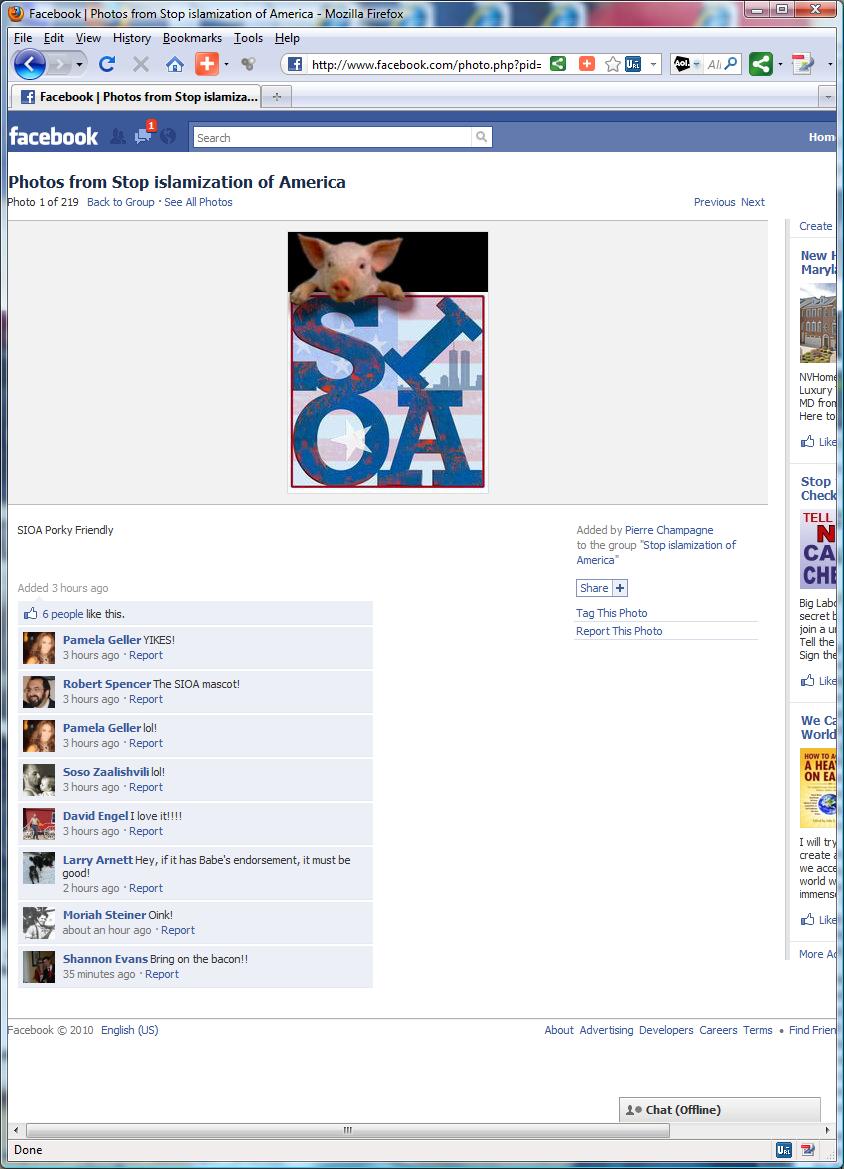
Since May 2010, the SIOA Facebook web page became a magnet not only for the outraged but also for those full of hate of hate, as well as numerous images of hate and violence. The SIOA Facebook web site became (and still is) full of images of violence, vulgarity, with numerous images that promote violence against Muslims and threats to kill “lieberals,”with images of feces and urination on the Qur’an, images of burning the Qur’an, images of animal sex, and the most depraved attacks on human beings.
One SIOA Facebook supporter, who relished in the depravity of the images by SIOA supporters there attacking Muslims, stated: “I am glad to know we have some capable of being able to reach them on the only level they seem to understand; total debasement.” This is the campaign that some Anti-Islam supporters seek, which has nothing to do with culture, nothing to do with human rights, and certainly nothing to do with human dignity.
At least three of the images in the video by the terrorist Breivik are identical to images that have been on the SIOA Facebook page for over a year – they are still there at the posting of this article, a month after Breivik’s terrorist attack.
Whether the terrorist Breivik got these violent images from the SIOA Facebook or another Anti-Islam source is unknown. But today, a month after the Oslo terrorist attack that killed 77, the images of violence and hate in Breivik’s video, remain on the SIOA Facebook website today.
There is no doubt that no one can hold the SIOA leaders accountable for the dozens and dozens of vulgar, foul, and violent images on the SIOA Facebook site, the threats of violence and hatred. Like Breivik’s actions, these are the responsibility of the individuals who made such statements and posted such images.
The SIOA supporters have freedom of speech to make such foul comments and postings, whether we like them or not. That is a freedom that we all have. But all freedoms come with responsibilities of accountability and even association – fair or unfair. It is the responsibility of the SIOA to demonstrate that their campaign rejects hate and rejects violence.
In addition, the SIOA Facebook site even became a magnet for those making death threats against those who would challenge their Anti-Islam views. When I discovered one such threat, I anonymously alerted the SIOA leadership and someone removed the posting (I also contacted the threatened individual and law enforcement). SIOA leaders also removed the member from the Facebook site.
The challenge for the SIOA, SIOE, and the Anti-Islam movement is not “isolated” extremists in their groups, it is a consistent message of anger, hatred, and venom against Muslims that is an extremist message that resonates with angry and violent people. That is where the NEXT Anders Breivik will come.
Calls for violence have become increasingly common within the Anti-Islam campaign, including in the websites of one of the SIOA’s leaders, Robert Spencer. In January 2011, Mr. Spencer’s JihadWatch website once again became the point of controversy from one of its contributors. This time, JihadWatch’s “Roland Shirk” called for Egyptian government to kill those Egyptians protesting for freedom against the tyrant Hosni Mubarak in the JihadWatch article “A Whiff of Grapeshot”, calling for a “Tienanmen Square” type massacre of the Egyptian protesters. R.E.A.L. responded to this with our objections and calls for JihadWatch to remove such calls for violence.
Mr. Spencer no doubt rightly states that he objects to the violence by the terrorist Breivik. But it remains troubling that he has been so silent about the images of violence on the SIOA Facebook web page, as he is aware of the photos page, and made his own postings there. It is troubling that he has been so silent for those calling for violence, even among his own writers, on his own website. Our intentions must be supported by our deeds. I hope that the SIOA leaders choose to reconsider their position on the comments and images by their supporters.
I regret to any group that I have to point to these embarrassing and ugly instances among their supporters. I can only imagine how I would feel if they pointed such instances out to me, and I genuinely feel sorry for them. But if even a casual viewer can see these, surely their leaders must be able to do so. They need to consider the consequences of pursuing such a path of negativity – both to our shared security and our human rights.
Such attractions of anger and hate have been facilitated by an ideological view that prioritizes “culture” over “human rights,” and that has been a consistent problem for such political groups as the SIOE and SIOA. The European parent group SIOE is proud of its slogan “Islamophobia is the height of common sense.” Three years ago, the SIOA website three years ago urged American activists that they should not worry about being “nice.” The original SIOA leader DL Adams stated that “Multiculturalism, tolerance, and ‘niceness’ are destroying the foundations of our cultures…”; this is the same DL Adams that the terrorist Breivik quoted in his manifesto against Islam and multiculturalism.
Let us never lose the ability to respect one another, no matter how much we disagree with one another.
When we prioritize the defense of a single culture over human rights, and when we allow human hate, not human rights, to become a voice for our campaigns, then we should question where we are going.
It would be optimistic to view that the Breivik terrorist attack was a wake-up call on the Anti-Islam extremism. I don’t believe it has been. We have had plenty of other warnings before this and acts of violence by Anti-Islam supporters that have also been ignored. Foolishly, some have sought to associate such violence only with the “right-wing,” which has mired this debate in political finger-pointing. We need to realize this problem is not limited to Breivik and not limited to only certain groups.
We have to challenge the Anti-Islam rejection of human rights and human dignity, by being consistent on these issues ourselves.
Furthermore, as I will describe in a separate writing, the Christian community needs to take responsibility and deal with the growing numbers of pastors and Christian leaders that have become involved in the Anti-Islam movement. This includes a growing number of Christian pastors, evangelists, and ministers who publicly show their affiliation and support the Anti-Islam SIOA group.
Christian leaders cannot look only to Muslim communities to challenge the extremists in their faith; Christian leaders must also own that same responsibility.
3. The Silence on Bin Ladenism
Shortly after Breivik’s terrorist attack on July 22, another accused terrorist Naser Abdo was arrested for allegedly planning a terrorist plot to kill soldiers at the Fort Hood Texas base. Naser Abdo’s case, like others, has been on the opposite end of the spectrum where individuals have rationalized violence and hate based on their extremist views of Islam.
Mr. Naser Abdo was a member of the American military who sought to reject his service because he is a Muslim. Whether you agree with the tactics, strategy, and actions of the American military in Afghanistan, let us be clear once again on who the Taliban are, and what they represent.
On August 19, 2011, the Taliban in Pakistan blew up a mosque killing an estimated 50 Muslims in the village Ghundi during Friday prayers. The mosque is in the Khyber region near the Afghan border. This terrorist attack during Ramadan demonstrates once again, who and what the Taliban really are – valueless killers and thugs, who readily will murder other Muslims. The same day, in Kabul, such terrorists attacked the British Council in Afghanistan killing another 8 individuals.
These terrorists are not acting on behalf of Islam or on behalf of Muslims. They are acting on behalf of their own ideology of violence and death, including killing fellow Muslims. They are acting on behalf of an ideology that rejects human rights and human lives.
Dr. M. Zhudi Jasser of the American Islamic Forum for Democracy (AIFD) wrote in the Wall Street Journal on August 18, speaking about the case of failed terrorist and Army Private Naser Abdo. According to Dr. Jasser, who is himself a Muslim veteran of the U.S. armed forces, “The vast majority of Muslims serve with honor and distinction. They are not the problem. The problem is the subset of Muslims who are Islamists.”
I understand the need to be sensitive to the feelings of Muslims on this issue, and for the purposes of this article I have described what Dr. Jasser calls as “Islamists” as “Bin Ladenists.” We have debated the lexicon and terms we should use for such extremists, whether it should be “ta’assub,” “irhabis,” “Islamists,” “extremists,” “radical Islam.” Years ago, I questioned if such lexicon debates were sensible if they led us to be in denial on real problems. Still, I underestimated how such hurt feelings might also prevent such a necessary dialogue. I urge Christians to start hearing about “Christian terrorists” and see how it makes them feel. But while we argue over lexicon, the two extreme ends of the spectrum on this issue continue to recruit followers. We need a national dialogue and lexicon for this debate in the United States, where many Americans do not know Arabic and terms like irhab and Hirabah are not understood.
I propose we consider something simpler such as “Bin Ladenism.”
If we look at the Bin Ladenist view of the world, that ideology also seeks to position the world through the defense of a religious extremist culture of its own. The failure by responsible leaders to challenge that ideological and human rights threat has left this largely to the vocal Anti-Islam advocates.
But the Bin Ladenist view not only rejects human rights and human dignity for non-Muslims, it also rejects them for Muslims as well.
One of the great historical failures has been the unwillingness of traditional human rights groups to aggressively take up the cause for women’s rights, religious freedom, in the face of groups, ideologies, and even nations that would justify stonings, “honor killings” of women, gays, and abuse and murder of people of all faiths – simply because of their identity. It has been and is a great moral wrong to ignore the ideology of the Bin Ladenists around the world.
Silence is not and must not be the answer.
Even when Bin Ladenist terrorists in the U.S. seek to plot attacks, such as Naser Abdo, we have silence. And the world wonders why such cancerous silence has metastasized into a political Anti-Islam movement?
Certainly a large portion of this is understandable embarrassment and protectiveness in the Muslim American community. But we need to have this dialogue in a way that we can debate this issue without blaming all Muslims and all of Islam for such extremists, so that interfaith leaders, human rights groups, and government agencies can play a responsible role.
It is true that any human rights issue has a struggle to get attention – from the genocide in Sudan, the concentration camps in Communist China and Communist North Korea, the killing of gays in Uganda, and the abuse of women in the Congo. All these and many more struggle to get the limited attention of busy people who wish they could do more, and many who have no idea such abuses are going on.
It is also true that every religious extremist group has their human rights areas of shame from “Hindu” “honor killings” in India, Christian extremist terrorists of the Lord’s Resistance Army (LRA) in Africa, the oppression of minorities in Uganda, and groups such as the Hutaree and the Westboro Baptist Church, who rationalize their hatred based on their extremist views of “Christianity.”
But few of these see the silence that we have seen with the oppression of minority Muslim sects and non-Muslims in too many “majority Muslim nations.” Two wrongs don’t make a right – and the media, the United Nations, human rights groups, and our governments remaining silent on these abuses – is another moral wrong.
We must challenge what is not only isolated cases of Bin Ladenist cultures but large numbers of individuals that seek to deny human rights for others – in any religion or any identity group.
About three years ago, I decided that I would develop the R.E.A.L. coalition on human rights where we would be consistent on these and other human rights issues. The week before one of our first event on International Women’s Day at the U.S. Capitol on March 2009, in Chechnya, the Chechen President brought a series of “loose women” out into the streets and had his police gun them down. The Chechen President claimed that his extremist view of Islam entitled him to kill such women in the streets. In Russia, they looked the other way. But not just in Russia, most of the world looked the other way. He committed murder in broad daylight to no objections, no world outcry, no marches or demands by feminist groups.
I and a few women stood in front of the U.S. Capitol and we were the only protest in the world.
We must not abandon our brothers and sisters around the world – of any identity group, any religion – to those who would rationalize violence, hate, or murder – based on their claim that their view of a religion justifies murder and oppression. That is not defending or respecting a culture. That is abandoning our shared identify as human beings with universal human rights.
We must refuse to let either anger or fear allow us to forsake our fellow human beings, their human rights, and their human dignity.
4. Our Shared Human Rights Are Greater Than Individual Cultures
We need to challenge extremist groups without accusations that there is a monolithic view of any religion as responsible for the actions of extremists. It is as absurd to claim all Muslims or all of Islam is to blame for specific extremists, as it would be to blame all Christians or all of Christianity is to blame for specific extremists. The world cannot move forward with such arguments that deny dignity, respect, and religious liberty for all. Our religious liberties exist – but abuse to our universal human rights remain the same – no matter where they are done or who is responsible for their abuse.
This argument for our universal human rights is so clear that both the Anti-Islam movement and the Bin Ladenist movement have rejected such shared human rights, and have chosen instead only defend “cultures” where they can decide who deserves freedoms, life, and liberty. In the United States and Europe, the Anti-Islam movement seeks to close mosques. In Indonesia and Egypt, the Bin Ladenist movement seeks to close churches. They seek to create closed societies, closed cultures, that will prohibit free choice, free thought, free speech, and free lives.
But we do not have a free world and a slave world. We do not have a “Muslim World” and Christendom. While some may perceive that we have a world of divisions, the reality is that we live in a world of unity. We breathe the same air, see the same sun and moon, have the waters of the world that eventually touch us all in some way. We live together on this shared Earth, where universal human rights are the right of all people in every part, no matter who seeks to deny them.
We are not the divisions or labels that some would have us wear. We are complex individuals with individual lives and aspirations. But while are unique and special individuals, we are also a singular human race, with a singular human destiny – both for good and bad. We are accountable for our actions, just as we are entitled to our freedoms.
History has shown that every cage will eventually be broken. Those who seek to build new cages, new closed societies to defend only “one culture” fail to understand that we are not many. We are one. We are humanity.
We are not a mere collection of diverse cultures, but we are human beings with shared bodies, brains, joys, sorrows, and even dreams.
We can dream, like others have before us, of the day when we set our divisions aside, and we all recognize that we are truly all “free at last, free at last, free at last.”
But if every journey requires an initial step, let us start here. Let us stop hating one another. If we let go of the rocks of hatred, we can begin to stop building artificial walls to divide one another. Let us resolve to end hate as a cancer that will close our minds to the infinite possibilities of hope, joy, and unity that we can have together.
Choose Love, Not Hate. Love Wins.