A New Hope: Human Rights and Human Responsibility

A New Hope: Human Rights and Human Responsibility
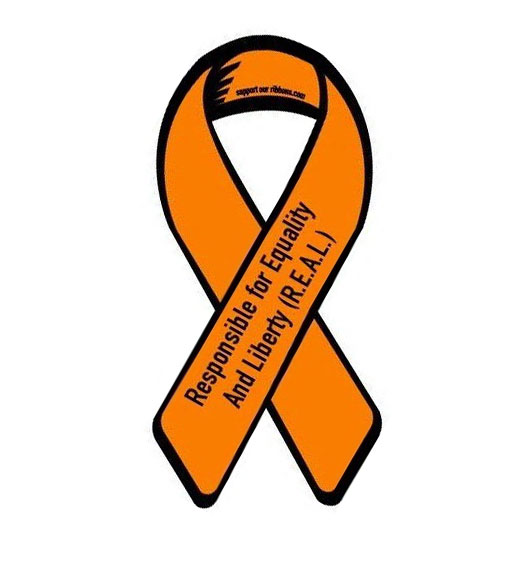
Jeffrey Imm, Responsible for Equality And Liberty (R.E.A.L.)

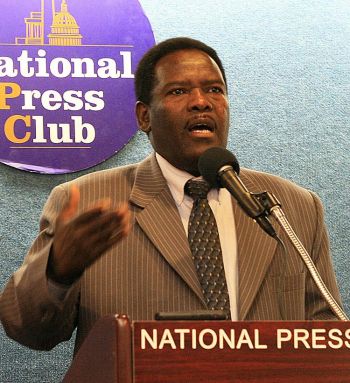
Hello, my name is Jeffrey Imm. I am the leader of the Responsible for Equality And Liberty (R.E.A.L.) coalition for human rights. The goal of R.E.A.L. is to use the Universal Declaration of Human Rights (UDHR), and we commemorate its December 10, 1948 creation every year, as a standard for progress in human rights objectives throughout the world, and as a coalition on together on shared human rights issues. This year we have gone back to having a press conference at the National Press Club, as we have had in the past. The reason the UDHR was created on December 10, 1948, was as a response to the “disregard and contempt for human rights have resulted in barbarous acts” during WWII. We have seen such disregard and contempt again over the past few years, and more barbarous acts than we can count.

The list of all of the atrocities and contempt against human rights is almost endless. So instead of only focusing on that horrible list, I come here this year with an offer for new hope. Because so many of us have been dispirited at the willingness of global representatives to commit “barbarous” abuses, which the UDHR was specifically created to discourage and prevent. Let us look at a path for solutions instead.

Even in the dark days of our world, let us find hope to remember that every day is still a Good Day to be Responsible for Equality And Liberty.

  1. The New Hope Begins with Ourselves

There is a new hope for universal human rights, despite grave injustices and dark days that we live in as human beings on our shared Earth today.

We can make a difference in our world by starting with ourselves and encouraging others on the path of KINDNESS, MERCY, and LOVE to one another. Kind people don’t mass murder others. Merciful people don’t persecute others. People with love in their hearts don’t hate and revile others as non-human beings. The path to degrading human rights through cruelty, mean-spiritedness, and hate is the path that we can change – one person at a time, one example at a time, one life at a time. We can set an example and standard, no matter how difficult the past or our past selves have been, for a new path forward to build the long abandoned infrastructure that a serious movement on universal human rights requires.

Where do the atrocities against human rights come? They came from a normalization of being mean and being cruel towards others. And they come from INDIFFERENCE – which is the true opposite of love – about acts by representatives in world governments and institutions of mean-spiritedness, cruelty, violence, and hate against our fellow human beings. We must find this unacceptable. We have demonstrations by some against such obscene behavior, but daily life shows that clearly those demonstrations are insufficient. We must not fail to recognize that accepting a society where only the smallest number is encouraged to live with a conscience – is not, and will never be enough. The change we must seek is within ourselves, and we must live that change, and THEN we must evangelize that change to the world. In so many other difficult times in history, THIS is how we made meaningful human rights change, by working to change the hearts of ourselves and being a beacon of that change to others. It is not enough to demand that we do not have representatives that reject human rights. Our lives must be a standard to others to embrace kindness, mercy, and love, so that cruel representation is not acceptable to them as well.

We begin to control the state of human rights by first working to control our own behaviors as human beings. The starting point is not someone else’s responsibility. It is not someone else’s problem. It’s not some organization‘s, the United Nations, our various government’s responsibility to begin with. The state of human rights begins the responsibility and accountability of each one of us in our lives with one another. WE…. are the starting point.

We… not they… are the leaders responsible for universal human rights. We… in the choices that we make in our lives – we are the new hope that we seek for universal human rights.

  1. Choice of Kindness and Mercy in Ourselves and Our Representatives

We can first choose to be kind and offer mercy to others. We do not have to be mean. I realize that many of us are in difficult situations in many different times of our lives. I realize that we have to stand up for ourselves and protect ourselves and boundaries in our lives.

But we don’t have to choose to be mean. We can choose to be kind and to offer mercy.

There is an addiction and normalization to being mean. We think it’s all right to be mean. We can justify and rationalize it. There are many leaders in our representatives, in society, in the media, in world organizations, and of course, among those in social media, who advocate being mean as being a good thing.

They are wrong. Let us never forget this. But we do not encourage change by adopting the tactics, the views, and values of those choose mean-spiritedness, cruelty, and hate. As the great Dr. Martin Luther King Jr. stated “Hate is Too Great A Burden.” And it is. We cannot let Hate and Mean-Spiritedness rob us of our ability to inspire, to offer hope, and most importantly to love our fellow human beings, especially those whose views we seek to change.

We change the debate by insisting that we share the common facts that humanity is worth our mercy and kindness, because the reality is that we cannot survive without it.

We must choose the kindness and mercy of offering an outstretched hand. Not just to those like us and to those we like, but also (especially) to those we do not like and those who are not like us. To the weakest. To the most confused. To the most vulnerable. And especially to the most hateful. Because every burden of hate towards others is a burden in our heart to keep us from being strong enough to be a beacon of kindness and hope – that we must be – to call for the institutional changes around the world for representation and for government actions based on our shared universal human rights – and that we reject all “barbarous acts” – for a path of kindness and mercy.

What type of humanity are we, without kindness and mercy?

Who is so deluded in their lives that they believe they will never need kindness and mercy in their life? And if we all need kindness and mercy in some part of our life, how can we receive what we cannot give?

When kindness and mercy become the center of your moral compass, your decisions must change. The choice of cruelty, the choice of hate, the choice of being mean to others may be expedient, but it is NO LONGER YOUR WAY. But you have to choose kindness and mercy first.

A commitment to kindness and mercy is not only karma; it is fundamental to survival of a shared species of life and to life itself. We are constantly every day, every hour, every minute, completely dependent on the kindness and mercy of others. We may not see or hear it. But like air and gravity, kindness and mercy are an existential part of human life.

Kindness and Mercy are fundamental to human rights and human survival. Mercy changes lives and transforms others. We must choose kindness and mercy to be consistent in a path for human rights.

Furthermore, we must reject the perversion of “The Golden Rule” that so many of our representatives and world has chosen – their dystopian view of “Do Unto Others As They Would Do Unto You” – as a rational for cruelty, mean-spiritedness, and hate. No. That was NEVER the intent of “The Golden Rule.” And as people of conscience it is NOT OUR WAY. We must choose to offer the outstretched hand – even to those who come to us with an upraised fist. Because we can never progress – by accepting a society of division and mean-spiritedness. We must find the courage and the choice of kindness and mercy – especially when it is hard to do.

  1. The Deception of Violence

The greatest advocate for non-violence in modern times, Dr. Martin Luther King Jr. lived in fear of violence against his family. At one point, this great advocate for nonviolence considered buying a gun to protect his family. He did not. But let’s not question the fact that there are those who want to kill and attack other people. We do not survive by being unwilling to defend ourselves if it truly comes to that as the LAST option. But we also do not survive by embracing the tactics of criminals, the cruel, and murderers. Becoming them does not make us safer. It simply makes us worse and undermines who and what we are.

Our society glamorizes and normalizes the deception of violence as something that we should use frequently at all the time. Not simply as the last possible resort.

We always have to find other solutions first. We must not choose violence first. The deception of violence as normal is apparent to anyone. If everyone chooses to be violent at whatever they believe is an appropriate provocation, we will literally live in a society of chaos and constant turmoil. This is not “warrior thinking”. This is madness. It is literally and genuinely unbalanced. The deception creates actual imbalance in society itself. Our society and our media popularizes violence as something endlessly good and worthy; not as something that is abused and is mostly disgraceful and shameful.

We – the ones responsible for human rights – must set an example by rejecting the glamorization and normalization of violence as something desirable or entertaining.

The deception of violence only makes humanity less and less safe.

  1. Love is All We Need

Love is Life.

Love is clearly the “inescapable network of mutuality, tied in a single garment of destiny,” referenced by Dr. King.

If we are unable to open our heart to love, we are unable to open our heart to our society and its universal human rights.

Love is life. Love is the network of life. Love is the destiny of life. Love is the power and the energy and the fuel behind ALL of life.

Without love, there would be NO humanity at all.

So love is not only our oxygen, love is not only our gravity, love is not only our moral compass, love is the network of life and destiny that ties our hearts truly together. Because when we choose to be open enough to love one another, our hearts beat in a way that they cannot beat when we do not accept love into our heart. Love is more than an individual bright light of mercy, kindness, and nonviolence to the world. With love in our hearts, we become human lighthouses that serve as beacons to the world to come together as one.

A new hope for human rights begins with the power of love. To change and be responsible stewards for human rights, and we have to break down the walls and the barriers to giving and receiving love. We must work to reject hard and cold hearts in ourselves. We must strive not for distance, but to embrace love. Life depends on it. Love is life.

Love is life. If we choose a path that love towards ourselves and our fellow human beings are not worth it, then we ultimately choose a path that human life itself is not worth it. How can we lead human rights change if the essential of human life as part of universal human rights is not an essential for us?

Love transcends all. It breaks down the barriers between the artificial categories that we create among our human species. It becomes a fuel for kindness, mercy, dignity, non-violence because who can love one another and still want to do horrible things to one another?

We don’t know how long we have on this Earth. We may think you do. We have no idea. We may have moments; we may have years; we may have something in between. Can we afford to be so recklessly wasteful with our precious lives born from love itself, as to not allow love in our lives?

But if we choose to spend the currency of our life exclusively in the pursuit of material success, what many in our cultures like to call “progress,” we have not invested in the essential part of life that is our love for one another, and we haven’t started towards real responsibility for human rights

Our campaigns for change in human rights must begin with change within ourselves. We cannot ask anyone to change when we are unwilling to change ourselves. That hypocrisy will never work and it never does.

So the fundamental part of being responsible for human rights must include being responsible to live our lives fully enough to open our hearts to give and receive love.

We not only have to be kind; we not only have to have mercy; we not only have to be responsible; we have to be able to actually love our fellow human beings.

When we chose to become a society of loving human beings, this is where responsibility for human rights begins. This is because our true connection to each other is then fully apparent and we are constantly aware of the ability to be connected as “one.”

Life is not practical and rational. Your human life came from the miracle of irrational love. The miracle of life constantly begins with the miracle of love, in some way. You were born in love, with the mission of love as your highest calling. The miracle of love that creates human life transcends all reason. Love transcends all logic. Love makes practicality look like a joke. Love laughs at all the plans, and all the campaigns that we can logically create, and that we logically believe makes sense.
Because when those campaigns or plans are not made out of love for or by people who understand love for their fellow human beings, or who by people whose hearts have been touched by the essential of love towards their fellow human beings – those plans may be well-intentioned, but they miss the energy of human love that is behind all meaningful human rights change.

  1. Islands of Isolation

Those who embrace the essential human infrastructure of kindness, mercy, nonviolence, and love – cannot live as islands of isolation. In a world normalizing cruelty, we are taught that the only ones we need to love are ourselves. We are taught and encouraged to become “successful” islands of isolation in our shared world. How can a sane society survive like this?

If we cannot connect with our fellow human beings, how can we work for their shared universal human rights? If we cannot love others, what do we really seek to accomplish with our lives? What accomplishments do we think our hardened hearts will really achieve?

So yes, when the poets say “all you need is love,” from a human rights perspective that is essentially true. Because we need hearts that love to be able to reach out and offer the universal human rights that all people deserve. But we cannot love one another as islands of isolation, we must reach out our outstretched hands to love our fellow human beings as ONE human society and to overcome the divisions that so many seek to promote between us.

  1. Coming Together as One

In our case, the concept of sharing our common cause of the objectives of universal human rights is the goal of our coalition.

Given the vast magnitude in dark circumstances regarding universal human rights today, the best use of my limited public attention this day, was not to recite a laundry list all the tragedies, persecutions, and horrific atrocities around the world. Rather, I offer this as an opportunity for a new hope and a new direction for change in human rights, which puts the responsibility for change in the hands of every fellow human being.

We must examine the mirror of our soul and ask ourselves the hard questions if we are doing what we can for universal human rights. Because we are responsible for change in universal human rights.

We must choose to be kind and reject being mean.

We must choose the existential of mercy to one another, especially to those not like us and to those we do not like.

We must reject the deception of violence as the answer, which only leads to a burden of hate and destruction in our own souls.

Finally, most importantly, we must pursue the imperative that love is life. We must open our hearts to give and receive love, not just in theory, but as a reality to bring us together in a oneness of humanity.

The new hope for human rights is there and it always has been. It is simply in our hearts if we choose to see it.

Yes, today, is another Good Day to Be Responsible for Equality And Liberty.
Enemy of Human Rights is Our Hate

On Human Rights Day, we remember the December 10, 1948 proclamation by the nations of the world to the Universal Declaration of Human Rights (UDHR). The chartered nations of the United Nations acted to form this declaration on human rights and dignity in the face of world horrors, described as “disregard and contempt for human rights [that] have resulted in barbarous acts which have outraged the conscience of mankind.” The chartered nations of the United Nations used the Universal Declaration of Human Rights to reaffirm “their faith in fundamental human rights, in the dignity and worth of the human person and in the equal rights of men and women and have determined to promote social progress and better standards of life in larger freedom.”

The foundation of such shared universal human rights is described in Article 1 of the UDHR. “All human beings are born free and equal in dignity and rights. They are endowed with reason and conscience and should act towards one another in a spirit of brotherhood.”

We cannot act towards one another with respect, with a conscience, in the spirit of brotherhood or sisterhood, when our hearts are burdened and consumed by hate.

The answer to respecting the brotherhood and sisterhood of our fellow human beings – begins with compassion, dignity, mercy. While we are outraged at the indignities of extremists and tyrants, remember to always fights the battle for compassion of human rights in our own hearts first.

Nigeria: 50 Churches Burned, 500 Christians Killed

Attacks in Nigeria are being reported that 50 churches have been burned and 500 Christians killed by the global terrorist organization Boko Haram.

The New Telegraph reports on these attacks:
“Diocesan Secretary, Catholic Diocese of Maiduguri, Rev. Father John Bakeni Bogna, disclosed this yesterday at a press conference in Maiduguri. Also speaking, Director, Catholic Diocese of Maiduguri, Rev. Fr. Gideon Obasogie, said more than 500 of their members have been killed, while more than 50 churches were burnt. The church said about 90,000 people were displaced, while 170 children were killed and more than 300 women were made widows. According to Obasogie, 1, 500 orphans have also been recorded by the church within the period under review while 34 parishes were completely destroyed in Borno, Yobe and Adamawa States. When giving details of the loss in schools and the health sector, the Project Manager, Catholic Diocese of Maiduguri, Very Rev. Fr. Bature Fidelis Joseph, said; ‘At least 33 schools built after the takeover by government earlier, made up of 23 primary and 10 secondary schools have been destroyed with three completely burnt.'”

Responsible for Equality And Liberty condemns such murderous attacks on the Nigeria people, and calls for the support by the Nigerian government and all governments for our universal human rights, and a defeat of those global terrorist organizations who seek the destruction of our fellow human being’s lives and universal human rights, including freedom of conscience.

Our support for the Universal Human Rights of all people must be for all nations, all continents, and every place on Earth. We seek to be responsible for equality and liberty for the oppressed people in Africa and every part of our shared world. We must call upon the nations of the world to take action to stop the growing violence and threat from the international terrorist organization Boko Haram, their kidnapping of children, their efforts to deny freedom of conscience, and their rejection of our shared universal human rights of equality, liberty, dignity, and security.

Human Rights and Human Wrongs

Our human civilization faces the great challenge of seeking to defend our inherent human rights, dignity, respect, safety, and lives for our brothers and sisters in humanity. We must defend these rights, lives, and dignity from those extremists who do not respect these universal human rights. But to do this, we must never use the words, the tactics, the hate, and God forbid the violence of such anti-human rights extremists. In defending human rights, we must not commit human wrongs. This is why it is so important to Choose Love, Not Hate as a compass of decency and dignity in our vital but difficult task.

As we reported after September 11, 2012, there are those who created a short YouTube video called “Innocence of the Muslims,” which ostensibly was initially to address abuses against Christians, but which was nothing less than a vitriolic screed against Islam. As we have seen very often from the anti-Islam movement, we have seen those who claim they seek to be concerned about human rights, but do so by committing human wrongs. The response by too many extremists in Muslim-majority nations mirrored this. There were extremists committing violence in Muslim-majority countries, killing the ambassador to Libya and others, and whose extremist violence resulted mostly in the deaths of fellow Muslims. We saw once again, those who claimed to be seeking the human right of dignity, committing human wrongs.

Since that shared disgrace, there are some in the Anti-Islam and in the Bin Ladenist camps who are intent on continuing to stir about more human wrongs to keep people agitated and fighting against one another. Pamela Geller, leader of the Stop Islamization of America (SIOA) and the Stop Islamization of Nations (SION) movement held a meeting in NYC on September 11, where some speakers spoke against Islam and the Qur’an, while violence was raging in Muslim-majority nations over the absurd anti-Islam YouTube video, and while Americans and others were being killed. But this wasn’t enough for Ms. Geller, who also leads another name for the SIOA/SION group called the “American Freedom Defense Initiative (AFDI).” She then decided to promote a series of poster in the NYC, Washington DC, and San Francisco public transit systems calling people “savages.” The complete ad reads: “In any war between the civilized man and the savage, support the civilized man. Support Israel. Defeat Violent Extemism.” Ms. Geller knew very well this would promote controversy, which is really all that she wants to accomplish. I urge her and members of the anti-Islam movement – reconsider your views. Remember hate attracts hate.

The Anti-Islam movement remains determined, probably not unlike the Bin Ladenist movement, to seek to continue to keep people agitated and angry. This is what both sides count on. Today, on the FrontPage Mag website, we see articles condemning Egyptian human rights activist Mona Eltahawy and an another article stating that “extremism” is actually “Islam.” There are those detemined to pursue their views by promoting human wrongs. No doubt some hope to be the next Nakoula Basseley Nakoula, so that they can claim the “accomplishment” of having incensed Muslim-majority nations with some film or article. But this continued path of incitement and agitation accomplishes only one thing – it works to prevent progress in human rights around the world.

The idea to create the Responsible for Equality And Liberty (R.E.A.L.) group in late 2008 was to have a consistent focus on our universal human rights for all identity groups, all religions and consciences, all races, all sexes, all ethnic groups, and all people. What I found disturbing was a consistent unwillingness to challenge certain supremacist and extremist groups. One was sexist and especially misogynist groups and individuals. One was the resurgent racial supremacist groups. Another was a religious extremist view from some groups. Others involved totalitarian groups, such as Communist Party, which has oppressed people in China, Vietnam, North Korea, and other parts of the world.

But our goal with R.E.A.L. was never to be about the oppressors, but to focus on what we BELIEVE in – our universal human rights for all people – and our goal to urge our fellow citizens to be responsible for equality and liberty.

R.E.A.L.’s first public event was in March 2009, I was standing with fellow volunteers in front of the Capitol building in Washington DC. It was a cool, but sunny day. It was our celebration of International Women’s Day. Our goal in working for human freedom started with our support for half of humanity, our human sisters, mothers, daughters, granddaughters, and grandmothers. They deserve a voice of respect, of dignity, of compassion, and of defense – everywhere. But as we got started for our International Women’s Day event, we were confronted once again by an institutionalized misogyny willing to suppress and even murder women. In Chechnya, Chechen President Ramzan Kadyrov had ordered seven young women to be murdered in the street, their bodies dumped by the roadside, because they had “loose morals.” Ramzan Kadyrov emerged from Friday afternoon prayers in a Chechen mosque and told the press that these women “deserved to die.” We said that we would stand by our Muslim sisters and defend their right to freedom, universal human rights, safety, and life. We urged the public to work to help protect our Muslim sisters being abused by extremists not only in Chechnya, but also around the world, including in the United States of America.

This was and remains a very REAL human rights issue. R.E.A.L.’s protest was one of the only public voices to speak out on this. Muslim women’s lives, women’s lives, and ANY ONE of our human sisters and brothers’ lives – are not cheap. The idea that their Universal Human Rights could simply be taken and crushed like an insect by institutionalized groups promoting extremism and supremacism was, is, and will continue to be an offense to every human being.

I felt that it was not enough to simply label Ramzan Kadyrov as a “criminal” or a “thug.” I urged my fellow human beings who were Muslims to challenge Ramzan Kadyrov’s extremist views and to publicly denounce his supremacist interpretation of Islam that believed that people deserved to die because if they didn’t follow his religious views.

I compared the example to the need of white Americans to speak out against the Ku Klux Klan, and do more than simply label them as “criminals” and “thugs,” but to reject, as Dr. Martin Luther King, Jr. called it the “white supremacy” view that some white Americans had that believed they had superior rights over others simply because of their white race. I argued that in fact, this did work in America, by not only rejecting the criminal actions of the KKK and others, but also rejecting the supremacist ideas that gave the KKK the argument that they had superior rights over other people. My interest in making this argument was to promote human rights for Muslims and to help them argue against supremacists who sought to redefine Islam along extremist terms. But let me be clear about this. When I urged Muslims to reject the “extremism” of Ramzan Kadyrov, Osama Bin Laden, and other extremists, I was never attacking the religion of Islam, as the anti-Islam groups and activists seek to do. I was arguing for Muslims to reject the perversion of Islam that such criminals were using to justify their acts, just like the KKK used a perversion of their racial identity to justify their criminal behavior. My argument was that it is important to undermine the ideas, as well as to reject the violent activity of such extremists.

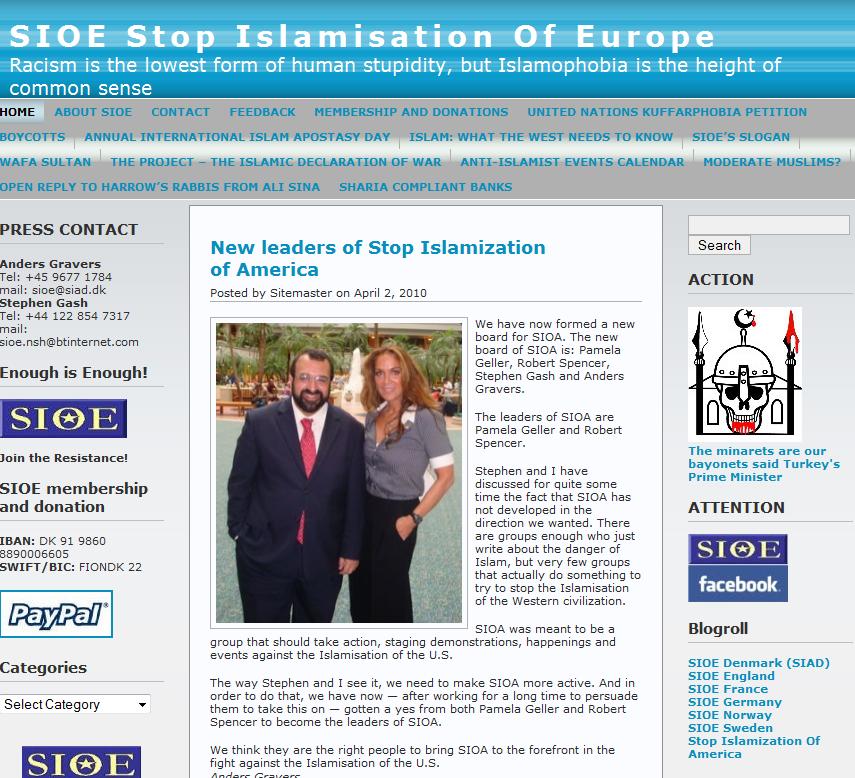
Six months later with the inspiration of some from the “Tea Party,” a new movement started which was based on an Anti-Islam ideology. Using organization from European anti-Islam groups, a group was created in the United States called the “Stop Islamization of America (SIOA) group.” This extremist anti-Islam group also planned to go to the Washington DC Capital building. But instead of rallying there for human rights, the SIOA group went there to help disrupt a peaceful Muslim prayer meeting, including plans to bring “donkeys and dogs” to upset the Muslim prayer group. Instead of addressing human rights violations by extremists around the world against Muslim women, this new anti-Islam movement decided to commit its own abuses against Muslim women themselves. While R.E.A.L. sought to promote human rights, SIOA sought to perform human wrongs.    The Stop Islamization of Europe (SIOE) group which founded this American Anti-Islam group had a motto which sought to PROMOTE Islamophobia, stating “Islamophobia is highest form of common sense.”

But hate is an attractive drug to polarized political groups, and so the SIOA did not disappear, although it was dormant from October 2009 until April 2010. Then its European anti-Islam leaders convinced Pamela Geller and Robert Spencer to take up the leadership of the SIOA group. The SIOA group had a new activist “human wrongs” objective – seeking to shut down mosques to deny religious freedom and freedom of worship in the United States.

At the time, many human rights activists and myself were deeply concerned about the treatment of religious minorities in Communist China, Asia, and the Middle East, including the violent treatment in Pakistan against minority Pakistan Shiite Muslims, Pakistan Ahmadiyya Muslims, Pakistan Christians, Pakistan Hindus and the treatment in Egypt against Coptic Christians, as well as many other groups. There are many many human rights violations against such religious minorities around the world who suffer great wrongs and human rights abuses. R.E.A.L. and others have sought to educate the public on such human rights issues and seek change to end their oppression.

But Pamela Geller’s SIOA had a different focus, they sought to deny Muslims religious freedom in the United States. Their answer to human rights problems were to commit their own human wrongs. This continues to be the approach that the anti-Islam commmunity takes today. Furthermore, Pamela Geller than took my argument comparing racial and religious extremist views, and redefined “extremism” as attacking all of Islam as a monolithic practice by all Muslims.

I know these claims that Islam is nothing but extremism to be a lie, and I know the great diversity of Muslim practice, and peaceful Muslim lives around the world. I ask my Chrisitian brothers and sisters – would you want to be defined by the white supremacist Christian Identity group? Of course not. Neither do the majority of our Muslim brothers and sisters want to be defined by extremists who deny human rights, preach hate, and promote violence.

I have stood side by side with my Muslim brothers and sisters across Washington DC, defending women’s rights, condemning stoning, supporting freedom of religion and conscience, calling for an end to genocide, and calling for love and respect for all human beings. I have attended services at Muslim mosques and heard calls for love, peace, and dignity with my own ears. After the attack on the U.S. Holocaust Memorial Museum in Washington DC, my brother Mohamed Yahya stood with me praying for our Jewish brothers and sisters threatened by the white supremacist terrorists. He stood by me while white supremacists sought to disrupt our memorial and attack us. His answer was the same one we believe at R.E.A.L. – “you seek to hate me, but I love you.” We stopped our event and we offered the white supremacists our outstretched hand in friendship and fellow humanity. We prayed together for peace, dignity, respect, and safety.

To those of you in the anti-Islam movement who seek to spread hatred against all Muslims, I know better, and I know your argument is a lie. There are many many different practitioners of Islam, and I have been grateful to know many who promote respect, human rights, dignity, and love for one another. Your hatred cannot hurt them, because they have Chosen Love, Not Hate. Love Wins.

I have repeatedly spoken out against the SIOA, SION, and Pamela Geller’s other organizations, and the anti-Islam movement. I have publicly expressed my regret and apology for my use of the term “extremism” in my argument on how to challenge the ideas of extremist groups who deny human rights. The last thing I ever wanted to do was to offend my Muslim brothers and sisters, but to urge them to challenge the extremist views that falsely claim they represent the majority view of Muslims. Since then, I have used the term “Bin Ladenism” to represent the term of such extremist views.  It is just as clear.

We cannot achieve human rights by committing human wrongs. None of us can, including myself.

We are all human beings with our weaknessess. But our focus must remain the same. We must continue to respect all of our brothers and sisters in humanity. We must defend their universal human rights, their dignity, their freedoms, their safety, and their lives. We must continue to approach defending human rights with an outstretched hand, not an upraised fist. We must be consistently Responsible for Equality AND Liberty – for all – without exception.

Most of all, we must Choose Love, Not Hate. Love Wins.

U.S. Holocaust Memorial Museum Attack Remembrance: R.E.A.L. Volunteers Jeffrey Imm, Mohamed Yahya, and Others Offer an Outstretched Hand, Not an Upraised Fist - to White Nationalism and Anti-Semitic Group Leader - Choose Love, Not Hate

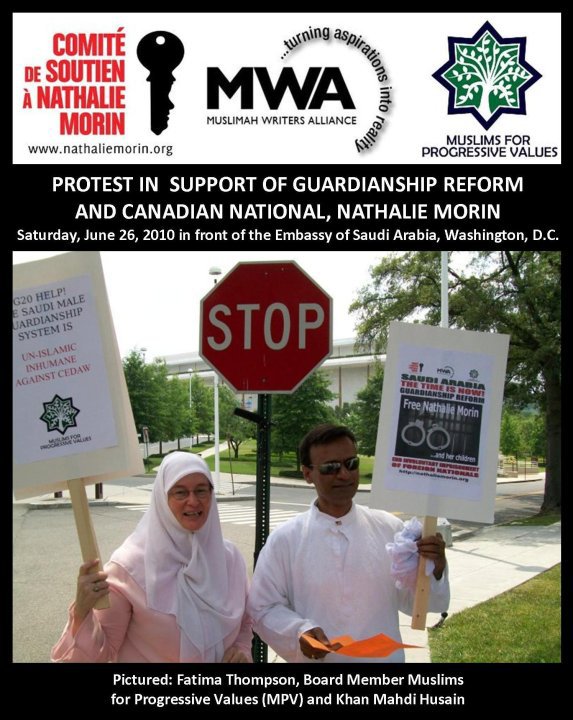
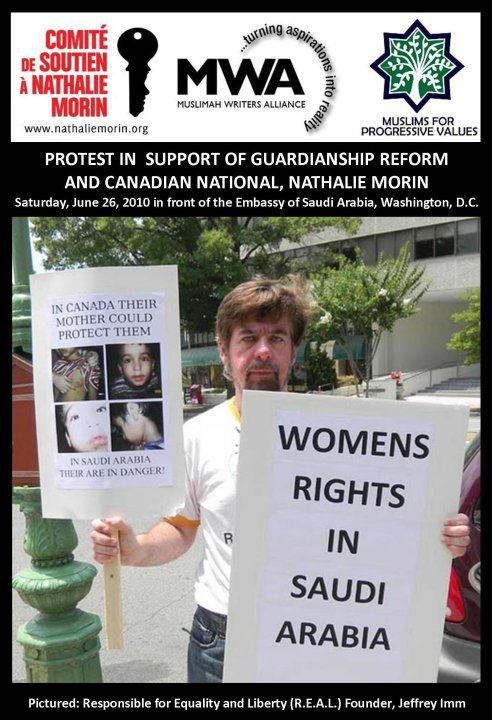
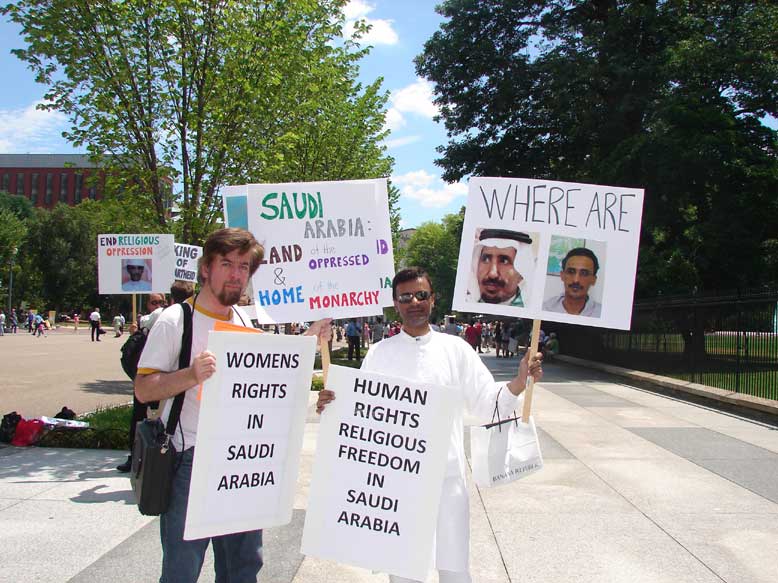
Muslim Mahdi Husain (Right) and Christian Jeffrey Imm (Left) of R.E.A.L. Picket Together for Religious and Women's Freedom in Saudi Arabia

September 11 - People of All Faith Stood Together in Washington DC for Human Rights, Freedom of Religion, and Dignity for all People - Christian Jeffrey Imm, Jewish Families, Muslims for Progressive Values (MPV) Groups

Religious Minority Oppression is Not Helped by Hate

To those Americans and Christians unaware of the struggle of Egyptian Copts, minority Christians, and minority members of religious groups around the world, their struggle for human rights, dignity, and safety is a real one.  The protection of these universal human rights are a shared struggle that we must have with minority Muslim, Jewish, Hindu, Sikh, Buddhist, and other brothers and sisters – who are oppressed around the world EVERY DAY.  These minority rights for religious freedom and freedom of conscience of beliefs around the world – are not just minority rights – they are HUMAN RIGHTS.   They are universal human rights that apply to all of our brothers and sisters around the world.

Supporters of the volunteer human rights group Responsible for Equality And Liberty (R.E.A.L.) have stood shoulder to shoulder supporting and praying with members of such minority groups, whose freedom of conscience, freedom of worship, dignity, safety, and lives have been constantly threatened.  This is not the challenge for individual religious leaders.  This represents a consistent threat to the universal human rights entitled to every human being.

We have stood by our Coptic Christian brothers and sisters over the years, as they have been oppressed, threatened, attacked, kidnapped, houses of worship  violently attacked, and murdered.  We have stood by our Pakistan Christian minority brothers and sisters, whose children have been attacked, women arrested, and churches burned. We have stood shoulder to shoulder with our Muslim brothers and sisters, when they have been attacked and threatened, their mosques attacked, their beliefs defiled, when they have been victims of terrorism in the United States and around the world.   We have stood by our Jewish brothers and sisters as they have been attacked with venomous Anti-Semitism in this country, around the world, and as Israel has been violently attacked. We have stood by our Hindu brothers and sisters when they have fled for safety due to their religious oppression, and when their young women have been kidnapped, forced to deny their religion, and Hindus have been injured and killed.  We have condemned and prayed with our Sikh brothers and sisters as they have been the victims of  hate violence in the United States and around the world.  We have stood by our Buddhist brothers and sisters in their call for peace and call for the right to practice their traditional religions in Asia.  We have stood by the practitioners of the Falun Gong when they have been kidnapped, tortured, and killed in China.

There is no nation without a record and history of minority religious oppression, so let us remember that such abuses happen everywhere, and must be confronted everywhere, just as our human rights apply everywhere.

After the Holocaust and the defeat of Adolf Hitler, the nations of the world banded together to form the Universal Declaration of Human Rights (UDHR), setting a world standard to guarantee universal human rights, freedom of conscience, dignity, safety, and respect for people around the world, of every nationality and every religion.

When we see hate and violence – we must point to our shared commitment as human beings to such universal human rights – everywhere and without exception.   It is the second part of this which confuses some people.  They want to believe in such universal human rights – for themselves, for their identity group.  But universal human rights apply to all of our brothers and sisters in humanity.

Our universal human rights also include our freedom of speech and our freedom of press.   We may disagree with things that people say and write, but we must be consistent on our freedoms.

But freedom of speech and press is also a two way street.  We too have the right to express ourselves.    We have a right to call for peace and patience around the world, despite the loud voices that call for conflict and violence.  To those of us who care deeply about the fate of Coptic Christian minorities, we also have the responsibility to disagree with those have created films that would make hateful comments against Islam.   A commitment to human rights is not a mandate to attack others’ religions.  Oppression does not justify venomous films that will spread hate and incite anger among many.   We have our free speech, which we also share, and in our support of human rights, we disagree with such speech and such actions.   At one Coptic rally at the White House three years ago, I met Morris Sadek, one of the reported promoters of this agitprop video on Islam.  I am shocked, distressed, and discouraged by his actions and those of others in promoting this YouTube video “Innocence of Muslims.”    It is wrong, counterproductive to anyone’s human rights, and I know that there are many leaders in the Coptic Christian community that spoke out against this film and these actions.  Let us be clear, such actions will not promote human rights, will not promote freedom of conscience and religion, and will not help those genuinely oppressed religious minorities, such as the Coptic Christians.

The response to religious oppression anywhere in the world – should never be hate.

There is a real global problem with religious oppression around the world.  Responsible for Equality And Liberty (R.E.A.L.) will continue to stand by our brothers and sisters in the Coptic Christian community, just like we do in the worldwide Christian community, Muslim, Jewish, Hindu, Buddhist, Falun Gong, and other communities to respect their universal human rights – without exception anywhere in the world.

Christian life is not cheap.  But that is because no one’s life is cheap.  We are all special and unique individuals, entitled to human liberty, human rights, safety, and human dignity.  Those who ask if promoting videos of hate are Christian actions, should merely reflect on the commandment by Jesus Christ to “love one another.”     This is the position that members of all religions of peace must take in responding to extremist views – anywhere in the world.

We stand by our brothers and sisters in humanity, and we have confidence that the minority of extremists and those stained by the disease of hatred, will ultimately be overshadowed by the bright light of our love, respect, trust, and hope in the dignity, decency, and love that we can find in humanity.

Choose Love, Not Hate.  Love Wins.

Be Responsible for Equality And Liberty.
Hate Hurts Us All

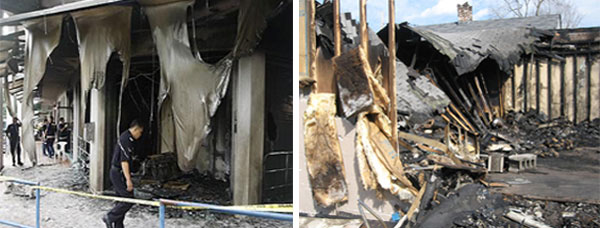
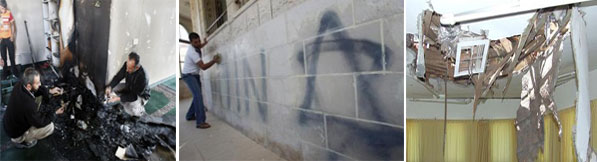
Church Burned Down in Malyasia, Mosque Burned Down in United States
Can You Tell The Difference Between a Burned Church or a Burned Mosque? Church Burned Down in Malaysia -- Mosque Burned Down in United States -- Hate is Hate

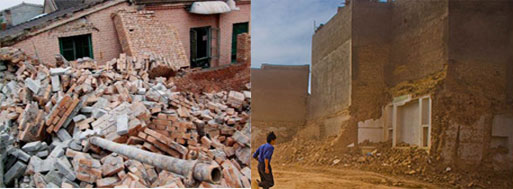
Communist China: Husan Church Destroyed (ChinaAid), Uighur Mosque and Kashgar Area Demolition (NYT)
Communist China: Husan Church Destroyed (ChinaAid) -- Uighur Mosque and Kashgar Area Demolition (NYT)

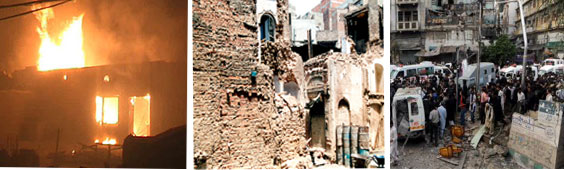
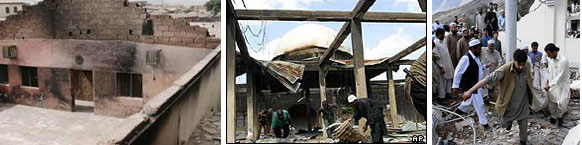
Pakistan: Mob Attack on Christian Churches and Homes, Destruction of Hindu Temple (Dawn), Bombing Attack on Muslim Shiites (Dawn)

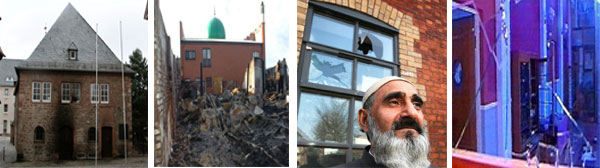
Malaysia Church Burned -- Indonesia Church Burned -- Indonesia Mosque Burned

Photograph showing destruction at Hindu temple (Photo:  Carlos Furtado)
Australia: Photograph showing destruction at Hindu temple (Photo: Carlos Furtado)

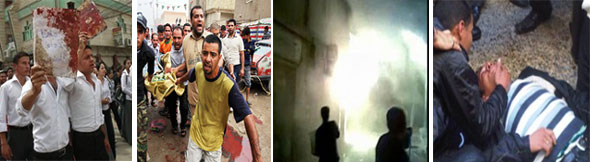
Middle East: Bombing Aftermath of Iraqi Christians (AP), Iraqi Shiite Mosques (London Times/Alice Fordham), Arson Attack on Egyptian Coptic Christians, and Terrorist Attack in January on Egyptian Coptic Christians (al-Masry al-Yom)

West Bank Mosque Arson (Getty), Vandalism (Reuters), and Israel Synagogue Attacked
West Bank Mosque Arson (Getty), Mosque Vandalism (Reuters), and Israel Synagogue Attacked

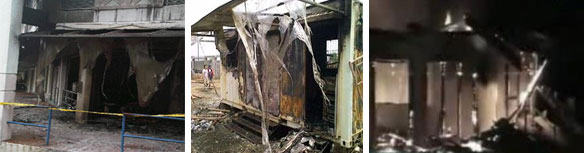
Nigeria Churched Arson, Nigeria Mosque Arson (AP), Somalia Mosque Bombing (AP)
Nigeria Church Arson, Nigeria Mosque Arson (AP), Somalia Mosque Bombing (Trend)

German Synagogue Arson, UK Mosque Arson, UK Mosque Vandalism, UK Synagogue Vandalism
German Synagogue Arson (DDP), UK Mosque Arson, UK Mosque Vandalism (MEN), UK Synagogue Vandalism

In America Today: Churches, Mosques, Synagogues, Other Houses of Worship Attacked
In America Today: Churches, Mosques (TIRCC), Synagogues, Other Houses of Worship Attacked

We can choose another direction.   Choose Love, Not Hate.  Love Wins.

2011 Human Rights Day Remarks – R.E.A.L.’s Jeffrey Imm

2011 Human Rights Day Event Remarks, National Press Club, Washington DC

December 8, 2011

Jeffrey Imm, Responsible for Equality And Liberty (R.E.A.L.)

(Full Remarks on YouTube)

December 8, 2011

Welcome and thank you for coming today!
It is another good to be Responsible for Equality And Liberty.
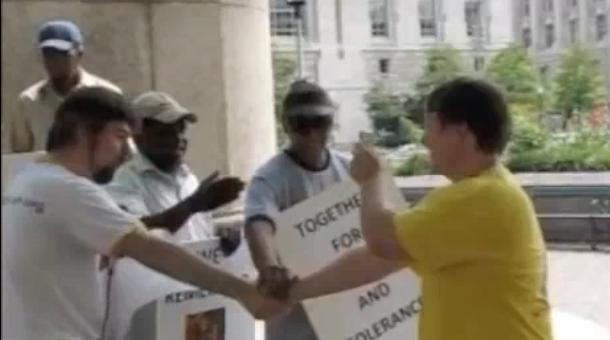
That is the name of our human rights coalition, Responsible for Equality And Liberty, and we are here today to invite our fellow human rights activists in a joint event where we remember the December 10, 1948 adoption of the Universal Declaration of Human Rights (UDHR) by the nations of the United Nations.

People around the world remember this human rights accomplishment as Human Rights Day, and there events going on around the world.

Here in Washington DC, Responsible for Equality And Liberty, has sought to also celebrate Human Rights Day here at the National Press Club, as we have done over the several years, with speakers on various human rights campaigns, to share our common bond together in our efforts to be responsible for our universal human rights for all people around the world.

Our common bond is our humanity. This includes the inherent human dignity and human rights for all people of all identity groups everywhere in the world that represent our universal human rights. We come from the nations of the world, from different races, different ethnic groups, different religions, different genders, and different identity groups – but our universal human rights apply equally to all – without exception, without reservation.

Our universal human rights are also based on our shared respect for one another as human beings. Such respect is essential in our human society. We find those who seek to be superior or arrogant in seeking rights for themselves that they would deny to others. But our universal human rights are based on shared respect for all people of all identity groups everywhere in the world. Our universal human rights require a commitment to being responsible for BOTH equality and liberty for all.

In our individual campaigns, we struggle with those who would seek to deny such universal human rights. We see extremist groups, totalitarian governments, and those with hate in their hearts seeking to deny human rights to others. Let us never forget this problem is one of human respect, first and foremost. If we are to RESPONSIBLE on this matter, we must treat all human beings with respect, even those with whom we disagree. The challenge we see in human rights is not only a challenge for individual campaigns, but it is a challenge for humanity itself.

So our combined campaigns for human rights must begin with a declaration of love and respect for our fellow human beings. The view with Responsible for Equality And Liberty is that we offer an outstretched hand, not an upraised fist – to all of our brothers and sisters in humanity.

Our common bond is our humanity and our common legacy must be one where we show our love and respect for one another, even as we challenge those who oppress, and even as we challenge those deny human rights and dignity to others. We must set an example. We must set a standard. We must offer a vision of the future based on hope.

We urge others to Choose Love, Not Hate. But we are not preaching about our own perfection, rather we are setting a goal for our society and ourselves with humility.

Our goal in our human rights campaigns must also be finding and building for the future of human society together.

That future must begin with a commitment to the most vulnerable among us, whether they are minorities in the race, religion, gender, ethnic background or other identity groups. It is easy to ignore those who are different. But the global danger is that we become arrogant and fail to respect their human rights. We have seen this around the world: in the United States, in Asia, in the Middle East, in Africa, in Europe. We have individuals who will speak today on campaigns to defend the human rights of minorities and other groups who are denied human rights based on perceptions in culture, including women in America.

Our future in human rights must also address the issue of the terrible poverty around the world, and the impact of this poverty on effectively denying the human rights of people. I also urge Americans to address this issue as well. Just a short drive from where we meet today, you can see some of the most dire circumstances of poverty and neglect. There are those who would seek to leverage such poverty to abuse the vulnerable in our society in America and around the world. To challenge the poverty in human rights around the world, we cannot also neglect the need to challenge the issue of poverty itself. Give where you can, help where you can. Use your declaration of love and respect to help those who need help.

If our commitment to the future must address the most vulnerable among us, then the most important part of that commitment is our children. Without our children, there is no future for human society. Our children are the future leaders of Earth, and we must set an example on human rights, respect, and love for one another – not just for our own sake – but also for our children’s future. I say “our children” because they are our shared responsibility and our shared future. We cannot just only expect the parents of our children to look out on their behalf, no more than only our parents looked out on our behalf. All of human society has a responsiblity to equality and liberty for our children, and all of human society has an obligation to safely protect and preserve our children, so that can live and grow to become the future leaders of our Earth.

But if we were to assess human society based on how its most vulnerable, we would a sorry story. Too few nations, including the United States of America, are signatories to the United Nations’ Convention on the Rights of the Child. A few weeks ago there was a separate event where people remember the ratification of the Convention on the Rights of the Child (CRC) on November 20, 1989.

If we are committed to human rights, we must first and foremost be committed to human rights for our children. Yet an endless parade of violence and abuse against children and young people continues throughout America and throughout the world.

On Monday of this week a 7 year old girl, Jorelys Rivera, was found murdered, sexually abused, and left in a trash bin. (Lifting her photo to the audience). This is the face of human rights in America and the world today. Our children are abused, raped, tortured, and killed in America and around the world with impunity. In Texas, children were killed by their own mother, after putting a Facebook posting warning of threats against them. In Pennylvania, institutional leaders ignored reports of repeated attacks and rapes of young boys for over a decade at the Pennsylvania State University, of which I myself am an alumnus.

This week in Afghanistan, a teenage girl who had been raped and imprisoned by the Aghan government as a result of being a victim, was finally given an oppportunity to be released from prison after 2 years, if she married her rapist.

Our disgrace in human rights for children are not just by criminals and extremists, it is by governments, it is by institutions, and it is by too many in society. This disgrace in human rights for children is only a reflection of the state of our society on human rights. We see extremist views from people who claim that they represent religious or cultural views justifying pedophilia and honor killings. On regular basis, such so-called “honor killings” frequently of young girls are reported at the international human rights group’s web site stophonourkillings.com. In the United Kingdom alone, there were 3,000 so-called honor killings last year.

This threat to our children affects all of us and all of in this room and the individual human rights campaigns represented here.

In Sudan and Darfur, children are killed, young girls are raped, children are starved, authorities refuse to let children learn about their culture, and some children are taught to become soldiers.

In Pakistan, we see an endless and horrifying oppression of young children, brainwashing by extremist of young minds, tying bombs onto children for terrorist acts, the abuse, rape, and murder of young Christian girls and other religious minitories, including a young girl Amariah Masih, who was murdered resisting an attempted rape and reported forced religious conversion.

In Balochistan, we have seen over 168 children who have “disappeared” and teenage boys killed as part of a brutal “kill and dump” campaign by authorities.

In China, only two months ago, the world saw heartless people continue to walk by as a two year old girl Yue-Yue was run over by a vehicle and left to die in the street. At the U.S. Congress a short drive away, I have sat and listened to testimony from young Chinese women forced into having abortions and heard reports of how the government instructed doctors to kill young babies. The Falun Gong, here with us today, could tell the story of how the children of their supporters are also oppressed, tortured, killed, and others left to be orphans or without parent as the Chinese Communist Party takes their parents away for their beliefs.

In Bahrain, I have a report from a few weeks ago of 5 children killed and hundreds of children subjected to excessive force by a brutal government that seeks deny democracy and human rights.

We such abuses too regularly, and it is easy to view such disgraces as statistics rather than as human beings, who are precious, unique, and loved.

My friends have also been asking why Responsible for Equality And Liberty has had less press conferences this year. One of my own personal focus has been dealing with people suffering in dire poverty in this nation and seeking to help them from their difficult living environment. This has included a teenage girl who came to me with her own story of abuse and I have been intervening to protect her and other American girls suffering from abuse as a result of their poverty, by those who seek to take their hope, dreams, and their innocence away.

They are all OUR children. They are all OUR responsibility for equality and liberty. Every one.

In the month of December, we see some people celebrating holidays of various sorts and some providing gifts to children.

I believe we can give them a special gift this year.

We must give the gift of our courage, our consistency, and our commitment for the universal human rights and dignity to all of our children around the world.

Some believe that abuses against our children are simply a law enforcement issue. Nothing could be further from the truth. If we are to be responsible as individuals in a human society, each of us must be responsible for the children that are our common bond and bridge to the future.

We must set an example for our children.

We must provide a beacon and symbol of hope for our children.

We must show that by our words and more importantly by actions, in the United States and around the world – to our children – and to each other…

We are Responsible for Equality And Liberty.
Mohamed Yahya October 17 Remarks – United Nations

UN Book Wish Foundation Organization Conference October 17, NYC

Mohamed Yahya, Damanga Coalition for Freedom and Democracy

See also

Video link of October 17, 2011 conference – John Prendergast, Mohamed Yahya, Udo Janz, and Grainne O’Hara– U.N. Conference on Libraries in Chad for Sudanese Refugees

========================

Ladies and Gentlemen –
Good afternoon. My name is Mohamed Yahya, and I am a survivor of the genocide in Sudan and Darfur. I lead the Damanga Coalition for Freedom and Democracy. I would like to thank the UNHCR, the UN Office for Partnerships, and the Book Wish Foundation for the invitation to speak to you today. I am deeply moved and grateful that proceeds from the book “What You Wish For” will be used to develop libraries in Eastern Chad refugee camps where many of my fellow Sudanese refuges live. They need hope, they need dreams, and they need their culture and history. I too was a refugee from Sudan, before ultimately coming to this country, and so I can tell you it means a lot to me. This is a great initiative by the Book Wish Foundation, and we can’t thank you enough for this program to help provide libraries of books to help the lives of the surviving refugees in Chad. We express our great gratitude in your efforts to help Sudanese refugees in Chad who had lost hope in getting an education. With the ongoing genocidal war, they lost the lives of their loved ones, lands, farms, belongings, animals, and properties. We also extend our thanks to those you who visited Darfur and Chad several times, putting your lives in the front to save the lives of others, providing them with the necessary means for survival or education.

As human beings, we are inspired by our wishes, our ideas, and our dreams. Many of these we find in books. Books help us grow. Books help make us who we are. Books help give us freedom.

In the West, I have read books that speak of great ideas and philosophy, including writing by Nelson Mandela. I have read great poetry and I enjoy Edgar Allen Poe’s poetry. I have read great books of drama and struggle such as those by Leo Tolstoy. I have read great religious books from people of all faiths and different philosophers. I have read many inspirational and historical books from around the world and in different languages. These books tell great stories, provide great education, and inspire great ideas.

I ask you to imagine this. What if you were not allowed to read them? What if you were not allowed to read books, poems, history books about your culture and your heritage? Books help us grow. But what if someone refuses to let you read them? This is what has happened in Sudan and Darfur, under Sudanese President Omar Al-Bashir.

Imagine if someone tried to take your imagination, your history, your culture, and your books away from you? That has been the case in Sudan and Darfur.

Sudan’s Omar Al-Bashir has led a long genocide against people in Darfur and Sudan. But the genocide is not just killing my brothers and sisters there. The genocide is also trying to erase their culture, their heritage, their ideas, and their dreams.

Imagine if someone tried to prevent books on your culture, your history, and your dreams – to try to erase your identity. That is how genocide begins.

It is a crime against all of humanity, including all of you here. We need the genocide to stop, and we need to heal the Sudanese and Darfuri people who have suffered.

This is why the work you are doing with this initiative is so important not only just for the Sudanese refugees, but also for humanity. We thank you and humanity thanks you.

I wish to recognize all those involved who have sought to defend in some way, the struggle of the Sudanese and Darfuri people from the genocidal war. I wish to recognize all those even killed, raped, or kidnapped while performing their duties, from UN peace keepers to individuals, workers, staffers, teachers of the World Food Program, UNHCR, US AIDS, International Rescue Committee, Enough, Our Humanity In The Balance, Darfuri Associations, African Union, European Community, Physicians for Human Rights, I-ACT, Stop Genocide Now, Save Darfur, American Jews Service, Mia Farrow, human rights organizations, UNICEF, Save the Children, Red Cross, Doctors Without Borders, Darfur Interfaith Network, Eric Reeves, Humanity United, Responsible for Equality And Liberty, Change the World It Just takes Cents, American Jewish World Service, Jewish World Watch, Massachusetts Coalition to Save Darfur, Refugees International, Radio Dabenga, Amnesty International, US Holocaust Museum, Sudan Now,Africa Action, and more.

Someday, you too will be in the books of history. We need to finish the job to end the genocide and to bring freedom to Darfur and Sudan, so that those people will be allowed to read such books.

The Darfuri refugee camps have asked me to bring to your attention, including the UNSC and the US Mission through the UNHCR, the following actions that are urgently needed:

1- The Darfuri refugees are asking for a Non-Fly Zone over Darfur and all the affected areas to stop the Sudanese government’s bombings and protect their lives outside and inside camps and villages.

2- The Darfuri refugees are in need of help to build them more schools, libraries, and a refugees’ university near the Chad border with Darfur to absorb students, who might otherwise end up on the streets or become recruited as a child soldier after high school.

3- We appreciate your ongoing efforts for a peaceful settlement to the Darfur conflict. But the real lasting solution to Darfur conflict should start with justice. Therefore, we need you to support the ICC to bring Al-Bashir and all suspects to justice. Then peace will come and all refugees will peacefully returns back home.

4- We ask all to give full access to the humanitarian organizations and aid workers to reach all refugee camp with shelters, medicine, clean water and food supplies.

Once again we thank you all for your efforts and this wonderful initiative for libraries for the refugees. We share your commitment to ideas, learning, education, and hope for a future of peace, respect, dignity, and human rights for all people.

Mohamed Yahya

===========================

Mohamed Yahya, Damanga Coalition Speaks on Human Rights, at National Press Club on Human Rights Day Event, December 9, 2010 (photo: Epoch Times)

9/11 – We Remember and We Are Not Afraid

Around the United States of America, people are remembering this day as “Patriot Day.”

Ten years ago today, terrorists attacked New York City, Washington DC crashing jets into buildings and murdering thousands. Another planned attack on Washington DC was thwarted in mid-air on Flight 93 by courageous people, and it crashed in Shanksville, Pennsylvania.

We remember.

But we do more than remember than tragedies and the loss of lives.

How many memorial services, how many funerals have you gone to that simply remember loss and death?

No, when we REMEMBER, we also and most importantly remember life. We remember dignity. We remember joyous days. We remember mercy. We remember our common bonds with one another. We remember not just death, but we remember what makes our lives worth living. We remember our hearts and our love for one another.

I believe we do have a destiny. I believe all of our lives are lived for a purpose. I believe that all of our lives have meaning and are special. Those whose lives were ended on 9/11 came from many different backgrounds, different religions, and different identity groups. For some, they died so that we here could live. For others, their last moments were of courage in seeking to save their fellow human beings. They included Todd Beamer, Steven Weinstein, Sophia Addo, New York Fire Department Captain Patrick J. Waters, Lydia Bravo, Army Major Wallace Hogan, NYPD Cadet Mohammad Salman Hamdani, and nearly 3,000 more. Their deaths from the terrorist attacks were not an end, and their lives will be remembered by Americans forever.

We remember our brothers and sisters on 9/11. We remember them and we reach out to them across the universe and across the heavens.

We miss them and we love them. We love them, no matter their names, no matter their ethnic group, no matter their race, no matter their gender, and no matter their religion.

Some worry that our love and compassion will be seen by others as weakness. Our love for one another is not a weakness, but it is the greatest strength in the world. It is a bond to holds fast our diversity around the globe into one singular and special human race.

In the Washington Post today, a writer writes that the 9/11 attacks were the “end of American innocence.” But in our nation and around the world, there are innocent children born every day, who are born into a world and a nation, where they are loved. We have opportunity for such innocent compassion to our fellow beings every day of our lives. So I don’t see any end to innocence in America, or anywhere in the world, I see the endless opportunity for innocent love towards one another.

There are some who ask, ten years later, isn’t it time for Americans to “get over” 9/11? Some of those people mean well. Some of those people are concerned about the divisions we have seen grow in our nation and the world. But we have a choice. As we remember the lives lost on 9/11, we also must continue the courage and dignity of those who were killed that day. We have the choice to remember 9/11 for the fearlessness and sacrifice that so many made to save their fellow human beings in New York City, in Washington DC, and on Flight 93 in the sky. We should never “get over” such profiles of courage, and we should use their inspiration today and every day.

Today, our nation and our fellow human beings must have a united message to those who seek to promote hate and violence.

We are not afraid.

We don’t make that statement arrogantly, but simply as a statement of the truth in our hearts.

We won’t allow ourselves to be dragged into the fear and hate that undermines the joys and the blessings that we have in our lives.

We urge our fellow human beings to choose peace, not violence, to choose human dignity, not disrespect, and to choose love, not hate.

We have the real courage to love one another.

We remember.

We are not afraid.

=============

Join us at John Marshall Park or the Unity Walk in Washington DC today


The Courage to Choose A New Dialogue

— Oslo and Finding the Courage to Change — A New Dialogue (Part II)

Once again, as I write this, there are those who claim to want to threaten my hometown and America’s national capital. We have seen it many times over the past 10 years. We have seen the barriers, the security procedures, the National Guard, and the police riding our subways with machine guns.

But once again, the path to peace anywhere in the world, Washington DC or New York City, the Middle East, Africa, Asia, and Europe – begins with a dialogue of peace.

Such a dialogue requires the courage to change the dialogue of the past and embrace the opportunities that we have to work together as fellow human beings to achieve change in our societies and our world.

At the end of July, I wrote of the terrorist attack in Oslo, Norway by confessed terrorist Anders Behring Breivik. I wrote about the need to comfort those who lost their lives and families of children whose lives were lost in the July 22, 2011 terrorist attack in Norway. I wrote of the need to balance our disagreements with dignity and compassion, and the lessons that we must continuously learn and teach from such violence.

At the end of August, I wrote details about the challenges of extremists in various groups. This includes extremists in the Anti-Islam group that Mr. Breivik claimed to represent as well as the Bin Ladenists who continue to commit and threaten terrorism around the world. My Christian friends reject the oppressive message and terrorist actions of Mr. Breivik, who sought to view himself as a “Christian crusader.” My Muslim friends reject the violence and hate of the Bin Ladenist movement. I embrace the efforts of all my brothers and sisters in humanity to pursue a path of compassion and human dignity.

These terrorists do not represent us, and we must not allow them to claim that they represent the “culture” of our faiths. It is the responsibility of people of such faiths to continue to make this clear to the world, not just with their words, but more importantly with their actions.

We must find the courage to seize the opportunity for a new dialogue on our freedom of speech and responsibility, to develop a new approach to our cultural ownership, to choose a new dialogue regarding religion and human rights, and to choose love, not hate not just in our hearts, but in our minds, in our words, and in our actions.

1. A New Dialogue on Freedom of Speech and Responsibility

We cannot have any dialogue without freedom of speech. When we fear to communicate and to disagree, then people stop talking and start plotting on how to overthrow “the other” (whoever that may be). So whether we agree on someone else’s views or not, let’s remember that if we deny their freedom of speech, we undermine the ability to build any type of dialogue in the future. I talk with a lot of people that I disagree with – in many different areas. Some people may choose to view me as an “enemy.” But I have no enemies; I only have brothers and sisters in humanity. That is what all must seek, no matter how disagreeable or how difficult that may be at times.

But while we work to support the freedom of speech for all, we must also work to build a greater sense of responsibility to use our words constructively. We can use our words to build, not destroy. We can use our speech to heal, not to divide. We can use our rhetoric to hope, not to hurt. We have a choice, and we also have a responsibility to our society.

We cannot legislate responsibility or our brothers’ and sisters’ thinking. They have universal human rights to say and think what they choose. While we have laws to protect people from violent threats and danger, the real work in building responsibility is by showing responsibility ourselves. We must spend less time pointing fingers and more time extending our hands in human fellowship. We must spend less time in dialogue with those who share our views, and more time listening to others with whom we disagree. We must set an example in being responsible for both freedom and dignity.

Building responsible speech in our societies is hard, grueling, thankless societal construction work. We will win no awards, get no supporters, obtain no donations, and get no accolades for the construction work of building respect and dignity for one another in our communications.

But imagine how our society would struggle if we had no construction of roads, of sidewalks, of building, of electricity. Imagine our homes with no windows or no doors. We depend on such thankless construction for our daily lives and our daily interaction with the world.

We must make a renewed commitment to such construction for peaceful, respectful construction in communications with our human brothers and sisters. A new dialogue begins with choosing to be responsible for showing dignity towards one another.

2. A New Approach to Cultural Owners

Imagine a home with no windows, no doors. It would be a tomb, or perhaps even a cell. In many parts of the world, our brothers and sisters in humanity live in such prisons. They are imprisoned for choosing freedom, for choosing dignity, and some simply because of their identity, including their religion. We see people of all types of faith imprisoned around the world in oppressive states for their faith, or by those who discriminate and oppress them for their faith.

But the jailers are also in jail themselves.

We must seek and work towards a new approach to cultural ownership, where our homes have windows and doors, where our cultural homes allow us to see and talk to one other, where our cultural homes allow the light of day and the stars at night.

Mr. Breivik’s terrorist attack was for what he called a “Christian culture,” and the Bin Ladenist movement seeks what they call an “Islamic culture.” My Christian and Muslim friends reject both extremist views. But we must do more than just reject extremism. We must also answer the more difficult questions in our societies about our insecurities regarding our cultures.

Many are adverse to change, and the globalist movement of the 20th century has caused many great concern. They fear local and traditional views will be challenged and even lost. Some have rationalized that the answer should be found in cultural tariffs to keep people of other cultures, other races, other ethnic backgrounds, other religions, other identity groups – OUT – of a culture that they don’t want to change.

But history has shown that the effort to build such cultural tariffs and cultural walls are doomed to failure. Oftentimes, such efforts have had catastrophic and horrific results. We have seen some examples with Adolf Hitler’s Nazi Germany, racist segregationists in the United States, Communist totalitarian nations, genocide in Darfur, and the endless waves of violence against religious minorities in the Middle East and Asia. History shows that the efforts to build walls around our cultures have many, many bad endings.

There is a great misunderstanding that comes with the closed minded views on isolated cultures. We have seen this with the manifesto of the terrorist Anders Breivik, who also used his attack (not unlike the Bin Ladenists) to reject what he calls multiculturalism. This misunderstanding comes from a basic confusion over what our responsibilities are involving multiculturalism.

Multiculturalism is not about submission or surrender. It is not about sacrificing our cultures. We do not have to agree or even like other cultures. Multiculturalism is not about any of that. The important point for human dialogue is simply that we show dignity and respect for others and their differences, regardless of whether we agree or whether we like them, simply because they are fellow human beings.

Fear and doubt can be greater motivators to build walls. But if we are serious about building security not just for this moment, but also for our children and the generations to come, we must build more doors and more windows. We must not be afraid to look outside.

A new dialogue begins with the realization that we must share our Earth together. Not only do we need to be heard, but also we need to be able to listen.

3. A New Dialogue on Religion and Human Rights

People of faith must seek the opportunity to build a new dialogue on religion and human rights. We have to reject the idea that our faith does not allow human rights, human freedoms, and religious freedom for our human brothers and sisters.

To people of all faiths, I ask you to look not only to your heart, but also to your soul. We must find something other than fear, hate, anger, bitterness, and rejection in ourselves, in our thoughts, in our words, and in our lives.

We are better, we are bigger, we are more decent than what we have seen in the dialogue over the past 10 years since the 9/11 attacks. We are more courageous than to let people of faith suffer in prison cells and in oppression around the world, simply because of their faith. We have more confidence in our faith than to seek to deny our brothers and sisters their own houses of worship and their freedom of conscience – anywhere and everywhere in the world, without exception, without caveat, without condition.

We have greater voices and greater power together than the extremists among us who would denigrate others, oppress others, and even cause harm and violence to others. We outnumber even the greatest mobs with torches, with our countless masses that can choose to stand for freedom and dignity for all.

We must not let the Breiviks or the Bin Ladenists speak for us. We must not our silence ever be interpreted as apathy, or God forbid, consent.

We do not pray for fear, we do not pray for hate, we do not pray for indifference, and we do not pray for weakness. To people of faith, I say that we must be who we say we are, and take the responsibility to live as courageously as we pray.

We must lose the mask that too many wear of cowardice, indifference, and despair. We are more powerful than that. We are people of faith, blessed by a higher power to give us guidance and courage.

We are not better than our fellow human beings, but we are blessed to offer the chance to reach out to our fellow human beings. We must never let ourselves believe that blessing is a license to reject, to oppress, to demean, to hate, and to hurt our fellow human beings. Our blessing of faith must be cherished like the gift that it is.

My Muslim brothers and sisters have stood by my side many times, in many forums. They have stood by me in women’s rights events, in challenging stoning, in standing for religious freedom, in defying violence and hate, and in remembering those who have lost their lives to extremists. They have shared their heart break with me over the abuse of Christians, other Muslims, and other religious minorities in many parts of the world. They have stood with me in challenging the Bin Ladenists and their views. While this may get little reporting by the news media, I know this is true, I have seen this over and over with my own eyes, and heard this with my own ears. We need to reach out to greater numbers of our brothers and sisters on these issues.

My Christian, Buddhist, Jewish, and Hindu brothers and sisters have also stood by me in these and similar human rights events, over and over again, in different parts of America, and in joint event for human rights in Europe. We still need to encourage more of our brothers and sisters to be involved in such issues.

I don’t offer a message for a new dialogue on religion and human rights based only optimism, but it is also based on years of personal experience witnessing this dialogue developing, seen with my own eyes and heard my own ears.

A new dialogue is developing and will continue to develop among people of many faiths and none at all – while we continue to remember our shared humanity, and while people of faith remember their shared blessing.

4. A Message to My Christian Brothers and Sisters

I am a Christian. Therefore, I also have a special direct message to my Christian brothers and sisters on this need to build a new dialogue of hope, respect, and dignity.

The terrorist attack of Anders Breivik and his calls for “Christian culture” was a deep insult to Christians around the world. A number of Christian commentators dismissed Mr. Breivik by stating that he was not really a Christian, but viewed himself as a “Christian agnostic” who liked what he viewed as the “cultural” traditions of Christianity, without actually having any faith.

While it is easy to dismiss Breivik, I would caution my Christian brothers and sisters not to do so too easily. While millions seek to promote a different type of “Christian culture” than the one that confessed terrorist Anders Breivik sought, he is not an “isolated incident.” There are too many others to believe this. We have seen the Hutaree, the racist “Christian Identity” movement, the African Lord’s Resistance Army (LRA), Ugandan extremists, and the Westboro Baptist Church. We have seen pastor after pastor join marches to deny religious freedom, and some who have led Qur’an burning campaigns. We have seen dozens of Christian pastors joining groups that seek to deny the rights of other religions. We have seen well-known pastors on television call for violence attacks on Washington DC, and some who have called for natural disasters as religious justifications to push a political agenda.

For every one of these extremists, there have been hundreds, thousands of Christians who actively reject their views. These very vocal extremists are a small fraction of Christians. But does that diminish our responsibility to reach out to them, counter their views, and offer a different dialogue?

So yes, it is no doubt that Mr. Breivik was not really a “Christian,” as we know it. But let us not get so arrogant to ignore the plank in our own eye, and the growing climate of intolerance, of disrespect, and even of violence that continues to grow in some corners of people who seek to redefine what we view as “Christian culture.”

While I may offer advice to my fellow Christians, let me be clear that I do not suggest that I am a “Christian leader” or an authority of any kind. Hardly. I am nothing of the kind. I am a poor sinner, weak, and imperfect. I am an average person, who has made enough mistakes to fill any book. But our God gives us all a chance, even to the least of us, to make a difference. If we believe in our Christian faith, our evangelism is not what we say, it is what we do.

What we do – is not enough. Not nearly enough. That is hard is to say and it is hard to hear, when we must feel that in this difficult world and economy that we do so much.

But whenever we believe we have right to be arrogant, disrespectful, cruel, and thoughtless, then we are allowing the definition of “Christian culture” to be undermined and attacked. Even a poor sinner like me can see this.

Our Christian culture is nothing if it is not first based on humility, respect, mercy, and kindness. We may suffer and struggle. We may be abused and disrespected. But to my Christian brothers and sisters, we have faith that Jesus Christ died on the cross for our sins and our opportunity for eternal life. Our Christian culture is a culture of sacrifice, selflessness, compassion, and love. It is not simply enough that we Reject Hate. To the Christian culture, it is also imperative that we Choose Love.

5. Our Unity and Dialogue in Our Shared March of Life

Whatever our identity group, our religion (or none at all), our nationality, our race, our ethnic group, or our gender, we are ONE. We march together every day of our life in solidarity. Our solidarity is in our lives together in the human race that we share.

That march of life that we take every day together around the world allows us to share the dawn, the sun, the sky, the sea, the air, and the stars together. Our home. Our shared Earth for all of us.

On some days, that march of life is a struggle, for others it is an adventure. To all of us, our march of life is a constant opportunity not only for ourselves, but also for our society and the future for all.

For our shared march of life, we need more than the stones of angry words. We also need the building blocks of respect, patience, and the willingness to listen, even (especially) when we disagree. We can grow beyond the history of where we have been and where we have failed, and we can work towards our possibilities of what we could achieve by respecting and gaining faith in one another.

The march of life requires more than closed cultures with border gates that prevent us from walking together. We need pathways to see and understand one another.

Our march of life together requires that we not only have faith, but that we demonstrate that faith in showing dignity, mercy, and respect to one another.

But most of all, our march of life requires more than just the faith in our religions (or none at all) or in our ideas. We need to work to build a new dialogue with our fellow human beings so that we can trust each other more. We have don’t have to agree with each other to respect each other. We don’t have to share each other’s views to love one another as fellow human beings.

Our march of life together does not just have to have the background of rush, confrontation, and conflict. Our march of life can be to a new anthem, a new dialogue of respect, compassion, and love for one another.

This new dialogue must not just be in our words, but also must be an internal dialogue as to how we think about each other, and how we act towards one another. We have seen enough violence, we have seen enough pain, we have seen enough suffering, and we have seen enough hate.

We can make another choice, and work to build a new dialogue for future generations.

We can choose a new dialogue based on respect, dignity, compassion, and love for one another.

This year, as so many mourn the 10th anniversary of the terrible terrorist attacks in America on 9/11, let us remember more than just victims. Let us honor their lives, their joys, and their hopes. Let us honor their dreams, their faith, and their hearts.

Let us Choose Love, Not Hate. Love Wins.

Orange Ribbon for Universal Human Rights - Responsible for Equality And Liberty (R.E.A.L.)


Overcoming Hopelessness and Fear in Our Shared March of Life

Many in the world are paralyzed by crushing hopelessness and fear in their lives.

They may be struggling from financial, health, family, or human rights issues. Those struggling may face situations or even other people who seek to threaten their health, their homes, their livelihood, and even their lives. This struggle with hopelessness and fear has no limits to one race, one religion, one ethnic background, one gender, one generation, or even one financial situation.

Hopelessness and Fear are great equalizers to human beings.

Hopelessness and Fear seek to attack us from within.

They seek to make us question not only our security and each other, but also they seek to make us question ourselves.

They will even drive some to the desperation of hate and violence. While we often dismiss those whose hearts are hardened by hate as simply lost, let us not forget they were not born into hate. They were taught hate and they were taught violence. The hate and violence of some is because of their own fears, their own insecurities, and their need to dominate others because they fear that they without domination their lives will hold no meaning.

We can and we must teach those consumed by hate and violence differently. But to do so, we must also overcome hopelessness and fear in our own lives, to set an example for others.

People of religious faiths are taught to reach to their faith in a higher power to believe in divine inspiration, strength, and even an afterlife. If you are a person of faith, it is vital that you use such faith to give you courage and strength.

Find a direction in your religion to love one another, and if you love one another, have the religious faith to also love yourself and those around you, even those who wish you ill. If your religion teaches forgiveness, then also find the religious faith to forgive yourself and those around you, even those who wish you ill.

I know how easy that is to say and how hard that is to do. When you feel that you have failed and that you are not where you believe you should be in life, you lose patience and courage with yourself. When you feel that others have failed you and even hurt you, then you may feel that such individuals do not deserve such love and forgiveness. But it is especially at these times, when love and forgiveness is the hardest to give and receive, that it is the most important to give and receive. This is really when love and forgiveness can truly make a difference in ourselves and in our society.

In addition to religious faiths, there is more than one type of faith. While those with religious faith have faith in God or the higher power that they believe in, there is also the need to find faith here on Earth as well, regardless of your beliefs.

We also need to have faith in ourselves, in one another, and in our shared human race that we will continue to survive, we will continue to show love and mercy towards one another, and that we will continue to have a future. Despite the sickness, the injustices, the travesties, the oppression, even the genocide of people by other people around the world, the human race marches on.

As a human race, the march of life continues.

This shared march of life should also give us hope and courage.

Certainly, in our individual situations where we feel fear and lose hope, it is often hard to see the value in this ongoing march of life.

We may be frustrated or despondent in our disagreements with others. But we can also choose to find courage that there is an endless opportunity for dialogue as fellow human beings.

We may grow fearful of our poverty, our failing health, and our age. But we can also choose to be thankful for the good days of the past and continue to appreciate the comfort of our fellow human beings in difficult times.

We may have heavy hearts over the loss of loved ones, friends, family, or the loss of relationships that brought great joy to our hearts. But we can also choose to be grateful for the comfort of our human family, and the endless relationships we can potentially have with them.

YOU ARE NEVER ALONE, no matter how lonely you may feel. Your brothers and sisters in humanity are there with you continuing the march of life for the human race.

We may be distraught at facing the dark door of death itself. But we can also choose to have the courage to remember that our end is not THE END. While the march of life for us may end, for other brothers and sisters in humanity, it is just beginning. Our human family will carry on somehow, as it has done over the years.

We may cringe at the growing darkness. But even in the darkest night, we can also choose give thanks for the light from the stars above.

You may think that you are forgotten, neglected, and alone. But somewhere in our shared Earth, there are those of your human brothers and sisters who send their love to you, whose hearts ache for you, who wish the best for you. They may not know your name, but they know YOU. They know you as a fellow human being, as a brother or sister in our human race. They may not be able to solve your problems, but there are human hearts that care about your problems, your fear, your hopelessness, your losses, and your struggles, even for those who hate.

There are those in your human family who seek to help others every day, and there are those in your human family who pray for those of all religions and those with none, simply because they love you as fellow human beings. They march alongside you, in the march of life.

From birth to death, we find ourselves in a march of life. That journey, like all journeys, may have rocks and difficult paths. That journey may find us at some point at an end from which we personally cannot recover. But our brothers and sisters in humanity will pick up the torch and keep the flame of the human spirit alive.

Our march of life is your march of life, a journey that we take TOGETHER.

Fear Not. You Are Not Alone.

In the March of Life, the Best is Yet to Come.

Orange Ribbon for Universal Human Rights - Responsible for Equality And Liberty (R.E.A.L.)