A New Hope: Human Rights and Human Responsibility

A New Hope: Human Rights and Human Responsibility
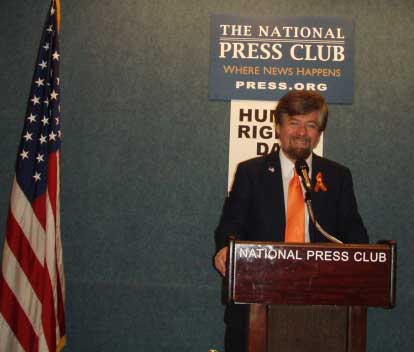
Jeffrey Imm, Responsible for Equality And Liberty (R.E.A.L.)

Hello, my name is Jeffrey Imm. I am the leader of the Responsible for Equality And Liberty (R.E.A.L.) coalition for human rights. The goal of R.E.A.L. is to use the Universal Declaration of Human Rights (UDHR), and we commemorate its December 10, 1948 creation every year, as a standard for progress in human rights objectives throughout the world, and as a coalition on together on shared human rights issues. This year we have gone back to having a press conference at the National Press Club, as we have had in the past. The reason the UDHR was created on December 10, 1948, was as a response to the “disregard and contempt for human rights have resulted in barbarous acts” during WWII. We have seen such disregard and contempt again over the past few years, and more barbarous acts than we can count.

The list of all of the atrocities and contempt against human rights is almost endless. So instead of only focusing on that horrible list, I come here this year with an offer for new hope. Because so many of us have been dispirited at the willingness of global representatives to commit “barbarous” abuses, which the UDHR was specifically created to discourage and prevent. Let us look at a path for solutions instead.

Even in the dark days of our world, let us find hope to remember that every day is still a Good Day to be Responsible for Equality And Liberty.

  1. The New Hope Begins with Ourselves

There is a new hope for universal human rights, despite grave injustices and dark days that we live in as human beings on our shared Earth today.

We can make a difference in our world by starting with ourselves and encouraging others on the path of KINDNESS, MERCY, and LOVE to one another. Kind people don’t mass murder others. Merciful people don’t persecute others. People with love in their hearts don’t hate and revile others as non-human beings. The path to degrading human rights through cruelty, mean-spiritedness, and hate is the path that we can change – one person at a time, one example at a time, one life at a time. We can set an example and standard, no matter how difficult the past or our past selves have been, for a new path forward to build the long abandoned infrastructure that a serious movement on universal human rights requires.

Where do the atrocities against human rights come? They came from a normalization of being mean and being cruel towards others. And they come from INDIFFERENCE – which is the true opposite of love – about acts by representatives in world governments and institutions of mean-spiritedness, cruelty, violence, and hate against our fellow human beings. We must find this unacceptable. We have demonstrations by some against such obscene behavior, but daily life shows that clearly those demonstrations are insufficient. We must not fail to recognize that accepting a society where only the smallest number is encouraged to live with a conscience – is not, and will never be enough. The change we must seek is within ourselves, and we must live that change, and THEN we must evangelize that change to the world. In so many other difficult times in history, THIS is how we made meaningful human rights change, by working to change the hearts of ourselves and being a beacon of that change to others. It is not enough to demand that we do not have representatives that reject human rights. Our lives must be a standard to others to embrace kindness, mercy, and love, so that cruel representation is not acceptable to them as well.

We begin to control the state of human rights by first working to control our own behaviors as human beings. The starting point is not someone else’s responsibility. It is not someone else’s problem. It’s not some organization‘s, the United Nations, our various government’s responsibility to begin with. The state of human rights begins the responsibility and accountability of each one of us in our lives with one another. WE…. are the starting point.

We… not they… are the leaders responsible for universal human rights. We… in the choices that we make in our lives – we are the new hope that we seek for universal human rights.

  1. Choice of Kindness and Mercy in Ourselves and Our Representatives

We can first choose to be kind and offer mercy to others. We do not have to be mean. I realize that many of us are in difficult situations in many different times of our lives. I realize that we have to stand up for ourselves and protect ourselves and boundaries in our lives.

But we don’t have to choose to be mean. We can choose to be kind and to offer mercy.

There is an addiction and normalization to being mean. We think it’s all right to be mean. We can justify and rationalize it. There are many leaders in our representatives, in society, in the media, in world organizations, and of course, among those in social media, who advocate being mean as being a good thing.

They are wrong. Let us never forget this. But we do not encourage change by adopting the tactics, the views, and values of those choose mean-spiritedness, cruelty, and hate. As the great Dr. Martin Luther King Jr. stated “Hate is Too Great A Burden.” And it is. We cannot let Hate and Mean-Spiritedness rob us of our ability to inspire, to offer hope, and most importantly to love our fellow human beings, especially those whose views we seek to change.

We change the debate by insisting that we share the common facts that humanity is worth our mercy and kindness, because the reality is that we cannot survive without it.

We must choose the kindness and mercy of offering an outstretched hand. Not just to those like us and to those we like, but also (especially) to those we do not like and those who are not like us. To the weakest. To the most confused. To the most vulnerable. And especially to the most hateful. Because every burden of hate towards others is a burden in our heart to keep us from being strong enough to be a beacon of kindness and hope – that we must be – to call for the institutional changes around the world for representation and for government actions based on our shared universal human rights – and that we reject all “barbarous acts” – for a path of kindness and mercy.

What type of humanity are we, without kindness and mercy?

Who is so deluded in their lives that they believe they will never need kindness and mercy in their life? And if we all need kindness and mercy in some part of our life, how can we receive what we cannot give?

When kindness and mercy become the center of your moral compass, your decisions must change. The choice of cruelty, the choice of hate, the choice of being mean to others may be expedient, but it is NO LONGER YOUR WAY. But you have to choose kindness and mercy first.

A commitment to kindness and mercy is not only karma; it is fundamental to survival of a shared species of life and to life itself. We are constantly every day, every hour, every minute, completely dependent on the kindness and mercy of others. We may not see or hear it. But like air and gravity, kindness and mercy are an existential part of human life.

Kindness and Mercy are fundamental to human rights and human survival. Mercy changes lives and transforms others. We must choose kindness and mercy to be consistent in a path for human rights.

Furthermore, we must reject the perversion of “The Golden Rule” that so many of our representatives and world has chosen – their dystopian view of “Do Unto Others As They Would Do Unto You” – as a rational for cruelty, mean-spiritedness, and hate. No. That was NEVER the intent of “The Golden Rule.” And as people of conscience it is NOT OUR WAY. We must choose to offer the outstretched hand – even to those who come to us with an upraised fist. Because we can never progress – by accepting a society of division and mean-spiritedness. We must find the courage and the choice of kindness and mercy – especially when it is hard to do.

  1. The Deception of Violence

The greatest advocate for non-violence in modern times, Dr. Martin Luther King Jr. lived in fear of violence against his family. At one point, this great advocate for nonviolence considered buying a gun to protect his family. He did not. But let’s not question the fact that there are those who want to kill and attack other people. We do not survive by being unwilling to defend ourselves if it truly comes to that as the LAST option. But we also do not survive by embracing the tactics of criminals, the cruel, and murderers. Becoming them does not make us safer. It simply makes us worse and undermines who and what we are.

Our society glamorizes and normalizes the deception of violence as something that we should use frequently at all the time. Not simply as the last possible resort.

We always have to find other solutions first. We must not choose violence first. The deception of violence as normal is apparent to anyone. If everyone chooses to be violent at whatever they believe is an appropriate provocation, we will literally live in a society of chaos and constant turmoil. This is not “warrior thinking”. This is madness. It is literally and genuinely unbalanced. The deception creates actual imbalance in society itself. Our society and our media popularizes violence as something endlessly good and worthy; not as something that is abused and is mostly disgraceful and shameful.

We – the ones responsible for human rights – must set an example by rejecting the glamorization and normalization of violence as something desirable or entertaining.

The deception of violence only makes humanity less and less safe.

  1. Love is All We Need

Love is Life.

Love is clearly the “inescapable network of mutuality, tied in a single garment of destiny,” referenced by Dr. King.

If we are unable to open our heart to love, we are unable to open our heart to our society and its universal human rights.

Love is life. Love is the network of life. Love is the destiny of life. Love is the power and the energy and the fuel behind ALL of life.

Without love, there would be NO humanity at all.

So love is not only our oxygen, love is not only our gravity, love is not only our moral compass, love is the network of life and destiny that ties our hearts truly together. Because when we choose to be open enough to love one another, our hearts beat in a way that they cannot beat when we do not accept love into our heart. Love is more than an individual bright light of mercy, kindness, and nonviolence to the world. With love in our hearts, we become human lighthouses that serve as beacons to the world to come together as one.

A new hope for human rights begins with the power of love. To change and be responsible stewards for human rights, and we have to break down the walls and the barriers to giving and receiving love. We must work to reject hard and cold hearts in ourselves. We must strive not for distance, but to embrace love. Life depends on it. Love is life.

Love is life. If we choose a path that love towards ourselves and our fellow human beings are not worth it, then we ultimately choose a path that human life itself is not worth it. How can we lead human rights change if the essential of human life as part of universal human rights is not an essential for us?

Love transcends all. It breaks down the barriers between the artificial categories that we create among our human species. It becomes a fuel for kindness, mercy, dignity, non-violence because who can love one another and still want to do horrible things to one another?

We don’t know how long we have on this Earth. We may think you do. We have no idea. We may have moments; we may have years; we may have something in between. Can we afford to be so recklessly wasteful with our precious lives born from love itself, as to not allow love in our lives?

But if we choose to spend the currency of our life exclusively in the pursuit of material success, what many in our cultures like to call “progress,” we have not invested in the essential part of life that is our love for one another, and we haven’t started towards real responsibility for human rights

Our campaigns for change in human rights must begin with change within ourselves. We cannot ask anyone to change when we are unwilling to change ourselves. That hypocrisy will never work and it never does.

So the fundamental part of being responsible for human rights must include being responsible to live our lives fully enough to open our hearts to give and receive love.

We not only have to be kind; we not only have to have mercy; we not only have to be responsible; we have to be able to actually love our fellow human beings.

When we chose to become a society of loving human beings, this is where responsibility for human rights begins. This is because our true connection to each other is then fully apparent and we are constantly aware of the ability to be connected as “one.”

Life is not practical and rational. Your human life came from the miracle of irrational love. The miracle of life constantly begins with the miracle of love, in some way. You were born in love, with the mission of love as your highest calling. The miracle of love that creates human life transcends all reason. Love transcends all logic. Love makes practicality look like a joke. Love laughs at all the plans, and all the campaigns that we can logically create, and that we logically believe makes sense.
Because when those campaigns or plans are not made out of love for or by people who understand love for their fellow human beings, or who by people whose hearts have been touched by the essential of love towards their fellow human beings – those plans may be well-intentioned, but they miss the energy of human love that is behind all meaningful human rights change.

  1. Islands of Isolation

Those who embrace the essential human infrastructure of kindness, mercy, nonviolence, and love – cannot live as islands of isolation. In a world normalizing cruelty, we are taught that the only ones we need to love are ourselves. We are taught and encouraged to become “successful” islands of isolation in our shared world. How can a sane society survive like this?

If we cannot connect with our fellow human beings, how can we work for their shared universal human rights? If we cannot love others, what do we really seek to accomplish with our lives? What accomplishments do we think our hardened hearts will really achieve?

So yes, when the poets say “all you need is love,” from a human rights perspective that is essentially true. Because we need hearts that love to be able to reach out and offer the universal human rights that all people deserve. But we cannot love one another as islands of isolation, we must reach out our outstretched hands to love our fellow human beings as ONE human society and to overcome the divisions that so many seek to promote between us.

  1. Coming Together as One

In our case, the concept of sharing our common cause of the objectives of universal human rights is the goal of our coalition.

Given the vast magnitude in dark circumstances regarding universal human rights today, the best use of my limited public attention this day, was not to recite a laundry list all the tragedies, persecutions, and horrific atrocities around the world. Rather, I offer this as an opportunity for a new hope and a new direction for change in human rights, which puts the responsibility for change in the hands of every fellow human being.

We must examine the mirror of our soul and ask ourselves the hard questions if we are doing what we can for universal human rights. Because we are responsible for change in universal human rights.

We must choose to be kind and reject being mean.

We must choose the existential of mercy to one another, especially to those not like us and to those we do not like.

We must reject the deception of violence as the answer, which only leads to a burden of hate and destruction in our own souls.

Finally, most importantly, we must pursue the imperative that love is life. We must open our hearts to give and receive love, not just in theory, but as a reality to bring us together in a oneness of humanity.

The new hope for human rights is there and it always has been. It is simply in our hearts if we choose to see it.

Yes, today, is another Good Day to Be Responsible for Equality And Liberty.
Human Rights Day 2025

Human Rights Day: December 10, 2025 – Content from Speakers

Updated Press Conference Press Release (Word / PDF

Human Rights Day: December 10, 2025 – Content from Speakers will be posted by Responsible for Equality And Liberty (R.E.A.L.) on the following shared Google Drive — Speaker Content Folder

Universal Declaration of Human Rights (UDHR)

https://drive.google.com/drive/folders/1IU2fGjlHKB3EXeWwguGMkuYdDx6XGMJD?usp=sharing

China Human Rights: Dr. Sean (Xiaoxu) Lin, Executive Director for Consilium Institute and Senior Advisor for Global Service Center for Quitting CCP

Pakistan Human Rights – Dr. Nazir Bhatti – Pakistan Christian Congress (Video / YouTube)

Othering and Societal Health – Shireen Qudosi (Video / YouTube) – Transcribed Text

Food Equity and Human Rights – Karen Imm Universal Declaration of Human Rights (UDHR) Article 25 on Food Equity

Unpaid Caregiving and Human Rights – Carolyn Cook

A New Hope for Human Rights – Jeffrey Imm, Responsible for Equality And Liberty (R.E.A.L.)Google Drive Backup

Infinite Hope and the Power of Mercy

Human Rights Day, December 10, 2022
Responsible for Equality And Liberty (R.E.A.L.), Jeffrey Imm

Our fellow human beings reach for courage in the difficult times and the difficult age we face today. To the many suffering, endangered, or living in mortal fear around the world, the idea of concern for universal human rights may seem naive and absurd. But while we live on this Earth, we are taught to build our homes on rock, and not on sand. The angry calls for power, violence, and division may seem attractive buildings to house hearts consumed by hate. We Survive Together – by making responsible choices – not with calls for hate, division, and violence. For responsible survival together, we must build on the rock of reason, mercy, mores of our faiths and conscience, and the human reason that understands human dignity must include dignity for ALL fellow human beings.

A responsible society and responsible individuals must recognize that such dignity, security, life, and human rights are for all – not just for those like us and those we like – but for all.

Whether we face the dark night or shining day of life, our commitment to a shared cause of reason and conscience must endure. We must continue to advocate for hope in humanity. Where it is lacking, we must take on the responsibility to be advocates for such campaigns of mercy, love, life, and dignity, which are universal human rights. As Reverend Dr. Martin Luther King, Jr. advised: “become the firemen. Let us not stand by and let the house burn.”

Despair must not be allowed the victory of stealing our hearts, dreams, hope, and most of all – the precious trust that we must have for one another. Hate and division must not pridefully steal our conscience and reason for a shared society. We can and we must find the strength to defy these thieves. We freely share and inspire hope, but we must refuse to allow others to steal hope from us.

“We must accept finite disappointment, but never lose infinite hope,” as Reverend Dr. Martin Luther King, Jr. was widely quoted in February 1968, two months before his assassination. But Dr. King spoke of this frequently. We must work to build the individual and the societal discipline to live from within instead of from without. Our shared cause must be to “stand up amid the disappointment of life without despairing,” as Dr. King counseled for many years. He counseled humanity that “Real peace is something inward, a tranquility of soul amid terrors of trouble. It is inner calm amid the howling rage of outer storm.”

Despite the terrible stories of hate, violence, and division among us, we are still share our identies as Human Beings. We are connected to one another, even to those who hate and seek to oppress us. Ultimately, not only do all of us need shared hope and universal human rights, most importantly, we all will ultimately need the power of Mercy in our lives – no matter how powerful and elevated we or others may think they are. In our fragile lives, we must keep the flickering flame of shared human rights shining – by a commitment to mercy – not just to those like and those we like – but to all.

Amongst the storm of hate, anger, division, violence, which howls cruelly at our doors and windows, and which ceaseless screams in our street – let our whisper for Mercy win. Let our defiant whisper for “Mercy” be heard. Not whispers for Mercy in prostrate surrender. But a gathering and an insistent growing whisper for Mercy on the lips of every one of our fellow human beings – ourselves, our loved ones, our cities, our nations. Make our insistent voice for Mercy heard.

Those who believe they can steal Mercy and Hope from our societies parade their pillage in the streets, on our television, and on the Internet. They are proud that they believe can steal these from us. But we have power to regenerate Mercy and Hope in our hearts and in our society, no matter how much is stolen, we can find it anew – every hour of every day. We must always freely give Mercy and Hope, to the fellow members of our human race, no matter who they are. Theivery of it will never pay and ultimately never win. Let us never lose infinite hope.

December 10 is once again the anniversary of the Universal Declaration of Human Rights (UDHR) in 1948 – 74 years ago. Nations of the world, of different nationalities, races, genders, faith, conscience, political views, and backgrounds gathered together to offer a code of 30 articles to offer a framework for freedom, dignity, and of course – Mercy. Foundation ideas and values of humanity are core of the UDHR.

After the end of the World War II in response to the “barbarous acts which have outraged the conscience of mankind.” They created the Universal Declaration of Human Rights as an opportunity for fellow human beings of all types to find a new path and to work towards “the advent of a world in which human beings shall enjoy freedom of speech and belief and freedom from fear and want has been proclaimed as the highest aspiration of the common people.”

Difficult times in a difficult age does not force us to choose to focus only on darkness and ignore shining stars of hope in the night. We can choose to be committed to our human “reason and conscience,” which is described in the Universal Declaration of Human Rights, and find ways to combat evil by building good.

Let our greatest advocacy on Human Rights be to ourselves. We know what is wrong. Let us not allow rationalizations to shout over our conscience, which we know is our guide.

Let us do more than simply be outraged at the many injustices in the world. Let us choose to offer and remember the need for Mercy as part of the human rights that we advocate for all.

And when we feel the darkness at our windows, let us light a candle of Mercy, and let the darkness be a canvass to shine upon. Let us our whispered calls for Mercy be most important message that we share amongst all of our society.

Courage.

Human Rights Begins with Humanity – for Every Individual Human Being

The needs and demands of powerful or the many cannot outweigh the rights and dignity of the individual. This respect for each human being is the soul of our universal values on human rights.

The Universal Declaration of Human Rights was created 70 years ago on December 10, 1948, so that in no part of world, no nation (totalitarian or democratic), the demands of the many would deny the Human Rights and Dignity of the Individual. We struggle for universal human rights for ALL – not only as a collective human race, but also every individual with inviolable human rights and dignity.

It is often forgotten why the nations of the world banded together in a United Nations (created in October 1945, a month after the end of World War II. Nations of conscience joined to develop this Universal Declaration of Human Rights (UDHR). It was December 10, 1948, three years after the horrors of World War II, including the Holocaust, and the world had jointly rejected the “disregard and contempt for human rights have resulted in barbarous acts which have outraged the conscience of mankind.” The horrors against humanity of total war, persecution, and genocide had convinced enough world leaders that it was time to say “enough” to such abominations against our fellow human beings. They had not only seen the worst of human violence, but they also had seen the most ignominus of persecution of individuals for who they were as human beings.

The importance of rejecting such “barbarous acts” in universal human rights is based on a foundational ideal of dignity and mercy. Article 1 of the Universal Declaration of Human Rights states: “All human beings are born free and equal in dignity and rights. They are endowed with reason and conscience and should act towards one another in a spirit of brotherhood.” We begin with a universal declaration of the dignity of humanity and a call for merciful spirit of brotherhood. World nations decided that human rights began with a commitment to humanity.

In the preamble to the UDHR, the world leaders recognized that “the inherent dignity and of the equal and inalienable rights of all members of the human family is the foundation of freedom, justice and peace in the world.” Note who they are referencing in this preamble – not simply citizens, not simply individuals, but “members of the human family.” Human rights begins with a commitment to the dignity of OUR family of human beings.

This is very important distinction from previous human rights documents, such as the British Magna Carta, the French La Déclaration des droits de l’Homme et du citoyen, and the U.S. Bill of Rights, all of which played historical (and in some cases controversial) roles in documenting the concepts of equality and human rights.

But by 1948, the “barbarous acts” of the past had so shaken leaders of the nations of the world, that they needed more than a litany of documented natural rights. They needed to begin with taking a stand on the dignity of the human being – both collectively  and individually – and the need for merciful “brotherhood” shown to him – not because of the person’s nationality, citizenship, gender, religion, or other identity group – but for “ALL human beings.” This makes the UDHR historically different than other previous natural rights documents. It introduces the concept of human rights and dignity for every human being, simply because they ARE another fellow human being.

The concept of such universal codification of the global priority of dignity and mercy cannot be overstated. It is a recognition that law, codes, organizations, structures, political systems – all are meaningless, if they cannot respect such dignity and mercy for our fellow human beings – both collectively and (more importantly) individually.

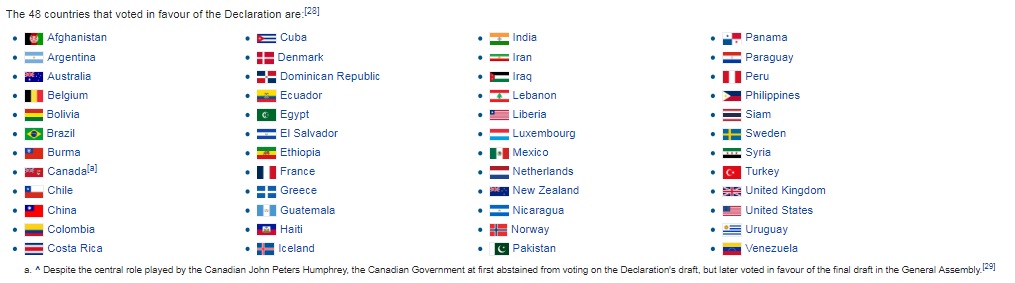
Of the 56 nations at that time in the United Nations (there are now 193), 48 of them voted in support of the UDHR. Notable abstentions among the 8 nations that did not support the UDHR included the Union of Soviet Socialist Republic (USSR) Communist nations of that time and Saudi Arabia.

The UDHR’s stand on the dignity and freedom of the individual human being to be unique and different, rather than only an element of a collective nation, set of nations, political ideology, or other group, is a marked and remarkable distinction of the UDHR in the history of humanity.

The foundational concept conveyed by the UDHR is, in essence, I have human rights and dignity because I am an individual Human Being. In an increasingly complex and challenging 21st century, we cannot lose sight of this essential concept in considering human rights and ethics for the future.

It was a statement which would be more concisely stated in the signs of those in the 1960s protests against white supremacy persecution in the United States of America, carrying a sign “I am a Man.” We see such similar statements by women in America and around the world, seeking the realization of the Universal Declaration of Human Rights, not only as goals and values, but also as part of daily lives for all.

The UDHR’s concept of the universal rights and dignity of the individual as a human being, without qualification, is different than other collectivist-based human rights agreements, such as the August 1990 Cairo Declaration on Human Rights in Islam (which as it states, is a human rights view based on this religion), and the 1975 Helsinki Accords or “Declaration on Principles Guiding Relations between Participating States,” refers to such “inherent dignity” as (ironically) something that must be promoted and encouraged “by participating States.”

The concept that an ideology, a belief structure, or a nation state is giving us, as human beings, dignity and human rights is NOT what we accept. We have been there before as a human race. We have seen how nations choosing to give collectivist human rights and dignity to only people of chosen belief sets, races, or identity groups, have led to the very “barbarous acts,” which drove world nations to create this Universal Declaration of Human Rights. It is, by definition, Universal. The UDHR is both a compass and a warning for generations in the future to choose the path of “Never Again” to massive persecution, not just for some, but for all of our “members of the human family.”

While this UDHR was legally formed into an international treaty as the International Covenant on Civil and Political Rights (ICCPR), the ICCPR also shares its commitment to a “human family” and our shared “inherent dignity and of the equal and inalienable rights of all members of the human family.” Like the UDHR, the ICCPR recognizes that “these rights derive from the inherent dignity of the human person,” not simply as some collective body, but as individual human beings. Similar to the UDHR, Article 10 of the ICCPR also calls for “respect for the inherent dignity of the human person.”

In addressing the future of world progress and world events, we must continue to use this Universal Declaration of Human Rights to guide us in fulfilling what the great human rights leader, Dr. Martin Luther King, Jr., might have called the “promissory note” of equality and dignity to all. If we believe in Universal Human Rights based on dignity and mercy, we must respect that “human family” regardless of their gender, age, race, or other identity group.

In U.S.A. and around the world, we continue to see movements to try to ensure that such values of dignity and mercy are used to truly respect freedom and equality for all. We must not forget that slightly less than 100 years ago, in the U.S., women did not have the right to vote. While black Americans were given the legal right to vote in 1870, it took another nearly another century for the Voting Rights of 1965 to be passed, to consistently ensure federal law enforcement of this right. If our human rights are based on mercy, then we must also accept humility in judging where others are on the path to make changes. We cannot seek change for others, while we are failing to change ourselves. Our greatest progress is achieved when we recognize this change is not for “others,” but for our shared “human family.”

In the People’s Republic of China (PRC), the Chinese Communist Party (CCP), which has had such horrific persecution of human beings for so long, has now made an official statement rejecting such universal human rights. While the UDHR was voted by the Republic of China in 1948 (before the Chinese Communist Party coup in 1949), the PRC did agree to the ICCPR in October 1998. Despite this agreement to the ICCPR, the Communist regime has continued to persecute democracy and human rights advocates, persecute religious and ethnic minorities, and violate the principles and concepts of the human rights and dignity in the ICCPR.

To ensure the world had no doubt about its intentions, the PRC Communist regime specifically told the United Nations in November 2018 that it was rejecting a “universal road to human rights.” In its November 2018 submission to the Universal Periodic Review (UPR), the Communist regime stated that “There is no universal road for the development of human rights in the world…” and it would only consider “human rights with Chinese characteristics”… “guided by Xi Jinping Thought on Socialism with Chinese Characteristics for a New Era.”

In China, we have seen the result of consciously abandoning the path of universal human rights, and abandoning mercy and dignity for the individual. We have seen the mass waves of persecution of Tibet Buddhists, destruction of their temples, the roundup and arrests of Uighur Muslims put in massive concentration camps, the arrest, torture, murder, and mutilation of Falun Gong (including horrific organ removals of political prisoners), and the destruction of Christian minority churches, arrest, beating, and imprisonment of people of Christian minority faith. In the PRC on Human Rights Day 2018, as this is being written, 100 Christian minorities are being arrested for their faith. The goal of the Communist regime to wage a war “against the soul,” however, ultimately is a losing battle, as the USSR and other Communist totalitarian regimes ultimately learn. As much as the Communist regime seeks to watch and control everything its Chinese citizens do and think, the human soul will find a way for freedom.

The anti-human rights war “against the soul” of members of the human family has also been waged in Pakistan against religious minorities. While also signatories to the UDHR and ICCPR, Pakistan has chosen to institutionalize legal persecution against religious minorities human rights and dignity. Among the most graphic examples of this has been the imprisonment of over 9 years of Christian minority woman Asia Bibi, who was imprisoned on false charges of blasphemy, due to argument over her drinking from the same water cup of those of the majority religion. Even when Asia Bibi was found not guilty by the Pakistan Supreme Court, extremist marched in the street calling for her to be murdered, the Taliban terror group called for attacks on her, and she and her family have been living in seclusion while terrorist have sought her. The blasphemy law in Pakistan is regularly used as an institutional method to persecute minorities who face institutional, social, and economic persecution.

In Pakistan, religious minority Ahmadi are also regularly and instituationally persecuted by the Pakistan government, which refuses to accept their faith as “Islamic;” other human beings of minority faiths, Shia Islam, Hindu, etc., are also regularly targeted for persecution, kidnapping, violence, murder, and terrorist attacks by extremists. Such religious minorities are often sought to be used for lowest paid employment and are frequently threatened by religious extremists of the majority faith. This has led to a number of Christian minorities fleeing the nation and seeking asylum from their persecution in Pakistan. But there, once again, such efforts to seek safe haven as refugees are regularly withheld, and only the smallest margin have thus far been successful in fleeing such persecution.

Consider that just the Communist regime China (1.4 billion human beings) and Pakistan (200 million human beings) alone represent 20% of the world’s population. If major nations, such as Communist regime China and Pakistan can normalize and accept a “war against the soul,” then a war against what it means to be a human being by technology extremists is a predictable expansion. If we agree that human rights is based on humanity, our modern struggle for human rights is not only for codes or values of rights, but more fundamentally on what it actually means to be a human being.

As we continue to work to improve human rights and dignity through mercy and equality, and defend human rights based on humanity, there are others who seek to also redefine what it means to be a human being. The concept of technology innovation is to develop tools to help human beings. This led to tools such as what is known as “artificial intelligence” to be used in machines to aid human being in making complex decisions on navigation and other multi-faceted functions. In his 1976 book “Computer Power and Human Reason” (Chapter 10, page 269), the “father” of such “artificial intelligence” (AI), MIT Professor Joseph Weizenbaum warned against abuse of such AI technology. Professor Weizenbaum warned that the concept of “an animal’s visual system and brain be coupled to computers… represents an attack on life itself. One must wonder what must have happened to the propsers’ perception of life, hence to their perceptions of themselves as part of the continuum of life, that they can even think of such a thing, let alone advocate it.” The professor continued to warn that “I would put all projects that propose to substitute a computer system for a human function that involves interpersonal respect, understanding, and love in the same category.”

But in 2018, while we see a war “against the soul” against our fellow human beings in much of the world, we also see a struggle over the very definition of what a human being is. Most troubling, there is not onlya common and consistent set of technology ethics used in such technology research, there is a very limited knowledge or even outright rejection of our shared Universal Declaration of Human Rights among some researchers. Many come from backgrounds that either support collectivist views of human rights, rather than the human rights of the individuals, or have views on mercy and dignity based on digital values rather than human values. A frequent pattern among many, based on R.E.A.L.’s research, has been a trend of “Marxist” collectivist views on “human rights,” which reject the value of the individual’s human rights and dignity as an individual human being. Once again, we see the critical nature of defining human rights for each and every individual as core to our univeral human rights.

Despite the warnings by Professor Joseph Weizenbaum, the very concept of such coupling of brains to computers is advocated by the CEO of one of the largest computer companies in the world, Microsoft’s CEO Satya Nadella, and he has been recently praising such brain reseach by Microsoft, who previously sought a patent for a system that could take action based on brain input. Neuralink has been seeking an objective of implanting tiny electronic devices into the brains of healthy humans within a decade, with such computer-human brain interfacing promoted by Tesla founder Elon Musk. Facebook’s Regina Dugan is part of a reported team of 60 engineers looking to control your computer from your brain. We must find a path of mercy to guide such technology innovation to respect the integrity of human beings.

This concept of seeking to redefine what a human being is through technology, known as “transhumanism,” is also leading to changes in calls for basic universal human rights. Dr. Jason Kuznicki published a book “Technology and the End of Authority,” which believes there can be a future rejection of murder as a crime. Life is a foundational part of the Universal Declaration of Human Right, as defined in Article 3. But to Dr. Kuznicki, human life may become a relative consideration, and we “might consider revisiting the prohibiton on murder, if, for example, futuristic technology made it possible to generate moment-to-moment backups of a person’s complete mental and biological state, and to regenerate them therefrom at trivial cost. Such technology could at least arguably falsify the statement ‘All human beings should be forbidden from murder.'” We must urge a call for change from this path.

With technology advocates supporting a redefinition of the “human being,” even biological experimentation is now ongoing among Communist regime China and America researchers in China laboratories, to alter the very DNA of human beings through what is called “gene editing.” The Communist regime state media Global Times has been actively promoting that the majority of its population support such “gene editing.” To what end, will the totalitarian Communist China regime seek to alter the very DNA of human beings, to “improve” human beings to meet the goals of a regime that denies the existence of universal human rights? As the world wonders, one Chinese scientist, He Jiankui, has already claimed to have edited the human genes of two live baby girls who have been born.

The world has previously faced and challenged the concept of political totalitarianism. But as we continue to struggle with that challenge of the 20th century, the new issue of technology totalitarianism may soon be upon us. Already we see large techology companies using ubiquitous techology tools to monitor our behavior, listen to our words, and track our movements. The creators of the Universal Declaration of Human Rights did not consider a humanity, where a large segment was being continously monitored, and is in Communist regime China, their every word and action monitored for a “social media score” to determine whether the public had the right to its freedoms. We see new technology changes by the totalitarian Communist China regime and many other parts of the world to include ubiquitous surveillance cameras, rejecting our Universal Human Rights of privacy. We see new technology changes with facial recognition tools being increasingly used around the world to track what we do, what we say, and where we are. In the Communist China regime, we also see a growing pattern of other devices to monitor human thoughts, including devices built into the hats of officials to measure their emotional state. The new age of technology totalitarianism is nearly upon the world.

But our answer to the problems of all those who seek persecution, by extremism, by state force, or by technology force, remains the same: we must continue to use respect and mercy of the dignity of individual members of our “human family.” In a world that questions our human rights and humanity, we can continue to seek change with an outstretched hand, not an upraised fist. As the great American human rights activist Dr. Martin Luther King stated: “Hate is too great a burden to bear.” “I’m not going to let my oppressor dictate to me what method I must use… our oppressors used hate… I’m not going to stoop down to their level.” Even those who seek to deny others human rights are part of our shared human family. We can and will reach hearts through a fearless commitment to mercy and dignity. Let us find the courage to find the mercy in our hearts to be Responsible for Equality and Liberty for all.


Enemy of Human Rights is Our Hate

On Human Rights Day, we remember the December 10, 1948 proclamation by the nations of the world to the Universal Declaration of Human Rights (UDHR). The chartered nations of the United Nations acted to form this declaration on human rights and dignity in the face of world horrors, described as “disregard and contempt for human rights [that] have resulted in barbarous acts which have outraged the conscience of mankind.” The chartered nations of the United Nations used the Universal Declaration of Human Rights to reaffirm “their faith in fundamental human rights, in the dignity and worth of the human person and in the equal rights of men and women and have determined to promote social progress and better standards of life in larger freedom.”

The foundation of such shared universal human rights is described in Article 1 of the UDHR. “All human beings are born free and equal in dignity and rights. They are endowed with reason and conscience and should act towards one another in a spirit of brotherhood.”

We cannot act towards one another with respect, with a conscience, in the spirit of brotherhood or sisterhood, when our hearts are burdened and consumed by hate.

The answer to respecting the brotherhood and sisterhood of our fellow human beings – begins with compassion, dignity, mercy. While we are outraged at the indignities of extremists and tyrants, remember to always fights the battle for compassion of human rights in our own hearts first.

Human Rights Day 2015 – Machine Guns at the United Nations Started with Appeasement of Extremists

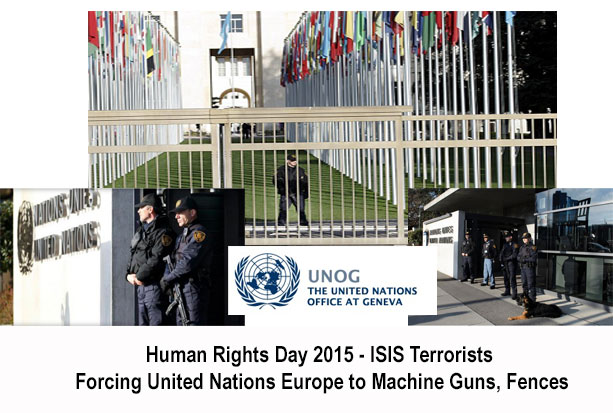
Of all the wonderful things, we can and should say about the 67th anniversary of the Universal Declaration of Human Rights (UDHR), the image of the United Nations’ Geneva, Switzerland, Palais de l’Europe guarded by security men with sub-machine guns describes just how much work is ahead of us in promoting universal human rights. But I know how we got to this sorry state of affairs. It began with deciding that we could compromise again and again on defending our Universal Human Rights.

UNOG-December-10

Much of the world has been in active war for the past 14 years. But we saw the violence of war within nations and the regional wars dramatically overflow across their borders on September 11, 2001. The “answer” to the September 11 attacks was focused on tactics only of security measures and war. The tactics of security measures resulted in an ever increasing net of security, until people could no longer tolerate it. The tactics of war, unfortunately, was primarily more war and violence, with the predictable result of escalating violence, with occasional changes in the war fronts.

But while the world war has ebbed and flowed, we have made little progress on the human rights challenges of defying extremism. Highly educated and powerful people decided that they would not learn the lessons of human rights from history, but decided instead to make their own rules by trying to stop the violence of extremists by appeasing them. However, the idea of “appeasing” extremists NEVER WORKS. NEVER. We know it. We have seen it through history; we have countless examples of this. But as the years went by, the argument for appeasement just became too popular, and the view that we should struggle to challenge anti-human rights views became just too much work for many. It was easier just to find a way to “get along” with anti-human rights forces, no matter who or where they were persecuting others.

If you think about it, it is understandable to some extent. Most people don’t want to be in a state of conflict. It is exhausting. It is painful. It is expensive. Then people ask themselves, what do they really have to show for all of the effort? Perhaps it is better just to be a little blind and deaf, and just “get along” already. After all, some will tell us, that “we can’t change the world.”

But weariness and weakness only fuels the resolve of extremists, who believe (rightly for some) that if they only persevere, the champions of human rights and equality will get tired and give up. Too many powerful individuals simply decided that giving up wasn’t such a bad idea, and that we should pretend that we don’t know that appeasement is wrong.

This failure was clearly obvious to me in 2008, when I was daily assisting counterterrorism professionals, who believed the answer to terrorism was to empower “non-violent” extremists. They thought we could “tolerate” extremism, as long as we could keep it from getting “violent.” In 2008, I declared to counterterrorism and foreign policy professionals that such an idea that we could make “deals” with extremists was absurd. Some believed we could use diplomatic strategies of (ironically called) “smart power” to “engage” with extremists, and somehow by tolerating (and legitimizing) their cause, we could “talk them out” of extremism, or at least make them less violent – to US anyways. Some “professionals” didn’t like that I found appeasement to be absurd. Some in the British government were unhappy with me. Some in the U.S. government were unhappy. But they were then, and they are today – WRONG. Appeasement of extremists always fails. We know this. We have seen this again and again in history.

But the view that we could appease extremists was viewed as a solution to violence and war. The so-called “solution” was that extremists could come up with their own ideas of “democracy” and their own views on “human rights,” because after all if we urged extremists to accept standard views on “democracy” and “human rights,” that would mean we were “cultural imperialists.”

It is simply nonsense. We know it, too.

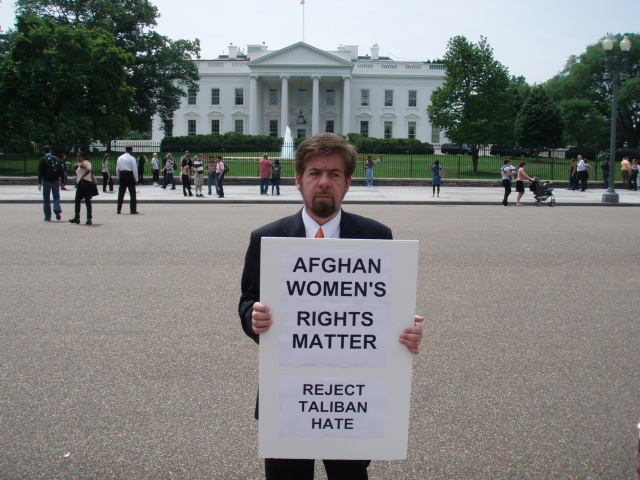
051210-WH-IMM-1

Now, the foreign policy and counterterrorism professionals don’t want to hear this. They want to say it is perfectly fine for everyone to have their own version of democracy, or human rights, or freedom. They believe that “equality” is a dirty word. Instead of equality, we need to believe in RELATIVISM. So if someone has a version of democracy, that is un-democratic, well, that should be fine, because democracy is not really one type of democracy, it should be relative to every person, every group, every extremist view, and every culture, so no one is offended. The same holds for “human rights.”

The results of relativism are that you have (incredibly) nations like the Communist Chinese Party (CCP) stating that they are great supporters of “human rights,” when they put political prisoners in concentration camps, force women to have abortions (while one major U.S. political candidate actually claimed they provide better maternity care), deny democracy, and deny religious freedom. But that won’t stop people talking about the CCP’s commitment to “human rights.” Because after all, the “professionals” argue, we can’t OFFEND the Communist Chinese government!

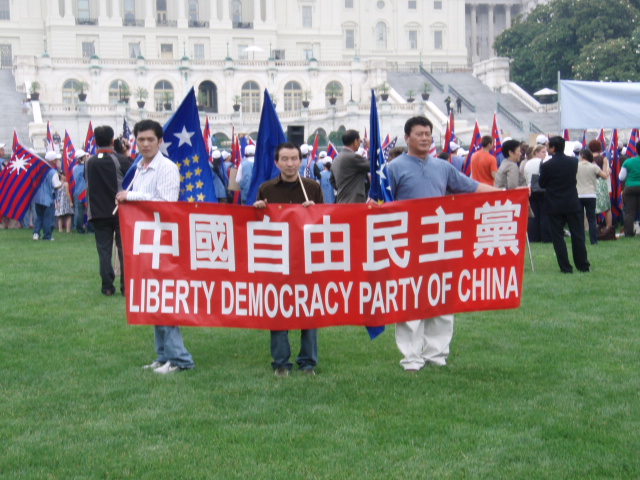
liberty-democracy-party-of-china1

But the “professionals” really like “relativism” because you can’t measure it. They can use relativism to twist words like “human rights” into any politically convenient argument they want, and never be wrong. Most of all, they can never be accountable, and certainly NEVER be RESPONSIBLE.

That is WHY is, in 2009 I founded “Responsible for Equality And Liberty.” Because our commitment to universal human rights cannot be left to the “professionals” who are only worried about no one actually being held “responsible” for anything. Political powers find the idea of real “responsibility” repugnant – they would argue if we hold nations, groups, and people “responsible,” then maybe we would have to also be “responsible,” and they believe we can’t do that. To the “professionals,” being responsible is a “bad” thing. “Responsibility” threatens their power, their political influence, and their careers.

Furthermore, the professionals will tell us, if we are not “relativists” on human rights, maybe we are secretly “bigots,” or “racists,” or some other foul accusation. After all, how “dare” we ask people to stop torturing, murdering, persecuting, or oppressing others?

The professionals would then ask, what gives us the RIGHT to question the actions of others?

The answer is the Universal Declaration of Human Rights, signed by the nations of the world on December 10, 1948.

THAT is what gives us the RIGHT.

On December 10, 1948, in the shadow of the Holocaust and the Axis powers’ mass murders, organized terrorism, concentration camps, persecution, and world war, the people of world decided we aren’t going to take this insanity and depravity anymore.

On December 10, the United Nations of the world decided we would create a code of UNIVERSAL human rights that every person of every identity group in every nation of the world has – the Universal Declaration of Human Rights (UDHR). It uses the words “ALL,” it demands “EQUAL RIGHTS,” and it calls for such universal human rights for “all peoples and all nations” – including “equal rights of men and women.” It speaks in detail to all of the UNIVERSAL human rights that we have: for freedom of speech, for freedom of religion and conscience, for life, for liberty, for the right to vote, for security, for dignity, for asylum, for freedom of movement, for justice, for education, for peaceful assembly, and for general welfare in a democratic society.

You won’t see the words: “but,” “except,” “not for,” or “relativism” – anywhere in the Universal Declaration of Human Rights. Please look. Be certain for yourself. You need understand for yourself the human rights, the liberty, and yes, the EQUALITY, that the powers of the politically elite and the oppressors of the world don’t want us all to have around the world.

The Universal Declaration of Human Rights – gives us the “right” to demand such universal rights, security, and dignity for ALL PEOPLE. Not some people. Not for those people when it is convenient. Not relative to the views of extremists or those we are afraid of offending. Not just for people we like or people like us. No, the Universal Declaration of Human Rights is for ALL PEOPLE.

The Universal Declaration of Human Rights gives us the authority and the responsibility not just to ask, but also to demand, that every one of our brothers and sisters in human is given the same human rights everywhere in the world, no matter what extremist group, not matter what tyranny, not matter what political force of oppression or denial may claim.  We have the code of the nations of the world which we can demand a basic standard and consistent level of human rights for all people – no matter the anti-human rights forces might  claim.

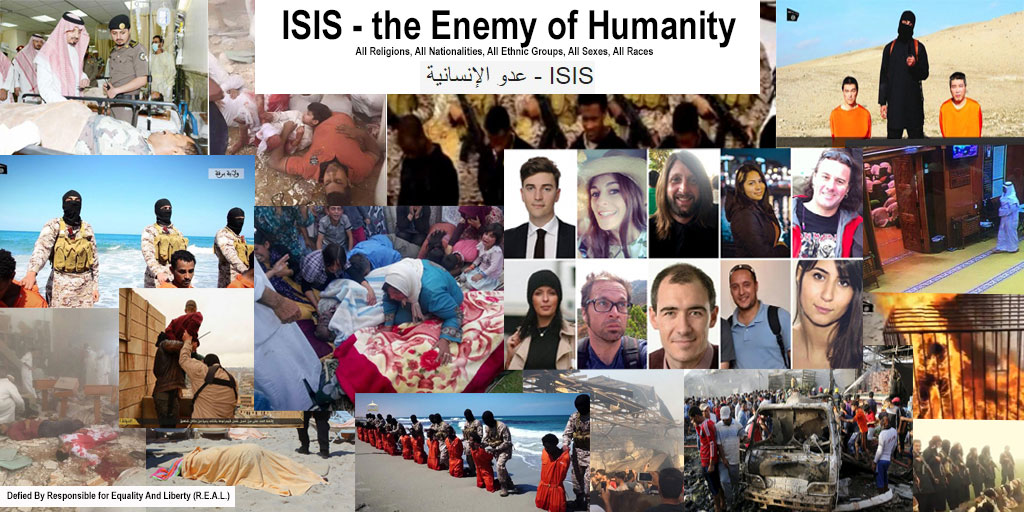
ISIS Terrorist Group - An Enemy of Humanity, Human Rights, Dignity, Security - for people of Every Nation, Race, Sex, Religion, Ethnic Group, and Political View (Responsible for Equality And Liberty - R.E.A.L.)
ISIS Terrorist Group – An Enemy of Humanity, Human Rights, Dignity, Security – for people of Every Nation, Race, Sex, Religion, Ethnic Group, and Political View
(Responsible for Equality And Liberty – R.E.A.L.)

Among its most important statements, the Universal Declaration of Human Rights states:

— “Whereas recognition of the inherent dignity and of the equal and inalienable rights of all members of the human family is the foundation of freedom, justice and peace in the world,”

— “Whereas disregard and contempt for human rights have resulted in barbarous acts which have outraged the conscience of mankind, and the advent of a world in which human beings shall enjoy freedom of speech and belief and freedom from fear and want has been proclaimed as the highest aspiration of the common people,”

— “Whereas it is essential, if man is not to be compelled to have recourse, as a last resort, to rebellion against tyranny and oppression, that human rights should be protected by the rule of law,”

— “Whereas it is essential to promote the development of friendly relations between nations,”

— “Whereas the peoples of the United Nations have in the Charter reaffirmed their faith in fundamental human rights, in the dignity and worth of the human person and in the equal rights of men and women and have determined to promote social progress and better standards of life in larger freedom,”

— “Whereas Member States have pledged themselves to achieve, in co-operation with the United Nations, the promotion of universal respect for and observance of human rights and fundamental freedoms,”

— “Whereas a common understanding of these rights and freedoms is of the greatest importance for the full realization of this pledge,”

“Now, Therefore THE GENERAL ASSEMBLY proclaims THIS UNIVERSAL DECLARATION OF HUMAN RIGHTS as a common standard of achievement for all peoples and all nations, to the end that every individual and every organ of society, keeping this Declaration constantly in mind, shall strive by teaching and education to promote respect for these rights and freedoms and by progressive measures, national and international, to secure their universal and effective recognition and observance, both among the peoples of Member States themselves and among the peoples of territories under their jurisdiction.”

Human Rights Day - Remembering the Universal Declaration of Human Rights (UDHR)
Human Rights Day – Remembering the Universal Declaration of Human Rights (UDHR)

But the political powers of the world have decided they only support the Universal Declaration of Human Rights, when it is convenient, or when no one will actually hold them RESPONSIBLE for it.

That has to change. Because when we give up on the Universal Declaration of Human Rights, we end up with violence, death, and oppression, running out of control around the world, and we can’t even begin to stop it. Because there will never be enough law enforcement, enough security measures, enough weapons of war and soldiers, until WE AGREE that EVERYONE DESERVES and is RESPONSIBLE for defending our universal human rights.

We can’t stop extremism when we teach our children that human rights only matter to people we like, or when it is convenient. Our children are looking for leadership, and our political leaders are giving them weak and cowardly relativist excuses. Our children see right through such nonsense. They are looking for answers. We have answers, but our political leaders have decided it would be too much trouble to actually be RESPONSIBLE for the truths that we hold self-evident.

Our political leaders have decided that it would be too difficult to actually work to acknowledge and defend our international code of universal human rights for ALL people.

So we, the people, have to DO something else. We are not going to get out of this mess with the leadership of our politicians, who base their lives and their view of the world on meaningless relativism.

We, the people of the world, in our different nations, need to take a stand – TOGETHER. We need to decide and make a commitment that we will be united in standing by the Universal Declaration of Human Rights for ALL people.

We, the people of the world, in our different nations, need to take a stand that we will work together to defend these universal human rights, and defy the forces of extremism and anti-human rights, no matter when, how, or where, they appear.

We must be CONSISTENT on our universal human rights for ALL. We cannot believe they only apply to some people. The relativist politicians will argue that only certain rights matter for some people, but we have tell our fellow human beings that this is wrong.

If the enemies of human rights can work together, build coalitions, spread violence, attack and kill people the world over, why can’t the defenders of human rights work together around the world, build our own coalitions, spread peace, reject extremist views, and call for equality of human rights and dignity the world over?

We can. We must. Our unity in universal human rights is the best hope we have today. We CAN change the world, just like the United States of America and so many other nations have changed. We can make change for all of our brothers and sisters in humanity.

We do not have to surrender to relativism. We do not have to give in to defeat and despair.

We can make another CHOICE.

On this Human Rights Day, and every day, we can CHOOSE to be Responsible for Equality and Liberty.

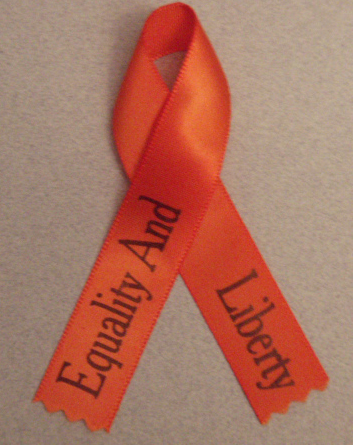
R.E.A.L.'s Orange Ribbon Campaign for Equality And Liberty
R.E.A.L.’s Orange Ribbon Campaign for Equality And Liberty

Human Rights Day Videos – National Press Club 2012

REAL Videos posted on YouTube
http://www.youtube.com/user/REALOrganization

Niemat Ahmadi – 2012 Human Rights Day
Darfur Women Action Group (DWAG)
https://www.youtube.com/watch?v=qj5-XmCAAtw

Nathalie Nguyen – 2012 Human Rights Day
International Committee To Support The Non-Violent Movement For Human Rights in Vietnam
https://www.youtube.com/watch?v=my-f0bhshiw&t=31s 

Dr. Charles Lee- 2012 Human Rights Day
Global Service Center for Quitting the Chinese Communist Party
https://www.youtube.com/watch?v=xDWIGMnqxFI 

Jeffrey Imm, Human Rights Day, Part 1
https://www.youtube.com/watch?v=dkol3rwtgN8

Jeffrey Imm -2012 Human Rights Day, Part 2
https://www.youtube.com/watch?v=TTcdG_I2GNo

NDTV Video
http://www.ntdtv.com/xtr/b5/2012/12/12/atext812692.html

Pakistan: Human Rights for Pakistan Christians

Statement by Nazir S. Bhatti, President, Pakistan Christian Congress (PCC), and Editor, Pakistan Christian Post (PCP) on Human Rights Day Regarding Human Rights Issues of Pakistan Christians, including urging the government of Pakistan to repeal blasphemy law and demand formation of Judicial Commission to investigate and to arrest killers of Shahbaz Bhatti, Federal Minister for Minorities who was assassinated on March 2, 2011, in Islamabad.

====================

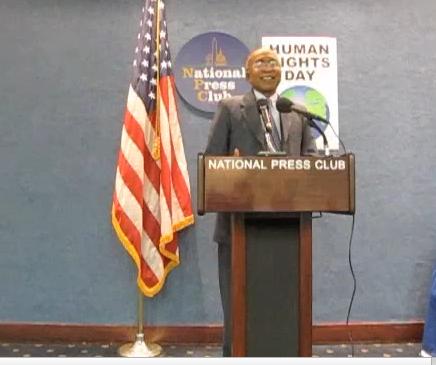
Pakistan Christian Congress' Dr. Nazir Bhatti - Speaking at a previous R.E.A.L. Human Rights Day Event - National Press Club, Washington DC

====================

I congratulate, Mr. Jeffrey Imm, Chief Coordinator of Responsible for Equality And Liberty (R.E.A.L.) for organizing this event as commitment to Declaration of Universal Human Rights of United Nation. It is important to pay homage to REAL leadership for commitment and re-commitment of Human Rights Day every year in DC when many champions of Human Rights not even bother to raise voice for persecuted communities on this day.

Availing opportunity of this occasion on Human Rights Day, I must submit that 20 million Pakistani Christians are a forgotten community by the International forums and Human Right organizations. There are incidents of gang-rape, abduction and enforced conversion to Islam of Christian women but silence prevails in capitals of Western governments. The Pastors are gunned down, Churches are attacked, Christian properties are set on fire, worshipers in churches are sprayed with bullets and Christian women and children are burnt alive but culprits walk free from courts if they are arrested. There are arrests of Christians under controversial blasphemy law to settle scores by Muslim majority but Human Right champions have never dared to press upon government of Islamic Republic of Pakistan to repeal such black laws which are contradictory to Universal Human Rights of UN, of which Pakistan is a signatory state.

There are frequent incidents of murder of Christian victims of blasphemy law in custody of law enforcement agencies and by hands of extremist elements but none of culprit is ever arrested and brought to justice. The Christian youth is denied equal opportunities in education and employment to undermine their due rights and even in share of US AID on such programs in Pakistan.

Dear Sirs,
It will be surprising to note that Islamic Republic of Pakistan claims to be a Democratic state but 20 million Pakistani Christians are deprived of their basic right to elect their representation by their vote in Pakistan. We are forced to vote for a Muslim and then that Muslim selects our member in Parliament but Western Democratic countries have never linked their AID to Pakistan for true democracy. Pakistani Christians have long standing demand of representation in National Assembly of Pakistan, Senate of Pakistan; Provincial Assemblies of Pakistan and Local Bodies with proportional to their population which is 13% but never received due consideration.

Dear Sirs,
I must submit that there have been more than 1,500 cases registered under blasphemy law in Pakistan since 1986, in which Christians, Ahmadi, Hindu and individuals of some Muslim sects were arrested. The Christian and Ahmadi victims of blasphemy law were killed by the hands of extremist’s Islamic elements in which none was arrested to ensure justice.

On occasion of Human Right Day, I will urge government of Pakistan to repeal blasphemy law and demand formation of Judicial Commission to investigate and to arrest killers of Shahbaz Bhatti, Federal Minister for Minorities who was assassinated on March 2, 2011, in Islamabad; The Tehreek-e-Taliban Punjab TTP accepted responsibility of killing of Shahbaz Bhatti but Joint Investigation Committee comprising of Islamabad Police and some Christian leaders have failed to make any arrest. I will also demand release of Asia Bibi, a Christian mother of 5, who was sentenced to death on accusation of blasphemy and waiting in jail for his appeal pending in Lahore High Court. Pakistan Christian Congress PCC demands release of more than 100 victims of blasphemy in jails and adequate security for those who have been acquitted from courts and forced to live in hidings.

It is also important to bring in notice of United Nation that Pakistani Christians are facing genocide in Islamic Republic of Pakistan and immediate action is required to safe 20 million Pakistani Christians by awarding Refugee Status for their safety and security of life and property.

I, President of Pakistan Christian congress PCC, Nazir S. Bhatti, on behalf of 20 million Pakistani Christians demand, His Excellency Ban-Ki Moon, Secretary General UN, on Human Right Day of 2011, to form a Commission to investigate genocide of Pakistani Christians under following Universal Conditions for Genocide.

1. Public display of ethnic and religious differences through physical features, language and communal symbols.
2. Absence in multi-religious and/or multi-ethnic societies of strong integrating institutions.
3. Absence of the rule of law and presence of authoritarian traditions of governance.
4. Deep-seated insecurity on the part of ruling elites.
5. Widespread perception of vulnerable religious and ethnic groups as potential agents of politically subversive powers.
6. Prevalence of a racially or religiously discriminatory ideology or worldview that upholds a utopian vision of a homogenous society as the foundation of political unity.
7. Institutionalization of racial or religious discrimination in statute law or social custom.
8. Widespread communication by state and/or non-state actors of hateful propaganda that portrays members of religious or ethnic communities as subject peoples, aliens within society, or as subhuman creatures.
9. Outbreaks of organized violence by mobs or individuals against members of vulnerable religious or ethnic communities.
10. Habitual denial of discrimination by state and non-state actors that engage in oppressive practices, including violence, against vulnerable groups in society.
11. Widespread militarization of society and/or widespread influence of non-state terrorist groups or militias.

We hope that formation of UN Commission on genocide of Pakistani Christians will be revival of Declaration of International Human Rights in Pakistan and around globe.

Nazir S Bhatti
President, Pakistan Christian Congress PCC
www.pakistanchristiancongress.org

Editor, Pakistan Christian Post PCP
www.pakistanchristianpost.com

7348 Belden Street,
Philadelphia, PA, 19111.
Dated: December 8, 201

Human Rights Day Event 2011 – Activists Call for Rights, Dignity for All

At the National Press Club in Washington DC, Responsible for Equality And Liberty (R.E.A.L.)  coordinated a Human Rights Day event on December 8, inviting co-sponsors from various groups to speak on behalf of human rights issues important to their organizations.  The groups remembered the adoption of the Universal Declaration of Human Rights (UDHR) by the United Nations on December 10, 1948 and the inherent human rights, human dignity, respect, and social justice that all of our fellow human deserve – of any identity group and in any part of the world.

(For each individual, we have provide Internet links to their Human Rights Day Event remarks.)

The speakers discussed the need to consistently show respect, compassion, dignity, and human rights to people in different parts of the world and in different identity groups.

Human Rights Day – Remembering the Universal Declaration of Human Rights (UDHR)

============

R.E.A.L.’s Jeffrey Imm spoke on the need to emphasize respect, instead of arrogance, in recognizing human rights, stating that it was arrogance by those who believe that they had superior rights to others that is a key problem in human rights around the world.  He urged the world to make a “declaration of love” towards their fellow human beings, and to Choose Love, Not Hate, in our lives and the lives of others in our communities, our nations, and our identity groups.  Jeffrey Imm spoke of the dire situation of poverty around the world and the impact on such poverty on human rights, stating that such poverty can undermine human rights for many, including individuals in the United States of America who he was working to support.  He urged people to give to charities and to people in need.

R.E.A.L.’s Jeffrey Imm also spoke on the future of human rights being defined by the example we set, and the way we treat our children.   He spoke on the continuing disgrace of abuse, rape, kidnapping, and murder of children around the world, as well as by those in institutions and society who have not made chidren’s rights a priority.  Jeffrey Imm urged the United States to adopt the Convention on Rights of the Child.

He also spoke on atrocities against children in the United States of America (the murder of 7 year of Jorelys Rivera, the murder of children in Texas), in Pakistan (the brainwashing of children by terrorists, the rape and murder of young girls, and the killing of Christian minority girls, including the recent killing of Amariah Masih), in Sudan and Dafur (rape of young girls, killing of children, and loss of their culture and innocence), in Balochistan (over 168 children have “disappeared” with teenage boys killed by authorities in a “kill and dump” campaign), in People’s Republic of China (the lack of concern of about a 2 year old child killed in the street, the government-sponsored forced abortions and infanticide, and the killing or abandonment of minority children such as children of Falun Gong practitioners), and in Bahrain (five children killed and hundreds of children subjected to excessive force by anti-protest authorities).  Jeffrey Imm also spoke on the institutional willingness to accept such abuses of children, including an Afghan girl released from prison on the condition she marry her rapist, and the reports of child abuse at the Pennsylvania State University and other institutions in America.  He also decried the so-called “honor killings” of young girls and boys by those who believe their cultural or religious views justified abuse and murder of children, and called for an end to these, noting that there were 3,000 such cases in the United Kingdom alone, according to stophonourkillings.com.  He spoke of the oppression against children in the United States of America, and his own efforts to stop such abuses.

Jeffrey Imm stated that these “are all OUR children,” who “are our common bond and bridge to the future.”  He suggested that in this season of reflection and gift-giving in much of the world, that we should first reach out to help the children and the less fortunate among us.   He stated that our greatest gift to children from adult human beings must be in making a renewed commitment to protect our vulnerable children around the world.  Jeffrey Imm stated, “We must give the gift of our courage, our consistency, and our commitment for the universal human rights and dignity to all of our children around the world…. We must set an example for our children. We must provide a beacon and symbol of hope for our children. We must show that by our words and more importantly by actions, in the United States and around the world – to our children – and to each other… We are Responsible for Equality And Liberty.”

A more detailed description of Jeffrey Imm’s remarks can be found at this web link.

A YouTube video of his remarks is online.

Jeffrey Imm, Responsible for Equality And Liberty (R.E.A.L.), Human Rights Day Event 2011

============

Ahmer Mustikhan, a senior journalist and Balochistan area expert, spoke on the issue of supporting democracy and human rights for the Baloch people, and called the end to abuses against Pakistan minorities.  Regarding the challenges within the Pakistan government, Ahmer Mustikhan called for the United States and the nations of the world to prevent the Pakistan military from interfering with the democratic government in Pakistan.  “It is true the democratic government of President Asif Ali Zardari gave the Baloch 300 bodies in the last four or so years, but still we would support it against the military generals. Democracy does make a difference in the lives of people and we can not remain oblivious to this fact,” Mustikhan said.  Mustikhan, who founded the DC-based American Friends of Balochistan and co-founded the International Voice for Baloch Missing Persons, also asked the world community to intervene in Balochistan on the same lines as they did in Libya to stop the genocide there and safeguard the right to self-determination of the Baloch people. He said scores of Baloch teenagers have been made victims of enforced disappearances and killed.  He narrated the story of a Baloch minor boy Abdul Wahid Baloch, aka Balaach Baloch, who gained fame after his picture showing him clad in a Balochistan flag was posted on social websites last year.  Ahmar Mustikhan also spoke on the issue of Pakistan minorities, including Pakistan Christians, and urged the Pakistan government to free Asia Bibi, who has been imprisoned on trumped-up charges of the “blasphemy law,” which has been used to target and oppress religious minorities in Pakistan.

A more detailed description of Ahmer Mustikhan’s remarks can be found at this web link.

A YouTube video of his remarks is online (Part 1, Part 2).

Ahmar Mustikhan, Senior Journalist and Area Expert, Balochistan – regarding the oppression and abuse of the Baloch people and Pakistan minorities on Human Rights Day Event 2011

============

Carolyn Cook, founder and CEO of United for Equality, spoke at the National Press Club in Washington DC on December 8, as part of a Human Rights Day Event, calling for a renewed commitment by Americans in support of the Constitutional rights for all American women, as part of our global human rights goals.   United for Equality is a social justice enterprise seeking the ratification of the Equal Rights Amendment (E.R.A.) by 2015. Carolyn stated that we must change the way people think and what we tolerate in our culture regarding the rights and dignity of our fellow Americans and fellow human beings.  Carolyn spoke out against the discrimination and the efforts to deny full equality to women in America, in every aspect of their lives.  She stated that we need to take our system back and make it ours. Carolyn Cook stated that United for Equality’s coalition successfully introduced a bill to the 112the session of the United States Congress calling for Congress to remove the time limit on the Equal Rights Amendment (E.R.A.), as the United States previously had the ratification of the E.R.A. in 35 states, and it requires ratification in 38 states and by 2/3s of the House and Senate.  She pointed out how previous U.S. government officials sought to halt the efforts to ratify the E.R.A. after 10 years when nearly all of the required states but 3 had ratified this Constitutional Amendment, and pointed out that women have no desire to “start over” the ratification of the E.R.A.

Carolyn Cook also spoke on the paradigm of options we have as activists and participants in defending human rights.  Carolyn urged a more holistic approach towards addressing human rights as lifelong causes.  She discussed lessons learned from the Occupy movement and other social activist efforts to bring change to the world.  Her discussion on lessons from the Occupy movement are detailed in the YouTube video of her speech beginning at 6:36 minutes in on Part 1 and continuing and concluding in Part 2 of her remarks.

A more detailed description of Carolyn Cook’s remarks can be found at this web link.

A YouTube video of her remarks is online (Part 1, Part 2).

Carolyn Cook, CEO and Founder of United for Equality, Speaks on Behalf of American Women’s Constitutional Rights – on Human Rights Day 2011 Event

============

Jared Pearman, Spokesperson for the Falun Dafa Association of Washington, DC, spoke on behalf of human rights and human dignity for the Falun Gong / Falun Dafa.  He provided information about the Falun Gong as “a peaceful spiritual practice rooted in traditional Chinese culture,” which “consists of meditation, five gentle sets of exercises, and a moral philosophy centered on the values of truthfulness, compassion, and tolerance.” While pointing out that Falun Gong is not political, Mr. Pearman stated that “as Falun Gong grew in popularity throughout the 1990s, China’s communist leaders began to view the practice and its moral philosophy as ideological competition.”  For the past 12 years, he indicated that “China’s rulers began a campaign to eradicate Falun Gong. Since then, like underground Christians and Tibetan Buddhists, millions of Falun Gong adherents have been denied the right to peacefully practice their faith.”  Despite massive arrests, torture, killings and denial of human rights for the Falun Gong by the Chinese Communist Party, Mr. Pearman stated that “Falun Gong has not been crushed, and reports from China indicate that the number of practitioners is instead growing. Ordinary citizens are increasingly standing up in defense of Falun Gong and are refusing to participate in the persecution.”  He called for the Chinese government and the world to recognize and defend the human rights of the Falun Gong. Mr. Pearman offered “an alternate vision of what China could be — an alternative way of conceptualizing Chinese national identity”…. that “connects with China’s moral and spiritual traditions of Confucianism, Buddhism, and Daoism, and holds that the cultivation of virtue, honesty, and humanness are the true sources of national greatness.”

A more detailed description of Jared Pearman’s remarks can be found at this web link.

A YouTube video of his remarks is online.

Jared Pearman, Spokesperson of Falun Dafa Association of Washington DC, oppressed in the PRC and denied their most basic human rights and dignity by those who view their practice and support for traditional Chinese values as a threat to the Chinese Communist Party (CCP) – Speaking at 2011 Human Rights Day Event

============

Husain Abdulla, leader of Americans for Democracy and Human Rights in Bahrain (ADHRB), spoke on behalf of Bahrainis oppressed by government forces that seek to deny democracy.  He spoke of the initial protests on February 14, 2011, of those who sought to join the “Arab Spring” movement for democracy, and the brutal oppression of the Bahrain government.  Since March 2011, Husain Abdulla stated that Bahrain protesters have been subjected to torture and death.  45 were killed, over 2,000 arbitrary arrests, 1,866 cases of documented torture, 5,000 prisoners of conscience, destruction of 40 places of worship, and 3,000 fired from their jobs, 500 forced out of Bahrain, 3 on death row, 477 students expelled from universities, and 300 students had scholarships taken away — all in retaliation for the willingness to protest against the Bahrain government.  He stated that over 500 doctors have been detained.  He noted that Bahrain is a close ally to the United States, and he urged Americans to call for the American government to end the “blind eye” to Bahrain human rights violations.

A more detailed description of Husain Abdulla’s remarks can be found at this web link.

A YouTube video of his remarks is online (Part 1, Part 2).

Husain Abdulla, speaking at National Press Club on Human Rights Day Event – Americans for Democracy and Human Rights in Bahrain (ADHRB) — speaking on behalf of Bahranis oppressed by government forces that seek to deny democracy

============

Niemat Ahmadi spoke at the National Press Club Human Rights Day Event on December 8, 2011, to address the abuse of Darfuris and Sudanese. Niemat Ahmadi represents the United to End Genocide group. She spoke about the Genocide in Sudan which has been ongoing for over 8 years, and that have driven 4,000,000 out of their homes.  Niemat Ahmadi spoke on the need for Americans to call for justice regarding Omar Al-Bashir.  She  noted that the efforts of Al-Bashir regime  have changed their tactics and seek to use rape against women as a weapon of war against the Darfuri people. Niemat Ahmadi spoke of the continuing attacks on Darfuri cities, homes, and attempts to stop safe travel of people of African nationalities who have been fleeing to displaced persons camps.  Niemat Ahmadi urged those in Arab nations seeking democracy in their nations to stand up to dictatorial Arab regimes who have supported the brutal Al-Bashir regime.

A more detailed description of Niemat Ahmadi’s remarks can be found at this web link.

A YouTube video of her remarks is online (Part 1, Part 2).

Niemat Ahmadi, with United to End Genocide, Speaks Out on the Darfur Genocide in Support of Human Rights – at Human Rights Day Event 2011

===============

In R.E.A.L.’s Jeffrey Imm’s concluding remarks, he urged the human rights activists to continue to work together in the coming year on joint activists.   He noted that after the winter comes the spring, and in the spring, he often goes to the U.S. Holocaust Memorial Museum during Holocaust Remembrance Days to participate in the reading of the names.   Even if there is only one or two people there, Imm noted, there is someone to remember, and it is done simply because it is the right thing to do.

He urged human rights activists to remember that in their work of spreading hope, reaching out to offer dignity, justice, freedom, and consistent universal human rights to all.  That is the vision and the mission of being collectively…

Responsible for Equality And Liberty….

Choose Love, Not Hate, Love Wins.

Orange Ribbon for Universal Human Rights – Responsible for Equality And Liberty (R.E.A.L.)

Husain Abdulla Speaks on Bahrain Democracy and Human Rights

Husain Abdulla, leader of Americans for Democracy and Human Rights in Bahrain (ADHRB), was a speaker at a Human Rights Day Event at the National Press Club in Washington DC, speaking on behalf of Bahrainis oppressed by government forces that seek to deny democracy.  He spoke of the initial protests on February 14, 2011, of those who sought to join the “Arab Spring” movement for democracy, and the brutal oppression of the Bahrain government.  Husain Abdulla spoke of earlier oppression by the Bahrain government in 2010 in reaction to earlier protests.  He also discussed how Amnesty International reported on Bahrain’s “torture edicts,” making the case the government of Bahrain has been systematically torturing political prisoners.  Husain Abdulla stated that Bahraini people are facing 6 governments that seek to deny them human rights.

Since March 2011, Husain Abdulla stated that Bahrain protesters have been subjected to torture and death.  45 were killed, over 2,000 arbitrary arrests, 1,866 cases of documented torture, 5,000 prisoners of conscience, destruction of 40 places of worship, and 3,000 fired from their jobs, 500 forced out of Bahrain, 3 on death row, 477 students expelled from universities, and 300 students had scholarships taken away — all in retaliation for the willingness to protest against the Bahrain government.  He stated that over 500 doctors have been detained.  He noted that Bahrain is a close ally to the United States, and he urged Americans to call for the American government to end the “blind eye” to Bahrain human rights violations.

Husain Abdulla, speaking at National Press Club on Human Rights Day Event - Americans for Democracy and Human Rights in Bahrain (ADHRB) -- speaking on behalf of Bahranis oppressed by government forces that seek to deny democracy

The video and audio of his full speech can be seen on YouTube, which is in two parts: Part 1 and Part 2.   The Americans for Democracy and Human Rights in Bahrain (ADHRB) group has a web site at BahrainSpring.org