U.S. State Dept Trafficking in Persons Report 2009 and Gender Imbalance in Human Trafficking

U.S. State Dept Trafficking in Persons Report 2009

— See also “Sudan: Women and Other Slaves Freed”

Gender Imbalance in Human Trafficking
Introduction, page 36 (hard copy), page 38 (electronic)

“The root causes of migration and trafficking greatly overlap. The lack of rights afforded to women serves as the primary causative factor at the root of both women’s migrations and trafficking in women…By failure to protect and promote women’s civil, political, economic and social rights, governments create situations in which trafficking flourishes.”
— Radhika Coomaraswamy, UN Special Rapporteur on Violence Against Women

———————————————————————

“According to the ILO, the majority of people trafficked for sexual exploitation or subjected to forced labor are female.”

“According to researchers, both the supply and demand sides of the trade in human beings are fed by ‘gendered’ vulnerabilities to trafficking. These vulnerabilities are the result of political, economic, and development processes that may leave some women socially and economically dependent on men. If that support from men becomes limited or withdrawn, women become dangerously susceptible to abuse. They often have no individual protection or recognition under the law, inadequate access to healthcare and education, poor employment prospects, little opportunity to own property, or high levels of social isolation. All this makes some women easy targets for harassment, violence, and human trafficking.”

“Research links the disproportionate demand for female trafficking victims to the growth of certain ‘feminized’ economic sectors (commercial sex, the ‘bride trade,’ domestic service) and other sectors characterized by low wages, hazardous conditions, and an absence of collective bargaining mechanisms. Exploitative employers prefer to use trafficked women — traditionally seen as submissive, cheap, and pliable — for simple and repetitive tasks in agriculture, food processing, labor-intensive manufacturing, and domestic servitude.”

“In countries where women’s economic status has improved, significantly fewer local women participate in commercial sex. Traffickers bring in more female victims to address the demand and also take advantage of women who migrate voluntarily to work in any industry. As commercial sex is illegal in most countries, traffickers use the resulting illegal status of migrant women that have been trafficked into commercial sex to threaten or coerce them against leaving. Gendered vulnerabilities fostered by social and institutional weaknesses in some societies — discriminatory laws and practices that tie a woman’s legal recognition, property rights, and economic opportunities to someone else — make women more likely than men to become trafficking victims. A woman who exists only through a male guardian who controls her income, identification, citizenship, and physical well-being is more susceptible to becoming a trafficking victim.”
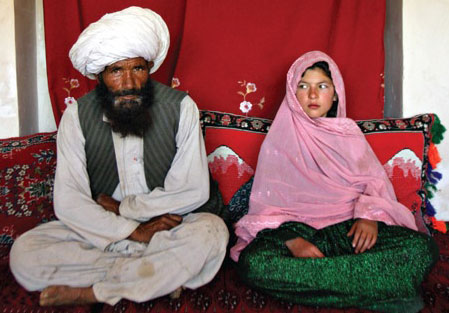
Image from State Dept 2009 Human Trafficking Report, section "Gender Imbalance in Human Trafficking"

Some Tier 3, 2 Watch, and 2 nations include (see Introduction, page 50 (hard copy), 52 (electronic copy)  for complete list)

Tier 3 Nations include:
— Saudi Arabia
— Iran
— Syria
— Sudan
— Kuwait
— Malaysia
— Mauritania
— Communist North Korea

Tier 2 Watch List Nations include:
— Pakistan
— Iraq
— Lebanon
— Algeria
— Yemen
— United Arab Emirates
— Egypt
— India
— Russia
— Communist China

Tier 2 Nations include:
— Afghanistan
— Jordan
— Kosovo
— Turkey
— Communist Vietnam

————————————–

“The ninth annual Trafficking in Persons Report sheds light on the faces of modern-day slavery and on new facets of this global problem. The human trafficking phenomenon affects virtually every country, including the United States. In acknowledging America’s own struggle with modern-day slavery and slavery-related practices, we offer partnership. We call on every government to join us in working to build consensus and leverage resources to eliminate all forms of human trafficking.”
–Secretary Clinton, June 16, 2009

The Report
The report is available in PDF format as a single file [PDF: 22 MBGet Adobe Acrobat Reader]. Due to its large size, the PDF has been separated into sections for easier download: Introduction; Country Narratives: A-C, D-K, L-P, Q-Z/Special Cases; Relevant International Conventions. To view the PDF file, you will need to download, at no cost, the Adobe Acrobat Reader.

PDF Version: Trafficking in Persons Report, June 2009
Introduction (PDF) [5071 Kb]
Country Narratives: A-C (PDF) [4074 Kb]
Country Narratives: D-K (PDF) [3889 Kb]
Country Narratives: L-P (PDF) [4036 Kb]
Country Narratives: Q-Z and Special Cases (PDF) [3868 Kb]
Relevant International Conventions (PDF)

———————————-

Additional News Reports on Human Trafficking Watch List
Expanded Human Trafficking Watchlist Puts Dozens of Countries on Notice
Iran not doing enough to combat human trafficking, says US
US adds Pakistan to human trafficking watchlist
Communist China: Dissident writer Liu Xiaobo held after sentence ends

(Communist China) Dissident writer held after sentence ends
— “Liu Xiaobo remains in custody in an undisclosed location in Beijing, in violation of China’s criminal law”
— “Mr Liu, 53, was taken away by police on December 8, a day before the publication of the Charter ’08 document that he co-authored with more than 300 intellectuals appealing for a new constitution, human rights, elections, freedom of religion and expression and an end to the Communist Party’s hold over the military, courts and government”

DC: China Embassy – Responsible for Equality And Liberty Challenges Chinese Govt

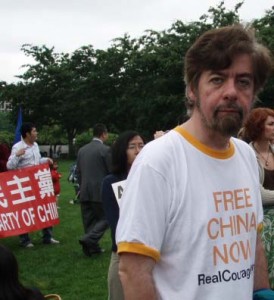
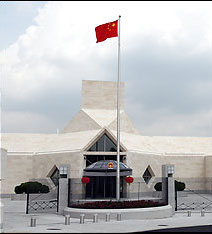
On the afternoon of June 4, 2009, the founder of the Responsible for Equality And Liberty (R.E.A.L.) organization held a protest demonstration outside of the Communist Chinese embassy in Washington DC.   R.E.A.L.’s Jeffrey Imm led this protest from 1 to 4 PM, in part during a driving rainstorm, as part of his way of honoring the memory of those who died in the June 4, 1989 Beijing massacre in the Communist Chinese government’s crackdown on the 1989 Tiananmen Square protests.

china-embassy

Jeffrey Imm began the rally by offering the Communist Chinese embassy a copy of the Universal Declaration of Human Rights (Chinese language version), a report on the Tiananmen Square protests and massacre, and a report on the May 31 Hong Kong protests – all printed in the Chinese language.  The embassy refused to accept these.

Jeffrey Imm recounted the circumstances that led up to the June 4, 1989 Beijing massacre and called upon the Communist Chinese government to release the names of all those who were killed on June 4, 1989.   He then read the names of those 195 known individuals who were killed in the massacre.

Imm addressed the humanitarian aspects of allowing families to publicly grieve and mourn for their loved ones.  “Those who died on June 4, 1989 were all someone special.  They were someone’s son or daughter.  They were all loved and they came into the world as part of the miracle of human life.   They were not only part of someone’s direct family, they were also all part of our shared family of humanity.  And as members of our shared family of humanity, they all deserved our inalienable, universal human rights of equality, liberty, dignity, and life.  Responsible for Equality And Liberty is here to remember them today, because we believe that their lives all were precious and important, we mourn them as members of our human family, and we vow not to let their deaths, their sacrifices, go in vain.”

Imm spoke to those watching and listening at the Communist Chinese embassy for three hours, imploring them to show dignity to those families that seek to mourn the loss of their loved ones.  He asked how 73-year old Ding Zilin could be a threat to the Chinese government when she was recently prevented from speaking in remembrance of her dead teenage son who was killed in the Beijing massacre 20 years ago.  He asked how 75-year old Sun Wenguang could be a threat to the Chinese government when he was recently bullied and manhandled by Chinese security police, having three ribs cracked, just because he sought to remember the death of former Chinese premiere Zhao Ziyang.  He challenged the Chinese government to ask themselves if they are this afraid of just those who would remember the dead, what will they do when the people of China finally seek to reclaim their natural, inalienable human rights and dignity again?

Imm recounted the initial experiences of those he saw in the Washington DC area after the June 4, 1989 massacre, when people of all kinds flocked to the old Communist China embassy in protest:

Imm said: “I remember June 4, 1989. I will remember it all of my life. Like many others, I was compelled to do something about this horrific tragedy in China. The Chinese protesters for freedom in Tiananmen Square were killed just because they dared to call for the very freedoms inherent in the universal human rights that every one of us has as human beings. I had to leave my job and go to the Communist Chinese embassy in Washington DC. Such a martyring of those struggling for freedom was unacceptable. Many others shared this human outrage. No one had to tell us what to do. We didn’t need a web site and directions. We didn’t need an email listing of who to contact. We just needed to be responsible as human beings and do something ourselves.”

“We protested, we shouted, we prayed, and we rallied in front of the Communist Chinese embassy. People came from diverse professions, various political parties, and many identity groups. Our shared organization was the family of humanity. We huddled together on the Washington DC street corner by the embassy, listening for news from those who had radios. We stood there until it was dark and we stood there – defiant – responsible for equality and liberty – not because the people killed in Tiananmen Square were Chinese – but simply because they were fellow human beings.”

Imm stated that was the same reason why he was at the Communist Chinese embassy on June 4, 2009.   “We don’t need a special reason or need to be members of a special group.  We protest the Communist Chinese government’s killing of those who called for democracy on June 4, 1989 for the simple reason that they are part of our family too — our shared family of humanity that is seeking its inalienable, natural, and universal human rights.”

Imm pointed out the sacrifices made by those who died on June 4, 1989, both sacrificing their lives and the burden their families have carried these 20 years with their loss.  He stated that those responsible for equality and liberty realize that sacrifice is a part of being responsible.  He stated that many can go to where it is convenient and comfortable and mouth platitudes about freedom, but those who truly assume their responsibility for equality and liberty recognize that such responsibility means sacrifice.  Imm addressed the story of the heroic sacrifices of Mr. Fang Zheng who lost his legs in Tiananmen Square and Dr. Wang Dan who was imprisoned for many years for his participation in the Tiananmen Square democracy movement.  They and many others are examples of the profiles of what it means to be responsible for universal human rights, Imm stated.  Imm told the Communist Chinese government that their sacrifice was honorable and should be commemorated by the Chinese people as heroes in seeking the universal human rights that all human beings deserve.

In addition, Imm read passages from the book “Prisoner of the State: The Secret Journal of Premier Zhao Ziyang” to those listening in the Communist Chinese embassy.   He read the May 18, 1989 letter from Zhao Ziyang to Deng Xioping calling for the government to reverse “the labeling and judgment made of them in the April 26 editorial, and acknowledgment of their actions as patriotic.”  Imm called for the Communist Chinese government to recognize the patriotic nature of the Tiananmen Square protesters and remember their actions as heroes of the Chinese people.  Furthermore, Imm also read from Chapter 5 of this book where Zhao Ziyang called for the creation of parliamentary democracy in China.

Imm also spoke in detail against the other abuses by the Communist Chinese government on its people.  He asked if the Chinese government really believed that it could maintain its economic growth which was dependent on denying human liberty and using forced labor camps.  He challenged the AEI  think tank and others who have focused on the economic aspects of Communist China to ask themselves what other nation uses forced labor camps, such as the estimated 1,000 Laogai camps holding 6.8 millions prisoners, to help their “capitalist” activities?  He challenged the AEI to ask them themselves if they would be as calmly addressing the economic prowess of Nazi Germany also using forced labor camps to improve its economic position in the world.

Imm addressed the issue of the attacks on human dignity in China as a violation of Chinese people’s human rights.    He addressed the reports of forced abortions, the selling of human body parts, and denounced the practices of those selling corpses for the entertainment of those in New York City’s “Body… The Exhibition” and elsewhere.  Moreover, Imm vowed to protest this practice of indignity against Chinese corpses in NYC in R.E.A.L.’s upcoming rallies in New York City planned for July 2009.

Imm asked the Communist Chinese government what it expected the results would be of its history of disrespect towards women, in part based on the practices of forced abortions, which has now led to gangs in China who kidnap women because they are so “scarce.”  Imm asked the Communist Chinese government how such lack of dignity and respect for fellow Chinese human beings would impact the future of peace in China.

A group of five individuals led by a Canadian-Chinese man also appeared later in the afternoon at the embassy and held up hand written signs in protest at the Communist Chinese government’s actions regarding the Tiananmen Square massacre.

Imm concluded the protest by once again reading the names of the known victims of the June 4, 1989 Beijing massacre, and saying that on behalf of those who could not speak for themselves, he would continue to chant: “Long Live Democracy!”  and “Free China Now!”

DC: Capitol Hill Rally Remembers Tiananmen Martyrs

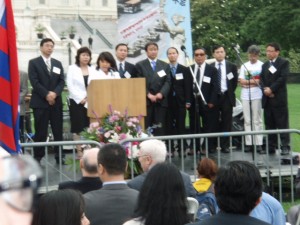
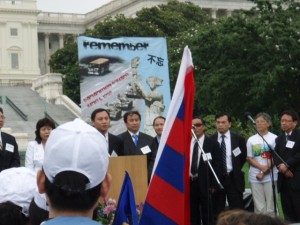
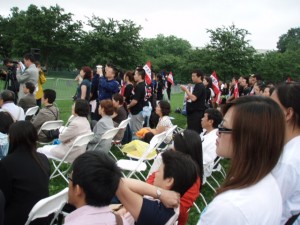
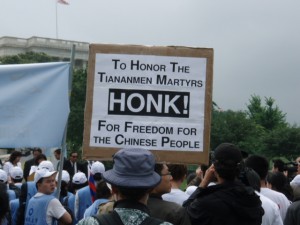
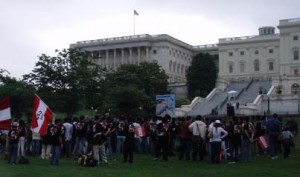
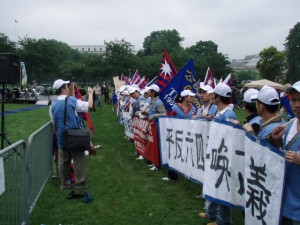
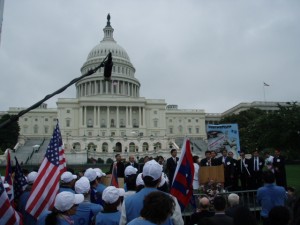
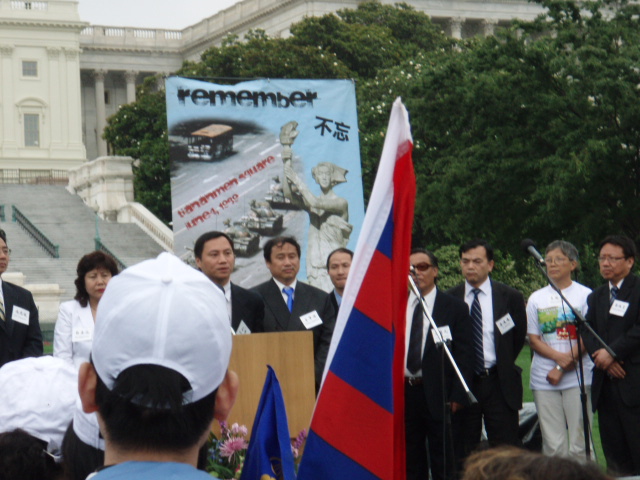
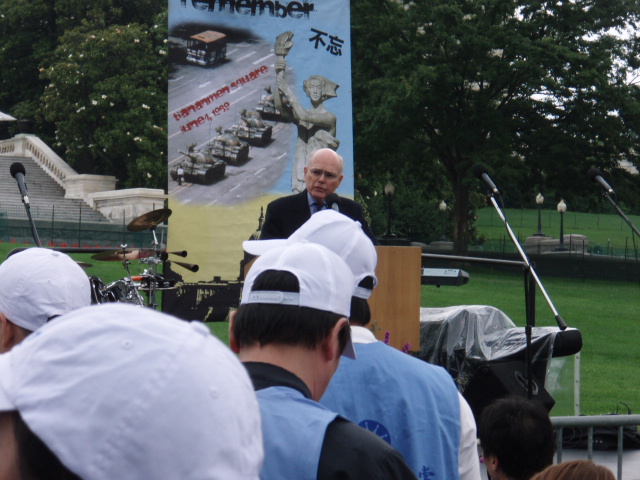
On June 4, the Initiatives for China and other groups held a Washington DC rally on Capitol Hill remembering the Tiananmen and Beijing martyrs for freedom killed on June 4, 1989.  At the Washington DC Capitol Hill rally, a number of individuals spoke on behalf of those continuing to seek liberty and democracy for the Chinese people, as well as remembering those who died in the June 4, 1989 Beijing massacre.

capitol-hill-heroes

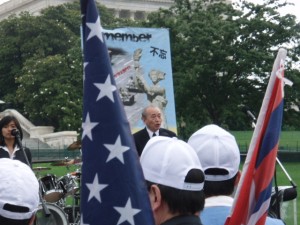
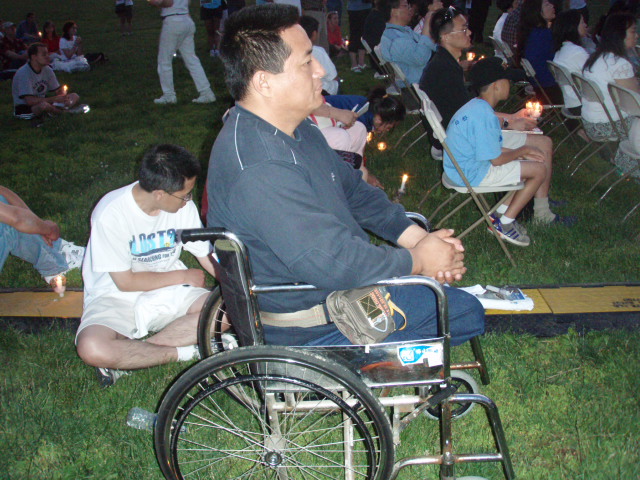
Former Tiananmen Square students and leaders recounted what happened 20 years ago, and they forcefully called for democracy and liberty for the people of China.   Tiananmen Square leader Dr. Wang Dan spoke at this Capitol Hill rally.   In addition, the heroic Mr. Fang Zheng, who lost both of his legs crushed by a Communist military tank in Tiananmen Square, also was present and honored at the Capitol Hill rally.

Tiananmen Square leader Dr. Wang Dan speaks at June 4, 2009 Capitol Hill rally for freedom

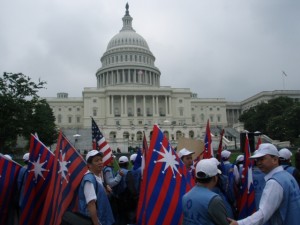
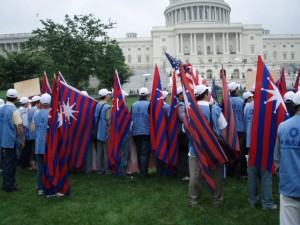
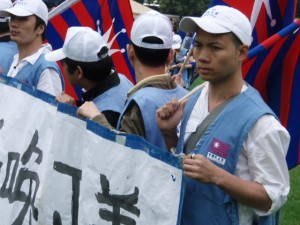
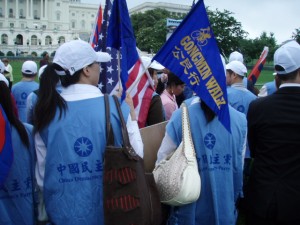
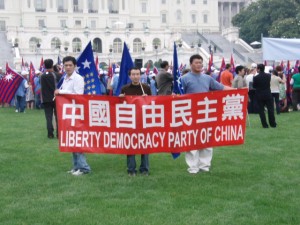
There were numerous attendees from the China Democracy Party organization, whose red and blue striped flags with a white star, dotted the West Lawn of Capitol Hill (China Democracy Party’s English website).

cdp-flag-1

flags-june-4-capitol

cdp-flags-2

cdp-group-1

cdp-3

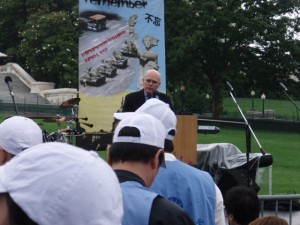
In addition, Dr. Lee Edwards of the Victims of Communism Memorial Foundation also spoke of his experiences seeking to challenge the Communist Chinese government on the issue of Tiananmen Square, as did several Congressional leaders.  The China Support Network (CSN) blog also reported on a statement by U.S. Congressional Speaker Nancy PelosiAmnesty International also had a number of attendees at the rally, and had a speaker from their organization addressing the continuing problem in China.

Dr. Lee Edwards of the Victims of Communism Memorial Foundation speaks

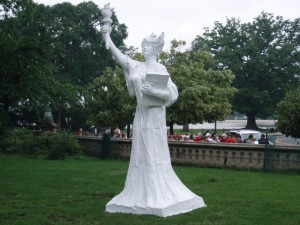
On the Capitol Hill grounds, a replica of the “Goddess of Democracy” was on display in remembrance of the Tiananmen Square protests of 1989 and Beijing massacre.

goddess-of-democracy-0604-replica

Responsible for Equality And Liberty (R.E.A.L.)‘s Jeffrey Imm attended the rally on Capitol Hill prior to the R.E.A.L. protest outside the Communist Chinese embassy later that afternoon.

Jeffrey Imm of Responsible for Equality And Liberty (R.E.A.L.) attends June 4, 2009 Capitol Hill Rally Remembering Tiananmen Square

Per the Initiatives for China website,  the 20th Anniversary Tiananmen sponsors, cosponsors, and participants:

“(Mainland) China New Democracy Party, (Outside Mainland China) Initiatives for China, Asian Human Rights Coalition, Uyghur American Conference, International Campaign for Tibet, Friends of the Falun Gong, Amnesty International, Pan Asian Human Rights Foundation, Allies of the Guard of Canadian Values, China Rights Network (Canada), June 4 Massacre Investigation, Democratic Team in Los Angeles, Federation for a Democratic China, Chinese Liberal Democratic Party, Society for Chinese Students and Scholars (Germany, Independent Federation of Chinese Students and Scholars (US), Sydney Workshop for Democratic China (AUS). Hong Kong Federation for a Democratic China, Asia Pacific Human Rights Foundation, Anti Political Persecution Alliance of China, Chinese Coalition for Citizens Rights, Chinese Democracy Promotive Society, Chinese Democracy Party USA Headquarters, China Democracy Forum (NY), Chinese Alliance for Democracy, The Overseas Chinese Coalition of Australia, China Social Democratic Party, Asian Pacific Human Rights Coalition, Chinese Constitutionalists Association.”

speaker-2

liberty-democracy-party-of-china

Other Images:

hka6420_bk

crowd-4

protest-sign-ch-060409

crowd-5

banner-hillbackground-ch

U.S.: John Kusumi, founder of the China Support Network, calls for Chinese people to rise up

“John Kusumi, founder of the China Support Network,calls for Chinese people to rise up and sweep away ‘the model of government-by-gangster'”
— John Kusumi: “I do fully support the Chinese democracy movement and its present-day agenda for political reform that is far-reaching and not just baby steps of incrementalism. There will be a change as the Communist Party is swept away, into the dustbin of history.”
— John Kusumi: “There is strength in this cause and in this movement. In 1989, students were asking the government for change. Some even kneeled on the steps of the Great Hall of the People — and one of them, Zhou Yongjun, has been arrested again in China. He belongs here, at this event, today. We demand his release, and that of Wang Bingzhang, Liu Xiaobo, and Gao Zhisheng. This is 2009. This time, we are not asking the government, we are telling the government — and calling for a revolution to come along side us.”
— John Kusumi: “We are standing where there is a statue of Tiananmen Square’s Goddess of Democracy. I remember standing here in 2007 with Tang Baiqiao as he called for a second June 4 movement. With today’s open call for revolution, his call is joined. Could the Chinese government negotiate, perhaps with Xu Wenli? Xu Wenli is a Chinese dissident who has called for a Future of China Conference, to be held this fall in Beijing. That, in preparation for a Constitutional Convention of 2010. Those events can and should happen, with or without the Communist Party at the table!”
— John Kusumi: “Long live democracy, and may the future of China be bright!”

U.S. House of Representatives passes H. Res. 489, for the 20th anniversary of Tiananmen Square

U.S. House of Representatives passes H. Res. 489, for the 20th anniversary of Tiananmen Square

Full text of the resolution:

Recognizing the twentieth anniversary of the suppression of protesters and citizens in and around Tiananmen Square in Beijing, People’s Republic of China, on June 3 and 4, 1989 and expressing sympathy to the families of those killed, tortured, and imprisoned in connection with the democracy protests in Tiananmen Square and other parts of China on June 3 and 4, 1989 and thereafter;

Whereas freedom of expression and assembly are fundamental human rights that belong to all people, and are recognized as such under the Universal Declaration of Human Rights and the International Covenant on Civil and Political Rights;

Whereas June 4th, 2009, marks the 20th anniversary of the day in 1989 when the People’s Liberation Army and other security forces finished carrying out the orders of Chinese leaders to use lethal force to disperse demonstrators in and around Beijing’s Tiananmen Square;

Whereas the death on April 15, 1989 of Hu Yaobang, former General Secretary of the Communist Party of China,  was followed by peaceful protests throughout China calling for the elimination of corruption and  acceleration of economic and political reforms, especially freedom of expression, and freedom of assembly; and calling for a dialogue between protesters and Chinese authorities on these issues;

Whereas by early May 1989, citizens advocating publicly for democratic reform across China included not only students, but also government employees, journalists, workers, police, members of the armed forces and other citizens;

Whereas on May 20, 1989, martial law was declared in Beijing after authorities had failed to persuade demonstrators to leave Tiananmen Square;

Whereas during the late afternoon and early evening hours of June 3, 1989, ten- to fifteen thousand helmeted, armed troops carrying automatic weapons and travelling in large truck convoys moved into Beijing to “clear the Square” and surrounding streets of demonstrators;

Whereas on the night of June 3 and continuing into the morning of June 4, 1989, soldiers in armored columns of tanks outside of Tiananmen Square fired directly at citizens and indiscriminately into crowds, inflicting high civilian casualties, and killing or injuring hundreds of unarmed civilians, who reportedly ranged in age from 9 years old to 61 years old; and whereas tanks crushed some protesters and onlookers to death.

Whereas even after 20 years, the exact number of dead and wounded remains unclear; credible sources believe that a number much larger than that officially reported actually died in Beijing during the period of military control; credible sources estimate that the numbers of wounded at least were in the hundreds; detentions at the time were in the thousands, and some political prisoners who were sentenced in connection with the events surrounding June 4, 1989 still languish in Chinese prisons;

Whereas there are Chinese citizens still imprisoned for “counter-revolutionary” offenses allegedly committed during the 1989 demonstrations, even though, according to the 1997 revision of China’s Criminal Law, the “offenses” for which they were convicted are no longer crimes.

Whereas the Tiananmen Mothers is a group of relatives and friends of those killed in June 1989 whose demands include the right to mourn victims publicly, to call for a full and public accounting of the wounded and dead, and the release of those who remain imprisoned for participating in the 1989 protests;

Whereas members of the Tiananmen Mothers group have faced arrest, harassment and discrimination; the group’s Web site is blocked in China; and international cash donations made to the group to support families of victims have been frozen by Chinese authorities;

Whereas Chinese authorities censor information that does not conform to the official version of events surrounding the Tiananmen crackdown, and limits or prohibits information about the Tiananmen crackdown from appearing at all in textbooks in China;

Whereas Chinese authorities continue to suppress peaceful dissent by harassing, detaining or imprisoning journalists, advocates for worker rights, religious believers, and other individuals in China, including in Xinjiang and in Tibet who seek to express their political dissent, ethnic identity or religious views peacefully and freely;

Whereas Chinese authorities continue to harass and detain advocates for democratic processes such as Mr. Liu Xiaobo, a Tiananmen Square protester, prominent intellectual, dissident writer, and more recently a signer of Charter 08 (a call for peaceful political reform and respect for the rule of law published on-line last December by over 300 citizens and subsequently endorsed by thousands more), who remains under house arrest.

Now, therefore, be it Resolved, That the House of Representatives —

(A)  expresses sympathy to the families of those killed, tortured, and imprisoned as a result of their participation in the democracy protests in Tiananmen Square and elsewhere in China on June 3-4, 1989 and thereafter, and all those persons who have suffered for their efforts to keep that struggle alive during the last two decades;

(B)  calls on the People’s Republic of China to invite full and independent investigations into the Tiananmen Square crackdown, assisted by the United Nations High Commissioner for Human Rights and the International Committee of the Red Cross;

(C)  calls on the legal authorities of the People’s Republic of China to review immediately the cases of those still imprisoned for participating in the 1989 protests for compliance with internationally recognized standards of fairness and due process in judicial proceedings and to release those individuals imprisoned solely for peacefully exercising their internationally-recognized rights;

(D) calls on the People’s Republic of China to end its harassment and detention of and its discrimination against those who were involved in the 1989 protests not only in Beijing, but in other parts of China where protests took place; and to end its harassment and detention of those who continue to advocate peacefully for political reform, like Mr. Liu Xiaobo, a signer of Charter 08 who remains under house arrest, and his wife, Liu Xia.

(E)  calls on the People’s Republic of China to allow protest participants who escaped to or are living in exile in the United States and other countries, or who reside outside of China because they have been “blacklisted” in China as a result of their peaceful protest activity, to return to China without risk of retribution or repercussion.

(F)  calls on the Administration and Members of the Congress to mark the 20th Anniversary of the events at Tiananmen Square appropriately and effectively by taking steps that include: meeting whenever and wherever possible with participants in the demonstrations who are living in the United States, and meeting with others outside of China who have been “blacklisted” in China as a result of their peaceful protest activities; signaling support for those in China who demand an accounting of the events surrounding June 4th, 1989; and expressing support for those advocating for accountable and democratic governance in China.

Also FYI:

Ron Paul criticizes House Resolution 489:
— “As to the substance of the resolution, I find it disturbing that the House is going out of its way to meddle in China’s domestic politics, which is none of our business”

Communist China: Police swarm Tiananmen Square on anniversary

Police swarm Tiananmen Square on anniversary

AP:
— “In Tiananmen Square, police were ready to pounce at the first sign of protest. In Hong Kong, a sea of candles flickered in the hands of tens of thousands who vented their grief and anger.”
— “Two starkly contrasting faces of China were on display Thursday, the 20th anniversary of the military’s bloody crackdown on pro-democracy demonstrators — from Beijing’s rigid control in suppressing any dissent, to freewheeling Hong Kong, which enjoys freedoms all but absent on the mainland.”
— “Tiananmen Square was blanketed by uniformed and plainclothes security officers who were ready to silence any potential demonstration, and there were few hints that the vast plaza was the epicenter of a student-led movement that was crushed on June 3-4, 1989, shocking the world.”
— “Police barred foreign journalists from entering the square and threatened them with violence, even barring them from covering the daily raising of China’s national flag.”
— “Dissidents and families of victims were confined to their homes or forced to leave Beijing, part of sweeping government efforts to prevent online debate or organized commemorations of the anniversary.”
— “The extraordinary security in Beijing came after government censors shut down social networking and image-sharing Web sites such as Twitter and Flickr and blacked out CNN and other foreign news channels each time they showed stories about Tiananmen.”
— “‘We’ve been under 24-hour surveillance for a week and aren’t able to leave home to mourn. It’s totally inhuman,’ said Xu Jue, whose son was 22 when he was shot in the chest by soldiers and bled to death on June 4, 1989.”
— “Police were also stationed outside the home of Wang Yannan, the daughter of Zhao Ziyang, the Communist Party leader deposed for sympathizing with the pro-democracy protesters, according to the Hong Kong-based Information Center for Human Rights and Democracy. Wang has never been politically active.”

See also:
June 4 – Estimated 150,000 Call for Democracy in Hong Kong