On Friday, October 2, 2009, the UN Human Rights Council (UNHRC) adopted resolution A/HRC/12/L.14/Rev.1 that was co-sponsored by Egypt and the United States. This freedom of expression resolution condemned any expression considered to promote “racial and religious stereotyping.”
A. Summary of New Resolution and Concerns Regarding Freedom of Expression Raised by Human Rights Groups
Resolution A/HRC/12/L.14/Rev.1 states:
— “its concern that incidents of racial and religious intolerance, discrimination and related violence, as well as of negative racial and religious stereotyping continue to rise around the world, and condemns, in this context, any advocacy of national, racial or religious hatred that constitutes incitement to discrimination, hostility or violence, and urges States to take effective measures, consistent with their obligations under international human rights law to address and combat such incidents..”
— “Recognizes the positive contribution that the exercise of the right to freedom of expression, particularly by the media, including through information and communication
technologies such as the Internet, and full respect for the freedom to seek, receive and impart information can make to the fight against racism, racial discrimination, xenophobia and related intolerance and to preventing human rights abuses, but expresses regret at the promotion by certain media of false images and negative stereotypes of vulnerable individuals or groups of individuals, and at the use of information and communication technologies such as the Internet for purposes contrary to respect for human rights, in particular the perpetration of violence against and exploitation and abuse of women and children, and disseminating racist and xenophobic discourse or content…”
The Associated Press reported that while the resolution was “passed” (UNHRC reports it was “adopted without a vote”), that “European and developing countries made it clear that they remain at odds on the issue of protecting religions from criticism.”
Rights group Article 19 challenged the resolution stating that “the language of ‘negative racial and religious stereotyping’ does not resolve the problems inherent in the earlier draft resolution: it is ambiguous as to what ‘stereotyping’ refers to and it may be easily interpreted to encompass religions, religious ideas and religious symbols, none of which are not protected by international law.” Article 19’s Agnes Callamard stated that “The equality of all ideas and convictions before the law and the right to debate them freely is the keystone of democracy.”
During the UN Human Rights Council discussions (see webcast), Egyptian representative Mr. Hisham Badr decries that freedom of expression has been used to promote “racial and religious stereotyping” and “incitement to racial and religious hatred.” U.S. representative Mr. Douglas M. Griffiths (see webcast) stated that U.S. partnership with Egypt on this resolution was to “bridge an unhelpful divide over the issue of freedom of expression in this Human Rights Council.”
The UNHRC chose to pass a Resolution A/HRC/10/L.2/Rev.1 in March 2009 condemning “defamation of religion;” the March 2009 resolution was promoted by the Organization of the Islamic Conference (OIC).
In December 2007, however, OIC nations, including Egypt, abstained from voting on UNHRC resolution A/HRC/6/L.15/Rev.1 because it also defended the right of individuals to freedom of religion and conscience, urging States:
— “To ensure that their constitutional and legislative systems provide adequate and effective guarantees of freedom of thought, conscience, religion and belief to all without distinction, inter alia, by the provision of effective remedies in cases where the right to freedom of thought, conscience, religion or belief, or the right to practice freely one’s religion, including the right to change one’s religion or belief, is violated.”
Despite the boycotting of A/HRC/6/L.15/Rev.1 by OIC nations, that UNHRC resolution passed in December 2007. The UNHRC has not sought to support the rights called for under December 2007 Resolution A/HRC/6/L.15/Rev.1, or seek the remedies for freedoms called for therein.
Increasingly, religious minorities have been oppressed by nations supporting a form of extremism that denies freedom of religion and that oppresses religious minorities through various laws, including laws that punish individuals for “blasphemy” and “apostasy.”
B. Associated Press Report on October 2009 UNHRC Resolution A/HRC/12/L.14/Rev.1
— “The U.N. Human Rights Council approved a U.S.-backed resolution Friday deploring attacks on religions while insisting that freedom of expression remains a basic right.
The inaugural resolution sponsored by the U.S. since it joined the council in June broke a long-running deadlock between Western and Islamic countries in the wake of the publication of cartoons depicting the Muslim Prophet Muhammad. The resolution has no effect in law but provides Muslim countries with moral ammunition the next time they feel central tenets of Islam are being ridiculed by Western politicians or media through ‘negative racial and religious stereotyping.'”
— AP also reported that human rights groups “said Egypt was in no position to lecture other countries about free speech as it has a poor record on the matter”
— AP report continues: “‘Egypt’s cosponsorship of the resolution on freedom of expression is not the result of a real commitment to upholding freedom of expression,’ said Jeremie Smith, Geneva director of the Cairo Institute for Human Rights Studies. ‘If this were the case, freedom of expression would not be systematically violated on a daily basis in Egypt,’ he said.”
— “Others warned that the resolution appears to protect religions rather than believers and encourages journalists to abide by ill-defined codes of conduct. ‘Unfortunately, the text talks about negative racial and religious stereotyping, something which most free expression and human rights organizations will oppose,’ said Agnes Callamard, executive director of London-based group Article 19. ‘The equality of all ideas and convictions before the law and the right to debate them freely is the keystone of democracy,’ she said.”
— “Although the resolution was passed unanimously, European and developing countries made it clear that they remain at odds on the issue of protecting religions from criticism.”
— “Some Asian and African countries had called for stronger condemnation of articles, cartoons and videos they believe defames Islam.”
C. October 2009 – UNHRC Resolution A/HRC/12/L.14/Rev.1 Debate
United Nations Human Rights Council (UNHRC) states:
— that “resolution on Freedom of opinion and expression (A/HRC/12/L.14/Rev.1)” was “adopted without a vote.”
— (associated ReliefWeb report)
— “In a resolution on Freedom of opinion and expression (A/HRC/12/L.14/Rev.1), adopted without a vote, the Human Rights Council reaffirms the rights contained in the International Covenant on Civil and Political Rights; expresses its concern that incidents of racial and religious intolerance, discrimination and related violence, as well as of negative racial and religious stereotyping continue to rise around the world; calls on all parties to armed conflict to respect international humanitarian law; recognizes the moral and social responsibilities of the media and the importance that the media’s own elaboration of voluntary codes of conduct can play; invites the Special Rapporteur on the protection and promotion of the right to freedom of opinion and expression, to carry out his activities in accordance with its resolution 7/36 and all relevant Council resolutions and decisions; requests the Secretary-General to provide the assistance necessary to the Special Rapporteur to fulfill his mandate effectively; requests the Special Rapporteur to submit an annual report to the Council and the General Assembly on the activities relating to his mandate; and decides to continue its consideration of the issue of the right to freedom of opinion and expression in accordance with its programme of work.”
“The resolution was introduced by Egypt and the United States on Thursday afternoon and a summary of the introduction can be found in press release HRC/09/124 of 1 October 2009.”
The European Union’s representative, Jean-Baptiste Mattei (France), “speaking on behalf of the European Union” stated that:
— ” The freedom of opinion and expression was a fundamental human right that every member of the Council had to uphold, promote and protect. The cornerstones of the European Union’s value systems were their beliefs in tolerance, non-discrimination, freedom of expression, freedom of thought, and freedom of religion or belief. They demanded that all people of the world were able to enjoy their right to hold opinions without interference. Restrictions on the right to freedom of expression should be no more extensive than permitted by human rights law. Respect for the freedom of expression and opinion was vital for strengthening democracy, combating racism, racial discrimination and related intolerance.”
— “Optional Paragraph four of the current resolution constituted a final compromise for the European Union since they firmly believed that debate on how to deal with these issues had to be grounded in international human rights law, which protected individuals in the exercise of their freedom of religion or belief. Human rights laws did not and should not protect belief systems. Hence, the language on stereotyping only applied to stereotyping of individuals and not of ideologies, religions or abstract values. The European Union rejected and would continue to reject the concept of defamation of religions and also rejected the misuse of religions or belief themselves for incitement of hatred. Further, the notion of a moral and social responsibility of the media as expressed in the resolution went well behind the ‘special duties and responsibilities’. The European Union could not subscribe to this concept in such general terms. States should not seek to interfere with the work of journalists and had to enable editorial independence of the media.”
The OIC’s representative, Zamir Akram (Pakistan), “speaking on behalf of the Organization of the Islamic Conference” stated that:
“ZAMIR AKRAM (Pakistan) speaking on behalf of the Organization of the Islamic Conference (OIC), in an explanation of the vote before the vote, said the Organization of the Islamic Conference attached great importance to the exercise of freedom of belief and expression, but the exercise of this right carried with it duties and responsibilities, including the need to fight against hate speech. The joint Egyptian/United States initiative sought to address contemporary issues in the exercise of this right. Building on the 2005 text, the current text included issues of incitement to racial or religious hatred, negative stereotyping, and the need to combat and address the abuse of the right under international human rights law. Negative stereotyping or defamation of religions was a modern expression of religious hatred and xenophobia. This spread not only to individuals but to religions and belief systems, leading to violence, discrimination and hatred, negatively affecting human rights. The Organization of the Islamic Conference wished to put on record, that as per its understanding, the references to obligations under international human rights law came under the Committee on the Elimination of Racial Discrimination and other particular bodies. The resolution should be adopted by consensus, now and in the future.”
D. United Nations Links on Resolution A/HRC/12/L.14/Rev.1
— Listed on UNHRC Web site in French, Spanish, Arabic, and Chinese — NOT English
— English version of A/HRC/12/L.14/Rev.1 (with markup from previous version)
Webcast on A/HRC/12/L.14/Rev.1
— Egypt – Mr. Hisham Badr – English (4 minutes)
— United States of America – Mr. Douglas M. Griffiths – English (2 minutes)
E. March 2009 UNHRC Resolution on “Defamation of Religion” A/HRC/10/L.2/Rev.1
In March 26, 2009, the UNHRC passed a resolution A/HRC/10/L.2/Rev.1 on “defamation of religion” that focused on “stressing the need to effectively combat defamation of all religions and incitement to religious hatred in general and against Islam and Muslims in particular,” and that urged “all States to provide, within their respective legal and constitutional systems, adequate protection against acts of hatred, discrimination, intimidation and coercion resulting from defamation of religions and incitement to religious hatred in general, and to take all possible measures to promote tolerance and respect for all religions and beliefs.”
The March 2009 Resolution A/HRC/10/L.2/Rev.1 was sponsored by the Organization of Islamic Conference (OIC) which created its own version of a human rights declaration based on Islamic Sharia law, the Cairo Declaration of Human Rights, in response to its rejection of the Universal Declaration of Human Rights (UDHR).
Reuters reported on objections to this March 2009 Resolution A/HRC/10/L.2/Rev.1 by Europe, Canada, and India.
F. Impact of UNHRC Resolution A/HRC/6/L.15/Rev.1 Challenging Intolerance But Allowing Freedom of Religion
The December 2007 UNHRC resolution A/HRC/6/L.15/Rev.1 has been widely ignored by the UNHRC and OIC members on this topic. Notably 15 of the OIC members abstained from supporting that December 2007 resolution on “intolerance,” because resolution A/HRC/6/L.15/Rev.1 also sought to promote freedom of religion and conscience.
On December 14, 2007, the UNHRC passed resolution A/HRC/6/L.15/Rev.1 “Elimination of all forms of intolerance and of discrimination based on religion or belief.” In that December 2007 UNHRC resolution, the resolution condemns “Islamophobia, anti-Semitism and Christianophobia” (paragraph 2), urges states to allow “the right to practice freely one’s religion, including the right to change one’s religion or belief” (paragraph 9.a), and urges states to make it illegal for “advocacy of religious hatred that constitutes incitement to… violence” (paragraph 9.d).
In seeking to protect the religious rights of the individual (rather than the protection of religious rights based on organizations), as demonstrated by resolution A/HRC/6/L.15/Rev.1’s defense of the right to “change one’s religion”, this resolution provides a clear distinction from the goals of political Islamist organizations and Sharia law. Under Sharia law, the changing of religion (from Islam to another religion) is illegal, and a number of Islamist states have apostasy laws forbidding such an individual choice of religious freedom.
Notably, 15 Organization of the Islamic Conference (OIC) nations in the UNHRC abstained from voting on this resolution, as they felt this resolution conflicted with the OIC’s support for Sharia, which is fundamental to their extremist view of “human rights”, as described in the 1990 Cairo Declaration on Human Rights in Islam. Pakistan (representing the OIC) urged for an Amendment to this resolution via A/HRC/6/L.49 to eliminate verbiage about the right to change one’s religion. Saudi Arabia felt that the resolution “went against Sharia law”, and Egypt felt that resolution needed to be applied “within the context of the tenets of Islam.”
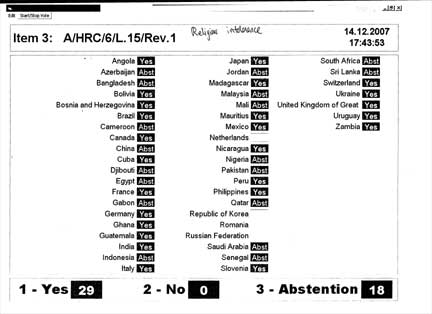
In fact, Egypt was one of the OIC nations that abstained from voting on the December 2007 resolution A/HRC/6/L.49 stating that:
“SAMEH SHOUKRY (Egypt), in an explanation of the vote before the vote, said Egypt attached great importance to the freedom of religion, and had been a traditional supporter of the resolution, while maintaining that it should be applied within the context of the tenets of Islam. Egypt had frequently during the negotiations expressed concern with regards to the text – of particular concern was the way in which it approached the mandate of the Special Rapporteur, in total disregard of the agreements reached during the institution-building process. It was not possible to continue consultations, as the European Union had circumvented the discussion with the Third Committee. Egypt had however continued to remain engaged in the process. The efforts made by some delegations to bridge gaps were acknowledged. However, it had become apparent during the later stages that some of the more important suggestions by the OIC would not be accommodated. Egypt regretted that the Council seemed to have missed a historic opportunity to comprehensively address the issue of religious intolerance, and hoped the issue would be considered in the future. Egypt would abstain from a vote on the text.”
G. Associated Articles and Reference Sources:
October 1, 2009 – ARTICLE 19: “UN Human Rights Council: Latest Version of Draft Resolution Still Compromises Freedom of Expression”
— Note Article 19 of the Universal Declaration of Human Rights states: “Everyone has the right to freedom of opinion and expression; this right includes freedom to hold opinions without interference and to seek, receive and impart information and ideas through any media and regardless of frontiers.”
September 26, 2009 – IHEU: “Freedom of Expression on trial again at the UN”
April 2, 2009 – The Economist: “The meaning of freedom”
March 26, 2009 – IHEU: “Human Rights Council Resolution ‘Combating Defamation of Religion'”
March 26, 2009 – Reuters: U.N. body adopts resolution on religious defamation
— European Union: “The European Union does not see the concept of defamation of religion as a valid one in a human rights discourse”
— “Condemnation of defamation of religion had been included in a draft declaration being prepared for an April U.N. conference on racism, known as “Durban II,” but was removed earlier this month after Western countries said it was unacceptable.”
— “India and Canada also took to the floor of the Geneva-based Council to raise objections to the OIC text. Both said the text looked too narrowly at the discrimination issue.”
— “‘It is individuals who have rights, not religions,’ Ottawa’s representative told the body. “Canada believes that to extend (the notion of) defamation beyond its proper scope would jeopardize the fundamental right to freedom of expression, which includes freedom of expression on religious subjects.”
— “A separate, EU-sponsored resolution about religious discrimination is due to be discussed by the Council on Friday.
— “Earlier this week, 180 secular, religious and media groups from around the world urged diplomats to reject the resolution which they said ‘may be used in certain countries to silence and intimidate human rights activists, religious dissenters and other independent voices’ and ultimately restrict freedoms.”
March 26, 2009 – JTA: U.N. rights council passes religious defamation resolution
March 26, 2009 – UNHRC Resolution A/HRC/10/L.2/Rev.1 — 26 March 2009
— entitled “Racism, Racial discrimination, Xenophobia, and Related Forms of Intolerance, Follow-up to and Implementation of the Durban Declaration and Programme of Action”
— “stressing the need to effectively combat defamation of all religions and incitement to religious hatred in general and against Islam and Muslims in particular”
— “Urges all States to provide, within their respective legal and constitutional systems, adequate protection against acts of hatred, discrimination, intimidation and coercion resulting from defamation of religions and incitement to religious hatred in general, and to take all possible measures to promote tolerance and respect for all religions and beliefs”
February 13, 2009 – Freedom House: “UN Sets Dangerous Precedent with Defamation of Religions Resolutions”
Blasphemy and the United Nations
February 2008 – Violent Extemism, Islamism, and the United Nations
December 2007 – UNHRC Resolution A/HRC/6/L.15/Rev.1 – stated that:
— Paragraph 4: “legal procedures pertaining to religious or belief-based groups and places of worship are not a prerequisite for the exercise of the right to manifest one’s religion or belief;”
— Paragraph 5: “Emphasizes that such procedures as described in paragraph 4 above, at the national or local levels, as and when legally required, should be non-discriminatory in order to contribute to the effective protection of the right of all persons to practise their religion or belief either individually or in community with others and in public or private;”
— Paragraph 8: “Emphasizes that promoting tolerance and acceptance by the public of and its respect for diversity and combating all forms of intolerance and of discrimination based on religion and belief are substantial elements in creating an environment conducive to the full enjoyment by all of the right to freedom of thought, conscience and religion, as enshrined in article 18 of the International Covenant on Civil and Political Rights;”
— Paragraph 9a urges States “To ensure that their constitutional and legislative systems provide adequate and effective guarantees of freedom of thought, conscience, religion and belief to all without distinction, inter alia, by the provision of effective remedies in cases where the right to freedom of thought, conscience, religion or belief, or the right to practice freely one’s religion, including the right to change one’s religion or belief, is violated”
— Paragraph 9b urges States “To design and implement policies whereby education systems promote principles of tolerance and respect for others and cultural diversity and the freedom of religion or belief;
— Paragraph 9c urges States “To ensure that appropriate measures are taken in order to adequately and effectively guarantee the freedom of religion or belief of women as well as individuals from other vulnerable groups, including persons deprived of their liberty, refugees, children, persons belonging to minorities and migrants;”