Italy: MP in court to defend herself against death ‘fatwa’ — Souad Sbai
— AKI reports: “An Italian MP and Muslim women’s rights activist was due to give evidence to a court on Thursday over death threats allegedly made against her in a ‘fatwa’ or religious edict. Souad Sbai, MP for the ruling conservative People of Freedom party, was due to attend the court in the northern Italian city of Bologna as witness.”
— “‘I am today in Bologna to defend myself against a death ‘fatwa’ issued against me, for which I had to live in fear for quite some time,’ said Sbai in an interview with Adnkronos International (AKI).”
— “Akrane H., is accused of having issued the death threat in 2007 and accused Sbai of taking advantage of immigrants for personal gain.”
— AKI reports that Akrane H. wrote in a letter to Sbai: “I call on God to act against you, in a way that he will expose you. You are a very bad woman, begin to pray to God, leave work for men. I have heard very bad things about you and you have thus been exposed as a ‘massihia’ (Christian).”
— “The claim by Akrane is an accusation of apostasy, which under Islamic law calls for the death penalty, which can be carried out by any Muslim at any time”
— Related Reports:
— April 1, 2009: Italy MP Gets Death Threats From Muslim Radicals —- “Sbai has lived in Italy for 30 years and is the head of the Association of Moroccan Women in Italy, which campaigns for women’s rights and gives legal advice to victims of abuse”
— February 4, 2009: Moderate Muslims to report polygamy in Italy: Sbai — July 15, 2008: Italy grapples with polygamy
— “‘They are kept in a kind of ghetto,’ Sbai said.”
— August 6, 2007: ‘Honor killing’ in Italy spurs quest for justice
—- “When the preliminary hearing in the ‘honor killing’ trial for the murder of 20-year-old Hina Saleem adjourned in late June, Moroccan-born Souad Sbai was on the scene.”
—- “‘We want justice for Hina and we ask that her dreams of freedom and her sacrifice should not be forgotten,’ said Sbai, president of the Rome-based Italian Association of Moroccan Women.”
Saudi Arabia: Police arrest ‘homosexuals’ at party
— 71 arrested in Riyadh according to al-Quds al-Arabi report
— “Several residents are reported to have notified police about people who were doing things that did ‘not conform’ with Islamic sharia law.”
— homosexuality “treated as serious crimes”
— Saudi Arabia “insists that it always acts in accordance with Sunni Islamic law”
— Filipino men detained in KSA for gay behavior
— “when the government feels that homosexuals are challenging state authority, the maximum punishment for the act is public execution”
— “Normally, however, the authorities impose other punishments such as fines, imprisonment, and whipping”
Gender Imbalance in Human Trafficking
— Introduction, page 36 (hard copy), page 38 (electronic)
“The root causes of migration and trafficking greatly overlap. The lack of rights afforded to women serves as the primary causative factor at the root of both women’s migrations and trafficking in women…By failure to protect and promote women’s civil, political, economic and social rights, governments create situations in which trafficking flourishes.”
— Radhika Coomaraswamy, UN Special Rapporteur on Violence Against Women
———————————————————————
“According to the ILO, the majority of people trafficked for sexual exploitation or subjected to forced labor are female.”
“According to researchers, both the supply and demand sides of the trade in human beings are fed by ‘gendered’ vulnerabilities to trafficking. These vulnerabilities are the result of political, economic, and development processes that may leave some women socially and economically dependent on men. If that support from men becomes limited or withdrawn, women become dangerously susceptible to abuse. They often have no individual protection or recognition under the law, inadequate access to healthcare and education, poor employment prospects, little opportunity to own property, or high levels of social isolation. All this makes some women easy targets for harassment, violence, and human trafficking.”
“Research links the disproportionate demand for female trafficking victims to the growth of certain ‘feminized’ economic sectors (commercial sex, the ‘bride trade,’ domestic service) and other sectors characterized by low wages, hazardous conditions, and an absence of collective bargaining mechanisms. Exploitative employers prefer to use trafficked women — traditionally seen as submissive, cheap, and pliable — for simple and repetitive tasks in agriculture, food processing, labor-intensive manufacturing, and domestic servitude.”
“In countries where women’s economic status has improved, significantly fewer local women participate in commercial sex. Traffickers bring in more female victims to address the demand and also take advantage of women who migrate voluntarily to work in any industry. As commercial sex is illegal in most countries, traffickers use the resulting illegal status of migrant women that have been trafficked into commercial sex to threaten or coerce them against leaving. Gendered vulnerabilities fostered by social and institutional weaknesses in some societies — discriminatory laws and practices that tie a woman’s legal recognition, property rights, and economic opportunities to someone else — make women more likely than men to become trafficking victims. A woman who exists only through a male guardian who controls her income, identification, citizenship, and physical well-being is more susceptible to becoming a trafficking victim.”
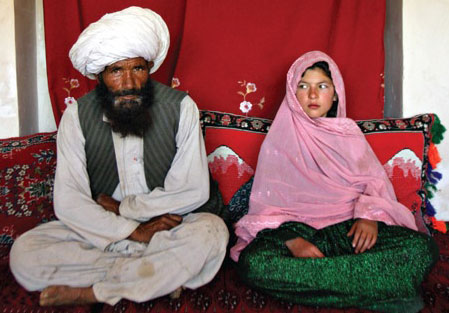
Image from State Dept 2009 Human Trafficking Report, section "Gender Imbalance in Human Trafficking"
“The ninth annual Trafficking in Persons Report sheds light on the faces of modern-day slavery and on new facets of this global problem. The human trafficking phenomenon affects virtually every country, including the United States. In acknowledging America’s own struggle with modern-day slavery and slavery-related practices, we offer partnership. We call on every government to join us in working to build consensus and leverage resources to eliminate all forms of human trafficking.”
–Secretary Clinton, June 16, 2009
Iran Human Rights Documentation Center — “As numerous examples have illustrated, the removal of an authoritarian regime does not necessarily lead to an improved human rights situation if institutions and civil society are weak, or if a culture of human rights and democratic governance has not been cultivated.”
(UK) Father fails in fight to change unlawful killing verdict
— Shafilea Ahmed
— “A few months earlier, she had refused an arranged marriage, and, during a visit to Pakistan to meet
a prospective husband, had drunk bleach and spent five weeks in hospital.”
— “After her death, police initially worked on the theory that she had been the victim of an honour killing
and arrested and questioned her parents, Iftikhar and Farzana Ahmed, on suspicion of kidnapping”
— “But a Crown Prosecution Service investigation found there was no chance of anyone being convicted
on the evidence available”