The 2009 report by the World Economic Forum has listed predominantly Islamic nations in the bottom of their 2009 annual Global Gender Gap (GGG) Index. This included such major nations as Pakistan (ranked 132 out of 134), Saudi Arabia (ranked 130 out of 134), Iran (ranked 128 out of 134), Egypt (ranked 126 out of 134), and Turkey (ranked 129 out 134). Yemen, which is 99 percent Islamic, was the bottom ranked nation as 134 on the Global Gender Gap Index. The only nation not predominantly Islamic in the bottom of the Global Gender Gap index was Benin.
(NOTE: In “Updated Later Reports” below, R.E.A.L. has provided links to reports in later years for comparison purposes by other researchers.)
In addition, the 2009 World Economic Forum Global Gender Gap Index report does not include rankings on a number of significant and predominantly Islamic nations where women are oppressed. Somalia (population of nearly 10 million) was not included in the index. Endless numbers of reports of the stonings and extremist abusesof womenhave been reported in Somalia in the past year, including the stoning to death of a 13 year old girl based on “Sharia law” in October 2008. Sudan (population of nearly 41 million) was also not included in the World Economic Forum Global Gender Gap Index. Among other nations, Afghanistan (29 million) and Iraq (29 million) are also not included in this Global Gender Gap Index. With the index not reporting on these 109 million, the desperate fate of an estimated 50 plus million women are not included in this Global Gender Gap index report.
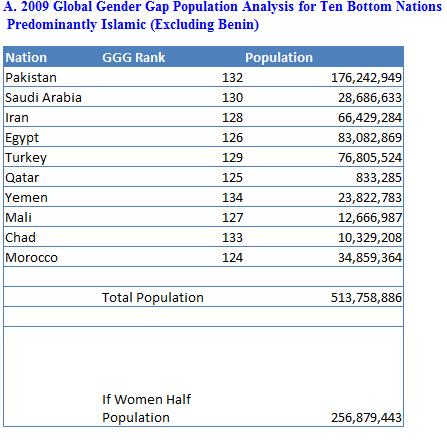
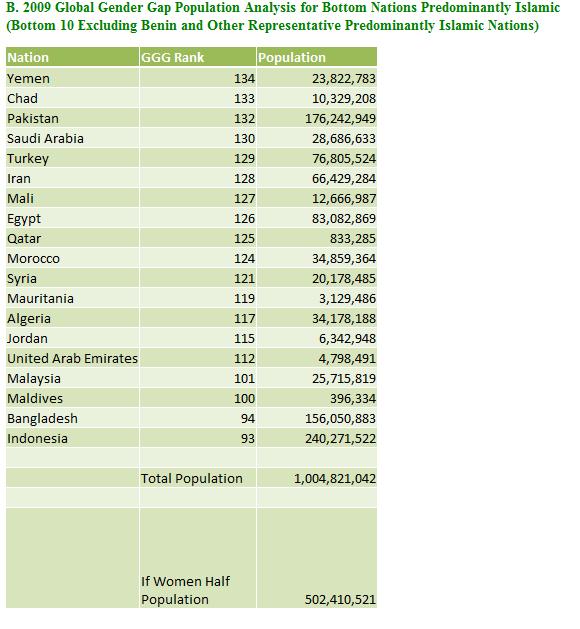
Even with these significant exclusions from the Global Gender Gap index report, the bottom 10 index nations (excluding Benin), which are all predominantly Islamic nations, represent a population of over half a billion individuals. These include Yemen (134 out of 134), Chad (133), Pakistan (132), Saudi Arabia (130), Turkey (129), Iran (128), Mali (127), Egypt (126), Qatar (125), Morocco (124). If women represent half of the population in these nations, then these bottom 10 predominantly Islamic nations demonstrate the ongoing oppression of an estimated 250 million women.
In March 2009, IPS interviewed WEF’s Global Gender Gap (GGG) co-author Saadia Zahidi about the findings of these gender gap reports. In the IPS interview, the reporter asked Saadia Zahidi why wealthy nations such as Saudi Arabia and other Gulf states were not among the nations at the higher end of the gender gap index, quoting a previous GGG report that stated “rich countries have more education and health opportunities for all members of society.” In the IPS interview, Saadia Zahidi replied: “We don’t have an explanation for this. Some people, when they look at how we have broken this up, say it is so because of Islam. But I am not sure we can say that. With the lowest scores we see different countries with different incomes, religions and cultures. In the middle of the list, you have Indonesia (93), which is doing much better than Saudi Arabia (128), for example.”
In the March 2009 interview, Saadia Zahidi was referencing the 2008 report standings, as in 2009, Saudi Arabia is now ranked at 130 out of 134; Indonesia remains ranked at 93 out of 134, which WEF’s Saadia Zahidi views as the “middle of the list.”
The Global Gender Gap report makes no reference as to how the impact of extremist behavior and ideologies regarding women and equality in such nations have any role in such gender gaps.
The June 2009 U.S. State Department report on global human trafficking also shows a number of the nations in the bottom of the Global Gender Gap (GGG) index as nations with the worst records on human trafficking as well. (Note – a number of poorly ranked nations on human trafficking, such as Sudan, Afghanistan, Iraq, are simply not referenced in the GGG index.) The State Department report states that “According to the ILO, the majority of people trafficked for sexual exploitation or subjected to forced labor are female.”
Tier 3 Nations on Human Trafficking also in the bottom of the Global Gender Gap Index include:
– Saudi Arabia — GGG rank 130 out of 134
– Iran — GGG rank 128 out of 134
– Syria — GGG rank 121 out of 134
– Malaysia — GGG rank 101 out of 134
– Mauritania — GGG rank 119 out of 134
Tier 2 Watch List Nations on Human Trafficking also in the bottom of the Global Gender Gap Index include:
– Pakistan — GGG rank 132 out of 134
– Algeria — GGG rank 117 out of 134
– Yemen — GGG rank 134 out of 134
– United Arab Emirates — GGG rank 112 out of 134
– Egypt — GGG rank 126 out of 134
Tier 2 Nations on Human Trafficking also in the bottom of the Global Gender Gap Index include:
– Jordan — GGG rank 115 out of 134
– Turkey — GGG rank 129 out of 134
Image from State Dept 2009 Human Trafficking Report, section “Gender Imbalance in Human Trafficking”
Press Coverage on Global Gender Gap Report:
The Associated Press has reported on this survey that: “At the bottom of the list were Qatar, Egypt, Mali, Iran, Turkey, Saudi Arabia, Benin, Pakistan, Chad and Yemen in last place with a score of 46.1 per cent.” The AP report also quoted the World Economic Forum’s founder and executive chairman, Klaus Schwab, who stated: “Girls and women make up one half of the world’s population, and without their engagement, empowerment and contribution, we cannot hope to achieve a rapid economic recovery nor effectively tackle global challenges such as climate change, food security and conflict.”
— Links to Key Gender Gap Country Profiles and Highlights
— 1. Gender Gap 2009 Report on Pakistan – Ranked 132 out of 134 Countries
— Pakistan – Islamic Republic, 96 percent Islamic
— Pakistan Population Estimate: 176,242,949
— 2. Gender Gap 2009 Report on Saudi Arabia – Ranked 130 out of 134 Countries
— Saudi Arabia – Islamic Absolute Monarchy, 97 percent Islamic
— Saudi Arabia Population Estimate: 28,686,633
— 3. Gender Gap 2009 Report on Iran – Ranked 128 out of 134 Countries
— Iran – Islamic Republic, 98 percent Islamic
— Iran Population Estimate: 66,429,284
— 4. Gender Gap 2009 Report on Egypt – Ranked 126 out of 134 Countries
— Egypt – 80 to 90 percent Islamic
— Egypt Population Estimate: 83,082,869
— 5. Gender Gap 2009 Report on Turkey – Ranked 129 out of 134 Countries
— Turkey – “the CIA World factbook states that 99.8% of Turkey’s population are nominally Muslims”
— Turkey Population Estimate: 76,805,524
— 6. Gender Gap 2009 Report on Qatar – Ranked 125 out of 134 Countries
— Qatar – 77 percent Islamic
— Qatar Population Estimate: 833,285
— 7. Gender Gap 2009 Report on Yemen – Ranked 134 out of 134 Countries
— Yemen – 99 percent Islamic
— Yemen Population Estimate: 23,822,783
— 8. Gender Gap 2009 Report on Mali – Ranked 127 out of 134 Countries
— Mali – 90 percent Islamic
— Mali Population Estimate: 12,666,987
— 9. Gender Gap 2009 Report on Chad – Ranked 133 out of 134 Countries
— Chad – 54 percent Islamic
— Chad Population Estimate: 10,329,208
— 10. Gender Gap 2009 Report on Morocco – Ranked 124 out of 134 Countries
— Morocco – 98.7 percent Islamic
— Morocco Population Estimate: 34,859,364
— 11. Gender Gap 2009 Report on Benin – Ranked 131 out of 134 Countries
— Benin – Predominantly Christian, 24 percent Islamic
— Benin Population Estimate: 8,791,832
— Other Nations of Concern that are predominantly Islamic: — Syria – ranked 121 — population 20,178,485
— Mauritania – ranked 119 – population 3,129,486
— Algeria – ranked 117 — population 34,178,188
— Jordan – ranked 115 — population 6,342,948
— United Arab Emirates – ranked 112 – population 4,798,491
— Malaysia – ranked 101 — population 25,715,819
— Maldives – ranked 100 — population 396,334
— Bangladesh – ranked 94 — population 156,050,883
— Indonesia – ranked 93 — population 240,271,522
— Jakarata Post reports “Women banned from wearing trousers”:
— “Women wearing jeans and other trousers in West Aceh will now face sharia police, as will clothes vendors selling slacks for women.”
— “West Aceh Regent Ramli M.S. issued the controversial regulation on Tuesday.”
— “Those found wearing tight trousers, such as jeans, will have them cut by sharia police, and will be forced to wear loose-fitting attire.”
— “‘We have issued the regulation to further enforce Islamic sharia granted by the central government,’ Ramli told The Jakarta Post by phone on Tuesday.”
— “To anticipate the huge number of slacks to be cut by police during raids, the West Aceh regency administration has prepared around 7,000 long skirts, which will be provided for free to those caught wearing trousers.”
— “According to Ramli, the new regulation will be effective as of Jan. 1, 2010.”
— “The regulation also prohibits clothes vendors in the regency from selling slacks or jeans to women.”
— “To implement the regulation, the West Aceh administration will issue an order for sharia police to conduct raids and patrols in every district in the regency.”
— “Three masked members of a militant Islamist group in Somalia last week shot and killed a Somali Christian who declined to wear a veil as prescribed by Muslim custom, according to a Christian source in Somalia.”
— “Members of the comparatively ‘moderate’ Suna Waljameca group killed Amina Muse Ali, 45, on Oct. 19 at 9:30 p.m. in her home in Galkayo, in Somalia’s autonomous Puntland region, said the source who requested anonymity for security reasons.”
— “Ali had told Christian leaders that she had received several threats from members of Suna Waljameca for not wearing a veil, symbolic of adherence to Islam. She had said members of the group had long monitored her movements because they suspected she was a Christian.”
— “The source said Ali had called him on Oct. 4 saying, ‘My life is in danger. I am warned of dire consequences if I continue to live without putting on the veil. I need prayers from the fellowship.'”
— “‘I was shocked beyond words when I received the news that she had been shot dead,” the source in Somalia told Compass by telephone. ‘I wished I could have recalled her to my location. We have lost a long-serving Christian.'”
— “Ali had come to Galkayo from Jilib, 90 kilometers (56 miles) from Kismayo, in 2007. She arrived in Puntland at the invitation of a close friend, Saynab Warsame of the Darod clan, when the extremist group al Shabaab invaded Kismayo, the source said. Warsame was born in Kismayo and had lived in Jilib but moved to Puntland when war broke out in 1991.”