The needs and demands of powerful or the many cannot outweigh the rights and dignity of the individual. This respect for each human being is the soul of our universal values on human rights.
The Universal Declaration of Human Rights was created 70 years ago on December 10, 1948, so that in no part of world, no nation (totalitarian or democratic), the demands of the many would deny the Human Rights and Dignity of the Individual. We struggle for universal human rights for ALL – not only as a collective human race, but also every individual with inviolable human rights and dignity.
It is often forgotten why the nations of the world banded together in a United Nations (created in October 1945, a month after the end of World War II. Nations of conscience joined to develop this Universal Declaration of Human Rights (UDHR). It was December 10, 1948, three years after the horrors of World War II, including the Holocaust, and the world had jointly rejected the “disregard and contempt for human rights have resulted in barbarous acts which have outraged the conscience of mankind.” The horrors against humanity of total war, persecution, and genocide had convinced enough world leaders that it was time to say “enough” to such abominations against our fellow human beings. They had not only seen the worst of human violence, but they also had seen the most ignominus of persecution of individuals for who they were as human beings.
The importance of rejecting such “barbarous acts” in universal human rights is based on a foundational ideal of dignity and mercy. Article 1 of the Universal Declaration of Human Rights states: “All human beings are born free and equal in dignity and rights. They are endowed with reason and conscience and should act towards one another in a spirit of brotherhood.” We begin with a universal declaration of the dignity of humanity and a call for merciful spirit of brotherhood. World nations decided that human rights began with a commitment to humanity.
In the preamble to the UDHR, the world leaders recognized that “the inherent dignity and of the equal and inalienable rights of all members of the human family is the foundation of freedom, justice and peace in the world.” Note who they are referencing in this preamble – not simply citizens, not simply individuals, but “members of the human family.” Human rights begins with a commitment to the dignity of OUR family of human beings.
This is very important distinction from previous human rights documents, such as the British Magna Carta, the French La Déclaration des droits de l’Homme et du citoyen, and the U.S. Bill of Rights, all of which played historical (and in some cases controversial) roles in documenting the concepts of equality and human rights.
But by 1948, the “barbarous acts” of the past had so shaken leaders of the nations of the world, that they needed more than a litany of documented natural rights. They needed to begin with taking a stand on the dignity of the human being – both collectively and individually – and the need for merciful “brotherhood” shown to him – not because of the person’s nationality, citizenship, gender, religion, or other identity group – but for “ALL human beings.” This makes the UDHR historically different than other previous natural rights documents. It introduces the concept of human rights and dignity for every human being, simply because they ARE another fellow human being.
The concept of such universal codification of the global priority of dignity and mercy cannot be overstated. It is a recognition that law, codes, organizations, structures, political systems – all are meaningless, if they cannot respect such dignity and mercy for our fellow human beings – both collectively and (more importantly) individually.
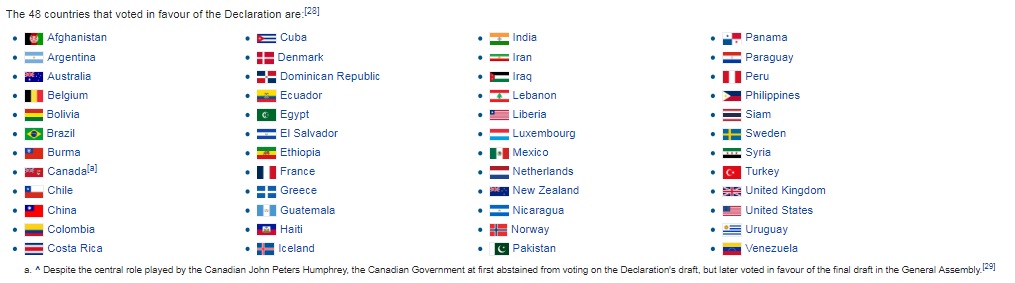
Of the 56 nations at that time in the United Nations (there are now 193), 48 of them voted in support of the UDHR. Notable abstentions among the 8 nations that did not support the UDHR included the Union of Soviet Socialist Republic (USSR) Communist nations of that time and Saudi Arabia.
The UDHR’s stand on the dignity and freedom of the individual human being to be unique and different, rather than only an element of a collective nation, set of nations, political ideology, or other group, is a marked and remarkable distinction of the UDHR in the history of humanity.
The foundational concept conveyed by the UDHR is, in essence, I have human rights and dignity because I am an individual Human Being. In an increasingly complex and challenging 21st century, we cannot lose sight of this essential concept in considering human rights and ethics for the future.
It was a statement which would be more concisely stated in the signs of those in the 1960s protests against white supremacy persecution in the United States of America, carrying a sign “I am a Man.” We see such similar statements by women in America and around the world, seeking the realization of the Universal Declaration of Human Rights, not only as goals and values, but also as part of daily lives for all.
The UDHR’s concept of the universal rights and dignity of the individual as a human being, without qualification, is different than other collectivist-based human rights agreements, such as the August 1990 Cairo Declaration on Human Rights in Islam (which as it states, is a human rights view based on this religion), and the 1975 Helsinki Accords or “Declaration on Principles Guiding Relations between Participating States,” refers to such “inherent dignity” as (ironically) something that must be promoted and encouraged “by participating States.”
The concept that an ideology, a belief structure, or a nation state is giving us, as human beings, dignity and human rights is NOT what we accept. We have been there before as a human race. We have seen how nations choosing to give collectivist human rights and dignity to only people of chosen belief sets, races, or identity groups, have led to the very “barbarous acts,” which drove world nations to create this Universal Declaration of Human Rights. It is, by definition, Universal. The UDHR is both a compass and a warning for generations in the future to choose the path of “Never Again” to massive persecution, not just for some, but for all of our “members of the human family.”
While this UDHR was legally formed into an international treaty as the International Covenant on Civil and Political Rights (ICCPR), the ICCPR also shares its commitment to a “human family” and our shared “inherent dignity and of the equal and inalienable rights of all members of the human family.” Like the UDHR, the ICCPR recognizes that “these rights derive from the inherent dignity of the human person,” not simply as some collective body, but as individual human beings. Similar to the UDHR, Article 10 of the ICCPR also calls for “respect for the inherent dignity of the human person.”
In addressing the future of world progress and world events, we must continue to use this Universal Declaration of Human Rights to guide us in fulfilling what the great human rights leader, Dr. Martin Luther King, Jr., might have called the “promissory note” of equality and dignity to all. If we believe in Universal Human Rights based on dignity and mercy, we must respect that “human family” regardless of their gender, age, race, or other identity group.
In U.S.A. and around the world, we continue to see movements to try to ensure that such values of dignity and mercy are used to truly respect freedom and equality for all. We must not forget that slightly less than 100 years ago, in the U.S., women did not have the right to vote. While black Americans were given the legal right to vote in 1870, it took another nearly another century for the Voting Rights of 1965 to be passed, to consistently ensure federal law enforcement of this right. If our human rights are based on mercy, then we must also accept humility in judging where others are on the path to make changes. We cannot seek change for others, while we are failing to change ourselves. Our greatest progress is achieved when we recognize this change is not for “others,” but for our shared “human family.”
In the People’s Republic of China (PRC), the Chinese Communist Party (CCP), which has had such horrific persecution of human beings for so long, has now made an official statement rejecting such universal human rights. While the UDHR was voted by the Republic of China in 1948 (before the Chinese Communist Party coup in 1949), the PRC did agree to the ICCPR in October 1998. Despite this agreement to the ICCPR, the Communist regime has continued to persecute democracy and human rights advocates, persecute religious and ethnic minorities, and violate the principles and concepts of the human rights and dignity in the ICCPR.
To ensure the world had no doubt about its intentions, the PRC Communist regime specifically told the United Nations in November 2018 that it was rejecting a “universal road to human rights.” In its November 2018 submission to the Universal Periodic Review (UPR), the Communist regime stated that “There is no universal road for the development of human rights in the world…” and it would only consider “human rights with Chinese characteristics”… “guided by Xi Jinping Thought on Socialism with Chinese Characteristics for a New Era.”
In China, we have seen the result of consciously abandoning the path of universal human rights, and abandoning mercy and dignity for the individual. We have seen the mass waves of persecution of Tibet Buddhists, destruction of their temples, the roundup and arrests of Uighur Muslims put in massive concentration camps, the arrest, torture, murder, and mutilation of Falun Gong (including horrific organ removals of political prisoners), and the destruction of Christian minority churches, arrest, beating, and imprisonment of people of Christian minority faith. In the PRC on Human Rights Day 2018, as this is being written, 100 Christian minorities are being arrested for their faith. The goal of the Communist regime to wage a war “against the soul,” however, ultimately is a losing battle, as the USSR and other Communist totalitarian regimes ultimately learn. As much as the Communist regime seeks to watch and control everything its Chinese citizens do and think, the human soul will find a way for freedom.
The anti-human rights war “against the soul” of members of the human family has also been waged in Pakistan against religious minorities. While also signatories to the UDHR and ICCPR, Pakistan has chosen to institutionalize legal persecution against religious minorities human rights and dignity. Among the most graphic examples of this has been the imprisonment of over 9 years of Christian minority woman Asia Bibi, who was imprisoned on false charges of blasphemy, due to argument over her drinking from the same water cup of those of the majority religion. Even when Asia Bibi was found not guilty by the Pakistan Supreme Court, extremist marched in the street calling for her to be murdered, the Taliban terror group called for attacks on her, and she and her family have been living in seclusion while terrorist have sought her. The blasphemy law in Pakistan is regularly used as an institutional method to persecute minorities who face institutional, social, and economic persecution.
In Pakistan, religious minority Ahmadi are also regularly and instituationally persecuted by the Pakistan government, which refuses to accept their faith as “Islamic;” other human beings of minority faiths, Shia Islam, Hindu, etc., are also regularly targeted for persecution, kidnapping, violence, murder, and terrorist attacks by extremists. Such religious minorities are often sought to be used for lowest paid employment and are frequently threatened by religious extremists of the majority faith. This has led to a number of Christian minorities fleeing the nation and seeking asylum from their persecution in Pakistan. But there, once again, such efforts to seek safe haven as refugees are regularly withheld, and only the smallest margin have thus far been successful in fleeing such persecution.
Consider that just the Communist regime China (1.4 billion human beings) and Pakistan (200 million human beings) alone represent 20% of the world’s population. If major nations, such as Communist regime China and Pakistan can normalize and accept a “war against the soul,” then a war against what it means to be a human being by technology extremists is a predictable expansion. If we agree that human rights is based on humanity, our modern struggle for human rights is not only for codes or values of rights, but more fundamentally on what it actually means to be a human being.
As we continue to work to improve human rights and dignity through mercy and equality, and defend human rights based on humanity, there are others who seek to also redefine what it means to be a human being. The concept of technology innovation is to develop tools to help human beings. This led to tools such as what is known as “artificial intelligence” to be used in machines to aid human being in making complex decisions on navigation and other multi-faceted functions. In his 1976 book “Computer Power and Human Reason” (Chapter 10, page 269), the “father” of such “artificial intelligence” (AI), MIT Professor Joseph Weizenbaum warned against abuse of such AI technology. Professor Weizenbaum warned that the concept of “an animal’s visual system and brain be coupled to computers… represents an attack on life itself. One must wonder what must have happened to the propsers’ perception of life, hence to their perceptions of themselves as part of the continuum of life, that they can even think of such a thing, let alone advocate it.” The professor continued to warn that “I would put all projects that propose to substitute a computer system for a human function that involves interpersonal respect, understanding, and love in the same category.”
But in 2018, while we see a war “against the soul” against our fellow human beings in much of the world, we also see a struggle over the very definition of what a human being is. Most troubling, there is not onlya common and consistent set of technology ethics used in such technology research, there is a very limited knowledge or even outright rejection of our shared Universal Declaration of Human Rights among some researchers. Many come from backgrounds that either support collectivist views of human rights, rather than the human rights of the individuals, or have views on mercy and dignity based on digital values rather than human values. A frequent pattern among many, based on R.E.A.L.’s research, has been a trend of “Marxist” collectivist views on “human rights,” which reject the value of the individual’s human rights and dignity as an individual human being. Once again, we see the critical nature of defining human rights for each and every individual as core to our univeral human rights.
Despite the warnings by Professor Joseph Weizenbaum, the very concept of such coupling of brains to computers is advocated by the CEO of one of the largest computer companies in the world, Microsoft’s CEO Satya Nadella, and he has been recently praising such brain reseach by Microsoft, who previously sought a patent for a system that could take action based on brain input. Neuralink has been seeking an objective of implanting tiny electronic devices into the brains of healthy humans within a decade, with such computer-human brain interfacing promoted by Tesla founder Elon Musk. Facebook’s Regina Dugan is part of a reported team of 60 engineers looking to control your computer from your brain. We must find a path of mercy to guide such technology innovation to respect the integrity of human beings.
This concept of seeking to redefine what a human being is through technology, known as “transhumanism,” is also leading to changes in calls for basic universal human rights. Dr. Jason Kuznicki published a book “Technology and the End of Authority,” which believes there can be a future rejection of murder as a crime. Life is a foundational part of the Universal Declaration of Human Right, as defined in Article 3. But to Dr. Kuznicki, human life may become a relative consideration, and we “might consider revisiting the prohibiton on murder, if, for example, futuristic technology made it possible to generate moment-to-moment backups of a person’s complete mental and biological state, and to regenerate them therefrom at trivial cost. Such technology could at least arguably falsify the statement ‘All human beings should be forbidden from murder.'” We must urge a call for change from this path.
With technology advocates supporting a redefinition of the “human being,” even biological experimentation is now ongoing among Communist regime China and America researchers in China laboratories, to alter the very DNA of human beings through what is called “gene editing.” The Communist regime state media Global Times has been actively promoting that the majority of its population support such “gene editing.” To what end, will the totalitarian Communist China regime seek to alter the very DNA of human beings, to “improve” human beings to meet the goals of a regime that denies the existence of universal human rights? As the world wonders, one Chinese scientist, He Jiankui, has already claimed to have edited the human genes of two live baby girls who have been born.
The world has previously faced and challenged the concept of political totalitarianism. But as we continue to struggle with that challenge of the 20th century, the new issue of technology totalitarianism may soon be upon us. Already we see large techology companies using ubiquitous techology tools to monitor our behavior, listen to our words, and track our movements. The creators of the Universal Declaration of Human Rights did not consider a humanity, where a large segment was being continously monitored, and is in Communist regime China, their every word and action monitored for a “social media score” to determine whether the public had the right to its freedoms. We see new technology changes by the totalitarian Communist China regime and many other parts of the world to include ubiquitous surveillance cameras, rejecting our Universal Human Rights of privacy. We see new technology changes with facial recognition tools being increasingly used around the world to track what we do, what we say, and where we are. In the Communist China regime, we also see a growing pattern of other devices to monitor human thoughts, including devices built into the hats of officials to measure their emotional state. The new age of technology totalitarianism is nearly upon the world.
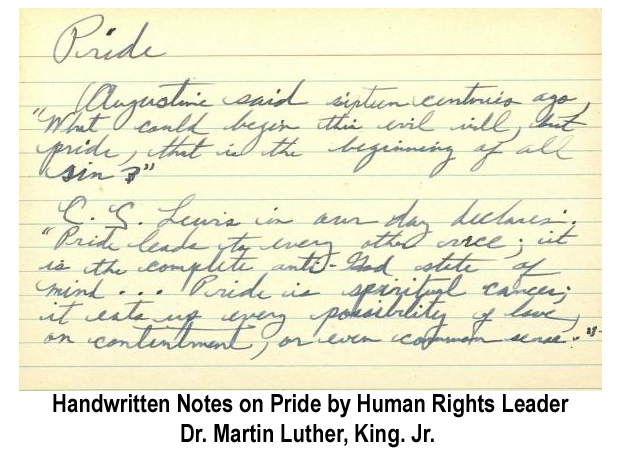
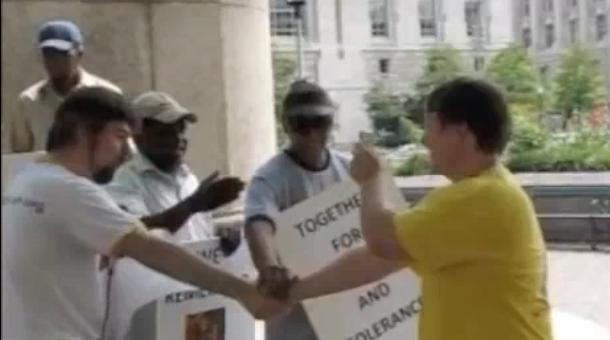
But our answer to the problems of all those who seek persecution, by extremism, by state force, or by technology force, remains the same: we must continue to use respect and mercy of the dignity of individual members of our “human family.” In a world that questions our human rights and humanity, we can continue to seek change with an outstretched hand, not an upraised fist. As the great American human rights activist Dr. Martin Luther King stated: “Hate is too great a burden to bear.” “I’m not going to let my oppressor dictate to me what method I must use… our oppressors used hate… I’m not going to stoop down to their level.” Even those who seek to deny others human rights are part of our shared human family. We can and will reach hearts through a fearless commitment to mercy and dignity. Let us find the courage to find the mercy in our hearts to be Responsible for Equality and Liberty for all.