Pakistan Surrenders to Extremist Demands; TLY Calls for Release of Terror Figure in U.S.

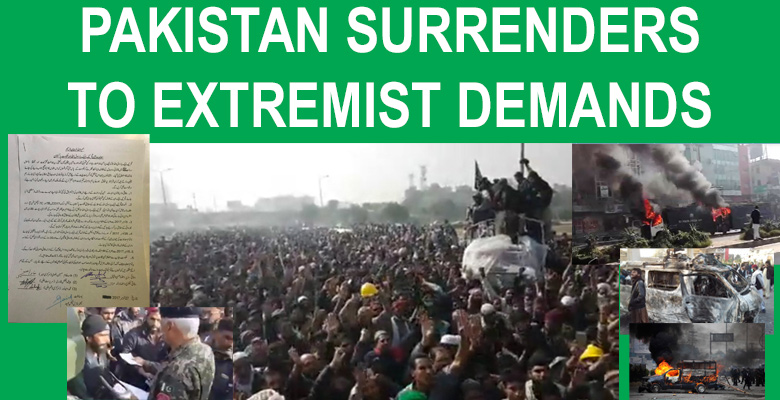
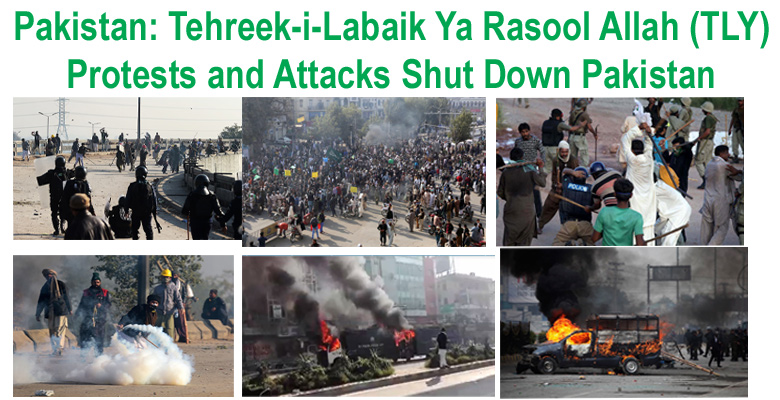
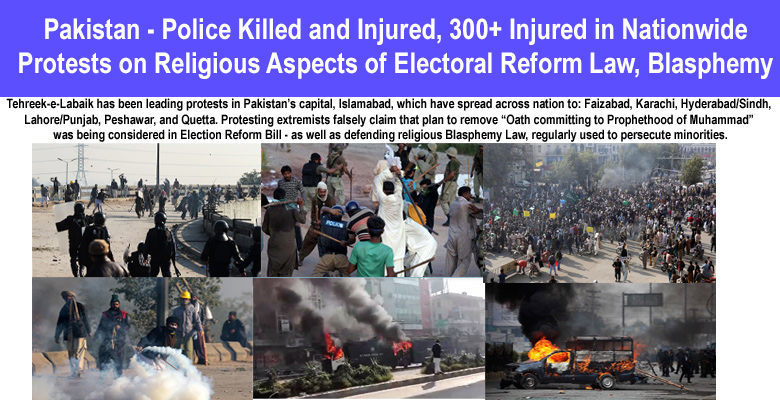
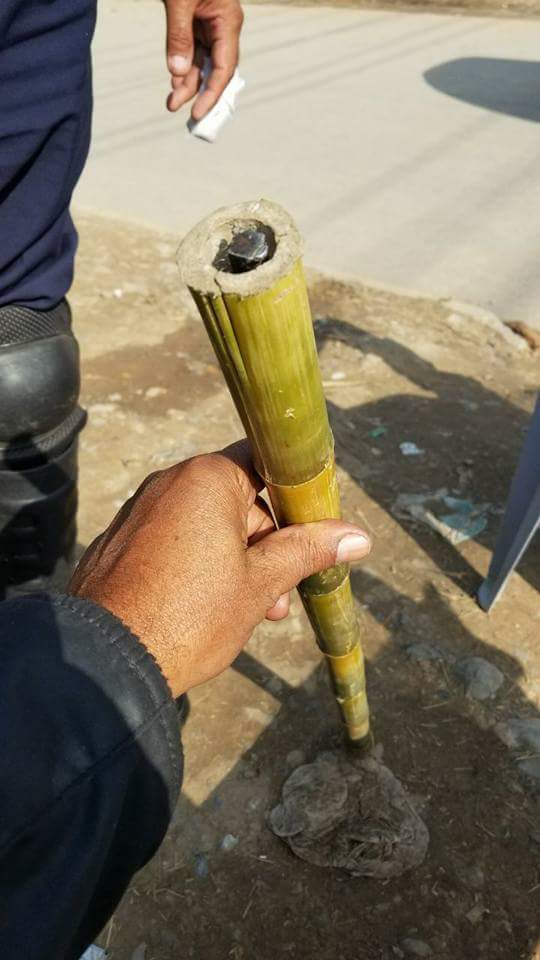
On November 27, 2017, the Pakistan Government surrendered to the demands of the Tehreek-i-Labaik Ya Rasool Allah (TLY)* religious political party and its supporters that had been allowed to paralyze streets in the Pakistan national capital of Islamabad and across the country. Violent protests led to the death of at least one police officer, 60 police injured, 45 Frontier Constabulary (FC) injured, 8 protesters killed, and 300 protesters injured. Four police vehicles were attacked, and at least one set on fire, and protesters created fires in the streets to create chaoas. Armed protesters beat Pakistan police with rocks, tear gas, slingshots, and metal rods hidden inside bamboo canes. Protesters damaged buses, cut down trees to block roads, and also attacked news media vehicles and set a Samaa television broadcasting van on fire. Pakistan police attempted to arrest and detain some of the protesters, reportedly detaining 150 protesters according to Dawn News. Attempts by police to stop protesters in disrupting law and order, by using tear gas, failed to do “unfavorable winds.”

On November 25 and 26, 2017, the TLY was joined by supporters of two other religious political parties: Tehreek-e-Khatm-e-Nabuwwat, and the Sunni Tehreek Pakistan. The protests, which started for three weeks in Islambad and Faizabad Inter-Change, spread to: Quetta, Karachi, Hyderbath/Singh, Sukkur, Umerkot, Mithi, Sujawal, Lahore/Punjab, Faisalbad, Gujranwala, Multan, Nakana Sahib, Mianwali, Gujrat, Sahiwal, Vehari, Toba Tek Singh, Murree, Peshawar, Khyber Pakhtunkhwa, Haripur, Mansehra, Dera Ismail Khan, Multan, Natha Khan Chowk, Sialkot, Sheikhupura. The protest crowd in the Pakistan capital Islamabad area alone grew (according to reports) from 1,000 to over 5,000.

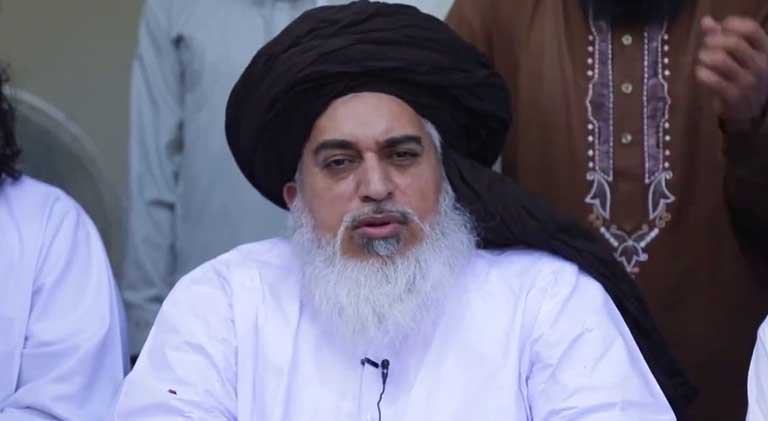
The protests were organized by TLY leader Khadim Hussain Rizvi, who used social media to help reach across Pakistan to spark religious protests.

Tehreek-i-Labaik Ya Rasool Allah (TLY) Leader Khadim Hussain Rizvi – Used Social Media to Organize Protests to Shut Down Pakistan Cities

Efforts by the Pakistan government to shut down social media outlets were stymied by use of VPN technology around Internet sites, and effort by the Pakistan government to temporarily shut down news media only led to public fear and anxiety.

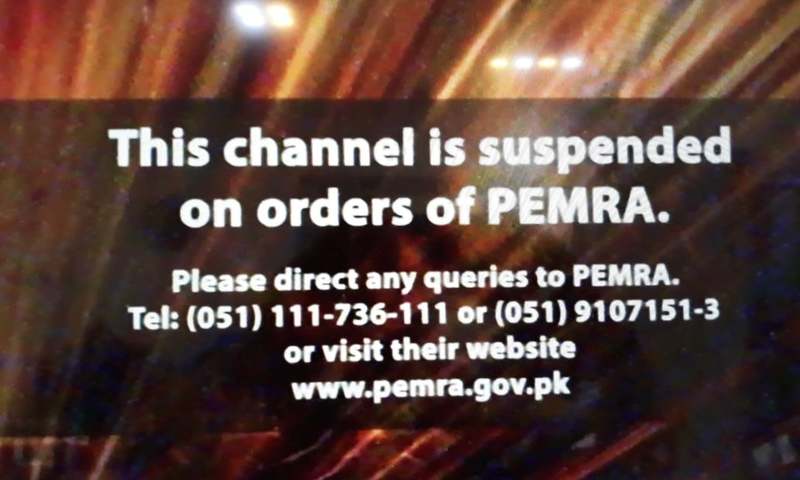
Pakistan Television Channels Were Shut Down by Pakistan Electronic Media Regulatory Authority (PEMRA)

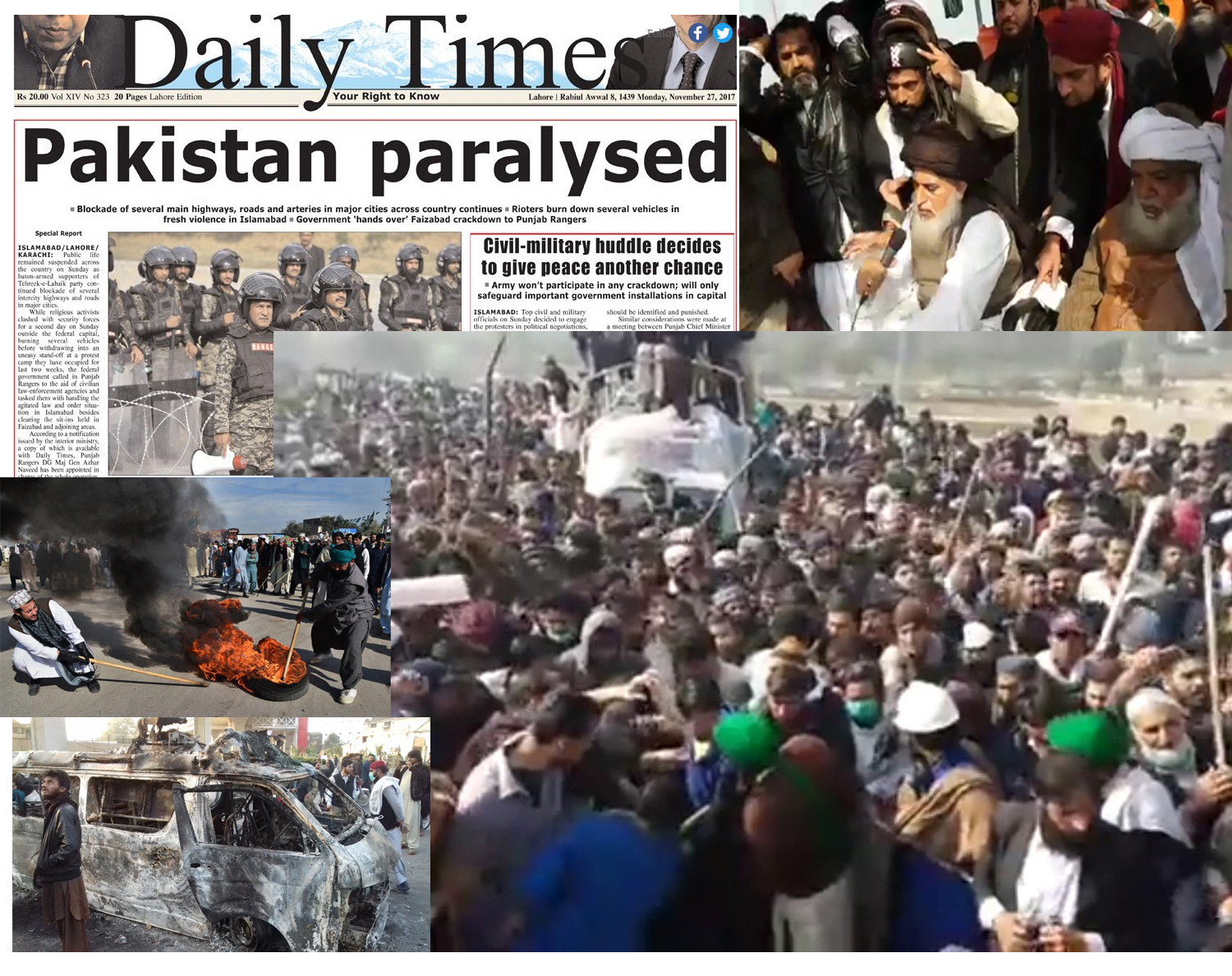
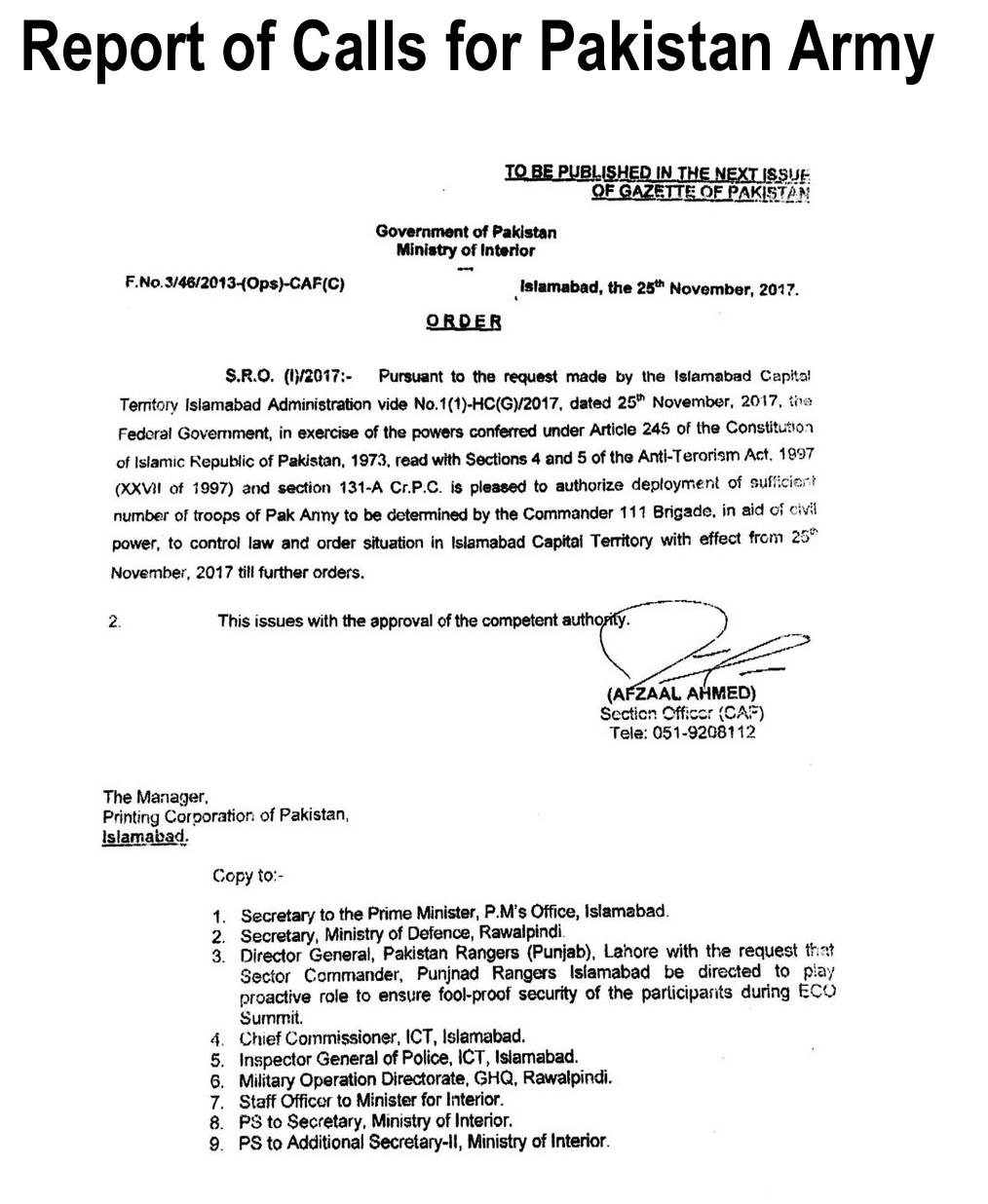
Despite efforts by the Pakistan Police, the ability to maintain law and order during the protest was lost, and the Pakistan Army was called in to protect Islamabad to “secure main offices of the judiciary, Parliament House, Presidency and Prime Minister Houses, foreign missions, foreign office and other important installations,” according to Dawn News. However, the Pakistan Army made it clear that it did not consider its mission to address the ongoing national security issue created by the extremist protests.  As the Pakistan Daily Times reports, “it was clear that the Army was not willing to face the protestors.”   The level of public disruption that was allowed by the failure and/or fear of government leaders to challenge such protesters seeking to disrupt law and order in Pakistan, should not only trouble the Pakistani public, but also trouble allies to the Pakistan nuclear armed nation.

The TLY and its partner religious political group’s protests claimed that the Electoral Reform Bill of 2017 was offensive to their political view of Islam. The Pakistan Electoral Reform Bill of 2017 was intended to integrate 8 existing laws and streamline processes, but the TLY and religious parties felt that it did not have sufficient wording about potential political candidates’ “Oath committing to Prophethood of Muhammad.” The Federal Law Minister Zahid Ahmid stated that this oath was included, as part of the Pakistan government electoral basis to require political candidates to consent to the “finality of Prophethood” of Muhammad (Khatam an-Nabiyyin). But the explanations were not satisifactory to the TLY extremists, who argued that one word in the bill was reading “declaration” instead of “oath.” TLY extremists not only sought the resignation of Federal Law Minister Zahid Hamid, but also hundreds of TLY protesters in Islamabad were accusing Zahid Hamid of “blasphemy.”

TLY extremists also alleged that Pakistan government officials were being weak on enforcing the Pakistan “Blasphemy Law” (Section 295 C of the Pakistan Penal Code), which is frequently used to persecute religious minorities, and protested with banners calling to “Hang Aasia” (sic). Christian minority woman Asia Bibi was falsely convicted of blasphemy in November 2010, sentenced to death, and who continues to seek appeal of this death sentence. TLY extremists also protested that Pakistan government officials were too weak on Ahmadi minority Muslims, who they believe should face further persecution.

Such calls by TLY protesters to call for persecution of religious minorities, and in particular, those reports that the Pakistan government has agreed to such TLY demands, should be questioned by the United Nation, and in particular, the UN High Commissioner for Refugees (UNHCR).  Five years ago in 2012, the UNHCR issued a series of guidelines regarding persecution of religious minorities: “UNHCR Eligibility Guidelines for Assessing the International Protection Needs of Members of Religious Minorities from Pakistan, 14 May 2012, HCR/EG/PAK/12/02.”  These UNHCR guidelines outline the status of Pakistan’s institutional persecution of religious minorities, including Pakistan Christians, Hindus, Sikhs, Ahmadi Muslims, Shiites, Sufis, Baha’is, which are targeted for persecution in Pakistan.  These guidelines also address Pakistan’s use of the Pakistan Blasphemy Law to persecute and oppress individuals and religious minorities.  Refugees who have fled from Pakistan should update the UNHCR on these new developments within the Pakistan government, due to the blatant surrender of authorities to TLY religious extremist political pressure.

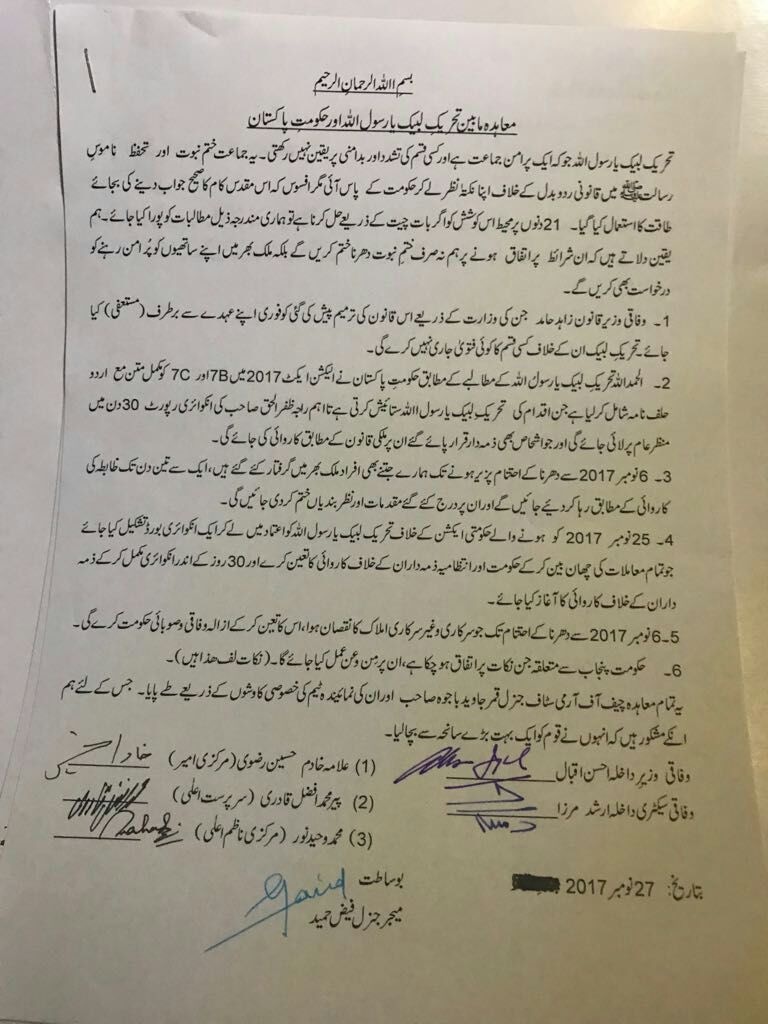
With the Pakistan government administration and police officials unable to develop a strategy to control the security sitution, the Pakistan government used the Pakistan Army as an intermediary to negotiate with the extremist protesters. On November 27, 2017, after negotiations between the TLY and the Pakistan government (including the Pakistan Army), TLY leader Khadim Hussain Rizvi held a press conference to call an end to the protests. According to TLY’s Khadim Hussain Rizvi, the Pakistan Government agreed to a series of 6 demands, including releasing those detained during the protests. Rizvi also stated that the Pakistan Army chief Qamar Javed Bajwa and Major Gen Faiz Hameed would be “guarantors for the agreement” of the TLY’s demands. Among those were the immediate resignation of Pakistan Federal Law Minister Zahid Hamid, who resigned in accordance with the TLY’s demands. Other TLY demands called for the Pakistan government compensating protesters for any loss of assets.

Pakistan Government’s November 27, 2017 Agreement to Demands of Tehreek-i-Labaik Ya Rasool Allah (TLY) (Urdu)

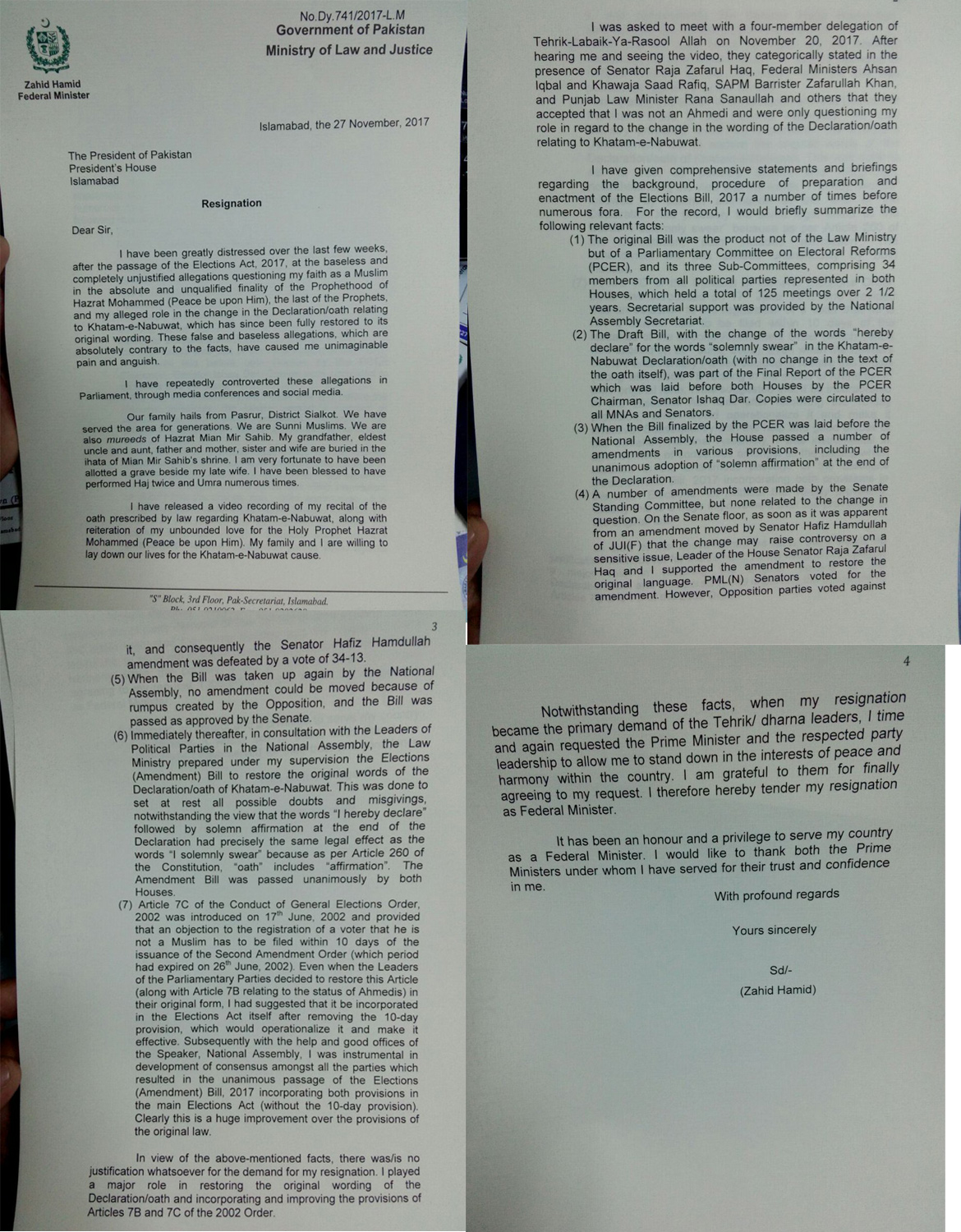
On the morning of November 27, 2017, the Pakistan Daily Times (PDT) issued an editorial calling for the Pakistan government to remain strong in the face of the TLY protester threats.  The PDT wrote that surrendering to such demands would “mean that government officials can be forced into resignation by any group of armed thugs that can use force and attack ministers’ houses to push for its unconstitutional and illegal demands. It should be stated by the government in clear terms that no minister would resign on demands of such hooligans.”  But on the same day, the Pakistan government did surrender to the TLY protester demands, and Federal Law Minister Zahid Hamid was forced to resign.

Pakistan Federal Law Minister Zahid Hamid Resignation Letter, November 27, 2017

On social media, Pakistanis posted a video of a Pakistan military figure passing out envelopes to (what appears to be) protesters. According to Dawn News, “Punjab Rangers DG Maj Gen Azhar Naveed oversaw the release of protesters and handed over cheques worth Rs1,000 to each released protester as fare for their travel home.” The Islamabad High Court criticized the Pakistan government’s role to use the Pakistan military to arbitrate with the TLY extremist protesters, with Justice Shaukat Aziz Siddiqui asking “Who is the Army to adopt a mediator’s role?” and “Where does the law assign this role to a major general?”

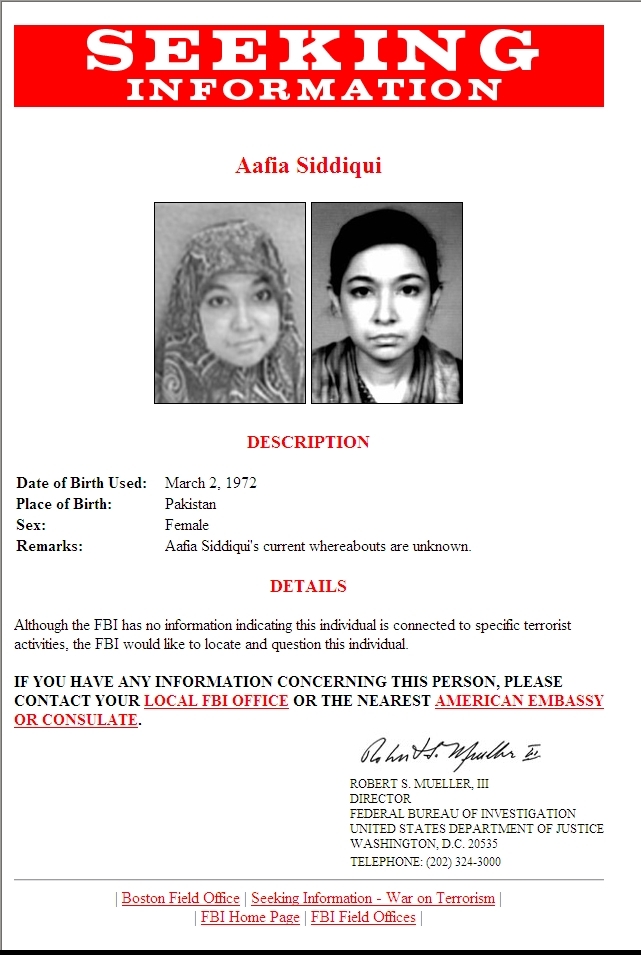
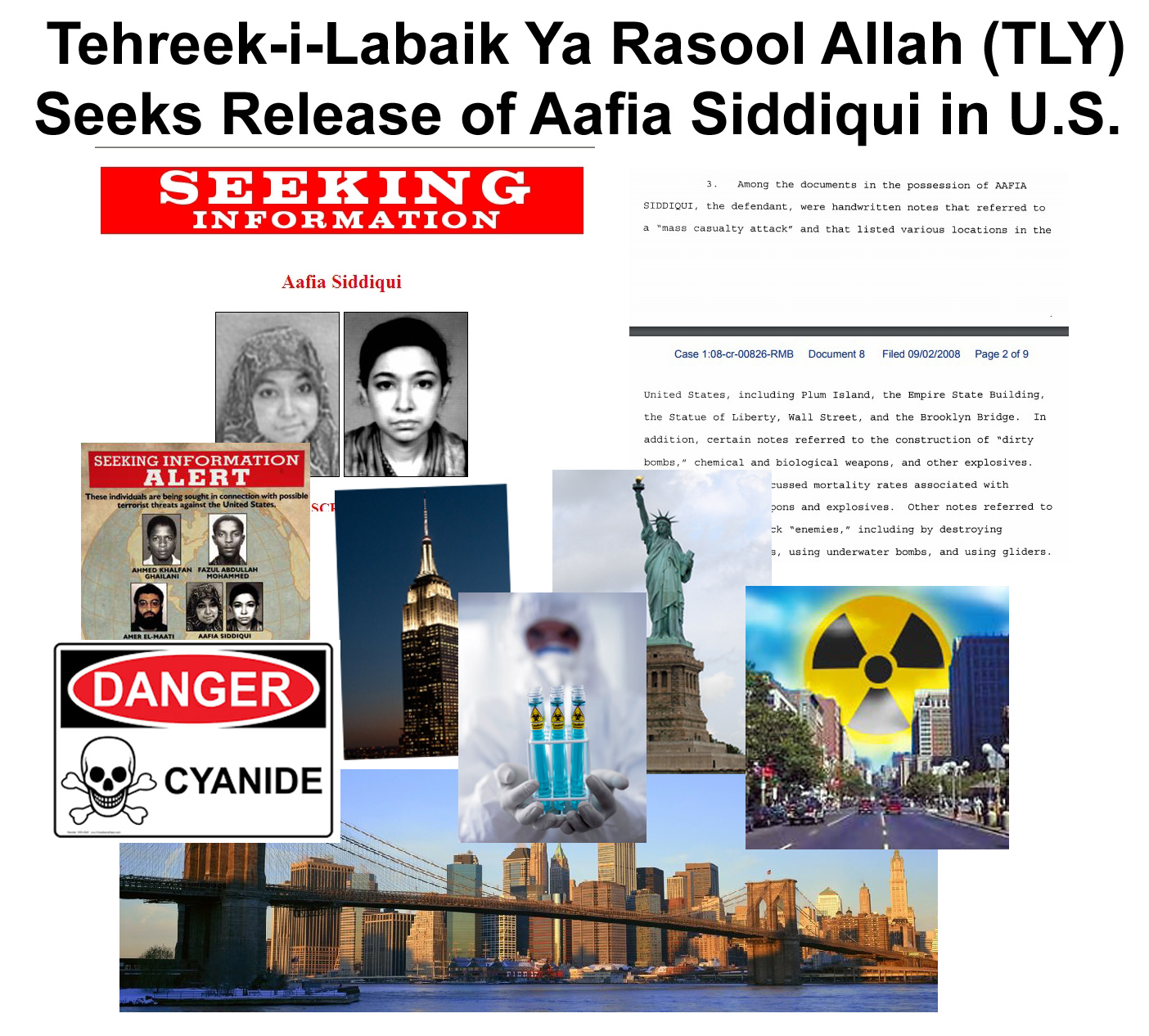
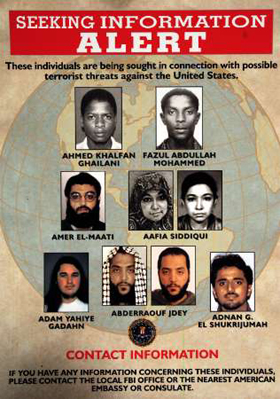
Other TLY demands, which they tell Dawn News that the Pakistan government has agreed to, address aggressive enforcement of the Blasphemy law used to persecute Pakistan Christians and other religious minorities, and investigation into government officials concerned about Ahmadi minority Muslims. Other TLY demands that they claim were accepted by the Pakistan government calls for seeking the U.S. to release a Pakistan woman, Aafia Siddiqui, convicted in the U.S. for shooting Americans, who was linked with “mass casualty” terror plots.

Pakistan Tehreek-i-Labaik Ya Rasool Allah (TLY) Leader Khadim Hussain Rizvi States Pakistan Government Agreed to Call for Terror-Linked Aafia Siddiqui’s Release

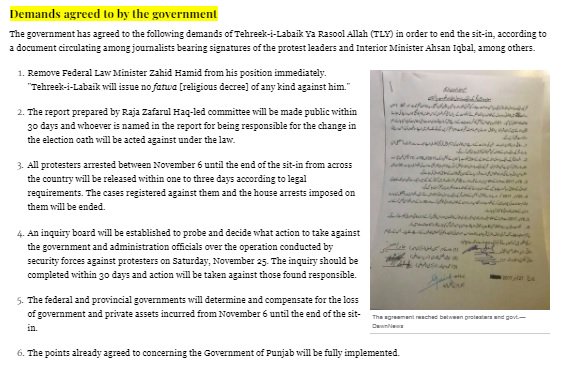
The six (6) demands of the TLY agreed to by the Pakistan government have been widely distributed in a document, signed by Pakistan Interior Minister Ahsan Iqbal, TLY leader Khadim Hussain Rizvi, Interior Secretary Arshad Mirza, two other protest leaders, and Major General Faiz Hameed, who facilitated the agreement. The six demands of the TLY agreed to by the Pakistan government, in a document with these signatures, are listed as:

“1. Remove Federal Law Minister Zahid Hamid from his position immediately. Tehreek-i-Labaik will issue no fatwa [religious decree] of any kind against him.”
2. The report prepared by Raja Zafarul Haq-led committee will be made public within 30 days and whoever is named in the report for being responsible for the change in the election oath will be acted against under the law.
3. All protesters arrested between November 6 until the end of the sit-in from across the country will be released within one to three days according to legal requirements. The cases registered against them and the house arrests imposed on them will be ended.
4. An inquiry board will be established to probe and decide what action to take against the government and administration officials over the operation conducted by security forces against protesters on Saturday, November 25. The inquiry should be completed within 30 days and action will be taken against those found responsible.
5. The federal and provincial governments will determine and compensate for the loss of government and private assets incurred from November 6 until the end of the sit-in.
6. The points already agreed to concerning the Government of Punjab will be fully implemented.”

In addition, Dawn News reports on nine (9) additional TLY demands allegedly agreed to by the Pakistan government, including increased use of the “Blasphemy Law” to oppress individuals and persecute religious minorities (including Pakistan Christian minorities), calls for investigation into government leaders to urge further persecution of Ahmadi Muslim minorities, and calls for the release of a Pakistan woman, Dr. Aafia Siddiqui, convicted of shooting Americans, who has been linked to terrorist plans to attack the United States.

These additional TLY demands, which TLY leader Khadim Hussain Rizvi states the Pakistan government has agreed to include the following, as reported both by Dawn News and the Pakistan Daily Times:

“1. A board of clerics led by Pir Muhammad Afzal Qadri will be set up to probe remarks made by Punjab Law Minister Rana Sanaullah against the persecution of Ahmedis. Sanaullah will have to accept the decision made by the board.
2. No difficulty will be faced in registering cases under clause 295-C of the Pakistan Penal Code (blasphemy law)
3. No leniency will be given to those convicted by courts for blasphemy
4. No ban will be imposed on the use of loudspeakers
5. The foreign and interior ministries will take steps for the release of Dr Aafia Siddiqui after taking her mother and sister in confidence
6. The holiday of Iqbal Day on November 9 will be revived
7. Two representatives of Tehreek-i-Labaik will be included in the panel assigned to decide changes in the textbook board. The officials will push for inclusion of translation of the Holy Quran and chapters about Seerat-un-Nabi (PBUH) and Muslim leaders.
8. The chehlum of martyrs will be held on January 4 at Rawalpindi’s Liaquat Bagh
9. Every year, November 25 will be observed as ‘Martyrs of Prophet’s honour day’ ”

The increased calls for persecution of individuals under the Pakistan “Blasphemy Law,” should be concerning to those advocating for Human Rights and religious freedom of all people.  It should be deeply concerning to Human Rights advocates that the TLY has obtained such support after its public calls for executing individuals and its reports to the Pakistan Daily Times and Pakistan Dawn, that the TLY has received agreement by the Pakistan government that blasphemy laws will be more aggressively pursued against vulnerable individuals.

Pakistan Protesters Calling for Execution of Christian Minority Woman Asia Bibi

The Blasphemy Law is regularly used to persecute religious minorities and other victimized by claims that they did or said something “blasphemous” against Islam. This law calls for the death penalty for individuals convicted on such laws, usually based on trumped-up or fabricated evidence. Some suffer for years in prison on such charges, seeking appeals, and even those who are released when found innocent face mob violence, including previous reports of those shot on courthouse steps. Media reports showed the current protesters with banners calling for the hanging of Christian minority woman Asia Bibi, who was convicted of blasphemy in November 2010, sentenced to death, and who continues to seek appeal of this death sentence. Christian minority woman Asia Bibi’s primary “offense” was sharing a water cup while working with extremist Muslim co-workers, who felt that her unclean touch of the water cup was offensive. This led to a dispute and fabricated charges against her in June 2009. She was imprisoned for over a year before being formally charged.  TLY protesters have been openly protesting in support of Asia Bibi’s death.

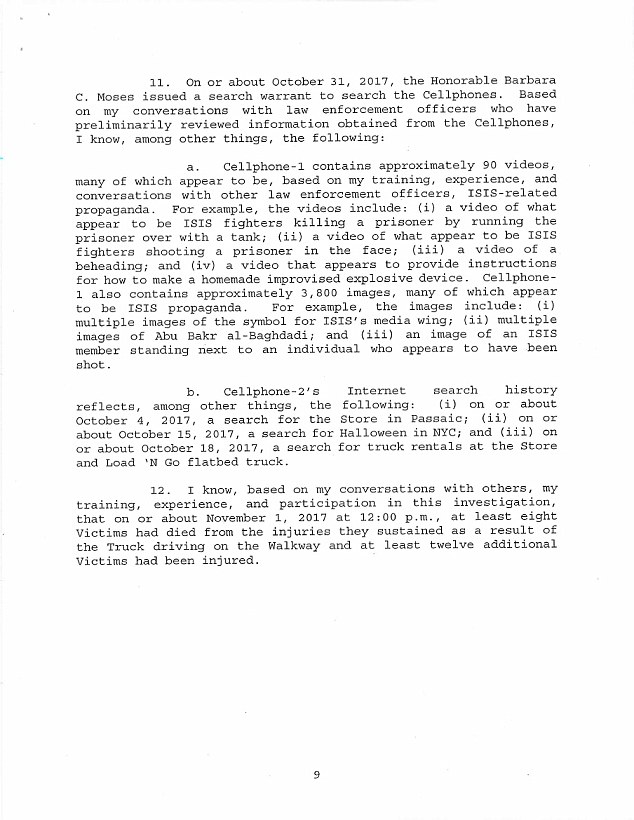
The American public should also be concerned about the calls by TLY leader Khadim Hussain Rizvi, which he claims to Dawn News, are supported by the Pakistan government, seeking the release of Dr. Aafia Siddiqui, who was convicted by U.S. courts after shooting Americans and attempting to murder them.  Al-Qaeda-linked Aafia Siddiqui was one of several high-profile terror suspects sought by the FBI in the United States, where she had been operating, prior to her capture in Afghanistan.  Afia Siddiqui was a graduate of the Massachusetts Institute of Technology (MIT), and obtained a Ph.D. doctoral degree from Brandeis University, where she taught a Biology Laboratory course. Media reports stated that Khalid Sheikh Muhammad, the alleged al-Qaeda chief planner of the 11 September attacks, named Afia Siddiqui as an Al-Qaeda operative. Khalid Sheikh Muhammad was related to Afia Siddiqui, as her second husband’s uncle.  According to the U.S. Government, Aafia Siddiqui had a role in assisting terrorists to “rent houses and provide administrative support for the operation,” including organizing travel documentation for Pakistani national Majid Khan in Baltimore, Maryland, whose role was to bomb gasoline stations and poison water reservoirs in America.  In U.S. courts, Aafia Siddiqui was convicted of attempted murder of U.S. nationals, officers, and employees, assault with a deadly weapon, carrying and using a firearm, and three counts of assault on U.S. officers and employees.  According to the complaint against Pakistan woman Aafia Siddiqui, she was arrested with notes on plans for terrorist attacks on “various locations in the United States, including Plum Island, the Empire State Building, the Statue of Liberty, Wall Street, and the Brooklyn Bridge,” as well as plans on “construction of ‘dirty bombs,’ chemical and biological weapons, and other explosives.”  She was also arrested with two pounds (900 grams) of sodium cyanide in a glass jar.

Responsible for Equality And Liberty (R.E.A.L.) has previously reported on UK-based groups that have praised terrorists, including the 9/11 Al-Qaeda terror attack on the U.S., which have campaigned for the freedom of convicted terrorists. According to the London Times, this included a “women’s network [that] is using macabre images on social media to raise funds for convicted terrorists and their families,” including Pakistan Dr. Aafia Siddiqui.

Pakistan media figures have considered the Pakistan government’s inability to manage law and order in the face of the TLY religious political protests across the nation.  During the protests, Dawn’s Zahid Hussain wrote: “The use of religion as a policy tool by the state and its confluence with politics has divided the nation along sectarian lines and fueled bigotry. The ongoing siege of the capital presents a serious challenge to not only the government but also the state” and “The authorities have not learnt from the consequences of the policy of appeasement.”

Pakistan Express Tribune’s Kamran Yousaf warns of religious extremism in Pakistan as a form of “Frankenstein’s monster,” writing “Our state and its inaction allowed ordinary individuals and groups to become monsters.” Mr. Yousaf states that despite security improvements in the military,”the battle against extremism has unfortunately not even been kicked off.  We have not only failed to stem the tide of extremism but in reality whatever little gains we may have achieved are now being reversed.”  “The tragic part is that we haven’t learnt any lesson from the past and as a consequence has allowed yet another individual to become larger than life character. Who is Khadim Hussain Rizvi and how has he risen to prominence within no time? Not long ago, he was just an ordinary cleric teaching at one of the seminaries in Lahore.” “The problem is that the path he has chosen to venture into politics is dangerous. He is openly inciting people to violence and ridiculing judiciary and other institutions. ” “This leaves us with a legitimate concern: are we paving the way for yet another monster?”

Pakistan Daily Times (PDT) writer Obed Pasha wrote on November 27 that TLY protesters led by Khadim Hussain Rizvi were not defied due to “widespread tacit support they have from a substantial portion of the society” in Pakistan, who “sympathize with Khadim Hussain’s cause.” PDT writer Pasha stated that the “fact of the matter is that the masses have chosen religious bigotry to unite for collective action,” and that a series of successful political religious extremists have “not only weakened the state machinery, but also legitimized the use of religion to achieve political goals in the society.”

Responsible for Equality And Liberty (R.E.A.L.) suggests to the Pakistan government, the frustrated among the Pakistan public, and those who believe in equality, liberty, and democratic processes another direction: Choose Universal Human Rights.

The path of religious extremism is only one path that Pakistan could choose.  Other alternatives could be to reconsider the position of Pakistan in making its rights and legal systems dependent on pluralistic values that show true respect and confidence in freedom of religion and faith, rather than an insecurity that demands religious extremist control all political and legal futures in Pakistan.   A faith and culture that is strong should also be strong enough to respect others and understand others without the fear-based extremism that demand total and unquestioning obediance to extremist views, and which will use violence and disruption if its adherants do not get their way.  Surely such appeasement of extremism undermines the foundational capabilities for democracy and democratic principles.

Pakistan is a signatory to the Universal Declaration of Human Rights (UDHR) (signatory as part of December 10, 1948 United Nations process), as well as the International Covenant on Civil and Political Rights (ICCPR) (signed 2008, ratified 2010). The ICCPR is the legal treaty to the UDHR. Within the UDHR, Article 18 states: “Everyone has the right to freedom of thought, conscience and religion; this right includes freedom to change his religion or belief, and freedom, either alone or in community with others and in public or private, to manifest his religion or belief in teaching, practice, worship and observance.” This is part of the ICCPR as well, as part of its own Article 18, which states “1. Everyone shall have the right to freedom of thought, conscience and religion. This right shall include freedom to have or to adopt a religion or belief of his choice, and freedom, either individually or in community with others and in public or private, to manifest his religion or belief in worship, observance, practice and teaching. 2. No one shall be subject to coercion which would impair his freedom to have or to adopt a religion or belief of his choice. 3. Freedom to manifest one’s religion or beliefs may be subject only to such limitations as are prescribed by law and are necessary to protect public safety, order, health, or morals or the fundamental rights and freedoms of others. 4. The States Parties to the present Covenant undertake to have respect for the liberty of parents and, when applicable, legal guardians to ensure the religious and moral education of their children in conformity with their own convictions.”

When ratifying the ICCPR, Pakistan stated that “The Government of the Islamic Republic of Pakistan reserves its right to attach appropriate reservations, make declarations and state its understanding in respect of various provisions of the Covenant at the time of ratification.” Pakistan’s reservations to such universal human rights under the UDHR and ICCPR have included the following reservation (June 27, 2011) regarding Article 18: “shall be so applied to the extent that they are not repugnant to the Provisions of the Constitution of Pakistan and the Sharia laws.”

Pakistan is also a member of the Organization of the Islamic Conference (OIC) which created its own version of a human rights declaration, titled the “Cairo Declaration on Human Rights in Islam (CDHRI)” adopted on August 5, 1990. Unlike the other universal human rights documents, the OIC’s version of “human rights” denies religious freedom, making human rights dependent on the interpretation of Islamic Sharia law by individual OIC’s states’ members. As stated in CDHRI Article 24, “All the rights and freedoms stipulated in this Declaration are subject to the Islamic Shari’ah.” As stated in CDHRI Article 25, “The Islamic Shari’ah is the only source of reference for the explanation or clarification of any of the articles of this Declaration.”  But even within Shari’ah there are interpretations by scholars.  Why cannot confidence, rather than fear be an interpretation?  Why cannot respect for others, rather than “compulsion” in religion not be an interpretation?

If Pakistan’s majority faith and religious culture is secure, then it should not need such artificial demonstrations of piety and rejection of pluralism to defend it.  It is time for Pakistan to recognize the foundational problems that it faces in its version of democracy and human rights, and understand that democratic values and human rights must be universal, to be responsible for the future of the diverse people and needs in Pakistan, and to be responsible in Pakistan’s future with the world.

Courage and confidence in equality, not surrender and fear of extremists, offers a real pathway for peace and prosperity for Pakistan’s future.  No nation can build a proud nation for its children, if on any day, a handful of extremists can readily drag it to its knees.  We urge the people and government of Pakistan to stand up and reject the attacks on democracy and representative government by such extremists.

We urge Pakistan and its people to be Responsible for Equality And Liberty.

(* NOTE: The TLY is also referred to in English media as Tehreek-e-Labaik Pakistan, Tehreek Labbaik Ya Rasool Allah, Tehreek-e-Labaik Ya Rasool Ullah, “TLYP,” “TLYR”.)

Pakistan – Police Killed and Injured in Violent Nationwide Protests by Extremists

In Pakistan, extremist religious supporters of three religious political parties: Tehreek-e-Labaik Pakistan, Tehreek-e-Khatm-e-Nabuwwat, and the Sunni Tehreek Pakistan, have been engaged in protests and violence starting in Pakistan’s capital Islamabad and spreading to other parts of the country. One of the groups, Tehreek-e-Labaik Pakistan (aka “TLY,” Tehreek Labbaik Ya Rasool Allah, Tehreek-e-Labaik Ya Rasool Ullah, “TLYP,” “TLYR”), has been led by firebrand cleric Khadim Hussain Rizvi, who continues to led protest activities and rally individuals armed with sticks and rods in the Islamabad capital. TLY group chief Khadim Hussain Rizvi has used social media to call for the protests and actions by supporters across Pakistan. The protests in Pakistan’s capital, Islamabad, and have blocked the blocking Faizabad Inter-Change for approximately three weeks. TLY protests have spread to other parts of the nation, and violence between protesters and the Pakistan police has increased, including protesters attacking police with iron and wooden rods, stones, setting police vehicles on fire, and starting fires in the streets. The protests and violence have spread to other parts of the country, and reports are being issued from Pakistan media of plans to restrict media reporting on the disruption.

The violent protests have attacked reported changes in electoral reform law, but also called for threats against religious minorities, including execution of Christian minority woman Asia Bibi for “blasphemy,” and anti-Ahamdi Muslim minority placards. Fires, attacks on police vehicles, injuries, and death have been reported as a result of the increasingly violent protests, which have led to the death of at least one police officer killed, over 60 police injured, 45 Frontier Constabulary  (FC) injured, 8-10 protesters killed,  and 300 protesters injured.

The recent protests and violence which began in Pakistan’s national capital of Islamabad, have continued to spread. The current protests and disruption has led to over 5,000 protesters seeking to disrupt Islambad and other parts of Pakistan, including: Faizabad, Karachi, Hyderabad/Sindh, Lahore/Punjab, Peshawar, Quetta. Multiple reports are also stating that a call has been made by the Pakistan Federal Government to authorize the use of the Pakistan Army “to control law and order situation in Islamabad Capital Territory.”  Reports stated that Pakistan military authorities were used to help contain protest violence.  According to Dawn, “The federal government on Saturday evening ordered the deployment of the army in Islamabad under Article 245 of the Constitution to aid civilian law-enforcement agencies in securing the capital, following the ‘suspension’ of the day-long crackdown against religious protesters camped out at Faizabad Interchange.”

According to the New York Times, Dawn, and other reports, electronic media and television media have been restricted from reporting on the violent protests.  The Pakistan Electronic Media Regulatory Authority (PEMRA) blocked live television coverage of protests. The New York Times reports: “At one point, the electronic media regulating authority took all television news networks off the air in most parts of the country, and Facebook, Twitter and YouTube were also inaccessible, amid concerns that live coverage of the police action was inflaming religious sentiments.”

The TLY extremist and protester groups are telling their leaders to “use VPN” as ways to work around the PERMA blocks on social media.

Pakistan Television Channels Shut Down by akistan Electronic Media Regulatory Authority (PEMRA)

Numerous reports of violence and disruption were reported across the Pakistan.

In Islamabad, protesters continued to occupy the Faizabad Bridge which connects Rawalpindi and Islamabad through the Islamabad Expressway and Murree Road, with a reported growth in the number of protesters from 1,000 to 5,000.   Additional protesters joined the Islamabad protest mob using Murree Road, Rawal Dam and Express Highway.  Reports continue to state that TLY leader Khadim Hussain Rizvi is leading protesters armed with rods and sticks. Protesters have used rocks and rods on the police, as well as tear gas shells.  Some are concealing their identity with masks. Police vehicles and police vans have been attacked and set on fire.  Protesters have cut down trees to block highways, and have burned tires in the streets, as well as attacked police, attacked FC personnel, and set police vehicles on fire.  The latest reports state that Islamabad’s Red Zone and Diplomatic Enclave were sealed off with containers to prevent protesters from entering the area.

In Quetta, protestors sought to disrupt and cause traffic jams in Hockey Chowk, and protesters sought to demonstrate against the security and law enforcement agencies seeking to restore order.

In Karachi, at least 23 were injured included 2 policemen, some with gunshot wounds. Pakistan Dawn quoted police officer Malir SSP Rao Anwar Ahmed stating: “One of the men among the protesters was armed with SMG rifle, who resorted to firing on the policemen, resultantly Memon Goth SHO Gulzar Tunio and constable Sabir sustained bullet wounds.” Throughout Karachi, there were reports of protesters creating fires and burning tires. Protests in Numaish Chowrangi created disruptions of traffic in the area for hours. Major affected areas were reported to include Teen Talwar, Boat Basin, Nipa, Sohrab Goth, Shahrah-i-Faisal near Stargate and Nursery, Hub River Road and Hassan Square.

In Hyderbath/Singh area, traffic was blocked by protesters including in the Haider Chowk area, as well as the National Highway near Khairpur.  Protests occurred outside the Badin Press Club and in Sukkur, Umerkot, Mithi, and Sujawal.

In Lahore/Punjab, significant protests in Shahdara, Imamia Colony, and other areas led to closing roads and blocking roads from Lahore to Gujranwala, including Faisalbad. Protests occurred in nine other cities throughout Punjab province ( Gujranwala, Multan, Nakana Sahib, Mianwali, Gujrat, Sahiwal, Vehari, Toba Tek Singh and Murree)  and motorists were stranded due to traffic congestion on the Lahore-Islamabad Motorway. Pakistan Today reported that the police prescence was difficult to discern, in their report: “Lahore police go missing as religious activists lay siege to Faisal Chowk.”

In Peshawar, protesters blocked King’s Road and created major traffic blockages in the area. They burned tires at a major protest rally causing smoke and fire. Other protests developed in four other areas throughout Peshawar, including Khyber Pakhtunkhwa, Haripur, Mansehra and Dera Ismail Khan.

In Multan, four protest rallies were led by Sunni Jamaat activists.

In Natha Khan Chowk, protesters set a vehicle on fire.

In Sialkot, protesters attacked the home of Law Minister Zahid Hamid with rocks.

In Sheikhupura, PML-N lawmaker Javed Latif was attacked and injured by protesters, when he attempted to negotiate with them. Protesters also attacked the home of PML-N’s former interior minister Chaudhry Nisar.

Social media reports have provided additional information that a number of the protesters are actually armed with weapons that are concealed.  One example shown is how metal rods are hidden inside “bamboo poles” and then used as weapons when not seen by photographers.

Social Media Showing Metal Rods Hidden Inside Protesters’ “Bamboo Poles”

A primary reason given by TLY group chief Khadim Hussain Rizvi and supporting protesters for such public disruption has been to call for the resignation of Pakistan Law Minister Zahid Hamid, after claims that a Electoral Reform Bill did not include a clause regarding belief in the finality of Prophethood of Muhammad (Khatam an-Nabiyyin) as part of the revised electoral reform act, regarding “Oath committing to Prophethood of Muhammad.” However, reports have show the both the proposed and previous verisions of the amended Electoral Reform Bill included this “oath” to consent to the “finality of Prophethood” of Muhammad. Law Minister Zahid Hamid denied the TLY allegations about the removal of this part of the proposed law, stating, “God forbid, we can’t even think of doing such a thing.” The intent of the Electoral Reform Bill was to combine eight different laws pertaining to elections to avoid legal confusion. One of the “controversial” aspects of the Electoral Reform Bill was a clause to prevent politicians that are disqualified from holding public office to lead political parties.

In addition, protesters have been protesting against religious minorities with particular targets on Pakistan Christian Asia Bibi and against Ahmadi Muslims. Protesters carried banners calling for the execution of Pakistan Christian minority woman Asia Bibi for “blasphemy.”

Pakistan Protesters Calling for Execution of Christian Minority Woman Asia Bibi

In Lahore, Pakistan Today reported that “Hundreds of protesters, including members of the Lahore Bar Association (LBA), carrying anti-Ahmedi placards and batons thronged the Faisal Chowk to register their protest against the operation in Islamabad.” “Protesters were also of the view that Punjab Law Minister Rana Sanaullah and Federal Law Minister Zahid Hamid should resign as the former is ‘friends with Ahemdis’ while the latter ‘is an Ahmedi’.”

Religious minorities are regularly persecuted throughout Pakistan, both by extremists and by insitutional prohibitions. This includes legal prohibitions against Ahmadis in their form of Islamic worship, as well as use of “Blasphemy Law” as ways to bully and persecute religious minorities. These forms of persecution have long been recognized by the United Nations as a form of attack on religious minorities’ human rights, as documented in UN High Commissioner for Refugees (UNHCR), UNHCR Eligibility Guidelines for Assessing the International Protection Needs of Members of Religious Minorities from Pakistan, 14 May 2012, HCR/EG/PAK/12/02.

Those protesting in defense of the religious “Blasphemy Law,” Section 295 C of the Pakistan Penal Code, in Pakistan, which is regularly used to persecute religious minorities and other victimized by claims that they did or said something “blasphemous” against Islam. This law calls for the death penalty for individuals convicted on such laws, usually based on trumped-up or fabricated evidence. Some suffer for years in prison on such charges, seeking appeals, and even those who are released when found innocent face mob violence, including previous reports of those shot on courthouse steps. Media reports showed the current protesters with banners calling for the hanging of Christian minority woman Asia Bibi, who was convicted of blasphemy in November 2010, sentenced to death, and who continues to seek appeal of this death sentence. Christian minority woman Asia Bibi’s primary “offense” was sharing a water cup while working with extremist Muslim co-workers, who felt that her unclean touch of the water cup was offensive. This led to a dispute and fabricated charges against her in June 2009. She was imprisoned for over a year before being formally charged.

Responsible for Equality And Liberty (R.E.A.L.), an advocate for universal human rights, urges the Pakistan government to reject policies of appeasement in dealing with extremist protesters throughout Pakistan, but also to re-examine Pakistan’s position on human rights in addressing the roots of such extremism.  R.E.A.L. notes the commentary by Zahid Hussain who states: “The use of religion as a policy tool by the state and its confluence with politics has divided the nation along sectarian lines and fueled bigotry. The ongoing siege of the capital presents a serious challenge to not only the government but also the state” and “The authorities have not learnt from the consequences of the policy of appeasement.”  While R.E.A.L. agrees with Mr. Hussain on this, the foundational issue comes back to the false idea that Pakistan can have a separate set of universal human rights, a different vision of democracy, and a view of religious tolerance that fundamentally rejects religious diversity and pluralism.  The root of this problem will not go away for Pakistan.

Pakistan is a signatory to the Universal Declaration of Human Rights (UDHR) (signatory as part of December 10, 1948 United Nations process), as well as the International Covenant on Civil and Political Rights (ICCPR) (signed 2008, ratified 2010). The ICCPR is the legal treaty to the UDHR. Within the UDHR, Article 18 states: “Everyone has the right to freedom of thought, conscience and religion; this right includes freedom to change his religion or belief, and freedom, either alone or in community with others and in public or private, to manifest his religion or belief in teaching, practice, worship and observance.” This is part of the ICCPR as well, as part of its own Article 18, which states “1. Everyone shall have the right to freedom of thought, conscience and religion. This right shall include freedom to have or to adopt a religion or belief of his choice, and freedom, either individually or in community with others and in public or private, to manifest his religion or belief in worship, observance, practice and teaching. 2. No one shall be subject to coercion which would impair his freedom to have or to adopt a religion or belief of his choice. 3. Freedom to manifest one’s religion or beliefs may be subject only to such limitations as are prescribed by law and are necessary to protect public safety, order, health, or morals or the fundamental rights and freedoms of others. 4. The States Parties to the present Covenant undertake to have respect for the liberty of parents and, when applicable, legal guardians to ensure the religious and moral education of their children in conformity with their own convictions.”

When ratifying the ICCPR, Pakistan stated that “The Government of the Islamic Republic of Pakistan reserves its right to attach appropriate reservations, make declarations and state its understanding in respect of various provisions of the Covenant at the time of ratification.” Pakistan’s reservations to such universal human rights under the UDHR and ICCPR have included the following reservation (June 27, 2011) regarding Article 18: “shall be so applied to the extent that they are not repugnant to the Provisions of the Constitution of Pakistan and the Sharia laws.”

Pakistan is also a member of the Organization of the Islamic Conference (OIC) which created its own version of a human rights declaration, titled the “Cairo Declaration on Human Rights in Islam (CDHRI)” adopted on August 5, 1990. Unlike the other universal human rights documents, the OIC’s version of “human rights” denies religious freedom, making human rights dependent on the interpretation of Islamic Sharia law by individual OIC’s states’ members. As stated in CDHRI Article 24, “All the rights and freedoms stipulated in this Declaration are subject to the Islamic Shari’ah.” As stated in CDHRI Article 25, “The Islamic Shari’ah is the only source of reference for the explanation or clarification of any of the articles of this Declaration.”

This creates a fundamental division and conflict between OIC nations respecting the CDHRI, and other nations of the world respecting the UDHR/ICCPR. It creates a continuing flashpoint in dealing with broad human rights issues on an international basis, where the very definition of “universal human rights” has a different interpretation in Pakistan and other OIC nations. The concept of those seeking to run for political office in other nations around the world, having to make a commitment or an oath to a specific religious viewpoint, would appear fundamentally un-democratic and an institutional attack of democratic processes. But throughout Pakistan today, TLY protesters are violently protesting and burning police vehicles based on a rumor that such non-religious democratic electoral reform could even have been considered. Furthermore, some TLY protesters are also using this unrest to further defend the abuses by the Pakistan “Blasphemy Law,” which is regularly used to persecute religious minorities and others.

We urge that the Pakistan police will get this unrest and violence under control, but this is yet another example of the dangerous lack of stability that Pakistan must resolve in basic agreement on human rights and democratic processes along with the rest of the world.  Long term solutions are not just police action, not simply Army action, and not further efforts to appease violent extremists.  The only long term solution for Pakistan to meaningfully address such violence is to build a pluralistic respect for universal human rights for all people of all faiths, without dependence on religious sanctions to operate basic national law and regulations on a daily basis.  As with all nations, the values, ethics, and mores (including religious mores) of its people are powerful influences on law and legislation.  But for adherents to the majority religion, the demonstration of real piety and religious conscience would be provide laws that allow for respect to all Pakistan citizens of all faiths and views, without the  insecure need for “compulsion” in religion.

As a nuclear weapon-armed modern nation (with an estimated 120 nuclear bomb warheads), Pakistan and the Pakistan people must consider both its national and its global responsibilities. Like the rest of the world, the Pakistan people have suffered from violence and terrorism. It remains essential for Pakistan and the world to continue to challenge terrorism. But terror tactics draw their inspiration from extremist views and values, and too many extremists continue to wield influence in Pakistan today, as we can clearly see in the streets of Pakistan, as the Pakistan police themselves lie injured and killed in the streets today.

Pakistan must come to realize that modern technology, modern weapons, and engagement with the rest of the world is a two-way street. Pakistan cannot simply take what it wants from our global modern age, and live as if the rest of the modern world does not exist, including our shared universal human rights. Growing technological and business interdependence with simultaneous denial on global standards of human rights is a strategy for Pakistan’s national disruption, security challenges, and both internal and external strife. Like all nations, Pakistan has the right to defend its culture, its majority religion, and its values. But the dependence on a completely separate set of “universal human rights” that reject the religious freedom and diversity of others will continue to be a weakness in the Pakistan national identity. Pakistan’s position in dealing with the TLY and the violent protesters is to tactically stop street violence, but to ignore the foundational problems that lead to such issues.

Pakistan must reassess its reservations to the Universal Declaration of Human Rights (UDHR) and the International Covenant on Civil and Political Rights (ICCPR), and reconsider its dependence on a Cairo Declaration on Human Rights in Islam (CDHRI), which demands a religious-based “universal human rights” code. If Pakistan’s majority faith and religious culture is secure, then it should not need such artificial demonstrations of piety and rejection of pluralism to defend it.

The time must come, to stop the violence in Pakistan, and take a real stand against extremism movements in Pakistan, by fully and completely supporting all of the Universal Declaration of Human Rights, including Article 18.  Pakistan could be begin this process by fully ratifying the Universal Declaration of Human Rights, rather than merely being a signatory to it.  R.E.A.L. urges the government of Pakistan to reconsider its dependence on the CDHRI, and to fully ratify the Universal Declaration of Human Rights and to remove its “reservations” to the International Covenant on Civil and Political Rights.  With the Human Rights Day approaching on December 10, this could be a move for Pakistan to begin to bring its stance on universal human rights in line with the rest of the world.

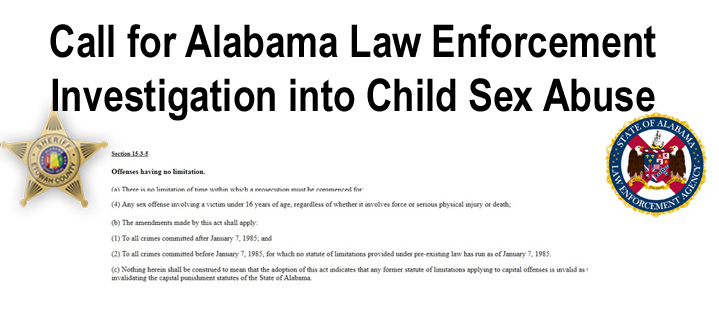
R.E.A.L. Call for Alabama Law Enforcement to Investigate Child Sex Abuse Charges

Responsible for Equality And Liberty (R.E.A.L.) is a non-partisan, volunteer human rights activist group, which supports the universal human rights guaranteed to all of our fellow human beings under the Universal Declaration of Human Rights (UDHR). This has also included our repeated and public activism on behalf of the rights of children, including their protection under the United Nations Convention on the Rights of the Child (UNCRC), which was adopted by the United Nations General Assembly on November 20, 1989. The United States of America signed this child’s human rights convention on February 16, 1995 (but has not ratified within its Congress). The Convention on the Rights of the Child is a detailed acknowledgment of the Universal Human Rights already agreed to by the United States of America and most world nations under the UDHR on December 10, 1948, and which is codified as a formal treaty under the International Covenant on Civil and Political Rights (ICCPR).  The Convention on the Rights of the Child includes specifics on action necessary for nations regarding neglect and abuse of children, including child sexual abuse (specifically Articles 19 and 34).

The United States of America and its various states also have laws and protection of children, including child sexual abuse, which it is empowered and has the resources to investigate and fully enforce.  The world can agree on such issues, because they are part of the fundamental human rights, which we must defend by law.  R.E.A.L. has in the past, and will continue in the future, to challenge the actions by individuals in any nation, which does not enforce such human rights and laws protecting our most vulnerable, including our children.

The United States of America laws and resources for protection of children include the state of Alabama.  It is deeply troubling that several detailed charges of child sexual abuse has been made in the state of Alabama against a former Alabama jurist.  Since November 16, 2017, R.E.A.L. has repeatedly been calling for the Alabama justice system to investigate the charges regarding child sexual abuse, that have been widely addressed in the news media regarding a former Alabama jurist.  It is our understanding that this would be the role of the Alabama Law Enforcement State Police and Etowah County Sheriff’s Office in Gadsden, Alabama on this case.  R.E.A.L. has also directly written to Alabama Law Enforcement Agency (ALEA) Office of the Secretary of Law Enforcement and to Etowah County Sheriff Todd Entrekin on this subject calling for an investigation into these charges of child sexual abuse.  The allegations refer to actions alleged to have happened 30 – 40 years ago.  But when it comes to enforcing the law and protecting our children, Americans and their law enforcement must be consistent, and must consistently send a message that there will be equality under the law for all.  The primary purpose of law enforcement in democratic, free nations is to enforce laws to protect the shared human rights of its citizenry, especially its most vulnerable citizens such as its children.

In regards to Alabama State Law,  Alabama has multiple laws to investigate, to protect children from child sexual abuse, and enforce the law, under Alabama Code Title 26. Infants and Incompetents § 26-14-1, as well as under Alabama Title 13A Criminal Code, Chapter 6 Offenses involving danger to the person, Article 4 Sexual Offenses, including § 13A-6-66 Sexual abuse, first degree, § 13A-6-67 Sexual abuse, second degree, § 13A-6-65 Sexual misconduct, § 13A-6-69 Enticing child to enter vehicle, house, etc., for immoral purposes. In accordance with § 26-14-1, Alabama law defines a “child” as “A person under the age of 18 years.”

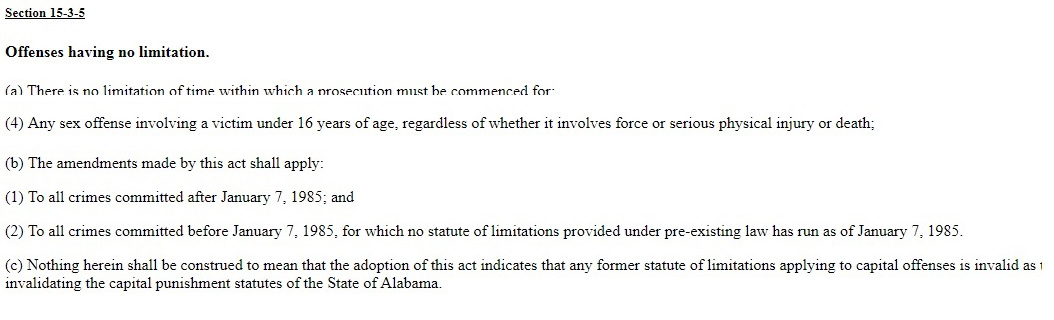
There is widespread belief that laws do not have to be enforced after a period of time has elapsed.  In terms of Alabama State Law, R.E.A.L. would urge a review of Alabama Code Title 15 Criminal Procedure, Chapter 3 Limitations of Prosecution, specifically § 15-3-5 “Offenses having no limitation.”  This § 15-3-5  provision of Alabama law states that there are time limitations on prosecution for “(4) Any sex offense involving a victim under 16 years of age, regardless of whether it involves force or serious physical injury or death.”  Furthermore, § 15-3-5, also provides amendment to clearly indicate that this aspect of Alabama Code Title 15 Criminal Procedure “shall apply” “(1) To all crimes committed after January 7, 1985; and” “(2) To all crimes committed before January 7, 1985, for which no statute of limitations provided under pre-existing law has run as of January 7, 1985.”

Based on this documented information by the Alabama State Government on its Alabama Criminal Code and Criminal Procedure, it is apparent that in the case of child sexual abuse for a child under the age of 16, there is no statute of limitations, even if that child sexual abuse occurred as early as 1979.

Among the recent allegations made against the former Alabama jurist, one individual has made a detailed allegation of child sexual abuse when she was a 14 year old girl in 1979.  Based on § 15-3-5  and § 13A-6,  such child sexual abuse claims remain the responsibility of Alabama law enforcement to investigate.  Ms. Leigh Corfman has made very specific and detailed allegations of child sexual abuse regarding a former jurist in the media, which have been broadcast across the nation.   It is the responsibility of law enforcement to investigate such troubling charges.

R.E.A.L. also notes that former jurist has denied the allegations as a “baseless political attack,” “completely false and a desperate political attack,” “the very definition of fake news and intentional defamation,” and stated that “After over 40 years of public service, if any of these allegations were true, they would have been made public long before now.”

R.E.A.L. calls upon the accuser, Ms. Leigh Corfman, to use the justice system, as it was designed, for legal charges against the accused individual.   Such serious charges cannot be a battle in the U.S. political media, but must be part part of the law enforcement system and laws intended to protect our society.

R.E.A.L. calls for the Alabama Law Enforcement Agency (ALEA) Office of the Secretary of Law Enforcement and Etowah County Sheriff Todd Entrekin to make a public statement to reassure the public that it will take responsibility for such an investigation, under Alabama law.

R.E.A.L. is a non-partisan organization.   For that reason, and given that the former Alabama jurist is currently involved in a political campaign, in this public statement, we have refrained from directly using his name, although we have been specific in our private communications with law enforcement.

The political nature of the very high national office involved, however, does have a further bearing on the urgency of the law enforcement investigation by Alabama in this case.  Such high national office has influence on both national and international matters involving American citizens including our children and vulnerable individuals.  In this unusual situation, it is of the highest priority to quickly and thoroughly conclude an investigation into such potential serious criminal charges in this case.

To U.S. President Donald Trump, R.E.A.L. also advises that while political measures may be necessary to achieve national legislative goals, our primary objective must remain our consistent adherence to the vow that U.S. Government representatives have sworn to preserve and protect the Constitution of the United States of America.  R.E.A.L. urges President Trump to call for a full investigation of this matter by the Alabama state law enforcement authorities to get a resolution on this matter, and ensure the public’s confidence in the integrity of those in our highest offices, when it comes to such serious criminal matters of child sexual abuse.  R.E.A.L further urges President Trump in regards to public governance ethics to avoid the appearance of being anything less than rigorous in calling for such an investigation.  While this may be an Alabama state matter, the resources and commitment to defend national law ultimately comes back to the White House.

UK Muslim Human Rights Groups Attacked by 5Pillars

In the United Kingdom, the “5Pillars” group and British Muslim news website on has attacked various UK-based non-theological groups by Muslims that have a human rights focus on peaceful co-existence and pluralism. The UK group “5Pillars” has attacked British Muslims for Secular Democracy (BMSD), Quilliam Foundation, We Will Inspire, New Horizons in British Islam, Muslim Women’s Network (MWNUK).

Such UK groups, attacked by 5Pillars, have promoted religious freedom, which is part of our universal human rights, while rejecting radical extremism and violence and providing a counter-extremist voice of British Muslims. It is disappointing that 5Pillars has chosen to attack these non-theological groups that advocate civic engagement, peaceful co-existence, counter-extremism, social inclusion, and harmony, free speech, human rights, individual liberty, and the value of open, democratic and diverse societies. 5Pillars has attacked these non-theological human rights and social harmony groups led by British Muslims for seeking to try “change Islam.”

5Pillars released a YouTube video on November 16, 2017, and then posted this on their website on November 18, 2017, generally condemning such groups without any specifics or details, with a title “10 aspects of Islam ‘Muslim reformers’ want to change.” Among the non-specific attacks by 5Pillars in their video, 5Pillars states that the non-theological groups seek to “change” in Islam are a “physical jihad” and a geographical “caliphate.”  The actual focus of these British Muslim human rights and social harmony groups are counter-extremism, rejecting violence, and promoting social inclusion and respect in societies.

Responsible for Equality And Liberty (R.E.A.L.) respects the efforts by human rights and social harmony groups in seeking to make progress in our shared universal human rights, pluralism, and respect for one another. Such human rights begins with a shared commitment to human dignity for all, including those with different views, while finding pluralistic ways of co-existence and peaceful harmony. We may not always agree with every human rights campaign or activist, which is also part of the individual liberty that we defend – the right to disagree. But the misguided and disappointing effort by 5Pillars to broadly attack those British Muslims seeking to promote pluralism and peaceful co-existence, as somehow unfaithful to Islam, is misguided, mean-spirited, and counter-productive. We urge 5Pillars to reconsider, and R.E.A.L. stands by these groups attacked by 5Pillars’ campaign.  With the growing struggles against hate and violence in the world, such attacks on these British Muslim human rights and social harmony groups is particularly disruptive to our shared global society. Those Muslim groups promoting human rights, counter-extremism, and social harmony must be defended by responsible human rights activism.

R.E.A.L.’s mission is the support of universal human rights for ALL, including our Muslim brothers and sisters around the world.  We call for the same universal human rights in the U.K., U.S., and around the world that we call for every other human being.   As with all of our fellow human beings, Muslims’ human rights matter.

R.E.A.L. has long stood with Muslim groups in the U.S., U.K., and other parts of the world that seek to promote our universal human rights, counter-extremism, pluralism, and peaceful co-existence. We urge all to Choose Love, Not Hate.  Love Wins.

R.E.A.L. Stands with Muslims and All People in Support of Universal Human Rights and Dignity


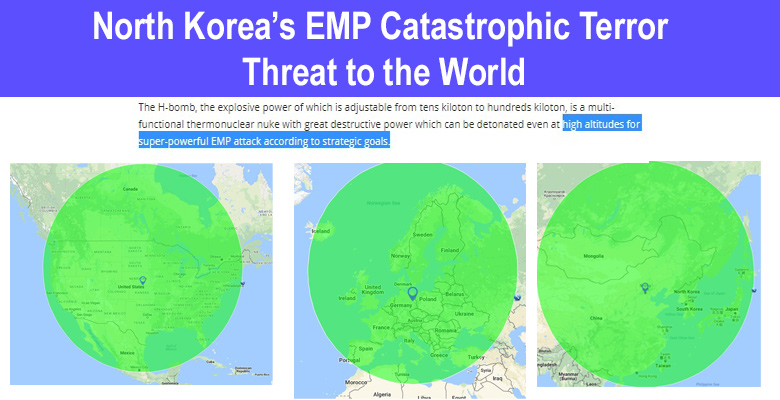
North Korea’s EMP Catastrophic Terror Threat Against the World

Responsible for Equality And Liberty (R.E.A.L.) has been reporting on threats to human rights and security of people persecuted by the totalitarian North Korea government, as well as the world conflicts impacted by the North Korea security threats. A key issue that is not getting recognition, however, was a catastrophic terror threat by North Korea, which is threat not only to its people, the region, and the United States, but is also a catastrophic terror threat to the world.  To those unfamiliar with R.E.A.L.’s mission, R.E.A.L. represents non-partisan, non-political, human rights activist volunteers with a focus on defending our shared universal human rights, including the human right of security.  Among other topics, R.E.A.L. routinely has reported on terror threats to the shared human rights of our fellow human beings.  While R.E.A.L continues to urge Communist North Korea to seek peace, North Korea’s terror threats must also be acknowledged and rejected by responsible nations and people of the world.

For decades, Communist North Korea has threatened its neighbors and the world from its isolated totalitarian state, which has been known largely for well-documented “crimes against humanity” against its own citizens. Much of the world got used to ignoring and dismissing such threats. But on September 3, 2017, the North Korea’s thermonuclear bomb test demonstrated substantially increased nuclear bomb capability, with estimations in the possible bomb yield ranging from 120 kilotons to 250 kilotons. It has greatly concerned many in the public and the world. As a result of that bomb testing, the world’s focus has mostly been on the ability of North Korea to use a thermonuclear bomb for a surface blast to kill many thousands of people in a concentrated area, with fallout affecting others based on the wind direction; it is a grave concern to those committed to global human rights and security.

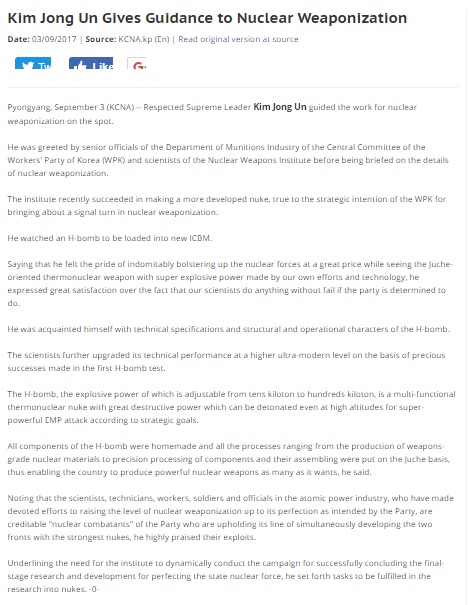
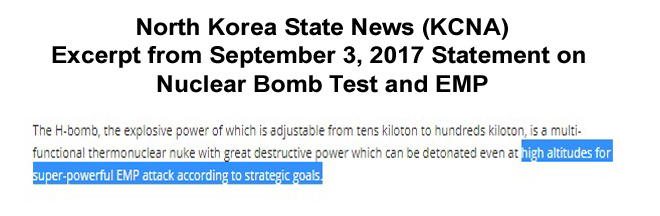
Along with its expanded nuclear bomb capability on September 3, North Korea also gained another first – by announcing itself as the first nation threatening, capable, and likely willing to use a high altitude Electromagnetic Pulse (EMP) bomb. As part of the September 3, North Korea state news (KCNA) report (screenshot) of its nuclear bomb test entitled “Kim Jong Un Gives Guidance to Nuclear Weaponization,” North Korea stated that it is willing to use its enhanced nuclear bomb capability to produce a high altitude Electromagnetic Pulse blast (EMP, also abbreviated as HEMP). North Korea used KCNA to state: “The H-bomb, the explosive power of which is adjustable from tens kiloton to hundreds kiloton, is a multi-functional thermonuclear nuke with great destructive power which can be detonated even a high altitude for super-powerful EMP attack according to strategic goals.”

North Korea’s high altitude “super-powerful” EMP threat is the same type of catastrophic, massive terror threat, as those threatening to poison food and water supplies, spread biological or chemical weapons, in areas which not only could go beyond cities, states, but even across borders. This is the main part of the security issue, which keeps getting buried in details on missiles, ships, timelines, and personalities. The September 3 North Korea boast of a “super-powerful” EMP threat was nothing less than a catastrophic terrorist threat against the world. We must recognize catastrophic terror threats as unacceptable threats against our shared universal human rights and security.
Can you imagine a nation-state proudly issuing a public press release about its new “super-powerful” ability to poison food and water supplies, to spread weaponized airborne versions of smallpox, plague, anthrax, or to release cyanide, ricin, chlorine chemical gas to poison many people? The sane world would rightfully condemn such a statement by any nation with horror and outrage. But North Korea’s terror threat statement of being willing to release a high altitude EMP weapon on the world was largely met with indifference by the world’s media, and politicians demanding that other nations be more understanding in respecting North Korea. Would pundits have made the same statements if the press release with EMP terror threat had been issued by ISIS, rather than North Korea? Would anyone really expect to be able to effectively negotiate with leaders that seek to boast about the ability to commit such mass terror attacks on the world?

The concept of a high altitude EMP blast would be to shoot a nuclear missile high up into the atmosphere and detonate it there; for this purpose, high altitude is defined as 40 to 500 kilometers (20 to 300 miles) above the Earth’s surface. The high altitude nuclear explosion would not have the physical destructive impact of a nuclear bomb surface blast, nor would it have any “fallout” (which comes from radioactive soil after a surface blast). But the high altitude nuclear explosion would send out a series of electromagnetic pulse broadband, high amplitude waves (invisible like radio waves) that would damage or destroy the electrical infrastructure, wiring, and electronic devices over a broad area. The EMP blast has three types of signals, as I will summarize based on a description by scientist Dr. Jack Liu. The first would be an E1 signal that is extremely fast, created by the nuclear blast’s gamma radiation ripping electrons out of the atmosphere, sending them down to Earth at nearly the speed of light, and impacted by the Earth’s magnetic field to create an electromagnetic pulse over a broad area. The second would be an E2 signal, created by gamma and neutron collisions, which would have an impact similar to lightning. The third would be an E3 signal lasting up to hundreds of seconds, creating impacts like a geomagnetic storm, that would impact major long line electrical conductors, and other electrical infrastructure.

A high altitude EMP bomb would likely destroy the electrical infrastructure used for the survival and lives by many, many millions of people, including crippling the infrastructure of a population not only in a local target area, but across a regional or national area, and even possibly across multiple national borders, depending on where it was launched. Many EMP analyses also believe that high altitude EMP pulses at the E1 level would also damage wiring and miniaturized Integrated Circuits (ICs). ICs are small square flat pieces of semiconductor material, typical silicon, on which thousand or millions tiny resistors, capacitors, and transistors are “integrated.” This technological innovation allowed massive change in the way the public lives and functions, as this miniaturization revolution allowed computer and electronics to become part of nearly every area of life. To provide context on such miniaturization, the original computer, ENIAC, was the size of three or four double decker buses and was thousands of times less powerful than a laptop computer today.

This IC revolution allowed most of the technology changes that are not only part of modern society, but more importantly, modern society has become dependent on to effectively function. People are dependent on ICs every day, but since they rarely actually see them inside their electronics, television, radio, automobiles, telephones, banking systems, even many public toilets and sinks, they never think about them, but simply take for granted that they will work. A high altitude EMP blast, as proudly threatened by North Korea, would change that. ICs are ubiquitously used in mobile telephones, computers, and many other forms of electronics. But electrical infrastructure and personal electronics are the tip of the iceberg in the extensive use of ICs throughout society in the 21st century. Such electronics and ICs are widely integrated within every aspect of society: medicine, banks and financial institutions, farms and food stores, retail services, utilities, public transportation, emergency services, law enforcement, sanitation. The vast use of ICs as part of modernization in the 21st century comes with one very specific weak spot, such electronics and ICs are particularly vulnerable to high altitude EMP blasts.

Numerous studies and Congressional testimony has been provided on the such EMP threats to the U.S. Government over the past 30+ years. Many of the early studies were done using data gathered from 1950s, 1960s nuclear bomb tests in secluded or ocean areas, during a time when electronic and communication systems did not have the ICs in widespread use, as they are today. (The first patent for an IC was not granted until 1961.) So much of the “EMP testing” that we have is either based on world electrical and electronic environments that were significantly different, or in controlled laboratory environments that can only simulate a very finite range of possibilities. So we have different scientists that have come up with a range of testimony and findings on high altitude EMP attacks and the impact on society. There is a good deal of classified research on this topic, which unfortunately is not available to the public; R.E.A.L. urges the U.S. government to reconsider the impact of such level of classification and the need to inform the public on such catastrophic threats. However, I have collected the unclassified, public source testimony and studies presented on this topic. They are gathered at:
http://www.emergencysafety.org/emp-research-and-testimony/

Consistently, most scientists believe that a high altitude nuclear blast in the atmosphere would release damaging EMP pulse waves that would impact and destroy wiring, electrical infrastructure, and many “personal electronic” devices. There is some debate over whether and to what extent, an EMP blast would impact automobiles, airplanes, and vehicles, and whether their electronics have enough “shielding” to prevent EMP pulse waves damaging them. Most scientists I have read believe there will be impact of a high altitude nuclear blast on transportation electronic systems.  But should a high altitude EMP blast affect transportation systems, we can be certain there will be significant public disruption and conflict.

Given the difficulty in seeking to “replicate” such a dangerous threat to society, with a high altitude nuclear bomb with gamma rays ripping electrons out of the atmosphere and impacted by the magnetic field of the Earth, there is only so much testing (and so much “proof”) that can actually be done to completely understand the full affects.  The extreme danger of such atmospheric testing is some of the EMP scientific analyses has to be done by scientific modeling. We have results of an actual 1962 high altitutde nuclear blast atmospheric test (Starfish Prime test) that discovered it could create EMP impacts as far as over 800 miles away in that test, with an impact that “drove much of the instrumentation off scale.”  But even in 1962, at the early days of the IC technology just receiving a patent,  a high altitude EMP test over the middle of the ocean impacted electrical systems, telecommunication systems, aircraft radios, and utilities over 800 miles away.  Lowell Wood, a physicist and expert on EMP at Lawrence Livermore National Laboratory, told Congress in 1999 (October 7, 1999: “EMP Threats to the U.S. Military and Civilian Infrastructure”) that: “Most fortunately, these tests took place over Johnston Island in the mid-Pacific rather than the Nevada Test Site, or the electromagnetic pulse would still be indelibly imprinted in the minds of the citizenry of the western U.S., as well as in the history books.” “As it was, significant damage was done to both civilian and military electrical systems throughout the Hawaiian Islands, over 800 miles away from ground zero.”

A high altitude EMP blast is very different from a low altitude, microwave-based EMP attacks. In 2008, the Congressional Research Service (CRS) reported on both High Altitude EMP (HEMP) attacks, and what were considered to be more “likely,” terrorists using surface level, low altitude microwave based devices to create a localized EMP affect. The low altitude microwave-based EMP attack is to create a local disruption, and vehicles are not likely to be affected by such EMP attacks, and the power and strength of a High Power Microwave (HPM) EMP attack is not as powerful as a high altitude EMP (HEMP) attack. In terms of this specific threat from North Korea, unfortunately, most of the limited preparedness efforts have been focused on recovering from a ground level microwave attack, rather than a high altitude EMP blast affecting a wide area.

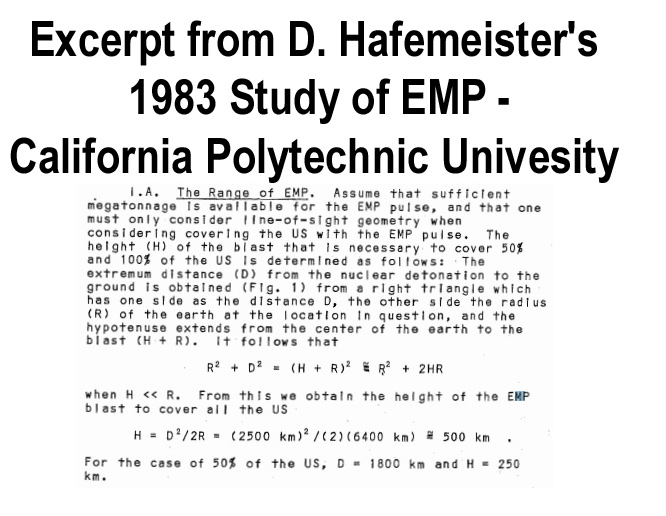
The affected area of a high altitude EMP blast differs among scientists, and as previously stated, most of the research on this is classified, so there is only a limited amount of public information available as unclassified for the public. According to a 1983 study done by D. Hafemeister (California Polytechnic University), as referenced by MIT’s Dr. Jack Liu in May 2017, the larger the nuclear explosion, the greater the affected area. Dr. Liu then estimated that a high altitude EMP blast at an “optimum height” would result in a correlation of blast yield to area covered, with a 250 kiloton blast covering a radius of 250 km (155 miles) and 1 megaton blast (currently not demonstrated as being part of North Korea’s capabilities) covering a radius of 1,000 km (621 miles). This would likely be the most “conservative” estimate.  Based on my review of Hafemeister’s study, I believe he intended the optimum height to be 300 miles/500 km.

If you look at the details of D. Hafemeister’s 1983 EMP study, however, Hafemeister also estimated that a high altitude EMP blast at 310 miles (500 km) in the atmosphere over the United States would affect the entire nation, and at 155 miles (250 km) in the atmosphere would affect half of the U.S.  As with much of the unclassified reports on such EMP research, the public is provided the minimum detail; based on this, it appear that Hafemeister estimated this based on use of a 1 megaton nuclear blast.  Dr. Liu does not mention this part of D. Hafemeister’s study in his analysis of potential EMP threat.
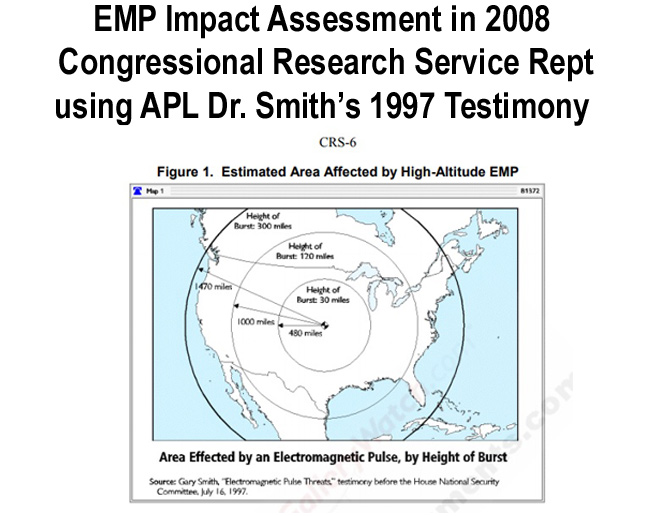
The March 26, 2008 Congressional Research Service (CRS) study (Order Code RL32544) on High Altitude EMP blast impacts has a more dire prediction in terms of a footprint of a high altitude EMP blast. On page 6, Figure 1 of this 2008 CRS study “Estimated Area Affected by High-Altitude EMP,” it provides an impact map from a 1997 Congressional EMP study stating that a blast at 30 miles in the atmosphere would affect a radius of 480 miles, at 120 miles in the atmosphere would affect a radius of 1,000 miles, and at 300 miles (500 kilometers) in the atmosphere would affect a radius of 1,470 miles.  This CRS figure refers to 1997 Congressional public, unclassified testimony provided by Dr. Gary L. Smith, Director, Applied Physics Laboratory (APL), Johns Hopkins University, on the topic “Threat Posed by Electromagnetic Pulse (EMP) to U.S. Military Systems and Civil Infrastructure.”   Based on Dr. Smith’s analysis, high altitude EMP blasts in the center of the U.S., could not only affect an extended part of the U.S., and concluded in his 1997 testimony on EMP “that a burst on the order of 500 kilometers [310 miles] in altitude can cover the entire continental United States.”   Notably, Dr. Smith also testified that the EMP threat was “not terribly burst-strength dependent.”  Dr. George W. Ullrich, Deputy Director, Defense Special Weapons Agency, provided similar views in his 1997 testimony on EMP threats: ” For example, if a megaton class weapon were to be detonated 400 kilometers [248 miles] above Omaha, nearly the entire contiguous 48 States would be affected with potentially damaging EMP experience from Boston to Los Angeles, from Chicago to New Orleans.”  In terms of EMP blast yield, to the extent it may be found to be consistent with nuclear blast “yield” (scientists do not agree on this), it is notable that current nuclear bomb test studies indicate that North Korea “only” has achieved nuclear bomb capability of 120 kiloton to the latest estimate of 250 kiltons, not yet 1 megaton (MT) thus far.  (However, new intelligence relayed to the public in October 2017 indicates that such estimates may be underestimating the EMP threat, due to new “Super-EMP warheads.”)

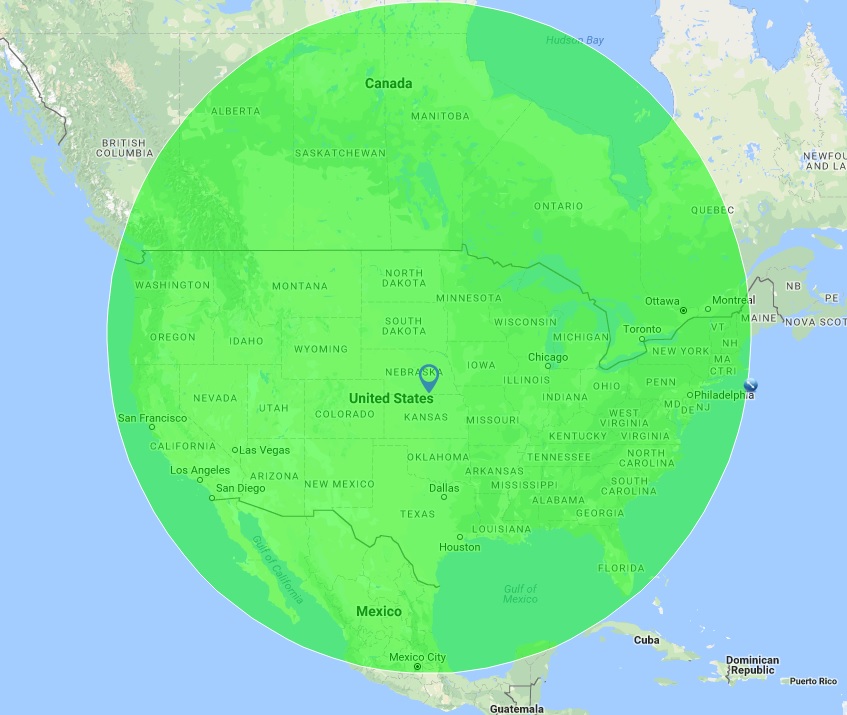
As shown in the impact study graphic included in the 2008 CRS study using Dr. Smith’s 1997 testimony, such a high altitude EMP blast could also impact most of Canada and Mexico as well as the United States, with the maximum coverage in that analysis being 1,470 miles (2365 kilometers).   Based on this study and scientific analysis, such a blast over Nebraska, U.S., with a coverage range of 1,470 miles, could reach from Mexico City, Mexico into the Canadian Northwest Territories.
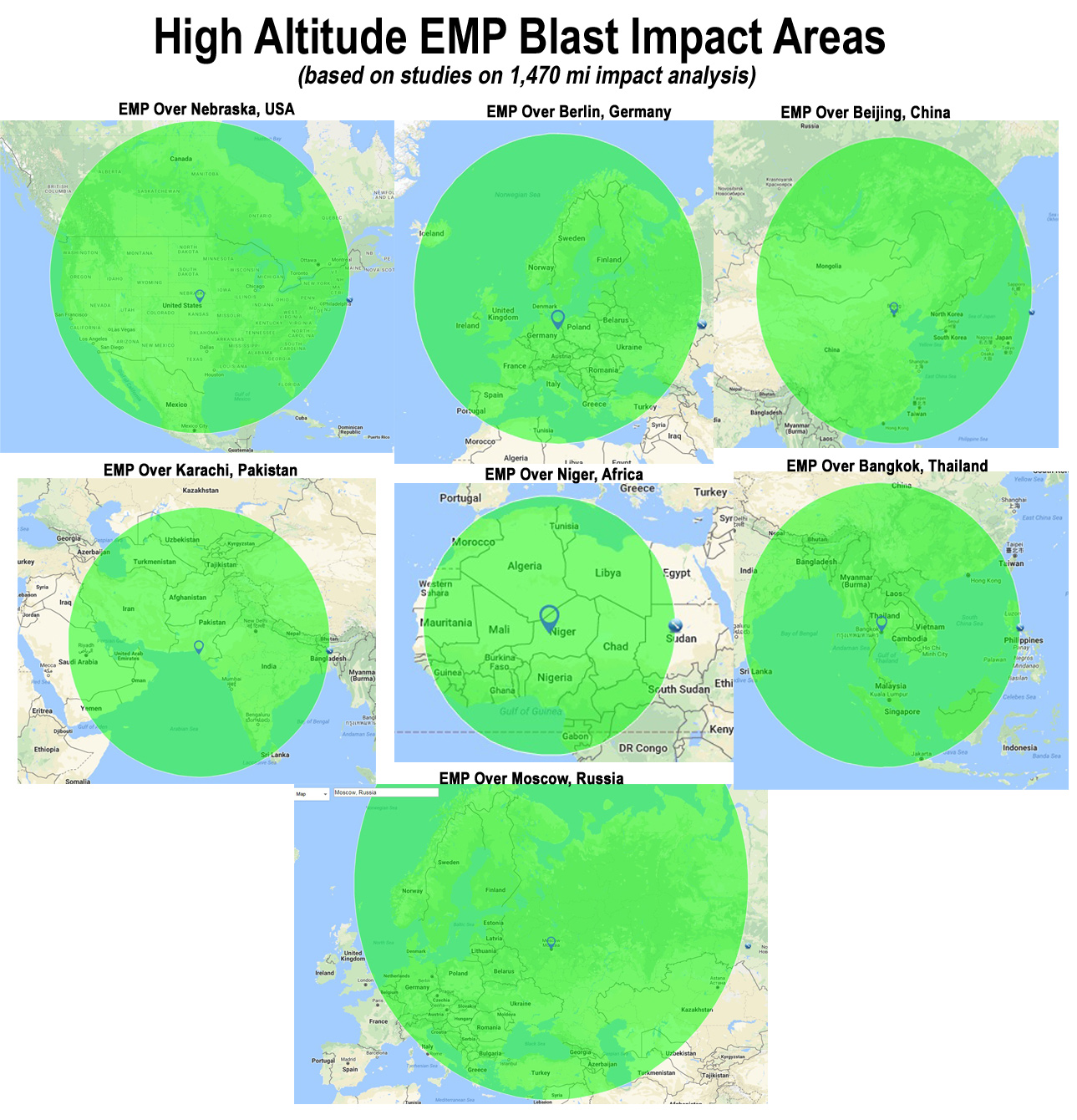
United Kingdom-based London Center for Public Policy Research and other researchers have published similar dramatic 1,470 mile high altitude EMP impact assessments.  If Dr. Smith, Dr. Ulhrich, and others assessing potential distance of a high altitude EMP blast impact are correct, what would be the impact of a 1,470 mile (2365 kilometers) coverage area be around the world?  The world media frequently forgets the large geographic size of the United States; the analysis of 1,470 mile potential coverage of a high altitude EMP blast is more than a regional or national threat, but represents a global terror threat. 

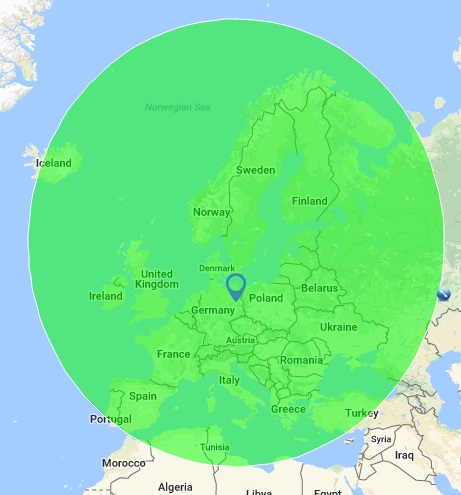
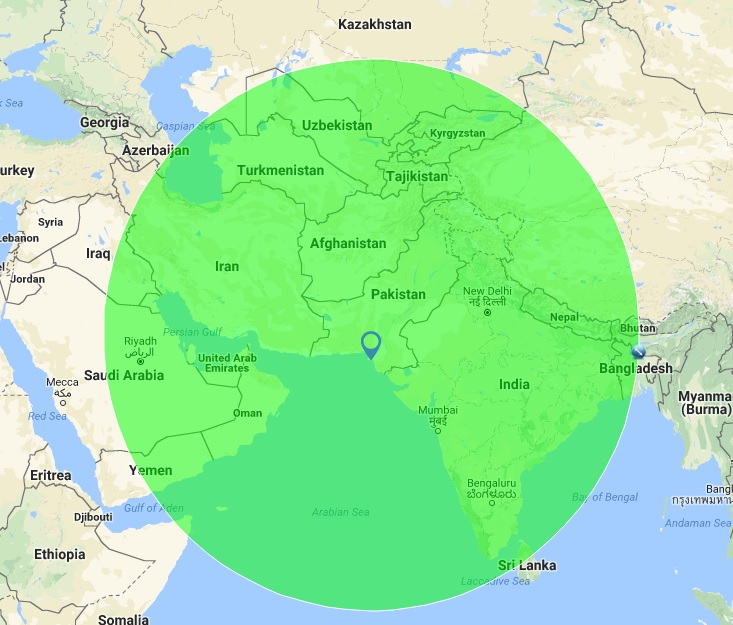
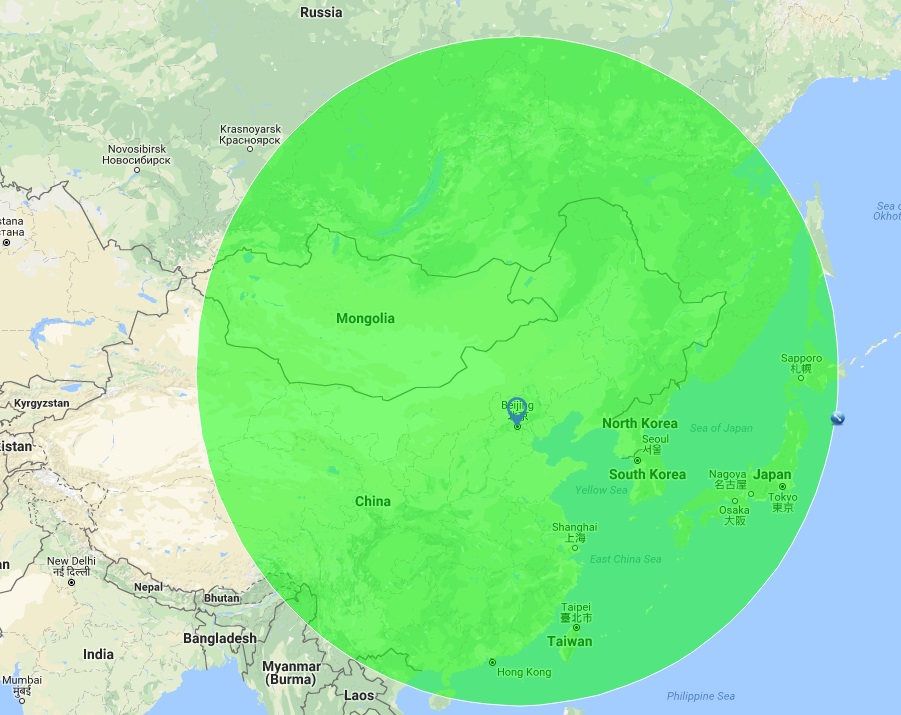
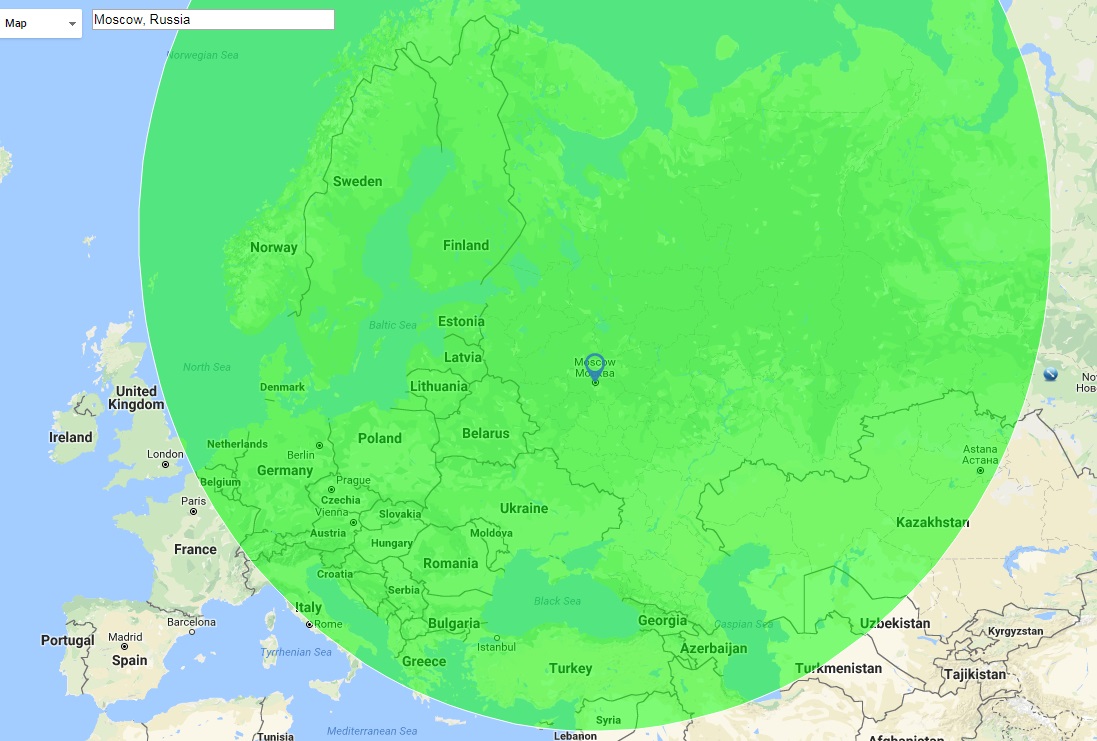
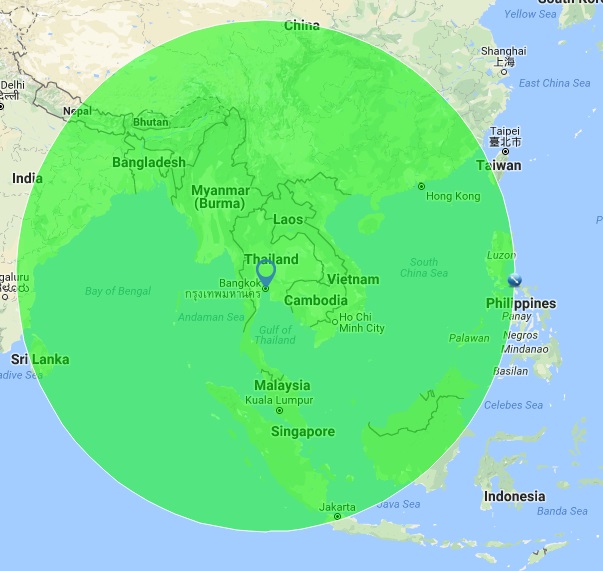
While many write about such studies and their impact on the United States, such a global threat would similarly impact any other part of the world.   To provide context of such a global threat, I have provided impact, using the 1,470 (2365 km) coverage estimate described by numerous scientists of a high-altitude EMP burst at 300 mile above the Earth.  Based on such a 1,470 mile EMP impact area assessment, such a high altitude EMP blast coverage centered above Berlin, Germany would impact ALL of Western Europe, Sweden, Norway, Finland, Denmark, Poland, Germany, Austria, Belarus, Ukraine, Romaina, France, Italy, Spain, Greece, Turkey, Spain, Portugal, including the United Kingdom and Ireland, all the way to Iceland, and across the Mediterranean Sea into Africa (Tunisia, Algeria, Morocco).  Such a 1,470 mile high altitude EMP blast coverage centered above Karchi, Pakistan would impact from Bangladesh to most of Saudi Arabia and Iraq, the Arabian Sea, from Kazakhstan to Sri Lanka.   Such a 1,470 mile high altitude EMP blast coverage centered above Beijing, China, would impact much of Asia, from parts of Russia to Myanmar,  Taiwan, North and South Korea, and Japan.  Such a 1,470 mile high altitude EMP blast coverage centered above Moscow, Russia, would impact Russia and much of Eastern Europe, Ukraine, Lithuania, Latvia, Estonia, Modova, Romania, Bulgaria, Serbia, Kazakhstan, Uzbekistan, Turkmenistan, Georgia, Azerbaijan, and most of Europe including, the northern regions of Norway, Sweden to the southern parts of Greece and Italy, reaching France and the border of the United Kingdom, and south beyond Turkey into Syria.  Similar results would be found with a blast over Bangkok impacting much of Asia, reaching from China to Jakarta, Indonesia, and with a blast over Niger, Africa, impacting much of North Africa from Gabon, Congo, Sudan, reaching north into the Mediterranean Sea all the way to Malta, and from Egypt through most of the Western Sahara.
These calculations and assessment by Dr. Smith, Dr. Ulhrich, and others, are part of a range of scientific assessments.  Yet even the most “conservative” assessments, such as Dr. Jack Liu’s interpretation of D. Hafemeister’s 1983 EMP study, also would demonstrate a catastrophic impact at any part of the world targeted by such a high altitude EMP blast.  Based on Dr. Liu’s assessment, a 250 kiloton high altitude nuclear blast would have an EMP affect over 250 kilometers, or 155 miles.  This too shows an international impact of high altitude EMP blasts, while not as far reaching in sheer miles, still impacting many millions of people across cities, states, and even across borders of different nations.

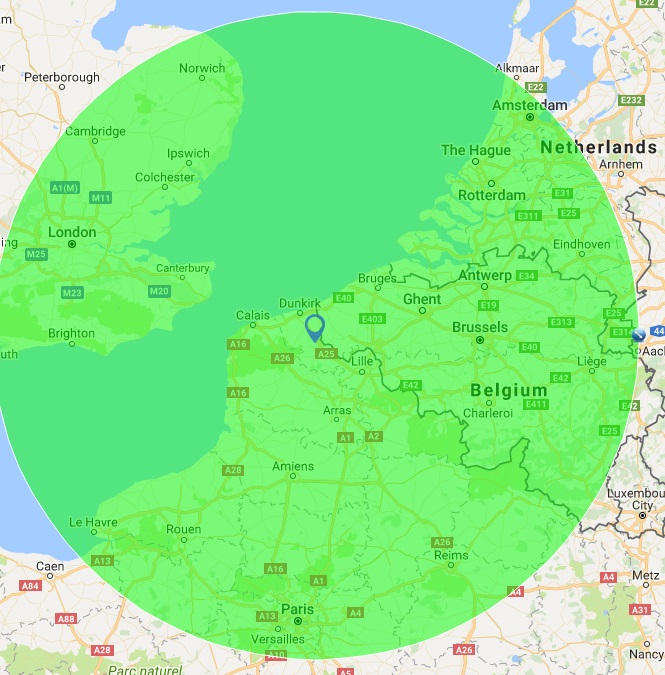
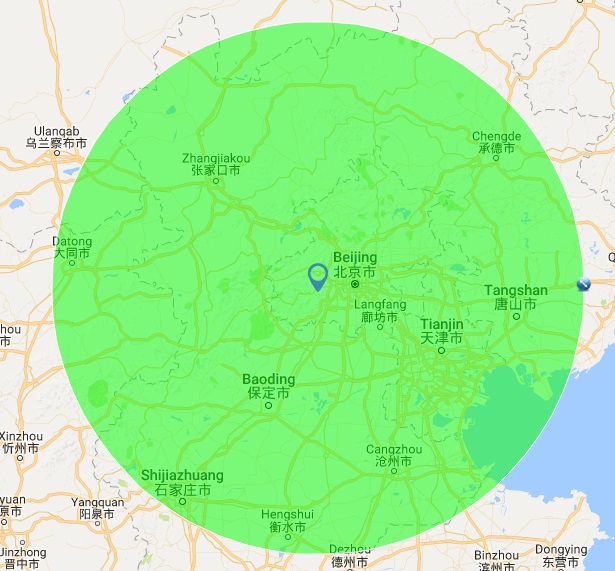
Based on such a 155 mile EMP (250 km) impact area assessment, such a high altitude EMP blast coverage centered above Dunkirk, France would impact most of France, Belgium, Netherlands, and a significant part of the United Kingdom across the English Channel, including major cities of Paris, London, Brussels,  Antwerp, Rotterdam, The Hague, and Amsterdam affecting a combined population of over 28.9 million people.  Such a 155 mile high altitude EMP blast coverage centered above Reading, Pennsylvania (USA) would impact Washington DC, New York City, Philadelphia, Baltimore, MD, Atlantic City, NJ, Connecticut, and Delaware, all the way north to Ithaca, New York, affecting a combined population of over 32 million people. Such a 155 mile high altitude EMP blast coverage centered above slightly east of Beijing, China would impact major Chinese population centers, including Beijing, Shijiazhuang, Langfang, Tianjin, Cangzhou, Baoding, Hengshui, affecting a combined population of over 73.9 million people.   Any one of these single EMP attacks would affect more than the entire population of North Korea (25 million).
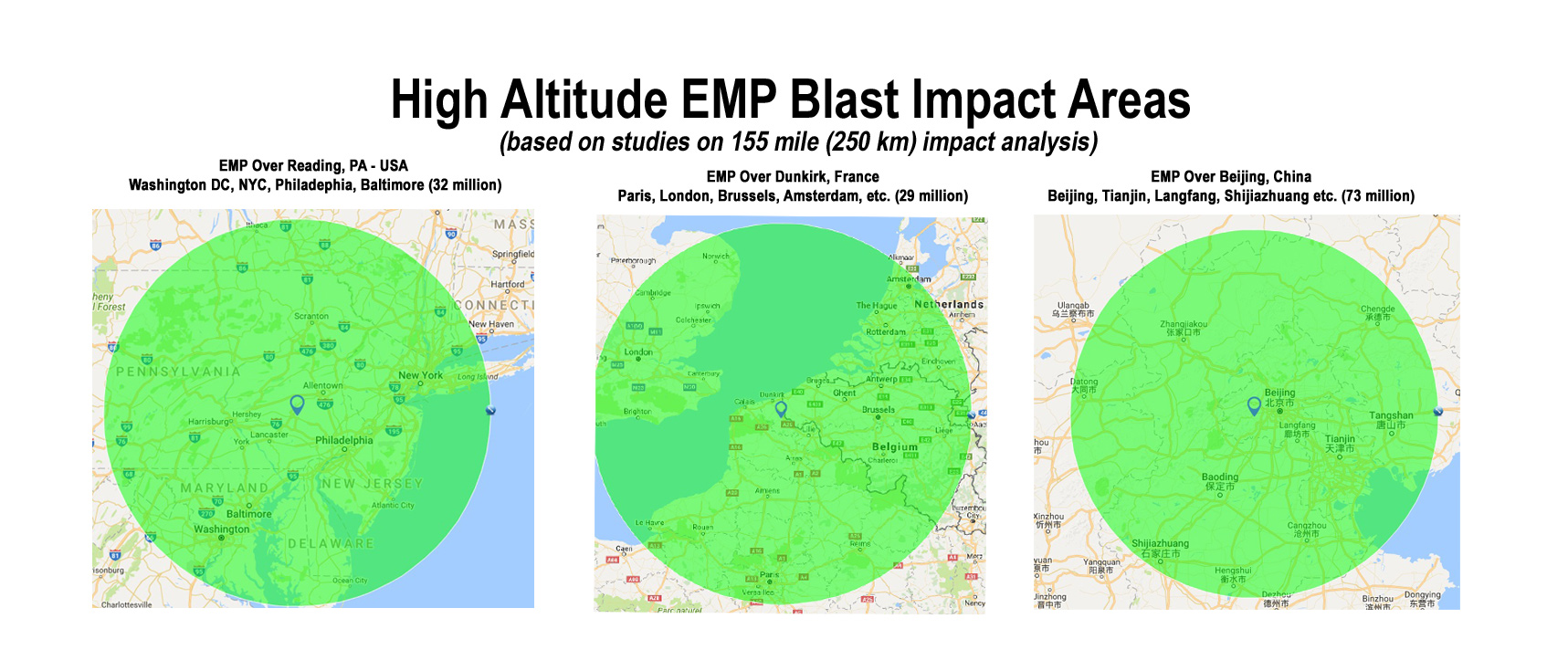
Regardless of the scientific study, analysis, or modeling used, the basic conclusions of a high altitude EMP blast, as boasted by North Korea on September 3, 2017, remains the same: the resulting impact would be a catastrophic terror attack on our fellow human beings – anywhere in the world.  The world must denounce the terror threat and contempt for human life shown by North Korea in its threat against humanity.

North Korea’s September 3, 2017 high altitude EMP blast terror threat is not simply a threat to its regional neighbors or the United States – it is a catastrophic terror threat against the WORLD.

The concept of state-based, transborder, truly “catastrophic terror” threats remains an ongoing struggle to understand and appreciate in security, military, and human rights organizations and the public.  The public hears little discussion or education on such challenges, and the concept of  “catastrophic terror” is not part of most of public’s consideration of geopolitical, security, and human rights issues.  The public is used to relatively contained terror threats that are bound to very limited areas, certainly no larger than a city or cities (with multiple attacks) at the worst.  The concept of catastrophic terror threats, impacting multiple cities, large widespread areas, are typically the worst-case views of Chemical, Biological, Nuclear, and Radiological (CBRN) analysts, seeking to plan for ways to prevent, stop, or contain airborne threats for a regional area, which thus far, the world has seen few examples of truly catastrophic terror.  The primary concern thus far in such planning has been for biological and radiological (e.g., “dirty bomb”) weapons.

What these CBRN security planners have to address catastrophic terror threats in these circumstances that you typically would not have in a high altitude EMP catastrophic terror attack is TIME.  With radiological weapons, radiation sensors would detect changes in atmosphere and allow alerts for the public to go inside within minutes and find areas of protection.  With biological weapons, spreading sickness provides a physical alert of time, and biological detection devices again provide the public with a margin of safety for containment and control.

High altitude EMP blast waves travel at nearly the speed of LIGHT.  A missile can reach from North Korea even to the remote United States within 30 minutes (or less).  By the time, it is understood that it is an EMP blast, it will be too late, the EMP damage will be done nearly instantly, as the EMP waves travel at the nearly the speed of light and would affect the targeted area almost immediately.  The luxury of TIME that is provided with most other catastrophic terror attacks is readily not provided in an EMP attack, and the nature of an EMP attack is such that it would shut down and prevent methods for any communication or warning nearly instantly after the EMP blast.  It is a uniquely difficult catastrophic terror threat to manage, and its global threat anywhere in the world must not underestimated.

In his 1997 testimony, APL Director Dr. Smith stated: “The EMP threat is unique in two respects. First, its peak field amplitude and rise rate are high. These quantities depend upon the rate of rise and the energy of the gamma ray output of the weapon. These features of EMP will induce potentially damaging voltages and currents in unprotected electronic circuits and components.  Second, the area covered by an EMP signal can be immense. As a consequence, large portions of extended power and communications networks, for example, can simultaneously be put at risk. Such far-reaching effects are peculiar to EMP. Neither natural phenomena nor any other nuclear weapon effects are so widespread.”  Dr. Smith also estimated that the EMP blast’s electric field would be “on the order of 50 kilovolts per meter with a rise time on the order of 10 nanoseconds and a decay time to half maximum of about 200 nanoseconds” (50,000 volts per meter) which is double the 25,000 volts per meter in D. Hafemeister’s 1983 study, referenced by Dr. Jack Liu and others.

On October 12, 2017, the U.S. Congress received new unclassified testimony that indicated that North Korea had obtained “Super-EMP” nuclear warheads with the capability with four times the EMP blast’s electric field as estimated by California Polytech’s D. Hafemeister, and double the EMP blast’s electric field as estimated by APL’s Dr. Smith, with the capability of an EMP blast electric field of 100,000 volts per meter.  Such new intelligence publicly provided to the U.S. Congress in October 2017, indicates that North Korea has obtained so-called “Super-EMP” nuclear warheads, designed to maximize a high level of gamma rays to generate EMP E1 pulses which would arrive over a target area at nearly the speed of light. This breakthrough may make previous EMP threat studies obsolete, as they were based on studies of nuclear EMP affects many decades ago, not the current EMP capabilities, that we now know that North Korea has today. According to such new intelligence, the North Korea “Super-EMP” nuclear warheads have EMP capabilities of “over 100,000 volts per meter.”

On October 12, 2017, Dr. Peter Vincent Pry, former Chief of Staff of the Commission to Assess the Threat to the United States from Electromagnetic Pulse (EMP) [aka “EMP Commission”], described a different threat challenge altogether. According to Dr. Pry, U.S. intelligence had learned that North Korea had obtained “Super-EMP warhead[s], capable of generating high intensity EMP fields over 100,000 volts per meter.” According to Dr. Pry’s October 12, 2017 testimony, “In 2004, two Russian generals, both EMP experts, warned the EMP Commission that the design for Russia’s Super-EMP warhead, capable of generating high intensity EMP fields over 100,000 volts per meter, was ‘accidentally’ transferred to North Korea. They also said that due to ‘brain drain,’ Russian scientists were in North Korea, as were Chinese and Pakistani scientists according to the Russians, helping with the North’s missile and nuclear weapon programs. In 2009, South Korean military intelligence told their press that Russian scientists are in North Korea helping develop an EMP nuclear weapon. In 2013, a Chinese military commentator stated North Korea has Super-EMP nuclear weapons.” “Super-EMP weapons are low-yield and designed to produce not a big kinetic explosion, but rather a high level of gamma rays, which generates the high-frequency E1 EMP that is most damaging to the broadest range of electronics. North Korean nuclear tests, including the first in 2006, whose occurrence was predicted to the EMP Commission two years in advance by the two Russian EMP experts, mostly have yields consistent with the size of a Super-EMP weapon. The Russian generals’ accurate prediction about when North Korea would perform its first nuclear test, and of a yield consistent with a Super-EMP weapon, indicates their warning about a North Korean Super-EMP weapon should be taken very seriously.”

One of the challenges in effective reporting on this terrorist threat remains the minimization of such a risk, based on years of counterterrorism thinking on this from a low altitude, microwaved-based EMP threat, or the years of “Cold War” era dismissal of this from the U.S.S.R., based on an agreed upon policy of mature government command and control resources on why we would reject “mutually assured destruction.”

So the terrorist threat of a high altitude EMP blast from a “rogue” nuclear nation has not really been taken very seriously, as the potential actors who might perform such an attack either did not have anything close the capability of this, or had a mature enough military infrastructure to respect the consequences.

So the high altitude EMP blast threat has not been taken seriously until now with the isolated, totalitarian nation of North Korea. Yet even today, a number of factors prevents the public from fully appreciating the terror threat that North Korea represents not only to the region and to the U.S., but to the world.

Thus far, the inability for the public to take this North Korea terror threat seriously is compounded by a number of factors: (1) an unwarranted belief that North Korea does not have significant missile launch capability, (2) an overconfidence that we can consistently eliminate missile threats from North Korea and that North Korea’s ability to target specific cities with a nuclear missile is limited, (3) political partisan personalities viewed as the “real threat” rather than the North Korea years of determination to develop weapons capabilities across many U.S. administrations, (4) the failure to understand that North Korea plans to not only survive a nuclear exchange but win it, (5) the denial that there is “no proof” that an EMP blast will affect electric infrastructure and electronics, and (6) the failure to understand that North Korea’s threat, especially its EMP terror threat is not only a threat to the U.S., but to the world.

Underestimation of North Korea Weapons Capability. The belief that North Korea does not have significant missile launch capability is grounded in Western arrogance and largely disrespect for the North Korean leader Kim Jong Un, as well as some degree of unstated racist views towards North Koreans as “backwards.” Such denial of North Korea weapons capability has increasingly been shown to ignore or be behind publicly demonstrated facts, and a high altitude EMP blast 300 miles in the atmosphere doesn’t sound so impossible when one considers that North Korea launched a missile 2,300 miles into the atmosphere just three months ago. On July 28, 2017, North Korea fired an ICBM missile (Hwasong-14) at an elevated trajectory of 3,700 kilometers (2,300 miles) high and for a distance of 1,000 kilometers (621 miles). On a flatter, standard trajectory, this missile would have traveled along a significantly broader distance, up to 10,400 kilometers (6,500 miles), and some analysts believe North Korea is currently building capability for missile strike of 11,700 kilometers (7,250 miles). Based on a standard trajectory of such a distance, this would have given North Korea the capability to hit deep within the mainland U.S. For context, from a fixed launch made within the North Korea soil, a launch of a missile reaching 6,500 miles could target Chicago, while a missile reaching 7,250 miles could readily target anywhere on the East Coast, including Washington DC (6,850 mi), NYC (6,750 mi), and Boston (6,700 mi). The July launch basically provided evidence that North Korea was only about 200-300 miles away in terms of missile technology of a direct strike on the United States East Coast.  It should be noted than on May 2017, two months before the July missile launch, there was still a widely believed perception that North Korea’s missile capability could only reach to a distance of 3,000 miles.  Furthermore, also as of May 2017, experts on North Korea were still reporting that North Korea’s nuclear bomb capability was only 20 kilotons and assessing threats based on this dramatically outdated intelligence, but by September 3, this was re-assessed as 120 kilotons and shortly thereafter as 250 kilotons.  The North Korea experts have repeatedly underestimated North Korea’s weapons capabilities.
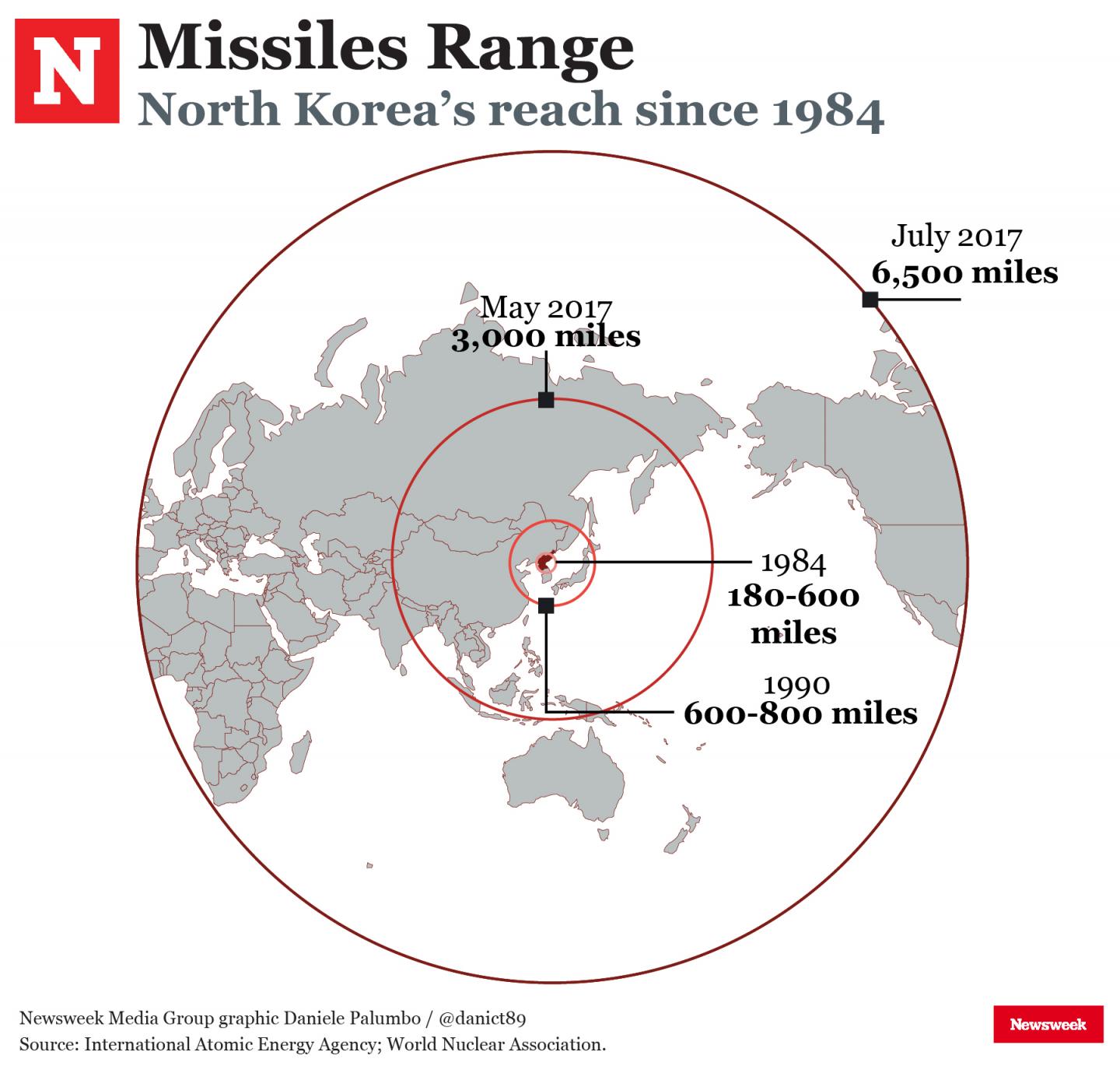
On October 20, 2017, the CIA Director Mike Pompeo warned that North Korea is on the cusp of being able to hit the U.S. with a nuclear missile. He stated “They are close enough now in their capabilities that from a U.S. policy perspective we ought to behave as if we are on the cusp of them achieving.” “We are not out of time… But we are running out of time.” NK News reported that he remarked “U.S. intelligence on the progress of Pyongyang’s nuclear and ballistic missile development was imprecise, he stipulated, saying that ‘when you’re now talking about months, our capacity to understand that at a detailed level is in some sense irrelevant’.” North Korea has demonstrated the ability to have missile launches at high altitudes over land masses; the North Korea September 15, 2017 missile launch over the Japanese island of Hokkaido, was reported as 475 miles in the atmosphere (770 kilometers) over Japan at the apogee of its flight path.   Another limitation that the U.S. has on the missile challenge is the belief that North Korea’s mobile missile launching capability is only limited to launches from its mainland, when it has been continuing to improve and test on Submarine Based Launch Missiles (SBLM) for a long time, with a fleet of a reported 60 submarines.  Too many in the U.S. are overconfident that only land-launched North Korea missiles can be easily targeted by U.S. missile intercept defenses, with the assumption that North Korea can only launch high altitude missiles over Guam towards the U.S., and that our intercept defenses can be sufficient to deal with a cluster of missiles that could be launched with a nuclear and/or nuclear EMP missile within a missile cluster.  Individuals interviewed in defense roles continue to state that they believe the North Korea still has a significant amount of development yet to complete in missile guidance and re-entry capability.  This confidence does not take into consideration that for a high-altitude EMP missile, re-entry and missile guidance for pinpoint surface attacks are not a necessity.

Missile Defense and Complex, Catastrophic Terror Threat. Given the vast expenditures in missile defense systems, Americans certainly do seek to have confidence in their effectiveness in stopping missiles launched at the United States. However, that confidence should also be based on an understanding of what such defense systems actually do. Shipboard Aegis systems are designed to target specific types of missiles, and are designed to defend thousands of square kilometers. However, to be able to shoot down a missile such as the one launched by North Korea on September 15, 2017 over Japan with an apogee of 475 miles in the atmosphere, a U.S. ship with a Aegis missile defense would need to be virtually in North Korea waters and would have to be ready to strike nearly instantly with the short 1-to-2 minute timeframe to “chase” such a missile in the air at such altitudes. THAAD and Patriot missile defenses are designed for missiles coming down, in the post-mid-course or terminal phases. So essentially other than planning to have perfect readiness and success with Aegis, the U.S. missile defense is largely dependent on the Ground-Based Midcourse Defense (GMD) interceptors based in Alaska and California. In July 2017, the Washington Post reported that Pentagon’s leading weapons tester, the Directorate of Operational Test and Evaluation, found that in staged tests, the GMD system took out test missile in 10 out of 17 tests, and a recent CBS “60 minutes” interview suggested that the GMD interceptor system was showing a “55 percent success rate”  in terms of its defensive capabilities. Most importantly, to understand in the case of the North Korea EMP threat, the missile needs only to explode in the atmosphere. It does not have to have “re-entry” capability like other nuclear surface missiles, nor does it need to have a precision “targeting” system to hit a specific targeted city.

Politics and the Actual North Korea Threat. We know from history that terrorist violence against the public impacts people from every political viewpoint, which is why it is essential that terror threats be impartially assessed based on public safety issues, not political concerns or partisan views.  In the politically charged atmosphere of the United States, political partisans (and particularly the U.S. political media) are more focused on U.S. President Trump than on the ongoing North Korea terrorist threat situation. The reality is that the North Korea terror threat will exist no matter who is in public office in the U.S., and it is a threat that has been building for many decades across multiple administrations controlled by different political parties.  There are those who are more interested in proving President Trump is “wrong” on anything as their real priority, rather than objectively assessing the situation that has been developing for a long time with North Korea, including a nuclear bomb and missile tests during President Obama’s administration. On November 4, 2017, New York Times writer Nicholas Kristof wrote: “Trump didn’t create the problem, and it’s real: We should fear North Korea’s gaining the capacity to destroy U.S. cities. Eerily, on my last visit, North Koreans repeatedly said that a nuclear war with the U.S. was not only survivable but winnable.” Mr. Kristof is neither a fan of President Trump, nor is he “conservative.” But in a charged political world, there is reality that some facts actually exist as facts, regardless of one’s political viewpoints. North Korea has been working to develop such aggressive weapons capabilities for a long-time, including working with Pakistan nuclear physicist Abdul Qadeer Khan, which Mr. Khan admitted to in 2004, and which began as early as 1993. North Korea did not simply begin its nuclear bomb ambitions in 2017 after President Trump took office, but has been actively involved in seeking to develop nuclear bombs for decades. These historical facts are conveniently forgotten by the U.S. political media when reporting on the North Korea’s nuclear bomb and ICBM breakthroughs in 2017, as if these are “sudden” advancements, rather than the achievements of decades of work, testing, and determination by North Korea. The idea that North Korea could threaten not only nuclear bomb attacks, but also a high altitude EMP threat, which could impact a much larger segment of the world, and the focus remains primarily on the U.S. administration, demonstrates how significantly the U.S. media is failing to recognize the very real and serious security and human rights threat that North Korea presents to the world.
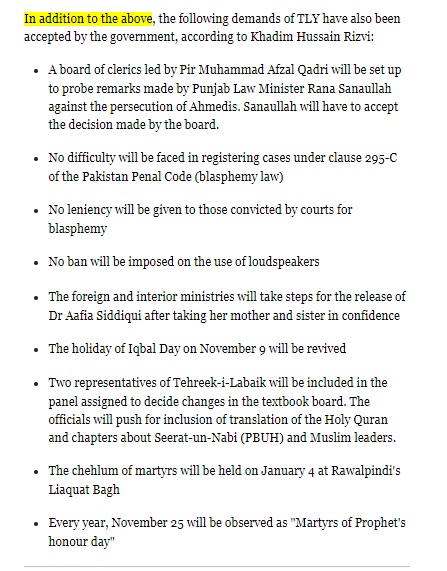
North Korea Confidence in Winning Nuclear Exchange.  Multiple U.S. media figures have interviewed North Korea government leaders with astonishment over the North Korea lack of concern, even confidence, in a nuclear war with the United States.  The message that Americans are failing to understand is that there are leaders in North Korea that not only expect to “survive” a nuclear war exchange with the United States, but also to be victorious in such a war.   Such report have come from Nicholas Kristoff (New York Times)and Evan Osnos (New Yorker). The NYT’s Nicholas Kristof wrote that North Korea governments leaders view “nuclear war is imminent but survivable.” “This military mobilization is accompanied by the ubiquitous assumption that North Korea could not only survive a nuclear conflict, but also win it.” In addition, according to Kristof, the North Korea people also believe this: “Ryang Song-chol, a 41-year-old factory worker, looked surprised when I asked if his country could survive a war with America. ‘We would certainly win,’ he said.” Kristof has also appeared on NBC television sharing this report.

The New Yorker’s Evan Osnos reported a similar discussion with North Korea government representatives, including North Korea Foreign Ministry’s Pak Song Il, who told Osnos “‘A few thousand would survive,’ Pak said. ‘And the military would say, ‘Who cares? As long as the United States is destroyed, then we are all starting for the same line again.’ He added, ‘A lot of people would die. But not everyone would die.” Osnos also wrote: “In the event of a nuclear war, American strategists assume that North Korea would first launch a nuclear or chemical weapon at an American military base in Japan or Guam, in the belief that the U.S. would then hold its fire, rather than risk a strike on its mainland. I mentioned that to Pak, but he countered with a different view. ‘The point of nuclear war is to give total destruction to another party,’ he said. ‘There are no moves, no maneuvers. That’s a conventional war.’ ”

Like other extremists, the North Korea state-based terror views global threats using nuclear and EMP devices to further the cause of their goals in Korean unification as well as mass violence and destruction towards any that oppose their ambitions.  North Korea does not need nuclear weapons or EMP blasts for “deterrence” in preserving its regime, any more than it has needed such weapons of mass destruction over the past 64 years since the armistice (July 27, 1953) in the Korea War to preserve the North Korea regime.  North Korea has had deterrence for all of these decades by its armed proximity to U.S. ally nations, which it has regularly threatened to use its existing weapons against such area U.S. ally nations, as methods of North Korea world policy.  The claims that it now needs such advanced weapons to ensure “deterrence” are based on those unfamiliar with history.

False Claims of Lack of “Proof” of EMP Threats.  Despite the magnitude of a nuclear dictatorship threatening to use a high altitude EMP weapon against the world, there are those who find a receptive U.S. media in claiming there is no real “proof” that EMP weapons are a threat.  On November 1, 2017, Wired Magazine’s Brian Barrett provided a voice to such dismissal of EMP threats in an article entitled “North Korea’s Plenty Scary Without an Overhyped EMP Threat.”  Wired Magazine used to be focused on technology issues, but in recent years, has migrated to focus on cultural and political topics.  Brian Barrett focuses his explanation on how EMP is an “overhyped threat,” by referencing to a 91-year old former Maryland Congressman Roscoe Bartlett, who Brian Barrett believes has exaggerated the EMP threat.  (Mr. Bartlett lives in a remote location, not dependent on electronic technology.)

Wired writer Brian Barrett has ready access to all of the scientific testimony, is aware of the 1962 Starfish Prime testing, and is aware of documented studies and testimony from physicists and scientists, so there is no lack of information in this case.  It is simply Wired writer Brian Barrett’s choice to believes the way to “prove” that EMP is “overhyped” is by targeting a retired politician.  This is the challenge with an increasing political focus of U.S. media on virtually every topic.  But when it comes to catastrophic terror threats, such political tunnel vision is more than short-sighted, but it is openly dangerous in public policy discussions.   Wired writer Brian Barrett also interviews Dr. Peter Pry, but Barrett seeks to reject Dr. Pry’s views because the EMP Commission that Dr. Pry was leading did not get funds for continuing in FY 2018.

Ignoring most of the other physicists, scientists from John Hopkins’ Applied Physics Laboratory, California Polytechnic University, and MIT associated with EMP studies, Wired writer Brian Barrett also interviews two other individuals, Philip Coyle and  Sharon Burke.  Philip Coyle is a senior science fellow at the Center for Arms Control and Non-Proliferation, and is not an expert in EMP studies, but this is primary “expert” that Wired journalist uses to try to discredit EMP threats (which we know for a fact since 1962 exist).  Barrett concludes simply that Coyle is “skeptical as to the true impact of the type of nuclear-based attack outlined by the EMP Commission.”  Barrett quotes Coyle as stating “I don’t know how the proponents of EMP get such huge results. I just don’t follow their logic.”  Wired writer Brian Barrett does not state what “huge results” that Philip Coyle doubts or what “logic” he is questioning, he just simply provides such a vague quote as his type of “proof” that “people” question EMP threats and moves on.  Wired writer also quotes Sharon Burke with the New America Foundation, who states “There’s still not proof that it would destroy a wide area of electrical equipment today,” ignoring the actual test results seen in the 1962 high altitude Starfish Prime nuclear test, and repeated documented testimony from  Dr. Gary L. Smith, Director, Applied Physics Laboratory (APL), Johns Hopkins University, Dr. George W. Ullrich, Deputy Director, Defense Special Weapons Agency, and others who actually had direct knowledge of such tests and EMP impacts.

One of the repeated recommendation of EMP scientists and physicists was that the Defense Department improve its protection and readiness for electrical equipment from an EMP blast.  Reportedly efforts to do so have been scaled back or halted in recent years. New America Foundation’s Sharon Burke, quoted by Wired writer Brian Barrett, as claiming there is “no proof” of the EMP threat, also previously served in the Assistant Secretary of Defense for Operational Energy in the Obama administration.   In her statements of the lack of “proof” by high altitude EMP nuclear blasts, Sharon Burke (and Wired writer Brian Barrett) conveniently neglect to mention that meaningful tests would be prohibited under the Comprehensive Nuclear-Test-Ban Treaty, signed by the United States in 1996.

As to the issue of “proof” of consequences of a high altitude EMP nuclear blast, the only true scientific “proof” would be to have more high altitude nuclear EMP blasts (which we cannot do under the 1996 Comprehensive Nuclear-Test-Ban Treaty.)  We also haven’t done such tests, due to a lack of interest or unwillingness to gather information, but for the obvious reason that the tests done thus far demonstrated a significant danger and risk to public safety and electrical infrastructure, that full scale public “testing” would be a threat to the public to repeat.  Like other terror threats, we do not need to do full scale public testing of every threat to recognize the danger.  We do not regularly conduct public radiological “dirty bomb” tests.  We do not regularly conduct weaponized smallpox or anthrax tests on the public, or conduct cyanide or ricin chemical weapon tests in public conditions to ensure that we have absolute “proof” that they will “work.”  As high altitude EMP blasts actually interact with the Earth’s atmosphere and magnetic fields, the idea that without more “proof” in the field, we can’t really believe it is a threat is reckless. Scientists conduct laboratory tests to mimic conditions to the extent possible, but the argument that with “field tests” of any terror threats, we don’t have “proof” of the threat is not rational.

Failure to Grasp EMP as a Global Threat.  The idea that a high altitude EMP blast is an American problem is as illogical and irresponsible as suggesting that any other type of terror threat, natural disaster, and threat to our shared human rights of security is limited only to one geographic area or region.  The reality is that a terror threat or any type of natural disaster can endanger the public in any part of the world, and our shared human rights of security should gain the focus of human rights activists on the lives and safety of people anywhere in the world threatened by weapons and acts of terror.   As R.E.A.L. has pointed out such high altitude EMP blasts, even with the most conservative estimates, can impact not only millions in diverse cities, states, and regions, but also in multiple countries with a single high altitude EMP blast.  High altitude EMP weapons represent a global terror threat to all of the world.  Among other nations of the world facing catastrophic terror from such weapons, R.E.A.L. points to Communist China to reconsider even the most conservative EMP terror weapon would have over the Beijing area, and the likely 73 million impacted by such an attack.  It is troubling to see the failure of security analysts to bring such an obvious incentive to China’s attention in dealing with the North Korea threat to world peace and security.
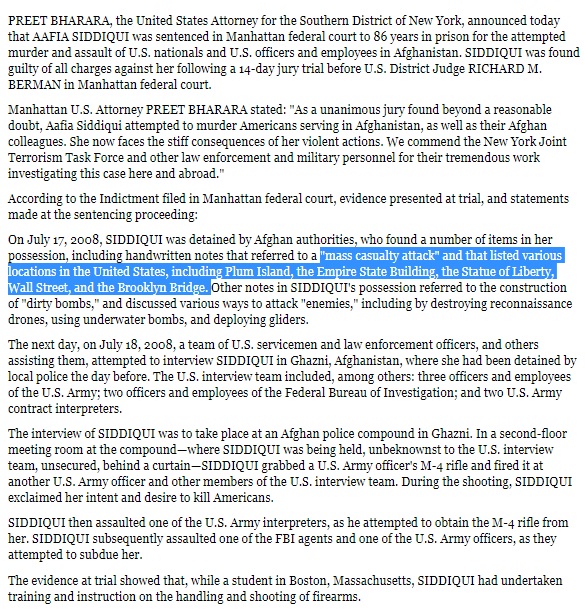
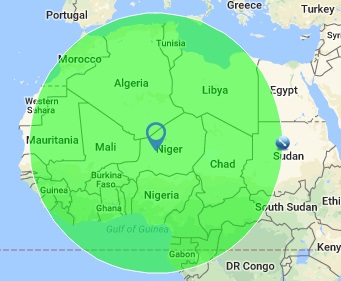
The concept that a high altitude EMP blast is a “military weapon” is as misguided and reckless as the idea that weaponized anthrax, ricin, cyanide, or other banned weapons are acceptable as anything less than weapons of terror in the 21st century.  We have international conventions which explicitly ban the use and stockpiling of such weapons by responsible nations for military purposes, but we have yet to ban the use of high altitude EMP weapons.  We recognize other banned weapons as used by those supporting acts of terror, and it is time to recognize high altitude EMP weapons as the same type of banned weapon, as biological and chemical weapons, only to be used by terrorist actors.

R.E.A.L. has not sought to provide this description of the North Korea call for a catastrophic terror threat using high altitude EMP blast as anything more than to recognize that this is a terror threat, and moreover, it is a global terror threat, not just a terror threat to the United States of America.  With that basis, there is enough serious threat information on high altitude EMP blasts that those supporting our shared human rights and security need to take such a catastrophic terror threat seriously.   Terror attacks rarely target individuals of only one political or identity group, despite the intent of terrorist actors.  We know all too well the painful lessons of failing to take terror threats seriously, and the U.S. and the world has paid the price in suffering and the loss of innocents lives repeatedly.

We can learn our lessons from the past.  We can work as nations to have better infrastructure and individual preparedness against such threats. The nations of the world can also unite in their determination that those individual terrorist actors, or state sponsors of terror such as North Korea, know that the world will not accept and will not stand by as threats or acts of catastrophic terror are made against our fellow human beings.

To North Korea and its leaders, as R.E.A.L. has repeatedly stated and implored in your language to you, we urge to stop your path of threats of catastrophic terror and nuclear bomb violence against the world, and renounce such unnecessary and suicidal weapons of mass destruction that will bring no peace to your nation, the region, or the world.