U.S. Law Enforcement “Leakers” Endanger Public Safety and Trust

U.S. law enforcement’s accomplishments are dependent on a shared law, shared mission of public safety and equal enforcement of the law, and dependent on the public trusting law enforcement organizations and agents. While in this case, the subject is about U.S. law enforcement, such basic standards apply in any free and democratic nation. A mission for public safety is dependent on public trust. Those that undermine public trust, don’t simply undermine trust in themselves or their agency, they undermine trust in all members of the law enforcement and justice community.

U.S. law enforcement communications with the news media must have the following primary objectives: (a) provide public and accountable reports on information essential to public safety, (b) provide public and accountable reports on progress on ongoing investigations and law enforcement activity without compromising sensitive and legal matters, (c) provide public awareness information on other general organizational information activities, such as meetings, events, facilities, etc. In a representative democratic nation, the law is enforced equally for all individuals, regardless of the political affiliation, identity group, or station in life.

We must expect our law enforcement, at every level, to be apolitical, just as we expect our military, our hospitals, and any other essential public safety organization.

Equality under the law is an essential art of public trust in law enforcement. Furthermore, that trust is dependent on public communications that confirm equality, fairness, and lack of bias in the values and standards shown by the law enforcement organization’s actions.

In a representative democratic nation, it is noticeable that none of the law enforcement communications objectives are: (1) spying, (2) planting rumors, (3) political targets, (4) seeking to undermine other government organizations or individuals. This is not the role of law enforcement in a representative democratic nation. The concept behind governance in a representative democratic nation is that our public officials and servants represent “the people,” not themselves, not their interests in shaping the nation to fit their views, not in political activism.

Those concerned about human rights regularly see such abuses of law enforcement authority with the news media in Communist totalitarian and other dictatorial nations, which have contempt and hate for representative democracy and public representation processes. In an anti-freedom, totalitarian nation the term “law enforcement” means “power enforcement” for the privileged and powerful. There is no intention of representing “the people,” but simply preserving power for the powerful, at any cost, and manipulating “the law” to read whatever the powerful want it to read. Those who care about human rights regularly protest such abusive forms of human persecution, and the persecutors use of “law enforcement” stage-actors abuse of law and justice to simply maintain, control, and manipulate power.

In the former Communist totalitarian East Germany, the East German secret police (Ministerium für Staatssicherheit aka “Stasi”) organization used a series of harassment tactics, or “Zersetzung” to infiltrate, spy, sabotage, and spread rumors about those they sought to prevent from gaining power. The Stasi tactics were part of late 20th century efforts to manipulate the public, up to the fall of the Berlin Wall in 1989. The massive 91,000 Stasi bureaucracy was three times the size of Adolf Hitler’s Gestapo. But given the post World War II environment, the Stasi needed to use subtler methods that concentration death camps for those that became “enemies of society.”

The Stasi police organization sought to psychologically isolate and trample its “enemies” using rumor, innuendo, and manipulating the minds of others. As researcher Max Hertzberg has written on Stasi Zersetzung tactics, its efforts at “intelligence from surveillance and the use of informants was rarely used to actually gain evidence for a prosecution.”

The Stasi “law enforcement” was not interested in actually prosecuting, but in spreading rumors through public and state-controlled media to undermine the credibility of individuals they opposed, and to create a sense of insecurity and paranoia in individuals they opposed. The Stasi tactics of “Zersetzung” method of spreading rumors would often use plausible untruths based on some real facts that would be difficult to refute.

In our world history, there is a good reason why in representative democracies, our law enforcement communications with news media focuses on verifiable facts that are specific to the law enforcement mission.

In my personal career, I worked many years ago with the Federal Bureau of Investigation (FBI). This knowledge of respect and sensitivity by those using law enforcement authority was well-known among all employees, no matter what your role was. Responsible individuals in law enforcement, including the FBI, are well aware of the essential need for focus on public and media communications consistent with respect for the law enforcement mission.  They really don’t need to be told right from wrong, and what is appropriate in terms of media communications.  They KNOW.

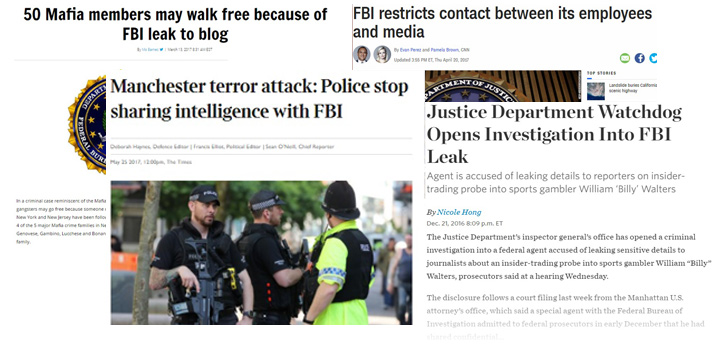
So, this week as the United Kingdom announced that it was going to stop sharing information with the FBI after a leak on an ongoing counterterrorism investigation that had taken so many lives in the UK, all of us connected in any form with a history in law enforcement must have been stunned. A reminder to all – one of the victims in the Manchester terrorist attack was an off-duty police officer. The importance of protecting counterterrorism information during an investigation of a terrorist mass-murder, including a fellow member of law enforcement, should not have to be explained to anyone.  This breach of trust must be investigated.

There is no excuse for this, and unfortunately there has been no public statement by the Interim Director of the FBI Andrew McCabe on this subject. R.E.A.L. urges the Interim Director to make a clear statement how the FBI values and respects the law enforcement trust and the partner trust that it has with the citizens of the United States and our global partners.  What is really missing is a lack of outrage, anger, and frustration heard from leadership in the FBI and law enforcement regarding leaks abusing law enforcement authority.  I can tell you that, of the 30,000+ working for the FBI, they are chosen largely because of their commitment to integrity.  I want to provide a voice for those others who we must hope share such outrage on this abuse of authority by leakers.

Three years ago, the U.S. Directive on National Intelligence (DNI) signed Intelligence Community Directive 119, under which intelligence information was to be protected from unauthorized disclosure, excluding whistleblower information on fraud. Part of the idea behind ICD 119 was to protect intelligence service “leakers” from being used to spread information to news media for political manipulation and persecution of individuals.

There are reports that the FBI is now modifying its media contact policies to limit media contacts to field office managers and public relations employees.  Unfortunately, over the past several years, we have continued to see this problem with leaks. But even after the recently reported changes on media contact management, we are seeing increasing alleged reports from anonymous FBI individuals to the news media, including those making actual threats against other member of the U.S. government. In any representative democracy, a law enforcement agency whose members use the news media to make anonymous threats against anyone else – has to be completely unacceptable. The idea that law enforcement in any representative democracy can use such political tactics completely undermines the public trust and commitment to public safety, which is the mission of our law enforcement.

Let us also remind all members of law enforcement, yes, it is OUR law enforcement, not YOUR law enforcement. That is how a representative democracy works.

We are keenly aware of the dangers of politicizing law enforcement in a way that will undermine a consistent commitment to public safety and trust. But after this embarrassing disgrace involving the Manchester terrorist investigation and the very public statements by the U.K. that it would stop sharing counterterrorism information with the FBI, there needs to be a stronger position mandated and real action by the U.S. Attorney General on this issue.

We measure the value of our law enforcement in their commitment to equality and integrity to the law, not by cunning and political acumen.  That is the hallmark of a democratic society.

A representative democracy, in the U.S., or any other country depends on not only the fidelity and bravery of our law enforcement to equal treatment of all cases under the law, it also depends on the integrity of our law enforcement to put the interest of public safety and public trust as their priority, and leave their personal and political aspirations out of the performance of the authority we have given them to represent us all.
Terrorist Threats and Need for a Public Safety Accountability Act

In challenging the destruction of terrorist threats on society, we not only need accountability for defying extremist ideologies that inspire terrorists and those who commit and assist in terrorist acts, but we also need accountability on those who have information on terrorist threats to public safety, but choose to withhold that information or fail to act on it to defend the public. In the United States of America, the United Kingdom, and other nations of the world, we need a clear, unambiguous law which defines such public safety accountability, with concrete, criminal, consequences for those that withhold information or those with such information that fail to act to protect the public.

As we witness continuing terrorist acts around the world, the most horrible truth is that too many know about terrorist threats to the public, but maliciously choose to do nothing to protect the public. The silence prior to such terrorist attacks on an unsuspecting society needs to stop. We need more than friendly slogans, “see something, say something,” to inspire confidence in public to play in active role in providing information on terrorist threats. We need to migrate from the casual volunteerism of “see something, say something” to a more severe “see something, say something, because it’s the law.”

Our legal systems must accommodate a new law that mandates accountability for those who know, but maliciously conceal such information, and those who know, but consciously fail to act on such information. Certainly, failure to provide information and failing to act on terrorist threats to the public is one of the most gross violations of “obstruction of justice” that we could imagine. Yet such “obstruction of justice” when it comes to information and action on terrorist threats happens on a regular basis, every single day, and even worse, it has too often been defended as part of public government policy.

People of conscience, and those committed to our universal human rights (which includes human security), must find the continuing malicious silence and inaction on terrorist threats as completely unacceptable. We must have a public safety accountability act to set expectations of a legal responsibility to provide information on terrorist threats, and to also expect accountability of our government to act on such threats. The public is threatened by sociopath terrorists which have no respect for law, and no concern about death, even their own. The idea that we can continue to allow such anti-life figures to kill and injure with impunity, while we have no accountability for those who could have stopped such acts, is the absolute height of social lack of responsibility and contempt for human rights.

The public safety of our citizens, our children, our families, our neighbors, our communities also should not be an afterthought to government authorities more concerned about intelligence spy-games than the real and present danger that such terrorist actors pose to public safety and lives. They have no right to play chess with the lives of our families, our children, and our communities. A cohesive, competent, and just society must demand accountability and consequences for malicious, Machiavellian, manipulations by those who have lost sight that our society is composed of other living, breathing human beings with dreams and purpose of their own.

In the United Kingdom today, we see children and families who have suffered yet another terrorist loss from a terrorist bombing atrocity this week. Civilized societies must not just ask, but must demand that the public provide information known to it regarding terrorist threats. It is also yet another discouraging case, where we learn that “intelligence” agencies knew about this terrorist mass-murderer of children, who apparently traveled to Libya to gain training, but he was never arrested for his involvement with Libyan extremists. Less than a year ago, Washington D.C. had a similar case of a Libya-trained ISIS terrorist supporter walking the street, but working as a police officer with the Washington subway system that hundreds of thousands regularly use, while this was known to the FBI. Our society must expect more from our fellow citizens, and those who work on our behalf in our governments.

As described in January 2017, R.E.A.L. has also proposed protective acts for human rights safety from those who have been engaged in terrorist planning, with a specific recommendation for a “Terrorism Prevention and Public Protection Act.” But our legal system must recognize that terrorist plots and terrorist training constitute criminal behavior. Our law enforcement should not have to wait until our children and public are murdered in the street by such sociopath terrorist actors, any more than we would wait for an arsonist plotting to burn down a building, must actually burn our public to death, before he is arrested. In view of the continuing global terrorist threats, our legal system must adopt some common sense respect for the public’s human rights, security, and dignity, to allow our society to continue to have cohesion and respect for the law, our authorities, and one another.

The inhuman cruelty and total disregard for life and public safety by 21st century terrorist actors cannot be fought only by a legal system designed for a 19th and 20th century world and criminal activity. We must recognize that modern, rapid terrorist threats demand that our legal system must move beyond passive non-consequentialism, which has been accepted by too many who shield those who enable harm by their malicious non-actions. The massive threat to public safety by the 21st century global terrorist movement networks is unlike previous criminal organizations and campaigns. We cannot continue to ignore wrongful conduct in our 21st century by malicious failure to act in providing information or failing to act, regarding terrorist threats to our public society.

This must require a new public act which imposes a pre-existing legal duty to act to the public to provide information, and to the government to act, on issues of public safety due to modern terrorist threats. Continuing to allow such duties to be “optional” ignores the very real and present, not hypothetical, instances of how such non-action enables harm. Those who choose to conceal information regarding terrorist threats and those in authority who choose not to act on information regarding terrorist threats must face more than social condemnation; they must face legal responsibility for their choices, as malicious and public endangerment.

The “rationale” for such malicious public endangerment by those empowering terrorists to act with impunity, by choosing to conceal such information regarding threats because to reveal this would make someone uncomfortable, inconvenient, or in the case of government agents, that such public endangerment was to help achieve additional “intelligence” or further investigations, must face real and concrete legal consequences, for such public endangerment to society.

The behavior of those who maliciously refuse to provide information on terrorist threats and those in authority who refuse to act to protect the public from terrorist threats, must be seen as engaging in malicious behavior against society, regardless of their rationale or justification. This is not to suggest that every person’s information about but genuine failure to understand information regarding a terrorist threat is malicious. Certainly, everyone learns small pieces of information that they do not recognize or maliciously conceal. A public accountability act would NOT call for criminal prosecution for random knowledge unknown by the public to impact a terrorist threat to society.

But let us be clear, unintentional concealment of information on terrorist threats is not the real problem that is facing our society regarding modern terrorism today. The terrorist actors who commit atrocities on our children, our families, our public, are regularly not criminal masterminds and agents. Most modern terrorists leave a trail, a definable trail, with very clear information seen by too many in the public, and incredibly, by unscrupulous individuals in our government agencies responsible for our protection. Too often, we see terrorist actors who are “known” to “intelligence” agencies. If they are that obvious, the public rightfully should ask why isn’t anyone who knew about such terrorists’ actions held accountable? In our modern society, they must be held accountable, which has become all too rare. In the United States, unless some other crime is committed, most of those who concealed or failed to act on knowledge of a terrorist threat, face no consequences for their malicious behavior against society.

In the 2011 “The Moral Status of Enabling Harm,” regarding the assessment of enabling harm, University of California Professor Samuel C. Rickless states that “the agent whose actions enable the victim’s death is described as the victim’s enemy. Persons who are described as enemies of those whose death they bring about intentionally are generally understood to be acting with malicious intent.” Professor Rickless further states that “[o]ur intuitions therefore count as evidence for the claim that malicious harmful enabling is morally equivalent to harmful doing, but they do not suggest that non-malicious harmful enabling is morally equivalent to harmful doing.” When facing the modern global threat of rapid terrorist violence to our public, we cannot ignore the necessity to codify and provide concrete consequences for those whose malicious behavior against public safety includes concealing information on terrorist threats or failing to act on terrorist threats.

Reckless disregard for public safety regarding terrorist threats to our public must be condemned by those that maliciously conceal information and by those that deliberately fail to act on such information. This recklessness costs lives, over and over again.

As we demand more from the public in making it their responsibility not to conceal information on terrorist acts, so we must also make it our government agencies’ responsibility to act on information regarding terrorist threats to protect the public. We must not allow protected, comfortable offices and conference rooms, to shield senior representatives of government from public outrage and the consequences of deliberately failing to act to protect the public. They must set an example for every one of our citizens. If they refuse that responsibility, they must be as accountable as any other citizen.

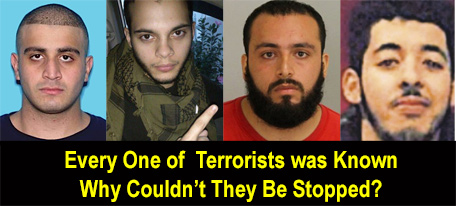
In the United States alone, the last three terrorist attacks were all by individuals “known” to U.S. law enforcement and intelligence. In each of these cases, members of the public came, despite endangerment to themselves, and warned the Federal Bureau of Investigation (FBI) about these terrorists. The excuses on the failure to act to protect the public sound hollow, when the innocent public lie dead and injured in the street. If there was this much “known” that the FBI was actually informed about these individuals, what else was known that was concealed by others? And why do we have no consequences for the failure to protect the public from terrorists?

Orlando ISIS terrorist Omar Mateen was “known” to the FBI and U.S. authorities. Omar Mateen committed the June 12, 2016 terrorist attack in Orlando, Florida, killing 49 Americans.

New York terrorist Ahmad Khan Rahami was “known” to the FBI and U.S. authorities, even his own father contacted the FBI about the threat he represented. Ahmad Khan Rahami committed terrorist attacks in September 19 and 20, 2016 in New York and New Jersey, injuring 29 Americans.

Fort Lauderdale terrorist Esteban Santiago-Ruiz actually went and told the FBI office in November 2016, that he had been watching ISIS terrorist videos and was being driven to attack and kill the public for ISIS. He was let go. On January 6, 2017, Esteban Santiago-Ruiz killed 5 and injured 6 in a terrorist mass shooting at the Fort Lauderdale airport, and an additional 36 were injured.

How can our authorities retain the confidence of our public to face the rapid, global terrorist network, if it fails to act to protect our public society from such known threats?

The most astounding story in 2016 in terms of terrorist threats was about the terrorist attack that did not happen, is about a known ISIS terrorist threat in Washington D.C., whose actions could have endangered the lives of many, many thousands of innocents. On August 2, 2016, the Washington D.C. news media announced the arrest of Nicholas Young, a Metro Police Department (MPD) police officer with the Washington Metropolitan Area Transit Authority (WMATA) subway system for providing material support to the ISIS terrorist movement. But there was no concern about the public’s safety to remove him from the MPD.

In the criminal complaint on ISIS support Nicholas Young, filed in court before federal Judge Theresa Carroll Buchanan, with sworn testimony by an FBI Special Agent David Martinez, it is documented that ISIS terrorist movement supporter and MPD police officer Nicholas Young had been under investigation since 2010. It is documented that Young had an AK-47 out of his window looking to shoot law enforcement in 2011. It is documented in 2011 that Young threatened to behead anyone who “betrayed” him and was looking to blow up automobiles. It is documented in 2011 that Young sought to attack the FBI and smuggle guns into a courtroom. It is documented in 2011 that Young sought to kidnap and torture an FBI special agent. It is documented in 2011 that Young traveled with terrorists (aka “rebels”) to Libya with arms, body armor, to overthrow the government there. (Of note, it is also documented that our DHS Customs and Borders Protection waved Nicholas Young with his military items right on through to Libya on the outbound trip.) In 2011, it is documented that Young had been meeting with a terrorist Amine El Khalifi, and warned him how to avoid the police; Amine El Khalifi planned a January 2012 suicide bomb attack on the U.S. Capitol building, and was arrested. In 2012, it is documented that Young sought to get revenge on those who warned the authorities about the U.S. Capitol suicide bomb plot. Throughout 2014, it is documented that Young repeatedly made plans to seek to join the ISIS terrorist movement, not just as a supporter, but to join their terror activities overseas. In 2015, it is documented how Young praised terrorist attacks in France by ISIS. Not long after his messages of support for ISIS terror attacks, it is documented that Young took his AK-47 to join other MPD police officers to “train” in shooting. In November 2015, it is documented how Young praised the Paris terrorist attacks by ISIS and how the West deserved such death and violence. It was not until 2016, when Young purchased gift cards to send to ISIS to help provide financial support, that eventually by August of 2016 that Young was arrested.

During all of this time, as the FBI knew about this, and Young remained as MPD police officer, endangering the safety of untold thousands on the WMATA Metro subway. Young told his fellow ISIS terrorist supporters by 2016 that “I have enough flags on my name that I can’t even buy a plane ticket without little alert ending up in someone’s hands,” but Young could remain on the WMATA MPD as a police officer, in a system with an average daily ridership with hundreds of thousands of riders. At the time of Young’s arrest, an anonymous “source” told ABC News, there was “no pending threat to the D.C. transportation system,” but how do we know this? How could someone in authority consider it anything less than a wildly irresponsible, malicious abrogation of public safety responsibility to allow an ISIS terrorist supporter (with terror training in Libya) to continue as a police officer for a major subway mass transit system?

After reading this, you might ask yourself, what exactly does it take to get arrested? Judge Buchanan never asked, why did it take you six years to arrest this terrorist figure. After a few local stories, the Washington D.C. media shrugged, and it was back to “business as usual.”

But a legal system that allows the malicious endangerment of the public from global terrorist actors must not be considered acceptable.

The public deserves protection from such sociopath terrorist figures, who not only have no respect for law, but have no fear of death itself. For full disclosure, R.E.A.L. respects our legal system, our law enforcement, and certainly our FBI, which it has directly aided for many years. But we need consistency and credibility in dealing with information regarding terrorist threats to the public.

We need to hold our public accountable for coming forward about terrorist threats to society, and we need to hold our government accountable to making arrests to protect the public from such terrorist atrocities. Anything less makes a true mockery of our legal system and our shared commitment to universal human rights.

Key Strategies for Challenging Extremist Hate

Key Strategies for Challenging Extremist Hate
1. Never Legitimize Hate Movements
2. Never Normalize Hate Images, Language
3. Set Expectations of Shared Respect based on EQUAL Rights and Responsibilities
4. Require Commitment to Shared Human Rights and Shared Dignity for Dialogue

We are ALL Responsible for Equality And Liberty

Key-Strategies