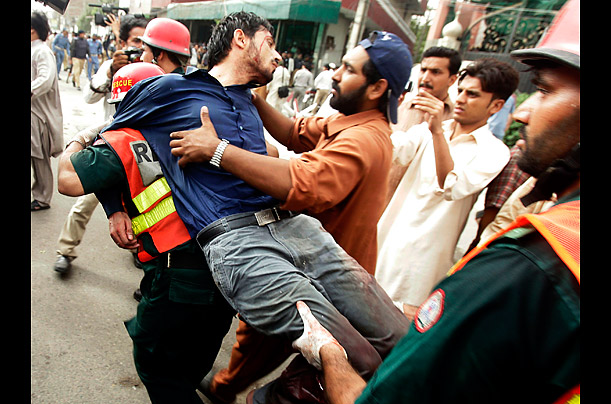
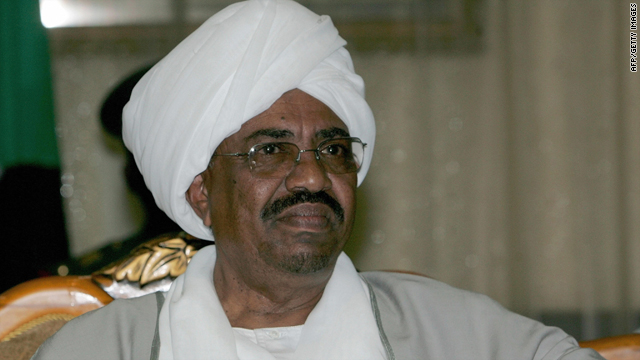
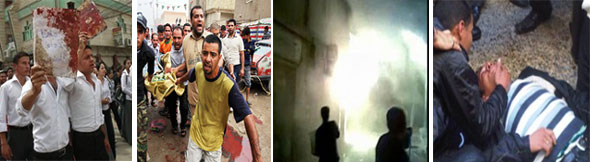
In Pakistan’s Lahore, terrorist attacks on two minority Muslim mosques have reportedly left 98 killed. The attacks are suspected to be the actions of the religious extremist Taliban organization, which used a combination of grenades, guns, and suicide bomb vests to attack worshipers during Friday Muslim prayers at two mosques by the minority Ahmadi Muslim sect, which represent 4 million Pakistani Muslims. The attacks took place at the in Garhi Shahu and Model Town mosques, while thousands were attending worship services. Dawn reported that at the Garhi Shahu mosque, terrorists exploded two suicide vests inside the entrance, injuring nearly 100 worshipers. Multiple reports stated that the terrorists also took Muslim worshipers hostage during the attacks on the two mosques. GEO Pakistan reported that the terrorist attacks took place while people where praying. The Ahmadi Muslims have received threats over the past year, but this did not deter them from exercising their universal human right of freedom of religion and freedom of worship. The Punjab province, where Lahore is the capital, is also a haven for many of the Taliban organizations. The Pakistan Interior Minister indicated today that the Pakistan Taliban and similar organizations were being suspected for the mosque attacks in Lahore on May 28, 2010.
The Ahmadi minority Muslims face discrimination throughout Pakistan according to the U.S. Commission on International Religious Freedom (USCIRF), which states that they face “the most severe legal restrictions and officially-sanctioned discrimination” (2009 USCIRF Report page 6). In 1974, the Pakistan government declared that the Ahmadi minority Muslims were “non-Muslims,” and in 1984, the Ahmadi Muslims were banned from proselytizing and identifying themselves as Muslims.
Across the world, we see a steady stream of news reports by those who seek to deny others freedom of conscience and freedom of worship. Whatever your religion (or none at all), you can be certain that houses of worship are being protested, vandalized, or bombed around the world – and your freedom of conscience is under attack.
Google news keeps a steady stream of reports on attacks on houses of worship under topics such as “church vandalism,” “temple vandalism,” “mosque vandalism,” and “synagogue vandalism.” There are so many attacks on houses of worship around the world, it is almost impossible to keep up with the endless list of hate and violence.
Global Violence and Hate against Religious Centers
In Asia, Africa, Middle East, Europe, and the United States, such violence against houses of worship and religious adherents is a widespread disease of hate. But whoever is responsible for such violence, whatever such groups and individuals claim to believe, and whatever their “rationale” may be – there is no doubt that Hate is Hate – no matter who, why, what, where, or how. We must challenge such hate against our fellow human beings and those who would deny our universal human right to freedom of religion and freedom of conscience for all people.
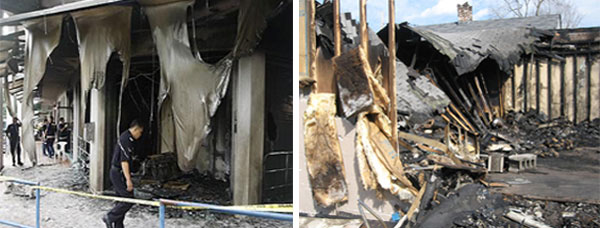
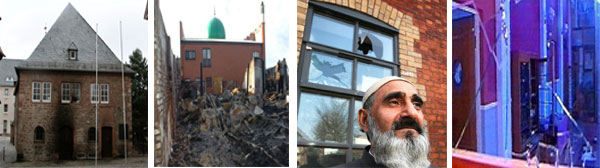
Church Burned Down in Malaysia -- Mosque Burned Down in United States -- Hate is Hate
Such global violence against religious centers is so widespread and so numerous, the incidents cannot be thoroughly summarized. Moreover, such global violence against religious centers and people of every different faith continue on a near-daily basis around the world. Hate and intolerance knows no boundaries.
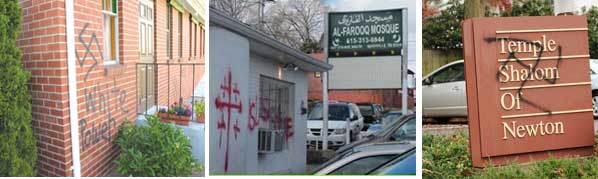
In America Today: Churches, Mosques (TIRCC), Synagogues, Other Houses of Worship Attacked
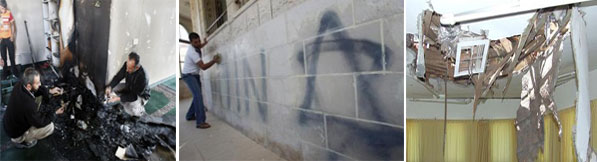
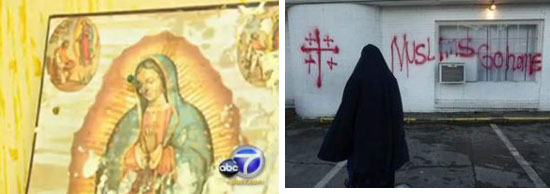
Many of these attacks have been designed to send a very specific message of hatred to undermine and defy human beings’ right to freedom of religion and freedom of worship. In Los Angeles, a Hispanic Christian church was vandalized with a cross defiled and a knife in a painting of the Virgin Mary. In Tennessee, a mosque was vandalized with with the message “Muslims go home.”
Raw Hate: Knife in Painting of Virgin Mary at Christian Church in LA (Photo: ABC); "Muslims Go Home" Vandalism in Tennessee (Photo: John Partipilo / The Tennessean)
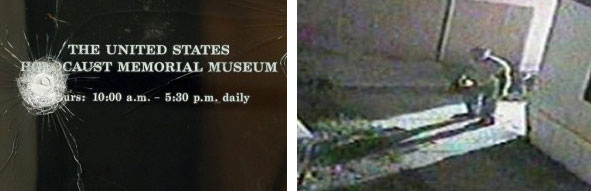
DC - Attack on Holocaust Memorial Museum (AP Photo/Alex Brandon) / Florida: Man Attacking Mosque with Pipe Bomb (FBI)
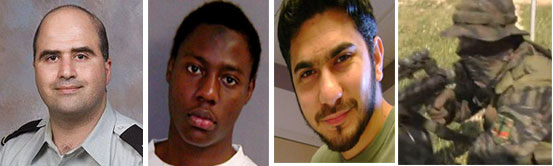
In the United States alone, there has been a steady stream of individuals accused of terrorist acts and plots, associated with religious extremism and extremism. Such major figures in recent American news reports have included: Nidal Hassan, Umar Farouk Abdulmutallab, Faisal Shahzad, and the Hutaree militia. But the list and the numbers of those who channel their hatred of people of other religions and religious institutions is an ever-growing fire of anti-human rights rage that continues to destroy people’s lives, families, cities, and even their houses of worship around the world.
In America: Recent Products of Hate against Other Religions and Religious Freedom: Nidal Hassan, Umar Farouk Abdulmutallab, Faisal Shahzad, Hutaree Militia
To work towards an end to such terrorism, we must first work towards an end to such hatred, disrespect, and contempt for each other’s universal human rights. For some people, some organizations, and even some nations, that must begin with acknowledging the very existence of our unqualified, universal human rights.
Certainly there are many attacks that we have not mentioned in this incomplete summary of some of the violence against houses of worship and religious faiths that we have seen. Nor have we tried to catalog the numbers of attacks by individual faiths. In different parts of the world, there are more attacks on some faiths’ houses of worship than on others. We readily recognize and acknowledge this fact. But whether there are more attacks on churches, synagogues, mosques, or Hindu or Buddhist temples really is not our point.
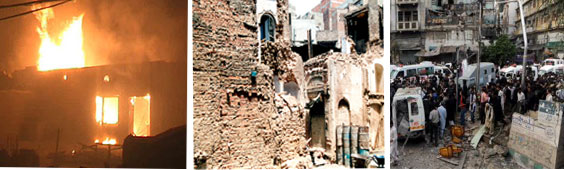
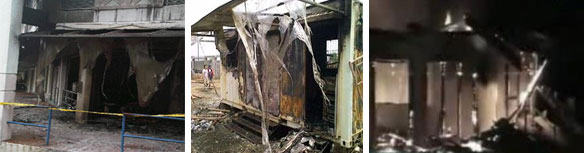
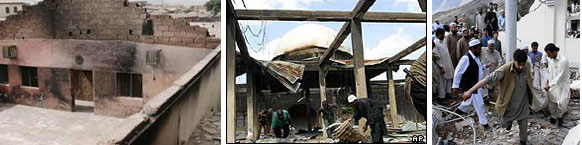
The point is that such attacks anywhere on houses of worship of any faith are attacks everywhere on all of our freedom of religion, freedom of worship, and freedom to believe. You may have noticed that a burned down mosque, synagogue, church, or temple all essentially look alike – that was the point of including such images together. Like our human rights, hate is also universal – and the consequences of hate are also the same.
The balance we are seeking is found in our consistent support of such universal human rights – not in choosing that such rights are only important when selected houses of worship of faiths are attacked. Hate is hate and it is always wrong, and always a challenge to our universal human rights.
Amidst these global waves of hate and violence against houses of worship, we should be seeing broader and more frequent calls from community and religious leaders to defy and condemn such attacks. But a response by such leaders is not enough, because such global attacks on our right to freedom of conscience and right to worship freely is not just their responsibility. It is our responsibility. It is our responsibility to equality and liberty for all people of all faiths (including those whose conscience reject organized religions) to defend all of our fellow human beings’ right to believe and to worship.
Relative Freedom of Religion or Universal Freedom of Religion?
A growing trend among some is the belief that our universal human rights of freedom of religion, conscience, and worship are somehow “relative” to certain parts of the world, certain faiths, and only certain situations. There is a growing trend that some want to call for relative freedom of religion – only for their faith, their conscience – and only when it suits them where they live. Some are determined to try to “tailor” such human rights to only those faiths, those beliefs, those forms of worship they approve. Such relativists believe that where they live, the universal human rights of freedom of worship only exists for those they agree with and can tolerate.
But relative human rights are no human rights. Relative freedom of religion, conscience, and worship is no freedom of religion, conscience, and worship. Such relativism is a cancer to human rights progress because some get the illusion of tolerance, respect, and even freedom – just until there isn’t. Freedom of religion, conscience, and worship must extend not only to people like us and people we like, but also to those who we disagree with, don’t approve of, and even those who challenge the very human rights and freedoms we all enjoy.
We cannot decide that for some religions that we like in some areas of the world, that they have the right to build houses of worship, and for religions that we don’t like that they do not have the right to build houses of worship.
A universal human right of freedom of religion is not “relative” to only those we agree with and to only certain parts of the world.
Such inalienable human rights for all people is the human code of conduct that supports laws to ensure orderly life, a standard of respect and human dignity that we each should expect, and most importantly, the trust that we must find within each other as human beings for continued co-existence on our shared Earth.
We ensure equality and liberty on a local level, in part, by ensuring that no one is above the law. On a global level, the stakes and the consequences for world peace are even greater. If we seek peace, dignity, and justice, we must also agree that no one is above our unqualified, universal human rights.
No one is “above the law” of our universal human rights, and no one has the right to deny our freedom of religion, freedom of conscience, and freedom of worship – by anyone, any place, at any time.
Our commitment to such universal human rights also requires a commitment to pluralism for all faiths. We don’t have to agree with each other on our religious views, or lack thereof, but we do have to respect each others right to our own beliefs.
We have a right to disagree with those who we believe are using religious faiths to promote extremist hatred that attacks on our universal human rights. Moreover, we cannot ignore those who would use a religious disguise to incite criminal violence which we must reject. Inciting and committing criminal violence is not a protected religious right or worship. But too often, those who seek “relative” human rights seek mere disagreement with those of other faiths as a justification to prevent their freedom of religion and freedom of worship.
We also have an obligation to respect each others universal human rights for all faiths, conscience, and freedom of worship – no matter who seeks such freedoms, no matter where they seek such freedoms, no matter how much we may disagree with them.
Article 18 of the Universal Declaration of Human Rights states that “Everyone has the right to freedom of thought, conscience and religion; this right includes freedom to change his religion or belief, and freedom, either alone or in community with others and in public or private, to manifest his religion or belief in teaching, practice, worship and observance.”
On December 10, 1948, the nations of the world joined together to create a Universal Declaration of Human Rights (UDHR) on December 10, 1948 as the world’s statement of “Never Again” to the hate of people of diverse races, religions, ethnic backgrounds, and beliefs. Seen in the context of the world reeling from the Nazi Holocaust of 6 million Jews, the UDHR remains one of the strongest international statements on consistent human rights for all people, and for people of all faiths. But when it comes to a right to worship freely, “never again” is now in too many parts of the world.
Such universal human rights and commitment to pluralism must not only extend to the nations that are signatories to the Universal Declaration of Human Rights, but also to all nations and all people around the world. But to reach those individuals and nations that do not accept such unqualified, universal human rights of freedom of conscience, it is essential that those who do – set an example for the world.
We urge the people of the world to make a new consistent commitment to pluralism and to our unqualified, universal human rights. We stand united together, respecting our differences, and respecting one another. We are one common civilization of humanity, with diverse races, ethnic backgrounds, languages, genders, and religions. But we are all one human race. While we respect our differences, a consistent commitment to pluralism requires our united commitment to our unqualified, universal human rights – including the right to believe for all people, everywhere – without harassment, without intimidation, and without violence.
We urge such commitment to all people and their right to freedom of worship, to set an example to all others that we are Responsible for Equality and Liberty.